Steven Soderbergh is stepping in to help finish shooting “The Batman Part II” while director Matt Reeves continues to deal with a personal matter.
“As Matt Reeves continues to attend to an ongoing family matter, Steven Soderbergh, as an admirer of Matt’s work, approached Matt and will step in, with the full support of DC Studios, to help the writer-director complete the final weeks of principal photography on ‘The Batman Part 2,’” the studio said Thursday in a statement first reported by Deadline. “Matt and Steven will work closely together with the actors and crew to fulfill Matt’s vision of the film.”
DC Studios chief James Gunn confirmed the news on social media Thursday while reiterating that Reeves remains the director of “The Batman Part II.”
“Matt is still the director of The Batman 2 and always will be,” he wrote on Threads. “I can’t express how profoundly grateful and moved we are by Steven’s offer to help him complete his vision.”
“Matt has the full support of DC Studios and we look forward to continuing the journey soon,” the studio said in a statement at the time.
The writer-director also took to social media Thursday to express his gratitude and to confirm he would be continuing his work on “The Batman 2.”
“Just to be clear, I am not leaving The Batman Part II,” Reeves wrote in a post on X. “I am profoundly grateful to Steven for coming to my aid during this challenging time to help me finish principal photography. Thank you to all for your concern and well wishes.”
Soderbergh expressed his appreciation for Reeves’ work while addressing his new role Thursday in a widely reported statement.
“I thought Matt Reeves’ work on ‘The Batman’ was stunning; it was intentional, specific, and rigorously coherent,” he said in his statement, first reported by Deadline. “The goal here is to work with Matt and his team to generate footage that will integrate seamlessly with what’s already been shot so Matt can properly finish his film.”
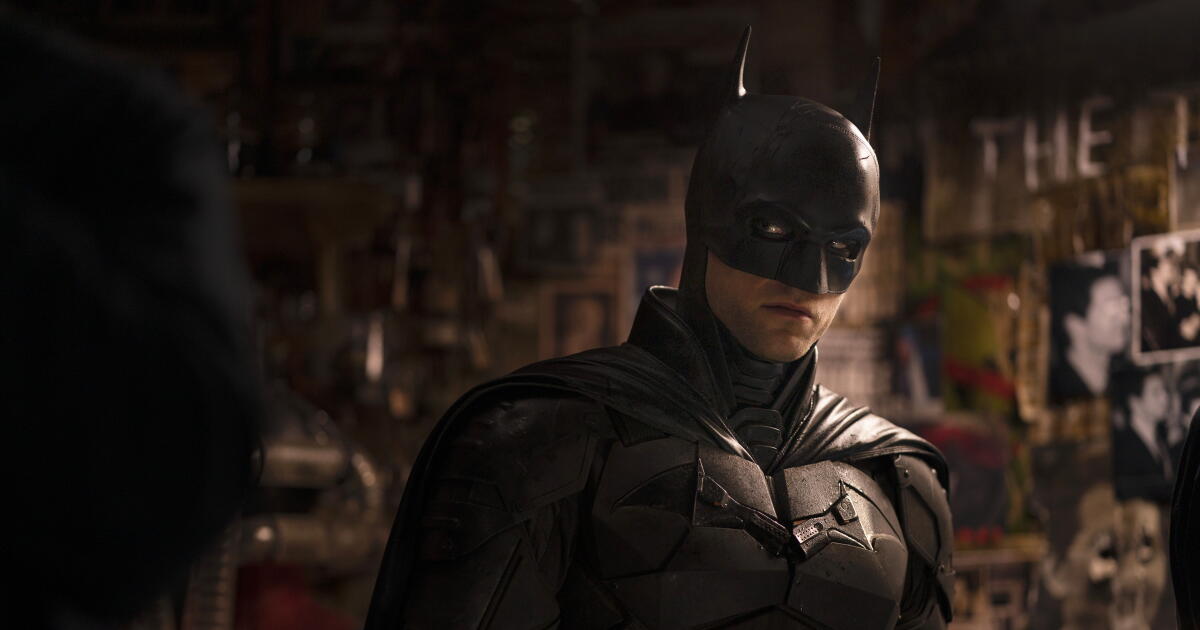
A follow-up to Reeves’ 2022 reboot, “The Batman,” the upcoming film will once again star Robert Pattinson as Gotham’s iconic Caped Crusader. “The Batman Part II” began filming in London in June after a number of previous delays while Reeves and Mattson Tomlin wrote the script. The movie is slated to hit theaters on Feb. 18, 2028.
The last time audiences saw Vision, the reconstructed synthezoid was flying off into the distance, and we didn’t know when we’d actually see him again. But he’s finally back.
Premiering Tuesday on Disney+, “VisionQuest” brings Vision (Paul Bettany) back into the spotlight — along with a few of his closest inorganic friends — as he tries to figure out his identity and understanding of humanity. Along the way, he’ll encounter a bounty hunter (Todd Stashwick) and a teenager that just might be his son (Ruaridh Mollica), sort of. It’s a long story.
Created by Terry Matalas, “VisionQuest” is set to wrap up the story set into motion by the 2021 series “WandaVision.” The Marvel Cinematic Universe’s first-ever streaming series saw a grief-stricken Wanda magically manifest a happy life for herself and Vision as newlyweds and, eventually, new parents. But that happiness wasn’t meant to last since the actual Vision was gone.
A lot has changed in the MCU since the conclusion of “WandaVision,” so here’s a quick refresher to get you up to speed for everything you need to know before watching “VisionQuest.”
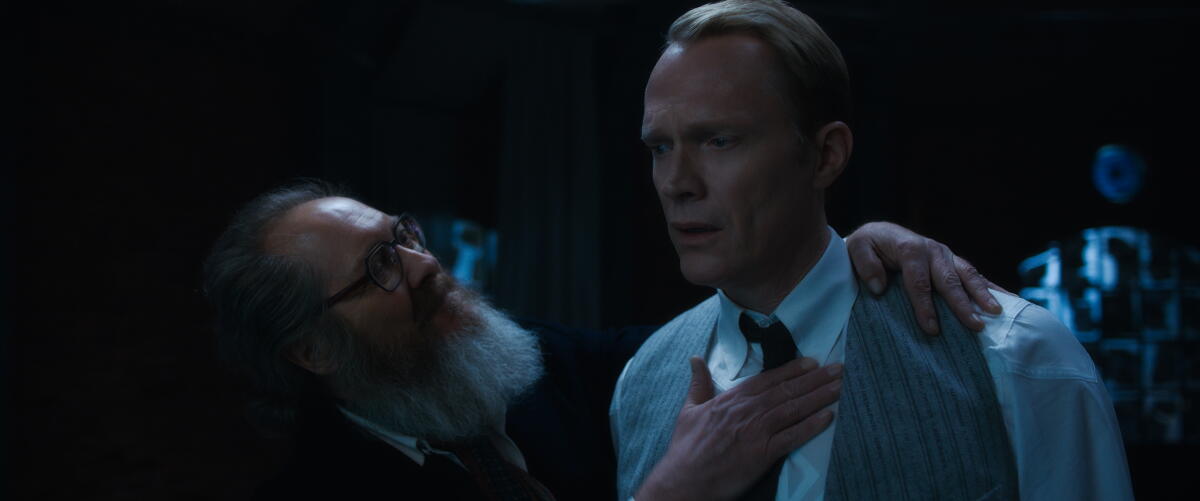
Ultron (James Spader), left, and Vision (Paul Bettany) in “VisionQuest.”
(Marvel)
What is ‘VisionQuest’ about?
Set some time after the events of “WandaVision,” “VisionQuest” will follow Vision as he tries to sort through his understanding of his identity and humanity. The former weapon of mass destruction has been in hiding for some time, but a bounty hunter tracks him down and disrupts his quiet life before also discovering a young man who appears to be Vision’s son.
When was the last time we saw Vision?
Audiences last saw Vision at the end of “WandaVision.” The monochromatic version of the former Avenger had been rebuilt without his memories to be a sentient weapon, but during a showdown with his magically created double, he regained them. He then flew off into the unknown to figure out what having access to these memories means for him.
What happened to Wanda?
After undoing her hex that let her live out a version of a happily ever after with Vision, Wanda had to watch him and their kids — twin boys Tommy and Billy Maximoff — disappear. Her story continues in the 2022 movie, “Doctor Strange in the Multiverse of Madness,” where she taps into some dark magic in order to find a way to reunite with her boys somewhere in the multiverse for another attempt at that happy life. But she’s a bit overzealous and things take a (villainous) turn for the worse before she ultimately sacrifices herself and is crushed by a mountain.
Thomas Shepherd (Ruaridh Mollica) in “VisionQuest.”
(Marvel)
What happened to Wanda and Vision’s kids?
Audiences learned in the 2024 series, “Agatha All Along,” that although Billy and Tommy’s physical forms disappeared when Wanda undid her hex at the end of “WandaVision,” their souls remained. Instead of crossing over into the afterlife, Billy, the magically inclined twin, transferred his soul into the body of William Kaplan, a teenager who had just been involved in a fatal car crash. Billy, now inhabiting the body of and living as William, was then able to use his powers to help Tommy’s soul find a new body to inhabit. At the end of “Agatha,” Billy and his magical mentor, Agatha, headed off to search for Tommy.
Who else is in this show?
Joining Vision in his “VisionQuest” adventures are an array of other AIs created by Tony Stark — all of which essentially now reside inside of Vision’s head. Most of these programs did not have physical forms in their original MCU incarnations, but appear in human form within the world inside Vision’s mind.
J.A.R.V.I.S. (James D’Arcy) is the AI assistant that Stark originally created to help manage his home and office as well as his Iron Man suit. His core programming was used to make Vision during “Avengers: Age of Ultron” (2015). F.R.I.D.A.Y. (Orla Brady) is the AI assistant that was created to take over J.A.R.V.I.S.’ duties afterward.
E.D.I.T.H. (Emily Hampshire) was created by Stark to help manage his company’s security and defense systems and was connected to his glasses. These glasses were passed on to Peter Parker in “Spider-Man: Far From Home,” before they were acquired by the film’s villain for his nefarious plot.
F.R.I.D.A.Y (Orla Brady), J.A.R.V.I.S. (James D’Arcy), U (Johnathan Sayer) and D.U.M.-E. (Henry Lewis) appear human in Vision’s mind in “VisionQuest.”
(Marvel)
D.U.M.-E. (Henry Lewis) and U (Jonathan Sayer) were a pair of arm robots that helped Stark in his workshop. All of these AI have specific roles and responsibilities within Vision’s home in his mind.
Another resident within Vision’s head is Ultron (James Spader), the misanthropic genocidal AI originally created by Stark and Bruce Banner to help save humanity. He tried to delete J.A.R.V.I.S. during the events of “Age of Ultron,” which led to the creation of Vision, so their dynamic is a bit complicated.
Also set to appear on the show is Mollica’s Thomas Shepherd, an older incarnation of one of Wanda and Vision’s magically created sons who had disappeared when the hex enveloping Westview was undone.
What do I need to watch before watching ‘VisionQuest’?
“VisionQuest” has been touted as the conclusion of the “WandaVision” trilogy, which also includes “Agatha All Along.” The events of “WandaVision” appear to be most central to “VisionQuest’s” story, though.
Those who’d like to see Vision and Ultron’s story from the very beginning should add “Avengers: Age of Ultron” to their queue. Fans who want to delve more into Vision and Wanda’s love story can also check out “Captain America: Civil War” (2016) and “Avengers: Infinity War” (2018) — with the latter adding more context to Vision’s current state of being. Those who want to see what happened to Wanda after “WandaVision” should also watch “Doctor Strange in the Multiverse of Madness.”
As we head into fall television season, you might notice some familiar titles, not just because a few shows are returning for new seasons, but because they’re prequels, continuations or adaptations of well-known books or films — sometimes both.
The only guide you need for fall entertainment.
Hollywood has leaned into established IP this season, but if you’re seeking an original story, don’t fret, several of those are coming too. Viewers will have plenty to cozy up to, with a slew of series dropping around holidays — a perfect time to binge your new favorite watch.
‘Monster: The Lizzie Borden Story,’ Sept. 17 (Netflix)
Ella Beatty as Lizzie Borden in Netflix’s “Monster: The Lizzie Borden Story.”
(Netflix)
Described as a “darkly comic spin on a Victorian-era murder,” the fourth installment of Ryan Murphy and Ian Brennan’s true-crime anthology chronicles the story of Sunday school teacher Lizzie Borden, who in 1893 was the prime suspect in the still unsolved ax murders of her father and stepmother inside their Fall River, Mass., home. The 32-year-old “spinster” was tried by an all-male jury who found her innocent of the gruesome crime. Their quaint view of women as meek, docile and powerless clearly worked in her favor. Ella Beatty plays the rage-filled, blood-spattered Borden in this eight-episode series. Charlie Hunnam, who appeared in the third installment of “Monster,” portrays her wealthy but ultimately unfortunate father Andrew Borden, and Rebecca Hall plays his second wife, Abby Borden. The drama reportedly includes the music of modern artists such as Kate Bush, while the trailer simply leans into the haunting Victorian-era nursery rhyme “Lizzie Borden took an axe …” — Lorraine Ali
‘Brothers,’ Sept. 23 (Apple TV)
Woody Harrelson and Matthew McConaughey in Apple TV’s “Brothers.”
(Ryan Green / Apple TV)
Twelve years ago, after their chemistry lit up Season 1 of “True Detective,” stars Woody Harrelson and Matthew McConaughey became Hollywood’s most beloved bromance. When Harrelson later told a tale in which McConaughey’s mother revealed she had known Harrelson’s father around the time McConaughey was conceived, it made a lot of hot-rumor sense. Also, apparently, a fine pitch for a series, with the two men playing fictionalized versions of themselves. After a family crisis, Harrelson flees with his wife and daughters to McConaughey’s Texas ranch where he hears a similar “I knew your father” story from Ma Mac (Holland Taylor). As he decides what to do, McConaughey decides to run for governor of Texas. The personal eccentricities of the two leads, along with their odd-couple vibe, provide most of the show’s humor, but the best reason to watch is Taylor, who shows both stars how it’s done, by stealing the show from under their feet. — Mary McNamara
‘American Hostage,’ Sept. 20 (MGM+)
Jon Hamm as Fred Heckman in MGM+’s “American Hostage.”
(Steve Ackerman / MGM+ / Sony Pictures Television)
Set in the 1970s, this anthology series based on a scripted podcast of the same name tells the true story of Fred Heckman, a respected radio journalist played by Jon Hamm, who also executive produces. Heckman, the news director of WIBC-AM in Indianapolis, is placed at the center of a story when hostage-taker Tony Kiritsis (Giovanni Ribisi) requests to be interviewed by the newsman as police attempt to negotiate the release of his hostage, mortgage broker Dick Hall (Kristoffer Polaha). The series contemplates topics like shady lending practices by financial institutions — something that will resonate deeply with today’s economy — and the ethics of placing oneself in a news story. Shawn Ryan (“The Shield,” “The Night Agent”) and Eileen Myers (“Big Love”) serve as co-showrunners and executive producers. — Maira Garcia
‘East of Eden,’ Oct. 1 (Netflix)
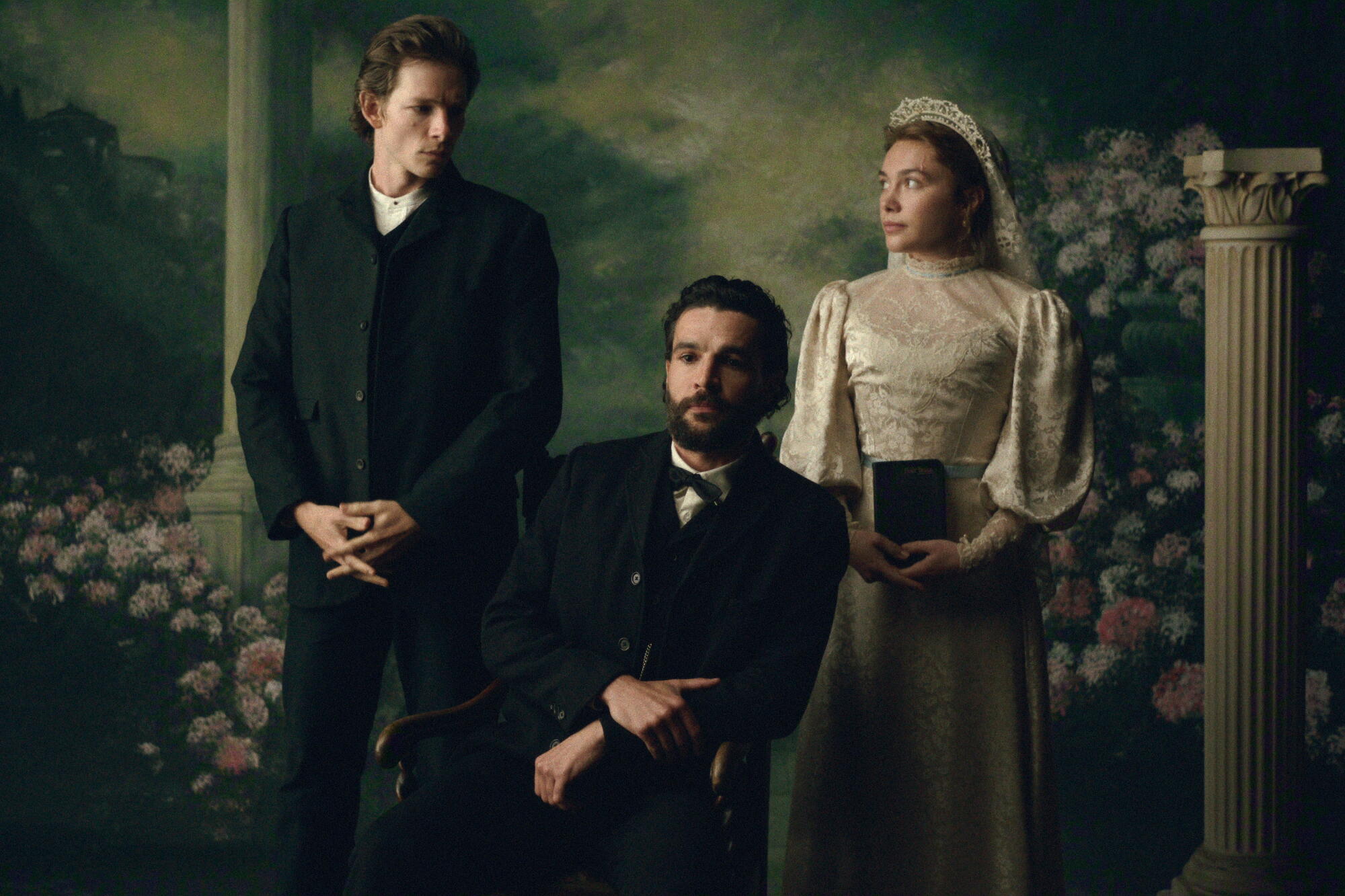
Mike Faist as Charles Trask, Christopher Abbott as Adam Trask and Florence Pugh as Cathy Ames in Netflix’s “East of Eden.”
(Netflix)
Zoe Kazan has established herself in the past several years as a versatile artist who impressed critics and audiences with her lead role in “Ruby Sparks” and her Emmy-nominated performance in HBO’s “Olive Kitteridge.” The spotlight is likely to get brighter with Netflix’s “East of Eden,” the latest adaptation of John Steinbeck’s classic novel. A previous version of the novel was directed by Kazan’s grandfather Elia Kazan, and is best known as one of three films starring James Dean. Zoe Kazan is the writer and co-showrunner of the Netflix project, which stars Florence Pugh as anti-heroine Cathy Ames — a character sidelined in the 1955 film. Christopher Abbott (“Girls”) and Mike Faist (“Challengers”) co-star. — Greg Braxton
‘Below,’ Oct. 8 (Netflix)
Josh Hartnett as Calvin and Mackenzie Davis as Fonda in Netflix’s “Below.”
(Netflix)
Summer is over, but that doesn’t mean there can’t still be stories about killer creatures under the sea. Netflix’s “Below” joins the watery spectrum already inhabited by “Jaws,” “The Meg,” “47 Meters Down” and numerous other entries as it unveils its premise about a seaside town targeted by a mysterious monster. Josh Hartnett (“Trap”) stars as a fisherman and single father living in a small Newfoundland town who must find a way to protect his family and the community when an unidentified creature starts wreaking havoc. He joins forces with a marine researcher (Mackenzie Davis of “Station Eleven”) who informs him of the town’s mysterious history and buried secrets. — G.B.
‘Cupertino,’ Oct. 8 (CBS)
Rachel Keller as Olivia Siffre, Ella Stiller as Christy Palladino and Mike Colter as Michael Price in CBS’ “Cupertino.”
(Elizabeth Fisher / CBS)
Robert and Michelle King return to the network and territory of their acclaimed series “The Good Wife” with this Silicon Valley-based legal dramedy, replicating that show’s mix of quirk, current events and courtroom nail-biters. To continue the David vs. Goliath comparison the network has put out, it launches its stones at the brow of the tech industry, with Mike Colter and Rachel Keller as lawyers fired with bad cause who team up to defend the little guys from the big jerks. Ella Stiller is their ingenuous aide-de-camp, Busy Philipps a flamboyant investor and Renée Elise Goldsberry as an opposing counsel who has history with Colter. — Robert Lloyd
‘Avatar: Seven Havens,’ Oct. 9 (Paramount+)
Saheli Khan as Pavi, Dee Bradley Baker as Geet/Ruhi and Aishwarya “Aishu” Devan as Nisha in “Avatar: Seven Havens” on Paramount+.
(Paramount+)
When “Avatar: The Last Airbender” premiered over 20 years ago, it introduced audiences to a world inspired by Asian and Indigenous cultures, where certain people can manipulate elements through a martial arts-infused ability known as bending. It also helped show that an animated kids series can tackle weighty themes such as war, genocide, imperialism, sexism, propaganda and political corruption in a serialized story and be a hit. In the world of “Avatar,” there is one special bender who is the master of all four elements — water, earth, fire and air — and is tasked with maintaining balance in the world. Set after the events of “The Last Airbender” and “The Legend of Korra,” “Avatar: Seven Havens” follows the current incarnation of the Avatar, Pavi. Young Pavi and her twin sister, Nisha, live in a world that no longer sees the Avatar as humanity’s savior after it was devastated by a calamity. Pavi and her allies still have to figure out a way to save the world, though. Every Avatar seems to have to deal with problems caused or left unresolved by their predecessors. As a Korra fan, I’m curious to see what sort of legacy she ended up leaving behind. — Tracy Brown
‘VisionQuest,’ Oct. 14 (Disney+)
Paul Bettany in Marvel’s “VisionQuest” on Disney+.
(Marvel)
When we last saw Vision (Paul Bettany), the reconstructed synthezoid and former Avenger had just regained his memories — thanks to an assist from his magically created double — before flying off into the unknown at the end of “WandaVision.” Much has changed in the Marvel Cinematic Universe since then, but I’m ready to dive back into this corner of the multiverse occupied by “WandaVision,” “Agatha All Along” and the upcoming “VisionQuest.” Capping off the TV trilogy, the new series will see Vision navigating life after “WandaVision” along with existential questions about his personhood and identity with the help of some friends in the form of other Marvel AI and robots, including Ultron (James Spader). Both “WandaVision” and “Agatha” were meditations on grief, trauma and motherhood, by way of sitcoms and magical escape rooms, respectively. I’m interested to see how this final installment will explore the patrilineal connection between Ultron, Vision and Tommy (Ruaridh Mollica), one of Wanda and Vision’s long lost twins who were magically created in “WandaVision.” Could the series tee up a full Maximoff family reunion? I hope so. — T.B.
‘Crystal Lake,’ Oct. 15 (Peacock)
Linda Cardellini as Pamela Voorhees in Peacock’s “Crystal Lake.”
(Peacock)
Drew Barrymore made a fatal mistake in the opening scene of the 1996 horror film “Scream” when the creepy murderer on the telephone quizzed her about the name of the killer in the original “Friday the 13th.” When Barrymore answered “Jason Voorhees,” she was reminded that the original killer was actually Pamela Voorhees, Jason’s mother. Pamela is center stage in “Crystal Lake,” Peacock’s prequel to the bloody franchise launched in 1980. Linda Cardellini (“DTF St. Louis”) plays the grief-stricken mother who seeks revenge after her son drowns at a summer camp. There will be blood. — G.B.
‘The Diplomat’ Season 4, Oct. 15 (Netflix)
Keri Russell as Kate Wyler, Rufus Sewell as Hal Wyler and Allison Janney as Grace Penn in Season 4 of “The Diplomat.”
(Netflix)
For those of us who stay ready for the Kate Wyler 2028 campaign, it’s time to lock in. The highly competent, intensely impulsive, deeply flawed and incredibly relatable political power player with unapologetically messy hair is back to clean up more backroom deals and betrayals, volatile international crises and unstable government leadership — all while managing a topsy-turvy marriage tangled up in it. The fourth season picks up directly after the Season 3 finale cliffhanger, where Kate (Keri Russell) learned that her husband, Vice President Hal Wyler (Rufus Sewell), and President Grace Penn (Allison Janney) secretly conspired to steal a Russian nuclear weapon. The new season will explore the fallout and tension in domestic and international relationships, and the marital strife in between. Somehow, political chaos feels good in a show like this. — Yvonne Villarreal
‘Nocturne,’ Oct. 30 (Apple TV)
Stephen Graham and Liev Schreiber in Apple TV’s “Nocturne.”
(Dennis P. Mong Jr / Apple TV)
Stephen Graham plays the diabolically cunning serial killer Jurek Walter in “Nocturne,” a chilling psychological thriller that promises “Hannibal”-level creepiness (as in the film). The 10-episode drama stars Liev Schreiber as Jonah Lynn, a former soldier turned homicide detective who moves to a small town in western Pennsylvania after working the tough streets of Philadelphia. But the peace and quiet he hoped for is shattered when his family is targeted by Jurek. Lynn’s surrogate daughter, FBI Agent Saga Bauer (Zazie Beetz), steps in the fray, upping the stakes. Based on Lars Kepler’s crime novels “Lazarus” and “The Sandman,” the series also stars Bill Camp, Rory Culkin, Poorna Jagannathan, Chrissy Metz and Gary Carr. The cast alone should make “Nocturne” a killer thriller, but we’ll have to wait until October to see if it slays. — L.A.
‘Yellowjackets’ Season 4, Nov. 20 (Paramount+)
Sophie Thatcher as teen Natalie in the finale of Season 3 of “Yellowjackets.”
(Paramount+ with Showtime)
At the end of Season 3, “Yellowjackets” gave us an on-the-nose cliffhanger: We see young Natalie (Sophie Thatcher) reach a cliff, satellite phone in hand, as Aerosmith’s “Livin’ on the Edge” plays. She screams into the receiver, “Can anyone hear me?” Response: “I can hear you.” Over the past three seasons, the Yellowjackets, the New Jersey girls soccer team lost in the Canadian wilderness after a plane crash, have been trying to survive harsh weather, a lack of food and medical care — and one another. It appears we’ll finally get to see them rescued, based on the recent trailer for the new season, as well as the aftermath. The series, created by Ashley Lyle and Bart Nickerson, was originally pitched as a five-season arc, but they announced last year that Season 4 would be the last. The dual timelines in the show, where we see the survivors as teenagers and adults, have felt disconnected at times, but let’s hope this season finally offers clarity. — M.G.
‘Dig,’ Nov. 23 (Peacock)
Hugh Laurie as Neville and Amy Poehler as Elise in Peacock’s “Dig.”
(Colleen Hayes / Peacock)
A new comedy series starring Amy Poehler that she co-created with “Parks & Recreation” executive producer Michael Schur? Sign me up! The workplace at the center of “Dig” is an excavation site in Greece, where Poehler’s Elise is among a team of archaeologists that unearths a rare artifact. According to the logline, this discovery kicks off an “adventure of a lifetime” — and I’m curious what that might mean for people whose careers presumably involve carefully sifting through old dirt all day. The show also stars Hugh Laurie as Neville, a British archaeology professor, as well as Geraldine Viswanathan, Antonia Thomas and Fina Strazza. The series is based on Kate Myers’ novel “Excavations,” and in the book, the four central women have their own issues and hang-ups and don’t really get along, at least initially. If there’s anyone I trust to mine comedy gold with that setup, it’s Poehler and Schur, who is co-showrunning with J.J. Philbin. — T.B.
‘Blade Runner 2099,’ Nov. 25 (Prime Video)
Hunter Schafer as Cora in Prime Video’s “Blade Runner 2099.”
(Clay Enos / Prime)
Having slept on the franchise’s previous sequel, “Blade Runner 2049,” I find myself quite excited by the prospect of this tale of biological and synthetic life forms in a smoggy, next-millennium Los Angeles, not least (and likely most) because Michelle Yeoh stars in it. Yeoh plays an aging replicant detective in search of rogue replicants — here, in a “Planet of the Apes” style twist, the world has turned upside down, with the artificial life forms in power and the people powerless. Hunter Schafer plays Yeoh’s partner, a human masquerading as a replicant. (As to L.A., you will not recognize the old place, which in any case was created in Prague and Barcelona.) — R.L.
‘The Hunting Wives’ Season 2, Nov. 26 (Netflix)
Malin Akerman as Margo, left, and Brittany Snow as Sophie in Season 2 of “The Hunting Wives.”
(Netflix)
For those who are watching the show for the plot, get ready to yeehaw about all the melodrama that’s about to hit your screen. Following its massive breakout success on Netflix, the series about East Texas socialites is back for a twisty and steamy eight-episode second season that will no doubt launch a heavy helping of memes, GIFs and explicit fanfics. For the uninitiated, the series based on May Cobb’s bestselling novel follows Sophie (Brittany Snow), a married East Coast liberal who moves to a wealthy Texas town and immediately becomes infatuated with Margo (Malin Akerman), the local queen bee of a clique of conservative women who have a knack for behaving badly. Their toxic, lusty friendship and the show’s crime mystery subplots had viewers hooked. After the chaotic events of the Season 1 finale, the new episodes pick up with Sophie and Margo on the outs but pulled back into another dangerous game of cat and mouse that will make their situationship all the more complicated and angsty. But fear not, Margo’s wig remains a comforting presence through it all. — Y.V.
‘Harry Potter and the Philosopher’s Stone,’ Dec. 25 (HBO)
Ron (Alastair Stout), Harry (Dominic McLaughlin) and Hermione (Arabella Stanton) in HBO’s “Harry Potter and the Philosopher’s Stone.”
(Aidan Monaghan / HBO)
In the U.K., Christmas Day telly is a much bigger deal than it is in the U.S., which may be why HBO decided to launch its new “Harry Potter” series, beginning with the U.K.-titled eight-episode “Harry Potter and the Philosopher’s Stone,” on Dec. 25. “Highly anticipated” doesn’t even begin to cover it; a quarter century since the film versions began lighting up the box office, the story of “the boy who lived” continues to entrance fans old and new. Starring newcomers Dominic McLaughlin as Harry Potter, Alastair Stout as Ronald Weasley and Arabella Stanton as Hermione Granger, the series promises a richer, more detailed adaptation of the books, along with a more contemporary feel. With John Lithgow as Albus Dumbledore, Janet McTeer as Minerva McGonagall, Nick Frost as Hagrid and Paapa Essiedu as Severus Snape, the cast is just as formidable and star-studded as the films. And with a reported $58-million price tag, the production values should burn just as brightly, especially at Christmas. — M.M.
‘North of North’ Season 2, Fall 2026 (Netflix)
Anna Lambe as Siaja in Season 2 of “North of North” on Netflix.
(Netflix)
No news regarding the coming fall season has made me happier than the return of this sunny, aspirational Indigenous comedy, set in a small town among the Inuit people in Nunavut, Canada’s northernmost territory. A luminous Anna Lambe plays Siaja, who in the first season went a long way toward finding herself in a life bounded by a narcissist husband (estranged, but always around), a once-difficult mother, a rambunctious child, a new love interest, a surprising father, a capricious yet not uncaring boss (Mary Lynn Rajskub) and a mythological sea spirit — in other words, lots to go on in a second season. (For even more Canadian content: “Kids in the Hall” alum Bruce McCulloch joins the cast as a first-aid instructor.) — R.L.
‘Pride and Prejudice,’ fall 2026 (Netflix)
Lizzie (Emma Corrin), Jane (Freya Mavor), Mrs. Bennet (Olivia Colman), Lydia (Rhea Norwood), Mary (Hopey Parish) and Kitty (Hollie Avery) in Netflix’s “Pride and Prejudice.”
(Ludovic Robert / Netflix)
Every generation gets its own Mr. Darcy. Experiencing Jane Austen’s most famous work — whether on the page or on the screen — is a cultural rite of passage for many young women. The 1995 BBC miniseries starring Jennifer Ehle and Colin Firth, and the 2005 film starring Keira Knightley and Matthew MacFadyen, are the two definitive, most popular screen adaptations of the classic novel, often drawing fierce debate from enthusiasts about which is better. (Sorry, but that misty sunrise walk by MacFadyen’s Mr. Darcy changed lives — namely, mine — and will always give the 2005 version a slight edge in my eyes.) Now, the classic novel is getting its streaming-era adaptation. Written by bestselling author Dolly Alderton (“Good Material”), the six-part limited series promises to be a faithful adaptation. Emma Corrin (“The Crown”) and Jack Lowden (“Slow Horses”) take the mantel as the original and ultimate enemies-to-lovers couple, Elizabeth Bennet and Mr. Darcy. Will it live up to its predecessors? Will it capture Austen’s witty text and unforgettable scenes of yearning? I don’t know. But I’m going to watch it anyway because — I mean, come on — it’s “Pride and Prejudice” and I’m just a girl who’s always on the lookout for slow-burn tension and hand-flex close-ups. I’m preparing myself now for the hours of sleep I’ll lose getting sucked into the TikTok discourse about it. — Y.V.
The slogan of the 1933 Chicago World’s Fair, which plays a prominent role in the new LACMA exhibition “Home of the Future, 1925–1985: Designing Domestic Utopias,” was blunt: “Science Finds, Industry Applies, Man Conforms.”
Those words capture a central tension in the sprawling show, which occupies interconnected galleries at the far end of the museum’s Resnick Pavilion. Many of the beautiful, sometimes ingenious products and technologies developed with the rise of the modern era gripped the popular imagination and made life easier, healthier and more connected. But they didn’t free people from domestic labor or deliver the prosperity and security heralded by their promoters. They instead often raised expectations, forced dependency and gave rise to a vision of progress that reinforced social exclusion, bred anxieties about status, and concealed the environmental costs of a culture built on consumption.
Sound familiar?
The desire for these transformative products was never innate, and LACMA’s exhibition zeroes in on that idea from the start. “Good design is seldom accepted. It has to be sold,” Midcentury photographer Julius Shulman is quoted as saying in the catalog.
The show traces the hard sell of a domestic utopia via world’s fair posters, model home catalogs, magazine advertisements, television specials and science-fiction imagery — along with close to 200 physical objects of every sort, including kitchen appliances, electronics and furniture. In each of its four documented eras — pre- and post-Depression, post-World War II, the height of the Cold War, and the counterculture ’60s and ’70s — promoters dressed the same promise in new terms, whether through cleanliness, leisure, security or freedom.
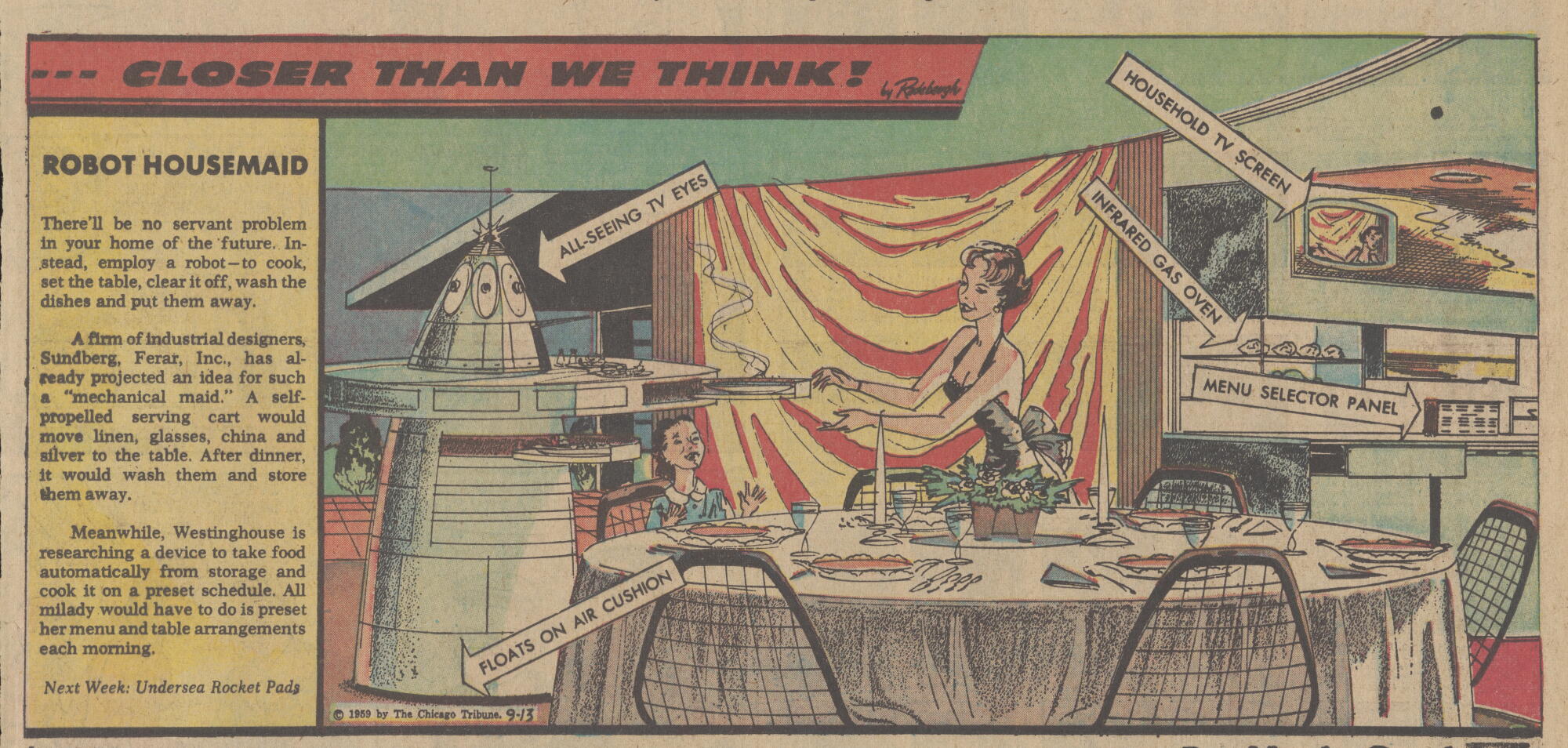
Arthur Radebaugh, “Closer Than We Think! Robot Housemaid,” 1959.
(Chicago Tribune / TCA, photo courtesy San Francisco Academy of Comic Art Collection, Billy Ireland Cartoon Library and Museum, Ohio State University)
At every turn a vision of a better life was made to seem desirable and, just as important, inevitable. Like any good advertising, it worked best when soothing our anxieties and tapping into our fantasies.
In the 1920s and ’30s, new discoveries about hygiene inspired products by soaring talents in the nascent field of industrial design who set out to create clean, easily maintained homes — laboratories for healthy living in an age still ravaged by diseases like polio and tuberculosis. Mathias J. Weber and Russell E. Vanderhoff’s seductively streamlined Health-o-Meter scale gave the illusion that homeowners could be scientists, for the first time monitoring their own weight and growth. Kohler’s Integra, introduced as “the toilet of the future” at the Chicago fair, had a dramatic black finish made to equate sanitation with modern design. And Bruce Goff’s gleaming Vitrolite kitchen for Libbey-Owens-Ford glass company, shown in Charles Turzak’s rendering, integrated pigmented structural glass counters and cabinets into a polished, easily cleaned whole.
American Stove Co., Magic Chef stove, series 1400, introduced 1935.
(Lynton Gardiner / The Wolfsonian–Florida International University )
Vast expansions in electricity, telecommunications and production promised to connect the country and ease the tedious work of cooking, washing and cleaning. The American Stove Co.’s Magic Chef stove, one of the first ovens to be equipped with a clock, recast kitchen work as something that could be measured and controlled. Frank G. Brotz’s Kohler Electric Sink, which incorporated a motorized dishwasher into the familiar basin, promised release from the “thrice-daily drudgery” of washing dishes. Western Electric’s clear-cased Model 302 telephone enticed gawkers with an impressively complex system of wires and mechanisms.
George R. Lum for Western Electric Co., Telephone, model 302, desk set 1938.
(AT&T Archives and History Center)
Many of the names who dreamed up these wonders are now etched in design history. Isamu Noguchi created a baby monitor before baby monitors were a thing: the Radio Nurse, a dark Bakelite receiver resembling an abstract face. Walter Dorwin Teague gave corporate products a precise, machine-age polish, while Raymond Loewy brought the same sleek optimism to objects like the globe-shaped New World radio for Colonial Radio Corp., molded in glossy, heat-resistant Catalin and embodying quite literally the new reach of communications.
Selling this promise of a technological future to those clinging to the dream of American prosperity was an especially potent exercise during the Depression. In his illustrated 1932 manifesto “Horizons,” Norman Bel Geddes cast “new design” as a path toward “economy, efficiency, comfort and happiness.” As the economy faltered, an orderly, healthy home could be sold as a form of salvation, with prosperity seemingly within reach. At the Chicago fair, corporations sponsored full-scale model homes and filled them with products already available or soon to be. For rural households still without electricity, Lester Beall’s 1937 Rural Electrification Administration poster “Wash Day” turns federal infrastructure into a household fantasy. Inside the black silhouette of a farmhouse, a pristine white washing machine appears at an almost monumental scale, set against flat fields of saturated color.
Irving Harper of George Nelson and Co. for Herman Miller Inc., Marshmallow Love Seat, model 5670, designed 1956, this example made c. 1960s.
(Jonathan Urban / Museum Associates / LACMA)
By the ‘40s and ‘50s, the postwar home and its many accouterments — powered by wartime advancements, growing abundance and an ethos of “buy now, pay later” — amplified the promise. Plastic, prefabrication and push-button convenience suggested that mass production could bring elegant, futuristic living — and freedom from drudgery — within reach of the masses. George Nelson treated furniture as a flexible system, producing (with designer Irving Harper) the candy-colored Marshmallow Love Seat; replacing conventional upholstery with 18 brightly colored circular cushions mounted on a spare steel frame. Eero Saarinen produced the molded-fiberglass Pedestal chair, sweeping the seat and stem into a single sculptural form intended to eliminate what he called the “slum of legs” beneath tables and chairs.
Eero Aarnio for Asko Oy, Ball Chair, designed 1963.
(Jonathan Urban / Museum Associates / LACMA)
Architects attempted to make the home itself into a sexy product. At Disneyland, Monsanto’s House of the Future, designed by architects Richard Hamilton and Marvin Goody, was a gleaming, cross-shaped structure of molded plastic, raised above the ground on cantilevered supports and partnered (in renderings) with a plastic heliport. Its kitchen featured molded surfaces and electric appliances. Promotional images and films conjured a playful, adaptable and benevolent house — plastic as the building block of family happiness.
Buckminster Fuller’s Dymaxion house was an aluminum, factory-made “dwelling machine” that could be delivered by air and assembled almost anywhere. Its unified form, modular furnishings, water-recycling system and labor-saving technology promised a more efficient life, less tied to conventional building and household routines.
Hamilton & Goody Architects, Monsanto House of the Future, 1956.
(MIT Museum)
Institutions like the Museum of Modern Art and magazines like Arts & Architecture promoted prototype homes from now legendary industrial designers and modernist architects like Saarinen, Charles and Ray Eames, Marcel Breuer, Albert Frey, Gregory Ain and even Frank Lloyd Wright.
Effective pitches could turn a product, whatever size, into a fantasy of freedom. In the General Motors film “Design for Dreaming” (1956), directed by William Beaudine, a woman enters a fabulous kitchen as if in a magical dream. The promise, said curator Wendy Kaplan, was that the fictional woman would have more time for “tennis and hanging with … friends.” The dream even hinted at a life beyond domesticity — perhaps even freedom to “actually have a profession,” Kaplan added.
But the housewife in these displays was still expected to remain responsible for the home. Liberation came through a more efficient kitchen, not a change in who cooked. And appliances that reduced some labor often raised the bar: more frequent washing, more cleaning, more elaborate meals, as University of Chicago home economics professor Hazel Kyrk described in “Economic Problems of the Family.”
Frank G. Brotz for Kohler Co., Electric Sink, introduced 1926, this example 1928, Kohler Co.
(Kohler Archives)
That universal “everyone” did not, however, include everyone. Government-backed home ownership and the suburban boom excluded many Black, Latino and Asian Americans through redlining, restrictive covenants and discriminatory lending — a fact reflected in the almost complete absence of minorities in these vast selling campaigns.
A few welcome exceptions on the creators’ side are architect Paul R. Williams’ “Small Home of Tomorrow,” which proposed a simple, well-designed home fitted with gee-whiz appliances; Arthur Elrod and William C. Raiser’s swirling, vivid orange Ebony test kitchen, which treated cooking as creative craft; and the proposed multiracial community of Soul City, founded by Floyd McKissick, which imagined homeownership as a claim to economic autonomy that segregation denied.
The vision of a utopian domestic future took a strange turn during the Cold War, marrying the breathless excitement of the space age with the existential dread of nuclear annihilation. The same scientific power that had transformed lives now produced weapons capable of destroying humanity. The home was imagined as both shelter and command center.
Office of Donald Deskey Associates. Drawing, design for Undersea Lounge: Scheme 3 Interior Perspective, ca. 1960s. Designed by Russell Heston (b. 1929).
(The Estate of Donald Deskey, courtesy Cooper Hewitt, Smithsonian Design Museum / Art Resource, NY)
As the age’s potent mix of terror and delirium spun on, designers and illustrators proposed ways to live comfortably in space, underwater or in underground bunkers. Paul László’s “Atomville, U.S.A.,” a vision of suburbia half a century in the future, buried the family home beneath an earthen shell that doubled as a helicopter landing pad. Its sunken gardens and swimming pool promised comfort, while a blast door, escape hatches and air filtration protected against nuclear fallout. Donald Deskey Associates imagined a hypnotic “Undersea Lounge,” a self-contained interior for living beneath the water, while NASA illustrator Rick Guidice vividly depicted physicist Gerard K. O’Neill’s proposed Stanford Torus — an enormous, wheel-shaped suburb in space.
Bob Lerner for LOOK Magazine, Anne Anderson in RCA Whirlpool Miracle Kitchen, 1959, kitchen designed 1956.
(Library of Congress, Prints and Photographs Division, LOOK Magazine, Photograph Collection / Robert S. Lerner Photography, LLC)
An endless array of products leaned into the public’s awe at the age’s sci-fi possibilities. This included prescient pieces ahead of their time, like the video-enabled AT&T Picturephone, and those that would never come to pass, such as the RCA Whirlpool Miracle Kitchen. The latter’s spread in Look Magazine (displayed for crowds at the 1959 American National Exhibition in Moscow) showcases a Roomba-like vacuum and other astonishing appliances that seem to work by themselves. But men hidden behind two-way mirrors actually operated them. Others, like the two-wheeled Ford Gyron Remote Control Car of the Future, only managed to come to life as children’s toys; and some were just plain ridiculous, like Honeywell’s H316 Kitchen Computer, which required a two-week training course just to retrieve a recipe.
By the late 1960s, confidence in technological progress was fraying. Environmental damage, plastic waste and the conformity of suburbia prompted designers and countercultural communities to imagine other ways of living — up to a point. The residents of Drop City, a Colorado artists’ community, built domes from the curved steel tops of salvaged cars. Architects Barry Simpson and Charles Hosford made a folding stool that could serve as a seat, stepstool or side table. Small, portable, multipurpose designs, from inflatables to cardboard furniture offered a life with fewer possessions. The Whole Earth Catalog, founded by writer and editor Stewart Brand, promoted ecological knowledge and self-sufficiency, but was still a compendium of things to buy.
Companies, too, found ways to sell all natural products, flexibility and individual expression. Zanotta advertised the first beanbag chair, the polystyrene-filled “Sacco,” as “A Big Bag, a Soft Seat.” Its formless body accommodated slouching, lounging or lying down, selling freedom from both conventional posture and the bourgeois living room. Even resistance to consumerism could be packaged as a new consumer ideal.
The pairing of objects with their promotional campaigns is the show’s most illuminating contribution, shedding light on the massive, often strange apparatus needed to drive these incredible designs — some icons, some welcome surprises — forward in each age. It reveals how the country’s 20th century manufacturing prowess expanded into the production of dreams. Corporations, government and the media taught consumers what progress should look like, which anxieties a product might soothe, and what kind of future to desire.
Isamu Noguchi; Zenith Radio Corporation, Radio Nurse receiver and Guardian Ear transmitter with original box, 1937.
( Museum Associates / LACMA)
But the sheer abundance of objects — I haven’t even mentioned the fascinating companion show-within-the-show, “The Kitchen and Its Discontents” — leaves less room for examining those campaigns and the work they performed. The excellent catalog follows those connections further, tracing how often hypnotic visions of the future home both reflected and shaped ideas about lifestyle, progress, gender, race, labor and consumption; in the galleries, those ideas remain largely suggestive.
Still, the exhibition offers a revelatory history — and a telling roadmap to our present. While the future imagined here made life easier, cleaner, more beautiful and more exciting, it did not arrive as advertised. The plastic home didn’t remake housing; the automated kitchen didn’t free women from domestic work; the self-sufficient home gave way to new forms of reliance. Yet a similar techno-utopian pitch survives in today’s smart homes and domestic technologies, from assistants like Alexa to artificial intelligence marketed as a way to make life easier. These tools may offer real benefits even as they addict and distract us. And while the systems sustaining our comfortable, consumption-driven lives launch us toward climate disaster.
These rooms powerfully evoke what Kaplan in the catalog calls America’s “restless forward motion, powered by the conviction that tomorrow’s design would solve today’s problems.” That ingenuity is worth celebrating. But its promises deserve open-eyed scrutiny.
Hollywood is filled with book-to-screen adaptations that have ignited grumbling and spirited debates. Even before its release, Zoe Kazan’s interpretation of John Steinbeck’s sprawling 1952 masterwork, “East of Eden,” roused passionate opinions from loyalists of the text on social media.
Much of the discourse surrounds Kazan’s creative choice in how to portray the book’s infamous antagonist, Cathy Ames, in Netflix’s seven-episode limited series out Thursday.
Steinbeck’s multigenerational saga ruminates on family, the power of choice and the nature of good and evil — deeply exploring the biblical stories of Cain and Abel and the fall of Adam and Eve — through the intertwined destinies of two families, the Trasks and the Hamiltons. Cathy (later known as Kate) functions as a chilling, destructive force in the saga.
Kazan pared down much of the Hamilton family’s story for the show and centered Cathy (Florence Pugh), whose arrival alters the lives of the Trask brothers, Adam (Christopher Abbott) and Charles (Mike Faist). In doing so, Kazan dared to humanize the character who has been considered one of literature’s most definitive symbols of pure evil, described by Steinbeck to be a “psychic monster” born without a conscience or kindness.
“I’m trying to protect my mental health by not being too much online,” Kazan said in a video call from London on a recent weekday. “I do think it is not surprising to me that this character brings up a lot of strong feelings for people … I’m excited to see what people think once they actually see what we have made and aren’t just anticipating something.”
Mike Faist as Charles Trask, Christopher Abbott as Adam Trask and Florence Pugh as Cathy Ames in Netflix’s “East of Eden.”
(Netflix)
When Kazan, an actor who has expanded her creative footprint behind the camera, first pitched the series in 2019 and was asked about which actor she envisioned as Cathy, she replied: “I have one.” She had seen Pugh in “Midsommar,” “Lady Macbeth” and “Little Women,” marveling at how the actor’s ultra femininity lived alongside her masculine energy.
“The range on that girl … I was like, if anybody can do that, they can play Cathy,” Kazan says. “It allowed me to write Cathy as complicated and mysterious [as I wanted] and with so much shadow and light.”
When it came to Adam and Charles, Kazan knew Abbott and Faist could depict the psychological nuance beyond the binaries of the nature versus nurture debate: “I wanted an Adam where you felt what his true nature was and the nature that his father had pushed him into … and I knew we needed that in Charles as well.”
Adapting a classic is hardly a simple endeavor, particularly one that has been done before. That Kazan would choose “East of Eden,” which unpacks legacy and generational shadows is apt: Her grandfather, Elia Kazan, famously directed the 1955 film version starring James Dean. The actors of the Netflix series are eager for viewers to see her vision come to life.
“When you do an adaptation of a book, especially a seminal American novel, no matter what, you’re always going to be up against it because … whenever somebody reads a book, the budget in their heads is unlimited,” Abbott says. “I think this is such a great adaption in its own right.”
Pugh adds: “I’m excited for people to do the stuff that I’m doing now, which is [to say], ‘Oh my God, let’s read this and see how it fits against what I’ve got in my head.’”
Over a video call together, Pugh, Abbott and Faist reflected on their journey to adapting Steinbeck’s epic story, including their first experiences with it and filling in the shades of these characters who remain timeless allegories of the human condition. This conversation, which contains spoilers, has been edited for clarity and length.
Florence Pugh, left, Christopher Abbott and Mike Faist take on some of literature’s most indelible characters — Cathy Ames, Adam Trask and Charles Trask — made famous in John Steinbeck’s classic “East of Eden.” (Photographs by Sophia Spring / For The Times)
When did you first encounter the book?
Faist: My first encounter with the story was the James Dean, Elia Kazan film. That was a movie that I watched, especially when I first moved to New York and wanted to be an actor. It wasn’t until Zoe and Florence asked if I’d be interested in doing this, that I picked up the book.
Pugh: I want to say maybe my early 20s, I read the book. I only watched the movie recently to prepare myself for these kind of conversations. I’m rereading the book now while we’re heading into press, just so I can like fine-tune what I thought I knew … there’s so much love that’s being breathed into every single sentence of every chapter [in this adaptation], and that is solely down to Zoe’s fantastic brain and her ability to want to dig deeper.
Abbott: A lot of my favorite books I’ve picked up and put down numerous times before actually plowing through it — that was the case here until Zoe approached me about doing it. I was like, “Well, this is a perfect excuse to finally [finish].”
This adaptation lit up social media early on for centering Cathy. She is such a polarizing figure. Some see her solely as an evil monster. Some argue there is more nuance to what’s driving her actions. Florence, how do you see her?
Pugh: It’s tricky because I know I’m gonna get asked this again and again, and I guess I’m still trying to figure out how to word it without totally pissing people off. I love finding characters that people automatically think are villains and trying to find a way for you to love them — it’s my favorite thing to do.
I read these episodes, and I was listening to Zoe and how she was wanting this to come from Cathy’s perspective, how Cathy was her hero and how she’s just been championing Cathy ever since she first read the book — that was so f— exciting to know that we’re not gonna just point the finger and say that she’s evil. It is my job to do my skills as good as possible so that I can argue in defense of them. I believe that I can argue for her, which is terrifying but also really cool. I care for her deeply. I understand where she went and why. Does she do some terrible things? Absolutely. Is she a product of the situation that she grew up in? Totally. You can’t get raped as a child and and you be totally fine for the rest of your life.
Florence Pugh as Cathy Ames. She hopes the adaptation prompts curiosity: “I’m excited for people to do the stuff that I’m doing now, which is [to say], ‘Oh my God, let’s read this and see how it fits against what I’ve got in my head.’”
(Netflix)
That detail was not explicitly stated in the book. What were your conversations with Zoe about it?
Pugh: That’s why we ended up choosing the way that we explained it and the way that we showed it — that little girl is so tiny you can’t even imagine anything bad happening to her, and the fact that she’s holding “Alice in Wonderland,” [in her mind], there’s so many through lines through Cathy and Kate’s life that all come back to that moment. You don’t need to do much. Everybody has the sinking feeling of what might happen to a vulnerable child in that situation. In the book, I think it’s constantly playing with the themes of can we trust her? Is she already a monster as a child?
What Zoe has done is made her a real human, and has given her cause and has given her time to understand. That moment that is alluded [to in the book ] — if Cathy asked the boys to tie her down, and whatever it is that they were doing to her — it’s no longer alluded [in the series]. That [assault] happened, but maybe people didn’t believe her.
Mike, what were you interested in excavating with Charles, this Cain archetype who’s tormented by rejection and jealousy?
Faist: What is amazing about this story is — and it’s the entire through line of the entire novel — is this idea of timshel. What happens in a person’s life, and the burdens that they carry, then the choices they make, and every single moment as they continue to live it. Charles jumped out at me. There was just something about him that I was very drawn to — and along with that pull, there’s this feeling of dread, where you say, “Oh God, I can’t believe that I’m about to jump in and do this thing.” You end up surrendering yourself to it. It is scary and deeply exciting.
Abbott: I don’t have a brother. You forget too that they’re half brothers and what that dynamic is like, what kind of Freudian s— pops up. I think the through line for Mike and I, because there’s a lot of conflict there, that it always comes from a place from love. The letters, as they [Charles and Adam] get older, that are written or the letters that he starts to write and doesn’t send, when there is hate between them, it’s because they love each other so much. Otherwise, it would just be indifference. A lot of that happens in the things that are unsaid.
1
2
1.Mike Faist as Charles Trask. (Netflix)2.Christopher Abbott as Adam Trask. He found the sibling relationship intriguing: “I don’t have a brother. You forget too that they’re half brothers and what that dynamic is like, what kind of Freudian s— pops up.”(Kirsty Griffin / Netflix)
When Zoe approached you, Chris, to play Adam, you questioned whether she actually meant for you to be Charles?
Abbott: I’m just used to being typecast, so I thought she made a mistake. Zoe’s mentioned this idea of masculine and feminine energy — what one presents and what one actually holds, and the old switcheroos of that. The very first email, I was like, “Oh, are you sure?” But I was excited to play with all the nuance of and the layers of what this is. I had seen the movie before, and it [covers] only the last 100 or so pages. It’s really gratifying to play a part where you get to see someone’s whole life and how this guy goes from being this wanderer, drifter to this to stoic, depressed, rigid older man.
What moment between these characters were you most eager or nervous to depict?
Faist: The scene that I reflect back on the most, that actively had the biggest impact on me, is the scene between Cathy and Charles, where she comes into his room and the two of them share this intimacy together. We had talked about what we were wanting to do, then on the day, none of it was really working. I remember Florence had this really specific thing she wanted to bring to the scene. And it was really powerful — there’s these very rare moments when you genuinely feel someone’s objective actively working against your own. [Pugh makes a quizzical face.] No, it’s good! It creates this friction and this tension that does exist and does live.
Abbott: That was your favorite, huh?
Faist: I’m sorry, Chris! That one was just such a visceral feeling of, I know what my character wants in this thing, and her character is very much wanting the exact opposite and the literal clash of that that moment and the feeling of that — I’ll never forget that.
Pugh: It’s such an important scene to get right because it literally is the ending moment of those two; it added so much pressure on the day of shooting. It’s actually really hard when you’re trying to do a sex scene that’s consensual, but it’s definitely not at the right time. The coolest thing about it is it wasn’t working and we had to push everyone out. Everyone was whispering and everyone was trying to figure out what they were comfortable with us doing and, eventually, Mike and I were just like: Right. Done.
Florence Pugh, with Christopher Abbott, left, and Mike Faist, says “East of Eden” endures because “every single one of these characters is struggling to survive realistically.”
(Sophia Spring / For The Times)
Chris, you have the daunting task of, in the closing moments of the series, delivering the word that’s the thrust of the whole story —timshel.
Abbott: I think that was the last scene I shot. I can’t say I was being lazy, but the character had a stroke so he was laying there. You just gotta listen [in a moment like that]. Hoon [Lee, who plays Lee] is reading from the Bible. You take in the room. I nailed it in one. [Pugh and Faist laugh.]
People have deep feelings about “East of Eden.” And it seems to have had a real resurgence recently, even outside of curiosity about this adaptation. Why do you think that is?
Abbott: That’s a big, existential [thing to think about]. There’s a ton of themes in the book that are relevant: displacement, family, love. The themes in the book aren’t specific to the time period. All great works are that.
Pugh: It’s also about generational trauma and change in healing. One of the things I recognized immediately when I started rereading the book months ago, the first few pages about the Salinas Valley describe very quickly that this place is about growth, change and moving on. What I’ve taken from our adaption of Cathy and her generational trauma and what she’s doing to her kids is that not everybody is going to get it right. The reason I think why people keep picking it back up is every single one of these characters is struggling to survive realistically, and they are all making decisions that affect and domino-effect other people around them. Us learning about how we could have done better will always be relevant. And especially with America, and what we’re watching in terms of its constant battle against racism and immigration. It’s relevant to life and to our lives.
Democrat Xavier Becerra and Republican Steve Hilton debated for 60 minutes Wednesday night on a soundstage in Burbank. Times columnists Gustavo Arellano, Anita Chabria and Mark Z. Barabak watched the gubernatorial match-up and weigh in.
Arellano: Steve Hilton came in with next to no chance of becoming the next California governor, but maybe if he focused on touting the feel-good messages he’s been spouting since launching his campaign in front of the Huntington Beach Pier earlier this year — Make California Gold Again! Califordable! I’m a Legal Immigrant with a British Accent! — he might’ve convinced at least a few voters to go with him.
Instead, Hilton debated like someone already preparing to launch a podcast or beg for his old Fox News job back after he gets walloped. When your solution for solving California’s housing crisis is building 10 new cities, you’re not running for California governor — you’re angling for an influencer job with the Irvine Co.
He whined and grumbled and grinned and quoted someone calling Becerra a “bitch ass,” which would’ve been a funny dig if he wasn’t running to run the greatest state on Earth. Hilton is charming in person, in the way all British people inevitably, initially come off as to Americans, and he has traveled to every California county — and especially to Latino-majority cities. He should’ve shared some of the many stories of hardship that I’m assuming he’s heard over the last year.
Nope! Instead, Hilton attacked Becerra again and again — why? California is a super-blue state, Latino Trump supporters notwithstanding, so Hilton should’ve tried to at least offer a reason for voters to choose him instead of saying — not completely inaccurately — that the problems Californians deal with are the fault of Democrats.
But blaming the other side only gets you so far — just ask Democrats how it worked out with them in 2024.
“We’ve got to try something different,” Hilton said in his concluding remarks. Californians agree — and his name is Xavier Becerra, who last I heard isn’t Gavin Newsom, no matter how much the California GOP is trying to convince people otherwise.
Becerra, meanwhile, didn’t offer much in terms of vision, mostly because he played defense most of the evening. But he didn’t have a major flub, except maybe raising a CNN coffee cup a few too many times. Why, Becerra sometimes even smiled — proof that he’s not some Chicano automaton. He hasn’t agreed to any more debates with Hilton — but after this blowout, Becerra should take the both of them on the road to make Hilton the next John Cox.
Chabria: Becerra came out as more of a fighter than we’ve seen before, even in the earlier Democratic debates. He held his own against Hilton, who is a skilled orator and attacker with a pointed wit and slick accent. But please, for the love of God, Hilton, button that shirt. This is not a casino.
Becerra was the clear winner, and to be honest, Hilton — usually a nimble pugilist — came across flat too much of the time. Maybe he’s already signed his Fox contract, as Gustavo suggests.
But Becerra also failed to lay out any kind of vision for the future of California. He did a good job of fending off Hilton’s attacks, but never told us what a vote for him will bring to the average Californian. There was some talk about housing, about protecting health insurance, but no big picture of what the California Dream of the future is and how we deliver it for the next generation.
I walked away from this debate certain that Hilton hadn’t gained a single voter, and equally certain Becerra hadn’t lost one. But also certain that Californians are rightfully disenchanted with this political moment because it offers little for the people who are voting. Becerra is going to ghost-coast into leading the most powerful state in the nation, and none of us will know what that will mean or why we should care one way or another.
Yes, there is a strong Legislature that will certainly keep the next governor focused on Democratic priorities. But what Becerra stands for remains a mystery that only the next four years will reveal. Let’s hope it has to do with our collective well-being.
Becerra exited the stage a little over an hour later, still the overwhelming favorite to become California’s next governor.
As the Democratic nominee in a state where Democrats enjoy big numerical, structural and political advantages — and have for decades — Becerra needed only to show up at CNN’s Burbank studio, field some questions alongside Hilton and avoid a Bidenesque disaster. (Even that might not have mattered.)
It was an exceedingly low bar, and one Becerra easily surmounted.
He was authoritative, crisp and kept on the offense most of the night, which raises the question of why his campaign handlers have been sheltering him up to now. Yes, it did get a bit repetitive when the Democrat’s response to so many questions amounted to: Trump, Trump, Trump! But that’s hardly surprising in a state where the president is about as popular as $6-a-gallon gas and $10-a-pound hamburger.
What was surprising was Hilton’s failure to do more to unshackle himself from the ball-and-chain sitting in the White House.
He allowed a smidgen of daylight here and there, but not enough to doff the MAGA mantle Becerra has draped around him. If anything, Hilton yoked himself even closer to Trump, sounding at times like his wacky Health secretary, Robert F. Kennedy Jr,. as he talked about vaccines — Hilton said he was for them, but also favored more parental discretion — and re-litigated masking and other pandemic policies from the Biden administration.
Hilton’s most effective moments came when he asked why unhappy California voters should expect anything different if they keep electing Democrats. Not an unreasonable question. Trump Lite, however, doesn’t seem like the remedy most are looking for.
Little to nothing seems likely to change as a result of Wednesday night’s encounter. Still, it was important to give California voters an opportunity to take the measure of the two gubernatorial hopefuls side by side and hear — in something more than a 30-second commercial — how they would lead the state.
It’s far more probable than not Becerra will be the candidate voters choose on Nov. 3. But for those who don’t like Becerra’s vision, his record, Democratic affiliation or, heck, his glasses or salt-and-pepper hair, Hilton offered an alternative — albeit more of a grouchy one than the happy warrior who’s appeared on the campaign trail.
Hilton gave it his best shot. Becerra ably deflected him.
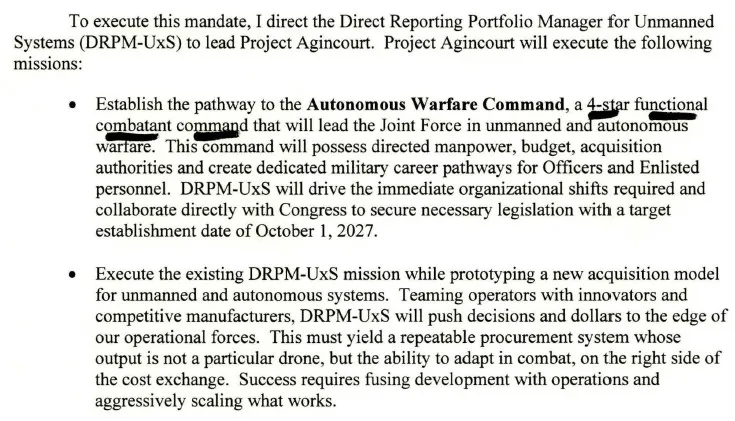
The Pentagon has announced plans for a new functional combatant command, very broadly akin to U.S. Special Operations Command (SOCOM) or U.S. Space Command (SPACECOM), but for operational activities involving autonomous and robotic capabilities. Secretary Pete Hegseth has also announced new initiatives to help further accelerate the fielding of uncrewed systems in the air, at sea, and on land, as well as explore future warfighting challenges. All of this builds on previous and long-overdue efforts to prioritize the fielding of various tiers of drones, as well as artificial intelligence (AI) and other emerging technologies, across domains, but there are questions about how these new efforts will translate into tangible developments.
Secretary Hegseth unveiled plans for what is tentatively dubbed Autonomous Warfare Command (AUTOWARCOM), as well as the aforementioned initiatives, called Project Agincourt and Project Meridian, during a speech to service members today at the U.S. Marine Corps’ base in Quantico, Virginia. Hegseth called this a State of the Force address, and said he planned to make it an annual event.
.@SECWAR “Today, at my direction—we are announcing the creation of Autonomous Warfare Command, or AutoWarCom:
A new 4-star combatant command—with service-like authorities—built to scale autonomous and robotic capabilities across the Joint Force in the fastest peacetime shift in… pic.twitter.com/kYWBxy6Dij
“At my direction, we are announcing the creation of Autonomous Warfare Command, or AUTOWARCOM, a new four-star combatant command with service-like authorities built to scale autonomous and robotic capabilities across the joint force in the fastest peacetime shift in modern military history,” Hegseth declared. “Drone warfare supercharged by SI-enabled targeting is the biggest battlefield revolution in generations. You already know that. Yet when I was sworn in to the Department of Defense, there was scant urgency in this domain.”
Hegseth called attention to the Drone Dominance initiative he unveiled last year, as well as the establishment of Joint Interagency Task Force 401 (JIATF-401), as examples of steps the Department has already taken in this regard. JIATF-401 is notably focused on counter-drone capabilities, as you read more about here.
“It’s a good start, but it’s certainly not enough. The pace of war is changing faster than the process to support it. Cheap compute, super intelligence, and advanced commercial manufacturing have enabled the proliferation of low-cost, high-precision strikes,” Hegseth continued. “For 40 years, the United States relied … primarily on expensive weapons that placed quality over quantity. Now, that approach gave us a lot of enormous advantages, and we need to preserve those capabilities. But today we need both quality and quantity. The term you know is high-low mix. An analogy is a thunderstorm. We need bolts of lightning high, our existing high-end kill chains capable of striking unexpectedly and decisively. We also need steady wind and rain, mass drones and other autonomous attritable systems that flip the cost exchange and impose unrelenting pressure on an adversary on the battlefield.”
Hegseth highlighted lessons learned from the ongoing conflict in Ukraine as underscoring these points.
.@SECWAR “Ukraine’s lesson is not that one type of drone wins wars but rather the need for a purpose-built system that maximizes the ability to adapt.
We will fuse procurement with operations at scale – and allow our warfighters, engineers, and entrepreneurs to learn, adapt, and… pic.twitter.com/x7iNMAbU0t
“So today, with Autonomous War Command, AUTOWARCOM, we institutionalize and we supercharge the era of SI, robotics, and autonomous systems, all in order to win,” he added.
A memo the Pentagon has now released makes clear that the establishment of this command is contingent on Congressional approval, and the current goal is for it to be established by October 1, 2027.
“Autonomous Warfare Command will define joint needs and integrate Service-provided forces in support of geographic combatant commanders,” the memo also notes. “It will test equipment and force designs with realistic opposition in demanding exercises and rugged environments, modify rapidly, and field what works. We must build a wartime arsenal whose main product is adaptation at the edge.”
Many questions remain to be answered about how these activities with work being done now within the individual services, and how all of that will translate into operational activities. Part of Project Agincourt’s role will be working to help answer the questions above. The name here is a reference to the battle in 1415 in which British forces prevailed over their French opponents, famously in part through the application of a particular military technology, the longbow.
The two main tasks outlined in a memo today on Project Agincourt, one of which is laying the groundwork for AUTOWARCOM. US Military
The office of the Direct Reporting Portfolio Manager for Unmanned Systems (DRPM-UxS) will lead this initiative. Owen West, head of the Pentagon’s Defense Innovation Unit (DIU), and U.S. Navy SEAL Senior Chief Max Strasiser are set to serve as the Chief Executive Officer and Chief Operating Officer of the DRPM-UxS, respectively.
Project Agincourt will also “prototype a new construct called warfighting acquisition, not just acquisition that happens at the Pentagon,” according to Hegseth. “This model fuses operators with entrepreneurs in rapid adaptation cycles while distributing decisions and dollars closer to frontline units, to combatant commands. Realistic training exercises, and when possible, the crucible of combat, will be used to compress innovation timelines and scale what works.”
“Also today, we are phasing in new MOS [Military Occupational Specialty] frameworks within each military department to support our shift to autonomy,” the Secretary also noted during his speech in the context of Project Agincourt and the plan for AUTOWARCOM. “We need institutional knowledge and career paths for a new generation of autonomous warfighters.”
Project Meridian sits adjacent to these efforts and has a broader mandate to explore ways to ensure the U.S. military maintains its technological edge on future battlefields.
“Project Meridian, the future of warfare, is not about developing new strategies or new policies. We already do that. Rather, its purpose is to creatively look to the future, and identify the domains that we must conquer, and capabilities we must master,” Hegseth said. “We need to be looking forward into the future to achieve technological and military dominance on the battlefield for decades to come. It is futuristic on purpose. Their work will be focused on discovering, developing, and fielding the weapons and systems that our children and our grandchildren will need in their lifetimes, without any creative limitations or restrictions, on any future battlefield, from under the Earth to beyond the Moon.”
“Project Meridian will study the battlefields of the future, identify which weapons and technologies warfighters will need to harness to dominate in these environments, and propose actionable solutions to start developing, testing and fielding these capabilities such that America will have overmatch for the 21st century and beyond,” according to a separate memo the Pentagon put out today. “The Joint Staff and all services should be prepared to connect their future warfare efforts and research to Project Meridian.”
The full text of the Project Meridian memo put out today. US Military
Furthermore, “Project Meridian will leverage critical perspectives from outside the Pentagon, drawing upon a group of top technologists, innovators, business leaders, policy makers, and national security experts,” according to the memo. “Project Meridian’s primary function will be to map the trajectory of future warfare, identify critical capability gaps, and propose actionable solutions in furtherance of the identified goals in the 2026 National Security Science and Technology Strategy.”
This is also very much a near-term initiative, with Hegseth demanding a final report no later 120 days from now, or January 28, 2027. The Pentagon’s Chief Technology Officer, Emil Michael, has been directed to set up this project. Today, Hegseth also named Elon Musk, Palmer Luckey, and Newt Gingrich as key members.
Elon Musk, founder of SpaceX, which dominates the commercial space launch and services market globally, as well as the host of other companies, has had an on-again-off-again relationship with the Trump Administration. Palmer Luckey is another entrepreneur now best known for founding Anduril, which has increasingly a major player in the U.S. defense industry. Newt Gingrich, a highly influential member of Trump’s Republican Party and former Speaker of the U.S. House of Representatives, has more recently become an outspoken advocate of advancing AI technology in the United States.
A screen capture from today’s livestream of Secretary Hegseth’s speech. From left to right, Palmer Luckey, Newt Gingrich, and Elon Musk. US Military capture
The inclusion of Musk and Luckey does raise ethical questions, as they both lead companies with major U.S. government contracts already, and which could be in line to see more opportunities based on Project Meridian’s findings. What guardrails might be put in place to prevent conflicts of interest is unclear.
To reiterate, it remains to be seen how all of these efforts will progress and how, or if, they will ultimately translate to more tangible developments. The U.S. military has a long history now of launching high-profile initiatives that still struggle to demonstrate real progress, despite widespread support for accelerating the fielding of uncrewed systems, AI, and other advanced technologies. The Pentagon has certainly produced tangible results through other organizational shifts in recent years, including the aforementioned Drone Dominance initiative and JIATF-401, as well as the Replicator initiative under President Joe Biden.
At the same time, there are real potential hurdles to these new plans. The Pentagon has itself already acknowledged that support from Congress will be key to the AUTOWARCOM vision. Annual budgeting, and the uncertainty that often surroudns that will also be a factor. There is also the matter of efforts to expand the U.S. defense industrial base. The limitations of existing U.S. industrial capacity and supply chains have already become a matter of national debate in light of concerns about dwindling stockpiles of critical munitions as a result of the ongoing conflict with Iran, as well as a succession of other global crises in recent years.
During his speech, Hegseth called attention to efforts to broaden the defense industrial base with new, smaller firms, as well as agreements with large established contractors to expand on their existing capacity. He also highlighted the Trump administration’s $1.5 trillion defense spending plan for Fiscal Year 2027 and issued a new call on Congress to pass an additional $350 billion reconciliation package.
With today’s announcements, the Pentagon has certainly reinforced its commitment to expanding the fielding of uncrewed and other high-tech capabilities across all branches of the U.S. military, but there is clearly work still to be done to turn those visions into realities.
Earlier this summer, Akriila flew to Los Angeles and played two nights at the Roxy in West Hollywood. At 22, the Chilean singer-songwriter, most identifiable by her fire engine red tresses, is one of the most visionary newcomers in the latest wave of post-urbano Latin artists.
Fittingly, Akriila kick-started her career with a trap mixtape. The most-streamed tracks on her debut, 2024’s dazzling “Epistolares,” favor a progressive reggaeton vein. She also collaborated with Milo J on “Llora Llora” — a folksy lullaby off the Argentine rapper’s masterpiece “La Vida Era Más Corta.”
“Hot gays listen to Akriila” became a celebrated slogan on social media.
Turns out she was just getting started. Released Sept. 3, her latest album, “Lucy Miró al Mundo y Notó Que Está Girando” — its title a delicious riff on Beatles lore — eschews reggaeton altogether, in favor of a hallucinogenic collage of shoegaze, electronic glitch pop and South American roots sounds.
A guidepost of Chilean hyper-pop, it is also a heart-wrenching mash of tenderness and distortion. The lyrics describe the trauma of a recent transition, after she left her father’s home and ventured to live on her own — and though she’s now an established artist signed to Atlantic Records, her music is still aching and vulnerable.
“She is a reference point for all of us in contemporary music,” says producer Diego Raposo, a Dominican tastemaker who featured Akriila on his 2023 debut album. “I believe we’re witnessing something that we’ll probably never see again. Her music reminds me of Björk, Aphex Twin, even Shakira — but it’s also incredibly fresh and original.”
A few days before traveling to London for her inaugural European tour, Akriila spoke to De Los about the seduction of second verses, her obsession with ’90s dream pop and the growing pains of living alone.
This is such a dreamlike record. Was that intentional? I wanted it to feel not necessarily ethereal, but hazy, like you’re inside a bubble. I love the way my voice is processed, sharing the space with so many layers. It’s really cool when the vocals are part of a track instead of lying there in the center of the mix.
I was your age in the ’90s, and this album has a very strange emotional effect on me: It reminds me of what it felt like to be in my 20s, listening to dream pop for the first time. That makes perfect sense, and it connects with a favorite exercise of mine: Every week — ideally, every day — I listen to a full album from beginning to end. I started with new releases, but then set my sights on the classics.
The Sundays’ [1990 masterpiece] “Reading, Writing and Arithmetic” was the album that opened up the space mentally for what I wanted to do. I always say that I make alternative pop. I start with something that’s catchy and easily digestible, and then mix it with sounds that feel uncomfortable. As I was starting to work on this album, I listened to the Sundays, the Cardigans, and every single record that Prince ever made.
I can definitely feel the ’90s vibe in the closing track, “Lucy.” It’s gorgeous. That’s inspired by the Sundays’ “Gone,” and the drums sound like Cocteau Twins. I love the art of collage — stealing from different artists, but doing it my way. There are samples of PJ Harvey, Patti Smith, but also Rosalía. When I make videos, I’m always thinking of something that MTV would have played back in the day.
I keep thinking of this record as a concept album, even though the actual concept is more of a feeling than anything else. I totally get you. It’s not an album like the Who’s “Tommy” — an actual musical that takes the conceptual deal to another level. I feel we’ve forgotten the art of making albums now that we’re so focused on playlists and TikTok. I invest a lot of effort in making my albums conceptual, since I’m not into records that are random collections of tracks. “Epistolares” was all about sending letters and dedications. The deluxe version was more sentimental. This one is a concept album for sure. I could outline in detail why every moment of the record happens when it does.
The bridge on “Abrázame” is incredibly romantic. That bit really freaked me out in a good way. It was shorter at first, but then I asked [producer] Vinco to make it longer. Those guitars on the bridge are the most beautiful thing he’s ever done. The contradiction of “Abrázame” is that everyone kept telling me that it should continue going up and explode at the end, but I had already overused that device on “Epistolares.” So I did the opposite and gave it a happy ending. That ethereal, ambient thing at the end kills me.
Talking about songwriting devices, here’s a trademark Akriila move: A song may be moving forward, and suddenly there’s a fracture — everything breaks and decomposes. Why? I think I have ADHD and need things to be constantly changing. I’ve tried to make songs that are plain, but I just can’t do it. My favorite part of songwriting is working on the second verse. You’ve already presented the main idea and shown what the chorus is like. On the second verse you can change the beat or the lyrics, and do anything you like. [Producer] Clemente is just like me in that respect. Sometimes we take things to the limit, and then step back. It’s one of the great things about my creative team: We’re not married to the demos. We may do five versions of the same tune until it sounds right.
Your Chilean roots shine through on “Partedemipartedeti.” I listened to those folk bits and thought: Here’s someone who grew up listening to Los Jaivas and Inti-Illimani. When I first started obsessing about music, the stuff that I liked was all in Spanish. I listened to tons of records from Chile, Argentina and Mexico. “Carta a Mi Papá” is like a traditional balada from Chile. I stole those chords from “Quizás, Porque” by [Argentine supergroup] Sui Generis. I listened to a lot of Pescado Rabioso when I was a teen. My partner has a cassette deck in her car, and she’s always playing [Charly García’s] “Piano Bar.” I don’t identify only with Chilean music. It’s more of a música latinoamericana thing. I don’t think gringos are that good in the lyric writing department. Artists like Bandalos Chinos, Alex Anwandter and Zoé are really great composers.
Do you think you’re an old soul? People always tell me that [smiles]. We’re a team of three; I think Clemente is a really young soul. Vinco and I are the old ones.
Before making this record, you stopped living with your dad, moved to a place of your own, and experienced a time of profound loneliness. What does your father think of the finished album? He loves it. He is a musician himself, and it must have been hard for him when we started living apart. It was also difficult for me to get home and feel so lonely because there was no one waiting for me anymore. My dad still comes to my place once a week; he doesn’t want to bother me, so he leaves food in the reception area. It’s his way of making sure that I’m doing fine.
The U.S. Air Force has been taking a new look at the feasibility of restarting production of the C-17 Globemaster III cargo plane as part of its still-evolving next-generation airlift plans. The service also continues to explore a wide range of next-generation aerial refueling concepts, including new stealthy and/or uncrewed tankers, but a firm vision for the way forward there has yet to emerge.
Air Force Lt. Gen. Daniel Tulley, head of Air Mobility Command (AMC), shared new details about future airlift and aerial refueling efforts, with TWZ and other outlets at a roundtable at the Air & Space Forces Association’s (AFA) 2026 Air, Space & Cyber Conference.
On the airlift side, the Air Force’s stated plan to date is to replace both the C-17A and C-5M Galaxy with a single Next-Generation Airlift (NGAL) platform, starting in the mid-2040s. Separately, the service is pursuing what could be a family of future aerial refueling capabilities under what is now called the Advanced Tanker Systems (ATS) program. Very broadly speaking, ATS presents a path toward what might come after the retirement of the aging KC-135 tanker fleet, though those aircraft are still expected to keep flying for years to come. The Air Force is also moving to further expand its fleet of newer KC-46A tankers in the interim, but persistent technical and other issues with that design continue to present hurdles.
A US Air Force C-5, at left, together with one of the sevice’s C-17s, at right. USAFA KC-135, at right, prepares to link with a KC-46, at left, during a test. USAF
At the roundtable today, Lt. Gen. Tulley was asked explicitly about restarting C-17 production. The manufacturer of those aircraft, Boeing, shuttered that line in 2015. The company also just marked the 35th anniversary of the design’s first flight yesterday.
“Heck yeah, but with a caveat, right?” Tulley said in response. “So we were just asking this question over the course of last week, and it’s in the context of next-generation airlift. So we are about to embark on the Analysis of Alternatives to replace the C-17 and replace the C-5. All options are on the table.”
“There’s always the option to service life extend the C-17, but the [production restart] question came up,” he continued. “I’ve heard this my entire career. Once we terminate an assembly line, can we ever bring it back? Does somebody store all the machinery and the dies and whatnot, and can you bring that out? So we’re asking that question.”
“But then whatever that answer is from the vendors, what will be the price tag associated with that?” he added. “You have to ask yourself, okay, is rebuilding a C-17 even if you make improvements – and there’s a loose analogy with the C-130J, [a] much more modern, capable variant of the C-130E [author’s note: the C-130J evolved more directly from the C-130H variant] I first learned to fly – if you do that with the C-17, is that the best move? Or are there new technologies that we can incorporate into it so that it can defend itself, so that it’s connected, it’s networked, it does all the things that maybe the current C-17 doesn’t do?”
“We’re looking into it as part of the Analysis of Alternatives. I’m hopeful that we’ll get to answer that question.”
In June, the House Armed Services Committee also directed the U.S. Air Force to prepare a formal briefing on the matter of new C-17 production in a report accompanying a draft of the annual defense policy bill, or National Defense Authorization Act (NDAA), for Fiscal Year 2027.
Boeing Pieces Together the Last C-17 on the Line
The RAND Corporation did conduct a detailed, independent analysis more than a decade ago that assessed the costs and complexities that could come from Boeing building more C-17As, as well as other variants and derivatives of the design. RAND’s conclusion was that any of the courses of action would require billions of dollars of new investment and entail risks, as you can read more about in more detail here.
Foreign participation in a new C-17 production run could help at least defray costs. Australia, Canada, India, Kuwait, Qatar, the United Arab Emirates, and the United Kingdom all currently fly Globemaster IIIs. The Strategic Airlift Capability (SAC) initiative, a multinational arrangement with several European members, as well as the United States, also operates three of these aircraft.
Boeing told TWZ directly in June that unnamed C-17 operators had been reaching out about the prospect of restarting the production line, and that the company was “encouraged” by those discussions.
As Lt. Gen. Tulley stressed, there are significant questions about whether buying new-production C-17s, even with substantial improvements, is not only feasible, but a good use of resources. The Air Force’s Globemaster III fleet today continues to prove itself to be critical to the U.S. military’s ability to project power globally, and is in very high demand right now, especially amid the ongoing conflict with Iran.
The Air Force’s desire to replace both the C-17 and C-5, which are very different aircraft in form and function, could still easily lead the service down a different route. Boeing is not the only one looking at future NGAL opportunities. Another company, Radia, has been very actively pitching a clean-sheet design that is physically bigger than either the C-17 and the C-5, and that is geared toward greater operational flexibility, at the Air Force. Radia is targeting a first flight of its aircraft, called Windrunner, by the end of the decade, but it is still in a very aspirational stage at present.
A rendering of Radia’s Windrunner design. Radia
Many questions also still remain about how the Air Force will ultimately proceed on the next-generation aerial refueling front.
“So thinking beyond the current KC-46 buy and the program extension, whatever that next tanker looks like, our Advanced Tanker System, it’s got to be connected. It’s got to be able to defend itself,” Lt. Gen. Tulley said at the roundtable. “But it begs the question: does it need to be manned? Could it be optionally manned? Could it be autonomous? Or is there a family of solutions maybe that would answer that question? So I do not believe that it has to be manned.”
“I think you’re seeing that with the MQ-25 and the Navy’s work, but then, how do we, the U.S. Air Force, bring that to bear in scope, scale, and range?” Tulley continued. “An optionally manned or an unmanned tanker, at range, the ranges we need to operate at, it’s a very large aircraft. And we’re not yet to where we’re employing fully autonomous large aircraft, but the technology, I would say, is there and rapidly getting there if it’s not.”
A rendering of a larger, land-based derivative of the MQ-25, depicted refueling from a KC-46 tanker. BoeingOne of the advanced tanker concepts Lockheed Martin’s Skunk Works has shared publicly in recent years. Lockheed Martin Skunk Works
“We will be going after how to make the tanker survive,” William Bailey, the Air Force official currently performing the duties of the Assistant Secretary of the Air Force for Acquisition, Technology and Logistics, had also told TWZ and other outlets at a separate roundtable at the Air, Space & Cyber Conference yesterday. Bailey was responding to a direct question about whether the service was moving away from the idea of a stealthy tanker as part of the ATS plan.
“So, lots of work around what do we do in the future for our tankers, and we spent a pretty dedicated effort to go through and look at what do we think those design solutions could look like,” Bailey also said. “We looked internally. We went out to industry, had those guys come back with their thoughts on how to provide a more survivable aircraft.”
“The stuff that was coming in for me might have been an incremental improvement, but [it was] not clear that that represented the next step, the next phase,” he added. “What you’ll see is we’ll take our efforts, and we’ll look at, hey, if the real question is tanker access, then let’s not constrain ourselves to just the aircraft itself and trying to make a stealthy tanker. We need a tanker to have access, so we’ll talk about all those systems that it would take to protect that tanker.”
Bailey said the question of operational “access” applied to next-generation discussions, as well.
This ex-French Air Force KC-135FR tanker, now operated by private contractor Metrea, is an example of the outside aerial refueling capacity the U.S. military has been increasingly leveraging in recent years. Metrea
Greater connectivity “can be a game changer, and it has been a game changer in Operation Epic Fury [against Iran],” Lt. Gen. Tulley said at today’s roundtable. “The ability for air crews to communicate, to coordinate tanker orbits and rendezvous, to pass threat information, to save lives and save aircraft has been everything we expected it to be and more.”
“We have MAF NEXUS that we’re pursuing. The goal is to have this on all mobility aircraft, whether they’re future-built and it’s incorporated, or it’s an add-on capability to existing aircraft,” he continued. “It brings edge compute, the ability to then employ AI [artificial intelligence] and much more computing core power forward on the aircraft, and it does network with the rest of the joint force and the Air Force’s battle management system.”
A picture of a US Air Force KC-135 tanker spotted earlier this year with a new large satellite communications antenna (further highlighted in the inset), underscoring work underway now to improve the network connectivity of those aircraft. Alessandro Ledda
When it comes to new options for protecting existing tankers, “nothing’s off the table,” the AMC boss added. “Whether it’s [in the] electromagnetic spectrum, whether it’s kinetic self-defense, a layered approach, we’re looking at everything to come up with what might be the best system. But it’s got to be a system that we can afford, and it’s got to be one that we can put on all the aircraft we have and the ones we’re about to build.”
The Air Force is otherwise still clearly continuing to shape its future airlift and aerial fueling visions. As part of that work, the service is now at least considering the possibility of rebooting C-17 production.