mahan

Plans for forum to replace scrapped USC governor’s debate fall apart

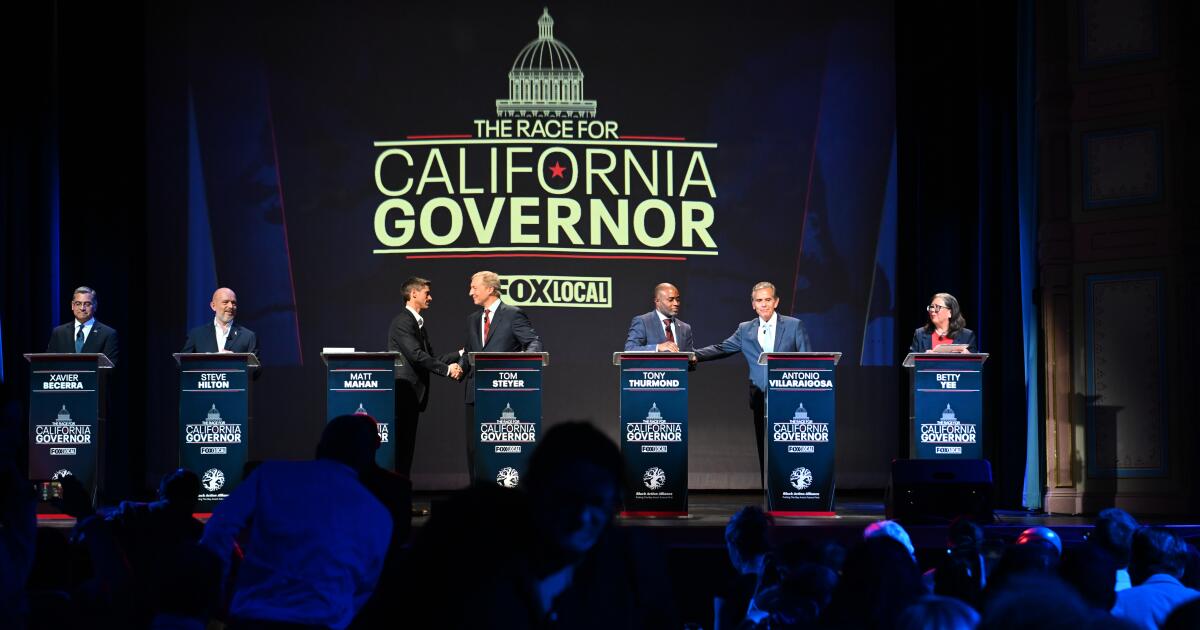
A proposed gubernatorial forum hastily cobbled together in the hours after USC canceled its Tuesday debate fell apart because the candidates of color who were excluded from the previously planned event were unable to show up in person at KNBC-TV’s studio in Universal City, according to multiple sources.

Facing mounting pressure that its debate selection criteria excluded every candidate of color, the university canceled its debate late Monday. On Tuesday morning, billionaire Tom Steyer — a Democrat — proposed holding an alternative face-off, with KNBC moderating. But the candidates who had not been invited to the USC debate had already made other commitments.

“A lot of this came out of nowhere — there’s a debate and you’re not invited, followed by there’s no debate, and then maybe we should all hang out and have a conversation,” said Kyle Layman, a strategist advising former U.S. Health and Human Services Secretary Xavier Becerra.

USC officials declined to comment on Tuesday’s developments — as did KABC-TV, one of the broadcast partners of the canceled debate. KNBC did not respond to a request for comment, but someone involved with planning a potential debate there said pulling together such an event in just a few hours was impossible, and also unfair to the candidates who had made other plans after initially being excluded from the USC debate.

“We looked into the possibility of doing something. It just wasn’t possible because of the last-minute logistics. It was not feasible,” said the person, who asked for anonymity to speak candidly. “We couldn’t get everybody here.”

The fact that the candidates excluded from the USC debate couldn’t find a way to participate in Tuesday evening’s alternative forum irritated some people involved in the planning, however. Becerra, state Supt. of Public Instruction Tony Thurmond, former Los Angeles Mayor Antonio Villaraigosa and former state Controller Betty Yee had loudly protested not being invited to the USC event.

“This is like probably one of the last opportunities they have to be with other leading contenders of the race, so why not take this opportunity?” said someone who took part in conversations about the proposed last-minute debate, who asked for anonymity to speak openly. “If the whole thing is about bringing your message to the voters, making sure voters have as much information as possible, talking about the issues that matter, wouldn’t you want to take every opportunity to do that?

“If you’re going to talk a big game about taking your message to voters, the importance of debates, why not do it?” this person said.

Becerra, Thurmond, Villaraigosa and Yee have reportedly formed an informal pact not to participate in any debate that does not include all of them, which Yee referenced in a Tuesday afternoon news conference.

“The idea that none of the candidates of color are going to be joining a debate is just inappropriate for a state like California,” Yee said. “We also need to have a commitment from all of the debate sponsors that they will include all of us going forward.”

Yee and Thurmond were not invited to the next major televised debate, which will take place April 1 at Fresno State University. Becerra and Villaraigosa had previously confirmed their attendance, according to a news release from the Western Growers Assn., one of the event’s sponsors.

And all four candidates of color, along with San José Mayor Matt Mahan, were not invited to a debate on April 22 in San Francisco that will be hosted by KRON-TV and broadcast on Nexstar Media Group stations throughout California.

“We don’t need gatekeepers,” Mahan said in a statement Tuesday evening. “I’m calling on my fellow candidates to work together to organize our own debates — so we can take our ideas for a better California to every corner of California. Let’s let the voters truly decide.”

The scrapped USC debate was going to be hosted by the institution’s Dornsife Center for the Political Future and co-sponsored by KABC and Univision. Six candidates had been invited to participate: Democrats Rep. Eric Swalwell (D-Dublin), former Orange County Rep. Katie Porter, Mahan and Steyer; along with the leading Republicans, conservative commentator Steve Hilton and Riverside County Sheriff Chad Bianco.

Candidates and elected officials called the criteria used to determine participation in the debate biased because it included Mahan, a white candidate who is polling near the bottom of the pack but is supported by notable names in the USC community. Hours after the debate was canceled, Steyer’s campaign sought to create an alternate event that would include all of the candidates.

“We were trying to do the right thing upon learning that the debate was canceled at USC,” said a member of Steyer’s campaign who asked for anonymity to speak candidly. “Tom immediately was like, ‘We can do something alternative.’ People want to hear from the gubernatorial candidates. It was on the table. It was offered.

“NBC couldn’t get all the candidates here, but we tried,” this person said. “Given the short amount of time we were trying to put this together, it ultimately could not happen because not all the candidates could get to the studio.”

Thurmond, who was in Sacramento and Richmond on Tuesday, joined a political influencer on YouTube Tuesday evening, while Yee attended previously scheduled events with the East Area Progressive Democrats and a women’s group in the L.A. area. Villaraigosa had lined up other interviews at his Wilshire campaign office, Becerra was traveling, and Porter was scheduled to host a livestream on her Instagram account Tuesday evening.

Source link

California governor candidate Matt Mahan unveils government reform plan

When he entered the race for California governor, San José Mayor Matt Mahan pitched himself as a pragmatic Democrat who would prioritize improving residents’ quality of life and government efficiency.

He unveiled a key part of that promise on Tuesday with an expansive plan to reform state government, including tying pay raises for elected officials and other top leaders to improvements on key issues, and pledging not to approve any tax increase until the state proves “that we can deliver better outcomes with the dollars we already have.”

Mahan also delivered a blistering rebuke of ballooning state spending — which, as he often points out on the campaign trail, has increased nearly 75% over the last six years. In 2020, amid the COVID-19 pandemic and accompanying economic uncertainty, California lawmakers approved a no-frills state budget that came in at $202 billion. Gov. Gavin Newsom’s latest spending proposal is nearly $349 billion.

“We have fallen into this lazy, reflexive mindset of always going back to voters and telling them that the only solution to every problem is a tax increase or a new bond or a new rule coming down from Sacramento,” Mahan said in an interview. “We need to step back and take a really hard look at our existing spending and increase the level of transparency and accountability in government.”

His eight-page plan includes ways to measure and track accountability, some of which are drawn from policies in other states. They include lobbying reforms, following up on audit recommendations and overhauling the state’s digital infrastructure and its procurement process — services Mahan described as “clunky and cumbersome.”

He also proposed a “California Performance Review,” inspired by a similar effort in Texas throughout the 1990s, that would review state agencies and solicit input from employees to eliminate waste and inefficiencies.

But near the top of the list is a proposal to tie pay raises for state officials including the governor, lawmakers and thousands of gubernatorial appointees to “measurable outcomes” in areas such as reducing homelessness and unemployment.

“People in the real world don’t get raises if they don’t do a good job,” Mahan said, “and I think it should be the same for the politicians and senior administrators who are allocating budgets, leading projects, making the big decisions on behalf of the people of California.”

Though the benchmarks would be created with input from the state Legislature, Mahan floated one example: reducing unsheltered homelessness by 5% to 10% within one year, something he said he’s accomplished three years in a row in San José.

It’s a solution one might expect from a former entrepreneur and mayor of a city in the heart of Silicon Valley. Mahan made a similar proposal at the local level last year, but it was rejected by the City Council.

“Tying pay to performance is nothing short of revolutionary in government. It’s a private-sector model that is overdue,” said former state Sen. Steve Glazer (D-Orinda), a Mahan supporter who sponsored several bills aiming to increase transparency in government.

Dozens of tech company executives are backing Mahan in the race for governor and have collectively donated millions to his campaign, as well as two independent expenditure committees supporting him.

That has raised concerns from some voters, and criticism from some of Mahan’s opponents, that he would be beholden to their interests and veto future regulations on tech or artificial intelligence companies.

Mahan has sought to dispel those concerns, arguing that he believes AI and social media platforms should be regulated. Of his plan to overhaul state information technology systems and infrastructure, he said that “whenever we spend public dollars, we have to run open, transparent and competitive procurement processes that ensure best value for the taxpayers.”

Though Mahan did not specify how he would link government outcomes to pay raises, state lawmakers have largely panned his campaign and are unlikely to get on board. The change probably would also require voter approval.

Currently, annual raises for elected officials are determined by a citizen commission that was added to the California Constitution in 1990. Changing how that panel works or imposing limits on when it can approve raises would require a constitutional amendment, which requires voter sign-off.

But Mahan contended it would be one of the fastest ways to fix a system that he says works for special interests at the expense of working people.

“I’m under no illusion that this will be easy, but I think it’s a necessary realignment of incentives,” he said. “We have to make ourselves as accountable to the people as we possibly can be.”

Source link

California leaders call to boycott debate if other candidates not included

Democratic legislative leaders on Monday called on voters to boycott USC’s upcoming gubernatorial debate if the university does not invite candidates who were excluded from participating.

The unsparing letter adds another layer of controversy to Tuesday’s forum, which as a result of the university’s selection criteria would not include any of the leading candidates of color.

“We are writing to demand you open the March 24 gubernatorial debate to all leading candidates,” said the letter sent Monday evening to USC President Beong-Soo Kim by Assembly Speaker Robert Rivas (D-Hollister), Senate President Pro Tem Monique Limón (D-Goleta) and the leaders of the legislative Latino, Black, Asian and Pacific Islander, Native American, LGBTQ, Jewish and women’s caucuses. “The outcry over this debate is deafening and includes legal demands from the excluded candidates’ attorneys, public calls by elected leaders across the state, concerns from the included candidates’ own campaigns, and growing alarm from California voters. Instead of responding to these valid concerns by expanding the debate, USC has doubled down.”

USC officials did not immediately respond to a request for comment Monday. Tuesday’s debate is scheduled less than two months before ballots begin arriving in voters’ mailboxes.

The university has been embroiled in controversy over the criteria it used to select the candidates it invited to participate in Tuesday’s debate, which is co-sponsored by KABC-TV Los Angeles and Univision.

Specifically, critics have pointed out the methodology allowed San José Mayor Matt Mahan — a white candidate who recently entered the race and is polling poorly — to vault above former U.S. Health and Human Services Secretary Xavier Becerra, former Los Angeles Mayor Antonio Villaraigosa, state Supt. of Public Instruction Tony Thurmond and former state Controller Betty Yee.

“The university’s selection process — built on a formula never before used for a debate of this scale, has delivered a result that is biased,” the letter says. “When a methodology produces this outcome — one that elevates a candidate with notable ties to USC’s donor community and the co-director of the Dornsife Center for the Political Future — the burden falls on USC to explain itself, not on everyone else to accept it. If USC does not do the right thing, we call on California voters to boycott this debate.”

Mike Murphy, a co-director of the USC center hosting the debate, has been voluntarily advising an independent expenditure committee backing Mahan. The veteran GOP strategist previously said he had nothing to do with organizing the debate and that he has asked for unpaid leave at the university through the June 2 primary if he takes a paid role in the campaign.

USC has also received tens of millions of dollars in donations from billionaire real estate developer Rick Caruso and his wife. Caruso, a USC alumnus who served as a trustee for years, is also a Mahan supporter.

“I had no conversations with the debate hosts or organizers,” Caruso said in a statement to The Times on Monday. “This is the most important election for California in a generation, and I encourage everyone to be engaged, learn as much as possible about each candidate, then form an opinion who can move California forward in the most positive of ways. Watching debates is a part of that process. That is why I believe debates should include all the credible candidates.”

The debate sponsors released a joint statement on Friday defending their decision.

“We want to be clear that we categorically, unequivocally deny any allegations that the debate criteria was in any way biased in favor or against any candidate and want to clarify the facts,” said the statement by the USC Dornsife Center for the Political Future and its broadcast partners. “The methodology was based on well-established metrics consistent with formulas widely used to set debate participation nationwide — a combination of polling and fundraising — and developed without regard to any particular candidate.”

Hours later, the four prominent Democrats who were excluded from the debate called on their rivals to boycott the event, reiterating their concerns that the criteria used to determine who was invited to participate resulted in every prominent candidate of color being excluded from the forum.

The four Democrats who are participating in the debate — Rep. Eric Swalwell of Dublin, former Orange County Rep. Katie Porter, billionaire climate activist Tom Steyer and Mahan — all issued statements criticizing USC’s selection criteria, but did not pull out of the debate.

“It is a shame that USC has decided to elevate one candidate at the expense of others,” Swalwell wrote on X on Sunday. “USC, and every host of a gubernatorial debate, should employ fair, objective, and honest criteria for all candidates. I remain hopeful they will do so Tuesday night.”

Porter expressed similar thoughts.

“Criteria used to determine which candidates qualify to participate in a debate must be transparent, fair, and objective,” she wrote on X. “I’m disappointed by how USC handled the process for Tuesday’s debate. Candidates and Californians deserve answers.”

Source link

Becerra blasts USC and ABC for excluding candidates of color from gubernatorial debate

Former U.S. Health and Human Services Secretary Xavier Becerra, one of the top Democrats running for California governor, on Friday blasted USC and the ABC affiliate in Los Angeles for hosting a debate that he argues purposely excludes all candidates of color.

Becerra said he and the other candidates were excluded from the televised debate unfairly, a decision that he said “smells of election rigging” in a hotly contested race less than three months before the June primary.

“My father used to tell me of the days when he would encounter signs posted outside establishments that read ‘No Dogs, Negroes or Mexicans Allowed,’” Becerra wrote in a public letter to USC President Beong-Soo Kim. “USC’s actions may not seem so transparent. But, you have deliberately chosen to selectively filter the voters’ view of the field of gubernatorial candidates in what all observers characterize as a wide-open race.”

The university said in a statement that it authorized a political expert to create the formula to determine who would be included in the debate.

“At the request of the Center for the Political Future, Dr. Christian Grose, Professor of Political Science and International Relations, independently established the methodology that determined eligibility for the debate,” according to a statement from the center. “No one in the USC administration had any role in developing, reviewing or approving those criteria.”

The center later said in a statement on Friday that it reiterated the criteria that determined which candidates were invited to participate in the debate, and that nothing had changed since the forum was first planned.

The criteria for gubernatorial candidates to participate considered opinion polling and campaign fund raising. Six candidates were asked to participate in the March 24 debate, which is cosponsored by ABC7 Los Angeles and Univision.

There was conflicting information about USC’s stated criteria, however. The methodology says that the fundraising totals considered were based on semi-annual reports campaigns filed with the California Secretary of State’s office. However, the document later says that the fundraising figures also includes large donations that campaigns are required to immediately report.

This is a critical difference, because San José Mayor Matt Mahan did not enter the race until late January, and thus far has not been required to file any semi-annual fundraising disclosures with the state. However, he has received significant donations since he entered the race.

Mahan agreed with Becerra, saying that he ought to be part of public forums about who will lead the state.

“The former Secretary is absolutely correct, he should be included in the debate,” Mahan said in a statement. “His long record of service to California has earned him a place on every debate stage in this campaign for Governor.”

USC officials said they are clarifying how they selected candidates to participate in the race.

“We are reissuing the criteria to make clear that they include current fundraising totals, including semi-annual and late reports, which were always part of the formula,” the Center for the Political Future said in a statement. “We are not changing the criteria. We have updated even as of today and the rank order includes the same top 6 candidates.”

Grose said that the selection of candidates was based upon polling and fundraising numbers, and that the sentence about semi-annual fundraising reports was inaccurate.

“It was just a wording issue. It’s not a methodology issue,” he said.

Six candidates are scheduled to appear at the debate: Republicans Riverside County Sheriff Chad Bianco and conservative commentator Steve Hilton; and Democrats Northern California Rep. Eric Swalwell, former Orange County Rep. Katie Porter, billionaire hedge-fund founder Tom Steyer and Mahan.

The kerfuffle occurs after Democratic candidates of color accused state party leaders of trying to oust them from the race in favor of white candidates, who have more support in opinion polls.

In addition to Becerra, other prominent Democratic candidates excluded from the debate include former state Controller Betty Yee, state Supt. of Public Instruction Tony Thurmond and former Los Angeles Mayor Antonio Villaraigosa, who also condemned the candidate-selection formula.

“Californians deserve a fair process, and voters deserve to hear from all qualified voices,” Villaraigosa, who taught public policy at USC for three years after leaving office, said in a statement. “But this biased and bigoted action by USC to manipulate the data to exclude every qualified Black, Latino, and API candidate in favor of a less qualified white candidate is shameful.”

Becerra said USC went to great lengths to justify the candidates that were excluded, but the bias was clear.

“You can’t escape the detestable outcome: you disqualified all of the candidates of color from participating while you invited a white candidate who has NEVER polled higher than some of the candidates of color, including me,” he said.

Becerra was clearly referring to Mahan, who recently entered the race and has received millions of dollars of support from Silicon Valley leaders. Becerra noted that veteran GOP strategist Mike Murphy, co-director of the USC Center for the Political Future, which is a sponsor of the debate, is assisting an independent expenditure committee backing Mahan.

Murphy said he had recused himself from anything involved in the debate, and that he was a volunteer for the outside group backing Mahan. If he becomes a paid advisor to the independent expenditure committee, he said he has requested unpaid leave from the university through the June 2 primary.

“I’ve been transparent that I’m personally a Mahan supporter,” Murphy said. “I’ve had zero to do with the debate.”

Source link