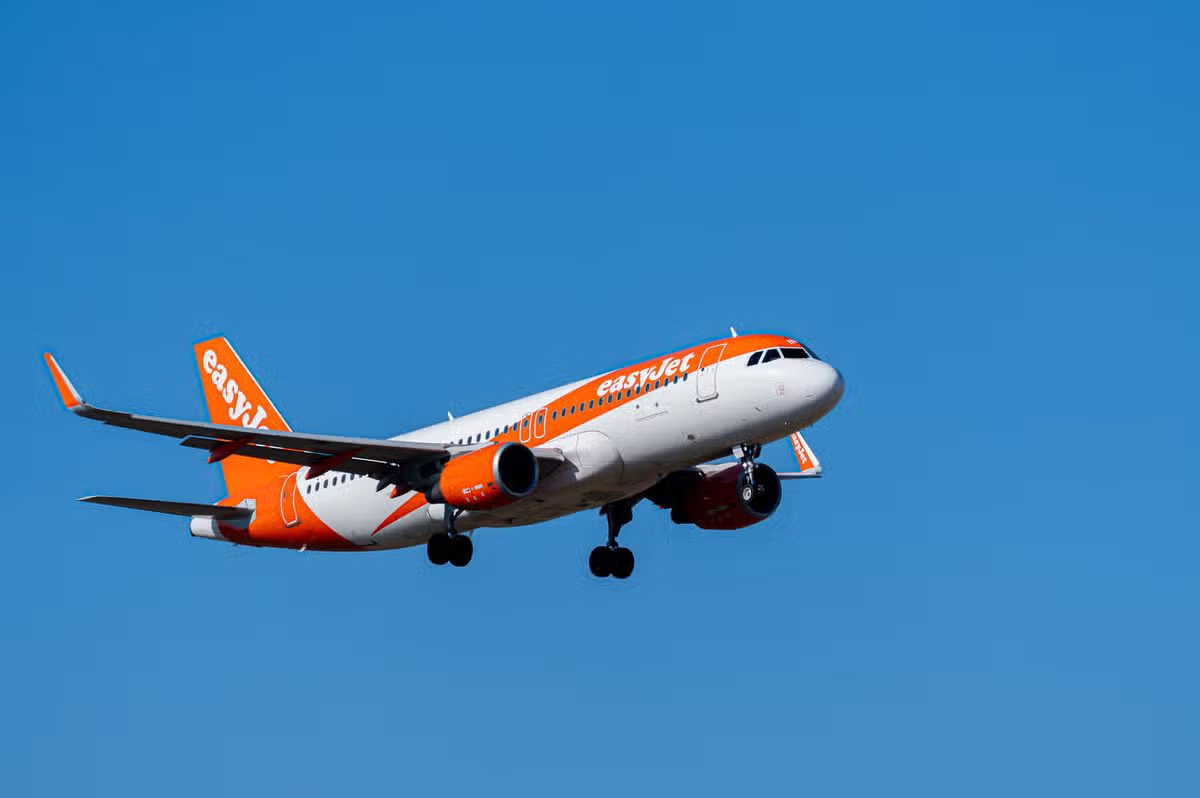
EasyJet chief executive Kenton Jarvis announced that the airline is removing a further 600,000 to 700,000 seats from its winter schedule, on top of 700,000 that have already been cancelled

The airline has cut over a million seats(Image: Reinhard Krull/Getty Images)
EasyJet is cutting thousands of flights this winter, with customers urged to check one date before their flight is due to depart.
EasyJet chief executive Kenton Jarvis told reporters in Brussels on 8 October that the airline is removing a further 600,000 to 700,000 seats from its winter schedule because of elevated fuel costs. This comes after it announced around 700,000 seats would be removed earlier this year, bringing the total reduction to between 1.3 million and 1.4 million seats.
EasyJet CEO Kenton Jarvis told the FT: “People are taking capacity out, we see that across all competitors,” adding that was “no surprise” given fuel costs. However, he admitted that the high cost of fuel had not been expected. “I honestly think it’s been quite a surprise for the industry that fuel has stayed as high as it is,” he said.
Do you have a travel story to share? Email webtravel@reachplc.com
Jet fuel costs have doubled following the start of the Iran conflict, which led to the closure of the Strait of Hormuz. Although prices have started to fall, they remain far higher than airlines expected when the war began.
EasyJet passengers have been urged to check their tickets for one date. If your booking is cancelled, you may not get paid compensation. Whether you do or not depends on your flight date, when you were notified of the cancellation, the reason recorded for that particular cancellation and the timings of the replacement journey.
Under the law UK261, passengers notified between seven and 14 days before departure are entitled to compensation unless the replacement leaves no more than two hours earlier and arrives less than four hours later . Passengers notified fewer than seven days before departure are entitled to compensation, unless the replacement leaves no more than one hour earlier and arrives less than two hours later.
Compensation ranges from £220 to £520 depending on the distance, unless easyJet proves that extraordinary circumstances caused the cancellation. It is unlikely that they will be able to in this instance. Passengers notified at least 14 days before departure are not entitled to fixed compensation, although their refund or rerouting rights remain fully intact.
Refund and rerouting rights apply separately. Passengers who still need to travel should therefore compare the proposed replacement before accepting a refund. If another airline can reach the destination significantly sooner, the CAA says the passenger may have the right to be rerouted on that alternative service.
An easyJet spokesperson said: “Like all airlines, we review our schedule on an ongoing basis and sometimes make some changes. The changes to our winter flying represent a tiny proportion of our flying programme. We make any changes in advance and typically choose multi-daily frequency flights so customers can easily move to an alternative flight.”
The airline originally released more than 25 million seats across almost 138,000 flights between 19 October and 31 January, giving an average of approximately 181 seats per flight. On that basis, the latest reduction is equivalent to roughly 3,300 to 3,900 one-way flights, with the total winter cuts equivalent to approximately 7,200 to 7,700 one-way flights.
These are capacity estimates, not confirmed cancellation numbers. EasyJet has not published the affected routes, the proportion involving UK services or how many removed seats had already been sold. The airline has said it makes changes in advance and typically targets routes with several daily services so passengers can be transferred to another flight.
Anton Radchenko, aviation expert and CEO of AirAdvisor , said: “Airlines commonly describe these decisions as capacity management, but passenger-rights law examines the individual booking. If a flight was sold and subsequently withdrawn, the airline should be able to show when the passenger was informed, the specific reason that service was removed and what comparable rerouting was offered; a general reference to higher fuel costs would not, by itself, establish extraordinary circumstances.
“The most revealing cases will be passengers transferred between services on a route that operates several times a day. Moving someone from a morning flight to an evening departure may appear to be a straightforward consolidation. Still, the resulting arrival time can change the compensation position, and the existence of a substantially earlier flight with another carrier may determine whether the rerouting offered genuinely met the earliest-opportunity requirement.”
“Passengers affected by a schedule change should retain the original itinerary, the timestamped cancellation email and every replacement option offered. Those three records will be considerably more important to an individual claim than the airline’s overall capacity figure.”