EasyJet chief executive Kenton Jarvis announced that the airline is removing a further 600,000 to 700,000 seats from its winter schedule, on top of 700,000 that have already been cancelled
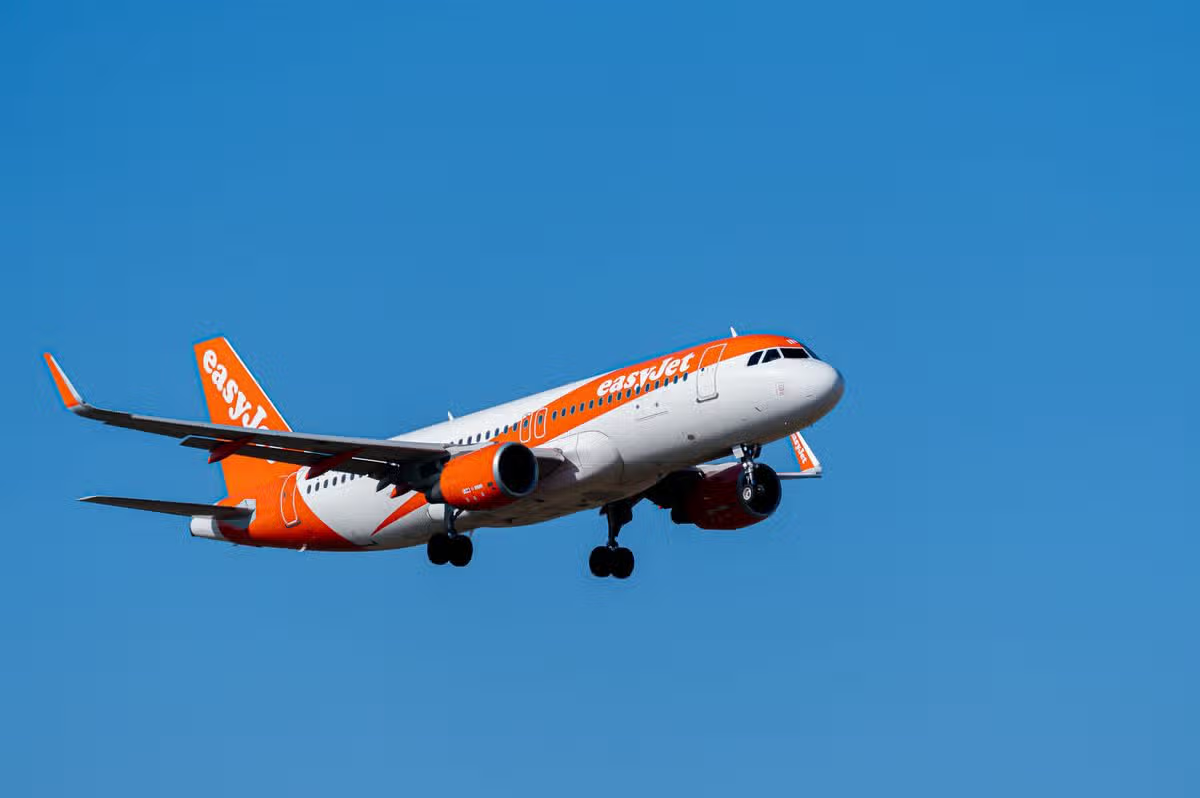
The airline has cut over a million seats(Image: Reinhard Krull/Getty Images)
EasyJet is cutting thousands of flights this winter, with customers urged to check one date before their flight is due to depart.
EasyJet chief executive Kenton Jarvis told reporters in Brussels on 8 Octoberthat the airline is removing a further 600,000 to 700,000 seats from its winter schedule because of elevated fuel costs. This comes after it announced around 700,000 seats would be removed earlier this year, bringing the total reduction to between 1.3 million and 1.4 million seats.
EasyJet CEO Kenton Jarvis told the FT: “People are taking capacity out, we see that across all competitors,” adding that was “no surprise” given fuel costs. However, he admitted that the high cost of fuel had not been expected. “I honestly think it’s been quite a surprise for the industry that fuel has stayed as high as it is,” he said.
Do you have a travel story to share? Email webtravel@reachplc.com
Jet fuel costs have doubled following the start of the Iran conflict, which led to the closure of the Strait of Hormuz. Although prices have started to fall, they remain far higher than airlines expected when the war began.
EasyJet passengers have been urged to check their tickets for one date. If your booking is cancelled, you may not get paid compensation. Whether you do or not depends on your flight date, when you were notified of the cancellation, the reason recorded for that particular cancellation and the timings of the replacement journey.
Under the law UK261, passengers notified between seven and 14 days before departure are entitled to compensation unless the replacement leaves no more than two hours earlier and arrives less than four hours later . Passengers notified fewer than seven days before departure are entitled to compensation, unless the replacement leaves no more than one hour earlier and arrives less than two hours later.
Compensation ranges from £220 to £520 depending on the distance, unless easyJet proves that extraordinary circumstances caused the cancellation. It is unlikely that they will be able to in this instance. Passengers notified at least 14 days before departure are not entitled to fixed compensation, although their refund or rerouting rights remain fully intact.
Refund and rerouting rights apply separately. Passengers who still need to travel should therefore compare the proposed replacement before accepting a refund. If another airline can reach the destination significantly sooner, the CAA says the passenger may have the right to be rerouted on that alternative service.
An easyJet spokesperson said: “Like all airlines, we review our schedule on an ongoing basis and sometimes make some changes. The changes to our winter flying represent a tiny proportion of our flying programme. We make any changes in advance and typically choose multi-daily frequency flights so customers can easily move to an alternative flight.”
The airline originally released more than 25 million seats across almost 138,000 flights between 19 October and 31 January, giving an average of approximately 181 seats per flight. On that basis, the latest reduction is equivalent to roughly 3,300 to 3,900 one-way flights, with the total winter cuts equivalent to approximately 7,200 to 7,700 one-way flights.
These are capacity estimates, not confirmed cancellation numbers. EasyJet has not published the affected routes, the proportion involving UK services or how many removed seats had already been sold. The airline has said it makes changes in advance and typically targets routes with several daily services so passengers can be transferred to another flight.
Anton Radchenko, aviation expert and CEO of AirAdvisor, said: “Airlines commonly describe these decisions as capacity management, but passenger-rights law examines the individual booking. If a flight was sold and subsequently withdrawn, the airline should be able to show when the passenger was informed, the specific reason that service was removed and what comparable rerouting was offered; a general reference to higher fuel costs would not, by itself, establish extraordinary circumstances.
“The most revealing cases will be passengers transferred between services on a route that operates several times a day. Moving someone from a morning flight to an evening departure may appear to be a straightforward consolidation. Still, the resulting arrival time can change the compensation position, and the existence of a substantially earlier flight with another carrier may determine whether the rerouting offered genuinely met the earliest-opportunity requirement.”
“Passengers affected by a schedule change should retain the original itinerary, the timestamped cancellation email and every replacement option offered. Those three records will be considerably more important to an individual claim than the airline’s overall capacity figure.”
The new Netflix thriller is currently sitting at number one on the streaming platform’s most-watched films
22:33, 26 Sep 2026Updated 22:34, 26 Sep 2026
Netflix viewers have shared their verdicts on the new film (Image: Netflix )
The true-story thriller has been slammed by furious viewers who ‘wasted an hour and a half of their lives’.
Brand new film Unabomber is based on the real story of lone wolf American terrorist Theodore Kaczynski, who carried out a mail bombing campaign that killed 3 people and injured 23 more. Known as the Unabomber, he committed his crimes between 1978 and 1995.
Netflix’s take on the late criminal’s story explores his transformation from a bright Harvard student into the infamous Unabomber. It stars 19-year-old actor Jacob Tremblay as the title character.
The main cast also features Oscar winner Russell Crowe, playing a Harvard professor who gets caught in Theodore’s orbit. While beloved actress Shailene Woodley portrays an FBI agent determined to get to the bottom of the Unabomber’s crimes.
The film has already climbed to Number 1 on Netflix’s most-watched charts after just one day on the streaming platform. But many viewers have urged others to skip the star-studded drama.
Writing on Rotten Tomatoes, one disappointed viewer said: “What an absolute waste of time. As far as movies go this had an okay cast. The story was based on real life so interesting I guess as it did happen. It’s sad it happened though but it did. I watched it and was expecting more than I receive.”
Someone else joined in to add: “A word that comes to mind is HOW. HOW DO THEY GET SO MANY BRILLIANT ACTORS IN 1 MOVIE AND STILL FIGURE OUT HOW TO MAKE THE MOVIE SUCK. I WAS BARLEY ABLE TO FINISH IT. COULD OF USED THESE ACTORS TO MAKE SOMETHING GREAT. LET DOWN.”
Get Netflix free with Sky
This article contains affiliate links, we will receive a commission on any sales we generate from it. Learn more
Sky is giving away a free Netflix subscription with its new Sky Stream TV bundles, including the £15 Essential TV bundle. This lets members watch live and on-demand TV content without a satellite dish or aerial and includes hit shows like Stranger Things and The Last of Us.
Someone else simply wrote on X: ” #unabomber on Netflix is an hour and a half of my life I’m not getting back.” At the time of writing, the thriller has a sour 22% score on Rotten Tomatoes.
But others have rushed to the movie’s defence, with one sharing: “Surprised by the negative reviews. I found the film very well done and with a captivating story, quite well engineered. Acting is brilliant and everything is top notch (costume, music, etc). Great film.”
While a second fan added: “I actually loved this. I was just hooked at the very start. And I’m not easily entertained by movies. First of all I loved the switch from the 50s to the 90s it was refreshing. “
For many celebrities, getting a Funko Pop! doll modeled after themselves is a sign they’ve made it in Hollywood. The 4-inch vinyl “Pop!” figurines, with their oversize heads and black dot eyes, symbolize being ingrained in pop culture — objects fans buy, celebrate and display.
At Funko’s flagship Hollywood store, there are thousands to choose from, ranging from NFL players to Disney princesses and characters from the Netflix period drama “Bridgerton.”
But the publicly traded company behind the popular dolls has been facing significant headwinds.
Funko Inc. last year posted a loss of $67.4 million on sales of $908.2 million, down 13% from the previous year. The company disclosed it had debts of $225 million.
The Everett, Wash.-based company warned investors in filings that there was “substantial doubt” about its ability to generate enough cash to meet its debt payments, citing the effects of tariffs in China, where most of its toys were made, canceled retail orders and loan covenants it expected to breach.
Funko Chief Executive Josh Simon, pictured at the Pokémon convention, says he took over the company at an “inflection point.”
(Carolyn Fong / For The Times)
Now the company is looking to stage a comeback.
Leading the turnaround challenge is Josh Simon, who left his job running global consumer products at Netflix to become Funko’s chief executive in September 2025 — the third person to hold the title in two years.
“Funko was at an interesting inflection point,” said 48-year-old Simon, who lives in Los Feliz. “I felt there was still a lot of really deep fandom and enthusiasm from retailers and at the same time, there were a lot of problems that had to be sorted out at the company. I thought it would be an interesting adventure and hopefully a way to help turn things around a bit and restore it back to that level of fan passion and glory that existed years ago.”
The rise and fall of Funko
Funko began in 1998 when entrepreneur Mike Becker decided bobbleheads would be the next big thing and shipped them out of his garage. After entrepreneur Brian Mariotti bought Funko in 2005, the business began licensing more characters. Sales took off with the launch of its big-headed “Pop!” figurines in 2010.
The company changed ownership over the years, added backpacks and other products, and went public in 2017. Most of its revenue still comes from making licensed characters and selling them through retailers, online and at events.
Funko survived a decline in sales with the rise of kidults — adults who collect toys.
(Carolyn Fong / For The Times)
But Funko’s sales plunged in 2025 following a global trade war.
The company overestimated demand, picked the wrong characters and made too many of dolls, said Gerrick Johnson, senior research analyst at Seaport Research Partners, which has a buy rating on Funko.
President Trump’s heavy tariffs imposed on China substantially raised the costs of making Funko dolls.
Amid lagging sales, retailers marked down the figurines, alienating collectors who want to see items appreciate in value.
“Collectors hate buying things 50% off,” Johnson said. “One of the biggest turnoffs in collectibles is a bargain bin.”
What kept the brand alive through the slump was the rise of kidults — adults who collect toys. Simon was one, picking up Pop! figurines from “Toy Story” and “Back to the Future” long before he worked there. Funko’s job, he said, is to distill what people love about a character into a stylized version of it.
“The number of inbound requests we get from musicians and athletes and celebrities — everyone is excited and pitching us they want a Funko Pop! made of themselves, because in some ways it suggests a mark of establishment in pop culture,” Simon said. “It’s like akin to getting your star on the Hollywood Walk of Fame in some way.”
Convention-goers create custom dolls at a Funko Pop! kiosk.
(Carolyn Fong / For The Times)
One expert said Funko’s job is to distill what people love about a character into a stylized version of it.
(Carolyn Fong / For The Times)
A turnaround plan
Though based in Washington, Funko has a large presence in L.A., where most of its senior leadership is based. They work out of the same offices as the flagship Hollywood store. The company also has employees in Arizona, London, Hong Kong and other markets.
Under Simon, Funko has diversified its supply chain, shifting production out of China to Vietnam and other countries. To improve cash flow, Funko renegotiated the timing of its debt payments and pushed products to market faster.
For example, Funko turned around figurines of the characters from “KPop Demon Hunters” — the Netflix film that became the streamer’s most-watched movie ever after its June 2025 release — in about four months, well ahead of Mattel, whose first items reached stores this spring.
When John Cena stepped into the ring for his final WWE match in December, there were pre-orders for a Funko figure wearing the same outfit down to the shirt reading, “The Last Time is Now,” built from an image Funko received a week earlier. The doll became a bestseller, said Scott Zanghellini, executive vice president of WWE Consumer Products.
“It’s happening in real time and his team being able to move quickly, and us always moving quickly in this world of we have seven hours of programming a week — how do you take advantage of that and give the fans what they want?” Zanghellini said.
Funko is also widening what counts as a license, making figures from “The Folk of the Air,” Holly Black’s fantasy series revived by book lovers on TikTok, as well as creating more original characters that aren’t licensed.
“We really want to make sure that we can be a part of these cultural moments while they’re happening,” Simon said.
Reaching out to fans is another priority. At PokémonXP, the first official Pokémon fan convention held last month at San Francisco’s Moscone Center, Funko ran a Pop! Yourself booth where attendees built custom figures in exclusive Trainer uniforms with a Pokémon of their choice.
“We really want to make sure that we can be a part of these cultural moments while they’re happening,” Funko’s chief executive said.
(Carolyn Fong / For The Times)
Jeff Leu, 40, of San Francisco spent about $100 there on two figures modeled after his kids. He already owns 40 to 50 “The Simpsons” Pop! figures and tracks his collection in a spreadsheet.
“I feel like there is a Funko for everything,” Leu said.
Now he feels the pull of the Pokémon ones.
“As they add more, there’s more pressure to buy it because I like to collect things,” Leu said. “Luckily I have a lot of room to display my toys.”
So far, the turnaround plan has yielded some positive signs.
Second-quarter sales rose 7% to $207.7 million and the company reported net income of $15.4 million, against a $40.5-million loss a year earlier. The quarter, however, included a $25.4-million benefit from expected tariff refunds, without which Funko would have lost money.
Funko’s share price closed Friday around $5.50, up about 1%. The stock has climbed 38% in the last year but is 60% below what it trade at in January 2025.
“It’s way too early to make any sort of calls on Josh at this point, but I like what he’s doing,” Johnson said. “It’s an interesting point in Funko’s history, and it’s a great opportunity for him to grow this business.”
MAJOR railway lines are closed due to a gas leak leaving commuters stranded in rush hour – with the disruption expected to last all day.
Passengers are urged not to travel between Reading and Swindon as engineers frantically attempt to fix the issue, while other routes are seeing significant delays.
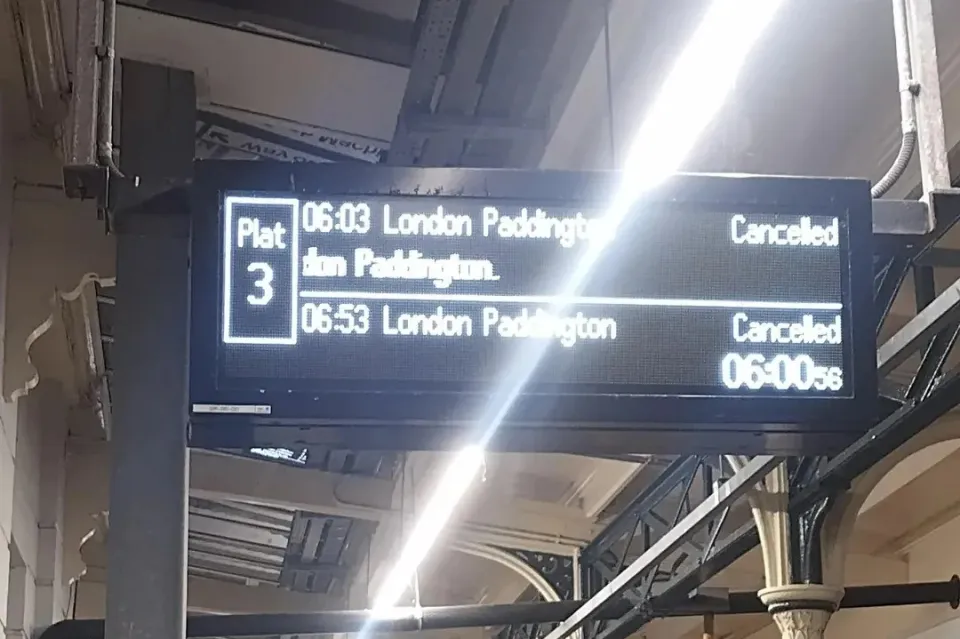
Trains to Paddington from Reading cancelled at 6am this morningCredit: RedditThe station is among those affectedCredit: Getty
The gas leak close to railway land at Didcot Parkway in South Oxfordshire is expected to cause severe disruption throughout Wednesday.
The Reading-Didcot section of the route is the gateway from Paddington towards Swindon, Bristol, Bath, South Wales, Cheltenham and other parts of the West Country.
Sign up for the Travel newsletter
Thank you!
Diversions are in place but Great Western Rail is cancelling some services outright because trains can’t get through Reading-Didcot.
A total of 72 services to and from Didcot are cancelled, while 39 have been axed at Oxford and 45 at Reading.
One social media user posted a photo from Swindon showing trains to Paddington cancelled at 6am.
They wrote: “Apparently there’s been a gas leak around Didcot Parkway so they’ve cancelled most of the services, and no replacement bus services running either.
“The staff at Swindon reckon this will last all day and probably tomorrow.”
Another person responded: “Absolutely ridiculous… not good enough.”
GWR is running roughly one train an hour Paddington-Bath/Bristol via a diversionary route – a fraction of the normal capacity.
It has warned only to travel if absolutely necessary.
Replacement buses are running between Swindon, Didcot and Reading but Network Rail says capacity won’t be enough for everyone.
CrossCountry is also telling passengers not to travel between Reading and Oxford – with one person responding to the company’s X post with: “Thanks for ruining my whole day.”
Network Rail said: “Engineers from gas distribution company SGN are on site working to rectify the problem as quickly and safely as possible.
“Network Rail and train operators are working together to manage the impact on passengers, but normal services cannot operate until the leak has been repaired because the railway falls within the safety exclusion zone.
“Severe disruption is expected to long-distance services that would usually travel through Didcot, and passengers are being warned that trains able to run either side of the affected area will be extremely busy.
“GWR will continue to operate as many trains as possible either side of the incident.”
GWR expects to be able to operate services between:
Reading and London Paddington
Swindon and Cheltenham Spa
Swindon and Chippenham/Bath/Bristol
South Wales to Bristol Temple Meads
Worcester and Oxford
An hourly service between London Paddington and Bath/Bristol via an alternative, diversionary route
Oxford and Didcot
An hourly service Bristol Temple Meads and Didcot
Usual timetabled services that do not run between Reading and Didcot
A limited bus replacement service will operate between Swindon, Didcot and Reading
New Delhi, India – On the morning of August 26, the Himalayan landscape above Nepal’s Rasuwa district changed in minutes.
A mass of ice and rock broke loose high in the mountains and sent a violent surge of water, mud and debris down the Lhende Khola River. The torrent travelled through valleys, swept away settlements and infrastructure and eventually reached the Nepal-China border.
What followed was not simply a flood.
It was a chain reaction.
By mid-September, more than 1,400 people had been reported dead and at least 6,000 remained missing in Nepal and across the border in Tibet. Twelve hydropower plants were destroyed, while roads, bridges and homes were buried or washed away.
The scale of the destruction has left scientists and disaster managers confronting a difficult question: How do you warn communities about a disaster whose trigger may occur high above them, in terrain that is difficult to monitor and where there may be only minutes to react?
Basanta Raj Adhikari, director of the Centre for Disaster Studies at Tribhuvan University in Kathmandu, described the event to Al Jazeera as unprecedented in size, affected area and mechanism. His estimate suggested that the energy involved was greater than that released by the Hiroshima atomic bomb, a comparison intended to illustrate the scale of the physical forces involved rather than suggest that the event was equivalent to a nuclear explosion.
For scientists who study the Himalayas, the disaster demonstrated how quickly an event originating in a remote, high-altitude environment can become a regional catastrophe.
And Nepal is not alone.
The warning problem
A warming climate is altering glaciers, snow cover, permafrost and high-altitude lakes. At the same time, roads, hydropower projects, tourist facilities and settlements have pushed deeper into mountain valleys.
That combination is creating a new risk landscape in which one hazard can trigger another.
An avalanche can block a river. A blocked river can form a temporary lake. A sudden release can become a debris flow. That debris can destroy a road or bridge, block another river and create another flood downstream.
The August disaster in Nepal showed how quickly such a sequence can unfold. It also exposed a weakness in the way early-warning systems are often designed.
Many systems are built around a particular hazard: rainfall, river level or glacial lake outburst flood. But the Himalayas do not always respect those categories.
In July, the International Centre for Integrated Mountain Development, or ICIMOD, warned that a below-normal monsoon should not be interpreted as a safer one.
“The biggest misunderstanding is that less seasonal rainfall means lower flood risk,” said Saswata Sanyal, a disaster risk reduction specialist at ICIMOD.
“A drier monsoon can still be a dangerous monsoon,” he added, warning that seasonal averages cannot capture the cloudbursts capable of producing catastrophic flooding in mountain valleys.
The Nepal disaster went a step further.
The immediate trigger was not simply heavy rainfall.
Scientists have been examining an ice-rock avalanche and other possible processes that temporarily obstructed the river system before releasing a destructive surge. ICIMOD has described the event as an ice avalanche rather than a conventional glacial lake outburst flood, while other scientists have examined the role of local seismic activity and other high-altitude processes.
That distinction matters.
A warning system waiting for rainfall or a rising river may not provide enough time when the real trigger happens several kilometres upstream and above the line of sight of the communities below.
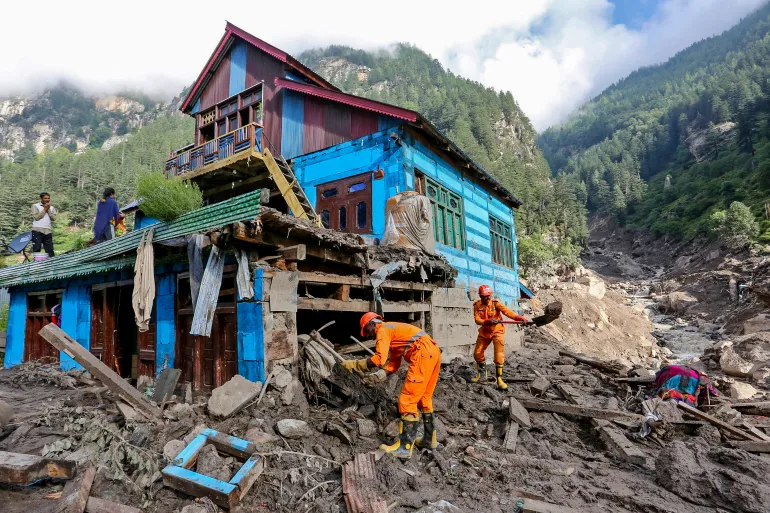
Indian National Disaster Response Force (NDRF) personnel conduct a search and rescue operation at the site of a flash flood at a village in the Kishtwar district of Indian-administered Kashmir on August 16, 2025 [AFP]
Kashmir’s warning signs
Thousands of kilometres away, scientists studying Kashmir’s Himalayas are seeing another part of the same problem.
A study published in the Journal of Glaciology this year mapped 155 glacial lakes above 2,500 metres (8,200ft) across the Himalayas in Indian-administered Kashmir.
The researchers found that the area of ice-contact proglacial lakes – bodies of water that form directly against the margin of a melting glacier, trapped by moraine ridges, bedrock basins, or ice dams – had increased by 26 percent between 1992 and 2024.
Five lakes were classified as having very high susceptibility to glacial lake outburst floods.
An outburst from those lakes, the researchers found, could threaten several thousand buildings, 15 major bridges, roads and a hydropower project.
More significantly, the study warned that hazards could occur in chains, with an upstream lake outburst potentially triggering secondary events downstream.
For Irfan Rashid, a glaciologist and associate professor at the University of Kashmir who co-authored the study, the implications extend beyond individual lakes.
Rashid recently told Al Jazeera that without action, the melting, thinning, and destabilisation of glaciers, seasonal snow cover, and permafrost along the Hindu Kush-Himalayas system would increase, and water shortages could become a major problem across the Upper Indus, Ganga and Brahmaputra basins by the end of the century.
That is why the Nepal disaster resonates in Kashmir.
The landscapes are different, the rivers are different and the individual hazards may differ. But the underlying problem is increasingly similar: Communities living downstream of a rapidly changing high-altitude environment may have little time to respond when something breaks loose above them.
The challenge is particularly acute in places where roads, bridges and hydropower projects occupy narrow valleys.
Once a mountain river begins carrying enormous quantities of rock, ice and mud, infrastructure designed for conventional floods can quickly become irrelevant.
Volunteers rescue flood-affected victims along with their livestock using a boat following heavy rains and overflowing of the Sutlej River, on the outskirts of Multan in Punjab province, Pakistan, on September 4, 2025 [Shahid Saeed Mirza/AFP]
Pakistan has already begun building a warning network
The same concern runs across the western Himalayas and Karakoram ranges.
The Gilgit-Baltistan region in Pakistan-administered Kashmir contains hundreds of glaciers and glacial lakes, while communities and infrastructure sit along valleys exposed to sudden floods and landslides.
Pakistan has responded by expanding early-warning infrastructure.
Under a United Nations-supported programme, early-warning systems, evacuation shelters, disaster-management centres and other protective measures have been established in vulnerable valleys.
But technology alone cannot solve the problem. A sensor can detect a change. Someone still has to receive the message. Someone has to understand what it means. And people downstream have to have a route to safety.
That last part is often the weakest link. A siren is useful only if the people hearing it know where to go. An automatic warning is useful only if it arrives before the flood. A satellite image is useful only if the information can be converted into a decision quickly enough to save lives.
This is why disaster scientists increasingly talk about anticipatory action rather than simply disaster response.
“The era of preparing for a single, predictable hazard is over,” Sanyal said earlier this year. “Anticipatory action and early warning must now be the foundation.”
Nepal army soldiers work during a search and rescue operation outside a tunnel near a hydropower project site, following deadly flash floods and mudslides, in Rasuwa district, Nepal, on September 1, 2026 [Reuters]
The infrastructure trap
The Himalayas are also becoming more heavily engineered.
Hydropower is central to Nepal’s economy. Roads are being expanded. Border crossings are growing in importance. Tourism is pushing deeper into remote valleys.
The benefits are obvious. So are the risks.
The August disaster struck an area where hydropower infrastructure was concentrated along the river corridor. At least 900 workers were believed to have been inside tunnels and other facilities in the aftermath, making rescue operations extraordinarily difficult. Two workers were eventually pulled alive from a hydropower tunnel nine days after the disaster.
The question is no longer simply whether infrastructure can withstand a flood. It is whether planners have adequately considered what happens when a flood is carrying an enormous mass of rock and ice, when a river changes course, or when one mountain hazard triggers another.
For decades, engineering risk assessments have often relied on historical records. But history becomes a less reliable guide when the physical conditions producing disasters are changing.
A river that flooded once every several decades may no longer behave according to the same pattern. A glacier that appeared stable from satellite imagery may sit beneath an increasingly unstable slope. A lake that was considered remote may suddenly become a threat to a road, village or power plant hundreds of metres below.
Relatives of victims and missing people react outside the morgue of the Tribhuvan University Teaching Hospital (TUTH), in Kathmandu, Nepal, August 29, 2026 [Narendra Shreshtha/EPA]
The border problem
There is another complication that no satellite can solve on its own.
Borders.
The Himalayas are divided among countries with different political systems, security concerns and approaches to sharing information. But rivers do not stop at international boundaries. Neither do floods.
The August disaster reached the Nepal-China border and damaged the Gyirong crossing, an important trade and pilgrimage route. The disaster also raised questions about how quickly information about hazards in high mountain areas can move between countries.
This is where regional cooperation becomes more than a diplomatic slogan, experts say. A sensor positioned in one country can provide warning to people in another. A satellite image collected over one mountain range can reveal a developing hazard that threatens a valley downstream. A river gauge can provide critical information before floodwaters reach a settlement.
The technical capability already exists in many cases. The missing piece is often the architecture connecting it.
A 2026 assessment of Himalayan disaster risks has argued for stronger monitoring, early-warning systems and regional coordination because hazards are increasingly interconnected.
The idea is simple: Information about a mountain hazard should not stop at the same line where a political boundary begins.
Buildings are inundated after flash floods triggered by sudden heavy rainfall swamped Rangpo town in Sikkim, India, Friday, October 6, 2023 [Prakash Adhikari/AP Photo]
From Nepal to Sikkim to Kashmir
The August disaster in Nepal isn’t a tragedy belonging to one country, point out experts.
The Kashmir Himalayas study has already identified lakes capable of producing destructive outburst floods and has warned of cascading processes.
Northeast India’s Sikkim provides another example.
Today, 40 high-risk glacial lakes have been identified in Sikkim, including 16 placed in the highest-risk category, with authorities working on drainage, flood-retention and other protective measures.
But the lesson from each disaster is broadly the same: Waiting for a disaster to prove the risk is the most expensive form of preparedness.
The world’s second largest mountain, the 8,611-metre- (28,251ft-) high K2 (seen in the distance), and the 8,051-meter- (26.414ft-) high Broad Peak (R), are illuminated by the moon at Concordia, the confluence of the Baltoro and Godwin-Austen glaciers, in the Karakoram mountain range in Pakistan, September 7, 2014 [Wolfgang Rattay/Reuters]
The Third Pole test
The Himalayas are sometimes called the Third Pole because they contain one of the world’s largest concentrations of snow and ice outside the Arctic and Antarctic.
Major Asian rivers depend on water originating in these mountains. Hundreds of millions of people live downstream.
That makes the changing Himalayas not only an environmental issue but a security, infrastructure and humanitarian one.
The August disaster demonstrated the most frightening version of that future. A mountain can collapse without warning. A river can become a weapon of debris. A hydropower tunnel can become a trap. A border crossing can disappear in minutes. And by the time people downstream understand what is happening, the water may already be there.
It’s a future that a region stretching from northeast India, spanning Tibet, Nepal, Kashmir and Pakistan, can no longer ignore. Yet disaster management remains largely divided by national boundaries. That contradiction is becoming harder to navigate.
The next glacial collapse could begin in Kashmir. It could begin in Pakistan’s high mountains. It could begin in Sikkim, Nepal or Tibet.
Wherever it starts, the same question will follow the mountain downstream: Who knew, how early did they know, and did the warning reach the people in time?
For a region entering an era of increasingly complex mountain hazards, that may be the real measure of whether the Third Pole is prepared.









![Indian National Disaster Response Force (NDRF) personnel conduct a search and rescue operation at the site of a flash flood at a village in the Kishtwar district of Indian-administered Kashmir on August 16, 2025 [AFP]](https://i0.wp.com/occasionaldigest.com/wp-content/uploads/2026/09/afp_68aac36f5150-1756021615.jpg?w=640&ssl=1)


