WASHINGTON — President Trump is hoping that $5,000 checks can juice Republican turnout in November’s midterm elections — but even some of his devoted fans are doubting that government payouts would arrive.
“I mean, I guess it’s good for some people. I really don’t care,” said Jamie Alvarez, who attended Trump’s recent Alaska rally in a red, white and blue outfit. “I don’t feel like your vote should be bought. I feel like you should vote for who you feel is going to do the best job.”
Joseph Eatherton was attending that same rally and said he was “not sure if it’s necessary.” When asked whether Trump could deliver on the promised money, he said, “I don’t know, and I hate being an armchair quarterback.”
The offering of government checks has become a go-to tactic for Trump when he faces a political jam. He’s previously endorsed $2,000 in dividends from tariff revenues and large refunds from spending cuts achieved by the Department of Government Efficiency, neither of which materialized. The latest example could reveal how much voters still trust Trump as they decide control of Congress in the midterm elections on Nov. 3.
Staunch supporters such as Lucy Martinez, the president of a Republican women’s club who attended a recent Trump rally in Texas, said there’s no doubt in their minds.
“I think that I will get the $5,000,” she said. Out of all the presidents, Trump is someone “who kept his promises to his people and all the United States.”
Trump has dished out payments as elections approach
However, many voters are already embittered by his economic leadership. His critics see a president who failed to tame inflation and keep America out of overseas conflicts, and whose agenda has fueled higher prices as the war with Iran appears to be at a stalemate.
“The trust on this is already gone for most people,” said Amy Frederiksen, a former Republican Minnesota Senate majority leader who now runs a public affairs firm.
“I just don’t see the energy around that line,” she added. “Most people know that’s a blatant over-the-top promise like several he’s made in the last couple of years, and they’re not buying it.”
As the midterms approach, Trump has also pledged a $90 payment to 20 million Medicare enrollees and $500 “rebates” for people the administration says were overcharged for their Obamacare plans. He has automatically enrolled every U.S. child in “Trump accounts” to invest in stocks.
The $5,000 payouts would only occur, Trump says, if Republicans keep their majorities in the House and Senate. Trump acknowledges that the cost would exceed $1 trillion, but it’s not clear that the White House is seriously engaging with the proposal’s ramifications, from the increased deficit to the likely boost to inflation.
The White House said the payments are possible because of Trump’s trade deals, investment commitments by foreign countries, government stakes in private companies and deals for oil and minerals.
The administration’s position is that the payments will help people recover from the inflation that began in 2021 under then-President Joe Biden, though Republicans, at the time, attributed that inflation to excessive government checks tied to pandemic relief.
When The Associated Press asked several weeks ago if the administration was modeling the economic impact from the checks, Christopher Phelan, chairman of the White House Council of Economic Advisers, said he would “refrain” from answering.
Roughly half of registered voters say Donald Trump does not keep his promises to Americans, according to an AP-NORC poll from September. About 3 in 10 say Trump tries to keep his promises but is unable to, while only about 2 in 10 say he keeps his promises.
Republican voters are more accommodating. About half say Trump tries to keep his promises but is unable to, and about 4 in 10 say he keeps his promises.
Trump is talking about the payments as a sure thing.
“If the Republicans win, you’ll each have $5,000 in your pocket and economic success for our country like we have never seen before,” he said at a Saturday rally in Kentucky. “And remember, ’cause they like to say, ‘Oh, well, maybe he won’t do that.’ Uh, I always do it.”
Campaign spending tracked by AdImpact suggests that Republicans are not running advertisements either on television or online about the promise. The few advertisements that do exist are from pro-Democratic groups such as Rolling Sea Action Fund that conclude with the voiceover, “Come on, do you really think he’s sending you a check? Yeah, right, we won’t get fooled again.”
At a Friday rally in Georgia, Trump noted that he had previously delivered a $1,776 “Trump dividend” to troops in the military. But those payments came from a congressionally approved housing supplement.
Trump claims the nation could not afford the payments if Democrats hold a chamber in Congress because the nation would be “flat broke.” But he said that one caveat is that the money could only be spent in the U.S., rather than in China, Japan or France. He joked that people should spend the check at his luxury club in Palm Beach, Florida.
“Let’s have lunch at Mar-a-Lago, where for $5,000, you’ll get one hamburger and a small dessert,” he told the crowd in Georgia.
Some in the crowd took Trump at his word that he would fight to get them the money. But they added the caveat that if he didn’t come through, it would not be his fault.
“I could use $5,000,” said Mike Boatman, a 58-year-old from Evansville, Indiana, who travels the country attending the president’s rallies. “I mean, he’s done everything he’s said he’s going to do.”
Boak, Bohrer and Barrow write for the Associated Press. Bohrer reported from Wasilla, Alaska, and Barrow reported from Dalton, Georgia. AP reporters Aaron Kessler and Linley Sanders in Washington and Lekan Oyekanmi in San Antonio, Texas, contributed to this report.
Tensions keep rising in the iconic house as housemates continue to clash
A clear divide continues to cause friction in the house (Image: ITV)
ITV Big Brother fans have issued the same complaint seconds in tonight’s explosive episode.
Tensions continue to bubble over in the iconic house as a clear divide causes frictions amongst the housemates. Just last night (October 18) saw Catrin left in tears after she expressed her frustrations over comments made behind people’s backs.
When Twinks mentioned there was a hierarchy in the house, things turned sour when Philip and Rochelle confronted the comments made. Twinks was also seen in tears as she admitted to Big Brother she was struggling in the house, with Philip admitting he was no longer going to talk to the newcomer.
The explosive scenes come after Rob’s live eviction on Friday, October 16 after he was voted the fifth housemate to leave the Big Brother house following a public vote.
Tonight’s episode brought yet more drama and chaos with just weeks to go until the final. However, just seconds in tonight’s instalment (October 19), viewers issued the same complaint when a preview was shown.
The episode had barely started when a preview hinted more drama to come, especially between Omar and Rhianna as they appeared to call time on their relationship.
Ensure our latest TV stories always appear at the top of your Google Search by making us a Preferred Source. Click here to activate or add us as Preferred Source in your Google search settings
Taking to social media, viewers threatened to switch off their television screens over the Rhianna and Omar-focussed episode, with many growing tired of their relationship. One person wrote: “An episode centred around the showmance? I might have to check out lol.”
Another said: “Cracks are definitely appearing between Omar and Rhianna”, as a third added: “The Omar Rihanna love story is so boring is that really the only thing that’s been happening the last few days?”
A fourth stated: “Not looking forward to this episode just knowing that Omar and Rhianna will have more than 5 seconds of airtime! Annoyed already!”
A fifth slammed: “Not another Omar and Rihanna edit please”, a sixth echoed: “Omar and Rihanna double eviction WHOS WITH ME.” One person stated: “Looks like this episode is about Omar and Rhianna.”
Viewers have previously commented that the pair are better suited apart as one person said: “Rhianna I love you dearly when will you finally be done with Omar.”
Taking to Instagram though, one viewer shared a reminder on this year’s cast, adding: “Reminder. It’s a TV show. No one’s been set up. They are willingly taking part in a show. You’re welcome.”
Big Brother continues tomorrow at 9pm on ITV2 and ITVX
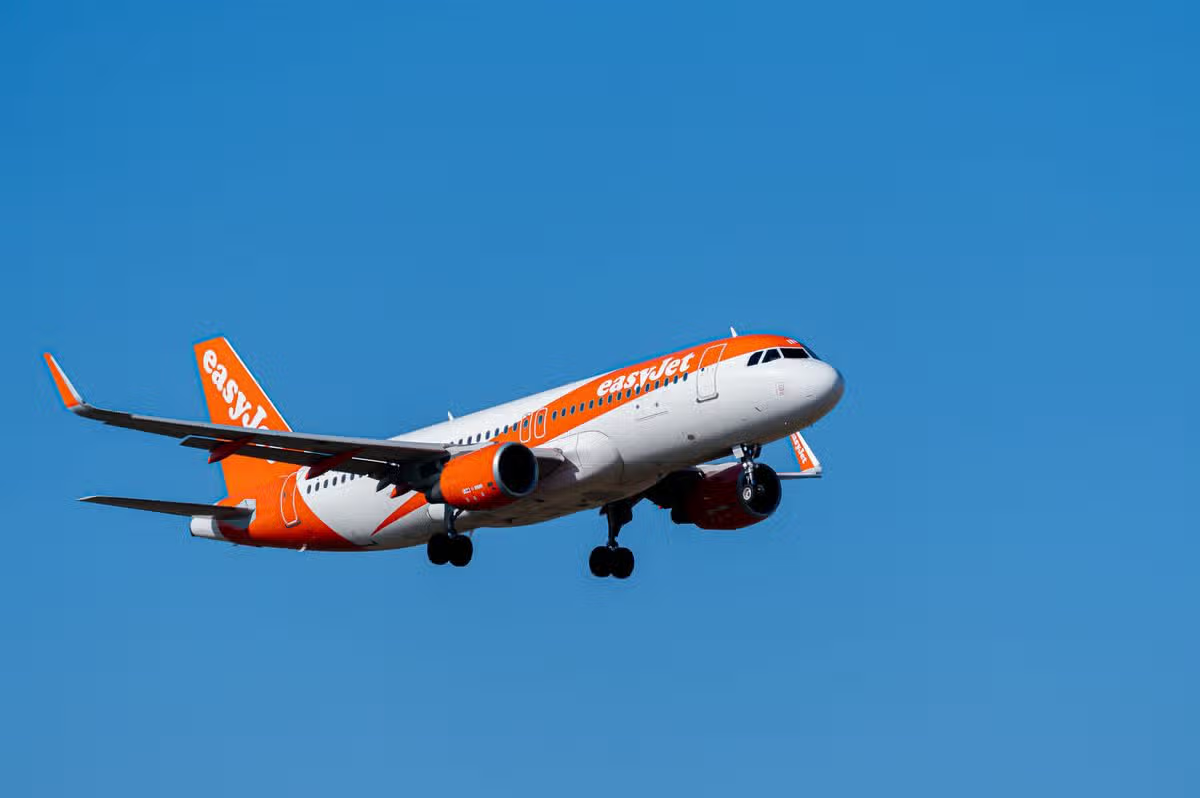
EasyJet chief executive Kenton Jarvis announced that the airline is removing a further 600,000 to 700,000 seats from its winter schedule, on top of 700,000 that have already been cancelled
The airline has cut over a million seats(Image: Reinhard Krull/Getty Images)
EasyJet is cutting thousands of flights this winter, with customers urged to check one date before their flight is due to depart.
EasyJet chief executive Kenton Jarvis told reporters in Brussels on 8 Octoberthat the airline is removing a further 600,000 to 700,000 seats from its winter schedule because of elevated fuel costs. This comes after it announced around 700,000 seats would be removed earlier this year, bringing the total reduction to between 1.3 million and 1.4 million seats.
EasyJet CEO Kenton Jarvis told the FT: “People are taking capacity out, we see that across all competitors,” adding that was “no surprise” given fuel costs. However, he admitted that the high cost of fuel had not been expected. “I honestly think it’s been quite a surprise for the industry that fuel has stayed as high as it is,” he said.
Do you have a travel story to share? Email webtravel@reachplc.com
Jet fuel costs have doubled following the start of the Iran conflict, which led to the closure of the Strait of Hormuz. Although prices have started to fall, they remain far higher than airlines expected when the war began.
EasyJet passengers have been urged to check their tickets for one date. If your booking is cancelled, you may not get paid compensation. Whether you do or not depends on your flight date, when you were notified of the cancellation, the reason recorded for that particular cancellation and the timings of the replacement journey.
Under the law UK261, passengers notified between seven and 14 days before departure are entitled to compensation unless the replacement leaves no more than two hours earlier and arrives less than four hours later . Passengers notified fewer than seven days before departure are entitled to compensation, unless the replacement leaves no more than one hour earlier and arrives less than two hours later.
Compensation ranges from £220 to £520 depending on the distance, unless easyJet proves that extraordinary circumstances caused the cancellation. It is unlikely that they will be able to in this instance. Passengers notified at least 14 days before departure are not entitled to fixed compensation, although their refund or rerouting rights remain fully intact.
Refund and rerouting rights apply separately. Passengers who still need to travel should therefore compare the proposed replacement before accepting a refund. If another airline can reach the destination significantly sooner, the CAA says the passenger may have the right to be rerouted on that alternative service.
An easyJet spokesperson said: “Like all airlines, we review our schedule on an ongoing basis and sometimes make some changes. The changes to our winter flying represent a tiny proportion of our flying programme. We make any changes in advance and typically choose multi-daily frequency flights so customers can easily move to an alternative flight.”
The airline originally released more than 25 million seats across almost 138,000 flights between 19 October and 31 January, giving an average of approximately 181 seats per flight. On that basis, the latest reduction is equivalent to roughly 3,300 to 3,900 one-way flights, with the total winter cuts equivalent to approximately 7,200 to 7,700 one-way flights.
These are capacity estimates, not confirmed cancellation numbers. EasyJet has not published the affected routes, the proportion involving UK services or how many removed seats had already been sold. The airline has said it makes changes in advance and typically targets routes with several daily services so passengers can be transferred to another flight.
Anton Radchenko, aviation expert and CEO of AirAdvisor, said: “Airlines commonly describe these decisions as capacity management, but passenger-rights law examines the individual booking. If a flight was sold and subsequently withdrawn, the airline should be able to show when the passenger was informed, the specific reason that service was removed and what comparable rerouting was offered; a general reference to higher fuel costs would not, by itself, establish extraordinary circumstances.
“The most revealing cases will be passengers transferred between services on a route that operates several times a day. Moving someone from a morning flight to an evening departure may appear to be a straightforward consolidation. Still, the resulting arrival time can change the compensation position, and the existence of a substantially earlier flight with another carrier may determine whether the rerouting offered genuinely met the earliest-opportunity requirement.”
“Passengers affected by a schedule change should retain the original itinerary, the timestamped cancellation email and every replacement option offered. Those three records will be considerably more important to an individual claim than the airline’s overall capacity figure.”
Anyone travelling with just hand luggage won’t be affected.
The airline claims this is as many as 80 per cent of passengers who don’t ever have checked bags.
But anyone who likes to rock up to their flight and still check a suitcase at the last minute will be in for a shock.
Ryanair CMO, Dara Brady, said: “This will allow these 20% of our customers (who check in a bag) more time to clear through airport security and passport queues, and get to their departure gate on-time, especially during busy travel periods when some of these airport queues can be longer.”
More self-check in machines have since been rolled out as well in a bid to speed up the process.
Another rule change has come in(Image: Oscar Wong via Getty Images)
Brits are being urged to check their passports before travelling, with a new rule now in effect.
Experts said the changes highlighted the risk of simple travel document mistakes. They have explained the rule change and given advice on wider passport checks to make before travelling.
From September 28, passengers travelling on Irish Ferries’ Dublin-Holyhead and Rosslare-Pembroke routes, in both directions, are required to present a valid passport or Irish passport card before boarding. But new research from Saga Travel Insurance suggests many Brits could still be caught out by basic passport and travel document rules.
It said 16% admitted they didn’t know when their passport expires, with a 8% currently holding an expired passport. Further, 10% had less than a year remaining on their passport and one in 14 (7%) had previously been denied entry to a country because they didn’t have enough time left on their passport.
Saga said there was also widespread confusion around post-Brexit travel rules, with half (50%) of holidaymakers saying they were not confident they understood the visa and travel requirements for visiting Europe.
Michelle Cooper, director of Travel Insurance at Saga, said: “Nobody should have their holidays ruined because of a simple passport error. A few quick checks can help people avoid unnecessary stress, unexpected costs and disruption at the airport.”
The travel insurance provider surveyed 500 people in the UK and found that Brits could be at risk of avoidable disruption when travelling overseas due to simple oversights.
The passport rules catching Brits out after Brexit
Half (50%) of holidaymakers are still not confident they understand the visa and travel requirements for visiting Europe after Brexit, the survey found.
Michelle said: “If you’re travelling to Europe for an extended period, you may now be required to apply for a new visa type. Travellers can spend up to 90 days in the Schengen area within any rolling 180‐day period, but it’s not as simple as it sounds.
“The 180 days are counted backwards from each day you’re in the EU or a Schengen country, so every trip adds up. That means even frequent short breaks can push you over the limit without realising.
“If you go beyond 90 days, you could face fines or even a ban from re-entering. Anyone planning to stay longer will need to apply for the new Schengen Visa.”
What is the Schengen area?
The Schengen area is a group of 29 European countries where travellers can move between countries without routine passport checks. It includes popular holiday destinations such as France, Spain, Italy, Greece and Portugal.
Confusion around the ‘10-year passport rule’ is the most widely discussed passport concern online, according to the analysis from Saga Travel Insurance, with Reddit discussions on the issue amassing 35,417 upvotes.
Michelle explained: “EU and Schengen countries require passports to be less than 10 years old on the day of entry. While all new passports last exactly ten years, passports issued before 2018 remain valid for 10 years and nine months. If you have an older passport, make sure you check both the issue date and expiry date before travelling to avoid problems at the border.”
Brits warned over new ETIAS travel checks for Europe
From late 2026, British travellers visiting most European countries will need to apply for a new European Travel Information and Authorisation System (ETIAS) before travelling. The new system is similar to the UK’s Electronic Travel Authorisation (ETA) scheme and will apply to visa-exempt travellers visiting 30 European countries for short stays of up to 90 days within a 180-day period.
Michelle said: “Travellers may not realise that visiting Europe will soon involve an additional pre-travel authorisation step. From late 2026, British holidaymakers will need to apply for ETIAS approval before travelling to many popular European destinations.
“The authorisation will be linked directly to your passport, meaning travellers could be denied boarding if their ETIAS details don’t match their travel document or if the authorisation has expired. Most ETIAS applications are expected to be processed within minutes, but it could take longer if additional checks are required. Holidaymakers should apply well in advance of departure to avoid last-minute disruptions.
“Similar systems already exist elsewhere. For example, UK travellers visiting the United States must apply for an Electronic System for Travel Authorisation (ESTA) before departure. These systems are becoming more common globally, so it’s important to check requirements for each destination well ahead of travel.
“As with passport validity rules, people are responsible for making sure they have the correct travel authorisation before they leave the country. If someone is unable to travel because they failed to obtain valid ETIAS or ESTA approval, travel insurance is unlikely to cover costs associated with denied boarding or cancelled trips.”
Many of us own one of these common colours for a suitcase but it is worth following simple advice that will stop any problems from arising
09:56, 06 Oct 2026Updated 09:56, 06 Oct 2026
This article contains affiliate links, we will receive a commission on any sales we generate from it. Learn more
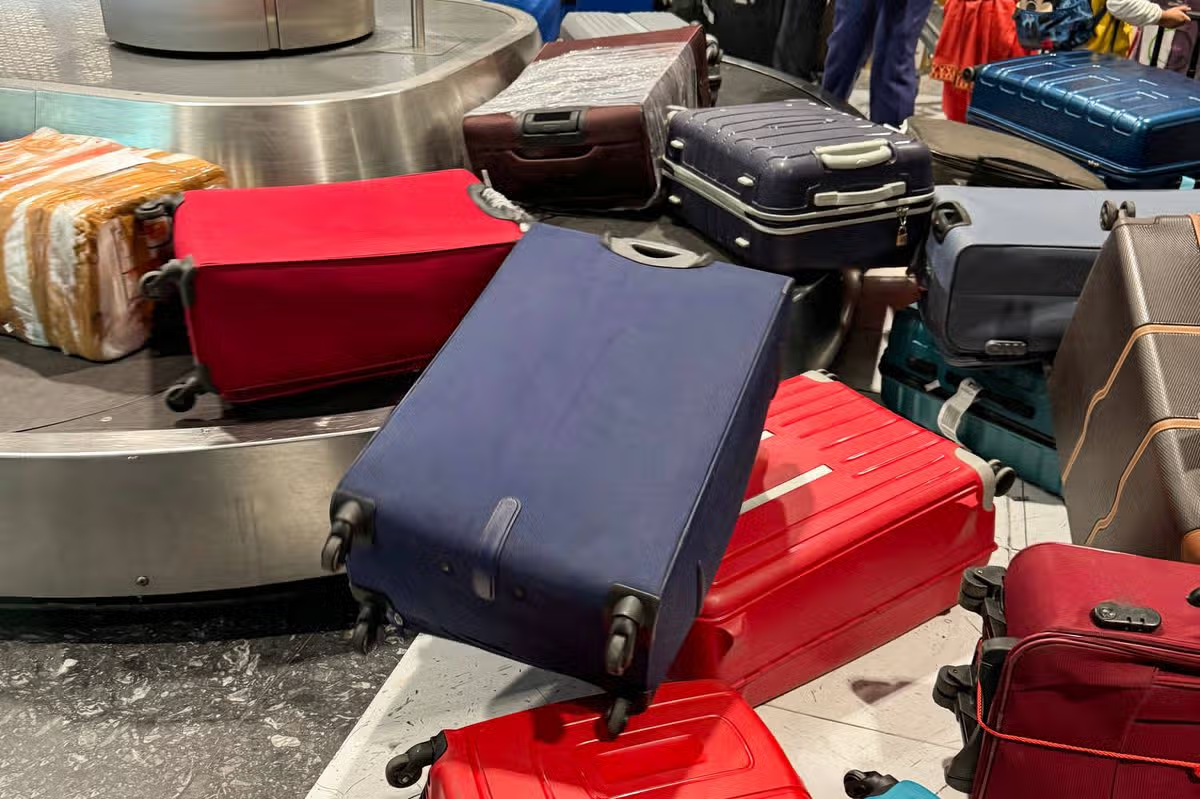
Many of us think they can spot their suitcase when it is on a baggage carousel(Image: mtreasure via Getty Images)
Ryanair continues to grow, with the airline carrying a record 208.4 million passengers in its latest full financial year – a four per cent increase on the previous year. However, the budget airline has also been cutting back at some European airports, with Ryanair withdrawing or reducing flights in certain locations.
The airline has pointed to factors including aviation taxes and airport charges. Despite this, the UK remains a key part of Ryanair’s expansion plans.
Its winter 2026 schedule includes 435 routes, with three new services from London Stansted and a new route between London Luton and Venice. A further 18 new routes have also been added from other UK airports.
As Brits gear up to the October half term holidays and winter, Ryanair has issued a warning to passengers who typically fly with black, navy or grey suitcases, urging them to ‘change’ their luggage to avoid any confusion when they land.
The budget carrier advised travellers to make their checked-in bags more distinctive on the carousel given the prevalence of these colours.
What Ryanair says
As reports the Express, Ryanair said: “Make it easier to spot your checked-in luggage on the carousel, especially if your luggage is black, navy or grey (like 99.9 percent of the population). Add a colourful luggage tag or ribbon to the handle so that there’s no confusion on arrival.”
Ryanair also recommends passengers create copies of their passport, driving licence, and/or ID card and email them to themselves.
It’s also suggested to photograph these documents and store them on your phone for offline access at your destination,
The well-known budget carrier transports an impressive 52 million passengers to and from the UK annually with its fleet of 107 UK-based aircraft.
In June, Ryanair experienced a spike in passenger numbers with 19.3 million people opting to fly with them across one of their 106,000 flights. This marked the first occasion the airline transported more than 19 million travellers and an 11 per cent rise compared to June 2023.
The airline also pulled out all the stops for England fans during the Three Lions’ Euro 2024 run, laying on over 1,500 extra seats to and from Berlin for the cup final.
On a separate note, if you’re on the hunt for stylish cabin bags and suitcases, Antler is well worth a look. Their Iconic Stripe Case, retailing at £175, is available in seven gorgeous colours, including mist blue.
WASHINGTON — California is sometimes described as the ATM of Democratic politics.
That’s certainly been the case in the most divisive Democratic races this year.
Donors from California have given more to far-left candidates and their moderate opponents in congressional races and U.S. Senate contests than donors from any other state — more than $17 million combined, according to a Times analysis of the most recently available campaign finance filings.
More of that money — nearly $11 million — went to more progressive candidates. That giving came from more than 95,000 individual donors, which was more than double the number of California donors who gave to their more moderate opponents. That includes 18,000 donors who gave to both progressive and moderate candidates.
There was a geographic divide in giving by Californians. The largest share of cash to progressive candidates came from donors in the Bay Area, while the largest share of financial backing to moderate candidates came from donors in the Los Angeles area.
The Times looked at competitive races outside California in which one of the candidates had been endorsed by either the Justice Democrats or the Democratic Socialists of America, or DSA, as well as key Senate races in Michigan, Minnesota, Florida and Maine that featured a stark ideological divide between top Democratic contenders.
Although these races represent a small fraction of the electoral contests across the country, they were the races in which the future ideological direction of the Democratic Party was most fiercely contested.
Progressive candidates fared better in the majority of these contests.
California donors helped fund the Senate primary victories of progressives Abdul El-Sayed in Michigan and Peggy Flanagan in Minnesota — second only to in-state donors in providing cash to each of those candidates.
Progressive House candidates such as Melat Kiros in Colorado and Darializa Avila Chevalier in New York were able to defeat more moderate incumbents with heavy support from California donors.
Their efforts weren’t always successful, however.
Former Rep. Cori Bush raked in more cash from California donors than in-state supporters in her bid to unseat incumbent Rep. Wesley Bell in Missouri’s 1st Congressional District, the seat she had held previously. But Bell easily cruised to victory in this year’s primary.
And then there was Graham Platner.
California donors gave nearly $2.5 million to his Senate campaign in Maine before he withdrew after he was accused of sexual assault by a former girlfriend. He has denied the accusation.
The Times analysis looked at direct contributions to campaigns, which are capped at $7,000 per election cycle. It did not include contributions to party committees or independent committees that could also be spending in these races. The analysis included both bigger contributions required to be disclosed by campaigns as well as small-dollar contributions through the Democratic fundraising platform ActBlue.
Flipping the script
Progressive donors said they were motivated to give to candidates who would shake up the Democratic Party’s status quo.
“The Democratic Party has to understand that they can’t keep doing the same thing,” said Rehan Alvi, a real estate investor in El Dorado Hills.
He gave the maximum allowable to support the campaigns of El-Sayed and Bush, and also supported Junaid Ahmed’s failed primary bid in the Illinois 8th Congressional District, as well as Platner’s campaign.
Harry Saddler, a retired designer who lives in San Francisco, said that the state of the party is “enraging.”
“That leads me to think about people who can actually flip the script,” he said.
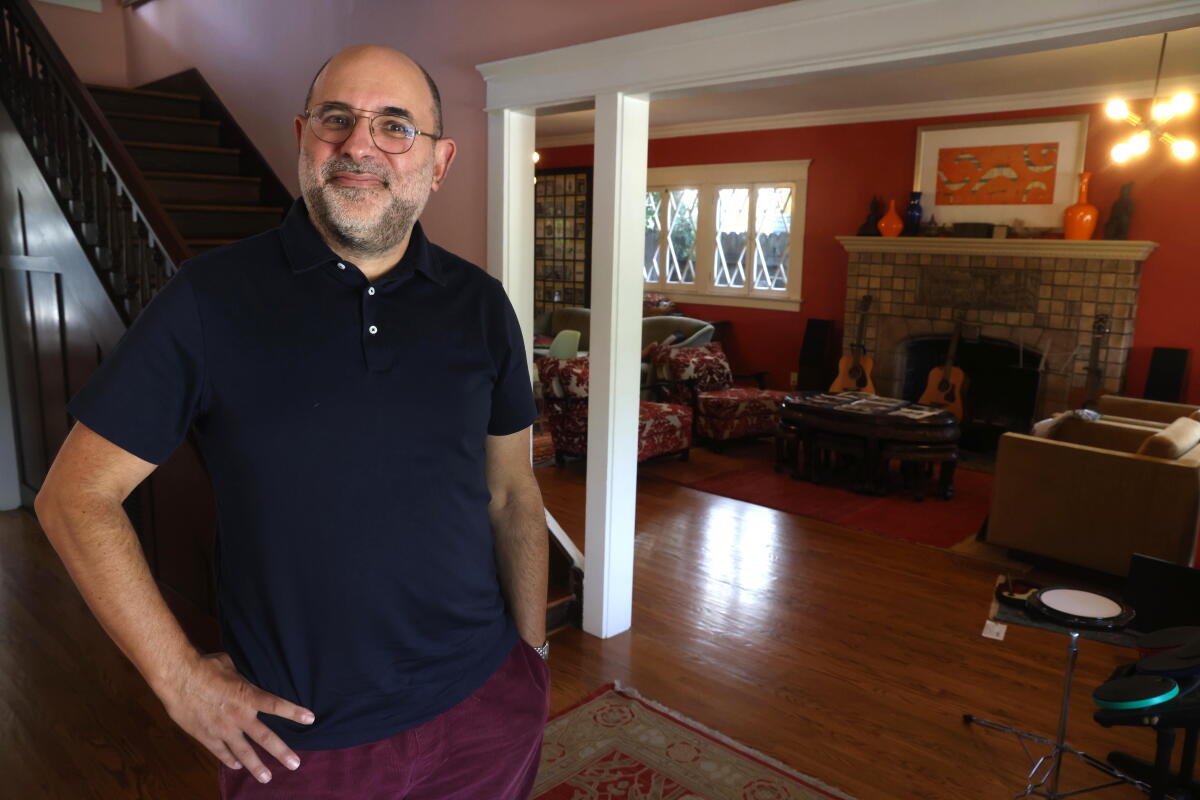
Joshua Saltman, shown in his Los Angeles home, is one of many Democratic donors from California who have given in divisive Democratic races across the country.
(Genaro Molina / Los Angeles Times)
Saddler has written checks to a number of more progressive candidates, including Flanagan, Chevalier, Ahmed and Nida Allam, who lost her primary bid to unseat incumbent Rep. Valerie Foushee in North Carolina’s 4th Congressional District, though he has also supported some moderate candidates in other races he sees as crucial to Democrats chances at retaking control of one or both chambers of Congress.
That pragmatic approach is part of the reason Joshua Saltman said he has supported a number of moderate candidates.
“The reality of the map is that if Democrats are going to retake the House, it’s not just winning super blue districts,” said Saltman, a former entertainment industry lawyer who now runs a Broadway music festival.
Saltman said that he considers himself to be a more moderate Democrat and is also inclined to give to moderate candidates who he believes “get a little less love” from other donors, particularly in California.
He has written checks to Rep. Haley Stevens, who lost to El-Sayed in Michigan; Rep. Angie Craig, who lost to Flanagan in Minnesota; Bell in Missouri and Gov. Janet Mills in Maine, who was Platner’s main competition in the Democratic primary before dropping out of the race.
Alan Burye, a retired accountant who lives just outside San Diego, said he prefers more moderate candidates because he thinks they are more productive politicians.
“The ones who are out on the edges, like Bernie Sanders, really don’t get much done,” Burye said.
He cut checks to Craig in Minnesota and Stevens in Michigan.
Israel’s impact
American support for Israel — in the wake of wars in Gaza and Iran — has been a major point of division among more progressive and moderate candidates and is a key fault line among many donors.
Progressive candidates have been increasingly critical of the actions and influence of the Israeli government as the public, broadly, has adopted a more negative view of the Israeli government.
Politicians who have drawn support in the past from the American Israel Public Affairs Committee, or AIPAC, have been a particular target of progressive challengers.
“The problem with the Democratic Party is that they’re all just beholden to AIPAC and to corporate interests,” said Alvi, the real estate investor in El Dorado Hills. “I want a candidate who has the courage to speak.”
In Michigan, El-Sayed described AIPAC’s support of Stevens, his moderate opponent, as “legalized bribery.”
El-Sayed has made no secret of his criticism of American foreign aid for Israel and said that he “doesn’t believe in ethno-states” in response to a question in the summer about whether he supports the right of Israel to exist.
El-Sayed’s comments and similar sentiments expressed by other more progressive candidates are part of the reason some donors have given to moderate candidates.
“I feel that people who fundamentally aren’t big fans of Israel aren’t necessarily people I want to give money to,” said Saltman, who gave to Stevens.
Saltman, who was born in Michigan, said that he would still vote for El-Sayed if he lived in the state.
Other donors said they were inspired to give to moderate candidates because of concern that anti-Israel rhetoric could veer into attacks on Jews more broadly.
Los Angeles investor Steve Emerson said his motivation in writing checks to moderate Democrats such as Stevens is “to fight antisemitism.”
El-Sayed, for his part, said in the summer that his criticism of Israel is about foreign policy, not Jewish people.
“Judaism and the Jewish people are a light onto the world,” he said.
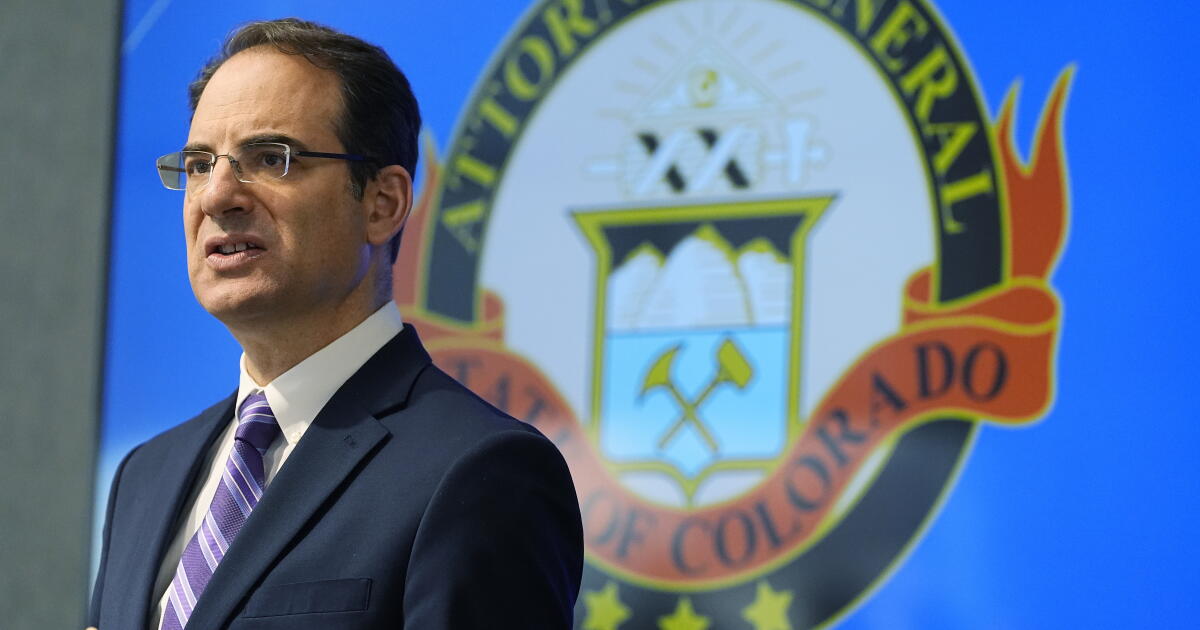
DENVER — The office of Colorado’s attorney general is a perch 10 stories above downtown Denver. From his aerie, Phil Weiser has a sweeping view of the city skyline, the gold-domed Capitol and, occasionally, a red hawk on the wing.
But looking toward November, Weiser sees something darker.
“With this administration what we have seen is it’s important that we not limit our imagination to what … type of harm could happen,” Weiser said during a sunny noon hour in the Mile High City.
For that reason, Colorado’s attorney general and his Democratic peers around the country have spent more than a year strategizing — by phone, via Zoom, sometimes in person — on ways to Trump-proof the midterm election.
They’ve researched history and the law, war-gamed what-ifs, divvied up responsibilities and drafted emergency lawsuits and temporary restraining orders so they can be hurried into court at a moment’s notice.
“We have prepared for a range of contingencies … so that we’re ready to act,” Weiser said.
“We’re not going to be reacting in real time” or pulling all-nighters, he added. “We are going to be following through on plans we’ve made, having looked at what’s possible.”
The efforts of Weiser, California’s Rob Bonta and more than 20 other Democratic attorneys general are part of a mass mobilization aimed at thwarting Trump’s unprecedented efforts to pervert and subvert November’s midterm balloting.
It’s remarkable that kind of man-the-barricades action is needed to preserve and protect the voting franchise in this, the land of the free and home of the brave. But having weighed the threats, Weiser said his greatest fear of election interference comes not from a bad overseas actor or some terrorist group, but rather our own federal government “and what this administration might do.”
So here we are.
To fend off that threat from within, state Democratic parties across the nation are aiming to recruit 10,000 volunteers to guard polling places in the event armed federal agents show up.
Various sponsors have launched education campaigns to explain election rules and offer hotlines for voters who have trouble casting their ballot.
Civil rights groups and democracy-defending organizations have staged their own tabletop exercises brainstorming and rehearsing various scenarios. A group of Democratic U.S. senators has done the same.
“What we’re doing is preparing for the fact that Donald Trump, in 2020, lied about the election in advance, lied about it in the aftermath, went to court … and then he instigated a violent insurrection in this very building,” Marc Elias, a Democratic elections attorney, told MS NOW in a July interview at the Capitol. “So I think we need to take these threats in the 2026 midterm run-up … both seriously and literally.”
In a more courageous, less heedlessly partisan world, Republicans would be working with Democrats to keep the power-drunk Trump in check. (The House and Senate supposedly comprise a separate and equal branch of government, with its own power, prerogatives and such.)
But, as Weiser noted, this Republican-led Congress “has been lacking in backbone, lacking in the role of checks and balances. That has left it to state attorneys general to fill that vacuum, going to court and essentially playing the role of a check on a lawless and often bullying president.”
The nation’s 24 Democratic attorneys general have filed more than 125 lawsuits in Trump’s second term alone, fighting his moves on trade and tariffs, energy and immigration policies and efforts to gut or eliminate programs and whole government agencies. They’ve prevailed in the overwhelming majority of cases that have been adjudicated or settled.
Even before Trump was elected again, some attorneys general began conferring on ways to fight the excesses they anticipated in a second administration. Anyone who didn’t see them coming wasn’t paying attention, said Weiser, who, most likely, will be elected Colorado’s next governor on Nov. 3.
(His victory in Colorado’s Democratic primary stemmed in good part from Weiser’s record battling Trump in court.)
Trump is constitutionally (small “c”) incapable of acknowledging the result of any election he didn’t win. He’s openly urged supporters to “cheat like hell.” Thus, one can only assume malign intent when the president tries to wantonly purge voter rolls, hijack the U.S. Postal service to gum up mail balloting and override the Constitution (capital “c”) by federalizing November’s election.
Some might call such fears melodramatic, or overblown.
Trump’s refusal to accept the outcome of elections “is historic,” the attorney general said. “It is unique. It’s a threat. And it’s why we have to stand our guard.”
Vote, to bring this rogue president to heel. Stay vigilant, to make sure that vote counts.