When we decided to rank the best Los Angeles movies, we thought 101 titles would be plenty: room enough for undeniable classics, personal obsessions, even a guilty pleasure or two. Of course it wasn’t. You let us know, endorsing many of our selections but insisting we’d missed a few.
Sifting through your responses, 14 films had the most passionate advocacy. You’ll find them listed below in alphabetical order. Together they make up a perfectly valid alternate list, one that captures the glamour and romance of L.A. — as well as its lovable plasticity — just as well.
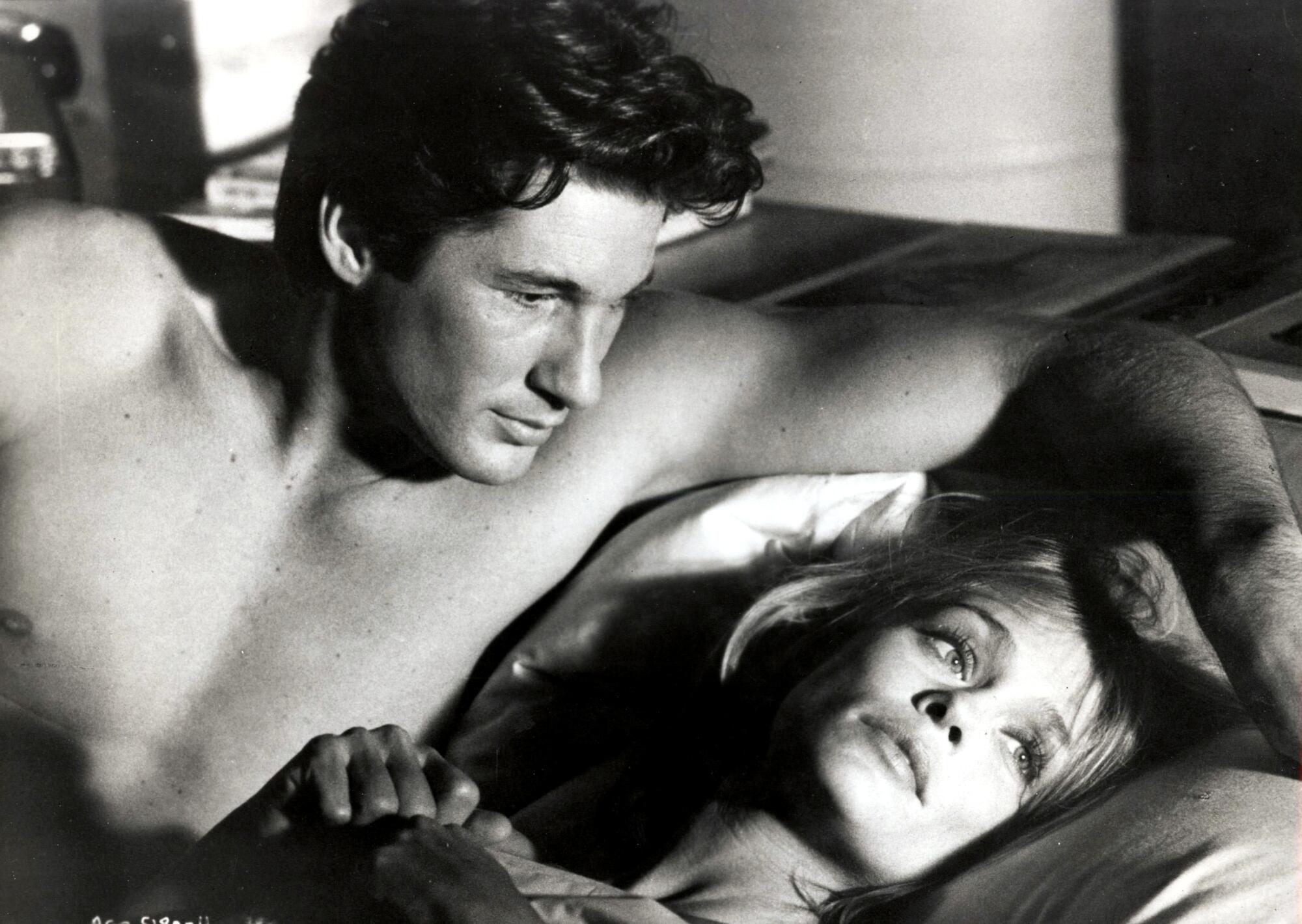
‘American Gigolo’ (1980)

Richard Gere and Lauren Hutton in the movie “American Gigolo.”
(Paramount Pictures)
Reader Cindy Simon from Pacific Palisades shares an anecdote: “I had just moved to L.A. from New Jersey. My friend and I — young mothers — ducked out of our baby-centered life to see ‘American Gigolo.’ The first scene was the incredible Richard Gere smoothly walking outside a Malibu beach house. My friend and I literally gasped!”
There is so much to recommend to this movie — an excellent choice and a regrettable omission on our part. Not only is it responsible for introducing Blondie’s “Call Me” to the world, it does so via an opening credits scene of Pacific Coast Highway cruising that all but defined L.A. hedonism as the ’70s became the ’80s.
‘The Anniversary Party’ (2001)

Jennifer Beals, Alan Cumming and Jennifer Jason Leigh in the movie “The Anniversary Party.”
(Peter Sorel / Fine Line Features)
“A dysfunctional showbiz marriage in the Hollywood Hills, a party with a lost dog, what’s not to love?” asks reader Jim Ehlers of Pasadena. “It’s so iconically L.A. — the sexy mid-century modern house. When do you get Parker Posey, Gwyneth Paltrow and John C. Reilly in the same cast?”
That spectacular glass-walled home in the Hollywood Hills is the Schaarman House, designed by architect Richard Neutra. But fans know the movie for other reasons: Phoebe Cates came out of retirement to act with her “Fast Times at Ridgemont High” co-star Jennifer Jason Leigh. Today’s audiences ogle a young Alan Cumming.
‘City of Gold’ (2015)

Jonathan Gold in the documentary “City of Gold.”
(Sundance Selects)
Junko Garrett of Eagle Rock says this documentary “captures the essence of L.A.: diversity and vibrancy, amazing food and people. I was a big fan of Jonathan Gold’s articles and looked forward them every week.”
So did we. Gold’s omnivorous enthusiasm remains a guiding light for so many Angelenos and his Pulitzer-winning food writing is easy to find. We’re still going to several of the film’s featured restaurants: Jitlada, Chengdu Taste, Guelaguetza.
‘Crash’ (2004)

Thandiwe Newton and Matt Dillon in the movie “Crash.”
(Lorey Sebastian / Lions Gate Films)
More than a few of our readers bemoaned the omission of an Oscar-winning best picture like “Crash.” Says Jim Rodriguez of Torrance, it “captures the quintessential reality that, in L.A., all the levels of social strata, at one time or another, exist side by side on our roads and freeways, separated by a few feet, metal and glass. And yet, still so isolated from each other.”
And Ian Barnard of DTLA calls the movie “a wonderful antidote to Hollywood’s whitewashed and unrealistically glamorous depictions of L.A.” It shows the city “in all its diversity, prejudices, contradictions, inequities and generosities.”
To us, “Crash” will always be the movie that stole “Brokeback Mountain’s” glory. But let’s be generous and note that Carney’s Restaurant on Ventura gets a nice moment.
‘The Day of the Locust’ (1975)

William Atherton, left, and Donald Sutherland in the movie “The Day of the Locust.”
(Paramount Pictures / Getty Images)
The Nathanael West novel is, of course, essential, so where’s the movie? Reader Andrea Hales, a San Diegan who lived in Los Angeles for 15 years, calls the film version “eerie and fascinating, capturing the essence of Los Angeles: the city of hopes and dreams, fires and riots. The setting is 1930s Hollywood but it could be today.”
One thing is certain: As a one-stop shop for classic L.A. locations, you can’t do much better than “The Day of the Locust,” which takes us to the Ennis House, Paramount’s iconic Bronson Gate and Grauman’s Chinese Theatre.
‘Earthquake’ (1974)

A scene from the movie “Earthquake.”
(United Archives / Hulton Archive / Getty Images)
Reader Dina Schweim, writing from Winston-Salem, N.C. (fine, we’ll allow an outsider’s perspective in this case), expressed her disappointment to not find “Earthquake” on our list: “There are few things I love more than a good disaster movie that obliterates L.A. to balance out fanciful and the corrupt — and yes, I was pleased to see that ‘Volcano’ made the list but ‘Earthquake’ really does capture the raw core of what destruction in L.A. can look like.”
The film was mostly shot on the Universal backlot and we wish it had more of an authentic L.A. feel. Still, if you harbor satisfaction at seeing the city get trashed (and who doesn’t on occasion?), we’re not getting in the way of that rumble.
‘(500) Days of Summer’ (2009)

Joseph Gordon-Levitt and Zooey Deschanel in the movie “(500) Days of Summer.”
(Chuck Zlotnick / Fox Searchlight Pictures)
You like this one. Really like it. “It celebrates and beautifies the city in a way few other movies ever have,” says Anthony Cavalluzzi of Yorba Linda, adding, “Its absence completely invalidates the list.” And Michael Backauskas of Beverlywood writes, “I went to see it five times and I never do that.”
Any film about an aspiring architect is going to make the most of its locations. If you mourn the lovers’ bench at Angel’s Knoll Park, know that it became immortal because of this film.
‘Get Shorty (1995)’

John Travolta and Rene Russo in the movie “Get Shorty.”
(MGM)
This comedy’s dialogue was quoted in our comments twice. For reader Sean Dickerson of Beverly Grove, the movie gives us “maybe the greatest line about our city: ‘What is the point of living in L.A. if you’re not in the movie business?’” And for David Hughes of Sierra Madre, the moment comes when John Travolta’s gangster-turned-Hollywood-wannabe is asked what he knows about the movie business: “I don’t think the producer has to know much.”
There is an unforced charm to the way Travolta’s character falls in love with Hollywood — he’s already a movie geek but other elements fall into place for him. Eagle-eyed viewers will recognize both the Aero and Vista theaters.
‘Grand Canyon’ (1991)

Kevin Kline and Danny Glover in the movie “Grand Canyon.”
(20th Century Fox)
Paul Krekorian of Encino calls this one “a brilliant and underrated study of life in Los Angeles. In a deeply personal way it lays bare so many of the societal challenges Los Angeles always struggles with — economic segregation, racial division and injustice, violence, the disparity between Hollywood-created facades and the reality of ordinary life, and the struggle to find meaning and substance.”
Its writer and director, Lawrence Kasdan, was also responsible for “The Big Chill,” a similar portrait of generational flux, and there are quiet moments in “Grand Canyon” that are some of his best. It also starts with a Lakers game.
‘Knight of Cups’ (2015)

Christian Bale in the movie “Knight of Cups.”
(Melinda Sue Gordon / Broad Green Pictures)
Reader Peter Turman of Brentwood sees depth in Terrence Malick’s oblique portrait of a distracted screenwriter (Christian Bale) searching for grace but finding a lot of sex, calling it “a fever-dream meditation on Los Angeles and Hollywood, with its promises, chimeras, illusions, seductions, nightmares and disappointments, told by a great filmmaker who knows of what he speaks.”
Malick shot all over Los Angeles but his moments on the Warner Bros. lot, the enormous numbered studio buildings looming, may be his most beautiful.
‘Lost Highway’ (1997)

Patricia Arquette and Balthazar Getty in the movie “Lost Highway.”
(October Films)
Even with two other David Lynch films placing on our list, that wasn’t enough for Clark Leazier of West Hollywood, who calls the L.A. vistas and landmarks in “Lost Highway” “the most burned in my brain — particularly the Firestone Auto Shop that is now the popular All Season Brewing in Mid City. Also it captures Southern California nighttime driving in a messed up yet accurate way.”
Lynch obsessives know “Lost Highway” to be the one narrative film in which you can see the director’s own house, part of his compound on Senalda Drive in the Hollywood Hills, used as the setting for his main characters’ mansion.
‘Spanglish’ (2004)

Paz Vega, left, Téa Leoni and Adam Sandler in the movie “Spanglish.”
(Bob Marshak / Columbia Pictures )
Says Rochelle Lapides of Ventura County, “It tells one of the essential stories of our Los Angeles-bound Mexican immigrant population and the cultural challenges they face. Also, in my opinion, it’s one of Adam Sandler’s best dramatic roles.”
Agreed, especially on Sandler, whose turn in “Punch-Drunk Love” so impressed director James L. Brooks, he decided to cast him here. The film’s romantic patio scene is filmed at the Beverly Hills restaurant Il Cielo.
‘Star 80’ (1983)

Mariel Hemingway, left, Eric Roberts and Cliff Robertson in the movie “Star 80.”
(Paramount Pictures / Getty Images)
“Talk about dying for the dream,” writes William Mariano of Escondido. “It was filmed in the same spot she died.” He means Playboy model Dorothy Stratten, murdered by her sicko husband Paul Snider in a Rancho Park home that was actually used by the movie’s production while filming their dramatization of the crime.
“Star 80” does crystallize the ominous side of the L.A. myth, as a place where you’ll arrive, find success (and exploitation) and be destroyed in the process. Bob Fosse completists need to see it; it was the “All That Jazz” director’s final movie.
‘Tequila Sunrise’ (1988)

Kurt Russell, Michelle Pfeiffer and Mel Gibson in the movie “Tequila Sunrise.”
(Warner Bros. Pictures)
Jean Clark of Manhattan Beach celebrates this thriller’s cast, cinematography and plot, which she sums up as “classic good guy vs. bad guy and the woman who loves them both, set against the dark underbelly of glamorous L.A. and its golden beaches back in the 1980s.”
And Jean would know — the movie was largely shot around Manhattan Beach. But don’t go looking for Michelle Pfeiffer’s restaurant Vallenari’s. It was entirely constructed on a soundstage.