As Puerto Rico continues to grapple with the long aftermath of Hurricane Maria — from an unreliable electrical grid to ongoing water shortages — the need for stories that see the island as more than a backdrop feels especially urgent.
That’s part of what makes “Hurricane Seasons,” an intimate new independent film about a Puerto Rican family returning home, feel so timely. The film, which screens Sunday at the Newport Beach Film Festival, stars comedian Aida Rodriguez as Glori, a Brooklyn-based artist and community-center worker. She returns to Puerto Rico to help her sister (Justina Machado) care for their terminally ill mother (Priscilla Lopez).
When their matriarch convinces the family to embark on a bucket-list road trip around the island, old family secrets surface as the 2019 protests following Hurricane Maria unfold around them. Directed by Nicole Gomez Fisher and written by Xavier Ortiz — with Rodriguez also serving as a producer — the film is both a story of a multigenerational family and a love letter to Puerto Rico.
For Rodriguez, who is best known as a stand-up comedian, “Hurricane Seasons” also marked a return to a part of her artistic identity that existed long before comedy — her love of acting. But she admits that stepping back into acting, especially as the film’s protagonist, wasn’t an easy transition.
Aida Rodriguez, left, and Priscilla Lopez in a scene from “Hurricane Seasons,” directed by Nicole Gomez-Fisher.
(Laura T Magruder)
“It was terrifying. It was very scary because as a stand-up comedian, I work very hard at trying to obtain my most authentic self so that I can share it with everybody — to be my truest self, my truest Aida,” she says. “And when you loan yourself to a character and the art form of acting, you’re loaning yourself to that character and bringing yourself to that character, of course, because that is why they choose you. But you are telling a story from the perspective of another person.”
Rodriguez had pursued acting before going into stand-up comedy. Upon moving to Los Angeles, she quickly booked acting work, signed with an agency and began taking classes.
But comedy eventually taught her to do almost the opposite of what acting required.
“When I started doing standup, the direction and the notes were always like: ‘Release any character you have in mind and just access yourself,’” she says. “So it was a battle for me. Coming back to becoming an actor and giving the character Glori what Glori deserved — and allowing Glori to live, and Aida to sit in the back — became something important for me to do.”
She adds that it took a lot of work with coaches and classes for her to relax into acting again, allowing Aida the comedian to rest while focusing on what this role required of her.
The film’s protagonist, Glori, is a Brooklyn-born-and-raised Puerto Rican woman whose connection to the island runs deep, despite her living stateside. This is something Rodriguez, who is half Puerto Rican and half Dominican, born and raised in the States, also personally relates to.
That tension — between where you live, where your family comes from, and who gets to decide whether you are “Puerto Rican enough” — is one of the film’s central themes and one reason the script resonated with Rodriguez.
“My testimony through my art has always been finding unity, solidarity, power and connection with other people,” she says. “I think that the story of growing up in the States and connecting to the island is a universal story that most people, regardless of where they come from, experience. [There’s this] idea that you’re never American enough nor whatever you are — in this case Puerto Rican enough — because there’s always a judge and jury on both sides.”
Rodriguez sees those tensions as a consequence of a much larger and complex history. She believes so much of the judgment on both sides is a lingering effect of colonization.
“For me, that was one of the most attractive things about the script — [it] was being able to engage in a conversation about what being Puerto Rican really is,” she says. “Is it based on colonial standards? Or is it based on maintaining our cultural richness and our legacy, that is handed down to us regardless of where we are?”
That question takes on even more weight today as Puerto Rico sits in the aftermath of Hurricane Maria, which Rodriguez believes shifted the relationship between Puerto Ricans on the island and those living stateside.
“There was a shift, because there are wounds from both places,” she says. “There are wounds from the people on the island that stayed and stuck it out. [They want to ask] the ones who left, ‘why do you get to claim this, if you’re not here sticking it out with us?’ Then the people who leave feel like, ‘we had to do this, so that we can not only survive, but send money back to the island.”
Rodriguez explains that, in many ways, the aftermath of the hurricane sparked arguments on both sides that were necessary to begin healing the tension. She believes it highlighted issues that Puerto Ricans, as part of a diaspora, could no longer ignore; it also highlighted an island and a community that Americans outside of the Latine community paid little to no attention to.
“It took a hurricane for people to know what Puerto Ricans were,” she says. “I think there was a cultural shift and there was a conversation that needed to be had, about what happens on the island. And what that means to those of us who are not there.”
That conversation serves as the meat and bones of “Hurricane Seasons,” in which Puerto Rico isn’t simply a location. It’s an integral presence in the story. Rodriguez, Ortiz and Gomez Fisher all agreed that filming most of the movie on the island was essential, not only creatively but also economically and culturally.
“The other thing that was very important about taking the movie back to Puerto Rico was to invest in Puerto Rico and to stimulate some sort of revenues for the island and that the crew was a Puerto Rican crew,” she says. “The DP [director of photography] was a Puerto Rican DP — all people that live on the island.”
It was important to them that if they were going to tell a story about Puerto Rico that was also shot in Puerto Rico, that Puerto Ricans on the island actually benefited from the production.
“It’s not cool to go to Puerto Rico and shoot a movie and bring in your own people from the States, and the people in Puerto Rico have to be inconvenienced with their roads being blocked and things shut down and an influx of Americans that come there to be disrespectful and them not making anything out of it,” Rodriguez says.
This commitment shows in the protest scenes. Rather than using background actors, the film features real Puerto Rican residents, including a local activist and singer.
“It didn’t feel rehearsed. It didn’t feel fake,” she says. “I just think that the feelings and the passion and the rage and the sense of urgency is still there.”
Ortiz’s commitment to specificity extended to the family casting, intentionally matching the actors to the real-life relatives they are based on.
“It wasn’t performative. It was actually real because that’s what all of our families look like,” she says. “Puerto Ricans, Dominicans, we just have that diversity because of all the stuff that’s happened in the past.”
Glori’s character also represents a refreshing departure from the way Latina women are often portrayed onscreen. She is a mother, a daughter, a community center worker, an artist — and a woman with a complicated romantic and family history. She is beautiful and desirable, but her sexuality isn’t the defining characteristic of her existence — something we don’t see enough when it comes to Latina roles.
“For me, I didn’t have to step outside of myself for the role, which was really refreshing because every audition that I ever get, I do have to step out of myself because when people write Latinas in Hollywood, they tend to write them one way,” says Rodriguez. “They look a certain way, they talk a certain way, and that’s not the reality of what being Latino, especially in America, is like.”
Rodriguez could freely inhabit a Latina character without feeling as though she had to perform her Puerto Rican-ness for the audience.
“I didn’t feel like I had to perform my Latinidad. I could just exist in it,” she says.
Rodriguez adds she’s ready for a Hollywood that wants Latina actors to have the same range of characterization that white actors have long been afforded. She’s open to seeing Latinas being everything in TV and film, where can they exist in a world in which they can just be people who just happen to be Latinas.
“I really do look for a day when we can just be people and not just be the funny, spicy friend,” she adds. “Some Latinas are not spicy. Some Latinas are nerds, and some Latinas are quirky, and some of them are goofy and some of them are clumsy. And just like everybody gets to see the spectrum of whiteness with all the different kinds of characters, I would love to see that for our people. For all people of color, actually. I think it’s important to see us all as full human beings, and that means that we can be anything.”
The film’s multigenerational story touches on the cultural inheritance passed between mothers, daughters and grandmothers — whether through old traditions or ordinary rituals. It’s something audiences, regardless of background, can likely relate to.
“The most important message that I’ve kept from my [foremothers] was never to lose my sense of Puerto Rico; that, even if I don’t live in Puerto Rico, Puerto Rico lives in me,” she says. So much of that inheritance lives in the little things she remembers about her Puerto Rican grandmother, she says, from the té de tilo she’d make for an upset stomach; the recao that grew on her grandmother’s balcony because she didn’t have a backyard; or the azabache she still wears to this day for spiritual protection. They are the same small traditions she has passed on to her kids.
“My daughter makes better arroz con gandules than all of us,” Rodriguez says. “And her recipe is true to what my grandmother’s recipe was. That will continue to live on, until we are able to go back to our island and live in peace.”
That freedom is one reason Rodriguez believes independent film is so important for stories like “Hurricane Seasons.” Without a studio machine making decisions based primarily on commercial expectations, filmmakers have more room to tell a story on their own terms.
“Once the studio gets involved, they start thinking about dollars, which they got to make money, but they prioritize the dollars,” Rodriguez says. “And I think that’s why a lot of these big projects that they spend a lot of money on have failed because they don’t honor the storytelling. They don’t honor the authenticity of the world, the authenticity of the stories.”
Her hope is that “Hurricane Seasons” encourages more people to tell their own stories — especially Puerto Ricans.
“Puerto Ricans are not a joke; we’re not a punchline. You don’t get to tell us we don’t speak correct Spanish and make fun of our songs. Then, years later, appropriate our culture and become big time doing what we do, using our terms and our colloquialisms because it brings you capital,” she says. “We are people. We’ve been doing this for a very long time, and our grandmothers and our tias and tios matter, and they’re not [a] costume that you can just put on [to] make money off of it.”
Before we wrapped up the call, Rodriguez paused for a moment when I asked her what Puerto Rico means to her. Then her eyes lit up, and her voice softened as she described why the island means so much to her — and why so many people, even outside of the diaspora, find themselves drawn to it.
“Puerto Rico is a very special place, which is why so many people want to kick us out, so they can move [in],” she says. “But they’ll never have the magic, because the magic is us.”
The slogan of the 1933 Chicago World’s Fair, which plays a prominent role in the new LACMA exhibition “Home of the Future, 1925–1985: Designing Domestic Utopias,” was blunt: “Science Finds, Industry Applies, Man Conforms.”
Those words capture a central tension in the sprawling show, which occupies interconnected galleries at the far end of the museum’s Resnick Pavilion. Many of the beautiful, sometimes ingenious products and technologies developed with the rise of the modern era gripped the popular imagination and made life easier, healthier and more connected. But they didn’t free people from domestic labor or deliver the prosperity and security heralded by their promoters. They instead often raised expectations, forced dependency and gave rise to a vision of progress that reinforced social exclusion, bred anxieties about status, and concealed the environmental costs of a culture built on consumption.
Sound familiar?
The desire for these transformative products was never innate, and LACMA’s exhibition zeroes in on that idea from the start. “Good design is seldom accepted. It has to be sold,” Midcentury photographer Julius Shulman is quoted as saying in the catalog.
The show traces the hard sell of a domestic utopia via world’s fair posters, model home catalogs, magazine advertisements, television specials and science-fiction imagery — along with close to 200 physical objects of every sort, including kitchen appliances, electronics and furniture. In each of its four documented eras — pre- and post-Depression, post-World War II, the height of the Cold War, and the counterculture ’60s and ’70s — promoters dressed the same promise in new terms, whether through cleanliness, leisure, security or freedom.
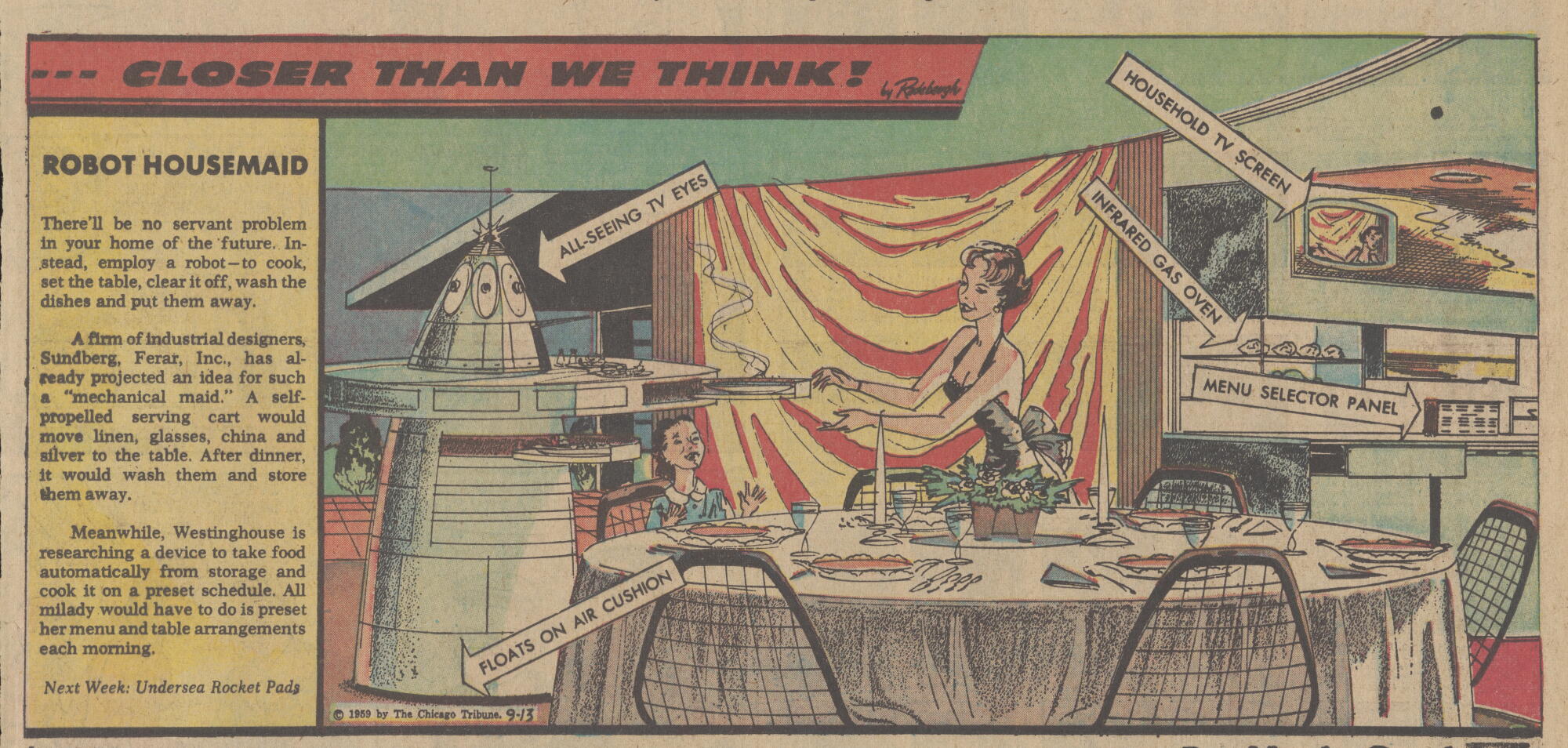
Arthur Radebaugh, “Closer Than We Think! Robot Housemaid,” 1959.
(Chicago Tribune / TCA, photo courtesy San Francisco Academy of Comic Art Collection, Billy Ireland Cartoon Library and Museum, Ohio State University)
At every turn a vision of a better life was made to seem desirable and, just as important, inevitable. Like any good advertising, it worked best when soothing our anxieties and tapping into our fantasies.
In the 1920s and ’30s, new discoveries about hygiene inspired products by soaring talents in the nascent field of industrial design who set out to create clean, easily maintained homes — laboratories for healthy living in an age still ravaged by diseases like polio and tuberculosis. Mathias J. Weber and Russell E. Vanderhoff’s seductively streamlined Health-o-Meter scale gave the illusion that homeowners could be scientists, for the first time monitoring their own weight and growth. Kohler’s Integra, introduced as “the toilet of the future” at the Chicago fair, had a dramatic black finish made to equate sanitation with modern design. And Bruce Goff’s gleaming Vitrolite kitchen for Libbey-Owens-Ford glass company, shown in Charles Turzak’s rendering, integrated pigmented structural glass counters and cabinets into a polished, easily cleaned whole.
American Stove Co., Magic Chef stove, series 1400, introduced 1935.
(Lynton Gardiner / The Wolfsonian–Florida International University )
Vast expansions in electricity, telecommunications and production promised to connect the country and ease the tedious work of cooking, washing and cleaning. The American Stove Co.’s Magic Chef stove, one of the first ovens to be equipped with a clock, recast kitchen work as something that could be measured and controlled. Frank G. Brotz’s Kohler Electric Sink, which incorporated a motorized dishwasher into the familiar basin, promised release from the “thrice-daily drudgery” of washing dishes. Western Electric’s clear-cased Model 302 telephone enticed gawkers with an impressively complex system of wires and mechanisms.
George R. Lum for Western Electric Co., Telephone, model 302, desk set 1938.
(AT&T Archives and History Center)
Many of the names who dreamed up these wonders are now etched in design history. Isamu Noguchi created a baby monitor before baby monitors were a thing: the Radio Nurse, a dark Bakelite receiver resembling an abstract face. Walter Dorwin Teague gave corporate products a precise, machine-age polish, while Raymond Loewy brought the same sleek optimism to objects like the globe-shaped New World radio for Colonial Radio Corp., molded in glossy, heat-resistant Catalin and embodying quite literally the new reach of communications.
Selling this promise of a technological future to those clinging to the dream of American prosperity was an especially potent exercise during the Depression. In his illustrated 1932 manifesto “Horizons,” Norman Bel Geddes cast “new design” as a path toward “economy, efficiency, comfort and happiness.” As the economy faltered, an orderly, healthy home could be sold as a form of salvation, with prosperity seemingly within reach. At the Chicago fair, corporations sponsored full-scale model homes and filled them with products already available or soon to be. For rural households still without electricity, Lester Beall’s 1937 Rural Electrification Administration poster “Wash Day” turns federal infrastructure into a household fantasy. Inside the black silhouette of a farmhouse, a pristine white washing machine appears at an almost monumental scale, set against flat fields of saturated color.
Irving Harper of George Nelson and Co. for Herman Miller Inc., Marshmallow Love Seat, model 5670, designed 1956, this example made c. 1960s.
(Jonathan Urban / Museum Associates / LACMA)
By the ‘40s and ‘50s, the postwar home and its many accouterments — powered by wartime advancements, growing abundance and an ethos of “buy now, pay later” — amplified the promise. Plastic, prefabrication and push-button convenience suggested that mass production could bring elegant, futuristic living — and freedom from drudgery — within reach of the masses. George Nelson treated furniture as a flexible system, producing (with designer Irving Harper) the candy-colored Marshmallow Love Seat; replacing conventional upholstery with 18 brightly colored circular cushions mounted on a spare steel frame. Eero Saarinen produced the molded-fiberglass Pedestal chair, sweeping the seat and stem into a single sculptural form intended to eliminate what he called the “slum of legs” beneath tables and chairs.
Eero Aarnio for Asko Oy, Ball Chair, designed 1963.
(Jonathan Urban / Museum Associates / LACMA)
Architects attempted to make the home itself into a sexy product. At Disneyland, Monsanto’s House of the Future, designed by architects Richard Hamilton and Marvin Goody, was a gleaming, cross-shaped structure of molded plastic, raised above the ground on cantilevered supports and partnered (in renderings) with a plastic heliport. Its kitchen featured molded surfaces and electric appliances. Promotional images and films conjured a playful, adaptable and benevolent house — plastic as the building block of family happiness.
Buckminster Fuller’s Dymaxion house was an aluminum, factory-made “dwelling machine” that could be delivered by air and assembled almost anywhere. Its unified form, modular furnishings, water-recycling system and labor-saving technology promised a more efficient life, less tied to conventional building and household routines.
Hamilton & Goody Architects, Monsanto House of the Future, 1956.
(MIT Museum)
Institutions like the Museum of Modern Art and magazines like Arts & Architecture promoted prototype homes from now legendary industrial designers and modernist architects like Saarinen, Charles and Ray Eames, Marcel Breuer, Albert Frey, Gregory Ain and even Frank Lloyd Wright.
Effective pitches could turn a product, whatever size, into a fantasy of freedom. In the General Motors film “Design for Dreaming” (1956), directed by William Beaudine, a woman enters a fabulous kitchen as if in a magical dream. The promise, said curator Wendy Kaplan, was that the fictional woman would have more time for “tennis and hanging with … friends.” The dream even hinted at a life beyond domesticity — perhaps even freedom to “actually have a profession,” Kaplan added.
But the housewife in these displays was still expected to remain responsible for the home. Liberation came through a more efficient kitchen, not a change in who cooked. And appliances that reduced some labor often raised the bar: more frequent washing, more cleaning, more elaborate meals, as University of Chicago home economics professor Hazel Kyrk described in “Economic Problems of the Family.”
Frank G. Brotz for Kohler Co., Electric Sink, introduced 1926, this example 1928, Kohler Co.
(Kohler Archives)
That universal “everyone” did not, however, include everyone. Government-backed home ownership and the suburban boom excluded many Black, Latino and Asian Americans through redlining, restrictive covenants and discriminatory lending — a fact reflected in the almost complete absence of minorities in these vast selling campaigns.
A few welcome exceptions on the creators’ side are architect Paul R. Williams’ “Small Home of Tomorrow,” which proposed a simple, well-designed home fitted with gee-whiz appliances; Arthur Elrod and William C. Raiser’s swirling, vivid orange Ebony test kitchen, which treated cooking as creative craft; and the proposed multiracial community of Soul City, founded by Floyd McKissick, which imagined homeownership as a claim to economic autonomy that segregation denied.
The vision of a utopian domestic future took a strange turn during the Cold War, marrying the breathless excitement of the space age with the existential dread of nuclear annihilation. The same scientific power that had transformed lives now produced weapons capable of destroying humanity. The home was imagined as both shelter and command center.
Office of Donald Deskey Associates. Drawing, design for Undersea Lounge: Scheme 3 Interior Perspective, ca. 1960s. Designed by Russell Heston (b. 1929).
(The Estate of Donald Deskey, courtesy Cooper Hewitt, Smithsonian Design Museum / Art Resource, NY)
As the age’s potent mix of terror and delirium spun on, designers and illustrators proposed ways to live comfortably in space, underwater or in underground bunkers. Paul László’s “Atomville, U.S.A.,” a vision of suburbia half a century in the future, buried the family home beneath an earthen shell that doubled as a helicopter landing pad. Its sunken gardens and swimming pool promised comfort, while a blast door, escape hatches and air filtration protected against nuclear fallout. Donald Deskey Associates imagined a hypnotic “Undersea Lounge,” a self-contained interior for living beneath the water, while NASA illustrator Rick Guidice vividly depicted physicist Gerard K. O’Neill’s proposed Stanford Torus — an enormous, wheel-shaped suburb in space.
Bob Lerner for LOOK Magazine, Anne Anderson in RCA Whirlpool Miracle Kitchen, 1959, kitchen designed 1956.
(Library of Congress, Prints and Photographs Division, LOOK Magazine, Photograph Collection / Robert S. Lerner Photography, LLC)
An endless array of products leaned into the public’s awe at the age’s sci-fi possibilities. This included prescient pieces ahead of their time, like the video-enabled AT&T Picturephone, and those that would never come to pass, such as the RCA Whirlpool Miracle Kitchen. The latter’s spread in Look Magazine (displayed for crowds at the 1959 American National Exhibition in Moscow) showcases a Roomba-like vacuum and other astonishing appliances that seem to work by themselves. But men hidden behind two-way mirrors actually operated them. Others, like the two-wheeled Ford Gyron Remote Control Car of the Future, only managed to come to life as children’s toys; and some were just plain ridiculous, like Honeywell’s H316 Kitchen Computer, which required a two-week training course just to retrieve a recipe.
By the late 1960s, confidence in technological progress was fraying. Environmental damage, plastic waste and the conformity of suburbia prompted designers and countercultural communities to imagine other ways of living — up to a point. The residents of Drop City, a Colorado artists’ community, built domes from the curved steel tops of salvaged cars. Architects Barry Simpson and Charles Hosford made a folding stool that could serve as a seat, stepstool or side table. Small, portable, multipurpose designs, from inflatables to cardboard furniture offered a life with fewer possessions. The Whole Earth Catalog, founded by writer and editor Stewart Brand, promoted ecological knowledge and self-sufficiency, but was still a compendium of things to buy.
Companies, too, found ways to sell all natural products, flexibility and individual expression. Zanotta advertised the first beanbag chair, the polystyrene-filled “Sacco,” as “A Big Bag, a Soft Seat.” Its formless body accommodated slouching, lounging or lying down, selling freedom from both conventional posture and the bourgeois living room. Even resistance to consumerism could be packaged as a new consumer ideal.
The pairing of objects with their promotional campaigns is the show’s most illuminating contribution, shedding light on the massive, often strange apparatus needed to drive these incredible designs — some icons, some welcome surprises — forward in each age. It reveals how the country’s 20th century manufacturing prowess expanded into the production of dreams. Corporations, government and the media taught consumers what progress should look like, which anxieties a product might soothe, and what kind of future to desire.
Isamu Noguchi; Zenith Radio Corporation, Radio Nurse receiver and Guardian Ear transmitter with original box, 1937.
( Museum Associates / LACMA)
But the sheer abundance of objects — I haven’t even mentioned the fascinating companion show-within-the-show, “The Kitchen and Its Discontents” — leaves less room for examining those campaigns and the work they performed. The excellent catalog follows those connections further, tracing how often hypnotic visions of the future home both reflected and shaped ideas about lifestyle, progress, gender, race, labor and consumption; in the galleries, those ideas remain largely suggestive.
Still, the exhibition offers a revelatory history — and a telling roadmap to our present. While the future imagined here made life easier, cleaner, more beautiful and more exciting, it did not arrive as advertised. The plastic home didn’t remake housing; the automated kitchen didn’t free women from domestic work; the self-sufficient home gave way to new forms of reliance. Yet a similar techno-utopian pitch survives in today’s smart homes and domestic technologies, from assistants like Alexa to artificial intelligence marketed as a way to make life easier. These tools may offer real benefits even as they addict and distract us. And while the systems sustaining our comfortable, consumption-driven lives launch us toward climate disaster.
These rooms powerfully evoke what Kaplan in the catalog calls America’s “restless forward motion, powered by the conviction that tomorrow’s design would solve today’s problems.” That ingenuity is worth celebrating. But its promises deserve open-eyed scrutiny.
A back three that has looked impressive was hassled to distraction, calm replaced with confusion. Scotland’s go-to leaders did not lead.
Robertson said his team was out-fought, which was a telling comment. Fight is the easiest part to get right, the thing that requires no talent.
On Saturday in Skopje, everything was easy for Scotland because North Macedonia were no good. They scored two and could have scored five and six.
Was there a sense of them believing in their own hype? Hard to imagine given that it was only North Macedonia they’d beaten, but there was a lack of edge about Scotland on Tuesday that begs that question.
Or can it all be laid at the door of the system? Slovenia did their work on that. Ripped it to pieces, in truth.
Pocognoli needs time, of course he does. He needs his most potent attacking midfielder, Scott McTominay, at the heart of things and needs more training sessions to drill his message into his players.
November is his next chance, away to Switzerland and home to North Macedonia. No real margin for error now. They had a big chance to make it a healthy seven points from four games and they blew it.
The head coach will need to nurse his wounds after this. He will have learned a lot about his players and has much thinking to do.
The honeymoon period is over. The reaction of the Hampden crowd at the end told you that the first marital row has now occurred.
YOU SAY Oxford Circus, you think crowded streets and busy shops – but there is a whole other side to it you might not have known about.
So we’ve taken it on in two different way – as a busy mum looking to keep her kid busy, to a girly weekend in the city without going to the shops.
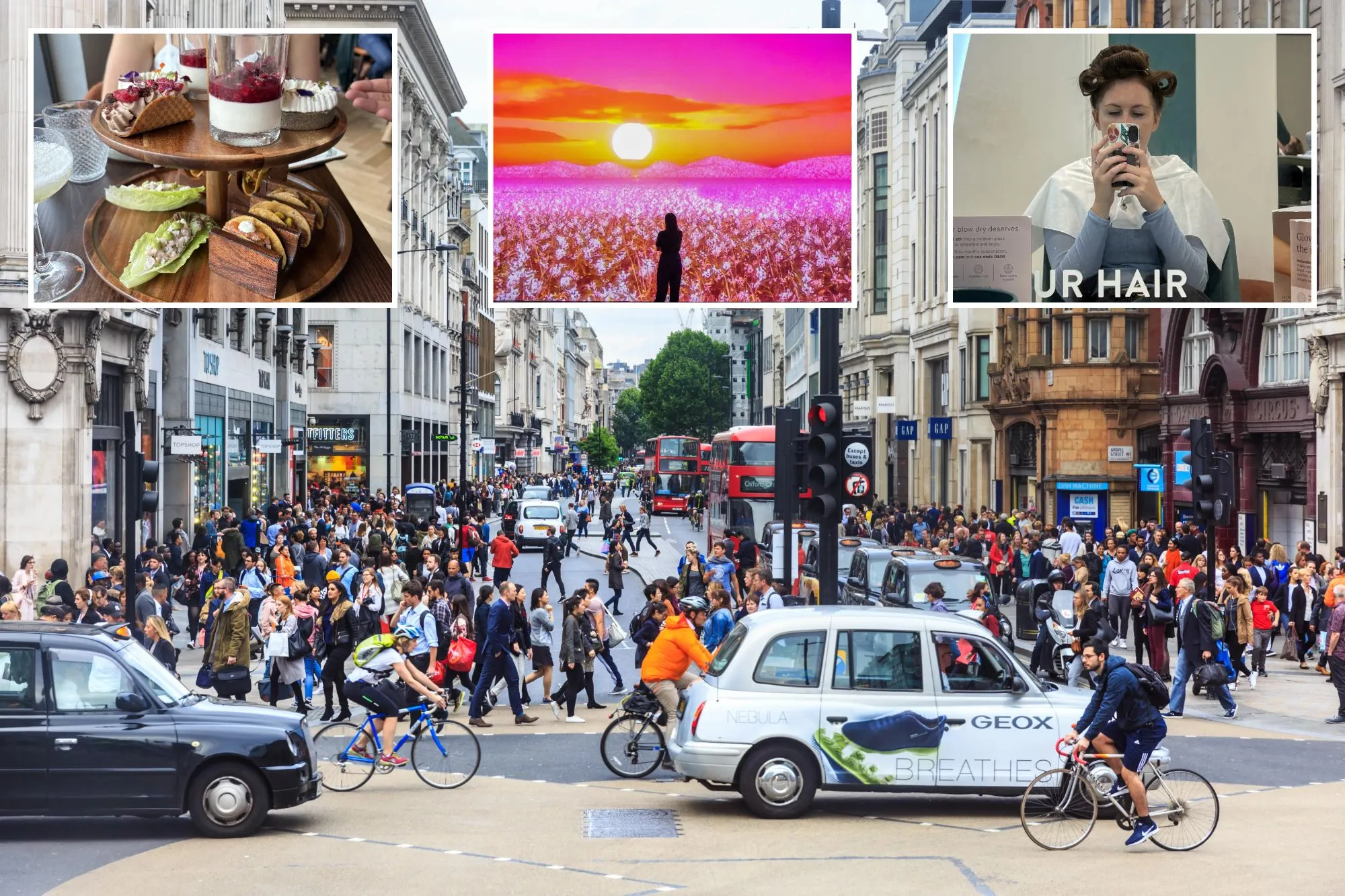
Soho might be famed for its shops but it has a whole other side to itCredit: AlamyAnd with the plans revealed for its pedestrianisation, here is how to do it as a mum, and a girly weekend without the shops.Credit: PA
Blow dry bars, Mexican afternoon teas and gorgeous Italian dinners
Kara Godfrey, Deputy Travel Editor, explores the busy centre on a girly weekend wanting some pampering.
Growing up in the countryside, my first impression of London was the hubbub of Soho, with bustling streets full of eager shoppers elbowing each other out of the way.
Sign up for the Travel newsletter
Thank you!
Yet 20 years later, having since moved to (and left) the crazy capital, I know there is more to the iconic city centre than its shops.
And with the announcement that it is about to become pedestrianized, it’s about to become an attraction in its own right.
If you want to explore the centre of London without actually dipping into the shops, it also makes for the perfect girly day out either with your best mate or your mum – if you know where to go as a local.
It is a fantastic destination for a pamper, with affordable nail salons and hairdressers – and did you know one of London’s most famed blow dry bars is found at the bottom of the John Lewis department store?
Having first launched in Chelsea back in 2014 (becoming a fave with the Made in Chelsea stars), Duck & Dry has become an institution for the place to go before a big event.
I sank into the plush chairs, laidback music overheard while I chatted to my hairdresser as my hair was massaged and washed.
As a woman in my mid-30s, I’ve realised that it’s the little luxuries that make life worth it and a person kneading all of my worries away is one of them.
Just 30 minutes later, I left a new woman with a fresh new do so gorgeous, I even bought a blow dry brush on my way out to try and replicate it at home.
What better way to start the day then with a blow dry?
(Don’t stop there though, one of my favourite nails bars, Cona, is just around the corner, with the hidden salon tucked behind the bold oranged painted cafe front).
Hair done, nailed fixed – we needed something to line our stomach and gone are the days of our 20s where we opted for a bottomless brunch.
Being more afternoon tea gals, one of the more unique ones is found in the Treehouse Hotel just off the main high street.
This isn’t your usual afternoon tea, however, (although you will still find a scone or two on top) – it’s called the Afternoon Te-Quila, so expect a Mexican fusion.
Starting with a freshly made margharita, we gorged on fresh fish tacos, pumpkin pies and even a unique chocolate taco, pumped full of decadent chocolate mousse.
The views are just as amazing, looking out over London from the top floor, but as I sat under a ceiling of green hanging plants, I was transported to somewhere much more tropical.
There is so much to do outside of this as well that doesn’t require you to lug shopping bags around town.
Or how about catching a West End show? The Palladium has some fantastic shows coming up including Delta Goodrem, Michael Ball and of course the Christmas panto.
Forget your usual afternoon teas – this is a Mexican inspired one with a viewI loved the free margherita alongside the fantastic views
(While I might have said there is so much to do along the high street without the shops, I would still recommend popping into the new M&S flagship, with four entire floors of homeware, clothes and a Food Hall. I may have left with both new linen trousers and some Percy Pigs…)
Don’t think I forgot about dinner, because London isn’t one of the world’s best food capitals for no reason.
And with more than 600 restaurants to choose from, according to OpenTable, where do you even start?
Well I’ve found just the place, if you want somewhere slightly quieter away from the crowds, but with fantastic service, a low-key atmosphere and hearty, Italian portions.
Enter Lavo at the BoTree.
Start at the bar for a cocktail – while the menu might sound confusing, it explains which cocktail they are similar to, so I had their version of a negroni.
On weekends there is also a live DJ who toes the line of great, lo-fi music without being so loud you can’t hear each other.
Slightly woozy at this point, my direction to my table was welcome before gorging on towering piles of tuna tartare and large bowls of penne a la vodka.
Our extremely funny server even tempted us into sharing what is now going down as one of the best tiramasus we’ve ever eaten.
The restaurant was low-key but so chicThe portion sizes were huge too
And when you need to rest your weary feet from a day of pounding the pavements, you can’t get much more central than the Radisson Blu Bond Street.
Currently undergoing a renovation, it is just steps from the main road, with some of the best views of the high street from my room overlooking the shops.
With Oxford Circus not having many late night openings, don’t worry about not getting any sleep, as it was super quiet once everything had closed.
The cosy restaurant – with that brand new smell – also had a fantastic breakfast spread to refuel, from pancakes and avocado toast to all of the pastries and trimming of a Full English.
So while Oxford Circus will always be known at the shopping high street, there is so much more to it to bring your out of town friend, siblings or parents to without having to step into a shop.
Unless you get a Percy Pig craving, that is.
Illusion museums, kid-friendly food halls and ‘treehouse’ hotels
Caroline McGuire, Head of Travel (Digital), explores as a mum with a seven-year-old to keep occupied
As a London mum, I regularly take my seven year old into the city centre for theatre, museums, parks and all the other awesome attractions it has to offer kids.
But Oxford Street? Are you mad? It’s somewhere I’d actively avoided, assuming it was the worst place for a very active kid who loves running around and touching everything in sight.
How wrong I was. Because we recently spent an overnight stay on Europe’s most famous high street… and it was one of our best 24 hours in the capital.
Oxford Street has changed a lot since I was a kid, coming up from the home counties to spend my Christmasmoney at Topshop.
In some ways for the bad (those many American candy stores), but in many other ways for the good.
As some of the big chain stores have departed, enterprising new ventures have opened up that are perfect for a family day out.
Take for instance, the Twist Museum. A brilliantly fun illusion museum – even though the grumpy middle aged woman in me still insists it’s not a museum.
We had such a great time exploring all of the mind-bending activities, our favourites being the 3D hologram creator, the mirror room and the ‘big and small room’.
Swingers surprised me with how great it was for kidsCredit: dot dash media
It was so cool that I now have three pictures from there alone on my fridge at home – high praise.
Equally fun was Swingers Golf and Carnival Games, which I’d always written off as an adults-only venue for big kids at heart to have fun with a beer.
Not so, as during the day in the school holidays it was packed with families enjoying easily the best crazy golf I’ve ever done in my life.
Then you get a half-hour pass to play as many games as you can in a retro-style arcade.
As a parent who’s forked out more pound coins than I care to remember at amusement arcades, it was a total joy to do it all for free… and with a time limit. Plus, I got to sip on an extremely good frozen marg while I did it.
If the kids are feeling hungry, their food offering is a godsend. Several high-end food trucks like Patty and Bun burgers and Breddos tacos mean you can all pick what you want to eat.
If you’re looking for something every so slightly more highbrow, we ended our day at Frameless – the very cool digital art experience where you’re put inside famous paintings, as they surround you on huge screens and come to life.
It was really surprising to see how much my son engaged with such old paintings, which he may have dismissed as stuffy in a gallery, by bringing them to life.
I was surprised how much my kid loved Frameless tooCredit: Alamy
Of course after pounding the streets for so long, we were in need of some refreshments, so we headed to Market Halls, which has every food any foodie or fussy kid would want.
I dined on Malaysian Nasi Goreng and Thai soup, while my son had savoury crepes for main… and Nutella crepes for pudding.
Thankfully, with our extremely full stomachs we didn’t have far to go to lay our heads, as we were booked into the Treehouse Hotel, an achingly cool and modern property on Langham Place, with some of the best views of London I’ve ever seen.
Our room was very Scandi-style, with a lovely window seat so we could look out over the city.
The next morning, we managed to find space in our stomachs for brekkie, at the Mexican inspired Madera restaurant, where I had a bagel topped with scramble tofu, vegan cheese and jalapeno pickled red onions, while my son opted for the waffles with whipped cream and berries.
We fell in love with the Treehouse hotel
We lingered far too long over breakfast, sad to tear ourselves away from the stunning views from our table.
All that fun of museums, art exhibitions, golf, arcades, and some fantastic food and drink, without stepping foot into a shop?
Teenage me would never believe it.
The New West End Company represents 100 streets in the district including Oxford Street, Regent Street and Bond Street.
They explain: “New West End Company is solely focused on representing and keeping the West End thriving. Established more than two decades ago, today our 800+ membership includes the most respected names in global retail, leisure, hospitality, real estate and business.
“We keep our West End streets clean and safe, promote world-class experiences, provide trusted data and insight, and make the case for policies that support growth. Between 2026-2031, we are investing £60 million to make the district stronger, safer and even more competitive.
“Together with our partners – including Westminster City Council, the Metropolitan Police, the Mayor of London – we are proud to shape the district our members thrive in.“
Wales will again be without the likes of Karl Darlow, Joe Rodon, Dylan Lawlor, David Brooks and Harry Wilson due to injury as they look to maintain the momentum gained thanks to the Norway triumph.
Bellamy says he has no choice but to make changes to the side which began on Thursday as Wales seek to make amends for last Sunday’s defeat in Denmark.
Having emerged with some credit despite losing their Nations League opener against Portugal 10 days ago, Wales were well beaten on a demoralising evening in Copenhagen.
Davies hopes the Cardiff City Stadium factor will be key as Wales chase victory against a Danish side who, in 21st, are 17 places above them in the Fifa rankings.
“It does make a big difference going away. We didn’t get a grip on the game [in Denmark] whereas when we played Norway in Cardiff, it’s our home, our fans, our atmosphere,” he said.
“It felt like a different game and we had much more control… you just know you have to try to make your home advantage count.”
Brown’s two goals were just reward for a player who has been quietly impressive for far longer than this campaign, and he was part of a back-five which stood out in what was a third consecutive clean sheet.
Brodie Spencer and Terry Devlin were drafted in at the full-back positions and both impressed, but Brown’s centre-back partners McConville and Tom Atcheson really shone.
Norwich City defender McConville, 21, commanded his area well and, as well as an assist for Brown, he also allowed the ball to trickle over the line when he could have touched home for the third goal instead of his team-mate.
Atcheson, himself only 20 and playing for Blackburn Rovers in the Championship, made his Northern Ireland debut in Wales in March, but showed composure beyond his years.
O’Neill said both players were “terrific” as he told BBC Sport: “They have no ceiling, to be honest.
“They are both playing in the Championship at the minute but they are ready to go to the next level.
“They will make mistakes at times and we’ve put a lot on them in terms of the physicality. The two of them were brilliant.”
O’Neill was also delighted for Brown, who said he had “really grown” into a senior role in the absence of injured Sunderland defender Dan Ballard.
“Three 90 minutes at this level is tough,” said O’Neill of the 28-year-old.
“He plays his club football in League One and he’s a better player than that.
“He brings a lot to the team. He was our most senior player tonight and he has really grown into that.”
In the most bizarre of cricketing summers, Ben Duckett has had a bizarre summer of his own.
The only Englishman to compile a Test ton, and the scorer of 141 against India in a one-day international at Lord’s, ends with nine scores below 20 from his other 15 innings.
He was talked about as the world’s best all-format batter after his 149 against India last summer but has averaged 27.15 since then across formats.
It is right that England are reticent to drop a batter who has hit such highs, especially as a senior player and one with significant List A experience – a total of 111 matches – behind him in a squad still lacking in 50-over matches.
Duckett and Jacob Bethell also shared an opening stand of 192 in the series decider against India at Lord’s.
But, unlike the Test side where Emilio Gay’s place as Duckett’s partner is not fully secure, never mind a replacement waiting in the wings, Tom Banton and Bethell have shown there could be another world without the diminutive left-hander.
Bethell, who scored 91 in the third ODI against India before missing the Sri Lanka series with a knee injury, is talked of as a senior player in the group, despite still being just 22, while Banton’s first England century on Sunday was superb.
The way Banton hits the ball at the top of the bounce looks suited to the bouncy pitches of South Africa, where the majority of the World Cup will be played.
Duckett, in contrast, averages 23.4 on surfaces deemed as ‘high bouncing’ since the start of 2023. This winter’s Test series in South Africa may shed some more light.
Pietersen’s eyes roll slightly when he is asked about Ben Stokes’ recent comments comparing Harry Brook’s talents to his.
Pietersen, like Brook, was a maverick – a batter capable of incredible highs. Those highs mean the lows come with a disproportionate level of criticism.
“Where I can help him is playing situations, because there was a lot of method in my madness,” Pietersen says.
“Yes, occasionally, I got out to reckless shots and crazy shots in the ’80s and ’90s but there was a lot of structure to the way that I batted.
“I’ve still got notes on my phone on how I played in T20 cricket, one-day cricket, Test match cricket, and about hitting straight back at the stumps, and the techniques, and how I did it, and don’t play certain shots.
“That all-round structure is something I could potentially help him with because he’s so flipping good.
“It’s actually frightening how good he is and how good he can be.”
And Pietersen says he will not limit himself to working purely on white-ball cricket.
He has already spoken to new Test coach Stephen Fleming about how he can help the Test batters during his time with the white-ball squads.
Though he said he would not have time for a full-time role, he suggested he is open to working with the Test side before next summer’s home Ashes series.
“I have got a pretty mad schedule,” he says. “I wouldn’t say no.
“I don’t think that necessarily means I need to be in a dressing room.
“There is a lot of time in the lead up to an Ashes series and a tour of South Africa, when I will be with the Test batters.
“There are conversations I can have there.”
Who knows how long this will last. England may as well make the most of this second chance.
Wales earned plaudits but Craig Bellamy wants more from his side, after admitting they were forced to suffer in their narrow 1-0 defeat in Portugal.
Joao Felix’s deflected strike proved enough to earn victory in Lisbon for the hosts, who also saw Cristiano Ronaldo’s effort ruled out by VAR.
It was a winning start to the Nations League title defence for Portugal and for new manager Jorge Jesus.
Despite being under pressure for long spells in Lisbon, Bellamy’s injury-hit side ended strongly as Brennan Johnson and Lewis Koumas both went close to snatching a draw.
“It was a difficult game for us. We had to suffer a lot,” said Bellamy.
“I think that’s the longest we’ve been in a game without the ball.
“We could have done more with the ball but I’m beyond proud as well.
“We have a lot of players who weren’t here. That’s OK, we can handle it.
“A lot of players who don’t play, week-in, week-out. So for them to use the energy they were able to, we’ve got to have a big heart to be able to do that. They’ve always shown that and they showed that again.”
Leaders of the six Gulf Cooperation Council (GCC) states are set to meet United States President Donald Trump in New York on Tuesday, as the US-Israel war on Iran nears seven months.
The meeting, to be held on the sidelines of the United Nations General Assembly (UNGA), brings together countries that have borne much of the fallout from a war they did not start.
Recommended Stories
list of 4 itemsend of list
Since the war began on February 28, Iran has repeatedly struck US bases across the Middle East as well as airports, energy facilities and hotels. The war has particularly hit the Gulf nations hard, as their oil and gas exports – the mainstay of their economies – have been disrupted, causing a global energy crisis.
A June memorandum of understanding (MoU) briefly raised hopes of an end to the war, but it collapsed last month amid disputes over navigation through the Strait of Hormuz, which remains effectively closed.
These talks come as Trump says he faces a “big decision” on the war, and as Iran’s president and foreign minister are also in New York for the UNGA.
So what is on the table and what might come out of the talks? Here is all you need to know:
What do we know about the GCC-Trump meeting?
Trump is set to meet the leaders from Bahrain, Kuwait, Oman, Qatar, Saudi Arabia and the United Arab Emirates, which form the GCC, on the sidelines of the UNGA.
Trump told US media outlet Axios on Thursday that he wanted to meet the GCC leaders as he faced a “big decision” on the war and wanted to speak with them directly.
Experts say there are two interconnected issues – the US-Israel war on Iran and the conflict between Houthi rebels and the Saudi-backed government forces in Yemen.
What do the GCC countries want from the meeting?
Broadly, experts say, the GCC nations share a common goal for the meeting.
The GCC has “shared positions on the main principles of regional security and de-escalation”, Luciano Zaccara, a researcher with the New Ground Research think tank in Doha, Qatar, told Al Jazeera.
“With Trump recently threatening to ‘wipe out’ Iran, I expect the six GCC states, or at least most of them, to convey to the US president their grave concerns about the likely consequences of another round of intense US military strikes on Iran,” Giorgio Cafiero, CEO of Gulf State Analytics, told Al Jazeera.
“They will probably seek to underscore their own vulnerabilities to a renewed cycle of all-out fighting between the United States and Iran,” he said, adding that they will try to persuade Trump into making certain concessions to Tehran.
Cafiero said they will look to develop an arrangement that builds on the MoU and which “offers the most viable path toward winding down the crisis”.
Chief among their common concerns is freedom of navigation through the Strait of Hormuz and the Red Sea, according to Ahmed Helal, managing director for the Gulf region at The Asia Group.
‘Divergent’ goals
Despite common goals, the Gulf states have still experienced “divergent” outcomes from the war and will also look to persuade Trump to address their particular predicaments, Helal said.
The UAE, he explained, has been able to keep exporting oil by pipeline to its port of Fujairah, which bypasses the Strait of Hormuz, although not at the volumes it would like.
But fellow GCC member Qatar, whose gas exports depend on the strait, has seen its LNG shipments severely curtailed and wants to avoid any renewed escalation that could see its energy infrastructure targeted again, Helal said.
Speaking at an event in New York, US, on Sunday, Qatar’s Prime Minister Sheikh Mohammed bin Abdulrahman bin Jassim Al Thani described the economic fallout from the US-Israel war on Iran as an “earthquake”.
Saudi Arabia has another problem, as it is now under “enormous pressure” as the Houthis gain ground in Yemen, and has been “intensifying their lobbying” for US strikes on the group, he said.
What does Trump want from the meeting?
Predicting what the US president plans has been difficult since the outbreak of the US-Israel war on Iran, experts say.
“It could be possible that the US is expecting a more direct GCC engagement against Iran in exchange for a direct US intervention to stop the Houthi attacks against Saudi Arabia, but without the GCC leaving the main role in defending themselves”, Zaccara told Al Jazeera.
“Regarding Iran, Trump has not ruled out another major military escalation. At the same time, the administration seems to be open to exploring diplomatic options,” he said, adding there are rumours of a possible indirect US-Iran meeting on the sidelines before Iranian President Masoud Pezeshkian’s speech on Wednesday.
Helal said the administration’s focus is domestic, with the midterm elections weeks away and Trump’s approval ratings at a record low; there is “immense pressure” to lower petrol prices.
While Trump has threatened further military action, he remains politically sensitive to an “escalatory ladder” that could spike oil prices, Helal said.
The talks are unlikely to produce a breakthrough, he added, with the best-case scenario an agreement to return to negotiations potentially brokered by Qatar or Pakistan.
After a bitter standoff, Paramount Skydance and California Atty. Gen. Rob Bonta have made progress in settlement talks that could push Hollywood’s massive merger over the finish line, people familiar with the matter said Friday.
The two sides have quietly been negotiating a truce to end the antitrust lawsuit brought by Bonta and 11 other Democratic state attorneys general — a legal volley that has threatened to derail Paramount’s $111-billion takeover of Warner Bros. Discovery.
It’s not clear how close to a resolution the two sides are, but talks in recent days have been constructive, one of the knowledgeable sources said.
Paramount Chief Executive David Ellison is highly motivated to end the court battle with Bonta before Oct. 1, when his company will be obligated to make a higher payout — an extra $7 million a day — to Warner Bros. Discovery shareholders on top of the $81 billion the company has already agreed to pay.
For weeks, Ellison and his team have been ratcheting up political heat on Bonta to abandon his lawsuit, including threatening to pull Paramount out of Hollywood — a scenario that has rattled state and local lawmakers who desperately want to bring film jobs back to Los Angeles, not lose thousands more.
Paramount declined to comment.
A spokesperson for Bonta’s office said in a statement: “Potential settlement talks are confidential. We cannot confirm or deny whether settlement talks are occurring or their alleged substance.”
Both sides have incentives to settle. Ellison, who has leaned on his family’s connections to President Trump and Washington Republicans, would like to avoid taking on more debt for the already highly leveraged deal. And he is eager to close the transaction and take the reins at Warner Bros. before the midterm elections.
Bonta has been on a winning streak with favorable rulings against the Trump administration and social media giant Meta, and he doesn’t want to overplay his hand or risk having his coalition of state attorneys fall apart.