SACRAMENTO — National union leaders, including the head of one of California’s largest labor organizations, on Wednesday urged Gov. Gavin Newsom to protect workers as artificial intelligence threatens to replace or surveil employees — and warned that a failure to do so could hurt his presidential ambitions.
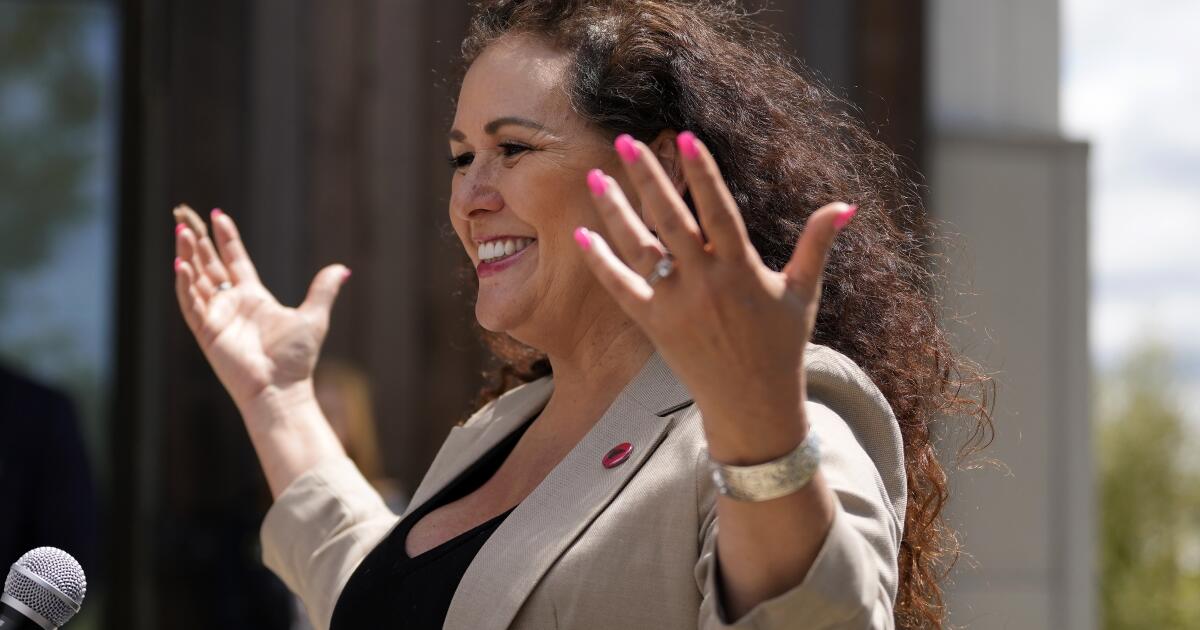
“This is a priority for the entire nation,” Lorena Gonzalez, president of the California Federation of Labor Unions, said at a news conference near the state Capitol. “He cannot spend his time waiting to be done in California and think he’s not going to get questions about the true issues surrounding AI, Big Tech and the Big Tech billionaires that are trying to buy our government.”
Gonzalez, a former state lawmaker from San Diego, said the federation is sponsoring a package of new bills aimed at reining in the use of AI and protecting the rights of workers, including safeguards against spying in the workplace and restrictions on layoffs.
The package of bills supported by labor organizations includes:
- Senate Bill 947 by Sen. Jerry McNerney (D-Stockton), which would require human oversight if an algorithm is used to justify the discipline or termination of an employee.
- Senate Bill 951, introduced by Sen. Eloise Gomez Reyes (D-Colton), which would require employers to provide a 90-day advance notice to workers and local and state governments before AI-related layoffs. It would apply to cases affecting 25 or more workers or 25% of the workforce, whichever is less. Recent layoffs, including at Amazon, Expedia and Pinterest, have been tied to AI, although some economists argue it’s challenging to determine whether that was the primary factor.
- Assembly Bill 1331, dubbed “No bosses in the bathroom,” would grant workers the right to remove workplace surveillance tools when entering public bathrooms or certain employee-only areas. The bill, authored by Assemblymember Sade Elhawary (D-Los Angeles), would subject employers to a $500 civil penalty for violations.
Gonzalez said labor organizations are often told to “work it out” with businesses but argued this was a dead end.
“We are not going to be able to achieve guardrails by working with bosses who want no guardrails,” she said. “It is time that the governor engages with workers in the workplace. Every AI convening he does, everybody he’s pulled together is [representing] AI and Big Tech lobbyists.”
Gonzalez was joined Wednesday by Liz Shuler, president of the AFL-CIO, and other labor leaders from Iowa, Georgia, North Carolina and Nevada.
“This is the most urgent issue that we [as workers] are facing,” Shuler said. “This is a crisis and no one is prepared.”
In a joint letter addressed to Newsom, they implored the governor to act quickly to establish meaningful safeguards around the technology.
“This fight extends beyond devastating job losses and new forms of union busting,” a copy of the letter states. “There is dignity in human work that is the foundation of a healthy, productive democracy. The future of our economy and our society cannot be left to the unchecked whims of profit driven technology corporations and billionaires.”
In an email to The Times, Newsom spokesperson Tara Gallegos said the governor had a strong record of fighting for workers’ rights, including raising the minimum wage and expanding sick leave and other worker protections.
“No Governor has done more than Governor Gavin Newsom to regulate AI in a way that protects workers without killing jobs or innovation,” she wrote. “Under his leadership, California has taken the most comprehensive, worker-centered approach to AI in the country.”
Adults in the United States are growing increasingly concerned about the ramifications of AI, according to a survey from the Pew Research Center. Fifty percent of those surveyed last year said they are “more concerned than excited” about the increased use of AI in daily life, up from 37% in 2021.