TONOPAH, Nev. — Some years ago, Harry Chahal and his wife were on a trip to Las Vegas when, like countless motorists before and since, they passed through this high desert speck of a town.
Tonopah, built by the mining industry around 1900 and depleted as the gold, silver, lead and mercury waned, is a remote way station about halfway between Reno and Las Vegas. Signs on either side warn — ominously, given the unforgiving expanse ahead — that once you’ve left, the nearest gas station is not for another 100 miles or so.

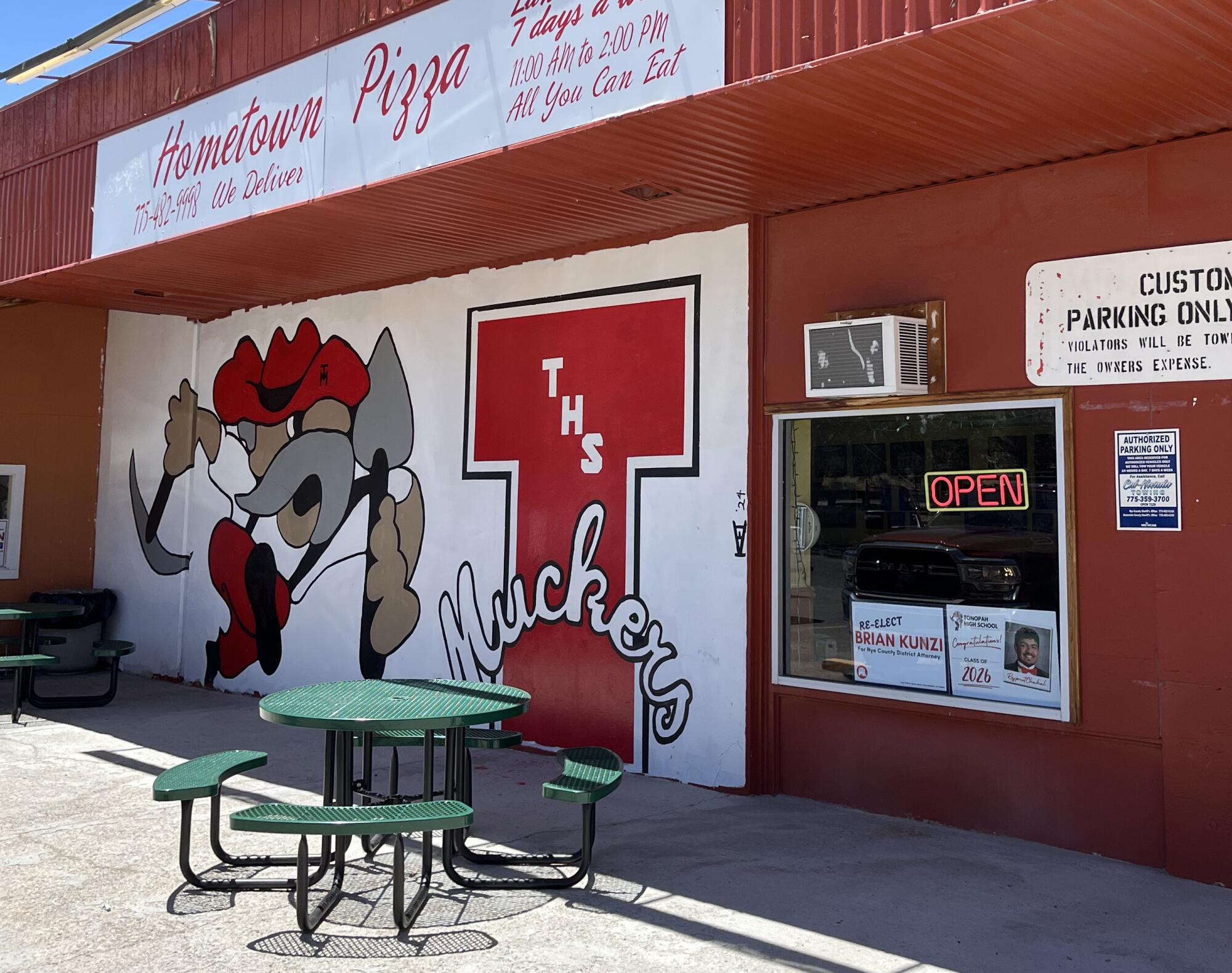
Harry Chahal opened hometown pizza in 2015 after driving through town and seeing there was no pizza place.
(Mark Z. Barabak / Los Angeles Times)
As he passed through town, Chahal noticed something missing: a pizza parlor.
Pizza is not generally associated with Punjab, India, where Chahal — given name Harvarinderjit — is originally from. But he learned how to make pizza, and how much customers loved gobbling it up, while working at different gas station mini-marts around rural Nevada.
In that absence, Chahal saw opportunity.
He and his wife, Ravinder, moved to Tonopah and in 2015 opened Hometown Pizza in a vacant building on U.S. Route 95, which runs through the heart of town. Ten years later, they bought the Dream Inn Motel, a 39-room operation just up the road.

Views of the 47th president, from the ground up
Lately, Chahal has been sprucing up the motor inn: new cabinets, new furniture, fresh paint every few months. The reason is President Trump.
Tonopah and the surrounding desert, stretching farther than the eye can reckon, is verging on a boom, owing to vast reserves of lithium, boron and other sought-after materials and a Trump administration promise to turn the U.S., in the words of Interior Secretary Doug Burgum, into “a mineral powerhouse once again.”
Chahal, 40, is a repeat Trump voter and even though he has issues with some of what the president has done — he’s not happy about the war with Iran and inflation has taken a decent-sized bite out of his pizza business — he feels his faith in Republicans in general and Trump in particular have paid off.
A registered nonpartisan, Chahal is fairly apolitical. “I vote for Republicans because they’re better for business,” he said as a lunch-time crowd of locals and folks passing through tucked into the $11.99 pizza-and-salad buffet. Here’s proof: In the last year, Chahal said, he’s seen motel occupancy increase significantly, from around 15 rooms rented each night to 25 or more.
Those fresh touches to the Dream Inn are Chahal’s investment in the future and a belief that, with Trump in office, even better times lie ahead.

Tonopah was built as a mining town around 1900. It’s fortunes have waxed and mostly waned.
(Mel Melcon / Los Angeles Times)
::
For much of its being, Tonopah relied on metal, minerals and other valuables scooped from the earth. Today, government is the largest employer.
But mining continues to hold fast to the town’s imagination.
A headframe — that’s the tower built directly over an underground mine shaft — is part of Tonopah’s logo. Mining-related sculptures, including statues of Jim and Belle Butler, who staked the first claim in the 20th century silver rush, dot the main thoroughfare. The high school’s athletes are called the “Muckers,” after those who shovel ore into underground rail cars.
The Tonopah Historic Mining Park is a big tourist attraction, along with the Clown Motel and other lodging establishments supposedly haunted by the ghosts of dead miners and other paranormal phenomena. (Chahal says there are no apparitions at the Dream Inn.)

The Clown Motel, which draws visitors from around the world, is said to be haunted by the ghosts of dead miners.
(Christopher Reynolds / Los Angeles Times)
Lately, however, mining is becoming more than just a part of nostalgic lore. It’s poised to again be a major boon to the local economy and the town’s 3,000 residents.
Plans are underway for a new lithium and boron mine at Rhyolite Ridge, approximately 30 miles southwest of Tonopah, in Nevada’s Silver Peak Range. (Lithium, most of which is now imported, is a vital ingredient in the batteries that store solar energy and power electric vehicles; boron is used, among other things, for bulletproof armor and vests.)
About 27 miles to the south of Tonopah, near the town of Goldfield, a new gold mine is set to open in 2028.
Joe Westerlund, Tonopah’s town manager, said fresh development and the prospect of hundreds of new, good-paying jobs are much welcomed. The median income here is about $37,000 annually, less than half the state average. The hospital in town closed in 2015. Venture off U.S. 95 and the rolling hills are flecked with weathered miner’s cottages and tumbledown homes no longer fit for habitation.
(A three-bedroom, two-bath home in a comfy subdivision on the north end of town can be had for around $250,000, but don’t hurry over to buy; inventory is low and could grow even leaner if demand for housing increases.)

The Tonopah Historic Mining Park is a big local tourist attraction.
(Mark Z. Barabak / Los Angeles Times)
While some of the groundwork for the mining resurgence was laid during the Biden administration, Trump is credited with fostering a much friendlier regulatory environment, which promises even more opportunities for extraction.
“As soon as he got into office, things started loosening up. We had 15 drill rigs,” said Westerlund, who has lived in Tonopah since 1972. “I had never seen that before in my life.”
There are, of course, environmental concerns — about pollution, water supply, native habitat — but those worries haven’t gained much of a toehold. Nye County, which is home to Tonopah, isn’t exactly tree-hugger country — and not just because most of the land is scrub-filled desert. Trump carried Nye County all three times he ran, with landslide support ranging from 68% to 70%.
“This is a pro-Trump town,” Westerlund said, “and I feel like his policies are doing good for the town.”
Chahal stands ready to cash in, knowing firsthand what economic good times feel like.

The Mizpah hotel, opened in 1908, offers the plushest accommodations in town.
(Chris Erskine / Los Angeles Times)
When he moved here in 2014, he and his wife were forced to stay in a motel for six months because workers finishing up a $1 billion solar energy project were taking up most of the living space. That’s the kind of extended-stay guest he’s after, not the tourists bedding at the Mizpah Hotel, the plushest resort in town, with its cut-glass chandeliers, Victorian furnishings and photo gallery of celebrities who’ve stayed the night.
“If I can rent 25 rooms a night, maybe 15 can be for the long term” of several weeks at a time, Chahal said. He’s done the math — $82 a night for a queen bed, single occupancy; $89 for a king — and likes how it pencils out.
::
Chahal came to the U.S. in 2006, after marrying Ravinder, who grew up in the Sacramento area. She had family in Punjab and was a regular visitor to India. The two met when they were 10 years old. Chahal became an American citizen in 2020.
Politically, Indian Americans lean heavily toward the Democratic Party. But in the tiny Nevada communities where the couple lived — Lovelock, Battle Mountain and Ely before Tonopah — there was little or no Indian American presence. So Chahal wasn’t acculturated into the party the way many others have been. Rather, he embraced the GOP gospel of lower taxes and less regulation.
Working seven days a week, Chahal has little time these days for politics, beyond voting. He isn’t particularly ideological or, for that matter, worshipful of Trump.
“Every coin has a head and a tail,” he said, flipping his wrist as though tossing a quarter in the air. He sees two sides to the president. “Maybe you’re angry for some things,” Chahal said. “Maybe you agree with some things.”
He supports the notion of tariffs as a way of bringing manufacturing jobs back to the U.S. He also laments that the pizza boxes he uses, which are made in China, once cost him 30 cents and now run almost 67 cents apiece.
He backs Trump’s promise to round up and deport violent criminals who are in the country illegally. But he’s also mindful of the important role immigrants play, especially in areas like farming and construction, in sustaining the U.S. economy.
Chahal criticized the heavy-handed enforcement that resulted in the killing of two protesters in Minnesota. But he blamed their deaths on overzealous ICE agents, not Trump.
Living in a town greatly shaped by outside forces — the fluctuation of commodity prices, the changing of presidential administrations, the shifting priorities emanating from Washington — Chahal is familiar with vicissitudes and the business cycles of boom and bust.
Not everything Trump has done has helped the mining industry.
His tariffs and inflation have greatly increased construction costs. Cuts to the federal workforce have slowed the oversight and approval processes. His hostility toward green energy has dampened the market for electric vehicles and made solar energy considerably less attractive.
But based on the talk around town, Chahal believes a more prosperous future is in the offing. He certainly hopes so, and he’s counting on the president to deliver.
If the Constitution allowed for a third term, Chahal said, he wouldn’t hesitate voting for Trump again.