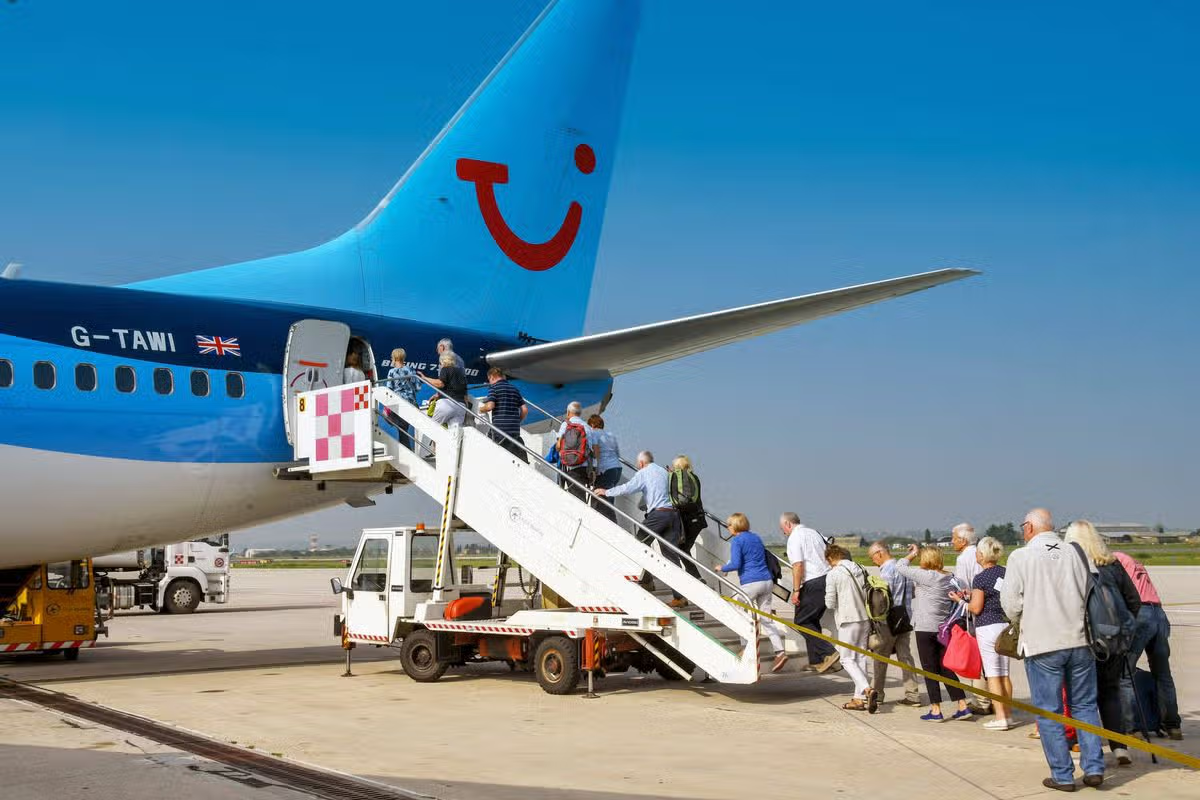
TUI is one of the UK’s most recognisable holiday companies, but despite millions of people booking trips with the company, many are still unaware of a detail about its name

People have no idea what TUI stands for (file)(Image: Ceri Breeze via Getty Images)
It’s one of the most recognisable airlines in the world, but not everyone knows what the company’s name actually stands for. Established in December 1968, TUI was formed when several German tour operators joined forces under a single name.
During the 1970s, the company expanded its hotel portfolio with the launch of the Robinson brand. Around the same time, former London taxi driver, ice cream truck operator and movie extra Neil Scott founded the travel agency Owners Abroad. By the 1980s, TUI had established itself as a “one-stop shop” for holidays and travel across Europe. In the late 1990s, the company became part of industrial conglomerate Preussag AG.
Then, in 2014, TUI AG and TUI Travel PLC merged to form the fully integrated TUI Group.
Despite its lengthy history, countless holidaymakers still remain in the dark about what TUI actually stands for, with one social media user asking: “This might be a stupid question, but what is TUI? I keep seeing it in posts. Is it a travel company?”.
According to TUI’s website, the name dates back to 1968, when the German tour operators united, with TUI standing for ‘Touristik Union International’.
TUI’s 2026 strategy
Today, the company centres its focus on holiday experiences, markets and its airline and central customer ecosystem.
Its strategy states: “The travel and tourism market is a significant contributor to the global economy, growing above global GDP levels pre-pandemic.
“Demand for tourism is driven by strong fundamental trends – people living longer, healthier lives; the growth of middle classes across the globe, which increases disposable income; and the desire for experiences, of which travel plays a significant part.
“TUI is well positioned within this attractive market, as a leisure experiences group covering the entire holiday journey, serving millions of customers, operating aircraft, hotels and cruise ships, as well as a sizeable experiences, transfers and tours business.
“TUI’s strategy focuses on delivering profitable growth, driven by growth in differentiated product, increased customer choice and flexibility, strong focus on operational efficiency and maximizing business synergies, and the implementation of scaleable platforms to enable global expansion.
“Our strategy is defined across both of our business divisions (Markets + Airline and Holiday Experiences), embedded onto one central customer ecosystem, underpinned by our Sustainability Agenda and by our people.”
TUI’s reputation with customers
Meanwhile, holidaymakers have been sharing their thoughts on the company after one traveller asked fellow passengers what they could expect ahead of their first ever TUI flight.
They wrote: “I’m flying from Manchester via TUI and it’s my first experiencing a flight not from Ryanair. What can I expect?”
In response, one user said: “I flew TUI once in 2016 and the plane was a slightly nicer budget airline-esque model with comfier seats and more leg room.”
Another added: “A comfortable seat and a little more leg room.”
A third user said: “I found that they are pretty visible through your journey airport side both directions. Very helpful, great app and reps were spot on hotel side. Relax and enjoy..”
Another user joked: “You get a pocket in the seat in front, at least.”
A final user added: “Communications from TUI are often good, with updates provided via email or their systems during travel.
“Seat allocation is automatic unless you pay to choose seats, so sitting together isn’t guaranteed.
“Luggage allowances are generally generous on package holidays, often including 20kg checked baggage plus cabin luggage.”
Ensure our latest headlines always appear at the top of your Google Search by making us a Preferred Source. Click here to activate or add us as Preferred Source in your Google search settings