Travellers

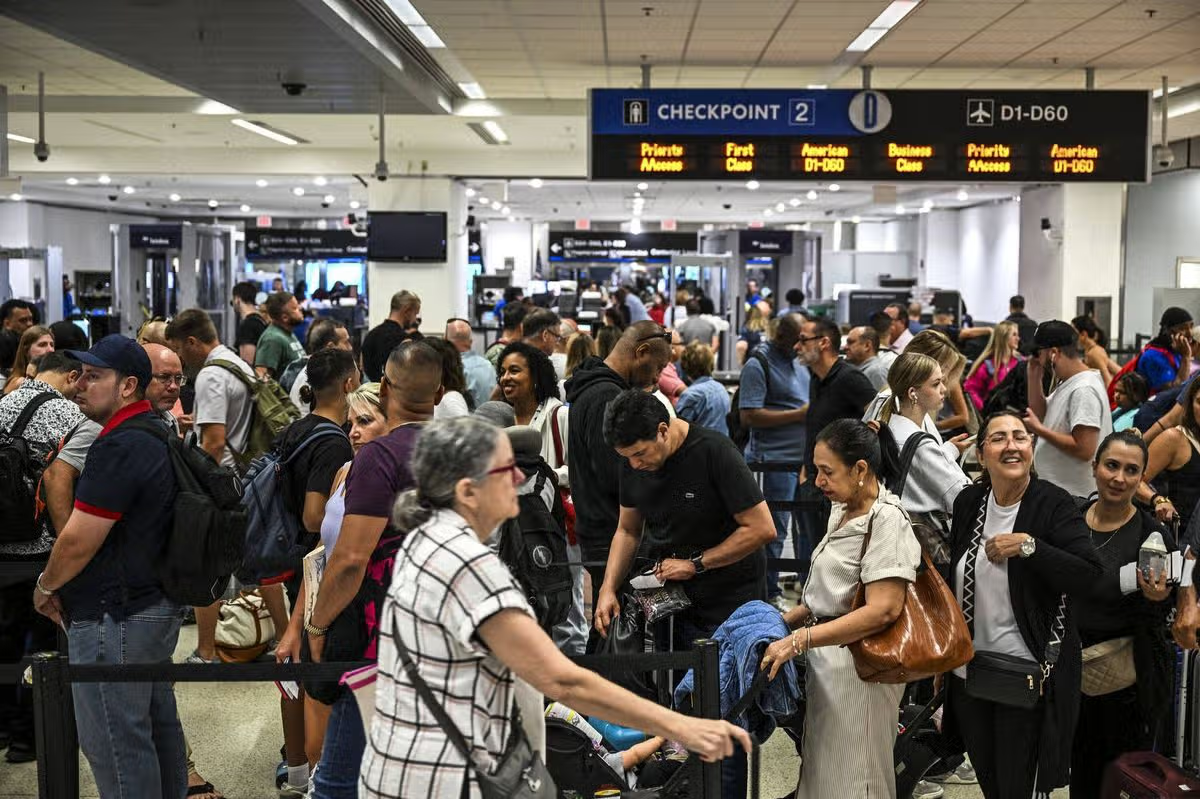
Airport security stainless steel bottle ‘rule’ all UK travellers must know

Airport security stainless steel bottle ‘rule’ all UK travellers must know – The Mirror


reach logo

At Reach and across our entities we and our partners use information collected through cookies and other identifiers from your device to improve experience on our site, analyse how it is used and to show personalised advertising. You can opt out of the sale or sharing of your data, at any time clicking the “Do Not Sell or Share my Data” button at the bottom of the webpage. Please note that your preferences are browser specific. Use of our website and any of our services represents your acceptance of the use of cookies and consent to the practices described in our Privacy Notice and Terms and Conditions.

Source link

Key new jet fuel supply update for travellers to Spain, Italy and France

An important update for family holiday plans

Holidaymakers planning trips to Mediterranean hotspots are being met with an enticing development as airlines grapple with concerns over possible jet fuel shortages this summer.

Ticket prices on major routes to destinations across Spain, Italy and France have tumbled by double digits – and in some instances drastically – as carriers attempt to entice hesitant travellers into making bookings. Costs have declined by 10% or more on 15 sought-after routes, including flights from Heathrow Airport to Nice, Manchester to Palma, and Gatwick Airport to Barcelona.

In the most striking case, fares between Milan and Madrid have nosedived by as much as 44%, according to analysis by the Financial Times.

The unexpected price cuts arrive as airlines wrestle with a decline in bookings, with numerous travellers postponing holiday arrangements amid warnings that jet fuel supplies could face disruption following tensions related to the closure of the Strait of Hormuz.

Industry insiders say consumers are holding fire, creating a high-stakes “confidence game” as airlines cut prices aggressively to fill seats before the peak summer holiday period.

One airline boss compared the present climate to the uncertainty experienced during the Covid pandemic, cautioning there remains “a lack of visibility” over how the situation will develop.

Analysis of fares between early April and early May reveals prices dropping on more than half of the busiest routes to southern Europe, particularly to seaside destinations around the Mediterranean. Significantly for families, the steepest reductions are being witnessed on traditional summer routes, with eight of the top 50 routes recording decreases of 20% or more. In contrast, only a small number of routes have experienced similarly sharp rises.

Travel industry insiders told the FT that holidaymakers were “freezing in the headlights”, resulting in them making reservations later than normal or opting for UK getaways instead.

READ MORE: UK officials issue 2026 Summer holiday fuel shortage update for families

Research indicates one in five Britons has already switched an overseas holiday for a domestic break this year, with another fifth contemplating doing likewise.

Airlines are now being compelled to boost demand through reduced fares even as fuel expenses climb and timetables are scaled back. Approximately two million seats have already been removed globally from May timetables, reflecting both elevated costs and weaker demand.

Low-cost carriers including easyJet and Wizz Air have acknowledged that passengers are making bookings later, while also seeking to reassure travellers.

EasyJet has committed not to impose fuel surcharges on existing package reservations, while British Airways has guaranteed prices will not increase after holidays are settled.

Despite the unpredictability, industry insiders emphasise the overwhelming majority of flights are still anticipated to run. Even in a worst-case scenario, only approximately 5% to 15% of flights could be axed and passengers would probably be transferred onto alternative services.

Source link

EasyJet issues new Saturday ‘flights and package holidays’ update for UK travellers

EasyJet has issued a new statement this Saturday, May 2 as UK travellers consider their holiday plans amid concern over jet fuel shortages

EasyJet has issued a new update for UK travellers currently looking to book their summer flights. Holidaymakers up and down the country are busy making plans for the warmer months ahead.

However, they are doing so amid uncertainty hanging over parts of the airline industry. This follows jet fuel shortages brought about by the effective closure of the Strait of Hormuz by Iran.

Lufthansa has already confirmed that 20,000 of its flights are to be axed as a result. Industry experts warn that further airlines are likely to slash their capacity in the coming weeks – with Ted Wake, managing director of Kirker Holidays, last week predicting that “I think other airlines within the UK market will be doing something similar.”

Across the Atlantic, we reported earlier today that budget carrier Spirit Airlines has announced it is grounding all of its flights, as the jet fuel crisis, combined with mounting financial pressures, pushed the airline to the edge of collapse. easyJet has now set out new commitments to customers alongside a fresh statement.

It is all part of a bid to put the minds of UK passengers at rest as they weigh up their summer travel options. Ryanair and Wizz Air have also moved within the past 24 hours to offer their own reassurances to British holidaymakers.

In a statement released today, easyJet said: “easyJet is not seeing any disruption to fuel supply. We continue to operate our flights and package holidays as normal, are not making changes and intend to operate our full summer schedule. We remain in close contact with suppliers who continue to provide uninterrupted supply and are diversifying exporting from additional countries globally to bolster supplies going forward.”

easyJet made the latest statement as it introduced new measures designed to give UK travellers greater peace of mind when booking flights. The airline has unveiled a ‘Book with Confidence Promise’ in a move to reassure passengers ahead of the summer season.

The carrier says it is guaranteeing that customers won’t be hit with post-booking price rises or fuel surcharges. easyJet says it plans to operate its complete network schedule, which includes more than 50 million seats and 30 new UK routes.

According to the airline, the ‘Ultimate Flexibility’ policy enables holidaymakers to amend or cancel their bookings up to 28 days prior to departure. Kenton Jarvis, CEO at easyJet said: “We understand that global events may affect travellers’ confidence at the moment, but we believe that everyone has a right to book their flights and holidays with confidence.

“That’s why we’re launching our ‘Book with Confidence Promise’. Our customers won’t be charged any more after they book, including no fuel surcharges, and package holidays customers can continue to benefit from Ultimate Flexibility when they book with easyJet Holidays.”

Jet2, easyJet and TUI have all pledged not to impose additional charges on travellers for fuel price increases. In new remarks published today, Michael O’Leary, the boss of Ryanair, Europe’s largest airline, told The Times that 80 per cent of its fuel supply until March 2027 had been secured in advance. He confirmed the company would not be reducing any flights, despite the crisis costing the firm approximately £37 million each month in extra fuel costs on its unhedged supply.

Eddie Wilson, chief executive of Ryanair, warned that rival airlines could soon begin “gouging” their schedules should prices remain elevated. He said: “What’s going to happen with airlines that are not financially robust, they either have to decide whether they are going to continue flying at a loss or start gouging their schedules. That’s not something we are contemplating.”

Meanwhile, Wizz Air has also moved to reassure customers. Speaking to renowned UK travel broadcaster and journalist Simon Calder on his Independent travel podcast, the airline expressed confidence that it will deliver a full schedule of flights this summer.

“We have just launched our biggest-ever network from the UK and in particular from Luton,” said Yvonne Moynihan, managing director of Wizz Air UK. “Despite the challenging geopolitical crisis, business goes on as usual. In airlines, we are well used to crises, so we are resilient and we’re well adapted.

“For low-cost airlines like Wizz in the UK, we don’t see any shortage of fuel.” She said that if jet fuel shortages affected the UK, the airline would get fuel from elsewhere.

“We can take more fuel than is required in those destinations,” she said. “We can even fly to other countries and and pit-stop, if you will, if we need additional fuel.

“But we’re not seeing an Armageddon situation. We have fuel supply. We have other mechanisms for uplifting fuel.”

A Jet2 spokesman said: “We remain in continual dialogue with our fuel suppliers, as is standard practice. Based on the conversations we have been having, we see no reason not to look forward to operating our scheduled programme of flights and holidays as normal.”

Airlines UK said: “UK airlines continue to operate normally and are not experiencing issues with jet fuel supply.”

Source link

Major EU travel rule change from Wednesday could see UK travellers denied entry

You need a new document at a cost of £90 a time

People travelling from the UK to Europe have been warned of a major passport change this week, making documents invalid from Wednesday, April 22. The post-Brexit change means that anyone travelling with a pet will need new documentation or face being sent home.

Until now, people taking their pets abroad – whether by plane, train, ferry or car – could use an EU Pet Passport. The EU Regulation 2016/429 – known as the Animal Health Law – comes into force this week after a 10-year transition.

That means anyone going to Europe with their pet now needs an Animal Health Certificate. The certificate requires a vet visit within 10 days of your trip, a new certificate each time and a £90 payment – per pet.

The Animal and Plant Health Agency (APHA) issued Briefing Note 14/26 on April 17, 2026. This statement marks a significant shift in pet travel rules, effectively ending the “loophole” where Great Britain (GB) residents used EU-issued pet passports to avoid the cost of Animal Health Certificates (AHCs).

A spokesman said: “An EU pet passport, issued to or held by a pet owner who is resident in GB, will no longer be a valid document for travelling with pets from GB to the EU. This applies to EU pet passports issued in an EU Member State or Northern Ireland, including those issued before 22 April 2026 . EU pet passports may only be issued to owners whose main residence is within the European Un ion.”

If your primary residence is in Great Britain, you cannot use an EU pet passport for travel from the UK to the EU, regardless of where or when that passport was issued (e.g., if you obtained it in France or Spain). UK residents must now obtain an Animal Health Certificate (AHC) for every single trip to the EU.

The briefing clarifies that EU pet passports issued in Northern Ireland are also invalid for travel if the owner is a resident of Great Britain.

APHA is updating the AHC forms to align with new EU regulations. While these new templates are being finalised, there is a transition period where older AHC templates will still be accepted for travel into the EU. There are currently no changes to the requirements for pets entering GB. You can still use a valid EU pet passport or AHC to return to the UK.

For dogs, the requirement for a vet-administered tapeworm treatment between 24 and 120 hours before arriving back in GB remains in place.

You should contact your vet immediately to arrange an AHC, as pet passports will no longer be accepted at the border for UK residents from that date.

Updated rules on the movement of dogs, cats and ferrets are included in a January 2026 EU regulation which is coming into force on April 22.

Source link

Jet2 holidays changes to 14 day rule for all travellers and sends email

Airline and travel company has contacted all passengers with holidays booked to inform them of a change to when booking documents are sent out amid Middle East conflict concerns

All Jet2 passengers with holidays booked have been contacted by the operator regarding an important change. Thousands of travellers have received emails notifying them that their holiday documents will be arriving later than originally expected.

This has raised alarm bells among some customers who fear it could be a scam – particularly as Jet2 has recently been warning about numerous fake social media accounts being created in an attempt to defraud passengers.

One passenger wrote on X: “@jet2tweets Hi, I’ve just received this email apparently from Jet2 saying I will now get my holiday documents 14 days before my holiday departure instead of 28, is this true or is it still 28, I’ve a feeling this was a spam email though.”

Another passenger added: “I had the same email. Flying on 25 May with jet2,” A traveller added: “Ive just had the same email !”

The email says: “Just so you know, following a change to when we send out the documents for your holiday, you’ll now receive your documents 14 days before departure, rather than 28 days as stated on your original booking confirmation. You don’t need to contact us or take any action – you’ll recveive your documents 14 days before you travel. Have a lovely holiday!”

Responding on X, Jet2 confirmed it was a genuine message and explained: “Hi there, thanks for reaching out. Yes we can confirm that you will receive your documents 14 days before departure. Should you require any further assistance, then please feel free to send us a DM. “

The shift towards holidaymakers securing their travel documents closer to their departure dates comes amid growing uncertainty sparked by the Middle East conflict. Last week, Fatih Birol, executive director of the International Energy Agency (IEA), warned there could be flight cancellations “soon” if oil supplies remain restricted by the Iran war.

The head of the world’s energy watchdog also cautioned that Europe has only six weeks’ supply of jet fuel because of the Middle East conflict. Iran continues to have a stranglehold on tankers passing through the Strait of Hormuz and has fired at several over the weekend.

Worried holidaymakers have been flooding Jet2’s social media channels with their concerns. One wrote: “@jet2tweets Hi there – we are looking to go away for a week to Malaga in June and want to know how concerned we should be about the reporting of lack of airport fuel and what happens to our holiday should something like this happen and impact our holiday. Can you help…?|”

Another posted: “Are holidays going ahead as usual? We’ve booked an all inclusive 10 day to Crete in June. I’m worried about jet fuel prices.” While a further traveller asked: “You guys aren’t planning on last-minute flight cancellations due to potential jet fuel shortages, are you? Family holiday booked in May, FYI” Jet2 responded: “Hi all, flights are planned to go ahead as normal. If anything were to change regarding your booking, we would be sure to reach out to you directly to make you aware and discuss the options available to you. Thanks”

Meanwhile, Javier Gándara, easyJet’s CEO for Spain and Portugal, spoke at the reopening of the airline’s base in Palma, Mallorca, where he gave his assessment of the current fuel supply situation: “What the producers and airports are telling us is that there won’t be any supply problems for the next three or four weeks.

“Beyond that, it’s difficult to see. In Spain, we are in a comparatively better situation than neighbouring countries for two reasons. Firstly, because of all the crude oil that is imported and then refined here, only 11% comes from the Middle East, which is the percentage affected by the closure of the Strait of Hormuz; the remaining 89% comes from elsewhere.”

He went on to warn: “No one will be immune to potential supply problems. Ships that leave and pass through the Strait of Hormuz and come to Europe take an average of 45 days, and they have already been practically out of service for two months. It will take time to recover all of that. It’s difficult to know what will happen, so we’ll react as we go.”

Source link

Senior travellers urged to do simple exercise on the plane ‘every 30 minutes’

Long-haul flights can cause in-flight circulation stiffness and fatigue, especially for older travellers

Anyone who’s flown long-haul will be acutely aware of the stiffness, exhaustion and sluggish circulation that can develop, potentially marring the start of your holiday. And this is particularly relevant for older passengers.

With this in mind, Inspiring Vacations has teamed up with Melbourne-based Pilates instructor Brittany Tatterson to reveal some movements anyone can perform while still aboard their flight.

She explained: “Seated movements every 30 to 60 minutes are ideal, with the opportunity to stand and walk every one to two hours where possible. Many people wait until they already feel stiff, but by that point the body has already tightened and circulation has slowed.

“The good news is you don’t need to stand in the aisle or take up extra space. The most effective movements are often the smallest and can be done entirely within your seat.”

The discreet in-seat exercises you can do (without anyone noticing)

The first movement Brittany suggests is gently tilting your pelvis forward and backwards, as this can help engage your core and relieve pressure from your lower back.

“You can also keep your toes on the floor and slowly lift your heels up and down to encourage circulation through the legs, which is particularly important on long-haul flights,” Brittany added.

“Breathing is another big one. Inhaling through your nose and allowing your ribs to expand, then exhaling slowly, can help improve both your breathing and overall energy levels.” She also notes that even minor neck movements, such as gentle nods, turns and slight tilts, can alleviate tension that accumulates from screen time and poor posture.

Meanwhile, simply clenching and releasing your glutes can help support your pelvis and ease strain on the lower back without drawing any attention from those around you.

How to move without annoying your neighbour

While these movements are vital for a comfortable journey, Brittany emphasises that they should never come at the expense of those around you.

“Move slowly and mindfully; there’s no rush. Slower movement is not only more considerate, it’s actually more effective for the body,” she says. “The key is to keep everything small and controlled, staying within your own space wherever possible.”

A few simple etiquette rules can make all the difference:

  • Keep movements small and within your seat space
  • Avoid wide arm stretches or anything intrusive
  • Move during quieter moments, not meal service
  • Only walk the aisle when it’s clear

Source link