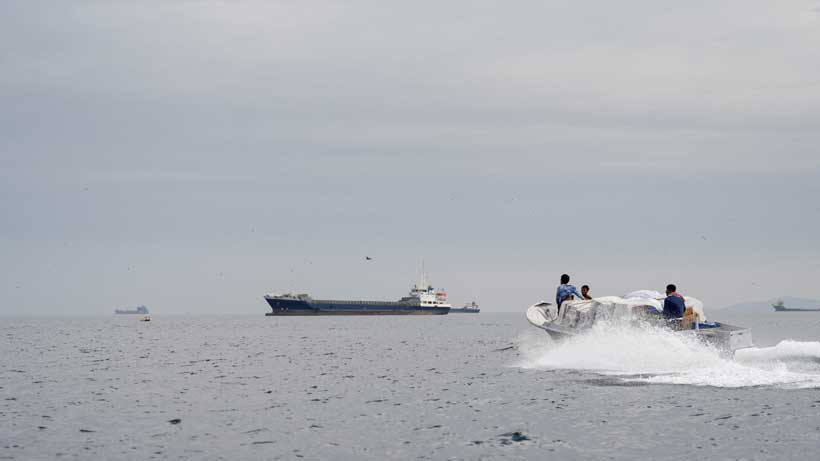
President Donald Trump announced on Sunday that the U. S. Navy would begin a blockade of the Strait of Hormuz following unsuccessful talks with Iran, endangering a fragile two-week ceasefire. Trump stated that the Navy would take action against vessels in international waters that had paid Iran a toll and would destroy mines allegedly placed by Iran in the strait, a critical passage for about 20% of global energy supplies.
Trump declared, “Effective immediately, the United States Navy. . . will begin the process of BLOCKADING any and all Ships trying to enter, or leave, the Strait of Hormuz. ” He added that no vessel paying an illegal toll to Iran would have safe passage and warned that any Iranian who fired at the U. S. or peaceful vessels would face severe consequences. Trump also mentioned that NATO allies had expressed interest in assisting with this operation.
In an interview with Fox News, Trump anticipated that Iran would return to negotiations, suggesting that his comment about wiping out Iranian civilization had prompted initial discussions. Each side blamed the other for the failure of the talks, which aimed to end six weeks of fighting that resulted in thousands of deaths and rising oil prices. Vice President JD Vance, who led the U. S. delegation, indicated that Iran’s unwillingness to accept terms relating to nuclear weapons was the main obstacle.
Iranian Parliamentary Speaker Mohammad Baqer Qalibaf criticized the U. S. for failing to earn Tehran’s trust despite proposed initiatives. He emphasized that the U. S. needed to decide if it could gain Iran’s trust. The recent talks were the first direct U. S.-Iranian meeting in over a decade and came after a ceasefire was announced.
Despite ongoing negotiations, Israel continued its military actions against Hezbollah militants in Lebanon, claiming that this conflict was separate from the U. S.-Iran ceasefire discussions. Israeli military struck Hezbollah rocket launchers, while air raid sirens in Israeli villages signalled incoming rocket fire from Lebanon. Iran seeks control of the Strait of Hormuz, war reparations, a regional ceasefire, and the release of its frozen assets. Even amidst these tensions, three supertankers laden with oil successfully passed through the Strait of Hormuz, marking the first vessels to leave the Gulf since the ceasefire deal.
With information from Reuters