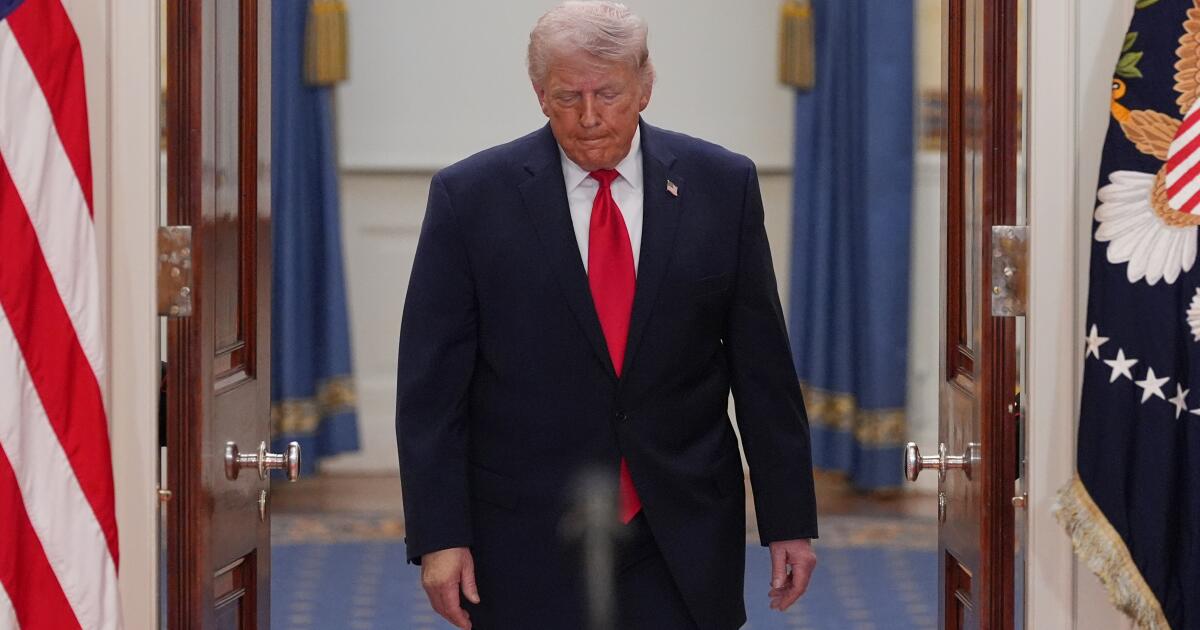
President Trump’s meandering speech on the Iran war late Wednesday — in which he paired promises of a swift exit with new threats of escalated bombing and denied responsibility for the Strait of Hormuz — did little to assuage U.S. allies and world markets concerned about the conflict’s ongoing disruptions to the global oil supply.
Stocks dropped after markets opened Thursday and oil prices soared, with the price of U.S. crude oil jumping more than 10%, to above $110.
In the wake of the speech, diplomats from more than 40 nations — not including the U.S. — met to strategize on how to lift Iran’s continued stranglehold on the strait, the vital oil corridor that the U.S.-Israeli war drove Iran to restrict but which Trump on Wednesday said wasn’t his problem.
Iranian officials remained unbowed, asserting the U.S. and Israel “know nothing” of its remaining capabilities, that “not a single life will be spared” if either attempts a ground incursion into its territory, and that “every last” Iranian would become a soldier if necessary.
“Iranians don’t just talk about defending their country. They bleed for it,” Iranian parliament Speaker Mohammad Qalibaf, a pugilistic figure and one of Iran’s most prominent wartime voices, wrote on X. “You come for our home… you’re gonna meet the whole family. Locked, loaded, and standing tall. Bring it on.”
Meanwhile, remarks Trump made earlier Wednesday about leaving NATO elicited subtle rebukes from both international and domestic allies, including French President Emmanuel Macron and Senate Majority Leader John Thune (R-S.D.), while the president’s comments about the U.S. not being able to focus on social services like Medicare or other domestic needs such as child care as it wages its foreign war sparked outrage at home.
Far from a call for a unified push to end the war alongside allies, Trump’s speech — his first formal address to the nation since the war began a month ago — further isolated the U.S. and the Trump administration on the global stage.
Trump firmly asserted in his speech that reopening the Strait of Hormuz to oil tanker traffic was not the responsibility of the U.S., despite it causing the war, because it receives less oil from the corridor than other nations.
“The countries of the world that do receive oil through the Hormuz Strait must take care of that passage. They must cherish it. They must grab it and cherish it. They could do it easily. We will be helpful, but they should take the lead in protecting the oil that they so desperately depend on,” Trump said.
“To those countries that can’t get fuel, many of which refuse to get involved in the decapitation of Iran — we had to do it ourselves — I have a suggestion: No. 1, buy oil from the United States of America. We have plenty. We have so much,” Trump continued. “And No. 2, build up some delayed courage.”
He said those nations should have been better assisting the U.S. in its war effort already, but should now “go to the strait and just take it, protect it, use it for yourselves.”
“Iran has been essentially decimated,” he said. “The hard part is done, so it should be easy.”
Trump has consistently downplayed the threat Iran continues to pose in the region. And securing the strait — which runs along Iran’s mountainous coast, full of strategic locations from which Iranian forces can threaten ship traffic — is not an easy task, as was acknowledged by the foreign diplomats meeting to solve the issue without the U.S. on Thursday.
“We have seen Iran hijack an international shipping route to hold the global economy hostage,” said U.K. Foreign Secretary Yvette Cooper.
Meanwhile, Macron, speaking in South Korea, said the U.S. “can hardly complain afterward that they are not being supported in an operation they chose to undertake alone.”
Macron also slammed Trump’s criticism of NATO, which Trump called a “paper tiger” in remarks prior to his speech Wednesday.
“If you cast doubt on your commitment every day, you erode its very substance,” Macron said.
Trump for weeks has suggested that NATO allies who declined to join the U.S. war had failed to live up to their treaty obligations, and that remaining in the alliance may not be worth it for the U.S., though he made no mention of NATO in his Wednesday evening speech.
Trump has no power to unilaterally withdraw the U.S. from NATO. That power sits with Congress — where Trump’s own allies downplayed the idea.
“We got an awful lot of people who think that NATO is a very critical, incredibly successful post-World War II alliance,” Thune said. “I think in the world today, you need allies.”
Trump’s formal speech appeared to be geared in part toward his allies at home, including his MAGA base, where frustrations with the war have mounted among the cohort of Trump supporters who’d championed his “America First” message and campaign promises to extricate the U.S. from foreign entanglements, not start new ones.
Trump said he has promised since his first foray into politics in 2015 that he would never let Iran develop a nuclear weapon. He told Americans listening that the war “is a true investment in your children, and your grandchildren’s future,” because it was making the world safer.
However, Trump exacerbated frustrations over the war’s distraction from domestic priorities with separate comments he made earlier on Wednesday at a private Easter luncheon, video of which the White House posted online and then deleted.
In those remarks, Trump said U.S. military needs had to take priority over social services and other major costs for Americans, such as child care, which maybe states could pay for by increasing taxes.
“It’s not possible for us to take care of daycare, Medicaid, Medicare, all these individual things,” Trump said. “They can do it on a state basis. You can’t do it on a federal. We have to take care of one thing: military protection. We have to guard the country.”
The president’s political opponents leaped on the remarks as out of touch.
“Trump says we can pay for war in Iran but can’t afford childcare,” Rep. Ro Khanna (D-Fremont) wrote on X, before asserting that the billions of dollars the U.S. has spent in Iran could have been used to offset Americans’ daycare costs.
White House Press Secretary Karoline Leavitt, in response, accused Democrats and the media of taking Trump’s remarks “out of context,” and claiming he was only talking about “stopping the scams” and rooting out fraud in such programs.
Democrats also took broader swipes at Trump’s framing of the war.
“Donald Trump’s month-long war with Iran has come at a big cost to taxpayers and has tragically taken the lives of 13 American service members. He dragged our country into a conflict that rattled markets, drove up gas prices, squeezed working families, and further destabilized the Middle East,” Sen. Alex Padilla (D-Calif.) wrote on X. “With his poll numbers falling to record lows, Trump is now trying to cut and run with little to show for it. He started this unauthorized war with no clear or consistent justification and the consequences of his choices won’t disappear when he walks away.”
United Nations Secretary-General António Guterres on Thursday said the war was “inflicting immense human suffering and already triggering devastating economic consequences,” and called directly on the U.S. and Israel to end it. He also called on Iran to “stop attacking their neighbors” and “respect navigational rights and freedoms along critical maritime routes, including the Strait of Hormuz.”
“Conflicts do not end on their own,” Guterres said. “They end when leaders choose dialogue over destruction.”
In addition to defending NATO, Macron and other French politicians on Thursday were also reacting to Trump mocking Macron in his remarks Wednesday. He mimicked a French accent while accusing Macron of only wanting to aid the U.S. war effort once the battle had been “won” and referenced a moment last year when Brigitte Macron was caught on video pushing her husband’s face, which he said was them joking with each other.
“There is too much talk, and it’s all over the place,” Macron said, according to French newspaper Le Monde. “We all need stability, calm, a return to peace — this isn’t a show!”
Yaël Braun-Pivet, president of France’s lower house of parliament, told the French broadcaster franceinfo that the Iran war is “having consequences for the lives of millions of people, people are dying on the battlefield, and we have a president who is laughing, who is mocking others.”
Times staff writer Nabih Bulos in Beirut contributed to this report.