WASHINGTON — As the year’s midterm primaries draw to a close, Tuesday’s results in Florida, Wyoming and Alaska continued to underscore an unpredictable election season marked by unreliable polls, intra-party divides and surprise showings by political outsiders.
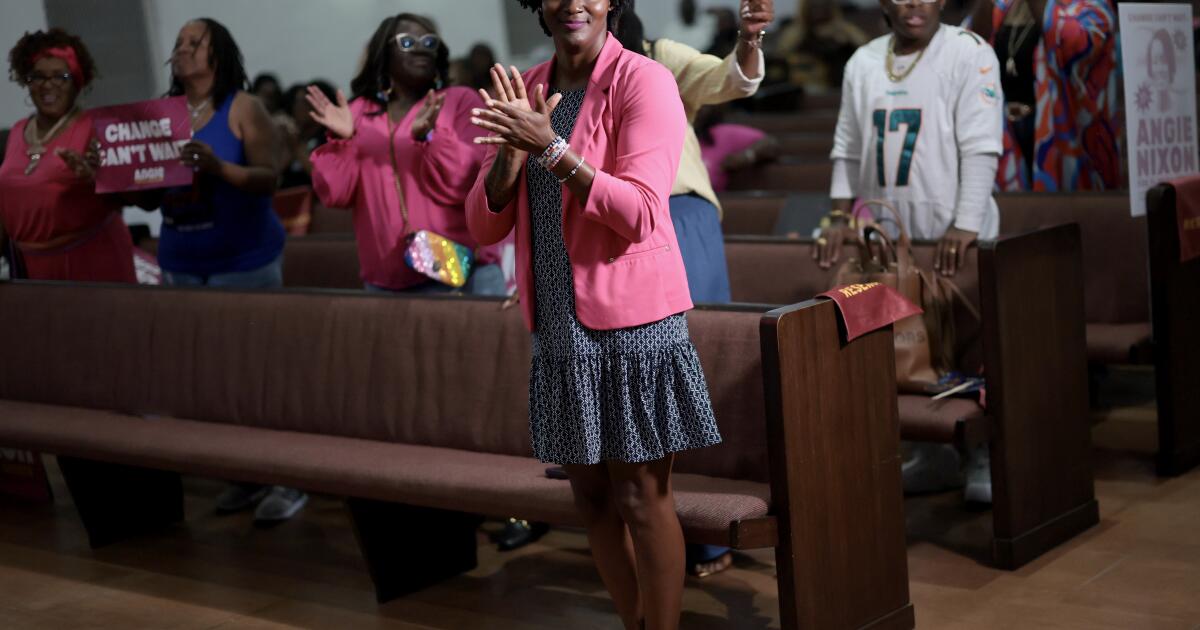
In one high-profile surprise, democratic socialist state Rep. Angie Nixon’s easily defeated former Army intelligence officer Alexander Vindman in Florida’s U.S. Senate primary, despite Vindman having raised 16 times as much money as the new Democratic nominee, according to OpenSecrets, a nonprofit that tracks campaign finance.
According to Florida Politics, a digital media outlet, a now-deleted Change Research poll showed Vindman leading Nixon by 10 points. At that time, 41% of Democrats polled were still undecided.
In the race for a Senate seat Democrats hope to flip, former Democratic Rep. Mary Peltola outpolled incumbent Republican Sen. Dan Sullivan, with another Republican Dan Sullivan — this one a retired teacher — also making the cut for the four-person, ranked-choice general election in November.
The results from Tuesday night also show that President Trump’s influence on his party’s base may be dwindling. Three of his endorsed candidates in Wyoming and Florida, both safe red states, were defeated.
Here are four takeaways from Tuesday’s results:
Democratic socialist overcame a huge cash disadvantage
Nixon, who recently joined the Democratic Socialists of America and the Working Families Party, won in a massive upset against Vindman, a moderate selected to run by the Democratic Senatorial Campaign Committee.
Nixon will face Republican incumbent Sen. Ashley Moody in November in a special election to serve the final two years of former Sen. Marco Rubio’s term. Moody was appointed to the seat by Gov. Ron DeSantis when Rubio became secretary of State.
Through a highly coordinated grassroots campaign, Nixon overcame a $15-million fundraising deficit against Vindman in a state where affordability, high property insurance costs and public infrastructure strain were top concerns for many voters.
Although Vindman had the support of the Democratic establishment his lack of profile in Florida — where he has lived for just three years — was a clear detriment, said Susan MacManus, a political analyst at the University of South Florida.
“Angie Nixon was extremely well known in Democratic circles,” MacManus said. “There’s a battle here in Florida: Do you want a Democratic candidate who’s a fighter, or do you want someone more in line with the establishment? … Nixon had no money, but she had a presence.”
But Nixon still faces a steep battle against Moody, MacManus said. According to state data, Florida has 1.5 million more Republicans than Democrats, meaning that Nixon will have to win over most of the independents — and perhaps convert a few Republicans — to have a shot in the general election.
Florida redistricting had a big effect on House races
In May, DeSantis’ office rearranged districts for the second time this decade to secure more safe-Republican seats in the House of Representatives, shortly after the Supreme Court narrowed the scope of the Voting Rights Act.
In Florida’s 25th District, a newly drawn coastal area north of Miami, incumbent Rep. Jared Moskowitz defeated democratic socialist and activist Oliver Larkin.
The redistricting increased the number of Jewish voters in the district, which likely hurt Larkin’s candidacy because of his openly anti-Israel stance, said Jonathan Cervas, an assistant professor at the Carnegie Mellon Institute for Strategy and Technology.
Moskowitz will face the former mayor of Boca Raton, Scott Singer, in the general election.
In Florida’s Black-majority 20th District, which was redrawn this year, Rep. Debbie Wasserman Schultz finished ahead of four Black rivals in a crowded field, and will face Brent Andersen, an insurance broker, in November. Black leaders criticized Wasserman Schultz, a white 11-term congresswoman, for running in the district.
“She won against a crowded field, but she didn’t win with 50% of the vote,” said Kareem Crayton, vice president of the Brennan Center’s Washington office. “The open question remains: Is she the preferred candidate of African Americans? We’ll see in the general.”
Although these two districts lean slightly blue, data suggest that Republicans will be more competitive in these areas than they were in the 2024 congressional races, Cervas said. He added that this shows Florida’s redistricting efforts were mostly a success, likely adding at least one or two seats in the general election.
Alaska was more competitive than Democrats thought
Some Democratic Party leaders had initially ranked Alaska behind other states with the potential to flip a Senate seat. But they likely will make the Alaska race a higher priority after a strong showing Tuesday by former Democratic Rep. Mary Peltola, who topped the field in the primary against incumbent Sen. Dan Sullivan. It has been 11 years since Alaska last had a Democratic senator.
According to the New York Times, the Alaska Survey Research poll shows Peltola with a two-point lead heading to the general election.
Peltola has run as a centrist Democrat, attacking the Trump administration’s cuts to the federal workforce and lack of resource development in Alaska, which is likely to have wide appeal in a state that Trump won in 2016, 2020 and 2024, but that has suffered in recent months from rising costs and job losses.
Three Trump endorsements fell short
Trump-endorsed incumbent Rep. Cory Mills — the subject of a House Committee Ethics probe stemming from accusations of assault by two women — lost his primary race in Florida’s 7th District to former television reporter Ryan Elijah, making him the 10th Trump-backed candidate to lose in a primary this year.
After the results were known, the president wrote in a Truth Social post: “I told Congressman Cory Mills of Florida, a friend of mine, to get out of the Race, but he wouldn’t listen. He thought he could win, so who can blame him?”
Trump had picked Catalina Lauf to replace Republican Rep. Byron Donalds, only to see her lose to Jim Schwartzel, a businessman-turned-politician. Donalds is the Republican nominee for governor, where he will face Democrat David Jolly, a former Republican House member.
Trump’s pick for Wyoming governor, Superintendent of Public Instruction Megan Degenfelder, was defeated handily by Republican state Sen. Eric Barlow.