Florida

Chargers rookie center Jake Slaughter wins over Justin Herbert

Jake Slaughter’s teammates could only laugh as the rookie center was swarmed by reporters asking him questions in the Chargers’ locker room.

“I don’t think he does too good with the cameras and stuff,” Isaiah World said as he recorded the spectacle with his phone. “He’s real old school.”

Whether he minds it or not, the precocious 23-year-old is living in the spotlight. Slaughter enters the Chargers’ season opener against the Arizona Cardinals as the starting center.

The second-round pick out of Florida took over the role after Tyler Biadasz, who signed a three-year deal with the Chargers last offseason, tore an anterior cruciate ligament in practice last month.

“Jake didn’t bat an eye,” offensive tackle Rashawn Slater said. “The way he’s built … he’s not going to hesitate.”

The 6-foot-4, 308-pound Slaughter, who started 33 games at center at Florida, is ready for his moment.

“You’re kind of foolish if you go into a football season not thinking you’re going to be the guy at some point,” Slaughter said. “You got to prepare like you’re going to play every snap of every series, every game … and that’s kind of been my approach since I’ve been here.”

At the time of Biadasz’s injury, Slaughter was a leading candidate in the team’s left guard competition. But the Chargers knew from the day they drafted him that he was fully capable of playing center if needed.

“Truthfully, I was like, dude, he’s going to be able to do either one,” general manager Joe Hortiz said.

Chargers defensive end Akheem Mesidor isn’t surprised by Slaughter’s seamless adjustment to center. The former edge rusher at the University of Miami remembers Slaughter’s time at Florida well.

“When we would scout him … it was always like … ‘I don’t like him,’” Mesidor said. “But then you get to meet him in person — he’s a great guy, bro. … Nothing like we portrayed him.”

Slaughter has shown the most important trait in new offensive coordinator Mike McDaniel’s system: conviction.

Grasping all of McDaniel’s concepts is no easy feat — even if they’re all Slaughter knows at the professional level. Yet the Chargers’ newest playcaller has been impressed with Slaughter’s comprehension and attention to detail.

“You can’t really compliment him. Not because he turns it down; he’s just not interested in hearing about his good play,” McDaniel said. “He wants to be corrected, and he wants to do the job right for the team. I feel like he’s wise … where he gets that regard, respect and trust of veterans — the end-all, be-all for rookies; he understands that.”

“You can tell he’s confident out there,” offensive tackle Joe Alt added. “We trust him. He trusts us.”

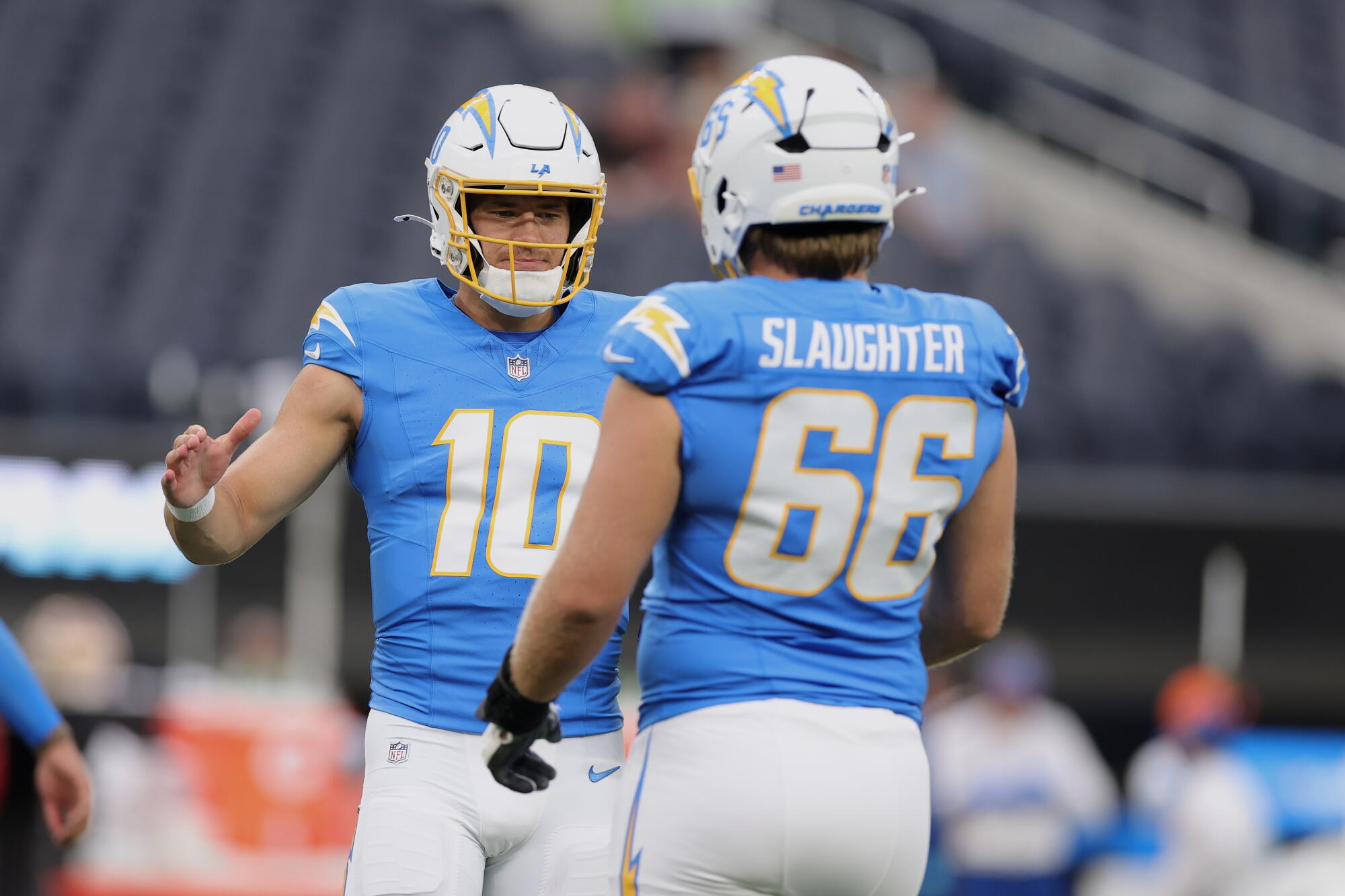
Chargers quarterback Justin Herbert, left, and center Jake Slaughter warm up before a preseason game.

Chargers quarterback Justin Herbert built trust with Slaughter this preseason.

(Ryan Sun / Associated Press)

Slaughter also has built trust with the franchise’s most important player: Justin Herbert.

The Chargers need to do a better job of protecting the seventh-year quarterback — and Slaughter needs to play a key role in that effort.

“He’s been awesome,” Herbert said. “He’s done such a great job of picking up the offense and playing like a veteran out there. Great to have a guy like that. He’s playing a lot earlier than I think he would have thought, but that hasn’t slowed him down.”

Slaughter credits his teammates and coaches for getting him up to speed after he was thrown into the fire.

Wide receiver Ladd McConkey said the locker room has “bought into” the Chargers’ new starting center. Offensive lineman Trey Pipkins III, meanwhile, took his praise for Slaughter a step further.

“He might be one of the smartest rookies I’ve ever seen,” Pipkins said.

Slaughter, however, earned veteran approval long before any cameras were crammed in his face. Coach Jim Harbaugh insisted he knew Slaughter was a starting-caliber player in early August.

“You know when you see it,” Harbaugh said.

But before the rookie can lose himself in any pressure or nerves on Sunday, he’s simply happy for the opportunity.

“That’s an experience I hope I’ll never forget,” Slaughter said about his upcoming NFL debut. “Something I really never thought I’d get to do growing up. It’s a really unique honor, and I’m really thankful I can be out there and play ball.”

Source link

Prep football: Palos Verdes, Sierra Canyon defeat teams from Florida

Palos Verdes and Sierra Canyon came away with football victories against teams from Florida on Thursday.

Standout junior safety Jalen Flowers came up with two interceptions, including a one-handed highlight play, to help Palos Verdes hold on for a 21-18 win over Orlando (Fla.) Bishop Moore in an afternoon game at Palos Verdes.

Linebacker Weston Reis also came through for 2-0 Palos Verdes, which travels to Carson next Thursday in another challenging nonleague game.

Sierra Canyon traveled to Florida, lost four fumbles in the first half but came back to defeat Hollywood (Fla.) Chaminade-Madonna 24-7.

Myles Baker had one touchdown pass and one touchdown run as the Trailblazers (2-0) broke open a game that was tied 7-7 at halftime. Jaxsen Stokes’ running, and strong defense from sophomore linebacker Eli Zamorano also helped the Trailblazers. Carter Sobel had a 31-yard field goal in the third quarter to give Sierra Canyon the lead for good.

Source link

Clinton Sweeps the South : Tsongas Takes 3 States; Bush Wins All 8 Races : Democrats: Arkansas governor’s victories, including Florida and Texas, re-establish him as front-runner. Contests held in 11 states.

Arkansas Gov. Bill Clinton swept the Southern states in Super Tuesday’s Democratic presidential voting, including delegate-rich Texas and Florida, re-establishing himself as the front-runner for his party’s nomination.

Former Massachusetts Sen. Paul E. Tsongas, Clinton’s principal rival, had his chief success in his home state, which he won easily as expected. He also won the Rhode Island primary and the caucuses in Delaware.

But Tsongas did no better than second in the Southern states, including Florida, where he had made his biggest commitment of time and resources and which was generally viewed as the most significant test of the day for him and Clinton. In addition to Florida and Texas, Clinton came in first in the primaries in Mississippi, Oklahoma, Tennessee and Louisiana, and he won the caucuses in Missouri.

The victories Tuesday brought Clinton 418 delegates, contrasted with 208 for Tsongas and 23 for former California Gov. Edmund G. (Jerry) Brown Jr. Clinton started the race with 275 delegates, twice what Tsongas had. The eventual nominee will need a minimum of 2,145 delegates.

“I must say, it is only tonight that I fully understand why they call this Super Tuesday,” Clinton told cheering supporters in Chicago, where he arrived to launch his drive for primaries next Tuesday in Illinois and Michigan. “From Florida to Texas and all states in between, people opened their hearts to Hillary (his wife) and to me.”

For his part, Tsongas put a brave face on the results. “We’re on our way to the White House,” he said at a victory rally in his hometown of Lowell, Mass. He cited a Washington Post-ABC poll published Tuesday that showed him beating President Bush by 5 percentage points in a trial heat, 3 points more than Clinton’s margin over Bush.

Brown had his best showings Tuesday in Massachusetts, Mississippi and Oklahoma, running second in those states.

“This crusade rolls forward,” Brown declared Tuesday night at a United Auto Workers union hall in Romulus, Mich., a suburb of Detroit. “Hey, governing elite, watch out.

“I think I’m a lot closer to the heart and soul of this party” than the other candidates, he claimed. “I’ve got as good a chance as anybody. But this is a campaign that builds week by week. We’ve already moved from the margin to the center.

“We’re getting Tom Harkin’s vote now.” Iowa Sen. Tom Harkin’s role in the campaign as the spokesman for traditional Democratic liberalism ended this week when he dropped out of the race.

All told, 783 delegates–more than one-third the total required for nomination–were at stake in contests waged in 11 states, from Hawaii to Rhode Island. But seven of them were in Dixie or on its borders, which gave the day its special cast and gave Clinton an advantage he fully exploited.

A television network exit poll showed Clinton taking 68% of the vote among native-born Southerners, contrasted with 19% for Tsongas and 8% for Brown.

Once again, as in the Georgia and South Carolina primaries last week, blacks made a big contribution to Clinton’s victory. He got about 80% of the black vote across the South, according to network exit polls, contrasted with 59% of the white vote.

A Times exit poll in Florida showed that voters picked change, compassion and agreement on the issues as the main reasons that influenced their choice for President. Clinton won the support of the first two of these groups soundly and split the third evenly with Tsongas.

Tsongas appeared to have been hurt by Clinton’s charges that he was prepared to tamper with cost-of-living increases for Social Security beneficiaries. About one-fourth of those interviewed in The Times poll said that issue had influenced them, and three-fifths of that group backed Clinton.

Even on this day of triumph, concern over Clinton’s controversial draft status during the Vietnam War cast a shadow. Of Southern Democratic voters polled by the networks, 20% said this issue made them think less favorably of Clinton, although one-third of these voted for him anyway.

By contrast, in Florida, the Times poll showed that Tsongas took the votes of those interested in a candidate whose ethics they do not doubt, whom they believe they can trust, who has convictions and who has values like their own.

These answers appeared to reflect not only their confidence in Tsongas, but also their misgivings about Clinton because of the draft controversy and earlier allegations that he had been unfaithful to his wife. Those charges had damaged his campaign in New Hampshire, when polls had him far in front of the field.

Clinton attempted to address this problem Tuesday night in his victory speech in Chicago.

“The people of the South heard the worst about me but they saw the best,” he said. “They know that the true measure of character in politics can never be perfection, because, if it were, no one could pass. The true measure is genuine commitment that lasts day in and day out, through failures and disappointment and defeat and setback.”

Tsongas, who was outspent and who many thought was outmaneuvered in the day’s battle, sounded a defiant note.

“There are those who believe the American people are not intelligent, that you can be Santa Claus, that you can pander and give middle-class tax cuts,” he said, sounding one of his favorite themes at his Lowell rally. “I’m going to tell you something, Bill Clinton, you’re not going to pander your way into the White House as long as I’m around.”

Brown also sounded as if he had just begun to fight.

“I will tell you that I have a better chance than my two opponents” of getting the nomination, he told ABC News interviewer Peter Jennings. “Both of them are fatally flawed. They don’t represent the majority of who the Democratic Party is. I do. That’s my background.

“It’s hard to get the message out. But as we do, the crowds are going now from the hundreds to the thousands.”

In the frantic days of campaigning that preceded Tuesday’s day of decision, the contrasting objectives of the three Democratic contenders reflected the differences in their prospects and resources.

For Clinton, the balloting presented the opportunity to take a giant step forward in the delegate race and to gain momentum for next week’s critical contests in Illinois and Michigan.

“It’s always been the case that we had more money and more organization than anybody else,” Craig Smith, Clinton’s deputy campaign manager, said on the eve of the balloting. “Our strategy has been to go in and win as many states as we can and roll up a big delegate margin.”

That is exactly what Clinton did Tuesday throughout the South.

Perhaps just as important as these tangible assets in helping Clinton was the region’s demography. It created an environment more receptive to Clinton’s economic message–centered on his call for a small tax cut for middle-class families–than Tsongas’ doctrine of relying mainly on tax incentives for business to generate growth.

“The clarity of choice between Clinton and Tsongas on economic policy works to our advantage in the South more than in states like Maryland and New Hampshire,” where Tsongas won, said David Wilhelm, Clinton’s campaign manager. “There are more middle-income voters and more working families.”

Under these circumstances, the Super Tuesday confrontation represented mainly an exercise in damage control for Tsongas. Seeking to minimize the impact of defeat, the candidate and his managers conceded the outcome well in advance.

They set their goal as finishing a “strong second” everywhere, particularly in Florida, Super Tuesday’s most competitive battleground. And they pointed to what they asserted would be more positive results elsewhere in the country next week.

“Once Super Tuesday is over, he (Clinton) has to go into the rest of the country, and we’ve done better there,” said Tsongas campaign manager Dennis Kanin, citing his candidate’s victories in New Hampshire and Maryland.

As for Brown, the self-styled candidate of protest, the balloting offered a chance to enhance the credibility his candidacy gained with victories in Colorado and Nevada. Waging his guerrilla style of political warfare from Dixie to New England, Brown sometimes seemed mainly a threat to Tsongas’ support, particularly when he appealed for the vote of environmentalists by demanding a ban on ozone-threatening products.

But Brown also sought to make inroads in Clinton’s backing among minorities, telling a rally of Latinos in El Paso, “You know you’re being ripped off, lied to, shined on.”

Here is a brief look at how the contest took shape in the biggest battlegrounds:

FLORIDA: 148 delegates.

Tsongas was drawn into making his biggest Super Tuesday commitment of time and resources here mainly because of demographics–the presence of more expatriate Northerners, more suburbanites and more upper-income voters than anywhere else in the South. Those characteristics have defined Tsongas voters in past primaries.

Recent political history also seemed encouraging. In the last two Democratic presidential campaigns, Florida has been won by non-Southern candidates who, like Tsongas, won the New Hampshire primary–former Colorado Sen. Gary Hart in 1984 and former Massachusetts Gov. Michael S. Dukakis in 1988.

But as Tsongas strategists soon realized, circumstances were more favorable for Hart–who was running against another non-Southerner, former Vice President Walter F. Mondale–and for Dukakis–who had financial and organizational assets that in the 1992 contest are possessed by Clinton.

Clinton’s operation had daily polling to guide it. By contrast, conceded Rob Schroth, Tsongas’ state coordinator, “The only way I can find out what is going on is by talking to voters, to reporters and to the Clinton people.”

More important, Clinton strategists contend, Tsongas hurt his own cause. Instead of concentrating solely on his theme of economic revival, they point out, he spent much of the past few days attacking Clinton, calling the Arkansas governor “cynical and unprincipled.” He also was forced to deal with Clinton’s attacks on him for favoring a gasoline tax, for allegedly being insufficiently supportive of Israel and for supposedly being willing to tamper with Social Security cost-of-living allowances.

“He got off his message for three days and it hurt him,” said Jeff Eller, Clinton’s state coordinator. Kanin concedes that Tsongas’ shift in emphasis may have undercut his message but asserts that his candidate had no choice but to hit back at Clinton. “What Clinton was doing was attacking him all over Florida on whatever issue appealed most in that area,” Kanin said.

TEXAS: 196 delegates.

Clinton helped himself by coming to Texas early and often, as well as by capitalizing on friendships in the state that go back more than 20 years. “He’s paid a lot of attention to this state,” said George Christian, an Austin political consultant and onetime aide to former President Lyndon B. Johnson. “He’s here every time you turn around.”

Because of that, Clinton has lined up an impressive list of endorsements from elected and party officials and from leaders of key interest groups.

“He’s got the who’s who of the Mexican community and the who’s who of the black community on his side,” said George Shipley, a Democratic consultant who guided Texas Gov. Ann Richard’s campaign to victory in 1990.

One influential group, the Texas Mexican-American Democrats, not only endorsed Clinton, but also mailed out 200,000 letters to Mexican-American voters urging them to cast their ballots for the Arkansas governor.

Tsongas campaigned here for only two days, and his late-starting organization seemed to have relied at least as much on misgivings about Clinton as on Tsongas’ own virtues to get support.

Clinton “has impressive financial assets, but he has heavy personal liabilities,” said Texas Railroad Commissioner Robert Kreuger, Tsongas’ state chairman.

The personal contrast with Clinton did appear to help Tsongas win some votes. After hearing Tsongas speak at a rally at the Alamo last week, Sylvia Jiminez, a San Antonio accountant, praised his economic message but said pointedly, “Bill Clinton is too much glitz.”

SOUTHERN PRIMARIES: Clinton was helped by a big edge in endorsements from prominent Democrats in the rest of the South. Tennessee, with 68 delegates, was the only state in which Tsongas campaigned, aside from Texas and Florida. Only Brown made a significant attempt to compete in Mississippi, with 39 delegates. In Oklahoma, with 45 delegates, Tsongas failed to get on the ballot because of a technical slip-up by his staff, leaving second place to Brown.

Staff writers Cathleen Decker, David Lauter, J. Michael Kennedy and Marilyn Yaquinto contributed to this story.

RELATED STORIES, PICTURES: A12-14

Super Tuesday Vote

Here are the top finishers in Super Tuesday’s key states:

DEMOCRATS Clinton Tsongas Brown % of vote in 1. Massachusetts (primary) 11 67 14 83 2. Rhode Island (primary) 21 53 19 100 3. Delaware (caucus) 21 30 19 100 4. Florida (primary) 51 34 12 92 5. Tennessee (primary) 67 19 8 99 6. Mississippi (primary) 73 8 10 94 7. Louisiana (primary) 69 11 7 99 8. Missouri (caucus) 61 6 4 90 9. Oklahoma (primary) 70 — 17 99 10. Texas (primary) 66 19 8 78 11. Hawaii (caucus) — — — —

GOP Bush Buchanan Duke % of vote in 1. Massachusetts (primary) 66 28 2 90 2. Rhode Island (primary) 63 32 2 100 3. Delaware (caucus) — — — — 4. Florida (primary) 69 31 — 92 5. Tennessee (primary) 73 22 3 99 6. Mississippi (primary) 72 17 11 93 7. Louisiana (primary) 62 27 9 95 8. Missouri (caucus) — — — — 9. Oklahoma (primary) 70 27 3 99 10. Texas (primary) 70 24 3 76 11. Hawaii (caucus) — — — —

All numbers are percentages. Complete results, A12

Super Tuesday Roundup

Here are the latest results from Tuesday’s presidential contests. PRIMARIES Texas DEMOCRATS 78% of precincts reporting

Dele- Vote % gates Bill Clinton 819,554 66 97 Paul E. Tsongas 230,607 19 28 Jerry Brown 93,657 8 2 REPUBLICANS 76% of precincts reporting Dele- Vote % gates George Bush 425,588 70 121 Patrick Buchanan 143,829 24 0 David Duke 15,723 3 0 Uncommitted 18,259 3 0 Florida DEMOCRATS 92% of precincts reporting Dele- Vote % gates Bill Clinton 536,088 51 87 Paul E. Tsongas 360,339 34 58 Jerry Brown 131,267 12 3 REPUBLICANS 92% of precincts reporting Dele- Vote % gates George Bush 554,173 69 97 Patrick Buchanan 254,150 31 0 Massachusetts DEMOCRATS 83% of precincts reporting Dele- Vote % gates Paul E. Tsongas 443,150 67 88 Jerry Brown 94,483 14 6 Bill Clinton 70,480 11 0 Uncommitted 10,114 2 0 REPUBLICANS 87% of precincts reporting Dele- Vote % gates George Bush 149,247 66 26 Patrick Buchanan 63,124 28 11 David Duke 4,785 2 0 Uncommitted 8,618 4 1 Tennessee DEMOCRATS 99% of precincts reporting Dele- Vote % gates Bill Clinton 211,488 67 56 Paul E. Tsongas 60,662 19 12 Jerry Brown 25,415 8 0 Uncommitted 12,217 4 0 REPUBLICANS 99% of precincts reporting Dele- Vote % gates George Bush 177,173 73 23 Patrick Buchanan 54,328 22 10 David Duke 7,662 3 0 Uncommitted 5,043 2 0 Louisiana DEMOCRATS 99% of precincts reporting Dele- Vote % gates Bill Clinton 259,731 69 59 Paul E. Tsongas 41,790 11 1 Jerry Brown 24,925 7 0 REPUBLICANS 94% of precincts reporting Dele- Vote % gates George Bush 75,346 62 26 Patrick Buchanan 32,484 27 5 David Duke 10,438 9 1 Oklahoma DEMOCRATS 99% of precincts reporting Dele- Vote % gates Bill Clinton 288,031 70 38 Jerry Brown 68,432 17 7 REPUBLICANS 98% of precincts reporting Dele- Vote % gates George Bush 147,426 70 34 Patrick Buchanan 56,234 27 0 David Duke 5,474 3 0 Mississippi DEMOCRATS 94% of precincts reporting Dele- Vote % gates Bill Clinton 138,777 73 39 Jerry Brown 18,222 10 0 Paul E. Tsongas 15,093 8 0 Uncommitted 11,642 6 0 REPUBLICANS 92% of precincts reporting Dele- Vote % gates George Bush 104,065 72 33 Patrick Buchanan 24,320 17 0 David Duke 15,516 11 0 Rhode Island DEMOCRATS 100% of precincts reporting Dele- Vote % gates Paul E. Tsongas 26,875 53 13 Bill Clinton 10,729 21 6 Jerry Brown 9,519 19 3 Uncommitted 689 1 0 REPUBLICANS 100% of precincts reporting Dele- Vote % gates George Bush 9,911 63 10 Patrick Buchanan 5,012 32 5 David Duke 327 2 0 Uncommitted 440 3 0 CAUCUSES Missouri DEMOCRATS 90% of precincts reporting Dele- Vote % gates Bill Clinton 306 61 34 Paul E. Tsongas 30 6 2 Jerry Brown 20 4 0 Uncommitted 143 29 30 Delaware DEMOCRATS 100% of precincts reporting Dele- Vote % gates Paul E. Tsongas 48 30 5 Bill Clinton 33 21 3 Jerry Brown 31 19 2 Uncommitted 47 30 4 Hawaii DEMOCRATS 0% of precincts reporting Dele- Vote % gates Bill Clinton xxx xx x Paul E. Tsongas xxx xx x Jerry Brown xxx xx x Uncommitted xxx xx x

* Republican caucuses in Missouri, Delaware and Hawaii will be held in the coming months.

Source link

Florida, hard-hit by Obamacare drop-off, feels the squeeze of rising healthcare costs

Florida chef Elijah Button was chopping onions in June when his knife slipped and sliced his middle finger to the bone.

It was his worst kitchen accident to date. But having given up his Affordable Care Act health insurance plan in January because of a $100 monthly premium hike he couldn’t afford, the 21-year-old in St. Cloud didn’t have the money for emergency care.

“Going to the hospital for it wasn’t even an option,” he said, gesturing toward his finger before preparing a pot roast for his aunt and uncle in their suburban home. “My first thought was, ‘how am I going to fix this?’”

After Republicans in Congress let enhanced federal subsidies for Affordable Care Act health plans expire in January, millions of Americans including Button had to decide whether to keep insurance that often doubled or tripled in cost — or risk going without it.

Months later, with no action from lawmakers to replace the lost funds, they’re facing the consequences. Some are dealing with strained budgets and exorbitant medical bills, while others avoid the doctor in fear of the cost.

Florida, whose large population of gig workers, entrepreneurs and small business owners relies heavily on the federal health insurance marketplace, has become one of the nation’s most visible epicenters of that impact.

Figures first reported by The Associated Press showed that about 440,000 Floridians dropped their Affordable Care Act plans this year — more than in any other state. Thousands more who kept coverage are struggling to get by, as prices of necessities like groceries and gasoline remain steep, and health insurers project another year of double-digit premium hikes.

While Florida had the most affected residents, its struggles are reflective of broader nationwide concerns over rising healthcare costs and a lack of meaningful policy to address them.

In the deep-red state where congressional districts were recently redrawn to strongly favor Republicans, the cost of healthcare is a major campaign issue. Republican midterm candidates have been promoting fraud crackdowns to protect federal health programs, while Democrats have been urging voters to help Congress change hands so they can restore subsidies.

Button, who is estranged from his parents, asked his uncle for help with his bloodied finger. With a butterfly bandage, splint and daily cleanings and dressings, it healed. But the scar still gnaws at Button as a symbol of what else could go wrong.

“It just feels like I’m living in a house of cards,” he said.

Florida’s population and politics make it ground zero for ACA fallout

Last fall, debate over the expiring subsidies consumed Congress, resulting in a record 43-day government shutdown as Democrats insisted on extending the COVID-era assistance and most Republicans refused.

Fast forward almost a year and lawmakers rarely reference the topic anymore. The administration says it is addressing affordability with fraud-busting efforts and deals with drug companies, but Congress hasn’t passed any significant legislation to lower health costs.

In part due to its large number of construction, hospitality and small business workers — and also because its Republican-led legislature never expanded the Medicaid safety-net health program — Florida has the largest Affordable Care Act enrollment in the country. At just over 3.8 million enrollees, it represents about a fifth of the nation’s total enrolled population.

Of the roughly 443,000 Floridians who left the marketplace, most are likely going without insurance, according to Cynthia Cox, a vice president at the healthcare research nonprofit KFF. She said that’s because it is typically a “place of last resort” to get coverage.

The data doesn’t tell the stories of those who kept insurance. Tracy Rand, a licensed mental health counselor in Leesburg, Florida, is one of them.

Ever since getting her ovaries removed last year due to benign but painful tumors, she has had severe menopause symptoms that require medication, including an overactive bladder and hot flashes that cause piercing headaches.

She uses clear plastic containers to organize the more than 30 medicines and supplements she takes daily, their bottles crammed into a living-room drawer and a tray on her kitchen counter.

The 51-year-old’s Affordable Care Act plan was going to surge in price this year from $55 a month to $1,100 a month, so she downgraded. Her new plan, with higher deductibles and copays, costs $160 a month.

To make that work in her budget, Rand quit a doctoral program she was working toward, started buying groceries at cheaper stores, gave up once-monthly dinners out with her husband and stopped meeting friends regularly at a paint-your-own pottery studio.

It’s been a difficult adjustment, but a necessary one for her health.

Rand said the prospect of insurers raising rates again fills her with dread.

“I don’t know what else we can get rid of,” she said, covering her face with her hands. “I don’t know if we’re going to have to file bankruptcy.″

Clinics for the uninsured are a saving grace — but they can’t take everyone

In Orlando’s leafy, brick-paved neighborhood of Colonialtown South, Tarsha Watson found her lifeline. A clinic there called Grace Medical Home provides low-income, uninsured Floridians with comprehensive care for a $5 per-visit fee.

Watson, 54, has a master’s degree in business administration, but she hasn’t been able to find work since losing her job two years ago. That means she doesn’t have health insurance. When she explored Affordable Care Act coverage, she was quoted $600 per month, far out of her reach.

At Grace, Watson learned her blood sugar is high and that she needed to lose weight. Now, she walks laps around her backyard pool and does Tai Chi YouTube tutorials to focus on fitness. She said she wishes everyone could have her experience.

“It’s very hard out here,” she said. “It’s not enough.”

At the clinic, patients cycle in and out of a wide hallway lined with appointment rooms as doctors scan supply shelves for complimentary over-the-counter medications. The expansive building has separate areas for dental, mental health, vision and pediatric care.

CEO Stephanie Garris said it’s one of 110 free or charitable clinics in Florida, but that’s not enough to handle demand. To treat more people in response to the Affordable Care Act changes, it recently started hosting a mobile acute care clinic for walk-in patients.

Garris said Grace Medical Home treated about 1,350 people last year. Every year, they take about 350 new patients.

“Would I love to double that, triple that? Of course,” Garris said. “I just think in the reality, with the huge number of uninsured that we have, it’s just not possible.”

Health costs become an issue in midterm campaigns

For U.S. Rep. Darren Soto, a Democrat defending his seat in a sprawling — and now much redder — redrawn district south of Orlando, health costs are a campaign focal point.

He said his district, which is near various theme parks, had the second-largest Affordable Care Act enrollment in the nation, in part because many small tourism businesses can’t offer employees health insurance.

“I just hear it everywhere I go,” he said. His Republican opponent, Navy veteran and former Trump administration official Dan Green, did not answer emailed questions about the subsidies but has emphasized affordability of groceries and property insurance as campaign priorities.

Soto voted with Democrats and some Republicans — including a few from Florida — to save the subsidies last year. The Republican majority declined and suggested other ideas, including funding Americans’ health savings accounts. No law along those lines has passed yet.

Button, a Democrat in Soto’s district, said he is open to different reforms for health costs, but said politicians aren’t acting fast enough.

“They keep trying to make excuse after excuse,” he said. “I don’t have six months to a year to wait for you guys to pass this through the hoops that you need to.”

Swenson and Martin write for the Associated Press.

Source link

‘I’ve stayed at 36 hotels at Walt Disney World – one is the best budget option’

If you’re planning a trip to Walt Disney World Resort in Florida, one of the most affordable hotels has been revealed by an expert, having stayed at the park a staggering 36 times

A devoted Disney World Resort enthusiast has named the best budget-friendly hotel to book when visiting the beloved park, after staying there a whopping 36 times.

Hotels can be one of the most expensive parts of a holiday, even more so when it’s a trip to Walt Disney World in Florida. As one of the most popular family attractions, attracting a staggering 76.7 million visitors last year, holidaymakers can pay up to an eye-watering £4,000 per person on a trip to ‘The Most Magical Place on Earth’.

For a family of four, that could amount to £10,000 for a 10-night stay at the bucket-list destination, and for many, it’s worth it. Yet there are plenty of ways to keep those costs in check, including booking a budget-friendly hotel, without sacrificing on the experience.

Mark Patterson, who has been to Florida’s Disney World Resort a remarkable 48 times over the past six years and stayed at 36 different hotels during the trips, said there’s one particular area that offers an affordable option. “The Flamingo Crossings area is my favourite, it’s newer, and the hotels are all new, and they all have free breakfast. They offer good, reasonable prices there.”

While it’s a budget-friendly option, he did point out that, due to its location, visitors will need to drive, get a lift, or hop on a shuttle bus to reach the park each day. Nevertheless, with free breakfast thrown in, it could well be worth travelling a little further to keep the costs down.

During his own trips, Matt, who is based in Southern California, targets an average hotel price of around $100 (£74.71) to $200 (£149.42) per night to keep things affordable, while keeping a close eye out for any hidden fees. Another area he recommends is Disney Springs.

He explained: “The Disney Springs area has a range of hotels, right there within walking distance to the shopping area, and it’s where pretty much everybody goes to eat at night. It gets very busy and popular, so being able to walk to that is very handy.

“However, the bad thing about that, or something you have to trade off, is that only one of the hotels offers a free breakfast; all the others you have to pay for. So I might get a hotel for around $100 (£74.71) per night, but will then have to pay for breakfast, which is $28 (£20.92), along with paying for parking, which can be around $25 (£18.68) and a resort fee of around $40 (£29.88).

“So it can literally double the price of what I thought I was going to pay. Disney Springs area is great, but you’ve got those little hidden fees.”

In a bid to help holidaymakers save even more on their trip to Disney, Matt also recommends booking a hotel that has a kitchenette. “All the restaurants at Disney are expensive, so the hotels I like have a kitchenette with a stove and a full-size fridge, so you can buy food and cook it,” he shared.

“You can then take it into the park with you, and that can save a lot of money. Even if you just take two meals in for the family, that can save you easily $100 (£74.71) to $200 (£149.42) per day.”

Mark documents his numerous visits to Walt Disney World Resort on his website, DDadBudget, offering useful tips to fellow fans.

Do you have a travel story to share? Email webtravel@reachplc.com

Source link

Trump-backed candidates struggle, and other takeaways from Florida, Wyoming, Alaska primaries

As the year’s midterm primaries draw to a close, Tuesday’s results in Florida, Wyoming and Alaska continued to underscore an unpredictable election season marked by unreliable polls, intra-party divides and surprise showings by political outsiders.

In one high-profile surprise, democratic socialist state Rep. Angie Nixon’s easily defeated former Army intelligence officer Alexander Vindman in Florida’s U.S. Senate primary, despite Vindman having raised 16 times as much money as the new Democratic nominee, according to OpenSecrets, a nonprofit that tracks campaign finance.

According to Florida Politics, a digital media outlet, a now-deleted Change Research poll showed Vindman leading Nixon by 10 points. At that time, 41% of Democrats polled were still undecided.

In the race for a Senate seat Democrats hope to flip, former Democratic Rep. Mary Peltola outpolled incumbent Republican Sen. Dan Sullivan, with another Republican Dan Sullivan — this one a retired teacher — also making the cut for the four-person, ranked-choice general election in November.

The results from Tuesday night also show that President Trump’s influence on his party’s base may be dwindling. Three of his endorsed candidates in Wyoming and Florida, both safe red states, were defeated.

Here are four takeaways from Tuesday’s results:

Democratic socialist overcame a huge cash disadvantage

Nixon, who recently joined the Democratic Socialists of America and the Working Families Party, won in a massive upset against Vindman, a moderate selected to run by the Democratic Senatorial Campaign Committee.

Nixon will face Republican incumbent Sen. Ashley Moody in November in a special election to serve the final two years of former Sen. Marco Rubio’s term. Moody was appointed to the seat by Gov. Ron DeSantis when Rubio became secretary of State.

Through a highly coordinated grassroots campaign, Nixon overcame a $15-million fundraising deficit against Vindman in a state where affordability, high property insurance costs and public infrastructure strain were top concerns for many voters.

Although Vindman had the support of the Democratic establishment his lack of profile in Florida — where he has lived for just three years — was a clear detriment, said Susan MacManus, a political analyst at the University of South Florida.

“Angie Nixon was extremely well known in Democratic circles,” MacManus said. “There’s a battle here in Florida: Do you want a Democratic candidate who’s a fighter, or do you want someone more in line with the establishment? … Nixon had no money, but she had a presence.”

But Nixon still faces a steep battle against Moody, MacManus said. According to state data, Florida has 1.5 million more Republicans than Democrats, meaning that Nixon will have to win over most of the independents — and perhaps convert a few Republicans — to have a shot in the general election.

Florida redistricting had a big effect on House races

In May, DeSantis’ office rearranged districts for the second time this decade to secure more safe-Republican seats in the House of Representatives, shortly after the Supreme Court narrowed the scope of the Voting Rights Act.

In Florida’s 25th District, a newly drawn coastal area north of Miami, incumbent Rep. Jared Moskowitz defeated democratic socialist and activist Oliver Larkin.

The redistricting increased the number of Jewish voters in the district, which likely hurt Larkin’s candidacy because of his openly anti-Israel stance, said Jonathan Cervas, an assistant professor at the Carnegie Mellon Institute for Strategy and Technology.

Moskowitz will face the former mayor of Boca Raton, Scott Singer, in the general election.

In Florida’s Black-majority 20th District, which was redrawn this year, Rep. Debbie Wasserman Schultz finished ahead of four Black rivals in a crowded field, and will face Brent Andersen, an insurance broker, in November. Black leaders criticized Wasserman Schultz, a white 11-term congresswoman, for running in the district.

“She won against a crowded field, but she didn’t win with 50% of the vote,” said Kareem Crayton, vice president of the Brennan Center’s Washington office. “The open question remains: Is she the preferred candidate of African Americans? We’ll see in the general.”

Although these two districts lean slightly blue, data suggest that Republicans will be more competitive in these areas than they were in the 2024 congressional races, Cervas said. He added that this shows Florida’s redistricting efforts were mostly a success, likely adding at least one or two seats in the general election.

Alaska was more competitive than Democrats thought

Some Democratic Party leaders had initially ranked Alaska behind other states with the potential to flip a Senate seat. But they likely will make the Alaska race a higher priority after a strong showing Tuesday by former Democratic Rep. Mary Peltola, who topped the field in the primary against incumbent Sen. Dan Sullivan. It has been 11 years since Alaska last had a Democratic senator.

According to the New York Times, the Alaska Survey Research poll shows Peltola with a two-point lead heading to the general election.

Peltola has run as a centrist Democrat, attacking the Trump administration’s cuts to the federal workforce and lack of resource development in Alaska, which is likely to have wide appeal in a state that Trump won in 2016, 2020 and 2024, but that has suffered in recent months from rising costs and job losses.

Three Trump endorsements fell short

Trump-endorsed incumbent Rep. Cory Mills — the subject of a House Committee Ethics probe stemming from accusations of assault by two women — lost his primary race in Florida’s 7th District to former television reporter Ryan Elijah, making him the 10th Trump-backed candidate to lose in a primary this year.

After the results were known, the president wrote in a Truth Social post: “I told Congressman Cory Mills of Florida, a friend of mine, to get out of the Race, but he wouldn’t listen. He thought he could win, so who can blame him?”

Trump had picked Catalina Lauf to replace Republican Rep. Byron Donalds, only to see her lose to Jim Schwartzel, a businessman-turned-politician. Donalds is the Republican nominee for governor, where he will face Democrat David Jolly, a former Republican House member.

Trump’s pick for Wyoming governor, Superintendent of Public Instruction Megan Degenfelder, was defeated handily by Republican state Sen. Eric Barlow.

Source link