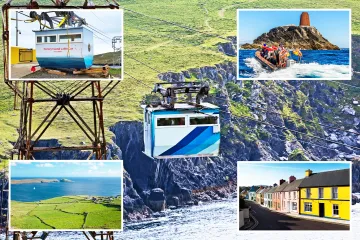
A TINY island off the coast of Wexford could make for one of Ireland’s most spectacular summer day trips.
The breathtaking Saltee Islands are just a two-hour drive from Dublin — with a short ferry ride from Kilmore Quay bringing visitors straight to Great Saltee.
The islands are famed for their incredible wildlife, with puffin-watching a must for anyone visiting during the summer months.
Day trippers can spend around three-and-a-half hours exploring the stunning island, spotting seabirds, seals and dramatic coastal views.
And with return ferry tickets costing €40 for adults, it could be the perfect seaside escape to kick off the summer.
The islands are located just 5km off Kilmore Quay in Co Wexford — and a 20-minute ferry trip is all it takes to get there.

Parking is available at Kilmore Harbour in the free public car park.
However, the little harbour is a busy spot during the summer months.
Visitors are advised to leave plenty of time to get to Kilmore Quay as parking spaces can be limited.
The ferry service picks visitors up at the top of the harbour in Kilmore Quay, beside the boat launching slip.
It brings passengers straight to Great Saltee, as permission to visit Little Saltee cannot be granted due to hazardous landing conditions.
But visitors can only access the island during certain hours each day.
Day trippers are allowed on the island between 11am and 4.30pm, and anyone landing on a boat outside these times will be asked to leave.
The popular Saltee Ferry is a daily service that runs from April to October every year.
A return ticket costs €40 for adults and €20 for children under 12.
Each ferry can carry up to 12 passengers at a time.
Visitors are advised to arrive at the ferry gate ten minutes before the trip.
A smaller transfer boat will meet the ferry just off the shore of the island.
It picks passengers up and brings them on the final part of the journey to Great Saltee.
Once you arrive, you will be given approximately three-and-a-half hours to explore the mesmerising island.
The ferry crew will give you an exact time to be back at the landing area for the return trip to Kilmore Quay.
The ferry trip can be booked in advance online at salteeferry.com.
The Saltee Islands are known as the most famous bird sanctuary in Ireland — and puffin-watching is a must on any trip there.
Puffin season is predominantly between May and June.
There are plenty to spot, so make sure to take lots of pictures.
One visitor said: “The trip of a lifetime. There were hundreds of puffins just a short stroll from the boat. If you sit quietly they’ll wander around you.”
But Discover Ireland chiefs have warned that the puffin population is in a dangerous position, and visitors are advised to keep their distance to avoid disturbing the wonderful birds.
As well as the magnificent puffins, the island is also home to an array of seabirds, from gannets and gulls to Manx shearwaters.
While exploring the picturesque island, you might also come across some friendly sea creatures.
Grey seals are known to breed around the Saltee Islands.
It is one of the very few places in eastern Ireland with a seal population.
Up to 120 animals are present in autumn and up to 20 pups are born annually.
The seals can regularly be spotted resting on the rocks around the island.
The Saltee Islands are among the most ancient islands in Europe.
As long ago as 3,500 to 2,000BC, people were living on the islands.
In December 1943, the Saltees were purchased privately by the late Prince Michael the First.
Since his death in January 1998, the islands have been owned by his five sons and one daughter.
Permission for people to visit the island was granted by the family in recent years — but visitors are asked to respect the island.
When the family is in residence, a flag will be flying at the house — which visitors are asked not to approach.
No one is allowed to stay or camp at the historic spot, but there is no admission fee for a day trip to the island.
But island chiefs have issued a major warning to visitors.
They said: “Please do not approach the nesting birds closer than six metres.
“The footfall is having a devastating effect on the bird population. Should visitors see photographers not obeying the signs, please explain to them that they are killing the birds and to use their lens instead of their feet.
“If things do not improve with the bird population due to the current footfall, we will be forced to close the island to visitors.”