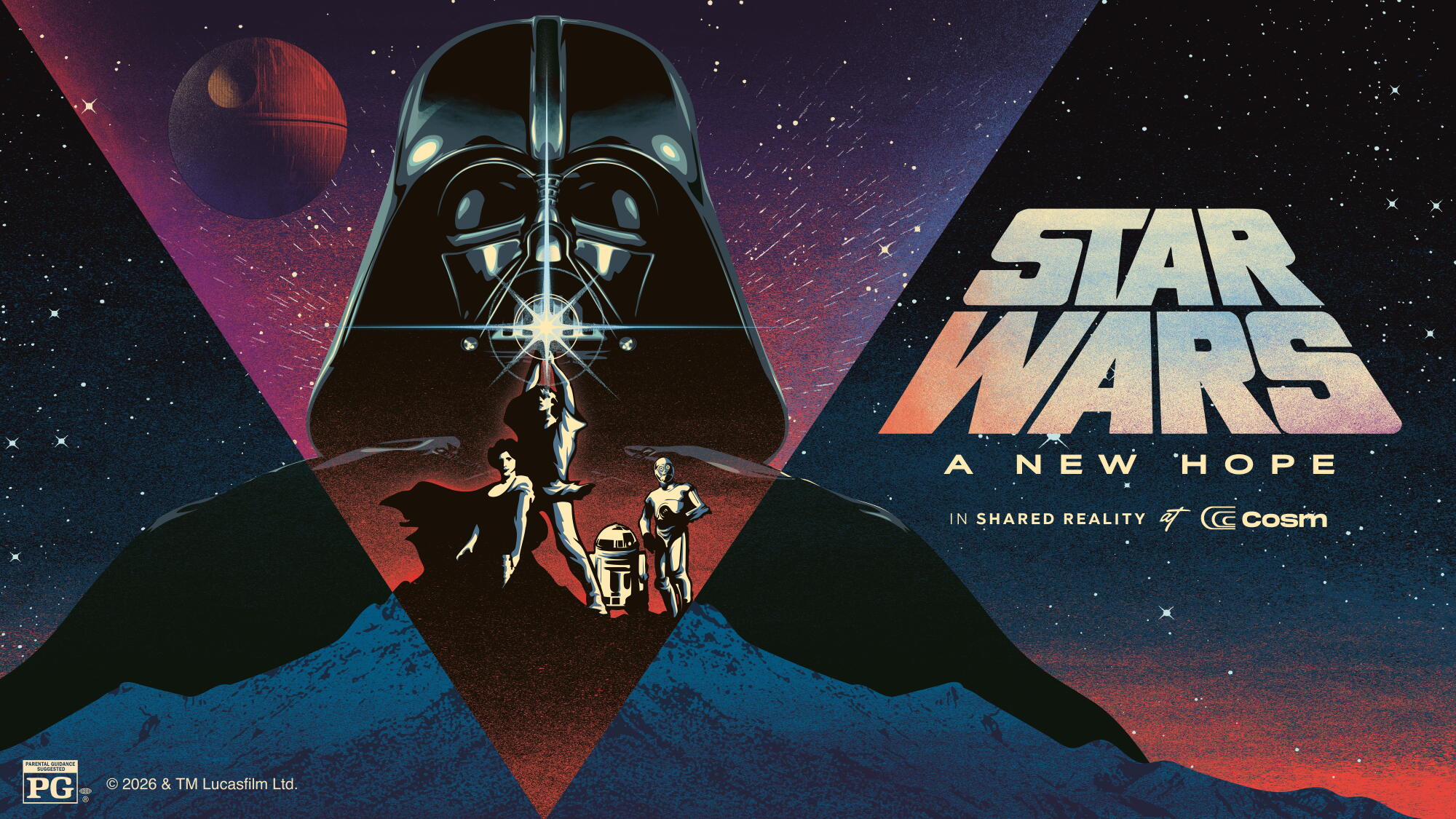
George Lucas’ original 1977 film “Star Wars” is being reimagined for its 50th anniversary. The pop culture phenomena that started an empire is coming to Inglewood’s Cosm, home to a high-definition spherical screen that wraps around audiences.
“Star Wars: Episode IV — A New Hope” is the first in a multiyear, multifilm agreement between the Walt Disney Co. and Cosm. The film will begin screening in March 2027. Cosm has previously screened films such as “The Matrix,” “Harry Potter and the Sorcerer’s Stone” and “Willy Wonka and the Chocolate Factory,” all from Warner Bros.
“We are thrilled obviously to be a part of the 50th anniversary,” said Alexis Scalice, vice president and head of Cosm Studios. “There are definitely going to be moments and effects that you haven’t ever seen before at Cosm.”
The El Segundo-based Cosm has been making more inroads in Hollywood of late. It was recently announced that Sony Pictures will invest $100 million and take a minority stake in the company.
Cosm’s entertainment offerings present the original film untouched in a frame that may shift around the screen, but accentuates it with supplemental, CGI content that helps flesh out environments. Cosm also has theaters in Dallas, Detroit and Atlanta, with a location in development for Cleveland. Cosm, which first drew attention for presenting live sports, shares its content among all its locations.

“Star Wars: Episode IV — A New Hope” will open at Cosm in March 2027. Artist Shepard Fairey designed the poster for the event.
(Cosm / Lucasfilm / Walt Disney Co. )
While “Star Wars: Episode IV — A New Hope” hasn’t been immune to tinkering and enhancements over the years, the Cosm treatment will be a step in a different direction. Cosm’s domed, 87-foot-diameter wraparound screen surrounds audiences and represents today’s hunger for collective, so-called immersive experiences that place attendees in fantastical environments. Cosm refers to its productions as “shared reality,” a term that in part is a nod to their communal nature.
Cosm will be screening the 2019 edition of “Star Wars: Episode IV — A New Hope,” a remaster to coincide with the release of streaming service Disney+. The film will be displayed in its original 16:9 format on the Cosm screen. Cosm is partnering with Lucasfilm, Industrial Light & Magic, and visual effects house MakeMake on the release, and worked with artist Shepard Fairey on a poster for the event. Like past entertainment offerings at the venues, Cosm will create a themed food and drink menu inspired by the film.
“I always say it’s like a best-hits album, where you have got to deliver,” Scalice said when discussing Cosm’s approach to embellishing original cinematic content. “You’ve got to deliver on light speed. You’ve got to deliver on moments.”
Over the decades, there have been efforts to expand the moviegoing experience, be it the on-and-off flirtation with interactive cinema, a brief trend in the ’90s that lived again on Netflix a few years ago (see “Black Mirror: Bandersnatch”), to more recent 4-DX theaters with movement-enabled seats (see the light, water and wind effects of “Twisters”). Cosm, like the bigger, more live music-focused Sphere in Las Vegas, seems to have a different pitch: an all-encompassing screen that can provide previously unexplored vantage points, at times even creating a theme-park-ride sense of movement.

Audience members watch the “Seek” immersive show at Cosm in 2024. The dome-like screen can create a sense of movement, making the venue feel akin to a living space.
(Michael Blackshire / Los Angeles Times)
Cosm’s interpretation of “The Matrix,” for instance, a collaboration with experiential creative agency Little Cinema, envelops audiences from its opening action sequence when a nighttime view of a city skyline seemingly places us on a rooftop. Elsewhere, an office building becomes a maze of cubicles. The film’s centerpiece red pill versus blue pill moment centers the frame among oversized, glowing capsules. When Keanu Reeves’ Neo awakens, we are lost amid mountainous, industrial pods.
“My favorite compliment from fans is, ‘I’ve seen this movie 100 times, but I feel like I’ve seen it for the first time today,‘” Scalice said. “That’s our biggest compliment because we don’t want to take away the authenticity of it.”
Cosm has worked best when it’s able to use its venue to create the illusion of no longer being a spectator, when the space itself starts to appear like a living theater. Feel this, for instance, in “Harry Potter” when the young wizards traverse a moving staircase. The frame of the screen may move, creating a slight sense of disorientation as the stairs themselves shift. The portraits on the wall, whose characters occasionally come alive, start to envelop us.
It’s moviegoing fit for a theme park, a medium in which “Star Wars” has long been familiar.