



David Cross says stand-up specials aren’t special anymore unless comics start breaking some rules
Ranting about the decline of comedy specials while releasing a new one at the same time feels a bit like an oxymoron. But somehow it still makes sense coming from alt-comedy pioneer David Cross, who isn’t just complaining; he’s finding his own route to making specials feel special again. The only way to do that is by putting one out in the manner he’d like to see more often — starting by making the whole crowd stand up too.
Capturing the energy of a concert at the famous 40 Watt Club in Athens, Ga., was the first step in differentiating “The End of the Beginning of the End” from the typical hour you watch on a big streamer. And, with this new special, Cross is able to get back to his own beginnings of touring across the country with love bands as his openers, performing for crowds for as long as he could until he had to run offstage to pee.
Premiering the special earlier this month on his website (and on April 7, it will be available on YouTube via production company 800 Pound Gorilla), Cross is hoping the special connects with comedy fans in a way that we’ve forgotten specials could.
This interview has been edited for length and clarity
Your new special is called “The End of the Beginning of the End.” What does that title mean to you as it relates to the impending doom of what we’re all living right now.
David Cross: Well, you can look at it in a couple different ways. To me, it signifies that the beginning of the end has occurred. And we are now at the end of the beginning of the end. And from where you go with that, that’s for you to decide.
One of the things I love about the special is the fact that you shoot it at a club in the style of a live–music concert.
I’ve shot specials in theaters and it’s just different, not that one is better than the other, but they’re just different. You have a different relationship with the audience. When I first started touring, I would go to music venues and I’d have a band open for me and then I would just go up and pretty much [perform] as long as I could until I had to pee. Sometimes I’d have a band playing, sometimes two bands, then I’d go out. And I did that a couple of times, and then stopped doing that and did theaters, and I decided for the last two specials I’m going to go to, when I shoot it, I’ll go to a music venue, and I was at the 40 Watt Club in Athens this last time, I was at the Metro in Chicago before that, both places I played on earlier tours, and, you know, it’s not seated. People are standing there at the stage, and I prefer it. It’s more fun. It’s not as lucrative but, to me, a more fun show to do.

Comedian David Cross
(Jason Armond / Los Angeles Times)
The ambience of it was great. You can hear people shouting and drinking and having a good time, and the crowd work is also a little more spontaneous and fun than it would be in a regular venue.
Yeah, well, there’s more opportunity for that. But my thing has never been about crowd work. I like engaging with it, it’s kind of a nice distraction from the set that you’ve been doing 100 times, 150 times at that point. So it’s always fun to have that thing happen and that feeling of spontaneity. And like the guy [who I talk to in the crowd during the special], I could not have asked for [someone better]. I mean, even if it was scripted, it wouldn’t have been as good. The guy who [I talk to] during the stuff about hiking Machu Picchu [with Bob Odenkirk], that’s just… [chef’s kiss].
Speaking of Bob Odenkirk, you guys have this long relationship. How would you describe the dynamic of working with Bob and just how you guys bounce ideas off each other?
I mean, it’s great. We have an inordinate amount of respect for each other, both as people and as creative partners. And so there’s never any real issues. There’s things we will definitely disagree with, but we’re both decent people. So you know somebody backs off and says, “OK, let’s do it that way.” But even then, there aren’t that many of those [issues]. We just have really worked well at building something or molding it, creating it and shaping it. And our aforementioned hike to Machu Picchu, we have a documentary about that, that will be premiering at a fancy festival at some point in the near-future. And so we got that doc and we’ve been working on that. And for the way we work now, because he lives in L.A. and I live in New York, and it’s been like that for a while, he’ll write a bunch of stuff, I’ll make notes, I’ll write my things, send it back. And so we’re able to do that and not necessarily have to be in the same room because we’ve had 30-plus years of working with each other.
It’s a kind of like an unspoken language you guys probably have in terms of comedy, which is super important, I imagine, just for collaborating.
Yeah, and it’s something we discovered very early on … before there was even “Mr. Show,” what would ultimately become “Mr. Show,” when we got together to write sketches for this bigger kind of comedy collective thing, and these shows that we would all do with each other, for each other, and the stuff that we would write together was just, like, really good, easy writing — again, one person adding this thing and one person saying here’s a switch yeah and another person adding this thing in. It was fun, it’s cool, still is. One thing he doesn’t get credit for is he’s a really decent human being. And with all the awfulness in the world that’s magnified, every sense is bombarded with it — it’s just good to be hanging with somebody whose energy is a good person, a decent person and an equitable, nice guy, so that’s good as well.

Comedian David Cross poses for a portrait ahead of his comedy special “The End of the Beginning of the End.”
(Jason Armond / Los Angeles Times)
One thing you guys also have in common is you both have kids, and he has a comedy show for kids called “The Appropriate Show.” Have you taken your daughter to see it?
It’s a sketch show [in which] all the sketches are appropriate for kids to watch. And the sketches have been done in other sketch shows onstage, live. And he puts together this thing once, twice a year here in L.A. And I took my daughter to it last year. It’s just sketches that kids can [understand]. At least if they don’t understand the actual references they get the archetype. “Oh, that’s the boss, that’s that uh… And it’s great, it’s a really cool idea uh… “ And would an ass— think of [a show like] that? No, one good decent person; a good man. But listen, this interview isn’t about me, it’s about Bob Odenkirk, so let’s get back to that.
Well, speaking of having comedy geared toward kids, your daughter’s at an age where she’s probably consumed or seen some of your comedy at this point.
Not, not really. No, no.
Do you shield her from your stuff, or are you not so concerned about it?
I don’t actively shield her, but I don’t introduce her to anything. So I was a little bummed out, and I got over it pretty quickly, but when I found out that she had seen a little bit of “Alvin and the Chipmunks,” and only because I don’t want to spoil the enjoyment of what movies are and what kids’ movies are and how things work. And I feel like that would introduce an element of reality that I want her to be able to just enjoy these things without — she’s seen “Kung Fu Panda”when she was younger, like, I don’t know, three, four, five times, has no idea that I’m in that, that my voice is in there. She knows I do stand-up, she gets that now. And when she was younger, she’d say, “Daddy’s silly for a living.” … I’m just trying to ride the balance of letting her have those childhood joys and experiences.

Comedian David Cross.
(Jason Armond / Los Angeles Times)
Does having a kid make you think about what’s coming up in the future of comedy, or what kids are gonna maybe find funny, or what they find funny now? Do you have any thoughts on kid comedy in general?
Not really. I mean, I can see that she and her friends, who are kind of like-minded, are naturally funny, and then that’s kind of encouraging and heartwarming and they’re silly, but I’ll be long gone when that generation is is providing comedy. And I’m still, although I’ve kind of given up, I’m still trying to grasp what works now. I mean, it’s short-term TikTok, Instagram stuff. There are some amazing, like really, really great things being done as far as film sketches for YouTube channels. “Almost Friday,” they’ve got genius-level stuff. I mean, really good. And where the sketch goes in a place, you’re never ahead of it, goes in a place where you’re not expecting. It’s really well written and well performed.
What are your thoughts on what a comedy special is nowadays or what it should be?
I mean, that’s a great question. I think anybody who plays with the form, whether I think it’s that funny or not, is different. But I’m happy when anybody kind of tries at least to play with a form. I just went to Rory Scovel‘s taping last week of his latest special. I don’t know when that’ll air, but if you’ve seen the beginning to his first special, stuff like that where you’re like, “Wait, what’s happening? What’s going on?” I love stuff like that.
I still get excited to watch specials by some of my favorite comics, but there’s a quality that’s missing. And these are stand-ups I love, and they’re not that great. They’re not bad but they’re not special, you know? And all those guys I mentioned, and more, have great specials. Like, you can go back and they’re great. And I don’t know why that is. I mean, there’s still funny stuff, but I don’t ever want to get to that place where its just feels a little phoned-in a little bit… that is, in part, why the last two specials were shot in this more intimate setting that feels special. And … as I said, the energy’s different, it’s a little bit different, and it’s less slick. It feels like you’re in the moment. You don’t need a million dollars to shoot a special. You don’t 28 camera angles, it‘s just bull—. And it takes something away.

Comedian David Cross
(Jason Armond / Los Angeles Times)
It all should feel the right amount of unsafe as well, I think.
That’s never gonna happen at a theater show. You’re never gonna feel that. And I don’t know, it really does feel almost like maybe we peaked in a sense, like there’s too much, and because of that, these things aren’t special. They’re not revelatory, they’re not unique. I dunno, can 18,000 people in an arena really relate to a … billionaire talking about how they’re gonna get canceled. I mean, is that a thing I guess? Those other big, slick specials that are shot in, like, a 3,200-seat, 3,500-seat theater, it just feels like, “Oh this person is up there and I’m listening to their jokes.” There’s nothing wrong with that. They’re often very funny jokes, but it doesn’t go beyond that. It’s just like, “All right, tell me your joke.” It might as well be an audio thing, you know?
Well, hopefully the robots aren’t coming for your job anytime soon.
Absolutely not. I mean, this could be naive, but I feel 100% safe that you are never going to replicate an evening of stand-up at a nigtclub like that. And not sitting down at tables while you’re having drinks and waitresses are coming by. I’m talking about everybody’s up on the stage, sold-out, maximum capacity; everybody’s there, focused, we’re all sharing that thing. You can’t. AI’s not going to be able to do that.
Yeah, the robots can’t do that, Terminator can’t do that..
Oh, I forgot about Terminator. He could do that. G— it.

Super League: York Knights 14-26 Wakefield Trinity
It was a scoreline which looked emphatic enough at the hooter but was built on rather shaky foundations with a poor start from the visitors.
Indeed, if the first half was a poor advert for Super League, Wakefield more than played their part in that by coughing up three penalties in the first quarter of an hour, struggling under the high ball and gifting 75% possession to their hosts.
York have shaken better teams than Wakefield already, making an assured start to Super League with victory over reigning champions Hull KR and suffering a narrow one-point defeat by Wigan.
Yet for all the ball they had here, and despite multiple chances from inside 10 metres, they came away from the first 20 minutes with just one converted try from Wood to show for it.
It always looked a light haul and, as Wakefield slowly started to get their own game into gear, it became clear the Knights were going to pay for a lack of finishing power when they had the chance.
On 18 minutes, York’s Williams dropped the ball as he went over which was to prove the first of two costly mistakes.
Wakefield’s Hamlin-Uele levelled matters shortly after, charging in from two metres with a great angled dart. Max Jowitt added the extras.
A crossfield kick from Ata Hingano gathered and touched down by 37-year-old Jones-Bishop restored York’s advantage at 10-6 but a poor miss from the goal attempt from Williams, his kick drifting wide from 15 metres just outside the right hand post, proved a body blow.
A Pratt try out wide for Trinity on the left flank and Jowitt adding the extras delivered a 12-10 half time lead, an advantage they never gave up.
Johnstone erred early in the second half, knocking on 10 metres out but York failed to capitalise, Paul McShane fumbling a pass with the line beckoning.
At the other end, Corey Hall went close to going in for Wakefield in the left corner only for the try to be ruled out for an elbow in touch.
Johnstone’s redemption was close at hand, though, with the Trinity winger dotting down hard against the left touchline on 57 minutes.
Jowitt was sin-binned for kicking Will Dagger’s hand as he tried to get the ball down and, despite Xavier Va’a being held up, York finally made the extra man count with Williams going over in the left corner.
But Wakefield were to finish strongly, first with 12 then back to a full complement.
Johnstone, less than convincing with his hands earlier, was dazzling with his feet on 75 minutes, picking a Hall offload and stepping inside Dagger to make it 22-14 with Jack Sinfield adding the two.
York started to fray – they had lost Toa Mata’afa to a nasty looking elbow injury just before Johnstone’s second – and with Rowitt back on, Pratt scored his second to secure victory.

‘Fingers on the trigger’ for military intervention, Houthis warn | US-Israel war on Iran
“We affirm that our fingers are on the trigger.” The Houthis have warned that they are ready for direct military intervention in the US-Israeli war on Iran, laying out the conditions that could prompt their involvement.
Published On 27 Mar 2026

Let’s Talk About All The Things We Did And Didn’t Cover This Week

Welcome to Bunker Talk. This is a weekend open discussion post for the best commenting crew on the net, in which we can chat about all the stuff that went on this week that we didn’t cover. We can also talk about the stuff we did or whatever else grabs your interest. In other words, it’s an off-topic thread.
This week’s second caption reads:
A field medical laboratory belonging to the 512th Field Hospital sits inside an old Soviet-era bunker as part of Exercise Dynamic Employment of Forces to Europe for NATO Deterrence and Enhanced Readiness (DEFENDER) 2025, Vepriai Rocket Base, Lithuania, May 12, 2025. During Swift Response, the initial phase of DEFENDER 25, the Defense Health Agency’s Force Health Protection team is providing essential support and expertise to U.S. Army medical providers assigned to the 512th Field Hospital, 519th Hospital Center, 30th Medical Brigade, and 68th Theater Medical Command. As part of DHA’s Operational Medical Systems Program Management Office, FHP works with combatant commands and regulatory experts across the globe to rapidly provide a treatment, diagnostic, or preventive medical countermeasure against high-consequence threats to the Warfighter when a Food and Drug Administration-approved product is not available. (Defense Health Agency Photo by T. T. Parish/Released)
Also, a reminder:
Prime Directives!
- If you want to talk politics, do so respectfully and know that there’s always somebody that isn’t going to agree with you.
- If you have political differences, hash it out respectfully, stick to the facts, and no childish name-calling or personal attacks of any kind. If you can’t handle yourself in that manner, then please, discuss virtually anything else.
- No drive-by garbage political memes. No conspiracy theory rants. Links to crackpot sites will be axed, too. Trolling and shitposting will not be tolerated. No obsessive behavior about other users. Just don’t interact with folks you don’t like.
- Do not be a sucker and feed trolls! That’s as much on you as on them. Use the mute button if you don’t like what you see.
- So unless you have something of quality to say, know how to treat people with respect, understand that everyone isn’t going to subscribe to your exact same worldview, and have come to terms with the reality that there is no perfect solution when it comes to moderation of a community like this, it’s probably best to just move on.
- Finally, as always, report offenders, please. This doesn’t mean reporting people who don’t share your political views, but we really need your help in this regard.

Fresh blow for Eamonn Holmes and Ruth Langsford as joint firm racks up six figure debts after split
EAMONN Holmes and ex-wife Ruth Langsford’s joint business has racked up six-figure debts, new accounts reveal.
Figures filed at Companies House today reveal Holmes & Away has to fork out £251,029 on bills.
It owes a six-figure sum to creditors, according to the figures dated 31 March 2025, and signed off by Eamonn in January.
All are due to be ‘repaid within a year,’ and will leave the firm, which currently holds £203,055 in assets, £47,974 in the red.
The Sun has contacted representatives for Eamonn and Ruth for comment.
It’s another blow for Eamonn, who has been grappling with ongoing health issues as well as a tax dispute with HMRC which he says has cost him £1 million.


Holmes & Away was set up by Eamonn and Ruth back in 2009.
The former couple still co-own and co-run the firm despite splitting in 2024.
It’s the second year in a row that the business has fallen into the red.
In 2024 it was £22,850 in the red and owed £149,115 in bills.
It’s a long way from the firm’s heyday.
At its peak, in 2018, it held assets of £658,680 as well as £337,477 in ongoing profits.
Efforts to end the business relationship seem to have failed, at least as at the date of the new accounts.
For two years running accounts have stated: “These accounts are prepared on a basis other than going concern as the company has ceased trading and plans to dissolve in the next twelve months.”
Despite its intention to close, the firm still has two employees.
In addition to his troubles at Holmes & Away, Eamonn has been outperformed by Ruth in their solo business ventures.
Figures filed last month reveal Ruth paid herself £585,000 and held £776,889 at her solo firm, Hey Ho.
Meanwhile, Eamonn’s solo business, Red White & Green, returned a £29,093 profit in the year to 31 March 2025.
Its accounts, also filed at Companies House today, report £264,778 in funds.
Set up in 2001, it was at the centre of his £1 million tax case that saw HMRC argue he had avoided tax through the firm.

Florida congresswoman Cherfilus-McCormick committed 25 ethics violations, House panel finds
WASHINGTON — Democratic Rep. Sheila Cherfilus-McCormick of Florida committed numerous violations of House rules and ethics standards, the House Ethics Committee found Friday in a ruling that could add weight to Republicans’ potential push to expel her from Congress.
After meeting into early Friday morning following a seven-hour hearing, the ethics panel of four Democrats and four Republicans found that Cherfilus-McCormick had committed 25 ethics violations, including breaking campaign finance laws. The panel said it would recommend a punishment in the coming weeks.
The allegations center around Cherfilus-McCormick’s receipt of millions of dollars from her family’s healthcare business after Florida made an overpayment of roughly $5 million in disaster relief funds. Cherfilus-McCormick is accused of using that money to fund her 2022 congressional campaign through a network of businesses and family members.
The congresswoman, who is running for a fourth term representing a southeastern Florida district, has denied wrongdoing, and her attorney stridently criticized Thursday’s public hearing — the first open proceeding in nearly 15 years. But the ruling from the Ethics Committee could fuel a potential vote on her expulsion and divide a Democratic caucus that is trying to make a comeback to power in the November midterm elections.
Cherfilus-McCormick also faces federal charges for allegedly stealing the $5 million in COVID-19 disaster relief funds and using it for purchases like a 3-carat yellow diamond ring. Her brother, former chief of staff and accountant were also charged. She has pleaded not guilty to those charges, and her attorney indicated Thursday that the trial is expected to start in the coming months.
What did the ethics panel find her guilty of?
The congresswoman declined to testify during Thursday’s ethics hearing, citing her 5th Amendment right against self-incrimination. Her attorney, William Barzee, sparred with some of the lawmakers on the ethics panel and argued that they should have allowed a thorough ethics trial, where he could present witnesses and evidence to counter the conclusions of House investigators.
Barzee accused the panel of giving further momentum to the effort to “throw a woman out of Congress who was duly elected by her constituents” based primarily on bank records.
Committee investigators laid out 27 violations of House ethics standards and rules in a 242-page report. The report accused Cherfilus-McCormick of winning a 2022 special election by portraying her campaign as self-financed when it was actually funded through the $5-million overpayment her family’s company received from Florida for coronavirus vaccination services.
Barzee had argued that “she was entitled to that money,” pointing to a document that broke down how her family would share the proceeds from the healthcare business. But lawmakers on the ethics panel were skeptical of that argument.
The panel found Cherfilus-McCormick guilty of all but two of the ethics violations proposed by investigators. Lawmakers declined to find her guilty of one allegation of receiving political help from an organization run by an advisor and her husband that received funding from the Haitian government. The panel also did not find her guilty of refusing to cooperate with the ethics investigation.
Will there be a push to expel Cherfilus-McCormick?
The full House Ethics Committee said it would meet after Congress returns from a two-week break in April and consider what punishment to recommend for a vote in the House.
Rep. Greg Steube, a Florida Republican, told reporters Thursday that once the committee makes a determination he “will move on the floor to expel.”
House Democratic leaders have declined to condemn Cherfilus-McCormick and said they wanted to see the ethics process play out. A couple of members of the Congressional Black Caucus, one of the most powerful groups of Democratic members, also showed up to the start of the ethics hearing Thursday in an apparent show of support for Cherfilus-McCormick.
But Democratic Rep. Marie Gluesenkamp Perez, a moderate member from Washington state who often breaks with her caucus, posted on social media Friday morning that “since she was found guilty, she should resign or be removed.”
The last member to be expelled from Congress was Republican Rep. George Santos of New York in 2023. He argued at the time that the House would be “haunted” by the precedent of expelling a member before a criminal trial played out. House Speaker Mike Johnson (R-La.) voted against expulsion at the time, expressing the same concern.
It takes a two-thirds majority in the 435-member House to expel a member.
Groves and Kinnard write for the Associated Press. Kinnard reported from Columbia, S.C.

Super League: Hull KR 52-10 St Helens – Robins hammer Saints
Hull KR: Broadbent; Davies, Hiku, Gildart, Burgess; Lewis, May; Sue, Litten, Amone, Hadley, Batchelor, Minchella.
Interchanges: Luckley, Whitbread, Brown, Booth.
St Helens: Robertson; Dagnall, Percival, Cross, Murphy; Sailor, Hastings; Klemmer, Wingfield, Delaney, Wright, Whitley, Shorrocks.
Interchanges: Clark, Paasi, Stephens, Davies.
Referee: Liam Moore.

Trump orders pay to TSA workers as Congress hits standstill
March 27 (UPI) — The U.S. Department of Homeland Security announced Friday that Transportation Security Administration employees will begin receiving paychecks as the department’s shutdown continues.
There was movement on Capitol Hill toward ending the shutdown and partially funding DHS on Friday. After the Senate unanimously voted to pass a bill that would fund the department, aside from Immigrations and Customs Enforcement, the U.S. House rejected the bill outright.
House Speaker Mike Johnson, R-La., said the House will pursue its own bill that would fully fund the department for 60 days. Johnson said the Senate’s bill would not move forward because it did not include funding for ICE.
President Donald Trump was also critical of the Senate-passed bill, saying it “wasn’t appropriate.” He signed an executive order to direct payment toward the more than 60,000 TSA employees.
“Today, at the direction of President Trump and the Secretary of Homeland Security Markwayne Mullin, TSA has immediately begun the process of paying its workforce,” a DHS spokesperson said in a statement to UPI. “TSA officers should begin seeing paychecks as early as Monday, March 30.”
Alan Fyall, associate dean of the University of Central Florida’s Rosen College of Hospitality Management, told UPI that news of TSA receiving pay is welcome, though for some it may be too late.
“If they’re going to get paid, that’s excellent,” Fyall said. “I’m sure there are quite a few who have left and probably won’t return.”
As of Friday, TSA agents were on their second pay period without receiving a paycheck.
On Wednesday, Ha Nguyen McNeill, deputy administrator of the TSA, told the House Homeland Security Committee that more than 480 workers have resigned and workers have missed $1 billion in pay.
“Most people in lower to middle salaries, if you miss two paychecks, that’s a problem,” Fyall said. “That’s not unique to TSA agents. As they would say, ‘do the math.'”
This is the second time the government has at least partially shut down, affecting the pay of TSA workers, in the past six months. The TSA has been shut down for more than 85 days this fiscal year.
“Many of our workforce have missed bill payments, received eviction notices, had their cars repossessed and utilities shut off,” McNeill told the House committee. “Some are sleeping in their cars, selling their blood and plasma and taking on second jobs to make ends meet.”
When the shutdown ends, Diego Bufquin, professor of practice at the Freeman School of Business at Tulane, told UPI he expects relief to come to TSA workers and travelers quickly, though the end of spring break adds to the long lines.
“We’re not going to have this resolved by this weekend,” Bufquin said. “Lines are going to be very long this weekend. There will be lots of complaints from passengers for sure.
“The thing is that the job market right now is not looking fantastic either,” Bufquin said. “I don’t think those TSA agents who are now considering switching jobs are in a good spot to easily find jobs in other sectors, given the current job market.”
Fyall said that the air travel industry as a whole is “resilient,” though the repeated government shutdowns will cause some travelers to change their habits, opting for direct flights when possible.
“If it’s a one-off, everybody complains but life gets back to normal pretty quickly,” Fyall said. “One of the things about the long queues is you might be waiting 3 or 4 hours, but that tells you that they’re doing their job properly. You want to get on your plane and be secure.”

President Donald Trump stands with U.S. Secretary of Agriculture Brooke Rollins during an event celebrating farmers on the South Lawn of the White House on Friday. Photo by Aaron Schwartz/UPI | License Photo

Guns in the streets as US, Israel intensify month-long attacks across Iran | US-Israel war on Iran News
Tehran, Iran – Heavily armed state forces continue to control Iran’s streets, despite the United States and Israel launching more strikes and preparing for a potential ground attack, as the nearly one-month war proceeds with no clear end point on the horizon
Checkpoints, roadblocks and patrols, some manned by masked forces wielding assault rifles and machine guns mounted on pick-up trucks, have become a common sight in Tehran.
Recommended Stories
list of 4 itemsend of list
Many of the checkpoints, operated by the paramilitary Basij force of the Islamic Revolutionary Guard Corps (IRGC), police or plainclothes forces, have been targeted by deadly drone strikes over the past two weeks. They are, therefore, often on the move, or positioned on highways, in tunnels, and under bridges.
“I counted 40 cars moving through my neighbourhood late last night while honking, flashing their blinkers, waving flags and escorting a pick-up truck that had massive speakers fitted at the back and somebody shouting religious slogans from inside,” a resident of western Tehran told Al Jazeera on Friday, asking to remain anonymous for security reasons.
He said local residents have been invited from the loudspeakers on multiple occasions to join gatherings at the neighbourhood’s mosque to denounce the US and Israel and express support for the theocratic establishment that has been in power since Iran’s 1979 Islamic revolution.
Such state-backed gatherings are taking place in numerous mosques, as well as city squares and streets. But they come as the US and Israel urge Iranians to stay in their homes and wait for a “clear signal” to take to the streets and overthrow the Islamic Republic.
For their part, Iranian state television and other state-affiliated media outlets have encouraged supporters to maintain control on the streets, and have been increasingly releasing footage of armed pro-state people, including women, carrying guns.
Rahim Nadali, the IRGC’s deputy for cultural affairs in Tehran, claimed on state television on Wednesday night that people of all ages have expressed readiness to join intelligence and security patrols and checkpoints.
“We have brought the age limit [down] to over 12 years. So now, children aged 12 or 13 years are going to participate in this space,” he said.
‘Sinking feeling in your gut’
A series of new air raids landed across Iran on Friday afternoon, hitting a civilian nuclear site, as well as power posts and production lines for steel and other industrial factories, according to Iranian authorities.
Washington has also deployed thousands more soldiers to the region while signalling that an attempt to occupy one or more islands on Iran’s southern shores may be imminent.
Iranian officials have promised to retaliate strongly if that happens, including by striking critical infrastructure across the region.
Javad Mogoei, a prominent IRGC-linked media personality, released a video from the island of Qeshm earlier this week, suggesting that the IRGC could launch missiles and drones at Iranian islands if they were occupied by the US.
Despite that potential for even further escalation, and while numerous areas in Tehran have been struck by bombs dropped from Israeli and US warplanes, the city continues to function as people try to practise a semblance of a normal life.
Some people visit friends and loved ones indoors, while others go on daytime walks to hold a routine or work out at gyms that are open for limited hours.
“It looks like the war will last for weeks, if not months, so we can’t afford to get drowned in all the anxieties and fears that come with it,” said another resident of the capital, who had sought safety in one of Iran’s northern provinces earlier in the war, but returned last week.
“But you still can’t help but get that sinking feeling in your gut for a moment, not knowing whether you will be next when you hear the jets flying over,” he said.
Another resident, a woman who lives in the more affluent northern areas of Tehran where multiple senior officials have been assassinated in residential buildings since the start of the war, said she finds herself worried.
“My mind sometimes automatically goes back to the concern that some official might be living in an adjacent alley or a nearby home, and my family could become collateral,” she said, adding that she has only been outside her home three times over the past month to buy essentials or visit immediate family.
Iranian authorities have said nearly 2,000 people have been killed since February 28 by US and Israeli attacks, and a large number of residential units, hospitals, schools and civilian vehicles have been affected.
Economy under strain
More businesses are expected to reopen when the country’s official working week starts on Saturday, following the holidays for Nowruz, the Persian New Year.
But the internet has been completely blocked to the civilian population for nearly a month, the longest recorded shutdown in Iran. The internet shutdown has tormented the country’s more than 90 million population and further squeezed an economy plagued by an inflation rate of about 70 percent.
State media released footage of President Masoud Pezeshkian personally visiting a hypermarket in Tehran on Friday to make sure that all essential goods are available to the population, and ensure that vendors refrain from jacking up prices or engaging in hoarding.
The government also continues to hand out a small cash subsidy, which it began doing after nationwide protests initially driven by the country’s economic situation in January.
The United Nations and international human rights groups say many thousands of protesters were killed by state forces, mostly on the nights of January 8 and 9, amid another total internet shutdown, but the Iranian government blames “terrorists” and “rioters” backed by the US and Israel for the unrest.
Iranian authorities have warned that anyone who takes to the streets to protest the establishment during the ongoing war will be treated as an “enemy”. They have also announced multiple war and protest-related executions, many hundreds of arrests over security charges, and confiscation of assets belonging to Iranians found to be dissidents inside or outside the country.
Iran’s judiciary announced asset seizures on Thursday for Ali Sharifi Zarchi, a former professor of bioinformatics and artificial intelligence at Iran’s top institution of higher education, the Sharif University of Technology.
He was found by authorities to have “transformed into an anti-Iran element and supporter of the Zionist regime”, in reference to Israel, due to his tweets and interviews in recent months in opposition to the Islamic Republic while based outside the country.
“The modest belongings you confiscated were the result of 25 years of teaching adolescents and young people, and of striving for Iran. They are a small sacrifice for even a single smile from the families of the children and youths whom you unjustly massacred” during nationwide protests in January 2026, late 2022 and early 2023, and November 2019, Sharifi Zarchi said in a post on X in response.

The L.A. Phil premieres Gerald Barry’s wacky ‘Salome’
Gerald Barry is today’s rare opera composer with a draught-dry wit. Is there such a thing as a soaking wet wit, the opposite of the parched variety, because he has that, too. He is Irish. He has some Beckett in him. And a helping of Oscar Wilde.
At the behest of British composer Thomas Adès, the Los Angeles Philharmonic has given, over the past 20 years, the U.S. or world premieres of four Barry operas in its Green Umbrella new music series, all conducted by Adès. The first, “The Triumph of Beauty and Deceit,” seemed to take zaniness to outlandish operatic extremes, which led to the orchestra commissioning the next three. “The Importance of Being Ernest” and “Alice’s Adventures Underground,” in 2011 and 2016 respectively, proved each funnier and more outrageous musical spectacle than the last.
On Tuesday night, the L.A. Phil New Music Group and a cast of extraordinary singers gave the U.S. premiere of “Salome” at Walt Disney Concert Hall. Here we go again.
The description by the composer (who is also his librettist) can hardly be bettered. He has cut Wilde’s play by about half. And, in that half, explored another less knowable side of the moon represented by Richard Strauss’ well-known “Salome,” which helped usher in 20th-century operatic modernism. Barry says his “Salome” is “an opera of voyeurism, the moon, French, God, punishment of sin, misunderstanding, sex, the metronome, suicide, hysteria, hunger, blood, typing, speaking correctly, sterility, ‘The Blue Danube,’ fever, art, Wilde, dreaming, beheading, Frankenstein, kissing.”
No nudity, though, and no dance. Salome is a typist. Her dance of the seven veils is sexy typing.
Barry begins where Wilde begins and Strauss (who follows the original play closely) with a pair of soldiers in Herod’s court peering at the moon, one moonstruck by the beauty of Herod’s daughter Salome. Salome has other ideas. She’s taken, perversely, with John the Baptist, imprisoned in a cistern and prophesying doom for the decadent, Godless heathens, Salome in particular. All of this readily registers on Barry’s Dada-absurdity meter.
Even so, Barry has an oracular outlook. He goes in for proclamatory melody, each note an event, when punched out by brass and lower string like hammering spikes in the ground. Harmonies can be raw. There is a Stravinskyan quality, but nothing is ever predictable.
The orchestral introduction to “Salome” is like that. But it gets screwy fast. Other than Salome, the characters are not named, rather treated as types. John the Baptist is The Prisoner. Herod and Herodias are The King and The Queen. All have some Alice in a different wonderland about them.
The Prisoner could be straight out of a Godard film. He speaks only French (Wilde’s play was first published in French in 1893). He speaks more than he sings and finds outrage everywhere he looks. The surtitles intentionally refrain from translating much of what he says, leaving the audience to rely on his loony spoken tone and loony tunes to carry meaning. His way of impatiently rebuffing Salome’s inappropriate advances is to give her singing lessons.
That’s the last thing she needs. Her part, like that of Alice in Barry’s previous opera, is enlivened by delightfully squeaky high notes in unexpected places. She’s Barbie with exceptional smarts and grotesque sexual fantasies. Soprano Alison Scherzer, who has starred in Barry’s other operas and in Adès’ “Powder Her Face,” is spectacular.
Everyone is odd. The half-crazed King, magnificently sung by the ever-disruptive Timur, lusts after Salome by speaking and singing at different speeds he selects on a metronome, as he entices her to type for him. When she first refuses, the King has everyone sing “The Blue Danube,” because that’s what you do when Salome won’t sexy type for you.
Sara Hershkowitz’s wildly contemptuous Queen adds further soprano glory. The baritone, Vincent Casagrande, a marvelously cantankerous Prisoner, tells us only sick people dream, and of course everyone on stage automatically enters a dream state.
The shock of Wilde’s play, amplified in Strauss’ opera, is the sheer horror of Salome demanding as a reward for her striptease the decapitated head of the prophet, whose bloody lips she desires to kiss. In this case, her typing, which is accompanied by the two soldiers (Justin Hopkins and Karl Huml) on their own typewriters, leads to a dismemberment Frankenstein-style. The ghoulish ending is not unhappy.
Barry’s score remains as uncanny as his sense of drama. He plays with our senses of normality. He frequently uses the instrumentalists in the chamber orchestra like theatrical characters. The ensemble contradicts the singers but also eggs them on. Adès, who has his own unpredictably whimsical side, conducts as though he had written the score himself and shares his pleasure with every delightful effect.
The premiere of “Salome,” intended for 2021 in Disney, was disrupted by the pandemic. The first performance, then, became a staging in Magdeburg, Germany, last year. Barry said Tuesday in the pre-concert Upbeat Live that he is often happier with concert performances, like at this Green Umbrella. He has good reason.
The magic of this “Salome” is its transcendence of silliness into acceptance. When presented without theatrical aspect but as a private process of the imagination, it becomes a lavishly lovable antidote to our too often accepting the world’s absurdity only as dooms-scrollable tragedy.
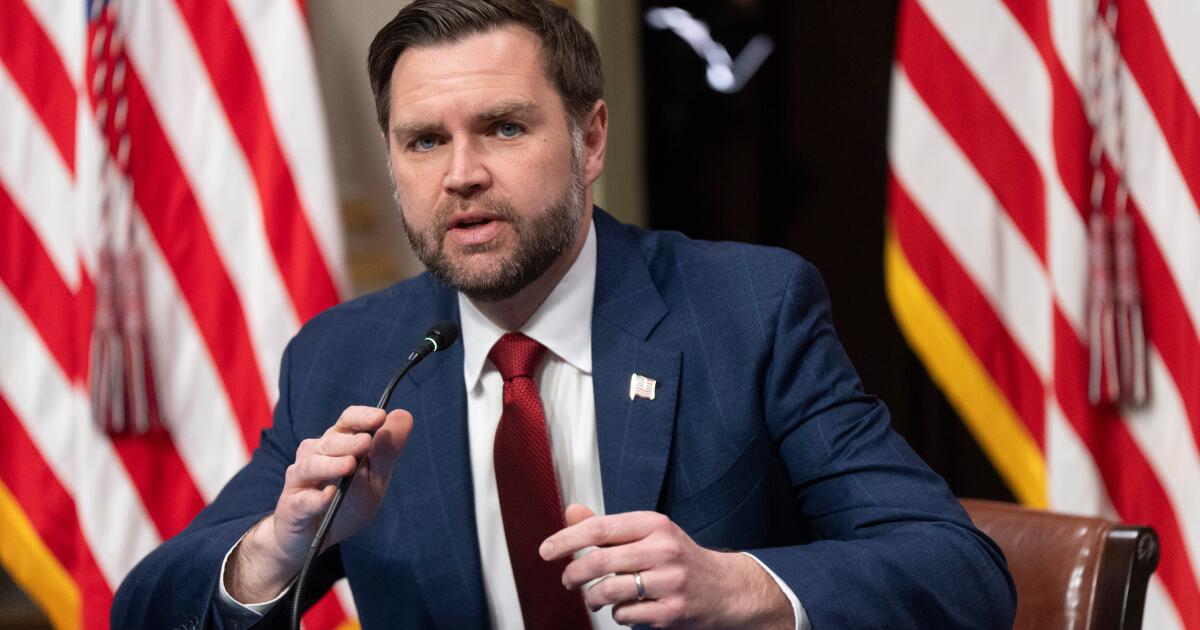
Vance holds first meeting of a new anti-fraud task force targeting benefit programs
WASHINGTON — Vice President JD Vance on Friday held the inaugural meeting of a new anti-fraud task force he’s leading as the Trump administration seeks to show it’s cracking down on potential misuse of social programs.
Vance, speaking Friday before the task force held a closed-door meeting, said that the federal government for decades had not taken the issue of fraud seriously and that it needed to be tackled with “a whole-government approach.”
“This is not just the theft of the American people’s money,” Vance said. “It is also the theft of critical services that the American people rely on.”
President Trump, a Republican, has made a crackdown on fraud part of his chief domestic focus as voters have said they’re concerned about affordability ahead of November’s midterm elections. That effort comes after allegations of fraud involving day-care centers run by Somali residents in Minneapolis prompted a massive immigration crackdown in the Midwestern city, resulting in widespread protests.
Vance cited some of the Minnesota allegations on Friday. Last month, he held a news conference to announce a temporary halt of some Medicaid funding until the state took actions that federal officials said would address their concerns.
Minnesota Gov. Tim Walz, a Democrat who faced Vance as a vice presidential candidate in 2024, has called it a “campaign of retribution” and said the Trump administration was “weaponizing the entirety of the federal government to punish blue states like Minnesota.”
The task force is also the most visible assignment to date that Trump has given to Vance, who is seen as a potential 2028 presidential candidate.
Vance and the task force, which includes about half the president’s Cabinet, the leader of a new Justice Department division focused on prosecuting fraud and Federal Trade Commission Chair Andrew Ferguson, are set to meet regularly to look at rooting out potential fraud and waste in federal benefit programs.
Ferguson, who is vice chair of the task force, cast the issue of fraud as a dire crisis facing the country and said it “shreds the social trust on which these programs and our entire nation depend.”
“This fraud crisis is thus existential,” he said. “If we fail to address it, the fabric of our nation will swiftly unravel.”
Joining the task force was Colin McDonald, a top aide to the Justice Department’s second in command. He was recently confirmed as the assistant attorney general overseeing the new division at the department focused on prosecuting fraud.
The Justice Department has long prosecuted fraud nationally through its Criminal Division, but the Trump administration says the new division is needed to crack down on rampant fraud.
Price writes for the Associated Press.

UCLA’s Cori Close says Bruins’ success has taken a toll on her
SACRAMENTO — Cori Close’s candid remarks about the growing challenges of coaching in modern college athletics sparked a reaction nationwide among her peers.
On Thursday, the UCLA women’s basketball coach was asked about the rapid changes shaping college sports ahead of her Bruins’ Sweet 16 matchup against Minnesota on Friday night. The No. 1-seeded Bruins (33-1) entered the Sweet 16 round considered a strong Final Four contender, powered by one of the deepest starting lineups in the nation.
“I’ve never been as tired as I’ve been in the last two years, and it’s made me think how much longer I can do this,” Close said. “And I’m just being transparent with you about that. There are so many things that are harder, and we keep losing incredible people on the men’s and the women’s side.”
UCLA has dominated throughout the season, entering the Sweet 16 on a 27-game winning streak that dates to late November. Three starters — Lauren Betts, Charlisse Leger-Walker and Gianna Kneepkens — began their college careers elsewhere before transferring into the program.
“How do we now figure out this transfer portal? Let’s not complain about it,” Close said. “Let’s have solutions about what’s right and what adjustments need to be made. … I’m a huge advocate for NIL. It should have happened 20 years ago. And we need boundaries. We need infrastructure. We need competitive equity. We need transparency.”
In contrast, Louisville coach Jeff Walz offered a more critical perspective when addressing the same topic during a NCAA news conference in Fort Worth, Texas.

UCLA guard Kiki Rice points across the court while talking with Bruins coach Cori Close during an NCAA tournament win over California Baptist at Pauley Pavilion on March 21.
(Gina Ferazzi/Los Angeles Times)
“I’m friends with Cori,” Walz said. “My favorite line, I would tell her, if you don’t like your job, find a new job. I mean, I’m listening this morning at 4:20 as the workers outside my window at the hotel in the street are working. I mean, you choose your profession. If you don’t like it, find a new profession.”
No. 3-seeded Louisville will face No. 2 Michigan on Saturday after falling short against Duke in the ACC championship game.
Close, who has spent 33 years in coaching, including 15 at UCLA, has navigated an evolving landscape shaped by name, image and likeness compensation policies and the transfer portal, just like everyone else. Last season, she earned national coach of the year and led the Bruins to the program’s first Final Four. UCLA has now reached at least the Sweet 16 during four consecutive seasons and eight times during Close’s tenure in Westwood.
This year, the Bruins swept through Big Ten play undefeated and once again secured a No. 1 seed in the NCAA tournament.
“I mean, of course, it’s a lot of work, but we chose to do it and we get compensated for it,” Walz said. “I don’t think anybody is going to feel too sorry for us that you might be tired. I’m tired, too, but who is not?”
Several longtime coaches have stepped away from the game in recent years, amid, though not always directly attributed to, the sport’s ongoing transformation. Hall of Fame Stanford coach Tara VanDerveer retired in 2025, while Georgia Tech’s Nell Fortner, Iowa’s Lisa Bluder and Harvard’s Kathy Delaney-Smith stepped down during the past three seasons.
“It’s ever-changing, and that’s the frustrating part, because you can never get a grasp on any of it,” Kentucky coach Kenny Brooks said. “You think that you have it. Then all of a sudden, it’s like somebody pulls a rug out and says, ‘No, we’re changing it,’ and now it’s going to be this way now. We want to get out ahead of everything, but we can’t. We always seem like we’re one step behind because there are so many changes.”
Ultimately, Close’s message centered on the need for structural support in a rapidly shifting environment.
“If there’s one thing I would ask of our governing bodies and the NCAA and our administrations is please develop infrastructure and boundaries that create an opportunity to have sustained excellence and sustainable pace,” she said. “Otherwise, we are going to continue to lose some of our best coaches, and I do not think our game can afford to do that.”

I got my new UK passport in under 2 weeks without fast track – here’s how
If you are planning a holiday abroad, you will want to double check your passport is valid

If you’re looking to save money, it’s worth knowing that it’s £12.50 cheaper to apply for a passport online than by post(Image: Getty)
If you’re planning a trip overseas soon, it’s crucial to ensure your passport is valid for travel. This means, depending on your destination, you might need to renew it earlier than anticipated.
For example, if you’re jetting off to Spain, the Foreign Office warns travellers that the country adheres to Schengen area rules. This means your passport must have a ‘date of issue’ less than 10 years before the date you arrive.
If you renewed your passport before October 1, 2018, it may have a date of issue that is more than 10 years ago. The rules also mean that you should have an ‘expiry date’ at least three months after the day you plan to leave the Schengen area – the expiry date does not need to be within 10 years of the date of issue.
In other places, like Cyprus, you need to have “at least one blank page for stamping”. So if you need to get a new passport, here’s what you need to know before you’re set to travel abroad.
How long did it take me to get my new blue UK passport?
I submitted an application for a new passport on July 13 last year and posted my old passport, as directed, on July 14. The Passport Office received my old one on July 15 – this step is necessary as you cannot possess two passports.
I received my next update on July 23, informing me that my passport application had been approved. This was followed by an email on July 24 letting me know my new passport had been printed.
The next day, I received my blue passport with a new photo I had taken myself at home. So it took me less than two weeks to get my new travel document – and I didn’t pay for fast track.
So I was pleasantly surprised at how swift and straightforward the entire process was. You can check how long it will take to get a passport before you apply.
And if you need a passport urgently, you can opt for their Online Premium or 1 week Fast Track services. They warn: “Do not book travel until you have a valid passport – your new passport will not have the same number as your old one.”
How to apply for a new UK passport?
You can submit an application via the GOV.UK website. It caters for various needs, whether you need to apply for, renew, replace or update your passport, and you can also pay for it online.
How much does a UK passport cost?
If you’re looking to save money, it’s worth knowing that it’s £12.50 cheaper to apply for a passport online than by post. It’s worth noting that prices increase on April 8, 2026.
Apply Online
- Adult (16 and over) standard 34-page passport – £94.50
- Adult (16 and over) 54-page frequent traveller passport – £107.50
- Child (under 16) standard 34-page passport – £61.50
- Child (under 16) 54-page frequent traveller passport – £74.50
- Passport for people born on or before 2 September 1929 – Free
Apply by paper form
- Adult (16 and over) standard 34-page passport – £107
- Adult (16 and over) 54-page frequent traveller passport – £120
- Child (under 16) standard 34-page passport – £74
- Child (under 16) 54-page frequent traveller passport -£87
- Passport for people born on or before 2 September 1929 – Free
Can I get my passport quicker?
If you’re due to travel abroad soon and are concerned it won’t arrive in time, you can opt for a premium service. Again, prices rise on April 8.
- When you’ll get your passport: Usually within 3 weeks (delivered securely to your home)
- Cost: £94.50 (or £107.50 for a 54-page frequent traveller passport)
- Needs an appointment: No
- When you’ll get your passport: Delivered by courier to your home 1 week after the appointment
- Cost: £178 (or £191 for a 54-page frequent traveller passport)
- Needs an appointment: Yes
- When you’ll get your passport: Collect it 4 hours after your appointment
- Cost: £222 (or £235 for a 54-page frequent traveller passport)
- Needs an appointment: Yes
How can I get a free passport?
If you were born on or before September 2, 1929, you can get or renew a British passport for free if you’re a British national. You can also utilise the Post Office Check and Send service for free and receive free secure delivery.
You must pay a fee if you need a passport urgently or want a frequent traveller passport, which provides 54 pages instead of 34.
Kash Patel’s personal email hacked by Iran-affiliated group
March 27 (UPI) — Iran-linked hackers broke into FBI Director Kash Patel’s personal email account, multiple news outlets reported Friday.
The hackers published photos and emails from the account from before Patel became FBI director, CNN, CNBC and CBS News reported. CNN said a source familiar with the breach confirmed the authenticity of the photos.
The emails the group stole from Patel date from around 2011 to 2022. They include personal, business and travel communication.
The hacking group, Handala Hack Team, said on their website that Patel “will now find his name among the list of successfully hacked victims.”
The photos published include Patel sniffing and smoking cigars, riding in an antique convertible, and making a face while taking a picture of himself in the mirror with a large bottle of rum. There are family photos and details of Patel searching for an apartment.
The group calls it a breach of “impenetrable” FBI systems, but the FBI was not breached.
“This isn’t an FBI compromise — it’s someone’s personal junk drawer,” cybersecurity researcher Ron Fabela told CNN.
“The FBI is aware of malicious actors targeting Director Patel’s personal email information, and we have taken all necessary steps to mitigate potential risks associated with this activity,” a statement from the FBI said. “Consistent with President Trump’s Cyber Strategy for America, the FBI will continue to pursue the actors responsible, support victims, and share actionable intelligence in defense of networks.”
It also said the information taken, “is historical in nature and involves no government information.”
The FBI also said that the State Department has offered a $10 million reward for information that leads to the identification of the Handala Hack Team.
The hackers have said they hacked the account to retaliate for a missile strike on an Iranian school, CNN reported.
Handala claimed Thursday to have published the personal data of dozens of Lockheed Martin employees stationed in the Middle East. The company said in a statement it was aware of the reports and had policies and procedures in place “to mitigate cyber threats to our business.”
Gil Messing, chief of staff at Israeli cybersecurity company Check Point, told CNBC that the move against Patel was part of Iran’s strategy to embarrass U.S. officials and “make them feel vulnerable.”
On March 19, the FBI took down two websites used by Handala after it hacked the medical company Stryker on March 11. The two sites were: one that had information about its hacks and the other used to dox people it alleges work with the Israeli military. The website it used to post Patel’s information was registered the same day the other sites came down.
President Donald Trump stands with U.S. Secretary of Agriculture Brooke Rollins during an event celebrating farmers on the South Lawn of the White House on Friday. Photo by Aaron Schwartz/UPI | License Photo

How important are the Gulf economies to the world? | US-Israel war on Iran News
Impact of US-Israeli war on Iran poses serious risks beyond energy sector.
The US-Israeli war on Iran is hitting Gulf Arab nations hard – but with a wider impact in today’s interlinked world.
As well as global oil and gas supplies, Gulf states play a critical role in many economies.
So how are they connected – and what could be at risk?
Presenter: James Bays
Guests:
Nikolay Kozjharnov – Research associate professor in energy security at the Gulf Studies Center at Qatar University
Cornelia Meyer – Macroeconomist and oil and gas specialist
Torbjorn Soltvedt – Associate director at global risk intelligence company Verisk Maplecroft
Published On 27 Mar 2026

‘Dead Lover’ review: A wildly creative feminist plunge into goth territory
p]:text-cms-story-body-color-text clearfix”>
“I want to lick your stink … I want to taste your foulness … I want to shower in your rot … I want to feast in your fetid funk.”
Have more romantic sweet nothings ever graced the screen? Scripted by Grace Glowicki and Ben Petrie (partners in life and in filmmaking), these words of seduction are music to the ears of a lonely Gravedigger (Glowicki), who has been formulating a perfume to cover up her corpse-like stench. What she discovers is that the right one will love her exactly the way she smells, learning that she’s not so pheromonally challenged after all.
Glowicki’s sophomore feature “Dead Lover,” sometimes presented in “Stink-O-Vision,” is one of those entirely singular freakouts that we can thank Telefilm Canada for subsidizing (see also: the Cronenberg family oeuvre, Matt Johnson’s current “Nirvanna the Band the Show the Movie” and many more).
She co-writes, directs and stars in this highly stylized, wonderfully DIY handmade project, beautifully designed with gruesomely gothic sets by production designer Becca Morrin and art director Ashley Devereux. The blend of intentional artifice paired with deep emotion calls to mind other Canadian auteurs like Guy Maddin and Matthew Rankin (“The Twentieth Century”), but Glowicki’s film also exists within another lineage: the feminist Frankenstein film.
The film opens with a quote from Mary Shelley: “There is something at work in my soul which I do not understand.” Her 1818 novel “Frankenstein: or, the Modern Prometheus” has always been a feminist text (despite Guillermo del Toro’s more bro-ey adaptation), grappling with the terrifying power of creating life — and how close that is to death. Feminist filmmakers have drawn out these inherent themes from the book, the most recent and loudest example being Maggie Gyllenhaal’s “The Bride!” But “Dead Lover” hews closer to Laura Moss’ modern medical take, “birth/rebirth,” and even more closely to Zelda Williams’ cute, poppy “Lisa Frankenstein,” in which a young seamstress stitches up a reanimated boyfriend.
Our Gravedigger speaks to us, and to the moon, about her heart’s desire in charming cockney rhyming slang. Her hopes are rather simple and conventional: one true lifelong love and a family. After much rejection, she finally finds her Lover (Petrie) in the cemetery, saving him from a ferocious beast while he mourns his late opera-singer sister (Leah Doz). After the pair consummate their fragrant lust, the Gravedigger is ready to settle down right away.
In order to make her dreams come true, Lover travels to Europe for fertility treatments, where he drowns on a ship, the only thing left of him a finger, delivered to her by fishermen. Our enterprising Gravedigger, a true woman of science, engineers a lizard elixir and regenerates the finger into a long tentacle that eventually demands a body. What better choice than his own sister? But when her wild new Creature (Doz) comes to life, all hell breaks loose, summoning the sister’s jealous, grief-stricken Widower (Lowen Morrow) into an unfortunate love triangle (or square?).
Glowicki is a terrific filmmaker, marshaling her tiny troupe to execute this unique project. Petrie, Doz and Morrow play multiple roles, including a gossipy Greek chorus and the band of merry fisherman (truly an astonishing array of Canadian accent work on display). Her commitment to her singular vision never wavers, but as an actor, Glowicki is truly astonishing. Caked in Halloween makeup and lit with an array of colored gels, Glowicki summons something primal, pure and deeply moving about the lengths one will go to for love, a screech from the depths of her gut.
With a dream-pop soundtrack by U.S. Girls that would be at home in an episode of “Twin Peaks,” “Dead Lover,” in all its stinky, sexy, queer and grotesque glory, is one of the grossest and loveliest films about love I’ve ever seen. This one’s for the horny, hopeless goth inside all of us.
‘Dead Lover’
Not rated
Running time: 1 hour, 25 minutes
Playing: Opens Friday, March 27 at Laemmle Glendale
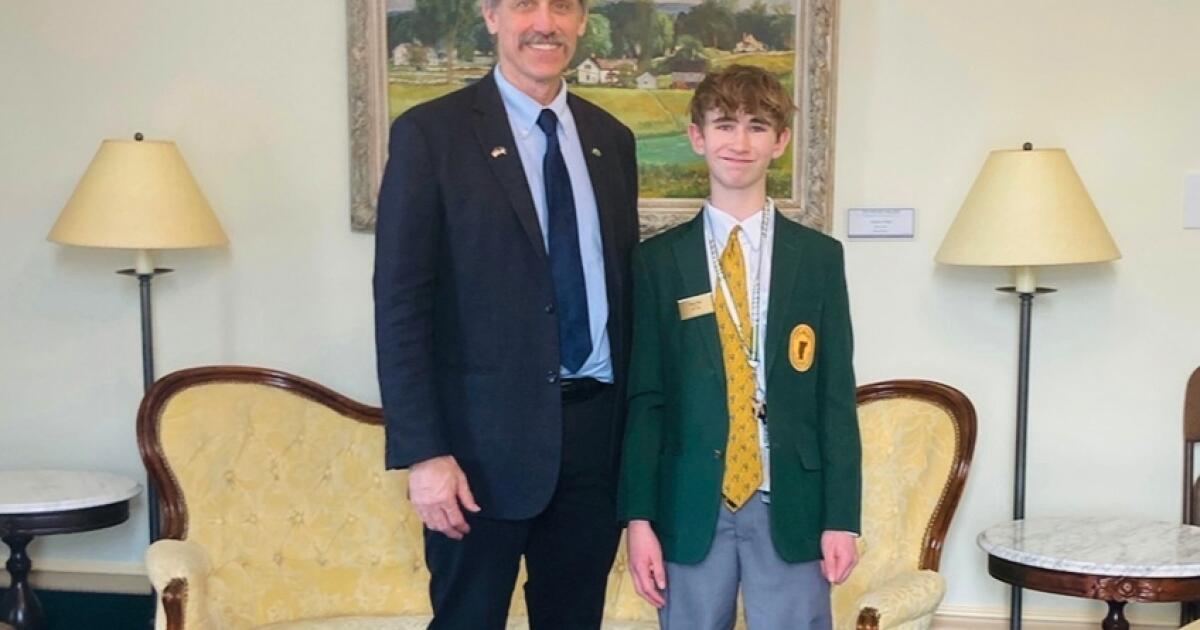
A 14-year-old running for governor is the first teen to get on Vermont’s general election ballot
STOWE, Vt. — Looking back, gubernatorial candidate Dean Roy says his political ambitions started in the eighth grade. And by that he means last year.
After working as a legislative page at the Vermont Statehouse, the 14-year-old freshman at Stowe High School now has his sights set on the corner office. In November, he’ll be the first candidate for governor under age 18 to appear on the state’s general election ballot.
“I don’t expect necessarily to win,” he said. “What I do expect is to start the movement, and get more young people to come in behind me and say, ‘Yeah, we also want to make change.’”
Another eighth-grader, Ethan Sonneborn, sought the Democratic nomination for governor in 2018 but finished last in a four-way primary. Roy secured his spot in the general election by creating his own third party, the Freedom and Unity party. Both were able to run because the state constitution sets no minimum age for gubernatorial candidates, requiring only that candidates have resided in the state for four years.
“I know it sounds crazy, a 14-year-old running for governor, but honestly, look at the people in charge right now,” Roy said in a post on his campaign’s Instagram page. “They’ve been doing this forever and things still aren’t working.”
Nearly all other states set minimum age requirements for governor, often 30 years old. In Kansas, lawmakers added a requirement that gubernatorial candidates be at least 25 years old in 2018 after six teenagers ran for office.
Peter Teachout, a professor at Vermont Law and Graduate School, has a different take than Roy on Vermont’s constitution. He points to a section in the document referring to what qualifies someone to be “entitled to the privileges of a voter,” and that is that they must be 18 years of age. Even under Roy’s interpretation, Teachout doesn’t predict a win for the teenager.
“In theory, a 4-year-old could run for governor. Should we be worried about it? No,” he said. “Vermonters can be a little cantankerous and provocative just for the fun of it, but it is not something they are likely to support in this context.”
But Roy’s former history teacher, James Carpenter, said he thinks it’s great that Roy is giving it his all. Though most 14-year-olds aren’t concerned with property taxes or healthcare, Carpenter describes Roy as an “old soul” with endless curiosity.
“It just really shows what type of kid Dean is. He’s very earnest in what he’s doing. There’s no gimmick behind this,” he said. “I think he blends that youthful optimism with some pragmatism that few kids have.”
Roy, who said he doesn’t identify with either major party, said housing is the most important issue facing the state. He’s also thought about how he’d juggle school with a full-time job as governor, saying he’d consider online classes and would do his homework at night after work.
The current governor, Republican Phil Scott, applauds Roy’s interest in politics and public service but questions whether someone so young is ready for the responsibilities that come with running a state.
“He believes it’s important for our youth to get involved,” said Press Secretary Amanda Wheeler. “But the governor also believes that a teenager may not be best suited to serve in that role given the lack of experience and lived perspectives youth have at that point in their lives.”
Roy disagrees that age has anything to do with whether a candidate is fit to run for office.
“What I’m aiming for is that these career politicians look at me and they say, ‘Oh my God, he actually has a chance to disrupt things,’” he said. “If I can get people to think that I am a threat to them, then I know that’s been a success. Because what I want is to show them that the youth have a voice. We’re gonna make change. The future is now.”
Swinhart writes for the Associated Press. AP reporter Holly Ramer contributed to this report from Concord, N.H.
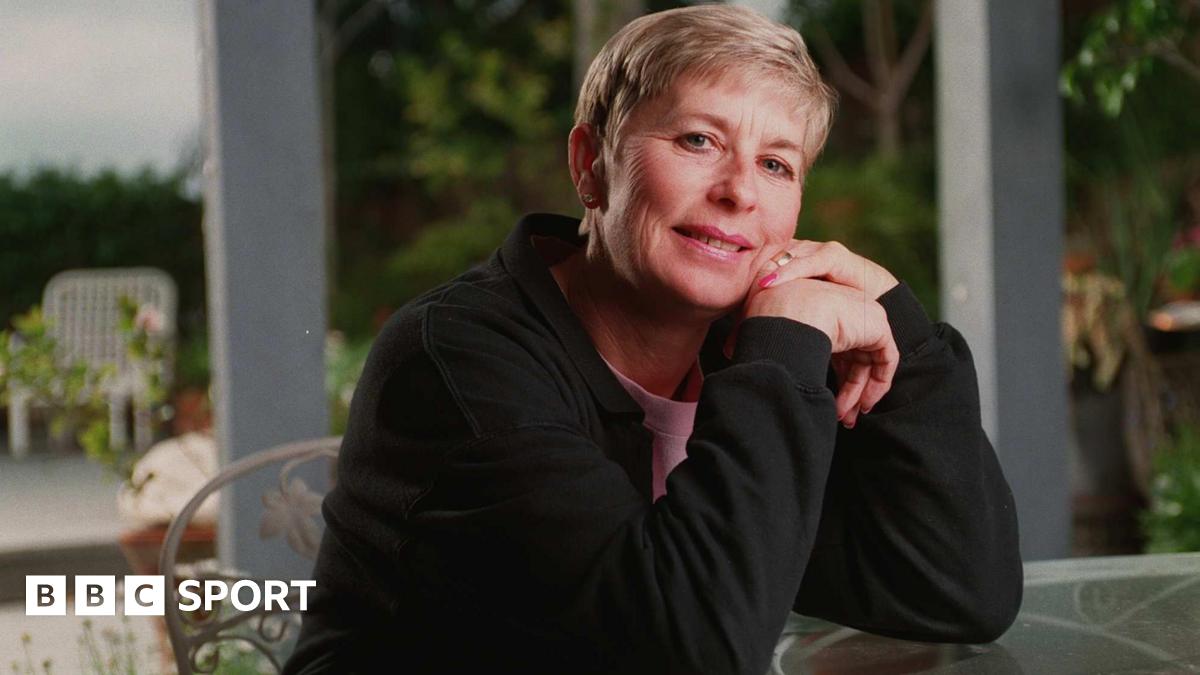
Mary Rand: 1964 Olympic gold winner dies at age of 86
Mary Rand, the first British woman to win an Olympic gold medal in athletics, has died at the age of 86.
Rand secured the long jump title at the Tokyo Games in 1964, also winning silver in the inaugural women’s pentathlon and bronze in the 4x100m relay.
That meant she also became the first British woman to win gold, silver and bronze at a single Olympic Games.
In the long jump, Rand broke the British and Olympic records with her first leap of 6.59m and then smashed the world record on her fifth attempt with an effort of 6.76m.
“Mary was the most gifted athlete I ever saw,” said Ann Packer, who won 800m gold at the 1964 Olympics days after Rand’s triumph and was her room-mate in Tokyo.
“She was as good as athletes get. There has never been anything like her since – and I don’t believe there ever will.”
Rand, whose first husband was British rower Sydney Rand, also won long jump gold at the 1966 Commonwealth Games in Jamaica.
However, injury denied her the chance to defend her Olympic title in 1968 and she retired at the age of 28 the same year.
Born in Wells, Somerset, she was only 17 when she set her first British record in the pentathlon, and she won 12 national titles across long jump, high jump, sprint hurdles and pentathlon during her illustrious career.
Rand was voted the BBC Sports Personality of the Year in 1964 and was awarded an MBE in the 1965 New Year Honours List.

JD Vance takes aim at Minnesota, Somalis ahead of anti-fraud task force meeting
March 27 (UPI) — U.S. Vice President JD Vance took aim at Minnesota and Somali immigrants on Friday ahead of the first meeting of the Trump administration’s anti-fraud task force.
While the meeting itself was behind closed doors, Vance gave brief remarks to reporters, touting the aims of the task force. He specifically took to task a scam in Minnesota involving a Medicaid program meant to aid children on the autism spectrum.
In September, the Trump administration announced charges against one person in a $14 million fraud scheme involving the autism program, and six additional defendants were charged in December.
“I think that the autism scam that we’ve seen in the Somalian parts of Minnesota really illustrates well what’s been going on across whole layers of our government,” Vance said.
“Now, what we’ve seen is Somali fraudsters at an industrial scale taking advantage of that program to the tune of millions and millions of dollars.”
In February, the Trump administration announced it was pausing more than $250 million in Medicaid payments to Minnesota over the alleged fraud.
President Donald Trump announced the formation of the panel during his State of the Union address earlier this year. He, too, took aim at at Minnesota and immigration in his announcement of the task force, which he said will help balance the federal judge “overnight.”
“The Somali pirates who ransacked Minnesota remind us that there are large parts of the world where bribery, corruption and lawlessness are the norm, not the exception,” Trump said.
“Importing these cultures through unrestricted immigration and open borders brings us problems right here to the USA. And it is the American people who pay the price in higher medical bills, car insurance rates, rent, taxes and, perhaps most importantly, crime.”
Gov. Tim Walz has lashed out at the Trump administration for targeting Minnesota, saying the withholding of funds “has nothing to do with fraud.”
“This is a campaign of retribution. Trump is weaponizing the entirety of the federal government to punish blue states like Minnesota,” he said in a statement.
Federal Trade Commission Chairman Andrew Ferguson, White House deputy chief of staff Stephen Miller and other officials from the executive branch joined Vance for the inaugural meeting of the White House Task Force on Eliminating Fraud.

President Donald Trump and U.S. Ambassador to Greece Kimberly Ann Guilfoyle attend a Greek Independence Day celebration event in the East Room of the White House on Thursday. Photo by Will Oliver/UPI | License Photo
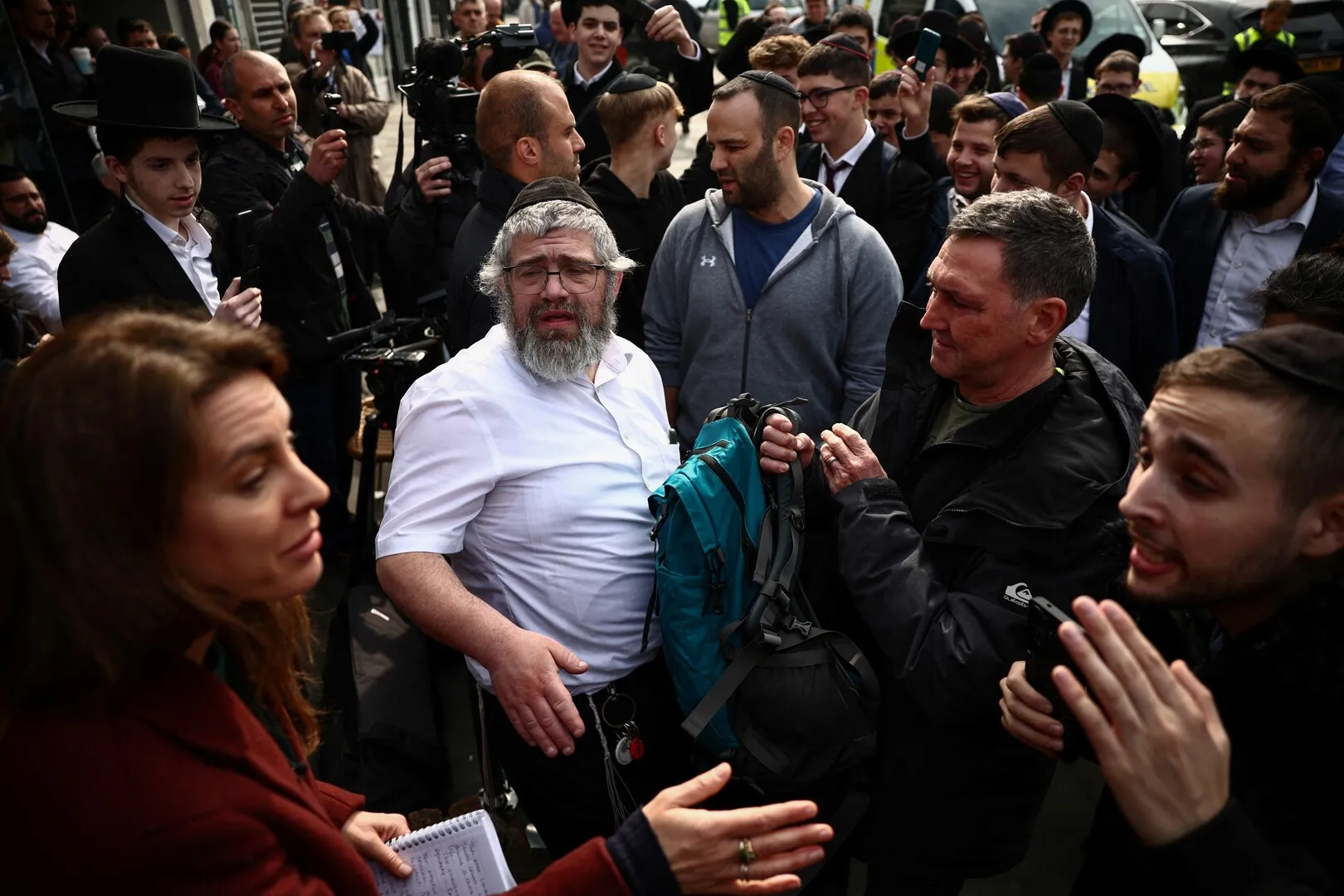
Off-duty London police officer filmed ‘intimidating’ Al Jazeera journalists | Freedom of the Press
An off-duty Metropolitan Police officer was among a group filmed confronting Al Jazeera journalists reporting on a suspected arson attack in north London, the force has confirmed. The incident is raising questions about press freedom.
Published On 27 Mar 2026

Who is in the cast of Jo Nesbo’s Detective Hole?
Need to know
Netflix’s gripping new crime drama Jo Nesbo’s Detective Hole follows troubled detective Harry Hole hunting a serial killer in Oslo.

Jo Nesbø’s Detective Hole is now streaming on Netflix(Image: Netflix)
Everything you need to know about the cast of Jo Nesbo’s Detective Hole on Netflix
- Netflix has released new crime thriller Jo Nesbo’s Detective Hole this week. The nine-episode series follows troubled detective Harry Hole as he hunts a serial killer in Oslo. The show draws inspiration from bestselling Norwegian author Jo Nesbo’s novels, particularly The Devil’s Star.
- The Netflix cast is led by Norwegian star Tobias Santelmann, who portrays protagonist Harry Hole. The actor is best known for his roles in The Last Kingdom, Kon-Tiki, and Exit. Meanwhile, Swedish-American actor Joel Kinnaman stars as detective Tom Waaler after appearing in Apple TV+’s For All Mankind, Hanna, Altered Carbon The Killing and Suicide Squad.
- Norwegian star Pia Tjelta portrays Harry’s girlfriend Rakel Fauke and counts credits in State of Happiness, Cold Lunch, Blindsone, Cold Lunch, Next Summer and Norsemen. Swedish actress Ellen Helinder also stars as officer Beate Lønn and has appeared in Exit alongside her co-star Santelmann, as well as Beck, Studenternas undergång and Veronika.
- Other cast members include Anders Baasmo, Maxime Baune Bochud, Kåre Conradi, Simon J. Berger, Prison Break’s Peter Stormare, Fridtjov Såheim, Eili Harboe, Atle Antonsen, Manish Sharma, Jesper Christensen, Kristoffer Joner, Ingrid Bolsø Berdal, Linn Skåber, Jonas Strand Gravli, Sonny Lindberg, Agnes Kittelsen, Nader Khademi, Agot Sendstad, Maja Christiansen, Frank Kjosås, Kelly Gale, Oddgeir Thune, Ravdeep Singh Bajwa, Henrik Mestad, Ingar Helge Gimle, Henriette Steenstrup, Helge Jordal, Eirik Hallert, Anders Danielsen Lie, Ane Dahl Torp and Dagny.
- Netflix describes Jo Nesbo’s Detective Hole as “a whodunnit serial killer mystery led by famed anti-hero Harry Hole” that operates as “a nuanced character drama about two police officers operating on opposite sides of the law.” The drama sees Harry clash with corrupt colleague Tom Waaler (Joel Kinnaman) whilst trying to solve murders. The streaming giant promises viewers will see how “Harry must do all he can to catch a serial killer and bring Waaler to justice before it is too late.”
READ THE FULL STORY: Jo Nesbo’s Detective Hole release date, cast, trailer and plot as it lands on Netflix

Georgia’s Fulton County and Trump administration square off in court over seized 2020 ballots
ATLANTA — Attorneys for Georgia’s Fulton County and President Trump’s administration squared off in court Friday over the county’s demand that the FBI return seized ballots and other materials from the 2020 election.
Abbe Lowell, an attorney representing Fulton County, noted that the January raid was “unusual” because it involved an old election and allegations that have already been investigated in the years since Trump, a Republican, lost the county and the state to Joe Biden, a Democrat.
Lowell contended that the Trump administration seized the materials because it grew impatient with litigation the Justice Department filed to obtain them last year. “There’s abundant law that the left hand of the department needs to know what the right hand is doing,” Lowell told U.S. District Judge J.P. Boulee.
Michael Weisbuch, representing the federal government, replied that the separate civil litigation wasn’t “relevant in any respect.” He said the administration has already provided Fulton County with digital copies of everything taken and needs to retain physical copies to carry out its own investigation.
Boulee wrote in a scheduling order that the hearing was needed after the two sides failed to reach an agreement in court-ordered mediation.
Trump’s actions alarm Democrats and election officials
The Jan. 28 seizure from a warehouse near Atlanta targeted the elections hub in Georgia’s most populous county, which is heavily Democratic and includes most of Atlanta. Fulton County has been at the center of unfounded claims by Trump and his allies that widespread election fraud cost him reelection.
The FBI’s move was among several actions by the Trump administration that have alarmed Democrats and many election officials who are concerned it’s using law enforcement to pursue the president’s personal grievances and is planning ways to interfere in this year’s midterm elections. The FBI also used a subpoena earlier this month to obtain records related to an audit of the 2020 presidential election in Maricopa County in Arizona, another battleground state Trump lost that year.
At the same time, the Justice Department is fighting numerous states in court for access to voter data that includes sensitive personal information. Election officials, including some Republicans, have said handing over the information would violate state and federal privacy laws.
Justice Department says it’s investigating 2020 ‘irregularities’
Lawyers for Fulton County argued in a court filing that the seizure of its documents was “improper and unjustified” and demonstrates “callous disregard” for the Fourth Amendment protection against unreasonable search and seizure. The Justice Department seeks to “set a precedent that would grant the federal government unchecked power to interfere with the local administration of elections,” it wrote.
Justice Department attorneys argued that preparing a detailed affidavit and presenting it to a judge “is the exact opposite of ‘callous disregard’” for those constitutional rights. “Their goal to disrupt an ongoing federal criminal investigation is clear,” they wrote of Fulton County officials.
The Justice Department said it is investigating “irregularities that occurred during the 2020 presidential election in the County” and identified two laws that might have been violated. One requires election records to be maintained for 22 months, while the other prohibits procuring, casting or tabulating false, fictitious or fraudulent ballots.
The filing said the FBI is looking into whether Fulton County properly retained ballot images; whether some ballots were scanned and counted multiple times; whether unfolded, unmailed ballots were counted as mail-in absentee ballots; and potential irregularities concerning tabulator tapes from the scanners used to count ballots.
Fulton County’s lawyers wrote that the “deficiencies” or “defects” in the county’s handling of the 2020 election cited in the affidavit are the kinds of human errors that commonly occur without any intentional wrongdoing and cannot establish probable cause.
Election tech expert cites problems in the affidavit
To support their claims, Fulton County officials submitted a sworn declaration from Ryan Macias, an election technology and security expert who advised the county during the 2020 election. He said the affidavit contains “a multitude of false or misleading statements and omissions” and offered explanations for the alleged “deficiencies.”
Investigations by the Georgia secretary of state and independent reviews contradict the core allegations of the affidavit, which is “rife with statements from witnesses lacking credibility, with extraordinary and undisclosed biases,” Fulton’s lawyers argued.
Georgia’s votes in the 2020 presidential race were counted three times, including once by hand, and each count affirmed Biden’s win.
Federal government lawyers rejected the idea that the FBI agent who wrote the affidavit “intentionally or recklessly misled” the judge, writing that “the supposed misrepresentations and omissions flagged by Petitioners are illusory and/or immaterial.” They also asserted that a lapse of the statute of limitations on the potential crimes does not negate probable cause.
The Justice Department also noted that a federal magistrate judge reviewed the FBI affidavit and signed off on the search warrant. Fulton County sought to have the FBI agent who wrote the affidavit testify at Friday’s hearing, but the Justice Department objected and the judge sided with the federal government.
Brumback writes for the Associated Press. AP writer Nicholas Riccardi in Denver contributed to this report.