



The Rebel Tours: Money or morals? | Digital Series
Would you break one of sport’s biggest boycotts for life-changing money? In the 1980s, some West Indies cricketers toured apartheid South Africa, sparking outrage. Al Jazeera’s Samantha Johnson explores the money, morals and consequences behind the controversial tours.
Published On 15 Oct 2026

After nearly buying Warner Bros., Netflix is laying off 1,000 workers. What happened?
It was a crowning moment. Netflix appeared to have prevailed in an audacious $82.7-billion deal to scoop one of the industry’s most prestigious studios: Warner Bros. The move seemed to cement Netflix’s status as the ultimate Hollywood gate-crasher and its dominance as the leading new player in media.
Now, nearly a year later, the plotline for Netflix has dramatically changed. The streaming giant lost out to Paramount Skydance in its bid for Warner Bros. Discovery and is facing headwinds on multiple fronts.
That was underscored this week when the streaming giant Netflix began shedding 6% of its workforce, or about 1,000 jobs — believed to be the largest layoff in the company’s history and exceeding the last round of job cuts in 2022, when it reported subscriber declines.
On Wednesday morning, Ted Sarandos and Co-Chief Executive Greg Peters sent a note to employees confirming the job losses, adding that the bulk of the cuts would affect the tech, product, legal and human resources teams.
“Our mission — to entertain the world — is ambitious, and delivering on it requires us to be disciplined about where we prioritize our people and resources,” wrote Sarandos and Peters in the memo obtained by The Times.
The cuts mark the latest reductions across the film and TV industry. Other entertainment and media companies have slashed their payrolls, including Walt Disney Co., Paramount and Sony Pictures Entertainment during a period of economic uncertainty in Hollywood.
But the scale of such downsizing is unusual for Netflix. Industry analysts and insiders chalk up the reversal of fortune to several factors. Although it still dominates the television business, the Los Gatos company hasn’t been able to produce enough new hit franchises to replace culture-defining shows from years past such as “Stranger Things” and “Squid Game.”
At the same time, Netflix faces rising competition from rivals such as HBO Max, Apple TV, Hulu and others that have upped their game. Free, ad-supported streaming platforms such as YouTube are increasingly taking a larger slice of consumer streaming hours. And Netflix’s efforts to diversify its business into new areas such as games have yielded mixed results.

A Netflix building on Sunset Boulevard in Los Angeles in 2025.
(Myung J. Chun / Los Angeles Times)
The upshot: Netflix continues to be the dominant video subscription streaming player with more than 325 million subscribers, but the time that consumers spend on the platform is growing at a slower pace than what investors want. In the first half of this year, consumer watch time on Netflix increased only 2% compared with a year earlier, even as content spending increased 11% to $20 billion this year. Netflix also narrowed its annual revenue forecast last summer, disappointing some investors.
“Netflix’s layoffs show that even the top streaming companies are not immune to stagnation and financial difficulties,” said Ross Benes, senior analyst at research firm Emarketer.
Amid the sobering signs, investors have grown restless. Netflix shares, which closed at $70.57 on Wednesday, have plummeted 42% in the last year. Part of that decline was fueled by anxiety among investors over Netflix’s deal to buy Warner Bros. Discovery, but the share price hasn’t rebounded even after that deal fell apart.
“They need to better prepare their balance sheet and economics since engagement has plateaued,” said Brandon Katz, director of insights and content strategy at Greenlight Analytics.
Katz said that Netflix’s five most-watched English-language scripted summer movie releases in their first eight weeks posted the lowest average hours watched compared with the streamer’s top five summer releases in 2025, 2024 and 2023, citing Nielsen data.
Sarandos acknowledged concerns about engagement at a Bloomberg Screentime event Sept. 30.
“Overall we’re not growing as fast as I want us to, and we’re working on making that move faster,” Sarandos said.
Netflix declined to comment on the layoffs.
“We’ll continue to invest aggressively in high-impact areas to improve our service and further drive growth and innovation,” Sarandos and Peters said in their memo to employees.
In some ways, Netflix has been victim of its own success. It has produced a string of shows and movies that have hit the cultural zeitgeist such as “KPop Demon Hunters” and “Squid Game.” But finding enough new popular shows that continue to drive subscriptions has been a challenge.
“A lot of these major hits are coming to an end at similar times, and they don’t yet really have heir apparents to replace them,” Katz said.
Sci-fi hit “Stranger Things” released its finale last year, followed by the young-adult drama “Outer Banks” and “Emily in Paris,” which ends this year. Netflix also announced that “The Witcher” and “The Lincoln Lawyer” will wrap after their next seasons.
What’s more, the second seasons of some shows with big followings have seen large view drop-offs compared with their first seasons. For example, the fantasy series “Avatar: The Last Airbender” season 1 debuted with 21.2 million views, but views for its second season dropped 59% to 8.7 million, according to Netflix data.
New series from Netflix also haven’t captured as much consumer demand as other competing shows from rival streamers, according to Parrot Analytics.
Last year, Netflix had just one show — the Japanese anime and manga series “Sakamoto Days” — that made it in Parrot’s top 10 list of first season original series on streaming platforms. Parrot’s ranking measures consumer demand in the U.S. and is based on digital interactions such as social media chatter and Google searches. By comparison, Netflix had three titles in 2022 alone: the true crime show “Monster,” the documentary series “Harry & Meghan” and the sci-fi mystery show “1899,” Parrot said.
Sarandos told investors in July that such declines are typical and that second season falloff is slightly improved this year. But popular shows on rival streaming services such as the medical drama “The Pitt” on HBO Max have not seen such declines. “The Pitt” drew even more viewers in its second season than the first.
To diversify its business, Netflix has expanded its programming offerings beyond TV shows and movies to include live sports, such as football and baseball games.
Although live programs have helped to spur significant subscription sign-ups, they still represent just 1% of watch time on Netflix while costing 5% of the company’s content budget, Sarandos has said.
Netflix also has added video podcasts that have helped to boost daytime viewing on the platform, and has made deals with YouTube creators to bring their content to the streaming service.
But some of the new content hasn’t clicked, particularly in games, analysts said. In August, Netflix shut down Hollywood-based Night School, the maker of supernatural adventure game “Oxenfree,” and said it was closing a Helsinki-based games studio.
“They are spending on a lot of things that haven’t necessarily proven to be effective yet,” said Rob Rosenberg, a partner at law firm Moses & Singer and former Showtime Networks general counsel. “It feels a lot like they’re trying to send a message to Wall Street that ‘we’re re-examining how we do business.’”
Meanwhile, Netflix continues to face more competition from rivals such as YouTube, which offers a free, ad-supported version of its video library.
Unlike Netflix, YouTube does not pay for the creation of many of the videos on its platform. Instead, creators or companies upload and produce the programs themselves and YouTube shares ad and subscription revenue.
YouTube’s share of streaming watch time in the U.S. on TVs has steadily increased. In July, YouTube represented 14.2%, compared with Netflix’s 7.8%, according to Nielsen.
The pressure to boost engagement on Netflix has caused tension within the company, particularly between the teams of people responsible for how programs are promoted on the platform and the employees responsible for bringing shows and movies on Netflix, according to people familiar with the matter who were not authorized to speak publicly.
Some blame the content for not being enticing enough, while others contend that the programs could be promoted better on Netflix.
“It’s a bit of a quagmire,” said one of the sources familiar with the matter. “There is a tension when things aren’t working. People tend to point fingers.”
In their staff memo, Sarandos and Peters said Netflix is on track to deliver its full-year forecast and will continue to invest in areas that improve its service and drive growth and innovation.
“Doing that means making focused choices across the business so we can keep delivering for our members, partners, employees, and investors,” they wrote.
Despite the downsizing, Netflix remains highly profitable. In the second quarter, the company generated $3.4 billion in net income, up 9% from a year earlier. Revenue rose 13% to $12.6 billion last quarter, including double-digit revenue growth in all of its regions. Next week, the company will share its third-quarter results.
The streamer is expected to get a boost from new seasons of popular shows — including season 4 of the political drama “The Diplomat” and spy series “Lupin: Part 4,” as well as Thanksgiving Eve and Christmas Day NFL games.
Having new seasons of popular shows such as “Lupin” and “The Diplomat” will help boost Netflix’s engagement, said Alejandro Rojas, vice president of applied analytics at Parrot Analytics.
“The new season is like a catalyst for people to watch the previous seasons,” Rojas said.
On the theatrical side, Netflix also has high hopes for upcoming movies including La Bola Negra, starring Penelope Cruz; and “The Further Mis-Adventures of Cliff Booth” featuring Brad Pitt. Next year, Netflix will release the Greta Gerwig-directed film, “Narnia: The Magician’s Nephew” on Imax screens.
Netflix has not signaled any changes to its strategy for releasing movies or TV shows. But some analysts said it could benefit from having more theatrical releases and by dropping episodes of shows once a week, instead of all at once, to generate more buzz for programs. They also expect that Netflix will be more disciplined in its content spending.
“While the company will expand its sports roles, it’s cutting back at a time when revenue matters much more than subscriber additions,” said Benes of Emarketer. “With pressure mounting, Netflix will look to turn the tide by getting a boost from low-cost content. The battle for top creators will become more pitched.”
Times staff writer Samantha Masunaga contributed to this report.

Prep talk: The Johnson family returns to Crenshaw
When it comes to City Section sports royalty, the Johnson family at Crenshaw High is in a class by itself.
Marques Johnson started the legacy in 1971, igniting the rise of Crenshaw basketball before moving on to UCLA and the NBA. He’s a City Section Hall of Famer. His son, Kris, was a City Section player of the year and led Crenshaw to consecutive state titles.
Now the last of the Johnsons for at least awhile — 6-foot-1 Shiloh Johnson — has transferred to Crenshaw from Windward. She’s the daughter of Marques and is a top junior girls’ basketball player.
Marques has been a strong supporter of the Crenshaw community and authored the book, “Crenshaw Chronicles.”
Just seeing him in the Crenshaw gym this winter with all the City and state championship banners on the walls will be something to enjoy. And look for Shiloh’s siblings and cousins to drop by, too.
“It’s always a great feeling,” Marques said.
Shiloh is now walking through the halls where her grandfather was a teacher, her aunt was a counselor and four of her five siblings went to school.
This is a daily look at the positive happenings in high school sports. To submit any news, please email eric.sondheimer@latimes.com.

Ukrainians lash out at Trump as Zelenskyy warns of US betrayal | Russia-Ukraine war
Ukrainians accuse the US of gambling with their lives as Russian strikes devastated residential buildings in the capital. President Zelenskyy says Donald Trump isn’t on the right side of history as Washington struck a diesel deal with Moscow.
Published On 15 Oct 2026

Sig Sauer’s M250 Machine Gun Gets Shorter And Lighter After Army Feedback
Feedback from the U.S. Army has led to an improved A1 version of the service’s still very new 6.8x51mm M250 light machine gun. Manufacturer Sig Sauer has shortened and lightened the barrel, reduced the overall weight, changed the buttstock, and made various other improvements to improve reliability and ease of use. The evolution of the M250 mirrors the transformation of Sig’s M7 rifle for the U.S. Army into the M8 carbine, where weight and bulk were major points of criticism of the original design.
Jason St. John, senior director of strategic products for the Defense Strategies Group at Sig Sauer, talked about the new M250A1 with our Howard Altman at the Association of the U.S. Army’s (AUSA) main annual convention today. The U.S. Army has already been acquiring and fielding baseline M250s as part of its Next Generation Squad Weapons (NGSW) program. The NGSW family also includes the M7 rifle and now the M8 carbine from Sig, both also chambered to fire the 6.8x51mm round. The Army chose Sig as the winner of the NGSW competition in 2022. The service is still in the early stages of fielding the NGSW family as replacements for a substantial portion of its existing 5.56x45mm M4A1 carbines and M249 Squad Automatic Weapons (SAW).

“We continuously and constantly evaluate and evolve our designs, and we discover things,” St. John told us. “Parts that might be able to be manufactured a little bit easier with a little bit of a design change. They might be more reliable, more durable than you currently have. You might look at the system and say, hey, we have an ability to make these recommendations because we see this from other customers across the board. We hear it from our inputs of soldiers that are in our ranks, and you know maybe old relationships out in the field.”
“The [NGSW] program office represents the entire formation, so they get feedback in the totality of every single unit that has them [M250s and other guns in the NGSW family] in their hands,” he continued. If “a systemic issue or something that needs to be addressed, then they run the soldier touchpoint events, which we’re fortunate enough to be a part of. And then we get unfiltered feedback from soldiers that day in the field while they’re encountering something that they have a concern about.”
As noted at the start, the most immediate standout feature on the M250A1 being shown at AUSA this week is the new 13-inch barrel. M250s entering Army service now have roughly 16-inch-long barrels. The Army’s official fact sheet says the machine gun was originally expected to come with a 17.5-inch barrel.
“We shortened the barrel to 13 inches, but the Army’s also buying the 16-inch barrel,” St. John explained. “So in some ways, you could consider it mission-configurable, whether they want to utilize a 13-inch barrel or a 16-inch barrel, to what they’re doing.”
“You’re going to maintain the same basic ballistics that you had with the M7 [rifle’s] 13-inch barrel, and then you’re going to have more maneuverability because you’re going to have a shorter weapon system,” he added. “You add the 16-inch barrel, and you get that lethality requirement with the length of barrel that they originally required. So you have some flexibility there.”
“You shorten the barrel, you’re going to lose velocity,” St. John did acknowledge. “We did not change the ammo. The Army had determined with the barrel change that they were meeting their ballistic and lethality goals with that length of barrel.”
With the current 6.8x51mm ammunition, “we’re operating in the mid-70s [sic; 70,000 pounds per square inch] as far as pressure, and the case has 125K psi potential,” he also noted. “If you wanted to shorten the barrel and you did have some lethality concerns or wanted more performance, all you need to simply do is just increase the little bit more pressure in the cartridge case, and you overcome that shortness.”

“We didn’t do that. The Army said it wasn’t necessary, but you know, as the battlefield evolves and defensive postures change, if that becomes necessary, one of the great things about the NGSW program is the ability for the weapon systems and the ammunition to grow in their performance capacity,” he continued.
In the case of the 13-inch barrel, “we tapered the barrel down a little bit to add a little bit of weight savings,” he noted.
TWZ has reached out to Sig about getting more complete specifications for the M250A1, including overall length and total weight with different barrel options. The baseline version weighs some 13 pounds, empty, and without optics and other accessories, according to the Army’s fact sheet. As already mentioned, the M7 rifle also got progressively shorter and lighter before giving way fully to the M8 carbine, in part through reprofiling of the barrel. The empty weight of the M8 with its 10-inch barrel is close to one pound less than that of the 13-inch barreled M7.

Different barrels can be readily swapped out on the M250A1, as well as the baseline M250. However, the new variant features significant changes to the quick-change barrel arrangement on the gun and associated elements of the design.
“It was interchangeable before, but it didn’t have a quick-change barrel handle. It wasn’t meant to be changed, and therefore it didn’t need the insulation of [sic; for] a hot barrel like you get with a barrel with a quick-change barrel handle,” according to St. John. “I think initially with the [M]250 program, it wasn’t necessary, and potentially might not have been desired initially. And why put that weight burden on there if we weren’t going to utilize it, right?”
St. John did not elaborate further on why these features were initially deemed unnecessary.
“When you look at the top cover of the forearm, that used to be loose, and now it’s captured, meaning that when you change the barrel, it actually came off completely in your hand,” he also noted. “We utilized a similar design to our .338 MMG [Medium Machine Gun], and then we make it captured now, so you’re not going to lose it.”

“We added a funnel to guide your gas piston in, so that when you’re doing barrel change operations, you don’t have to be precisely lined up,” he added. Now, “you have something that’s going to guide it in a stressful environment, to get that into position to do your barrel change.”
The M250A1 features a host of other changes that are unrelated to the barrel.
Sig also “improved our gas system a little bit, just to make it more reliable and durable,” to include modifications to keep it better “insulated from carbon and things like that.”
“We opened up the trigger guard to incorporate the Arctic fight, the Arctic glove, more so than just the operational normal tactical gloves,” according to St. John. “We opened it up a little bit more to accomplish that.”

The Arctic is an ever-more strategic region where the U.S. faces growing geopolitical competition, especially from Russia and now China. Army officials also regularly point out that the harsh environment presents challenges when using standard equipment designed around use in more temperate locales.
“We improved the buttstock, and we improved the interface … to the receiver,” St. John explained. “We’ve made the interface between that more robust because through IMTing, and over time, and the buttstock getting slammed on the ground, and just normal military training and operations, we noticed that we had a tendency for some of them to loosen up and have some play in them.”
“The entire buttstock is a different buttstock than they had,” he added. “They [Army soldiers] preferred that buttstock over the buttstock that we had on it. So we just put soldiers’ preference on there. … It’s just a commercially available [design from] Magpul that they thought was better than the other Magpul that day one we were using.”
Changes were made to points where the M250 is designed to be attached to tripods on the ground or pintle mounts on vehicles.
“We put cross-bolts through the receiver to provide more durability,” he explained. “Initially, it was like an M-LOK type of lockup, and you can just think of a steel nut on an aluminum receiver being vibrated over a life cycle of the weapon system, it has some unfortunate wear characteristics. So, putting these cross pins redirects that force, and the way we lock it down with a saddle screw prevents that from happening and provides long-term durability to the receiver in the pintle and T&E [traverse and elevation] tripod-mounted configuration.”

M-Lok
The continued evolution of the M250 is not new. Sig talked to TWZ at AUSA last year about changes, including to the bipod and top cover, that were already making their way into the design.
The Army has yet to formally adopt the M250A1 configuration, and further changes could be made before service moves to officially acquire an improved version of the gun.
“This is likely to be the accepted configuration. We anticipate that acceptance,” Sig’s St. John told us. “We just finalized the acceptance on the M8, and they’re moving into the acceptance of the [M]250s. We anticipate right now, with the feedback that we’re getting from the program office, that the majority, if not all, of these changes are likely to be accepted.”
It’s important to reiterate that changes to the M7 rifle, and then the Army’s decision to transition fully to the further evolved M8 carbine, followed significant criticism of the core design of those guns and their ammunition, as well as the underlying doctrine. Sig has repeatedly pushed back on those critiques, and the Army continues to push ahead with the entire NGSW program.
Despite the steadily shortening barrels on guns in the NGSW family, the Army’s position remains that the weapons chambered for the new 6.8x51mm round offer essential additional accuracy, range, and terminal effectiveness over existing 5.56x45mm types. The genesis of the NGSW program had been heavily informed by the war in Afghanistan, where there were regular reports of U.S. ground units being outranged by their opponents. Adversary body developments were also a factor.

What Is the New Army XM-7 Rifle Like? | GOARMY
It is also important to point out that teething troubles are not at all uncommon in major weapon system programs, including when it comes to small arms. Sig has drawn attention to the less than positive reception that the AR-15/M16 family initially received in the mid-1960s, which led to a host of changes to that design. Rifles and carbines in that pattern are now in widespread service across the U.S. military and with dozens of armed forces and security services globally.
Regardless, even with the Army still very early on in the process of fielding the entire NGSW family of guns, the M250 light machine gun’s design is now evolving significantly.
Contact the author: joe@twz.com

Strictly’s Janette Manrara pays tribute to husband Aljaz after exit
Janette Manrara spoke about her husband becoming the latest person to get eliminated from the BBC show.

Janette and Aljaz met on the BBC show(Image: Gareth Cattermole/Getty Images)
Aljaž Škorjanec and Melanie Walters were the latest couple to get eliminated from Strictly Come Dancing.
Now former professional dancer on the BBC show, Janette Manrara, has shared how her husband Aljaz is feeling after he wasn’t saved by the judges during Sunday’s results show (October 11) with his celebrity partner Melanie Walters.
While she appeared on This Morning to speak with Ben Shephard and Cat Deeley about her role in a new play, the 42-year-old discussed balancing motherhood alongside her demanding career, particularly while Aljaz features on the BBC programme. The couple are parents to three-year-old daughter Lyra.
After praising their family and support network, she said of combining work and home life: “As long as you plan, if you’ve got a plan and you need the village. Between the two things, you can make it work. Aljaz has no clue, by the way, he just says, ‘Where is she today and who’s got her?'”
She continued: “He’s an amazing dad. At the moment, obviously, he’s left the competition now with Melanie (Walters). He’s sad about leaving the show, but he’s also super happy because he’s going to spend so much time with her (Lyra) now, which is nice.”
Although Aljaz is no longer in the running to lift the Glitterball trophy, he’ll still appear in the professional group dances. Elsewhere, Janette spoke candidly about her feelings upon missing out on the presenting role on the BBC show, reports Wales Online.
When veteran hosts Tess Daly and Claudia Winkleman departed from their positions on the BBC programme, speculation was running wild about who might step into their shoes.
While many had tipped Janette as a frontrunner — having previously been a professional dancer on the show before leaving to front spin-off programme It Takes Two — it emerged that she had auditioned for the role but was unsuccessful. The presenting duties ultimately went to Emma Willis, Josh Widdicombe and Johannes Radebe.
Ben noted that Janette had previously been forthright about feeling ‘heartbroken’ at being overlooked for the role. She responded: “Yeah, I’ve talked about it on Jamie Laing’s podcast, it was (tough) because Strictly was such a huge part of my life, I was there for almost 14 years.
“Aljaz is still in the show, so I just hoped that it would go in that way for me. But, it didn’t, and that’s ok because I think life finds a way of still giving you that magic that is needed for you. I really wanted to act. I had been working on my acting skills for the last couple of years, actually.”
She continued: “Then, I did Roxie Hart in Chicago on tour, and I got the bug for serious acting, so I really started to push that narrative. I think life has a funny way of closing one door and opening another, and that’s exactly what happened.
“Now I watch Strictly and watch Aljaz and everybody on the show, and I’m just buzzing for them. I’ve been there, and I know how exciting that feeling is.”
This Morning continues weekdays on ITV from 10am. Strictly Come Dancing airs Saturdays on October 17 from 6:15pm.

The Sports Report: Dodgers are in a deep NLCS hole
Dodgers are in a deep hole
From Maddie Lee: Blake Snell stood on the mound with his hand on his hip, waiting for Jake Bauers to cross the plate before punching in his pitch call for the next batter.
The Dodgers left-hander had just given up the lead on Bauers’ two-run homer in the seventh inning, spoiling what had been a stellar start Wednesday night at Dodger Stadium. But Snell was ready to move on.
Two pitches later, he watched another ball fly over the fence, this time off Garrett Mitchell’s bat. And with it went the last of the Dodgers’ momentum in what would become a 6-2 loss to the Milwaukee Brewers in Game 3 of the National League Championship Series.
“It sucks,” Snell said of falling behind 3-0 in the series. “But it’s part of it. How do we bounce back? How do we fight? I think that’s the most important thing. It’s us coming together and finding a way to win.”
After setting their sights on a history-making three-peat, the Dodgers will have to win the next four games to advance to the World Series.
“At the beginning of this year, we set out to do something historic,” veteran third baseman Max Muncy said. “It looks like we’re going to have to make a little more history along the way if we want to accomplish that.
“That’s the task ahead of us. We still have the pitching staff to be able to do it. We just have to get some hits.”
‘We just need to win tomorrow’s game.’ Dodgers remain optimistic despite 3-0 hole
Dodgers’ three-peat dream is nearly over
From Bill Plaschke: Blake Snell stood on the mound with his hand on his hip, waiting for Jake Bauers to cross the plate before punching in his pitch call for the next batter.
The Dodgers left-hander had just given up the lead on Bauers’ two-run homer, spoiling what had been a stellar start Wednesday night at Dodger Stadium. But Snell was ready to move on.
Two pitches later, he watched another ball fly over the fence, this time off Garrett Mitchell’s bat.
The Dodgers’ 6-2 loss to the Milwaukee Brewers in Game 3 of the National League Championship Series, after the visitors regained the lead with back-to-back home runs in the seventh inning, gave the Brewers a commanding 3-0 lead and set up an elimination game Thursday. After setting their sights on a history-making three-peat, the Dodgers will have to win the next four games just to advance to the World Series.
Here’s what Dave Roberts was thinking
From Bill Shaikin: You don’t want to hear from me. You want to hear from Dave Roberts, the Dodgers’ manager.
The Dodgers are one loss from an abrupt ending to their season, and from a National League Championship Series sweep by the Milwaukee Brewers.
Let’s take you through the critical decisions Roberts made Wednesday night, the ones you second-guessed at home. They all pretty much backfired on him.
MLB postseason schedule
All times Pacific
NLCS
No. 1 Milwaukee vs. No. 2 Dodgers
at Milwaukee 2, Dodgers 1 (box score)
at Milwaukee 7, Dodgers 4 (box score)
Milwaukee 6, at Dodgers 2 (box score)
Thursday at Dodgers, 5 p.m., FS1/FOX Deportes/FOX One
*Friday at Dodgers, 6 p.m., FS1/FOX Deportes/FOX One
*Sunday at Milwaukee, 5 p.m., FS1/FOX Deportes/FOX One
*Monday at Milwaukee, 5 p.m., FOX/FS1/FOX Deportes/FOX One
ALCS
No. 1 Tampa Bay vs. No. 2 Cleveland
Cleveland 7, at Tampa Bay 3 (box score)
at Tampa Bay 3, Cleveland 1 (box score)
Thursday at Cleveland, 10 a.m., TBS/truTV/UniMas/HBO Max
Friday at Cleveland, 3 p.m., TBS/truTV/UniMas/HBO Max
Saturday at Cleveland, 5 p.m., TBS/truTV/UniMas/HBO Max
*Monday at Tampa Bay, 2 p.m., TBS/truTV/UniMas/HBO Max
*Tuesday at Tampa Bay, 5 p.m., TBS/truTV/UniMas/HBO Max
* if necessary
World Series starts Friday, Oct. 23
Rams’ Alaric Jackson has suspension reduced
From Gary Klein: Rams left tackle Alaric Jackson’s suspension for punching a Buffalo Bills player after a game has been reduced from two games to one, an NFL spokesman said Wednesday.
Jackson was suspended for striking Bills linebacker Bradley Chubb in the face after the Bills defeated the Rams, 37-34, in overtime on Monday night.
Jackson appealed the suspension.
“Hearing officer Derrick Brooks, jointly appointed by the NFL and the NFLPA, has reduced the two game suspension of Los Angeles Rams offensive lineman Alaric Jackson to one game,” Michael Signora, the NFL’s senior vice president of football and international communications, said on social media.
Galaxy defeat the Timbers
Marco Reus had a goal and an assist to back JT Marcinkowski and the Galaxy beat the Portland Timbers 2-0 on Wednesday night at Dignity Health Sports Park.
Reus staked the Galaxy (10-11-9) to a 1-0 lead in the 17th minute when he used assists from Robert Taylor and Pablo Ruiz to score his eighth goal of the campaign.
That’s where the score stood until Reus set up up Justin Haak in the 80th minute for his second goal this season and his fourth in 110 matches. It was the career-high 11th assist for Reus.
LAFC defeats Austin FC
Denis Bouanga and Son Heung-min both contributed to all three goals for LAFC in a 3-1 victory over Austin FC on Wednesday night at BMO Stadium.
Neither team found the net until Bouanga took a pass from Son seven minutes into the second half and scored to give LAFC (12-9-9) the lead.
Austin’s Brandon Vázquez scored for the second time this season, using an assist from Myrto Uzuni, to knot the score in the 66th minute.
This day in sports history
1933 — The Philadelphia Eagles play their first NFL game and suffers a 56-0 loss to the New York Giants.
1961 — Mickey Wright wins her third LPGA Championship with a rout, nine strokes ahead of Louise Suggs. Wright shoots a 3-over, 287 at the Stardust Country Club in Las Vegas for her third major title of the year and her tenth tour victory of the season.
1972 — Stan Mikita of the Chicago Blackhawks becomes the sixth NHL player with 1,000 career points. Mikita assists on Cliff Koroll’s goal in a 3-1 loss to the St. Louis Blues at Chicago Stadium.
1983 — The Chicago Blackhawks and the Toronto Maple Leafs score five goals in 1 minute, 24 seconds to set an NHL record for the fastest five goals by two teams. The Maple Leafs beat the Blackhawks 10-8.
1988 — Oklahoma rushes for an NCAA-record 768 yards, including 123 by quarterback Charles Thompson. Thompson scores three touchdowns and passes for one in the first period of a 70-24 rout of Kansas State.
1988 — Mario Lemieux of the Pittsburgh Penguins scores eight points — two goals and six assists — in a 9-2 win over the St. Louis Blues at the Civic Arena in Pittsburgh.
1989 — Wayne Gretzky of the Kings passes Gordie Howe as the NHL’s all-time leading scorer in a during a 5-4 overtime win over the Edmonton Oilers. Gretzky flips a backhand shot past Oilers goaltender Bill Ranford with 53 seconds remaining to tie the score and pass Howe with his 1,851st point. Gretzky wins the game in overtime.
1995 — The Carolina Panthers beat the New York Jets 26-15 for their first NFL victory.
2005 — Michigan gives up a touchdown to Penn State with 53 seconds left, then marches down the field to score on a TD pass from Chad Henne to Mario Manningham with no time remaining for a 27-25 win over the eighth-ranked Nittany Lions.
2005 — USC’s Matt Leinart pushes and spins his way into the end zone with 3 seconds left to cap a chaotic finish to the top-ranked Trojans’ 28th straight victory, a back-and-forth 34-31 win over No. 9 Notre Dame.
2008 — Fabian Brunnstrom scores three goals in his NHL debut to match the league record in Dallas’ 6-4 victory over Nashville.
2009 — Detroit’s Nicklas Lidstrom becomes the first European defenseman and eighth overall to reach 1,000 points, assisting on two goals in the Red Wings 5-2 win over the Kings.
2012 — The Nets bring professional sports back to Brooklyn with a preseason victory, beating the Washington Wizards 98-88 in the first basketball game at the Barclays Center.
2015 — Carey Price makes 25 saves and the Montreal Canadiens make team history by starting a season with a five straight wins, the latest a 3-0 victory over the New York Rangers.
2017 — New England quarterback Tom Brady passes for 257 yards with two touchdowns in the Patriots’ 24-17 win at the New York Jets. Brady, who has 187 regular-season victories, surpasses Hall of Famer Brett Favre (186) and Peyton Manning (186) for the most regular-season victories by a starting quarterback in NFL history.
Compiled by the Associated Press
Until next time…
That concludes today’s newsletter. If you have any feedback, ideas for improvement or things you’d like to see, email me at houston.mitchell@latimes.com. To get this newsletter in your inbox, click here.

Ukrainians fear US intelligence cuts as Russian strikes intensify | Russia-Ukraine war News
Kyiv, Ukraine – The supernova-like blasts of exploding Russian ballistic missiles are followed by thunderous thumps, shockwaves, fires and deaths – and the staccato of Ukrainian air defence systems.
This week’s nightly attacks on Ukraine that killed at least 15 and wounded dozens resembled hundreds of previous raids – with one exception.
Recommended Stories
list of 4 itemsend of list
The air raid sirens began howling just seconds before or after yet another wave of missiles struck apartment buildings, power plants and warehouses.
But Ukraine’s partners did not provide the country with intelligence data from NATO’s early-warning satellites, President Volodymyr Zelenskyy said on Monday, as tensions between Washington and Kyiv rise.
He did not name the United States and President Donald Trump has denied that Washington has stopped sharing intelligence.
The constellation of military satellites detects Russian ballistic missile attacks by the rockets’ thermal flames seconds after launch.
The warnings give Ukrainians up to 10 minutes – precious, life-saving time to sound air raid sirens and send emergency text messages to prompt evacuations to bomb shelters.
“That’s what helps prevent the killings,” Zelenskyy said.
Ukraine’s ground radars can only detect the incoming missiles as their speed ranges from 6,000 to 12,000km/h (3,730 – 7,260 miles per hour).
‘Trump pressures our president’
Despite Trump’s denial, Ukrainian observers have a simple yet harrowing explanation – the US president wants to help Republicans win more congressional seats in upcoming midterm elections by pressuring Kyiv into declaring an “energy ceasefire” with Moscow that would drive global oil prices down.
“Trump pressures our president, pressures Ukraine” as he strives to “get advantage by any means necessary in the election campaign,” Lieutenant-General Ihor Romanenko, former deputy head of Ukraine’s general staff of armed forces, told Al Jazeera.
The lack of intelligence data “significantly affects the effectiveness of air defence, we don’t have time to respond,” he said.
Without the satellite data, Ukrainian drones and missiles also “lose precision when striking targets deep in Russia,” he said.
On Sunday, Trump announced the ceasefire that envisages no mutual strikes on energy infrastructure – from Russian oil refineries and fuel depots to Ukrainian power and heating stations.
“Effective immediately, there is an ENERGY CEASEFIRE in the War between Russia and Ukraine. Both parties have agreed. Do not break it!” Trump wrote on social media.
Kyiv said the announcement was a surprise, while Moscow declined to say whether it backs the idea – and kept on hitting Ukraine’s energy infrastructure.
The pressure goes beyond the refineries as Trump wants to quickly reopen, arbitrate and complete peace talks between Kyiv and Moscow – even if they benefit the Kremlin.
“He needs peace talks to succeed. Ideally, it is a certain unblocking of the peace settlement process, when Kyiv shows more willingness to agree with Russia’s demands,” Kyiv-based analyst Igar Tyshkevych told Al Jazeera.
The pressure will continue until “Kyiv shows readiness for a compromise and concessions towards Russia,” he said.
Moscow “simply abuses” the pressure and the suspension of air raid warnings to escalate attacks on Ukraine, he said.
Kyiv’s ‘priority’: The destruction of oil refineries
The suspension of data-sharing was especially shocking, given that Kyiv did stop hitting Russian refineries for three days.
It was only on Wednesday that its drones attacked refineries in Saratov and Ryazan regions, said Russia’s Deputy Prime Minister, Aleksander Novak.
However, Kyiv’s focus on striking oil refineries is ineffective and counterproductive, another observer said.
“Kyiv’s strategic priority is still the destruction of oil refineries,” Nikolay Mitrokhin of Germany’s Bremen University, who has penned hundreds of authoritative analyses of the hostilities, told Al Jazeera.
However, Russia overcame the initial shock by transporting gas from refineries in Siberia and exporting it from neighbouring Belarus and Kazakhstan.
No economic collapse, massive joblessness or public protests followed the strikes, while Moscow continued its air raids, adding jet-powered drones that resemble cruise missiles and are hard to down with Ukraine’s existing air defence system, he said.
“What is the basis for Kyiv’s and its backers’ conviction that strikes on oil refineries and depots will lead to Russia’s strategic defeat before Ukraine is defeated? I don’t understand,” he said.
However, Ukrainian attacks on data centres, bridges and factories where drones are assembled are far more effective, he said.
Recent strikes on data centres of Russian online giant Yandex and the state-run Sberbank resulted in disruptions of services in Russia and even former Soviet republics where Yandex operates its online payment, food delivery and taxi services.
Trump “didn’t ask him to stop the war, to give away cities or stop striking Russian rears in general,” Mitrokhin said.
Kyiv has repeatedly reiterated that it was ready to start peace talks if they are preceded by a ceasefire, but Moscow wanted to continue ground assaults and air raids until the peace terms were finalised – which could take months or even years.
‘We’re ready for any turn of events’
On Wednesday, Ukraine’s drone czar accused Elon Musk’s SpaceX of throttling Starlink satellite terminals that are part of the military-grade Starshield system.
Serhiy Beskrestnov said that SpaceX abruptly and without any warning limited services for terminals placed on drones flying over 160km/h (100mph).
The limit affected crucially-important interceptor drones and followed Trump’s request, presidential adviser Serhii Sternenko said.
Musk said that the White House owns and controls the Starshield systems and that any limits on speed are decided by Trump.
Some military analysts warn that the limit may be followed by a total shutdown of Starlink for Ukraine that could damage the quality of all military communications.
“But we were getting ready for everything,” Andriy Pronin told Al Jazeera. “We already know it may happen, that’s why we’re ready for any turn of events.”
In September 2022, Musk secretly ordered engineers to switch off Starlink coverage in the Russia-occupied Kherson region, effectively thwarting Kyiv’s push to retake it, Reuters reported.
In 2023, Musk threatened to cut off Ukrainian military access to Starlink unless the US defence department took over the costs.
Later, the Pentagon, Poland and other European allies took over the costs.

How to make the most of short breaks as Brits plan trips around sport and music
Holidaymakers are increasingly planning their next destination around music, sporting and cultural events

NFL veteran Efe Obada is Marriott Bonvoy’s new ‘Check-In Coach’ (Image: PinPep)
More and more British holidaymakers are planning their trips around music, sports, and cultural events, according to a recent study. This surge in event-driven travel is shifting how people holiday, prompting 45% of respondents to explore destinations they’d never even thought of visiting before.
What’s more, out of all the travellers who stayed overnight for an event in the past four years, 62% planned their entire trip specifically around it. Looking ahead to 2027, 36% say they’re even more excited to travel for a concert, festival, exhibition, or big game than they were last year.
The survey of 2,000 adults revealed that 56% of sports fans would happily use their annual leave to follow their favourite team anywhere they play—and 31% are willing to head abroad to do it.
With hotels right near nearly every NFL stadium, Marriott Bonvoy—an Official Sponsor of the NFL—is helping fans build the ultimate game plan by bringing on Efe Obada as their official Check-In Coach.
Efe Obada said: “In the NFL, preparation gives you a strong starting point, but you’ve also got to trust your team and be ready to adapt when things change.
“I approach travel in the same way. If you’ve only got a few days in a city, be tactical, adaptable and make a game plan.
“Book your hotel, know how you’re getting to the main event and ask people who know the city for advice. That’s how to make the most of every trip.”
The research also identified four NFL-inspired traveller types, showing the roles people typically adopt while on holiday.
A quarter (25%) see themselves as ‘The Quarterback’, the trip leader who unites the group, takes charge of major choices, and adjusts plans when circumstances shift.
An equal proportion (25%) regard themselves as ‘The Coach’, the organiser who handles the practicalities, from accommodation and transport to excursions and schedules.
Meanwhile, 24% assume the position of ‘Rookie’, the first-timer who is discovering a location or occasion for the first time and seeks advice and insider tips from companions.
In contrast, 19% fell into ‘The Receiver’ category, the impulsive explorer who identifies possibilities, proposes unplanned diversions, and contributes to unforgettable experiences.
Andrew Watson from Marriott International, said: “This research highlights what we see in our hotels, that travellers are increasingly planning trips around the things they are passionate about.
“Our partnership with the NFL is just one example of a wider commitment to helping our members pursue what they love.”
Efe, who applied the strategy to his hometown, London, added: “London is one of those cities where every neighbourhood has its own personality.
“For a perfect weekend, I’d book at stay at citizenM Tower of London then grab a coffee at Qima Café in Covent Garden, walk along the Thames around Southbank or spend an afternoon at Hampstead Heath for unbeatable London views.
“For food, you can’t beat 2210 by NattyCanCook in Herne Hill or head to Passyunk Avenue in Waterloo for unmatched game-day vibes and a Philly cheese steak.”
EFE’S PLAYBOOK FOR A TACTICAL WEEKEND TRIP:
- Do your pre-match analysis: Book your hotel early, check journey times and map out the key moments you don’t want to miss.
- Kick off strong: Give yourself time to fuel up before heading out. A good game plan always starts with the essentials.
- Teamwork is key: Local knowledge can make all the difference. Ask hotel staff for recommendations and insider tips.
- Don’t be afraid to adapt: Leave room for unexpected discoveries – be that a bar, restaurant or neighbourhood. Sometimes the highlights aren’t part of the original strategy.

Severe drought declared in parts of southern England
The government said customer water supplies would be uninterrupted.
Declaring a severe drought “ensures proactive steps are taken to safeguard water before any disruption occurs”.
The government’s plans include:
-
Ministers instructing water companies to conduct daily monitoring of reservoir and river levels and tougher water quality monitoring
-
The Environment Agency to increase compliance checks on businesses that withdraw water from natural sources to ensure they are only taking permitted quantities of water
The government said the change to severe drought status had been prompted by specific concerns for two major reservoirs, Ardingly in West Sussex and Wimbleball in Somerset.
The latest figures, external for Wimbleball Reservoir on Exmoor show it is at 14.9% capacity, while Ardingly is 19.4% full, external. Other major reservoirs are also low, including Roadford in Devon at 36.8%, Burrator at 33.6%, Colliford in Cornwall at 35% and Stithians at 21.9%.
The Environment Agency has classed Colliford and Wimbleball as having exceptionally low levels, external
Wimbleball serves about 300,000 properties across east Devon, north Devon, Somerset, west Dorset and West Somerset. Ardingly Reservoir serves 280,000 customers across East and West Sussex.

Loose Women star opens show with ‘sad news’ as they send love to Ruth Langsford
Today’s Loose Women episode started with some “very sad news” as support poured in for co-star Ruth Langsford

The Loose Women panel shared their love for co-star Ruth (Image: ITV)
Loose Women’s Ruth Langsford continues to be flooded with support after sharing the devastating loss of her dog Maggie.
Charlene White, Brenda Edwards, Judi Love, and Kéllé Bryan returned to ITV screens this morning (Thursday, October 15) to front today’s instalment of Loose Women, where they were on hand to discuss the latest news and headlines from around the globe.
Just seconds in, today’s hosts shared some “sad news” that came as a shock as they expressed their love and support for their co-star, Ruth Langsford.
Earlier this week, Ruth took to social media to share the heartbreaking news that her dog Maggie had died, paying an emotional tribute.
On the show, Charlene said: “We’re going to start with some really sad news, actually. It came as a bit of a shock to all of us this morning when our Ruth shared the news that her beloved dog Maggie has sadly passed away.”
Sharing the emotional tribute Ruth had paid this morning, Charlene then added: “Loads of you watching will of course have known Maggie for years, wouldn’t they? All of us, she’s like a part of our family.”
Brenda said, “We were literally on the panel on Monday talking about Ruth and Maggie. Maggie is in every single conversation, and I’m sending so much love to Ruth right now because this is really sad.”
Admitting she didn’t understand the connection between owner and pet before she got her own cat, Judi added cat Bella is now a ‘part of the family.”
Charlene added: “We just absolutely adore Ruth, and we just know what a hit this will be”, as Kelle replied: “Absolutely, and I think the relationship between Maggie and Ruth’s mum has been one that we’ve all followed, and it’s been so lovely that every time Maggie goes in, mum lights up.”
The panel then sent their love for their co-star as tributes continue to pour in from fans and loved ones on social media.
In an emotional statement online, Ruth shared a photograph of Maggie as she wrote: “It is with a heavy heart that I tell you our beautiful Maggie has gone to sleep forever.
“She was 16 years old, and sadly, this was her time. Her passing was painless and peaceful, and we were with her until the very end. We are so thankful to have had her in our lives for 15 years… she gave us so much joy & unconditional love. We will treasure our memories forever. Rest in peace, our beautiful girl.”
Loose Women airs weekdays on ITV at 12.30pm

What is the Rhodes weather forecast and where is the flooding? Latest updates after urgent Greek holiday hotspot warning
A STATE of emergency has been declared on the Greek island of Rhodes after flash floods swept cars into the sea and claimed the life of a hotel worker.
A Mediterranean autumn storm system has moved across the region, bringing torrential downpours and high winds.


Greek authorities have ordered British holidaymakers to restrict all but essential travel – here’s everything you need to know.
Where is the flooding in Rhodes?
Rhodes’ eastern coastline bore the brunt of the weather, with the area around Stegna beach near Archangelos suffering flash flooding.
A 62-year-old hotel worker was caught in a torrent of water while retrieving his car near the beach.
Coastguard officers later recovered his body after four vehicles were swept into the sea.


Dozens of cars were submerged or abandoned across the island’s road network as drainage systems struggled to contain the rainwater.
Data from the National Observatory of Athens confirmed that Rhodes recorded 264mm of rain, 202mm of which fell in just six-and-a-half hours.
That’s a month’s worth of typical rainfall in a single morning.
What is the current Rhodes weather forecast?
Conditions across Rhodes have begun to calm as the worst of the storm front moves east.
The UK Met Office and the Hellenic National Meteorological Service both forecast drier conditions for the region on Thursday October 15, with sunny spells for the remainder of the day.
Temperatures are expected to peak at 23C, with moderate northwesterly winds between 12 and 16mph.
Though the forecast points toward calmer conditions, forecasters and officials stress that the danger has not fully cleared.
Because the island’s terrain is saturated, more rain could present a risk of further localised flooding and mudslides.
Tomorrow (October 16) is expected to stay largely dry and sunny, but an unsettled Atlantic front is forecast to push across the Aegean Sea over the weekend.
This is expected to bring a renewed chance of showers by Saturday.
Elsewhere in Greece, the Hellenic National Meteorological Service has issued yellow “Be Aware” alerts for Crete and the South Aegean.
What is the advice for holidaymakers?
Thousands of UK tourists visit the region every year for late-season sunshine.
With 112 emergency alerts remaining active, tourists are advised to limit their movements to absolutely necessary journeys.
Several key bridges and roads across Ialysos, Faliraki, Afandou, and Rhodes Town are submerged or damaged by mud.
Authorities have suspended multiple transport routes, including the key Rhodes–Faliraki tourist corridor and services to and from Akandia port.
Greek emergency services recommend that all travellers monitor local weather warnings through the Hellenic National Meteorological Service and follow instructions via the official @112Greece Twitter/X channel.
Never attempt to drive or walk through standing or flowing water, as road surfaces may have collapsed underneath.
Keep an eye on the UK Foreign, Commonwealth & Development Office (FCDO) travel advice pages for Greece regarding sudden disruptions.
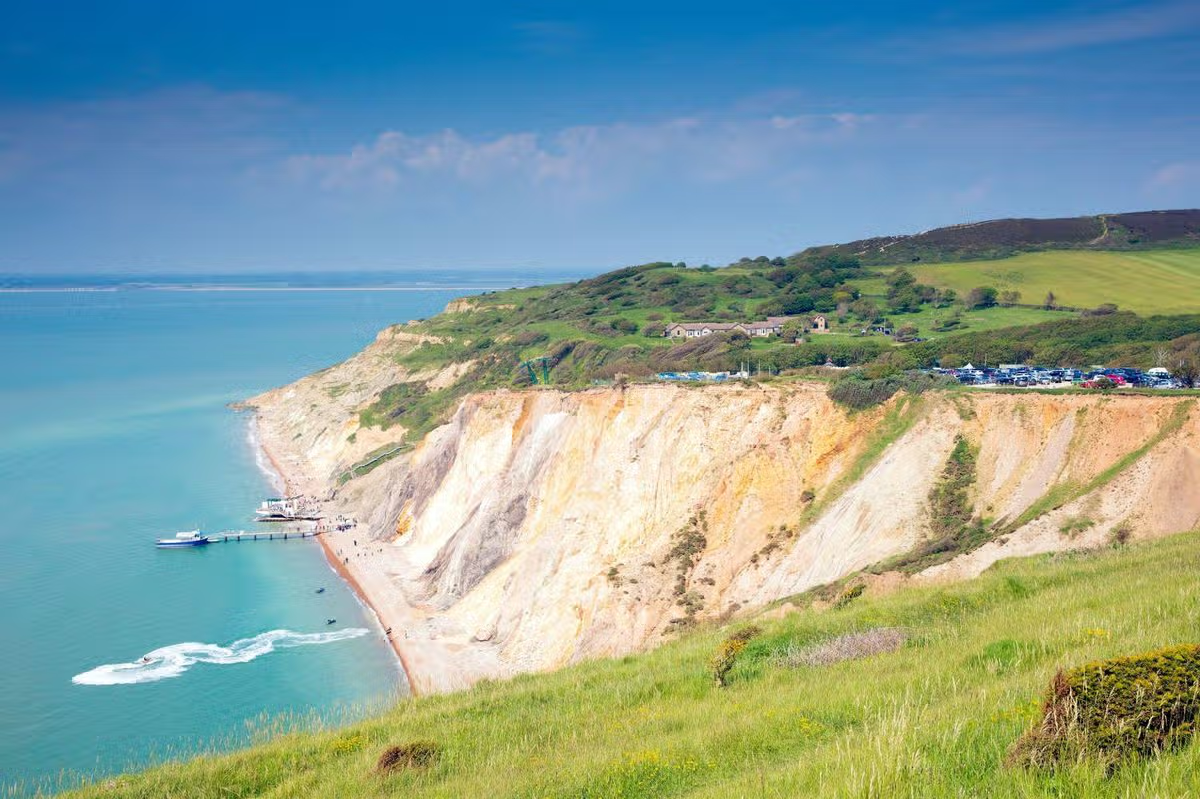
Pretty UK destination with stunning cliffs and villages makes ideal autumn escape — not Dorset or Dover
The spot is renowned for its striking chalk cliffs, charming villages and coastal walks – making it the perfect autumn getaway for families and couples

One UK spot has less crowds and is the perfect autumn escape(Image: Getty)
With its untouched landscapes, fascinating heritage and tranquil way of life, one UK destination has become a haven for ramblers, nature lovers and tourists looking for a serene seaside retreat. West Wight, located on the western edge of the Isle of Wight, is famous for its dramatic chalk cliffs, delightful villages and endless attractions.
Getting to the Isle of Wight is remarkably easy. Red Funnel operates services between Southampton and the Island via both car ferry and rapid foot-passenger routes, meaning you can bring your vehicle or rely entirely on public transport.
October makes an ideal time for a visit now the summer holiday crowds have dispersed.
Ensure our latest DWP headlines always appear at the top of your Google Search by making us a Preferred Source. Click here to activate or add us as Preferred Source in your Google search settings
The Needles and Alum Bay
Amongst the Isle of Wight’s most iconic sights, The Needles comprise a series of impressive chalk formations rising majestically from the ocean off the island’s western shore.
Close by, Alum Bay is renowned for its rainbow-hued sand cliffs, sweeping coastal panoramas and classic seaside diversions, establishing it as a must-visit destination for those discovering the region. When visibility is good, the surrounding shoreline provides magnificent views stretching across the English Channel.
Freshwater and Freshwater Bay
Freshwater ranks among West Wight’s main settlements, providing gateway access to some of the island’s most beautiful coastal landscapes. Just south of the village, Freshwater Bay boasts a stunning shingle beach framed by dramatic chalk cliffs.
The spot is perfect for coastal walks, photography and soaking up the seaside atmosphere, with swimming on offer when conditions allow.
Tennyson Down and the coastal paths
Perched above Freshwater Bay, Tennyson Down is a vast expanse of open grassland that provides some of the Isle of Wight’s most spectacular walking routes.
The area is named after Victorian poet Alfred, Lord Tennyson, who resided close by at Farringford. Visitors can take in sweeping sea views, rolling countryside and the chance to spot local wildlife, making it a firm favourite amongst walkers and nature enthusiasts.
Yarmouth
Nestled on the island’s north-west coast, Yarmouth is a historic harbour town renowned for its charming streets, independent shops, traditional pubs and cafés.
The town is also home to Yarmouth Castle, a historic coastal fortification, and acts as a key ferry hub linking the Isle of Wight with Lymington in Hampshire.
With its rich maritime heritage and laid-back atmosphere, Yarmouth provides a delightful contrast to the island’s larger, more bustling resorts.
Weather in October
October in West Wight typically brings mild yet unpredictable weather, making it an attractive time for coastal walks, countryside adventures and discovering quieter seaside villages. Visitors should come prepared for the odd shower and breezy spells.
Daytime temperatures typically sit between 13°C and 16°C, while night-time lows usually hover around 8°C to 11°C. Periods of sunshine can feel comfortably mild, though temperatures dip considerably once the sun goes down.
How to get to West Wight
By car
One of the easiest ways to reach West Wight is via the Wightlink car ferry from Lymington, located in the New Forest, to Yarmouth on the Isle of Wight.
The journey takes approximately 40 minutes, providing a simple route for drivers heading to the western side of the island. Upon arrival in Yarmouth, travellers can quickly access nearby spots such as Freshwater Bay, Totland and The Needles.
Without a car
Those travelling without a vehicle can catch a train to Portsmouth Harbour before hopping on the Wightlink FastCat passenger ferry to Ryde Pier Head on the Isle of Wight.
The crossing takes roughly 22 minutes, making it an efficient choice for those on foot. From Ryde, connecting bus services through Newport link passengers to West Wight, including Freshwater and the nearby coastal communities.

Rugby League World Cup 2026: Australia edge New Zealand in opener
Australia (10) 24
Tries: Bostock 3, Trbojevic, Walsh Goals: Walsh 2
New Zealand (10) 22
Tries: McLean, Ponga 2 Goals: Isaako 3 Penalties: Isaako 2
Australia underlined why they are favourites for the 2026 Rugby League World Cup by fighting back from a mauling at the hands of New Zealand’s powerful pack to win a thrilling opening match of the tournament.
This was as good as it gets in terms of international rugby league, with more than 40,000 fans – the biggest Test match crowd in Sydney for 50 years – witnessing the ultimate smash-and-grab victory by Kevin Walters’ side.
Casey McLean’s stunning early try gave New Zealand the impetus and they were on top until the final five minutes, when Jack Bostock marked a stunning Kangaroos debut with his third try to decide an epic match.
Bostock’s dream debut – which included one interception try and two by winning aerial battles to claim spiralling Cameron Munster kicks – was one of many fascinating sub plots.
Kalyn Ponga’s match-up against his Australia counterpart Reece Walsh, arguably the sport’s biggest star, was another.
The Kiwi full-back scored twice and looked to be coming out on top in their personal battle until Walsh conjured up a superb long-range try to lay the platform for the defending champions’ last-gasp triumph.
Ponga left the field injured with the game in the balance and had his left arm in a sling at full time, which does not bode well for the rest of his tournament.
More to follow.
FIFA set for rule change after Balogun red card row at the World Cup: reports | Football

Published On 15 Oct 2026
Football’s global governing body is expected to change a rule that allowed a red card for USA forward Folarin Balogun to be controversially overturned during the World Cup, according to media reports on the agenda for Thursday’s FIFA council meeting in Zurich.
The decision-making body is convening for the first time since this year’s tournament, and a motion to prohibit such actions in the future will be top of the agenda. Members will also discuss the organisation’s funding, rules and other matters amid a turbulent time in the sport.
During the World Cup’s round-of-32 match, Balogun received a red card for stepping awkwardly on the right ankle of Tarik Muharemovic of Bosnia in a 2-0 win for the home team. It triggered an automatic one-game suspension.
However, United States President Donald Trump urged FIFA President Gianni Infantino to review the case, and Balogun’s red card was overturned, allowing him to play in the USA’s round-of-16 match against Belgium.
The decision to overturn Balogun’s red card ignited one of the tournament’s biggest controversies, with widespread criticism from football federations, former FIFA officials, experts and coaches.
The 37-member FIFA council is expected to vote on whether to prohibit disciplinary committees from overturning automatic match suspensions at the World Cup, but the Balogun controversy is unlikely to go away.
FIFA Vice President Debbie Hewitt is among the sport’s leaders who have asked Infantino to release all documents related to the case.
Thursday’s FIFA council meeting is the first since Infantino came under fire earlier this year for a now-shelved plan to sell a 20 percent stake in the World Cup’s commercial business to private investors.
Infantino has faced calls to resign from the leaders of three regional football confederations – UEFA (Europe), AFC (Asia) and CONCACAF (North and Central America and the Caribbean) – and their representatives will be present in Zurich for the FIFA meeting.
They will be joined by their counterparts from Africa, South America and Oceania.
On the agenda will be a discussion of the failed FIFA Forward Enterprise (FFE) scheme, which Infantino was forced to abandon within days of announcing it in July.
Under the plan, Infantino proposed selling a minority stake in a FIFA commercial subsidiary to private investors, with a company launched by Joshua Kushner, the brother of Donald Trump’s son-in-law Jared Kushner, identified as the proposed lead investor.
The council will also address FIFA’s governance, with some of the sport’s most powerful figures determined to limit Infantino’s powers if they cannot force him out of office.
Infantino, 56, will stand for re-election in March 2027, with a November 18 deadline looming for potential candidates to submit their nominations.
ERROR: The request could not be satisfied

The request could not be satisfied.
CloudFront attempted to establish a connection with the origin, but either the attempt failed or the origin closed the connection.
We can’t connect to the server for this app or website at this time. There might be too much traffic or a configuration error. Try again later, or contact the app or website owner.
If you provide content to customers through CloudFront, you can find steps to troubleshoot and help prevent this error by reviewing the CloudFront documentation.
Generated by cloudfront (CloudFront)
Request ID: LEyJ0BAWidCAHV608uGVmCS3hiOh2zxyY97FVueBJMrs_vOB3t6Jww==

Fighting in Yemen intensifies: What’s the latest on the battlefield? | Houthis News
Forces aligned with Yemen’s government on Thursday said that they had intercepted a drone headed towards Medina in Saudi Arabia, and a missile fired towards Riyadh, amid escalating fighting between them and Yemen’s Houthi group.
Fighting between the Saudi-backed Yemeni government forces and Iran-aligned Houthi rebels has intensified along the country’s western Red Sea coast, along with expanding Houthi attacks on oil facilities and airports in neighbouring Saudi Arabia.
Recommended Stories
list of 3 itemsend of list
On Wednesday, Yahya Saree, the military spokesman for the Houthis, also known as Ansar Allah or Supporters of God, said the group’s forces had conducted “a high-quality military operation targeting Aramco in Dhahran”, as well as strikes on Riyadh airport and a refinery in the capital.
He added that operations “will continue in the coming days, targeting Saudi enemy airports and oil facilities”.
A Saudi Ministry of Energy official confirmed that a building belonging to Aramco in Dhahran was hit, resulting in a “limited fire” but “no casualties or fatalities”. Dhahran is home to Aramco’s headquarters, a vast complex comprising numerous buildings and residential compounds.
Meanwhile, the Saudi-led coalition launched strikes against the Houthi stronghold in the Yemeni capital, Sanaa, which the armed group seized in 2014 and has held ever since. The coalition fought the Houthis, who also seized large quantities of Yemen’s military assets, until a ceasefire was agreed in 2022. That ceasefire has broken down in recent months.
Reporting from Sanaa, Al Jazeera’s Yousef Mawry said the war has become a tit-for-tat exchange of blows. The Iran-backed group “will continue to launch these air strikes and … its goal is to meet fire with fire – air strike for air strike, capital for capital, airport for airport, and energy facility for energy facility”.

Which sites have the Houthis targeted in Saudi Arabia?
Recent Houthi strikes on Saudi Arabia have mainly targeted key infrastructure on the outskirts of Riyadh, but they appear to be edging closer to the city centre.
Houthi attacks on Riyadh’s King Khalid international airport over the weekend killed 14 people and wounded more than 300 others. Houthi attacks have also been reported on other airports, including Abha international airport in southern Saudi Arabia, where two people were killed, and on Saudi Aramco energy facilities.
Authorities say Riyadh airport will remain shut at least until Saturday as several airlines cancelled flights, emptying the skies over the kingdom’s capital.
Al Jazeera’s Mawry said Saudi Arabia “has much more to lose” from tit-for-tat attacks disrupting air traffic, as Sanaa international airport has been closed for many years due to the damage it has sustained over the years of civil war. There are currently no Yemeni airliners at the airport.
Additionally, by disrupting security, the Houthis are signalling that Saudi Arabia will suffer mounting economic costs for its involvement in Yemen. Earlier this year, the Houthis similarly began launching strikes on Saudi-linked shipping in and around the Bab al-Mandeb strait at the entrance to the Red Sea. Saudi Arabia has increasingly relied on this shipping route for oil exports since Iran closed the Strait of Hormuz in March, under fire from the United States and Israel.
The kingdom is set to host a major investment conference in Riyadh later this month, dubbed “Davos in the desert”, but it is now unclear whether the event will go ahead amid the attacks.
Organisers of the Six Kings Slam tennis tournament, originally slated to begin next week in Riyadh, have announced the event will be pushed to December.
Saudi Arabia is also preparing to host the FIFA World Cup in 2034.
Al Jazeera’s Zein Basravi, reporting from the Qatari capital, Doha, said, “These military hits by the Houthi forces are meant to create a pressure campaign that is also having knock-on economic effects.”
“The Gulf Cooperation Council has become a place where these enormous events have been playing out over the past year, and if they carry on, the international implications for the global economy will continue to be negative,” he added.
What’s the situation on the ground in Yemen?
Yemeni government forces are currently engaged in a major counteroffensive operation, called “Dawn of Yemen“, to retake coastal territory seized in recent weeks by the Houthis near the Bab al-Mandeb strait, a vital maritime trade chokepoint.
The Saudi cabinet pledged in a meeting led by Crown Prince Mohammed bin Salman this week that it “will not allow its security or freedom of navigation in the Red Sea and Bab al-Mandeb strait to be threatened”.
On Wednesday, Yemeni government forces said they had carried out 2,309 “targeting operations” against the Houthis as part of their “Dawn of Yemen” military campaign.
The forces’ spokesperson, Majeed al-Nuzaili, said the operations were conducted using combat aircraft, drones, artillery and rocket launchers, and destroyed 460 Houthi military vehicles.
Government forces say they have retaken areas in Sabr al-Mawadim and al-Sarari in Taiz governorate and have repelled a large Houthi attack west of Taiz city in southwest Yemen, a government-held city that was besieged by Houthi fighters earlier this month. Taiz governorate includes the flat, western coastal region on the Red Sea, which contains the port city of Mocha and the Bab al-Mandeb. Much of the governorate also lies within Yemen’s highlands while its capital, Taiz, is nestled between mountains.
Al Jazeera’s Mawry said fighting has been so intense in the area because of its strategic value. “Whoever controls the altitude and gains control of the mountains controls the landscape. They control the Red Sea coastlines and even the city of Taiz,” he said.
The internationally recognised Yemeni government has been calling for more reinforcements as well as Saudi air attacks on the positions recently taken over by the Houthis, mainly in the district of al-Misrakh, south of Taiz, and the district of at-Turbah, which are the gateways to the city of Taiz.
Mawry reported that while the Saudi-led coalition’s aerial strikes are forcing the Houthis to withdraw and retreat, allowing government forces to advance, they have not been able to gain a full hold over some of those positions.
“It is then followed by another counter-military offensive by the Ansar Allah group to retake the area. And this is sort of the routine that we have been seeing since early September,” he said.
The Houthi siege of Taiz has resulted in civilian casualties and severe shortages of fuel, gas and other supplies. On Wednesday, the United Nations World Food Programme (WFP) reported that wheat flour stocks have been nearly exhausted.
The Red Cross said front-line hospitals in areas including Marib, Taiz and Yemen’s Red Sea coast are registering unprecedented numbers of weapon-wounded patients, with some facilities admitting more than 700 casualties in a single week.

The travel website selling £9 flights, £16 hotels and £118 package holidays to Brits
IF you’re desperate for a getaway but don’t want to spend loads, it might be time to look beyond the usual high street holiday agents.
We’ve found a lesser-known booking site where you can bag entire package holidays from just £118, hotel rooms from £16 a night, and flights for as little as £9.
Browse cheap holidays, flights and hotels on Opodo
Opodo acts as a massive travel search engine, scouring hundreds of airlines and millions of hotels to pull together some of the absolute cheapest deals on the internet.
As a travel writer who scours the internet each week for the cheapest holidays for Sun readers, these are some of the lowest travel fares I’ve ever seen.
So whether you’re after a quick weekend city break, a week-long beach escape, or even a solo travel retreat – here’s our guide to the very best travel bargains on Opodo right now.
Package holidays
Package hols are where you get the most bang for your buck on Opodo, as you can save up to 40% extra by booking your flights and hotel together through the website.
Read more on cheap holidays


We’ve rounded up a selection of some of the most affordable package holidays on the site.
Or you can click here to browse all cheap package holidays.
Mallorca – from £121pp
With flight times around two and a half hours, Mallorca is an easy hop away for some autumn sun, with pleasant October temperatures of around 24C.
Spend your days exploring the winding, cobbled streets of Alcudia’s Old Town, hiking the spectacular Serra de Tramuntana mountains, or soaking up the sun on the pristine white sands of Es Trenc.
Browse Mallorca holidays from £121pp
Tenerife – from £147pp
The flight to Tenerife is only four hours from the UK, yet it still reaches highs of 26C in October.
Once you’re there, stroll the volcanic beaches of Costa Adeje, enjoy €3 tapas in traditional tavernas, hit up award-winning waterpark Siam Park or even go whale watching.
Browse Tenerife holidays from £147pp
The Algarve – from £118pp
Autumn is the perfect time to visit Portugal‘s stunning southern coast, offering warm highs of 25C without the overwhelming summer crowds.
Wander around the bustling Olhao fish market, hike along dramatic coastal cliffs to see the spectacular rock formations, or simply relax on the golden sands of Praia dos Pescadores right by Albufeira’s old town.
Browse Algarve holidays from £118pp
Rome – from £119pp
You don’t need a huge budget to experience Rome, especially with Opodo offering package holidays from £119pp.
In the Italian capital the streets themselves are their own attraction. Soak up the atmosphere at the Spanish Steps, or toss a coin over your shoulder into the Trevi Fountain.
Browse Rome holidays from £119pp
Flights
Opodo offers super cheap flights to destinations in Europe and beyond, but they get even cheaper if you join Opodo Prime.
For example, you can bag a one-way flight to Barcelona for £24 each way, but if you’re signed up to Opodo Prime this sinks down to £9.
It costs £8.99 a month and also gets you discounts on hotels, so if you like to go on holiday regularly, it could save you some serious cash.
We’ve rounded up the cheapest flight deals we could find on Opodo.
Or you can click here to browse all flights.
- Barcelona – from £24 each way (Prime price: £9)
- Faro – from £37 each way (Prime price: £12)
- Milan – from £39 each way (Prime price: £22)
- Edinburgh – from £25 each way (Prime price: £9)
- Dublin – from £25 each way (Prime price: £12)
- Amsterdam – from £111 each way (Prime price: £56)
Browse cheap flights from £9 each way
Hotels
If you prefer planning your own holidays by booking flights and hotels separately, there’s some bargains to be had on the hotels page, too.
This is a good option if you like to regularly book flights directly with the same airline in order to collect points.
Here’s our selection of bargain hotels we found on Opodo (prices per night).
Or you can click here to browse all cheap hotels.
- Amsterdam – from £37
- London – from £50
- Barcelona – from £45
- Lisbon – from £43
- Paris – from £48
- Rome – from £30
- Milan – from £24
- Prague – from £22
- Marrakech – from £16
Browse cheap hotels from £16 per night
Prices correct at the time of publication.

Traitors star wows fans with glam makeover months after winning iconic BBC show
Rachel Duffy, joint winner of The Traitors UK series four, has wowed fans after debuting a glamorous new makeover months after winning the iconic BBC reality show

The Traitors star showed off a glam makeover (stock image)(Image: BBC)
A former champion of The Traitors has left people totally wowed as she showed off a super glam makeover. Rachel Duffy is primarily recognised for jointly winning series four of the BBC reality contest The Traitors UK in January 2026, and it’s fair to say life has changed for her a few months down the line.
Now commanding over 200,000 Instagram followers, she recently admitted she took part in a photoshoot, even though she was a bit nervous at first. However, it’s clear people thought she didn’t need to be, as they told her she looked absolutely sensational and showered her with kind words.
It comes after Rachel had a very tough start to the year. Months ago, she announced the death of her beloved mum who drove her to victory.
Alongside the pictures, she wrote: “FULL transparency. I was petrified doing this shoot! I mean I couldn’t sleep properly the night before. I even Googled how to pose for a magazine.
“I was so chuffed when @jackmurphyjewellers asked me to be their cover girl for @ulstertatler but it sent me into a spiral of self doubt. They should have asked someone younger, thinner, prettier – all these terrible thoughts that go through our heads when we don’t feel we belong.”
Ensure our latest DWP headlines always appear at the top of your Google Search by making us a Preferred Source. Click here to activate or add us as a Preferred Source in your Google search settings
She added: “Some days I have sooooo much confidence in myself and my ability but, on days like this shoot, it was very wobbly! I’m so grateful for the fabulous team at Jack Murphy’s for making me feel at ease, to @gemmamurphyjewel for hyping me up and covering me with the most beautiful diamonds (not to mention doing my zips b/c of my gammy hand), to Charlotte and Tara for being the best wing women and keeping me right and cheering me on behind the camera and to @jamierobb for being so chilled out and making it fun!
“There’s a huge difference between the first shots taken on the day and the last video here. I could have done it all over again.
“Point to my post – I overcame a lot of self doubt on the day and I am beyond happy at how these photos turned out. I’m getting the cover shot printed on my duvet. I’m very proud of myself for pushing through the doubt and encourage you to do the same.
“Here’s to backing ourselves more! A big thank you to @wearonceloved, @salon_602_ and @emzobeauty for making me look so pretty. You’re the best.”
In the photographs, Rachel can be seen wearing a sleek, off-the-shoulder black dress. Beautifully figure-hugging, she looked absolutely breathtaking in every shot.
She styled her hair in an elegant half-up-half-down look, also modelling a chic black jumpsuit. Finished off with a delicate smoky eye and a touch of lipstick, she looked utterly stunning as she confidently worked the camera.
The post has since amassed more than 8,000 likes, with fans rushing to the comments section to share their reactions. They had plenty to say, clearly blown away by the stunning transformation.
One said: “Damn. Hot.” Another added: “I hope you feel as just as incredible as you look in these photos.”
A third replied: “You are simply gorgeous. One hot lady.”
Meanwhile, a fourth commented: “Wow, Rachel! You take my breath away! Go girl!”
Someone else also responded: “You look amazing. We are so good at putting ourselves down and filling our heads with negativity. Beautiful photoshoot.”
UK’s biggest Christmas Market with 210 stalls, pop-up ‘pub’ and huge Ferris Wheel to return in just weeks
THE festive wrapping paper is on sale, the family-size box of Quality Street is stacked in shops – Christmas is officially on its way.
If you’re a true fan of the season, you’ll obviously want to head to the UK’s biggest Christmas market.
And the largest is actually in Manchester which opens at the beginning of next month.
Returning on November 6, it will run for over six weeks – so there’s plenty of time to visit whether you’re a local or not.

It’s so enormous that there are 210 stalls across 10 locations spread about the city centre.
The stalls will sell everything from festive food and drink – think hot chocolate and mulled wine – to international street food, if you’re over the yorkshire pudding wraps.


Handmade gifts and stocking fillers can be found there too, if you’re ready to start Christmas shopping.
Albert Square will be where most of the city’s festivities will be, including its 50-metre high Ferris wheel.
There will also be a pop-up ‘pub’ for the festive season as well as a giant Santa, a vintage Helter Skelter and a huge tree installation and life-sized selfie sleigh.
If you’re on the hunt for ice skating, you’ll find it at Cathedral Gardens along with some market stalls too.
Across the city will be live entertainment, and plenty of Christmas lights.
The Manchester Christmas Parade will be held again this year on December 6.

Kids will be able to spot Snow Queens, reindeers, Nutcrackers, toy soldiers and even Santa who will be travelling onboard the Elf Express.
Visitors will find the market spread across locations including; Albert Square, Lincoln Square, King Street, St Ann’s Square, Exchange Street, New Cathedral Street, Exchange Square, Corn Exchange, Cathedral Gardens, and Market Street.
A recent study by Christmas Tree World also recently crowned Manchester Christmas Market as the UK’s best.
Factors were based on the number of Google searches, social media posts and videos, hotel prices, history, number of stalls, entry cost and closeness to public transport.
With much cheaper hotel prices than the like of New York city, the Manchester Christmas Market was also voted second best in the world.
The market will come to a close on December 22.
However, the Albert Square and Cathedral Gardens will remain open throughout the Christmas period until January 3, 2027.
The cheap holiday destinations set to rival Spain in 2027

SPAIN has long reigned as the most popular holiday destination for Brits – but a cheaper alternative is set to rival it, according to easyJet.
Destinations across North Africa are seeing a huge boom in bookings, as holidaymakers look for better value holidays.
North African holiday destinations include Morocco, Egypt and Tunisia – which all offer great winter sun options as well.
EasyJet holidays CEO Garry Wilson said at the recent ABTA convention in Madeira: “When we look at demand for next year, places like North Africa, we will see that continue to grow in popularity.
“Spain has been a bit overheated and we will see capacity demand slow down a bit.”
Luxury five star hotels are much cheaper across North Africa compared to mainland Europe.


For example, a five-star, all-inclusive week in Egypt can be found for under £450 each in November with loveholidays – the same in Spain is over £1,000.
Tunisia is even cheaper, with five star, all inclusive breaks just £249pp each in November for seven nights, while Morocco is around £509pp.
The Sun’s Head of Travel Lisa Minot explained further: “Holidaymakers looking for the best value this winter and into next summer should be honing in on the emerging – and wallet-friendly – North African destinations of Tunisia, Morocco and Egypt.
“With the number of flights from the UK more than doubling since 2019, they have become a serious contender to our traditional Spanish favourites.
“Now tour operators are joining the fray with easyJet Holidays, TUI and the UK’s largest tour operator Jet2 all offering even greater choice – at very competitive prices.”
She added that Brits are “recognising the value they offer as the cost of living crisis continues to hit family budgets,” which is despite the conflict in the Middle East.

Lisa continued: “I saw for myself the premium offering in Marsa Alam on a trip in February and holiday prices for this winter to the Red Sea resort are lower than before the escalating tensions.”
Egypt recently announced they had welcomed a record 14.4million international tourists in 2026, an increase of four per cent compared to last year.
With a target of 30million by 2030, hotel capacity is set to double, with plans for 35,000 extra hotel rooms.
When it comes to Morocco, not only was Fez named a trending destination for 2027 by Skyscanner, but Rabat was named a top place to go next year by Lonely Planet.
EasyJet, Ryanair and TUI have all launched new flights to Morocco this year too.
And a new study by TravelSupermarket found that Tunisia holidays have dropped in price compared to last year.
Jet2 is launching more holiday packages to Tunisia next year, after restarting routes from the UK this summer.

L.A. voters worry about outside influence in midterm elections, new poll finds
Los Angeles County voters are concerned about a host of voter fraud issues that could disrupt the Nov. 3 general election, even though they have a high degree of confidence in local elections officials, according to a new poll funded by the nonprofit California Community Foundation.
Nearly three-quarters of respondents expressed concern that false rumors and misleading information online could confuse voters or make them believe that their vote won’t count, the poll found. Other top concerns included politicians interfering with the election and mail-in ballots getting lost, stolen or delayed.
Still, most of the voters surveyed expressed confidence in the county’s handling of election proceedings, with 68% saying L.A. County does an excellent or good job at running elections and counting ballots.
Once presented with information about how the county handles elections, that number rose to 72%. Around three-quarters of respondents also believe that the upcoming election will be fair, secure and accurate, the poll found.
The online poll was conducted from Sept. 30 to Oct. 6 by Tulchin Research, a San Francisco-based public opinion firm. It surveyed 500 voters in L.A. County considered likely to cast ballots in the Nov. 3 election and has a margin of error of 4.4%.
“Voters feel good about the local officials running their elections. So, reinforcing the fact that that is who’s in charge of the election and how the process works is reassuring to folks,” said Ben Tulchin, the polling company’s president. “It … reduces their anxiety about some of the outside criticism that California, L.A. County faces.”
The poll was funded by the California Community Foundation, which awards millions of dollars in grants to local charitable groups, to support the “A Count You Can Trust Coalition,” an initiative aimed at enhancing trust in local elections.
Recent polling has suggested that potential federal interference in the Nov. 3 election is a top concern statewide for California voters. The local poll was administered to shed light on how L.A. County voters feel, said former Los Angeles Mayor Antonio Villaraigosa, who co-chairs the A Count You Can Trust group with Miguel Santana, who leads the California Community Foundation.
“This is the epicenter of the California vote,” Villaraigosa said. “The concern is not as great as it is statewide. Here in L.A. County, people seem to trust the vote to a greater degree.”
A recent poll by the UC Berkeley Institute of Governmental Studies, co-sponsored by The Times, found that 61% of California voters identified interference by the Trump administration as a “major concern.” President Trump has fueled doubts over election integrity, spreading unverified claims of widespread voter fraud in blue states such as California.
Young voters and Latino voters expressed the lowest levels of confidence in how the county runs elections, the new poll found. The findings suggest those demographics need “a lot more reassurance” that elections are safe and that their votes matter, Tulchin said.
“It’s not surprising at all, and it means we’ve got work to do,” Villaraigosa said. “We got a lot of work to do to communicate to those people and to make it clear that, in fact, this vote can be trusted.”
Villaraigosa said he plans to focus his efforts on social media engagement and creating video content with poll workers to speak on how vote-counting works in the county.
The poll also asked respondents whether “things in Los Angeles County are going in the right direction or do you feel things have gotten pretty seriously off on the wrong track?” Most — 62% — said wrong track, and 26% said right direction.
Among voter concerns in the upcoming election, 18% listed the economy, the cost of living and inflation as their biggest worry, followed by election integrity, fraud and interference at 17% of respondents. Concerns about Republicans and Trump “winning or retaining power” came in third, with 16% of respondents saying that is their biggest concern.
Homelessness and immigration, two issues that have been prominent the L.A. mayoral race between incumbent Karen Bass and Councilmember Nithya Raman, ranked low in the list of concerns for the surveyed voters. Tulchin noted that the focus of the survey was on election integrity, which could have had an effect on what issues were top of mind of respondents.
The survey findings indicate that L.A. County voters seem to trust the county more than voters statewide. Still, just over 30% of surveyed voters have a fair or poor view of how the county runs elections, Villaraigosa said.
“They’re concerned, but what we found in this poll is that there are a number of people who, while concerned, do trust this county,” he said.