


Route 66 landmark Mel’s Drive-In faces demolition. Can it be saved?
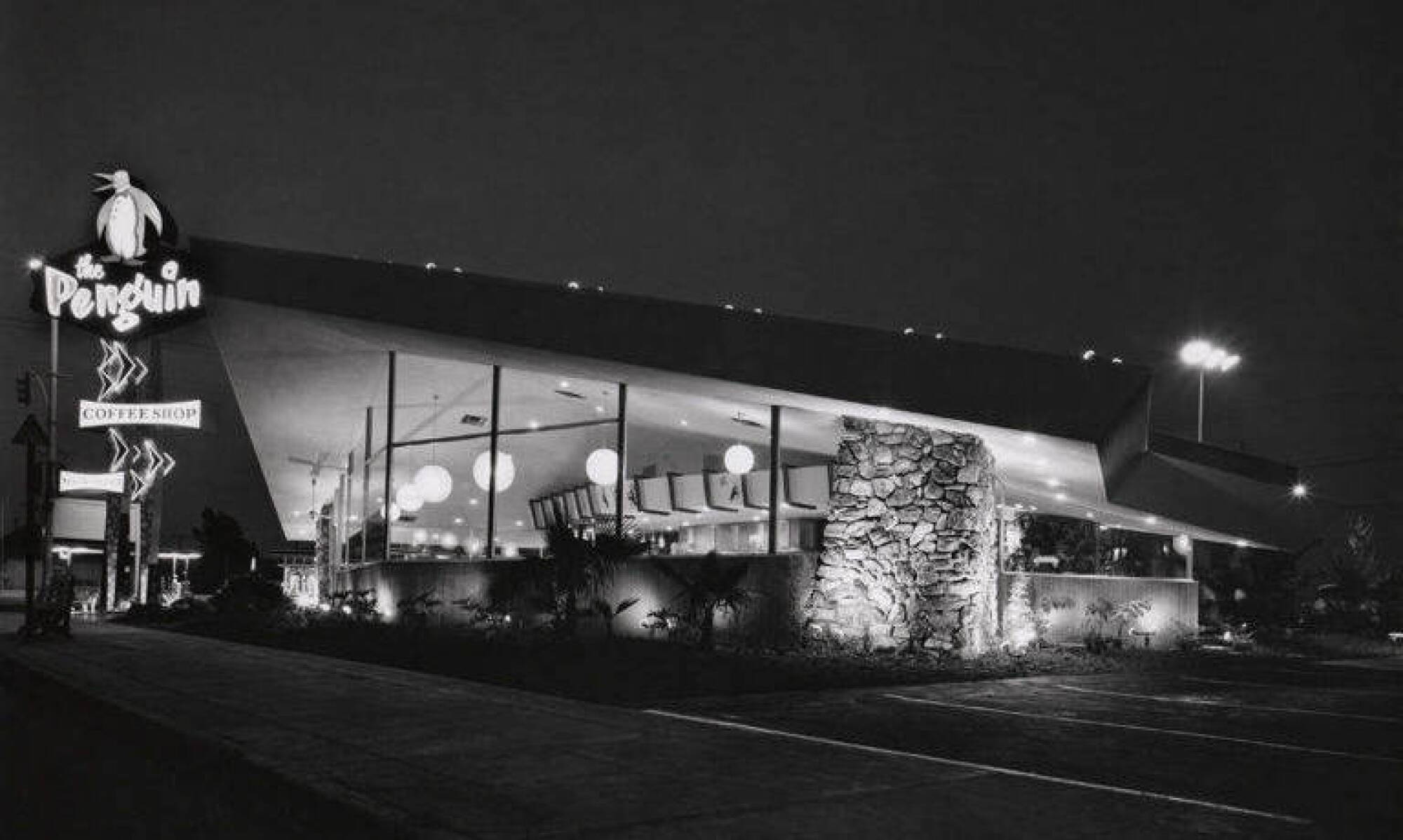
For decades, the bold, mid-century building at Lincoln and Olympics boulevards in Santa Monica has been the end of the line — the last address on the 2,400-mile westward journey of Route 66. Once home to the Penguin Coffee Shop, today it holds Mel’s Drive-In. But now its future is in doubt.
The owners of the property have filed early paperwork to level the structure and replace it with an eight-story apartment building. Preservationists are pushing for a historic designation that might protect it.
The groups appear headed toward a showdown Dec. 14, when the Santa Monica Landmarks Commission will hold a hearing on the site’s nomination for protected status by the Santa Monica Conservancy and the Los Angeles Conservancy. The allied conservancies contend that the building is “the most significant representation of its style and period in architecture and design in Santa Monica.”

Designed by famed mid-century architects Armet & Davis, the building held the Penguin Coffee Shop from 1959 through 1991.
(Architects Armet Davis / Santa Monica Public Library Image Archives)
“This isn’t about saving a modern restaurant. It’s about preserving some really important Googie architecture,” said Nina Fresco, vice president of Santa Monica Conservancy. She added that “there’s no reason why housing and historic preservation can’t be partners.”
Irvine-based firm ValueRock Realty bought the half-acre Mel’s property for $6.2 million in 2020, and in 2025 began offering the property for sale, asking $26 million through brokers Newmark Pacific.
Soon after learning that the building was for sale, the Santa Monica and L.A. conservancies nominated Mel’s for a landmark designation, which can protect buildings from demolition, Fresco said. As part of the effort, Santa Monica Conservancy leaders raised $6,800, the cost of a Santa Monica landmark nomination, and enlisted the L.A. Conservancy as an ally.
Then on Sept. 18, ValueRock filed a preliminary application with the city (also known as an SB330 application) to replace the 1959 building with an eight-story apartment building, including 138 apartments, 123 parking spaces and first-floor retail space.

The sign of Mel’s Drive-In features a penguin, homage to the coffee shop of yesteryear.
(David Fouts / For The Times)
When it bought the property in 2020, ValueRock announced that it “is considered to be a historical landmark within the community.” But in its September filing for the apartment project, ValueRock management checked a box indicating that no historic or cultural resources are known to exist on the property.
“We didn’t know they would be quite this aggressive, but it’s not a huge surprise,” Fresco said.
Under city law, Fresco said, if a property is more than 40 years old, the owner must wait at least 75 days after seeking a demolition permit before any demolition can happen. “So we’re OK at least until that hearing” in December, Fresco said.
If the Landmark Commission agrees to confer landmark status on the building, Fresco said, it may be shielded from demolition — but the owner can appeal the decision to the City Council.
Management at ValueRock Realty did not immediately respond to requests for comment.
The restaurant remains open, receiving a steady stream of locals and Route 66 travelers. “We’re going to be here until 2029,” said Marilina Borchio, manager of Mel’s, citing a lease that runs through June of that year. As she spoke, the breakfast crowd was trickling in on Sunday morning. Borchio said she’s spending a lot of time reassuring customers who “think we are going to be demolished tomorrow night.”
The Googie-style building, designed by famed mid-century architects Armet & Davis, held the Penguin Coffee Shop from 1959 through 1991, catching the eyes of passing drivers with its dramatically slanted roof, oversize windows and a long counter inside for diners in a hurry. Architectural historians describe Googie style as a bold strain of Mid-Century Modernism, notable for big neon signs and swooping roofs, especially popular among restaurants, bowling alleys and car washes, now increasingly rare. Rae’s Diner, a 1958 building on Pico Boulevard, is another Santa Monica example.
The coffee shop never earned a Michelin star (nor has Mel’s) but its workaday American fare won a following. “The Penguin gets my vote for the best diner around,” wrote Times restaurant critic Charles Perry in 1989.
But two years later, the Penguin was gone. By 1992, the building had been converted into a dentist’s office. Eventually it fell idle, until the San Francisco-based Mel’s chain arrived in 2016 and began a renovation aimed at bringing back the restaurant’s ’50s atmosphere.

Mel’s Drive-In now occupies the old Penguin Coffee Shop building at the official end of Route 66 in Santa Monica.
(Christopher Reynolds / Los Angeles Times)
The renewed restaurant opened in 2018, with a penguin atop its sign, in homage to years gone by.
“A lot of the neon elements are gone, but the main elements are still there,” said the Santa Monica Conservancy’s Fresco, who is also a Santa Monica planning commissioner and former landmarks commissioner.
The renovation and restoration effort included removing layers of paint and tile that had been added over decades, revealing interior stone cladding that had been covered and replicating the counter and stools, vinyl cushioned booths, tables of plastic and metal, terrazzo floor, and light fixtures. The work was “to the letter of the Secretary of the Interior’s standards” for the treatment of historic properties, Fresco said.
The building is not mentioned in “An Architectural Guidebook to Los Angeles,” by David Gebhard and Robert Winter, which is a prime source for many preservationists. But Mel’s won a $10,000 grant from the National Trust for Historic Preservation in 2025 to pay for Route 66 centennial signage project.

Route 66 memorabilia at Mel’s Drive-in.
(David Fouts / For The Times)
“This site, like Route 66 itself, represents something greater than itself,” said Rhys Martin, manager of the National Trust’s Preserve Route 66 initiative, in an email. “It’s a connection to a journey through time and space that will be forever lost if this remarkable Googie structure is demolished.”
Fresco said she’d love to see the building continue to operate as Mel’s, but in the big picture, “we can’t stop them from building housing.” Still, Fresco said, she is hoping that the owner can come up with a project that retains the existing building while adding housing around it, as several other developers in Santa Monica have done. At 829 Broadway, developers agreed to preserve a World War II era Quonset hut while building a five-story apartment building around it. (The Quonset hut was occupied by Pono Burger from 2013 to 2025.) And the old Rapp Saloon — an 1875 brick building at 1436 2nd Street — was reborn in the late 1980s as a meeting space within a four-story hostel, now known as Hostelling International’s HI Los Angeles Santa Monica Hostel. The Santa Monica Conservancy begins its walking tours there.
If the allied conservancies win landmark status for the Penguin/Mel’s building, Fresco said, the owners “will be able to do exactly what they want to do now. They will just have to do it differently.”
Route 66, which was born and officially named U.S. Highway 66 on Nov. 11, 1926, was extended to Santa Monica in 1935. Though many travelers think of the Santa Monica Pier as the end of the route, its official terminus from 1935 on was at the intersection of Lincoln and Olympic boulevards, where Mel’s now stands.
Though Route 66 was decommissioned in the 1980s, its popularity as an Americana-rich driving route has grown in recent years, especially during this year’s centennial celebration of the road.
By the time the coffee shop building was going up at the end of the route in 1959, Fresco said, interstate freeways were already beginning to usurp Route 66’s role and the Santa Monica route of Interstate 10 had been plotted. By putting their eye-catching building on a spot along Route 66 and next to the path of the freeway, Fresco said, the people behind the Penguin were catering to motorists on roads rooted in two different eras.
“The Catholic Church shaped Rome. Commerce shaped Manhattan. It is popular culture that has shaped L.A.,” architecture critic Alan Hess told a Times reporter in 1993. “We should see these buildings in that context and take them seriously.”

Tuesday 13 October The Passing of King Bhumibol in Thailand
The provided text from an Occasional Digest article highlights the historical legacy of King Bhumibol of Thailand, also known as Rama IX. It details his remarkable tenure as the longest-reigning monarch in the nation’s history, spanning from June 1946 until his passing in October 2016. Additionally, the source notes that despite operating as a constitutional monarchwithout official governing powers, he made several vital political interventions. He is widely credited with helping guide the country toward democracy during the 1990s. The webpage also includes various unrelated updates concerning global news, financial exchange rates, and weather conditions.
What we learned from UCLA’s breakthrough win at Oregon
Saturday was a day of breakthroughs.
It marked the first time UCLA defeated Oregon since 2017. The win was the Bruins’ first at Autzen Stadium since 2004. And Bob Chesney became the first UCLA head coach to start his tenure 5-0.
Sunday came with one more breakthrough: The Bruins cracked the top 15 in the Associated Press’ Top 25 for the first time since 2022.
UCLA’s 17-15 victory over Oregon proved that the Bruins deserved a spot in the upper echelons of the Big Ten. Not only did UCLA leave Oregon with an undefeated record — one win away from being bowl eligible — but the Bruins also will returned to Los Angeles with three consecutive home games on the schedule, a stretch that could push them farther up the totem pole.
“It doesn’t matter. Now we have to get better,” Chesney told reporters after the win. “How do we get better? We go back and look at the things we need to fix. We evaluate our personnel and see where we stand once we figure out whether some of these guys are coming back next week. There’s a lot of football left to be played, so it doesn’t matter. Getting better is always the message when we turn the corner.”
Newsletter subscription change
Starting Sept. 21, this newsletter will be available to Los Angeles Times subscribers only. A free press isn’t free, and we depend on reader support to report on the stories that make a difference. If you’re already a subscriber, nothing will change. If you’re not, there’s never been a better time to sign up. Get started here.
Here are three takeaways from UCLA’s fifth win, which kept the Bruins among nine remaining undefeated Football Bowl Subdivision schools and avenged one of Chesney’s two losses last season when his magical run at James Madison ended against Oregon.
Colin Hitschler can bounce back with the best
The week leading up to defensive coordinator Colin Hitschler’s rematch against Oregon featured reminders about how the Ducks steamrolled his Dukes’ defense last season in the College Football Playoff, finishing with 51 points and 514 yards.
And Hitschler acknowledged that Ducks coach Dan Lanning’s offense got the best of him, leaving him with a chip on his shoulder.
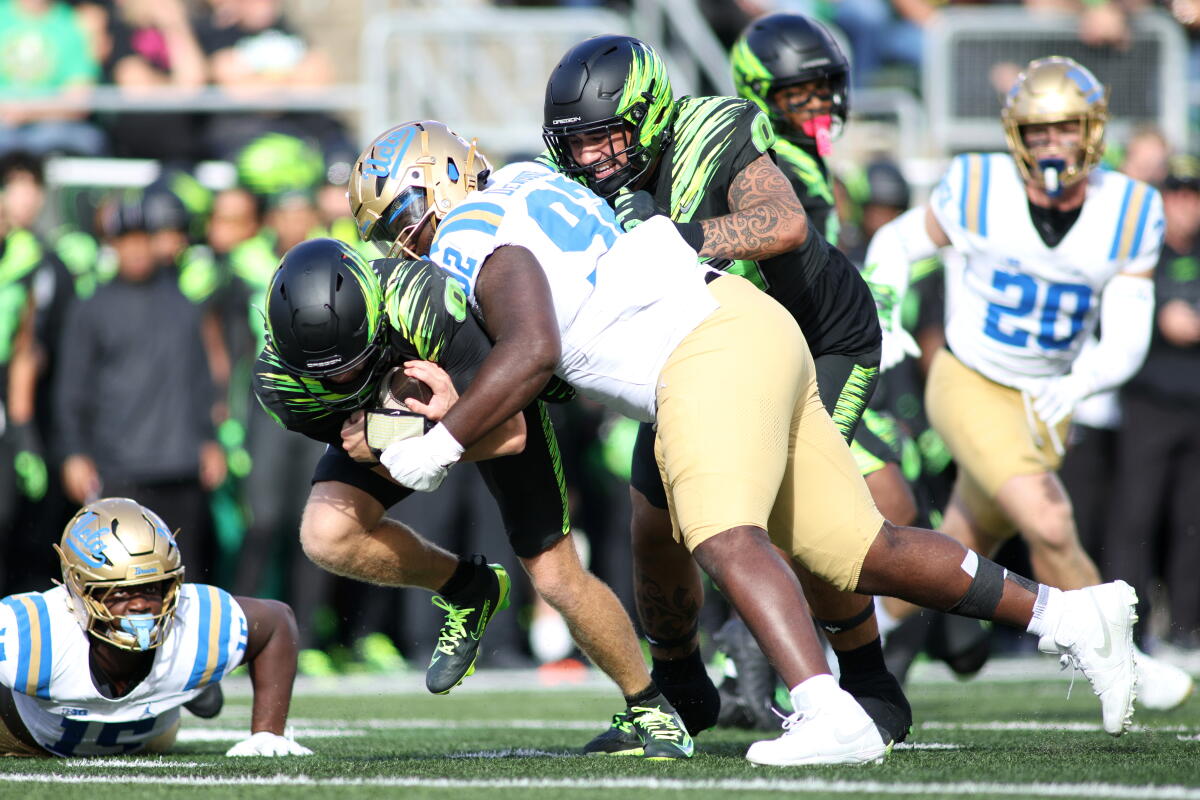
His “Bruin Bullies” made their presence felt from the first whistle to the last, forcing seven turnovers — five fumble recoveries and two interceptions, categories in which UCLA now ranks first and second, respectively, in the nation.
And while Oregon quarterback Dante Moore remained sidelined because of a head injury, backup Dylan Raiola — who spent the previous two seasons as Nebraska’s starter — was a highly regarded talent and expected to challenge the UCLA defense, particularly after throwing for 289 yards and two scores against USC last month.

UCLA defensive lineman Darold DeNgohe tackles Oregon quarterback Brock Thomas on Saturday in Eugene.
(Lydia Ely / Associated Press)
The Bruins gave Raiola more headaches than anything else as he finished with 43 passing yards and three turnovers before he was benched for third-stringer Brock Thomas in the fourth quarter.
And even when Thomas entered for Raiola, the Ducks’ offensive weapons largely flatlined despite their perceived superior status.
Running back duo Dierre Hill Jr. and Jordon Davison — who combined for 238 all-purpose yards and three touchdowns against the Trojans — and tight end Jamari Johnson, who torched the USC defense for seven catches and 119 yards, were limited to a combined 111 all-purpose yards and just one score.
The Bruins’ defense was everywhere in Eugene, limiting the run game to 2.7 yards per carry, largely blanketing pass catchers in coverage downfield and forcing turnovers at every level.
“We don’t focus on outside chatter,” senior linebacker Sammy Omosigho said after the win. “That has no meaning to us, no focus to us, no value to us. We focus on ourselves.”
Bruins’ QB concerns aren’t going anywhere
Many observers who watched Saturday’s showdown will tell you the Bruins should have won more handily.
The Bruins almost doubled the Ducks in time of possession, yet there was a chance for Oregon to win on the last drive of the game.
UCLA had to overcome its own problems, with quarterback Nico Iamaleava battling Raiola for most turnovers and questionable decisions under pressure.

UCLA coach Bob Chesney calls to his players.
(Lydia Ely / Associated Press)
Iamaleava got off to a slow start this season as UCLA relied on its potent rushing attack. He rebounded against Purdue and Maryland, combining for 485 yards and four touchdowns with zero turnovers.
While Iamaleava went 10 for 17 for 162 yards in the first half, his mistakes came at especially costly times for the Bruins.
During UCLA’s second drive, the Bruins were pinned on their 10-yard line. With Oregon outside linebacker Nasir Wyatt blitzing, Iamaleava attempted to throw the ball away to the flat and instead fumbled, giving the Ducks the ball on the Bruins’ one-yard-line. Oregon scored one of its two touchdowns immediately after the turnover.
Later in the half, Iamaleava threw two interceptions, the first at midfield and the second coming at Oregon’s 22-yard line, wiping out a field-goal opportunity.
Iamaleava struggled with accuracy and timing, underthrowing a deep ball to wide receiver Aidan Mizell on the first play of the game — a pass that arguably could have been a touchdown if Mizell was hit in stride — and mistiming a pass to running back Jaivian Thomas, who was wide open in the end zone, on third and goal during the same drive.
Iamaleava was facing a formidable Ducks defense, the best unit the Bruins have played to date, and was injured during the second interception. He did not return to the field after sustaining a leg injury near the end of the first half, and it is unclear how long he will be sidelined.
Backup Ty Dieffenbach steered UCLA to a win, but the Bruins need better quarterback depth.
UCLA is a playoff contender

The Bruins celebrate their win over the Oregon Ducks.
(Tom Hauck / Getty Images)
Saturday was more than just a win. It was a bold announcement to the rest of the Big Ten and the nation that UCLA is a playoff contender.
Chesney told fans during a UCLA men’s basketball game shortly after he was hired that the football team is playing for banners. And Saturday’s win proved that his plan to pursue championships — something that seemed absurd amid a lost 2025 season — has a real possibility of paying off with one.
The Bruins have one of the easier schedules in the Big Ten with seven games remaining. UCLA will play five home games, including with 2-4 Michigan State, 2-3 Nevada of the Mountain West and 3-3 Illinois.
While UCLA still has road games at Michigan and Minnesota and competitive home games against Wisconsin and USC, the Bruins proved Saturday that they can hang in any environment, frustrating the Ducks at hostile Autzen Stadium.
Big Ten confirms a big mistake
The Big Ten released a statement Sunday announcing its officials placed the ball at the wrong spot during Oregon’s final failed two-point conversion attempt after a UCLA penalty. The ball should have been placed at the half-yard line instead of the 1½-yard line. The lead officially announced the correct placement, but the crew never moved the ball.
UCLA’s defense stuffed the two-point conversion attempt, and the Bruins went on to secure a 17-15 win.
The mistake has drawn limited outrage, with fans more concerned about the number of errors by Big Ten officials this season than about them potentially thwarting Oregon’s chance to tie the score. That probably has a lot to do with the number of mistakes the Ducks made and the perception the Bruins outplayed them.
Dieffenbach has long embraced change
Before Ty Dieffenbach was asked to lead UCLA’s offense in the second half at Oregon, he began his high school career in Southern California as a wide receiver.
The Times’ Eric Sondheimer spoke with Dieffenbach ahead of his senior season about his switch to playing quarterback for Agoura, a team that needed a signal-caller and quickly developed a prolific one.
Agoura coach Dustin Croick told Sondheimer he wouldn’t have asked Dieffenbach to play the position just because of the 6-foot-5 athlete’s arm strength. Croick detected something else.
“We can teach kids how to throw, how to read defenses, but the leadership has to be a natural thing,” Croick said.
The two have stayed in touch as Dieffenbach spent two seasons at Pittsburgh without playing before transferring to Cal Poly and starting for one season. Dieffenbach then joined UCLA during the offseason and prepared as though he could be asked to play at any time.
Dieffenbach celebrated with the high school coach who first believed in his quarterback skills via Facetime after UCLA’s win.
Nakase leads Valkyries to WNBA Finals
Former UCLA point guard Natalie Nakase led the Golden State Valkyries to an 87-77 overtime win over the Aces in Las Vegas on Friday, sweeping the series and advancing to the WNBA Finals.
The Valkyries became the first WNBA expansion team to reach the playoffs in its first season and the Finals in its second.
“I told them that I was proud of our whole team, the whole 14, because I saw another level of fight tonight,” Nakase said after the clinching win. “And that’s what I was really proud of. We talked about leveling up one more as a team and I think that overtime proved strength in numbers. We really left it all out there on the floor. We really emptied the tank.”
Golden State hosts the Atlanta Dream at 12:30 p.m. Saturday to open the Finals. The Dream notably are led by UCLA alum Jordin Canada, the the starting point guard and ignition to their offense.
Bruins on deck
Wednesday, Oct. 14
Women’s basketball at California (exhibition)
Thursday, Oct. 15
Women’s tennis at ITA Regional Championships, all day
Men’s tennis at ITA Regional Championships, all day
Friday, Oct. 16
Women’s tennis at ITA Regional Championships, all day
Men’s tennis at ITA Regional Championships, all day
Women’s golf at Stanford Intercollegiate, all day
Men’s golf at Golf Club of Georgia Collegiate Invitational, all day
Men’s soccer at Wisconsin, 5 p.m.
Women’s volleyball vs. Penn State, 7 p.m.
Women’s soccer vs. Washington, 8 p.m.
Saturday, Oct. 17
Women’s tennis at ITA Regional Championships, all day
Men’s tennis at ITA Regional Championships, all day
Cross country at UC Riverside, 8 a.m.
Men’s water polo at USC, 1 p.m.
Football vs. Wisconsin, 4:30 p.m.
Sunday, Oct. 18
Women’s tennis at ITA Regional Championships, all day
Men’s tennis at ITA Regional Championships, all day
Women’s volleyball vs. Ohio State, 3 p.m.
In case you missed it
UCLA proves it’s a playoff contender in thrilling win over Oregon to remain unbeaten
No. 21 UCLA defense helps power Bruins to an upset of No. 13 Oregon
UCLA urges defense to stay calm during high-stakes showdown with potent Oregon
Meet UCLA receiver Semaj Morgan, who started a foundation at age 17 to help others
USC, UCLA push to extend West Coast dominance of Big Ten women’s basketball
Bob Chesney urges surging UCLA to ignore hype as Bruins prep for potent Oregon
How UCLA built one of the most dominant rushing attacks in the country
UCLA Unlocked: Bruin alum Natalie Nakase is shaking up the WNBA
Have something Bruin?
Do you have a comment or something you’d like to see in a future UCLA newsletter? Email newsletters editor Houston Mitchell at houston.mitchell@latimes.com. To get this newsletter in your inbox, click here.
Sports editor Iliana Limón Romero contributed to this report.

Dozens of journalists in India detained while covering anti-gov’t protests | Censorship News
Police in India detained at least 35 media workers covering protests in New Delhi over a 48-hour period, according to the US-based Committee to Protect Journalists. Authorities allege they were obstructing police duties.
Published On 13 Oct 2026

Cut screen time in classrooms to avoid long-term health issues, government urged
The amount of time children in England spend on screens at school could be harming their “physical and developmental health”, a group of more than 150 clinicians has warned.
GPs, paediatricians and other specialists said in an open letter to Education Secretary Lucy Powell and Health Secretary Yvette Cooper that tablets and laptops are being used without a full understanding of their long-term health impacts, including on eye health.
The clinicians said they are prescribing glasses, hearing aids and speech therapy to children “for a problem that is unintentionally being made worse in our schools”.
The government said it was consulting on screen time guidance for children aged five to 18 but that technology could be a powerful learning tool if used properly.
The group of clinicians said nearly one million children are using screens in most lessons, despite studies suggesting a rise in short-sightedness.
They pointed to an analysis of 276 studies covering 5.4 million participants around the world.
That analysis, they claimed, found a rise in short-sightedness among children and adolescents from around 24% in 1990 to almost 36% by 2023, warning the condition is associated with an increased risk of a range of eye health problems.
Many children now spend longer on screens in the classroom than is recommended in a 24-hour period, the letter said, adding: “As a country, we need to wake up to this now, and start rolling back screen use in schools before the damage compounds further.”
One of its signatories was, Dr Becky Foljambe NHS GP and founder of Health Professionals for Safer Screens. She told BBC Radio 4’s Today programme parents had not been given the chance to “opt out” of the “excessive” use of screens in schools, which risks children “just not thriving” in education.
She said an “explosion” in short-sightedness “cannot be put down to genetics alone”.
Foljambe said it was a “lazy argument” to advocate for screen use to prepare children for a digital work, adding: “They also need their sleep, their eyesight, they need rest, they need ability to critically think and appraise.”
“We are conscious that some of this evidence is still surfacing but the direction of travel is consistent across multiple, independent, and in some cases very large, bodies of research,” the letter continued.
It also warned that children with special educational needs are “disproportionately” directed to screen-based learning.
A Department for Education spokesperson said the government was developing new screen-time guidance for children aged five to 18, and will consult on the safety of artificial intelligence and educational technology in schools.
They said: “Used well, technology can be a powerful tool to support learners who need it and free up teachers to deliver the excellent education every child deserves.”
It comes after a ban on smartphones in schools in England came into force in June, making individual schools and trusts legally responsible for being phone-free throughout the day.

Netflix show grips viewers so much they binge all 26 episodes over and over again
A Netflix show has been gripping viewers so much that they admit to watching all 26 episodes over and over again. It’s had many people totally hooked, and it’s been deemed a “masterpiece”

Viewers are watching the Netflix show again and again (stock image)(Image: Dark/Netflix)
Every now and then we have to find something new to watch, and a certain offering appears to be keeping people on the edge of their seats. It’s clear viewers can’t get enough of it, with many admitting to watching it again and again.
The Netflix series recently came to light on Reddit, when a user was searching for a quality show to binge, and it wasn’t long before people brought up a certain series they’ve been gripped to. In fact, many TV lovers have confessed they’ve found it hard to find anything else that matches its quality, which is perhaps why so many have admitted to binging it repeatedly.
It’s not the only show to have seized people’s attention of late, either. Previously, Netflix viewers admitted they were staying up all night to binge another offering.
The social media user asked: “Any good binge watch shows? Can be Netflix or non-Netflix?” It didn’t take long for one particular title to emerge as the firm favourite, with several viewers declaring it utterly spectacular.
One person simply said: “Dark.” To this, another replied: “The best show ever created.
“I’ve watched it from start to finish four times and realised I missed something every time. I’m probably going to watch it again because I just don’t want it to be over.”
A third noted: “Loved Dark.” Meanwhile, in a separate thread, viewers were equally forthcoming with their glowing praise for the drama.
Someone else wrote: “I’ll say it one million times, but I wish I could experience this masterpiece like the first time I watched it.”
A different social media user offered: “I consider Dark the best series on Netflix. I’ve watched it countless times.”
One more said: “Took a chance with this one. I don’t regret it. Very intricate storytelling.”
What is the plot?
For those unfamiliar with it, Dark is a German science-fiction mystery thriller television series, created by Baran bo Odar and Jantje Friese.
It’s been available on Netflix for some time, having aired across three seasons from 2017 to 2020. Despite this, audiences are still discovering it for the first time.
The narrative primarily tracks four families from the fictional German town of Winden, as they pursue the truth following a child’s disappearance.
Yet, as events unfold, they find themselves uncovering a disturbing time travel conspiracy stretching across multiple generations. Essentially, the series explores the existential consequences of time and its impact on human nature and existence.
With 26 episodes available to watch, many viewers insist it’s thoroughly worth your time, though you’ll likely need subtitles given it’s a German production.

Inside the UK’s ‘Little Switzerland’ with beautiful views and ‘spectacular’ autumn walks
This beautiful seaside town has gorgeous coastal walks and plenty to see

This gorgeous spot is perfect for autumn(Image: Tom Meaker via Getty Images)
As the summer throngs start to thin out, late August and September offer an ideal opportunity to discover Devon’s coastline, with less crowded beaches, gentler temperatures and beautiful walks just waiting to be enjoyed. A delightful seaside town nestled between steep hills and the Bristol Channel has been crowned Devon’s finest seaside destination by Which?, placing it squarely on the map for an idyllic West Country escape.
Lynmouth is the sort of spot that appears almost impossibly picturesque, with its lovely riverside location, striking coastline and classic village appeal. Perched on the fringes of Exmoor National Park, it’s encircled by breathtaking scenery and is frequently dubbed “Little Switzerland”.
The region is a paradise for ramblers, with the South West Coast Path and Tarka Trail winding through the village and providing numerous routes to discover. Tourists can trace the River Lyn upstream to Watersmeet, a striking wooded gorge looked after by the National Trust, complete with riverside paths and a tea garden.
Among Lynmouth’s standout features is the renowned Lynton and Lynmouth Cliff Railway, which has linked the twin villages since 1890. The 260-metre railway holds the title of the world’s highest and steepest water-powered railway, with travellers enjoying panoramic coastal vistas as they journey between the two settlements.
Those looking to transform their visit into a romantic getaway, River View is a second-floor flat positioned directly alongside the river in Lynmouth. The property boasts a furnished balcony with views over the bay, and on a clear day, guests might even glimpse the Welsh coastline in the distance.
Within, the flat provides a cosy open-plan lounge and kitchen space kitted out with everything required for an uncomplicated self-catering break. A king-size master bedroom with an en-suite shower room delivers a peaceful retreat in which to relax after a day discovering the coastline.
The balcony proves a particularly beautiful location for a morning cuppa or an evening tipple, with vistas across the river and the neighbouring village. There’s also no need to fret about preparing every meal, with numerous cafes and eateries nearby for breakfast, lunch or dinner.
For a different setting, Ilfracombe sits less than 20 miles away, celebrated for its selection of restaurants and historic harbour. Guests can also catch sight of Damien Hirst’s eye-catching ‘Verity’ statue positioned at the harbour entrance before returning to the tranquil environment of Lynmouth.
For even more striking scenery, holidaymakers can make the 1.5-mile trip to the Valley of Rocks, where soaring cliffs and distinctive rock formations form one of Exmoor’s most spectacular landscapes. The area is also home to intrepid goats and some of the highest sea cliffs in Britain, making it a memorable spot for a coastal walk.
If a large group gathering is in the pipeline, the area is additionally home to Lynhurst, a spacious, impressive property just a brief stroll from the historic village of Lynton. Nestled within stunning gardens and natural woodland, it boasts a games room with a slate pool table and dart board, alongside an outdoor table tennis table for abundant entertainment.
Visitors who have previously enjoyed a stay at River View have posted glowing reviews online. One guest said: “Lovely apartment. Perfectly situated with everything we needed. A real ‘home from home’. We love Lynmouth and will be back.”
Another added: “A wonderful location for walkers as several spectacular river and coastal walks from the door. Great for visitors with dogs, close to the promenade for walks and meeting lots of other dogs.”
A more in-depth review explained: “A small but well-equipped and comfortable flat with beautiful views over the river to the sea. Good location to explore the area. Luckily found a temporary parking spot initially on Riverside Road in order to unpack, as the flat entrance is on a pedestrianised street.
“Parking permit was £25 for the week at the nearby Upper Lyndale car park. Tesco delivered groceries without difficulty. Walks locally and some National Trust properties made it a very enjoyable week in a lovely location.”
One guest pointed out, however, that “the two flights of steep stairs would need to be taken into consideration by anybody perhaps not a 100% fit”, while another revelled in the scenery, commenting: “We had the door open all the time and could listen to the water and the wildlife, which we really enjoyed.”

Dodgers will consider sitting Shohei Ohtani after Game 2 NLCS loss
MILWAUKEE — Mookie Betts slapped his bat with his free hand after tipping a slider from Brewers right-hander Abner Uribe back into catcher William Contreras’ mitt.
Betts had been setting the tone for the Dodgers from the leadoff spot all postseason, taking good at-bats against some of MLB’s best starting pitchers. But there wasn’t much he could do against a sinker-slider mix like Uribe’s.
Uribe shuffled off the mound, and the crowd at American Family Field roared.
Then, with left-handed-hitting Freddie Freeman coming to the plate, Milwaukee had an answer for him too. Manager Pat Murphy signaled to the bullpen, left-hander Aaron Ashby emerged and struck out Freeman on four pitches, only one of which touched the strike zone.
“They all throw 100 [mph] from different angles,” Freeman said after the Dodgers’ 7-4 loss in Game 2 of the National League Championship Series on Monday.
Those back-to-back strikeouts in the eighth inning were part of five perfect innings thrown by the Brewers’ bullpen — a postseason record. And the Dodgers’ inability to rally against the Brewers’ relievers, paired with the shortest start in Yoshinobu Yamamoto’s postseason career, sunk their chances of evening the series.
The NLCS heads to Los Angeles with the Brewers leading 2-0 in the best-of-seven series.
The Dodgers’ performance against the Brewers’ bullpen on Monday magnified how much the star-powered lineup hasn’t been clicking with Shohei Ohtani struggling at the plate. He went 0 for 4 in the cleanup spot in Game 2, bringing his postseason total to three hits, all singles, in 20 at-bats.
Manager Dave Roberts told the Athletic after the game that he would “have a conversation” with Ohtani on Tuesday to determine “what’s best for him, what’s best for [the team].”
Factoring into the decision of whether to bench Ohtani is an understanding that he likely is not completely healthy, according to a person with knowledge of the situation not authorized to speak publicly.

Ohtani has dealt with left knee and right biceps issues for much of the season. But it’s been difficult since he returned from the injured list to determine whether health, bad swing habits caused by earlier injuries, or some combination of the two has been to blame for his poor performance.
Ohtani hasn’t addressed the media since the day before Game 1 of the division series.
“It’s tough,” Teoscar Hernández said. “We obviously need his help. He’s a big, big part of this team, and it’s really important. And I feel bad for him. I know what he’s capable of. He’s been dealing with some stuff in the past. We don’t know if it’s still there. But it’s Shohei. Any moment he can come through.”
The game wasn’t doomed, per se, when Yamamoto exited after 2⅔ innings, but it was clear it would be an uphill battle for the Dodgers.
Yamamoto stood on the same mound where a year ago he’d thrown a complete game and was pummeled by Brewers fans’ chants:
“Yel-li! Yel-li!”
As the fans celebrated Brewers captain Christian Yelich’s two-run single for an early lead, Roberts emerged from the visiting dugout, ready to take the ball from the starter who’d made himself a household name with his postseason heroics.
“He just didn’t have it tonight, which is very rare,” Roberts said.
The two walks Yamamoto issued in the inning set up Yelich for a big at-bat. The first walk, to Brice Turang, included a borderline ball-four call. Yamamoto’s hand flew up to the back of his hat like he was contemplating an ABS challenge, but neither he nor catcher Will Smith pulled the trigger. And the second, to Jake Bauers, lasted 12 pitches.
The other run Yamamoto gave up, in the first inning, also included a missed opportunity for a challenge.
Yamamoto struck out Jackson Chourio — whose leadoff home run last year was the lone run in Yamamoto’s NLCS complete game — to open the frame.
Then Turang worked a full count — although the first ball caught most of the low and outside corner — before he hit an opposite-field double.
“It was kind of early in the game, we kind of had him on the ropes where we could just get him out there,” Smith said. “The walk one was a bummer but I guess it happens. It’s baseball.”
The next batter, William Contreras, fought off a low slider, poking it into shallow left field to tie the score.
Against Brewers starter Logan Henderson, the Dodgers capitalized on a couple of errant throws by the pitcher, on a pickoff attempt and a sacrifice bunt, to contribute to two unearned runs, on a day when he gave up four runs in all.
Hernández and Freeman hit sacrifice flies in the first and fifth innings, respectively. Freeman’s came off former Dodger Dustin May, driving in a runner inherited from Henderson. And that was the most the Dodgers accomplished against the same relief corps that held them off the day before. They finished with three hits, their fewest in a playoff game since 2020.
“If there is a positive, you can say that a lot of our guys are starting to get looks at their back-end guys,” third baseman Max Muncy said. “But when they’re as good as they are, I don’t know how much that helps. Unfortunately, that’s the issue with that.”
If the Dodgers are going to bounce back, they’ll either have to figure out how to score against the Brewers’ suffocating bullpen, or build early leads and maintain them.

The Dodgers were forced to throw seven relievers behind Yamamoto. In the fifth inning, with the Dodgers up 4-3, Roberts brought in left-hander Kris Bubic — replacing right-hander Roki Sasaki after a hitless inning — to face the left-handed-heavy heart of the order. But Bubic missed down the middle to the right-handed-hitting Contreras, who gave the fastball a ride over the center field wall, tying the score.
In the sixth, against Dodgers right-hander Brock Stewart, Contreras drove in the go-ahead run in a traffic-filled inning that included a Freeman error on a muffed pickoff attempt. Left-hander Tanner Scott came to the rescue and struck out Bauers and Yelich to end the inning and Garrett Mitchell to kick off the seventh.
The Brewers added insurance runs in the eighth inning with RBI singles by Turang off hard-throwing right-hander Edgardo Henriquez and Bauers against left-hander Justin Wrobleski.
“The guys in here are really good at staying together,” Betts said. “I don’t think there’s much doubt going on. I think we just need to regroup and figure out what we need to do individually. But there’s no doubt.”

Emir of Qatar reiterates the need for safety and stability in the region | Government
Sheikh Tamim bin Hamad Al Thani addresses the Shura Council and emphasises the need for stability and safety in the region and that mediation efforts do not hinder Qatar’s right to defend its own sovereignty.
Published On 13 Oct 2026

RJ Mitte: Breaking Bad actor dies aged 34
Mitte, who grew up in Louisiana, was a young teen when he auditioned for the breakthrough role after moving to Los Angeles to support his younger sister’s acting career in 2005.
He had said that his first audition in Los Angeles was for a California state public service announcement for an anti-meth commercial.
“Fast forward to auditioning for Breaking Bad, which is still, in my opinion, an anti-meth thing because it doesn’t end well for anyone,” he said on the Joe Vulpis Podcast earlier this month.
His character was based on Gilligan’s late friend who had a more severe case of cerebral palsy and used forearm crutches, which Mitte did not require.
Mitte was seen as playing the role with honesty and accessibility, cracking jokes as a teen whose health condition was rarely mentioned in the series.
Breaking Bad aired on US cable broadcaster AMC for five seasons from 2008-13.
After shooting to fame, Mitte fought for more varied roles and complex depictions of characters with disabilities, both visible and invisible.
“Whenever awards season rolls around, we always hope to see a diverse group of projects that reflect all of us, in body and mind,” he told the BBC in 2021.
“Watching the awareness grow around disability representation has been great to see, but breakthroughs sometimes come in pieces and moments instead of larger change,” he said.
Mitte’s other on-screen credits include Hannah Montana, Switched at Birth, Westhampton and his latest project, Talking to Strangers, which came out earlier this year.
Additional reporting by Rebecka Pieder.
If you have been affected by the issues raised in this story help and support is available via the BBC Action Line.

Warner Bros. could face loss of at least $150 million on ‘Digger’ after tepid box office
The Tom Cruise-led “Digger” is poised for a massive loss after ticket sales for the political satire fell 60% in its second weekend in theaters in the U.S. and Canada.
The Warner Bros. film made just $3.2 million in those theaters over the weekend, according to a studio estimate. Its opening weekend brought in $8 million, Cruise’s lowest opening as a leading man since 2007’s “Lions for Lambs.” Global ticket sales for “Digger” were only $35.3 million.
The tepid box-office returns mean the studio is now expected to lose at least $150 million on the film, including ancillary revenue streams such as premium video-on-demand and streaming, industry sources said. Historically, a film has typically needed to make 2½ to three times its budget to recoup its costs.
A Warner Bros. spokesperson did not respond to a request for comment.
It’s a tough result for the film, which stars Cruise as an aging oil tycoon whose company sets off an environmental catastrophe. Analysts have said that the film was challenging to market, given a major twist in the plot, and that Cruise’s nearly unrecognizable appearance could have dissuaded his fan base from coming out to support the film.
The film suffered from polarizing critical reviews, notching a 53% on aggregator Rotten Tomatoes. Opening-night audiences gave it a C+ on CinemaScore, a grade that typically points to weak word of mouth and steep drops in the weeks that follow.
The budget for “Digger” raised the stakes. Warner Bros. has said the film cost $125 million to produce, though some industry experts and trade reports have estimated the cost was at least $160 million, citing production delays.
That figure also doesn’t include marketing costs, which sources said could have increased in the days after the film’s opening since Warner Bros. began using the divided reviews in social media and TV ads to encourage people to see the film for themselves.
The film will have value to Warner Bros. — and Skydance, the newly combined company that now owns it — beyond its theatrical reception. “Digger” probably will make money through downstream revenue sources such as streaming. If Cruise wins his first competitive Oscar, that also would be a plus for the film.
But a film’s domestic reception, and to some extent, its international box office revenue, does play a role in the value of those downstream revenue opportunities, experts said.
“Even with respectable ancillary income based on the film’s pedigree, the movie is going to lose a lot of money,” David A. Gross wrote in his FranchiseRe movie industry newsletter shortly after the film’s opening.
The reception for “Digger” comes during a tough time for Warner Bros.
The film opened Oct. 2, the same day the studio’s film chiefs, Michael De Luca and Pam Abdy, departed. Four days later, Paramount completed its acquisition of Warner Bros. Discovery, and the combined company took the name Skydance.
The studio has had a string of disappointments this year, including Maggie Gyllenhaal’s “The Bride!” and DC Studios’ “Supergirl.” None of its 2026 releases has crossed $100 million at the domestic box office.
But the prospects for Warner Bros. should improve next year, according to the research and brokerage firm Bernstein. Skydance has said it will keep the Warner Bros. and Paramount studios distinct, though Paramount Pictures chiefs Dana Goldberg and Josh Greenstein are expected to oversee both. Bernstein expects the Warner Bros. film and TV studios to amass $11.7 billion in revenue, driven by strong titles that include the sequel to “Minecraft” and a new “Lord of the Rings” movie.

Save 20% on all inclusive holidays in MEGA Club Med flash sale
CLUB Med has just dropped a massive Summer 2027 flash sale, slashing up to 20 per cent off all inclusive escapes.
You’ll need to act fast, though. The sale is on for strictly four days only, running from October 13 until October 16.
Save up to 20% on Club Med all inclusive holidays
The sale covers holidays between May – November 2027, giving you the perfect chance to book in something to look forward to next year – and save some extra cash while doing so.
Known for premium all inclusive escapes that offer everything from Michelin-level dining to indulgent spas, Club Med are near impossible to beat when it comes to all inclusive breaks. And with this sale, prices for these fancy premium breaks have been slashed.
Each resort is also packed with activities like watersports, archery, a flying trapeze and more, plus kids clubs to keep the little ones entertained while you unwind.
From stylish Spanish retreats to white Caribbean beaches, here’s some of Club Med‘s most popular getaways you can book now in their mega flash sale.
Read more on all inclusives


Magna Marbella, Spain
Sitting at the foot of the dramatic Sierra Blanca mountains, this 14-acre oasis offers sweeping views over the sparkling Mediterranean Sea.
The sprawling Spanish resort is the ultimate family playground, packed with activities including a flying trapeze, a massive splash park, and trendy Padel courts.
For some quiet time, grown ups can retreat to the adults-only Zen Zone pool while the young ones are kept busy in the kids club, or unwind with a relaxing treatment at the indulgent Cinq Mondes spa.
With endless activities and unlimited Mediterranean dining and drinks included in the price, it is the perfect fuss-free European getaway for all ages.
Save up to 20% on Club Med all inclusive holidays
Palmiye, Turkey
Club Med Palmiye in Turkey is home to a private expanse of pearl-coloured sand and pebble beach, giving it a peaceful and uncrowded feel.
When booking accommodation here, you can choose between the sleek, main hotel facing the sea, or the Villagio, a collection of peaceful bungalows tucked away in the green gardens.
Palmiye’s biggest draw is its massive range of watersports held right on its own shoreline.
You don’t have to pay extra or shuttle off-property to get out on the water: waterskiing, wakeboarding, sailing, and windsurfing are all included in the stay, complete with professional instruction.
Save up to 20% on Club Med all inclusive holidays
Punta Cana, Dominican Republic
Set on a 2,000-foot stretch of pristine white Caribbean sand, Club Med Punta Cana offers the ultimate Dominican Republic getaway – without the cramped, elbow-to-elbow feel of the coastline’s mega-resorts.
This private retreat is wrapped up in lush coconut groves and tropical gardens. At the massive lagoon pool, take your pick between chilling on an in-water lounger or lazing on a giant cabana.
All inclusive food and drink here is second-to-none, with the Hibiscus Bar serving up smoothies and cocktails and the Indigo Beach Lounge grilling local seafood and meats.
As the evening draws in, the venue transforms into an oceanfront nightclub where you can dance the night away on the sands and watch the sun sink behind the sea.
Save up to 20% on Club Med all inclusive holidays
Cefalu, Sicily
Perched on the rugged cliffs of northern Sicily, Club Med Cefalu offers a totally different vibe to your typical beachfront all inclusive.
Here you’ll stay in a private wooden bungalow built into the rocks, with incredible views over the glimmering bay.
Only 20% of the grounds here are actually built upon, so you’ll have plenty of stunning landscapes to explore.
Dining is overseen by a Michelin-starred chef, serving up everything from beachfront barbecues to local Italian wines and handmade pastas.
Save up to 20% on Club Med all inclusive holidays
Gregolimano, Greece
Forget the crowds of Santorini or Mykonos. Reaching Club Med Gregolimano feels like discovering a secret Greek gem, with a dramatic boat arrival onto the island of Evia.
This breath-taking resort is draped across a private, pine-covered peninsula that hooks out into the Aegean Sea.
As for activities, there’s tennis, Padel, yoga and Pilates classes plus an archery range shaded by a canopy of pines, to name but a few.
While it’s tempting to never leave the property, Gregolimano acts is a great base for exploring some of the Greek islands‘ best historical sites.
Well-positioned on the island of Evia, the resort can organise excursions to the mystical ancient ruins of Delphi or the sky-high monasteries of Meteora.
This spot is truly a Club Med gem – it’s rare that you can walk through millennia of history in the morning and be back at the pool with a cocktail by the afternoon!
Save up to 20% on Club Med all inclusive holidays
Prices correct at the time of publication.

The Caribbean’s Payment Rail Moves to Pilot
CAPSS has entered its pilot phase, bringing real-time local currency payments to 11 Caribbean nations.
This article appears in the October issue of Global Finance Magazine.
The long-awaited CARICOM Payment and Settlement System (CAPSS), designed to transform cross-border payment settlement across the Caribbean, has entered its pilot phase, putting the region’s vision for real-time payments in local currencies into practice across 11 jurisdictions.
Developed by the region’s central banks in partnership with the African Export-Import Bank (Afreximbank), CAPSS connects national payment systems to enable real-time cross-border payments in local currencies, allowing businesses and consumers to bypass the U.S. dollar as an intermediary.
“While background settlements will still involve U.S. dollars among central banks, day-to-day transactions will use local currencies — a key innovation with broad potential,” said Timothy Antoine, governor of the Eastern Caribbean Central Bank, which serves eight Caribbean countries and territories that share a common currency.
Cutting Costs
The project aims to boost intra-CARICOM trade, with goods exports to regional partners accounting for roughly 8% of the bloc’s total goods exports, according to the IMF.
Settling directly in local currencies cuts foreign exchange conversion costs and makes smaller cross-border transactions worthwhile, which matters most to small- and mid-sized businesses, who pay the highest relative costs for international payments.
“If for instance, I am in Barbados and I want to buy goods from Trinidad and I don’t have the U.S. dollars to make that payment, then it becomes simply wishful thinking. We think that stifles trade,” said Okechukwu Ihejirika, acting chief operating officer at Afreximbank’s Caribbean office.
CAPSS also offers a route around the region’s shrinking correspondent-banking network. Research by the Economist Intelligence Unit in 2024 found that about 40% of correspondent banks had withdrawn from the Caribbean over the previous 15 years.
An IMF working paper published in May, “Mind the Gaps: Caribbean Trade Patterns and the Connectivity Constraint,” found cross-border banking relationships lift CARICOM trade at less than half the global rate.
Modeled On African Payment Rail
The system is modeled on the Pan-African Payment and Settlement System, or PAPSS, launched by Afreximbank and the African Union in 2022. PAPSS provides a framework for real-time cross-border payments in local currencies and now connects banks and payment providers across 16 African countries.
The Caribbean push began in October 2023, when every CARICOM central bank adopted PAPSS as its preferred settlement system.
A proof of concept took place in February 2025 at the Central Bank of The Bahamas, where a live payment between Barbados and The Bahamas settled in each country’s own currency, with no dollars passing between them. Afreximbank and PAPSS provided a design already running in Africa, while payments software firm Montran Corp. built the connection between the two national systems. Trinidad and Tobago’s central bank took part, and Suriname sent an observer.
Governors expanded the test last November. CARICOM’s central bankers meet again in November, the next point at which the timetable could firm up.
Beyond the pilot, central banks plan to link CAPSS to PAPSS, building a payment bridge between Caribbean and African markets.
Thomas Monteiro is a contributing writer based in Spain.

Dodgers’ three-peat dreams are on life support after grim Game 2
Once brimming with life, the Dodgers’ historic quest has curled up into a withered heap.
The three-peat is dying.
The three-peat is slowly, agonizingly having the life squeezed out of it by a collection of hardscrabble Midwesterners with no regard for stardom or status.
Two games into the National League Championship Series, the three-peat was formally placed on life support Monday after the mighty Dodgers lost a second consecutive game to those little giants known as Milwaukee Brewers.

Shohei Ohtani strikes out during the sixth inning
(Robert Gauthier/Los Angeles Times)
This time the score was 7-4 after another devastating night at American Family Field, and now the Dodgers trail two games to none in a best-of-seven series that appears beyond their control.
For a second consecutive game, their ace was knocked out. For a second consecutive game, their powerful offense petered out.
For a second consecutive game, they looked like a weary, aging band of fallen stars that had stumbled into a surprisingly deep pothole and had no idea how to climb out.
For the Dodgers to win this series and continue their journey toward a third consecutive championship, they must beat the Brewers in four of the next five games, the last two of which would be played in Milwaukee.
It doesn’t seem likely. It doesn’t even seem possible.
Not once in in their previous two title seasons did they trail anybody two games to none, and they certainly don’t seem equipped to survive it now.
Look at how they lost Monday. On second thought, don’t look, because what you’ll see bears scant resemblance to the swaggering, self-assured Dodgers of postseasons past.
They pitched their October ace Yoshinobu Yamamoto, and he’s always saved them, right? Not this time. He couldn’t make it out of the third inning, battered by scattered wildness and scathing swings.
They were handed runs on two errors by the Brewers’ shaky rookie starter, Logan Henderson, and they’ve always capitalized, right? Not this time. They couldn’t make the Brewers pay for their clumsiness, managing just three hits, the slumps of their superstars ever deepening, Will Smith and Shohei Ohtani becoming absolute offensive liabilities.
Even with all this, they sent Henderson packing after four innings and took aim at a heavily used Brewers bullpen and surely they could summon the firepower to send at least one of those relievers running, right? Not this time, as four Brewers relievers set a postseason record by pitching five perfect innings.
The last two innings being a sad microcosm of the previous seven.
Entering the eighth inning, the Dodgers trailed only 4-3 and had the top of their order coming up in what still could have been a trademark Dodgers October comeback.

Mookie Betts strikes out in the eighth inning.
(Robert Gauthier/Los Angeles Times)
Not so fast.
Facing Abner Uribe, Mookie Betts struck out. Facing Aaron Ashby, Freddie Freeman struck out and Teoscar Hernández grounded out. Yeah, with perhaps their season on the line, they couldn’t even get the ball out of the infield.
The Brewers, of course, sealed the deal with two runs on three singles in the bottom of the eighth, and the Dodgers went meekly 1-2-3 in the ninth.
It was surely, truly painful for Dodgers fans to witness the final out, a strikeout by … yep, last season’s World Series hero Miguel Rojas.
The three-peat is dying, and it’s almost unbearable to watch.
Having both of their aces beaten in Milwaukee, the Dodgers will come home with Blake Snell and Tyler Glasnow starting in Games 3 and 4, respectively.
In any other scenario, both pitchers are aces as well, and the Dodgers would have a huge advantage. But neither pitcher has looked great in the postseason, and both will be pitching while bearing the weight of a stressed-out Dodgers Nation.
“Yeah, it’s certainly a challenge,” manager Dave Roberts said. “I think that if you look at Game 3, I like where we’re at as far as in a vacuum, who’s pitching, where our bullpen is at, being at home. Then you’ve got to go from there.”
Perhaps the most frustrating thing about Game 2 is that the Dodgers led … then blew the lead … then led … then blew the lead … then led …then blew the lead.
The Brewers’ final tying blow came on William Contreras’ fifth-inning homer against Kris Bubic, who has struggled in this postseason and perhaps shouldn’t have been in the game. The Brewers’ final go-ahead run came in the sixth on Contreras’ bases-loaded single after Brice Turang surprisingly was intentionally walked in front of him.
But neither of those plate appearances was the game’s most important. The key moment that actually didn’t score any runs was Jake Bauers’ 12-pitch walk in the third inning.
That loaded the bases, and Christian Yelich then greeted an exhausted Yamamoto with a two-run single.
“Yeah, it just got to a certain point where it was straight compete mode, a little bit of like blackout, just kind of in the flow a little bit competing,” Bauers said. “It was fun. It was a fun at-bat. I knew that was a moment where the guys needed something, the team needed something.”
Funny, but those are the kind of things Dodgers hitters used to say, back when they were confident and full of life.
But Smith is one for 23, and Ohtani is three for 19, and the Dodgers have just one extra-base hit against the Brewers, and nobody is saying anything about the fun of competing.
In fact, things are so lousy, Roberts appeared to call out Smith for not using the ABS challenge in the early innings against Turang. Both times strikes were called balls, and Turang took advantage of the missed calls to double and walk and score twice.
Yamamoto also seemed annoyed that his catcher could be letting his batting woes affect his work behind the plate.
“Obviously in that spot, Will didn’t feel like it was a strike, but obviously if you look back, that’s a called third strike, he doesn’t double, and that changes the outing,” Roberts said of Turang’s first-inning at-bat.
Roberts still has hope. But he’s not looking past Game 3.
“As far as can we do it, absolutely, but it’s just you want to get that first one,” he said.
Dodger Stadium will be filled with fans in what could be a celebration. Or a wake.

20-year-old lost in Thailand after missing flight back to UK
His family has not heard from him in days

Bailey Singh
A man from the UK has vanished 5,000 miles away from home after missing his flight back. Bailey Singh did not board his scheduled flight back home.
The 20-year-old’s phone is now reportedly off, and he has not been in contact with family for days. He was reported missing on October 5 and was last seen at Suvarnabhumi Airport, Bangkok, Thailand.
Bailey’s family is now pleading for anyone to come forward with information on his whereabouts. His sister Chardonnay said he may have travelled to the Pattaya area – a hotspot for Brits abroad and expats.
He is described as around 5ft 11 with dark brown eyes, curly brown hair and a goatee beard. Bailey is known to have two distinctive tattoos, including a jigsaw on his left inner arm and one behind his left ear which says ‘eleven’.
It is believed that at the time he vanished, he was wearing a blue tracksuit, a blue top and grey trainers. The family says they have contacted the UK Embassy in Thailand.
They state that they were unable to confirm whether he had been arrested or reported injured. Pleas have been shared across social media and amongst local Thai travel groups.
Mother Lisa Ely said: “He’s in Thailand and not heard from him in two days and his phone is off and his location, which is not like him.”
Chardonnay Ely said: “He has been missing for over a week in Bangkok and have suspicions he’s now in Pattaya. If anyone has any information on him please contact me.
“Me and my family are very worried and concerned for him and just want to make sure he is safe.”
Malaysia’s Firefly cancels flights to Singapore over haze from Indonesia | Climate Crisis News
Move comes as haze from Indonesian fires makes Singapore and Kuala Lumpur the world’s most polluted cities.

Published On 13 Oct 2026
Firefly, a Malaysian low-cost airline, has extended the suspension of its flights between Kuala Lumpur and Singapore through Wednesday as smoke from fires in Indonesia continued to blanket the region.
The announcement came as IQAir, an air quality monitor, ranked Singapore and the Malaysian capital Kuala Lumpur as the world’s two most polluted cities on Tuesday.
Recommended Stories
list of 2 itemsend of list
Firefly said in a statement that flights between the Sultan Abdul Aziz Shah Airport (SZB) near Kuala Lumpur and the Seletar Airport in Singapore (XSP) have been cancelled up to Wednesday due to “weather and haze conditions”.
It called the action a “proactive safety measure”.
The fires, mostly on the Indonesian islands of Sumatra and Borneo, are the country’s most intense in 11 years. They have been spurred by El Nino, a weather pattern expected to be among the strongest in four decades.
IQAir, a Swiss air quality monitoring company, said Air Quality Index in Singapore stood at 199 on Tuesday and 183 in Kuala Lumpur. Readings above 150 are generally considered unhealthy, and those above 300 are classified as hazardous.
Firefly, a subsidiary of Malaysia Aviation Group, which includes Malaysia Airlines, first announced the flight cancellations on October 10, citing “low visibility” due to the haze conditions.
Firefly said that affected passengers were being rebooked on Malaysia Airlines flights between Kuala Lumpur International Airport and Singapore’s Changi Airport, subject to seat availability.
The Singapore government has reintroduced subsidised care for haze-related illnesses, as it last did in 2015, when smoke from Indonesian fires hung over the region for weeks.
In Malaysia, schools reopened in most states on Tuesday as air quality improved slightly, but they remain closed in three states, one federal territory and several districts.
Malaysia’s foreign minister, Mohamad Hasan, said on Monday that he would press for stronger regional mechanisms when foreign ministers of the Association of Southeast Asian Nations (ASEAN) meet next month.
“We already have an ASEAN mechanism for natural disasters, but haze is not included or classified as a natural disaster,” he told reporters in Sepang, according to Bernama, Malaysia’s state news agency.
The Philippines, which chairs the bloc this year, confirmed that the issue would be on the agenda.
“It’s in the agenda,” Dominic Xavier Imperial, a spokesman for the Philippine Department of Foreign Affairs, said of the November meeting, which will precede the 49th ASEAN summit in Manila.
Mohamad, the Malaysian minister, said Indonesia had deployed about 60,000 personnel to fight the fires, but thick smoke had grounded 34 aircraft, including planes and helicopters.
Remote terrain and limited water supplies have also hindered the effort, he said, and cloud seeding is not possible without suitable rain clouds. He acknowledged Indonesia’s efforts but urged more effective action, citing the toll on Malaysian communities.
Emir says Qatar has shown resilience in face of ‘exceptional events’ | Politics News
Sheikh Tamim bin Hamad Al Thani says Qatar has demonstrated its strength and cohesion.

Published On 13 Oct 2026
Qatar’s Emir Sheikh Tamim bin Hamad Al Thani has told the Shura Council that the region has faced “exceptional events”, following months of instability amid the United States-Israeli war on Iran.
Speaking in the Qatari capital, Doha, on Tuesday morning, Sheikh Tamim said the events had demonstrated the strength and cohesion of the country’s state institutions.
“Our country and the region have faced exceptional events that have once again proven the cohesion of state institutions,” the Emir said.
Qatar has found itself caught up in the war, which began on February 28 and has triggered a global energy crisis. The Gulf state has been directly attacked by Iran on several occasions, including in March, when Tehran struck Qatar’s Ras Laffan gas facility, the world’s largest liquefied natural gas (LNG) production site.
Sheikh Tamim said Qatar had been able to absorb the consequences of the regional instability due to policies implemented before the war, stressing that Doha’s preference was to resolve conflicts through peaceful means and dialogue. However, the Emir maintained that the Gulf Cooperation Council’s (GCC) security was non-negotiable.
“The security of the Gulf Cooperation Council states and the preservation of their sovereignty is a matter that cannot be compromised on,” he said.
The war on Iran has disrupted global supply routes, particularly the Strait of Hormuz, which Tehran has effectively blocked since the start of the conflict.
Sheikh Tamim said efforts to safeguard maritime routes must be increased.
“Efforts must be doubled to secure navigation in the Gulf and the Strait of Hormuz and to protect energy facilities and civilian infrastructure.”

Anthea Turner says bus drivers ‘think she’s too young for her pass’ as she unveils results of £500 non-surgical facelift
ANTHEA Turner has revealed that she has had bus drivers “think she’s too young for her bus pass”, following her £500 non-surgical facelift.
The Blue Peter legend, 66, has been wowing people with her timeless look, as she showed off the results of her procedure.
Anthea, who shot to fame in the late 80s hosting Top of the Pops, revealed before having the non-evasive treatment, she was starting to feel less confident about her looks.
“I think you get to an age where you suddenly stand in front of the mirror and start pulling your skin tighter around your face,” the TV star confessed.
Earlier this year, Anthea headed to her local aesthetic clinic, Bodyvie in Richmond, and underwent six monthly full face Focus Dual treatments, which is a facial rejuvenation procedure.
The system uses the micro-needling and radio frequency technology to boost the youthful appearance of skin.
Read more on Anthea Turner


Anthea said the treatment has made her feel younger, and now people can’t believe her age.
“Since having these aesthetic treatments there have been quite a few occasions when I try to use my Freedom Pass and the bus driver asks, ‘You’re not, are you?’ and I have to persuade them that I am indeed 66-years-old!” she laughed.
Speaking about getting older, the star confessed: “I think that up until probably your mid to late 40s, you don’t really notice a huge amount.
“Everything seems to be going in the right direction, that’s okay.
“And then all of a sudden, as you approach 50 and beyond, you do notice changes.”
After shooting to fame on Top of the Pops in 1988, Anthea then got another big break when she landed a job as a presenter on Blue Peter in the early 90s.
After this, the stunning star became a household name and has continued to appear on TV ever since.

Guardians rally past Rays to win Game 1 of ALCS
Nathaniel Lowe ended an eighth-inning tie with a two-run single after Chase DeLauter and Patrick Bailey homered off Drew Rasmussen, and the Cleveland Guardians rallied past the Tampa Bay Rays 7-3 in Game 1 of the American League Championship Series on Monday night.
Junior Caminero and Jonny DeLuca had RBI singles in the first and Cedric Mullins hit a solo homer for the Rays, who never trailed in a three-game sweep of the New York Yankees in their AL Division Series.
“It’s been a while since we lost, so I think that’s a good thing, and I know the guys will come back and respond tomorrow,” Tampa Bay manager Kevin Cash said.
Game 2 is Tuesday night at Tropicana Field. Rookie left-hander Parker Messick starts for Cleveland, and right-hander Freddy Peralta takes the mound for the Rays.
Five relievers combined for five innings of one-run, two-hit ball for the Guardians, who became only the 11th team to overcome an 0-2 deficit in a best-of-five playoff series with a victory over the Chicago White Sox on Saturday night.
Cade Smith, who pitched in all five games against Chicago, tossed a perfect ninth.
“Obviously we came off an emotional series, had a quick turnaround. But these guys come ready to play every day. Couldn’t be more proud of them,” Cleveland manager Stephen Vogt said. “We got punched early. And our pitching staff, credit to them, for stopping it and keeping us in the game as long as they did. And the offense came alive.”
Rasmussen took a 2-0 lead into the sixth before DeLauter led off with an opposite-field homer to left-center. Bailey started the seventh with a towering shot to center that went a projected 436 feet, ending Rasmussen’s night.
Rasmussen took a no-hitter into the eighth in Game 1 of the ALDS against the Yankees.
José Ramírez opened the eighth with an infield single off Tyler Wells, and DeLauter ripped a double to right. After Wells retired Jo Adell on a grounder to second, Ian Seymour entered. Lowe lined an 0-2 pitch up the middle to drive in two, giving Cleveland a 4-2 lead.
Mullins connected off Erik Sabrowski for a solo shot in the bottom half.
Ramírez, whose two-run homer lifted Cleveland to a 2-0 win in Game 5 vs. Chicago, provided an insurance run with an RBI single in the ninth off Cole Sulser. Ramírez helped the Guardians get two more by breaking for third with two outs and two strikes on Adell. Caminero ran to cover the bag and was out of position when Adell hit a sharp grounder toward third. The ball rolled into left field for a two-run double.
A crowd of 35,361 fans waved yellow rally towels and rang cowbells at Tropicana Field in the Rays’ third appearance in the ALCS in the franchise’s 29 season-history.
They were fired up when the 98-win Rays jumped ahead 2-0 in the first and Rasmussen battled to keep it there until the sixth.
Coming off that dominant performance against the Yankees, Rasmussen went six-plus tough innings. The two-time All-Star right-hander, who was four outs from a no-hitter in a 1-0 victory against New York, allowed a hit to the second batter he faced and eight total, striking out seven.
Guardians starter Foster Griffin allowed two runs and five hits in four innings.
The Rays allowed just 12 hits in three games against the Yankees but the Guardians got 14 in the series opener, including three apiece from Ramírez and DeLauter.
Glove work
The Rays helped Rasmussen with outstanding defense.
Nick Fortes threw out Ramirez trying to steal second in the first. Caminero made an excellent play to retire Adell on a hard bouncer to third. Caminero short-hopped the ball with his backhand and fired a strong throw to first.
The Guardians had a runner on first with one out in the third when second baseman Ben Williamson robbed DeLauter of a hit that prevented a first-and-third jam. Williamson, who wasn’t on the ALDS roster, made a diving grab on DeLauter’s sharp grounder, got up and threw him out.
Stranded runners
Rays slick-fielding shortstop Taylor Walls was 0 for 3 and left six runners on base. He struck out with the bases loaded to end the first, lined out with a runner on in the fourth and grounded out with runners on first and second to end the sixth.
Up next
Messick took the loss in Game 1 of the AL Division Series, giving up two runs in 4 1/3 innings. He threw 2 1/3 innings in relief in a Game 4 victory, giving up two runs. Messick had 11 strikeouts in the two appearances. He was 12-9 with a 2.56 ERA in the regular season.
Peralta gave up one run and three hits over 4 2/3 innings in Game 2 of the AL Division Series vs. the Yankees. He was 5-2 with a 3.25 ERA in 10 starts after joining Tampa Bay at the trade deadline. Peralta was 5-9 with a 4.99 ERA for the Mets this season.
Middle East and Central Asia’s economy to shrink in 2026 amid war, IMF says | Business and Economy News
Iraq, Bahrain, Kuwait and Qatar face double-digit declines in GDP amid the fallout from the US-Israel war on Iran.

Published On 13 Oct 2026
The economy of the Middle East and Central Asia is set to shrink in 2026 amid the fallout of the US-Israel war on Iran, with countries such as Kuwait and Qatar facing double-digit contractions, according to the International Monetary Fund (IMF).
The region’s gross domestic product (GDP) is forecast to contract by 0.3 percent this year, a sharp downgrade from the 1.9 percent expansion projected in April, the IMF said in its latest economic outlook on Tuesday.
Recommended Stories
list of 4 itemsend of list
The IMF cited the prolonged disruption to shipping in the Strait of Hormuz, a conduit for one-fifth of global oil supplies in peacetime, for the downgraded outlook.
Kuwait, Iraq and Qatar are forecast to have the most severe economic contractions, with their GDPs expected to shrink by 16.7 percent, 16 percent and 15.6 percent, respectively.
Bahrain’s GDP is forecast to contract by 11.3 percent, while Iran’s economy is projected to shrink by 7.6 percent.
Saudi Arabia, which has partially offset the hit to its energy sector by boosting oil exports through the East-West pipeline, is projected to record negative growth of 3.3 percent.
Kyrgyzstan is expected to have the strongest growth in the region, with GDP forecast to expand 9 percent.
The Middle East and Central Asia is the only region that is expected to experience negative growth in 2026.
Emerging and developing Asia’s GDP is forecast to grow 5.1 percent, while the economies of Sub-Saharan Africa and Latin America and the Caribbean are projected to expand 4.5 percent and 2.3 percent, respectively.
The United States and China, the world’s two largest economies, are forecast to register growth of 2.3 percent and 4.5 percent, respectively, while the eurozone’s GDP is estimated to grow 1.1 percent.
The IMF said it expected global GDP to grow 3.1 percent, up from 3 percent in its previous outlook.
The Washington, DC-based institution said while economic activity had proved resilient this year, the global economy faced multiple risks.
“Further escalation in conflicts, a reassessment of expectations surrounding artificial intelligence (AI), renewed trade tensions, and fiscal vulnerabilities could weaken growth,” it said.
“On the upside, stronger momentum in AI investment and productivity gains from AI or a sustained easing of geopolitical and trade tensions could strengthen growth.”
Michael Jordan’s ‘Last Dance’ NBA Finals jersey sells for record $14m | Basketball
The basketball memorabilia ranks as the second-largest sale in history among game-worn sports jerseys.
Published On 13 Oct 2026
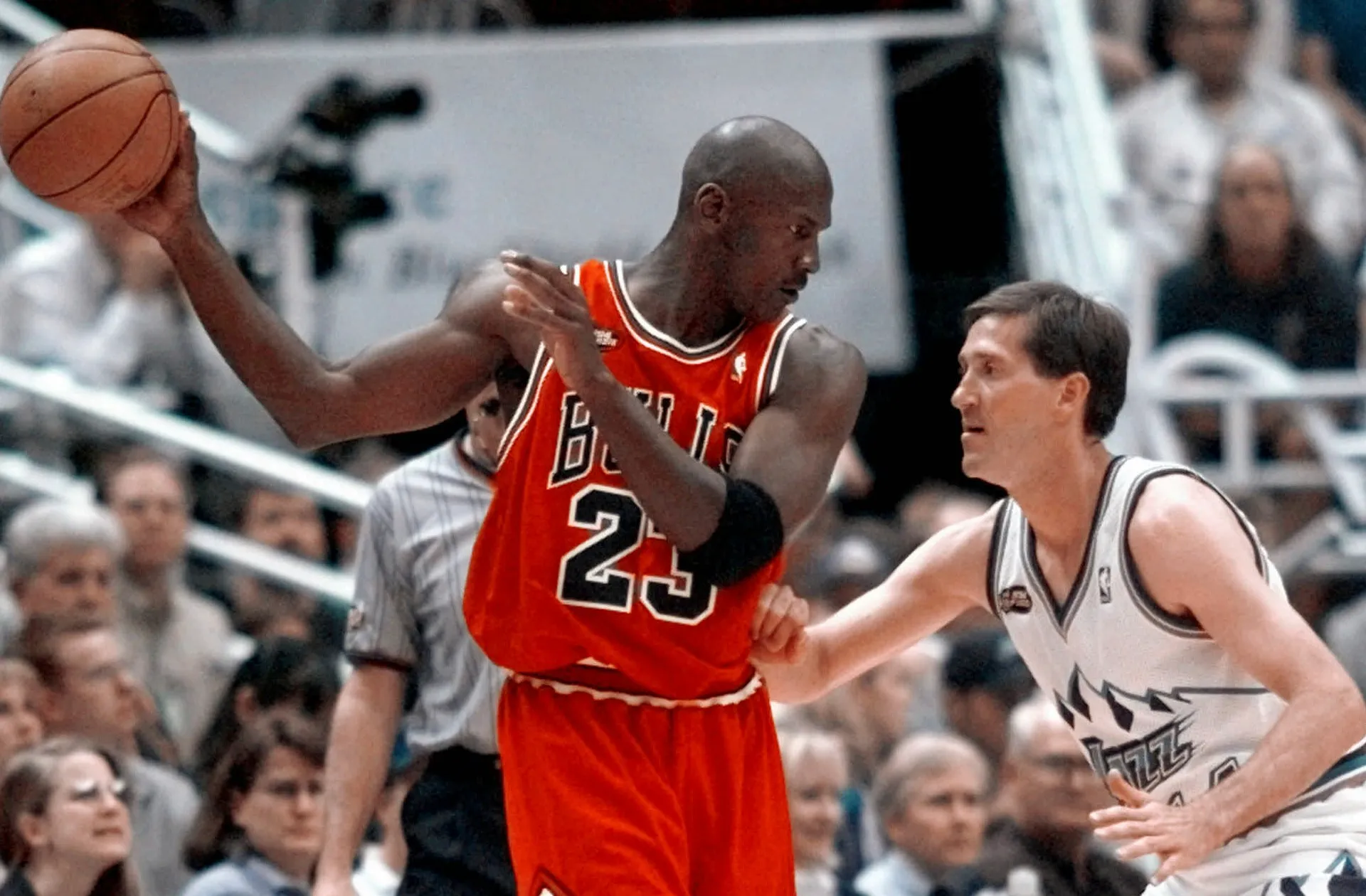
The jersey Michael Jordan wore during Game 2 of the “Last Dance” 1998 NBA Finals has sold for a record $14m.
Hunt Auctions announced on Monday that the game-worn, autographed Chicago Bulls jersey was bought by Miami real estate investor Ron Firman in a private sale.
It is the highest price ever paid for a piece of basketball memorabilia and, according to the auction house, the newly sold Jordan jersey ranks as the second-largest sale in history among game-worn sports jerseys.
The New York Yankees jersey worn by Babe Ruth in Game 3 of the 1932 World Series – during which Ruth called his shot before a home run – went for $24.12m in 2024.
Jordan and the Bulls defeated the Utah Jazz in six games to win the 1998 championship, the sixth and final title of his career in Chicago.
Game 2, played on June 5, 1998, in Salt Lake City, saw Chicago even the series 1-1, largely thanks to a dominant performance by its superstar guard.
Jordan put up 37 points, five rebounds, and three assists in a 93-88 victory. He would go on to collect his sixth and final Finals Most Valuable Player (MVP) award, two more than anyone else in NBA history, nine days later.
The wildly popular “Last Dance” documentary, released in 2020, was centred around that 1997-98 Bulls season.
“The record-setting price achieved for the related Michael Jordan jersey is yet another corroborative result as to the significance of Jordan within the industry and popular culture. This remarkable garment bore witness to one of Jordan’s most hallowed NBA Finals appearances as part of his ‘Last Dance’ season to complete his illustrious career,” David Hunt, president of Hunt Auctions, said in a statement.
“While Michael Jordan’s importance within the sports memorabilia marketplace has long been established, it has now escalated to an elite asset class more typically reserved for iconic works of art. We are very pleased to have been able to facilitate this historic sale which serves as another benchmark for our industry.”
This sale becomes at least the third time a Jordan jersey from that 1998 Finals has fetched at least $10m. A jersey from Game 1 was sold at auction for about $10.1m in 2022, and a jersey from Game 3 was auctioned last month for about $12.3m via an auction in September.
“Michael Jordan was an incredibly talented player who is admired around the world,” Firman said in a news release distributed by the auction house. “I’m very excited about the purchase.”
The jersey that Firman bought was originally bought from the Bulls by a private collector in 2003, Hunt said, adding that it “has remained within a succinct chain of custody, having only changed hands once from the original purchaser”.
Just about anything related to the 1998 Finals and Jordan’s final season with the Bulls has been the subject of huge interest in the collector space. In 2023, a pair of Air Jordan sneakers that he wore in Game 2 against the Jazz was sold by Sotheby’s for $2.2m, touted at the time as “a new world record for the most valuable sneakers ever sold”.
Crime thriller hailed ‘masterpiece for the ages’ on Film4 tonight
The neo-noir crime classic has an almost perfect rating on Rotten Tomatoes and fans say it is one of the greatest films ever made

The film has been hailed a ‘masterpiece’(Image: Rex)
It was a film which cemented the blossoming careers of two of the world’s biggest actors, has a near perfect rating on Rotten Tomatoes and was nominated for a huge nine Oscars – and now it’s airing on Film4 tonight.
LA Confidential is a noir crime thriller starring Kim Basinger, Kevin Spacey, Danny DeVito and Australian actors, Guy Pierce and Russell Crowe, in what would become a breakthrough role for both of them.
Based on James Ellroy’s novel, the film was directed by Curtis Hanson, who also co-wrote the script with Brian Helgeland. Set in the Los Angeles that gives the movie its title LA Confidential is the story of a group of police officers in the 1950s and deals with corruption and the world of Hollywood celebrity.
LA Confidential was nominated for Best Picture, Best Director, Best Supporting Actress, Best Screenplay, Best Cinematography, Best Original Score, Best Sound and Best Film Editing at the Academy Awards and walked away with Oscars for Kim Basinger for Best Supporting Actress and Best Screenplay. It is often cited as one of the best films to have lost the Best Picture Oscar.
The film also has an incredibly rare, almost perfect rating on the film review website, Rotten Tomatoes, standing at a 99 percent approval rating.
One critic said: “Writer-director Curtis Hanson’s adaptation of the James Ellroy novel wasn’t merely one of the two or three greatest movies of the 1990s; it stands as a masterpiece for the ages.”
Another added: “The flawless ensemble…, the masterfully written story, the vibrant yet gritty vision of 1950s LA – most everything clicks in this fittingly cynical and undeniably seductive period crime thriller that still maintains its style and sizzle.”
While a third wrote: “Adapted from a novel said to be unadaptable and set in a genre that has seemed increasingly played out, it brings clarity and life to its art and to life. That’s a pretty good definition of a masterpiece, isn’t it?”
Fans of the film were equally as lavish in their praise from the movie. One wrote: “A masterclass in crime noir. L.A. Confidential is one of those movies that reminds you why people love cinema. The cast is phenomenal, the acting is excellent, and the production design makes every scene feel authentic. The writing, dialogue, editing, and score all come together to create a gripping crime noir that never loses momentum.”
Another said: “A mystery thriller that moves like few others. The twists and turns will be obvious to any average movie goer, but the plot was never the focus. This is a clear cut character piece and here, few can rival the masterclass work on display. The cast is flawless, the script is magnificent and Hanson’s directing somehow weaves all of it together so it’s not only (structurally) a marvel, but wildly entertaining.”
While a third added: “L.A. Confidential is, without a doubt, the best film of the ’90s, and one of the best films ever made. Curtis Hanson was a much better director than Speilberg or Tarantino. Great script, the story is riveting, the dialogue is smart and funny, and the characters are written in three if not four dimensions. One can almost forgive the casting of DeVito, who did a good job. There should have been several sequels.”
LA Confidential is on Film 4 at 12.45am this morning.