



Track Cycling World Championships: Emma Finucane will ‘come back fighting’ after narrowly missing gold in Shanghai
Emma Finucane said she will “come back fighting” for gold medals after narrowly missing out on the top step of the podium for the third time at the Track Cycling World Championships, external in Shanghai.
Finucane, 23, was forced to settle for bronze in Sunday’s keirin after being pipped to the finish line by neutral athlete Alina Lysenko and Lea Friedrich of Germany after leading into the home straight.
She finished just 14 thousandths of a second off top spot, with her bronze adding to silver medals won in the team sprint and individual sprint – both won by Chinese cyclists.
Finucane was part of Great Britain’s team sprint gold medal-winning trio at the Paris Olympics in 2024 and Finucane says retaining that title in Los Angleles is the big aim.
She told BBC Sport: “To medal in all three races at the world champs, I’d never done that before.
“The confidence I have gained this week and the way I’ve been riding my bike, I can take that into the years to come.
“I’m actually really proud. I am frustrated not to be on the top step but I’ll come back fighting. You can beat yourself up about races but I am learning all the time.
“Ultimately we are learning for the Olympics, that’s a huge goal. I put myself in winning positions in every race and that’s something I am proud of.”
Finucane, who took bronze in both the individual sprint and keirin in Paris, won Britain’s first Olympic gold in the women’s team sprint alongside Katy Marchant and Sophie Capewell.
In Shanghai, Rhianna Parris-Smith replaced the newly-retired Marchant in the team which was beaten by Chinese trio Jiang Yulu, Tong Mengqi and Yuan Liying.
Finucane says the strength in depth inside the British team will drive them to success at the LA Games in 2028.
She said: “We won the team sprint in Paris which is one of the best moments of my life and there are 10 girls back at home fighting to be in the team. That’s how we progress, and we will build on the momentum of this silver medal.
“Internal competition is how we win bike races. World records keep falling, we are pushing each other and it’s really exciting.”
Great Britain topped the medal table overall at the championships with 12 medals, including a hat-trick of gold medals for Anna Morris.
Funeral held for 75 Palestinians after remains recovered from Gaza ruins | Israel-Palestine conflict News
Most of the victims were from the Daraj neighbourhood in Gaza City, the Health Ministry says.

Published On 18 Oct 2026
A mass funeral has been held for 75 Palestinians whose remains were found recently under the rubble of homes and buildings destroyed in the months since Israel launched its genocidal war on Gaza in October 2023, the Ministry of Health announced.
Hundreds of Palestinians attended the funeral procession before the remains were buried at the Sheikh Radwan Cemetery on Sunday morning.
Recommended Stories
list of 3 itemsend of list
Most of the victims were from the Daraj neighbourhood in the northeastern part of Gaza City.
Al Jazeera correspondent Nour Khaled said the majority of the remains belonged to women and children “who were inside their homes when they were targeted”.
The remains consisted of some body parts and personal belongings and were wrapped in Palestinian flags before the burial, she said.
Abdullah al-Majdalawi, director of public relations and media for Gaza’s Civil Defence, told the Turkish state news agency Anadolu that the remains had been recovered over recent weeks from several destroyed homes in Daraj.
He said the buildings were bombed while residents were inside during the early months of the war and that the victims belonged to about 20 Palestinian families, including people who had been displaced to the homes.
Efforts to recover bodies from beneath the rubble continue to face severe difficulties due to a lack of equipment and heavy machinery, he added.
The Civil Defence launched the second phase of its recovery operations in July. It recovered 333 bodies and remains of 559 people during its first operation in November 2025.
The Civil Defence says it believes the remains of another 8,000 Palestinians are still trapped beneath the rubble across Gaza. There are about 200,000 damaged and destroyed buildings in Gaza, according to the UN agency for Palestinian refugees, UNRWA.
At least 74,475 Palestinians have been killed since Israel launched the genocidal war three years ago.

Who is Mehrdad Akhlaghi, Iran’s new tech-focused defence minister? | US-Israel war on Iran News
Tehran, Iran – Mehrdad Akhlaghi Ketabchi has been appointed Iran’s defence minister at a time when the war with the United States is expected to escalate.
The 68-year-old was approved on Sunday by parliament, which has convened online since the start of the US-Israel war on Iran on February 28, to assume leadership of the Ministry of Defence and Armed Forces Logistics. In total, 237 lawmakers voted in favour of Akhlaghi’s appointment and 15 against.
Recommended Stories
list of 3 itemsend of list
Former Defence Minister Aziz Nasirzadeh was killed along with a large number of other senior figures, including Supreme Leader Ali Khamenei, on the opening day of the war.
The position was filled temporarily by Majid Ebn-e Reza, who will now become Akhlaghi’s deputy.
Akhlaghi will be responsible for rebuilding and expanding Iran’s military-industrial infrastructure, which has been heavily targeted by the US and Israel.
The new minister’s defence plans were approved earlier by senior military authorities, President Masoud Pezeshkian and parliament’s Commission on National Security and Foreign Policy.
“The Islamic Republic of Iran will not be the instigator of aggression against any country but will defend the territorial integrity of the country strongly and to the death against any aggression,” Pezeshkian said.

The president said Akhlaghi has more than 42 years of experience in the Defence Ministry and related organisations.
His principal expertise is in ballistic missiles, solid-fuel propulsion, aerospace technology and military-industrial production, according to state media.
Previously, he served as the head of the Shahid Bagheri Industrial Group, the Aerospace Industries Organization and the Defence Industries Organization. Akhlaghi and these entities are all subject to sanctions by the US. He is also under United Nations sanctions.
He has been associated with developing several missile types and related weapons-development projects over the past decades, according to Tasnim, a newspaper linked with the Islamic Revolutionary Guard Corps (IRGC),
Akhlaghi reportedly played a role in expanding the major Sejjil and Zolfaghar family of Iranian ballistic missiles as well as precision-guided weapons, such as the Almas missiles and Yasin guided bombs.
He is also said to have expertise in space launchers, research rockets and infrastructure associated with the Imam Khomeini Space Center in Semnan. These have all been critical elements in Iran’s wars against Israel and the US.
This month, Iran’s Defence Ministry spokesman, Brigadier General Reza Talaei-Nik, told reporters that Akhlaghi’s nomination reflected Iran’s need to increase the quantity and quality of strategic weapons, particularly missiles and drones.
“Offensive arms are being actively improved,” the spokesman said.
The US has repeatedly claimed that it has destroyed most of Iran’s military-industrial capacities, but Tehran has maintained it continues to have considerable offensive and defensive capabilities outside the reach of US and Israeli bombs. These weapons have been upgraded based on Iran’s new war experience, it has insisted.
Akhlaghi told members of parliament this month that he had met with senior military commanders, including the commander-in-chief of the IRGC, Brigadier General Ahmad Vahidi, to develop a better understanding of their requirements during and after the war.
His priorities as defence minister would be faster military-industrial development, air defences, incorporation of emerging technologies using government and private sector firms, improvements in armed-forces welfare and development of international military cooperation, according to reports.
In his first comments as defence minister on Sunday, Akhlaghi taunted the administration of US President Donald Trump, which this month threatened to use the “mother of all bombs” on Iran’s nuclear and energy infrastructure.
“We have made preparations and continue our work with ease of mind,” he told reporters. “The US president must think of getting his forces out of our region in one piece. If he drops one bomb, he must see how many of his troops he will have to evacuate horizontally.”

Gripping BBC drama series ‘that will have you completely hooked’ is a must-watch
People looking for a gripping TV drama to watch have been recommended a BBC show that is leaving people ‘hooked from start to finish’. The programme features stars such as David Tennant and Stephen Graham

The BBC drama has people ‘hooked’ from start to finish(Image: BBC/BBC Studios/Peter Marley)
Deciding what to watch next has become a daily headache for millions of British viewers, thanks to the sheer volume of streaming platforms now available, including Netflix, BBC iPlayer, Disney+, Amazon Prime Video, and Apple TV+. But one influencer is on a mission to make that choice easier by sharing his top TV and film picks online. EccyReviews’ is the online handle of Luke Eccleston, a well-known UK-based content creator and self-proclaimed “TV fanatic” who regularly shares his must-watch television recommendations with his 5,000+ followers.
In one of his most recent posts, Luke put forward a TV suggestion for anyone “looking for a gripping new TV drama series to go and watch right now”.
He added: “You’ll be completely hooked from start to finish.”
The show in question is BBC prison drama Time. “Season 3 just dropped on BBC and I’ve binge-watched all three episodes and it is my favourite season by far,” he said.
Time is a critically acclaimed, BAFTA award-winning BBC series penned by celebrated British screenwriter Jimmy McGovern.
Each three-part series shines a spotlight on a different setting and ensemble cast within the UK criminal justice system, exploring themes of guilt, punishment, redemption, and institutional failings.
Season 1 centred on Mark Cobden (Sean Bean), a former teacher consumed by guilt after accidentally killing a man while drink-driving, who is subsequently sentenced to four years behind bars. It also features Eric McNally (Stephen Graham), a principled prison officer attempting to safeguard the inmates in his charge.
When a dangerous prisoner uncovers Eric’s weakness, he faces an excruciating decision between his professional obligations and his loved ones.
Series 2, meanwhile, relocated the action to a women’s facility, Carlingford Prison. It follows three women who arrive on the same day: Orla (Jodie Whittaker), a mother who tampered with her electricity meter; Kelsey (Bella Ramsey), a pregnant young drug addict; and Abi (Tamara Lawrance), a woman serving a life sentence carrying a tragic secret.
Compelled to share a cell, they forge an unlikely alliance to endure.
The most recent season, which recently dropped, has shifted attention to a Young Offender Institution. The narrative examines young men ensnared in the justice system following a tragedy, grappling with prison overcrowding and institutional collapse.
This instalment is fronted by David Tennant and Siobhan Finneran, who returns to her recurring role throughout the anthology as prison chaplain Marie-Louise O’Dell.
Since each season presents a self-contained narrative with a different principal cast, viewers can jump into any series without prior knowledge, though chaplain Marie-Louise serves as the connecting element throughout all three.
Discussing the latest series, Luke tells viewers: “I was gripped from start to finish and all the performances are brilliant.
“I guarantee that you will absolutely love this show.”
The recommendation proved a massive hit, with the post amassing more than 7,000 likes.
One person wrote: “Watched it all tonight – best thing I’ve watched for ages. Very violent and very sad. The writer spent a lot of time in these youth offenders prisons and was horrified at the conditions, it was all based on truth.”
Another added: “I have just started watching it, it’s brilliant very gripping.”
While a third added: “Totally hooked from the start! Talent is incredible.”
All series of Time are available to stream on BBC iPlayer now.
Ensure our latest DWP headlines always appear at the top of your Google Search by making us a Preferred Source. Click here to activate or add us as Preferred Source in your Google search settings

UK’s largest one-day Christmas market returns to historic town with REAL reindeers, brass bands
A HISTORIC town will host a festive wonderland with real reindeers for just one day.
The UK’s largest single-day Christmas market is returning with more than 120 stalls this December.
The Beverley Festival of Christmas will return on Sunday, December 13, bringing thousands of visitors to the East Yorkshire town for one of the country’s biggest festive events.
Shoppers will be able to browse more than 120 stalls selling everything from handmade gifts and Christmas decorations to jewellery, homeware and locally produced food.
The market will spread across Beverley’s historic Saturday Market, Wednesday Market and North Bar, with independent traders offering plenty of inspiration for anyone still searching for Christmas presents.
The day will kick off with a spectacular parade at 10am, setting off from Wednesday Market and travelling along Toll Gavel towards Saturday Market.


Santa Claus will lead the procession alongside his reindeer, with live music, comedy acts, Steampunks, majorettes and Bernese mountain dogs also expected to take part.
After the parade, Father Christmas and his reindeer will remain in Saturday Market until mid-afternoon, giving families the chance to see them up close and take photographs.
Visitors can also expect traditional Victorian fairground rides, face painting, birds of prey displays and ice sculptures throughout the day.
Brass bands, carol singers and dancers will provide a festive soundtrack as shoppers explore the town centre.
The festival will be running from 10am until 4pm and the entry is free.
The event was first established in 1995 by local shop owner John Bird, who brought Beverley’s traders together to create a special day of Christmas shopping.
It has since grown into one of East Yorkshire’s best-known festive traditions, with 2026 marking its 30th year.

‘He’s everywhere’: Carl DeMaio’s push to make the GOP relevant again
ROSEVILLE, Calif. — San Diego County Republican Carl DeMaio had a warning for conservatives at a get-out-the-vote rally this month in Placer County.
“You are doomed,” DeMaio said, crooning the phrase like a foghorn. The audience chuckled.
“Doomed” is DeMaio’s description for races that lack a conservative candidate. Skip voting in those, he told the crowd, briskly walking them through the Nov. 3 ballot.

Rep. Carl DeMaio speaks to attendees during a “Beer, BBQ & Ballots” event for Proposition 39 at the Nevada County Fairgrounds.
(Fred Greaves / For The Times)
Microphone in hand, the freshman state legislator paced the floor, threw up his hands and scowled as he declared California a “communist state,” the progressive Bay Area “the gates of hell” and Hillary Clinton “the wicked witch.”
Urging volunteers to door-knock at Republican households, he instructed them to ignore Democratic homes entirely.
“I don’t need to remind them there’s an election going on,” he said, prompting more laughs.
DeMaio, 52, is emerging as a prominent voice for California Republicans, promising a path back to power and delighting audiences with his sharp takedowns of Democrats. His vehicle this election is Proposition 39 — he is coauthor of the ballot measure — which would require Californians to provide ID when voting, an initiative backed by millions of dollars from conservatives and condemned by the state’s Democratic leaders and voting rights experts.

A woman grabs a “Yes on 39” lawn sign at the Nevada County Fairgrounds.
(Fred Greaves / For The Times)
On his YouTube channel, he regularly skewers Gov. Gavin Newsom, the Sacramento “swamp” and the media with shows titled, “Thinking of California? 3 Reasons Not to!” and “Socialism on the CA Ballot in 2026!”
His advocacy group, Reform California, supports conservative candidates and helps raise money. Backed by volunteers, the group is usurping the California Republican Party’s influence, according to both his critics and allies.
DeMaio appears undaunted by his quest.
Registered Democrats outnumber Republicans nearly 2 to 1 in California, control the state Legislature and hold every statewide elected position. In Los Angeles, a democratic socialist running for mayor leads in some polls.
“Republicans are tired of what’s going on in the state of California, and they’re looking for somebody to lead them out of the minority,” said Corey Gustafson, former chair of the San Diego County Republican Party. “Many people think Carl is the answer to that.”
An alternative GOP machine
In an interview at Reform California’s Escondido office, DeMaio said his goal is to restore political balance in the state by electing more Republicans.
“I’m trying to get my party to pull its head out of its ass, be more effective at campaigning, and get its ideas across,” DeMaio said, ticking off values he believes the Republican Party should champion: socially moderate positions, environmental stewardship and challenging big corporations.
Though the GOP has a poor track record on those issues, DeMaio says: “I’m just simply tapping into something that already exists, that just needs leadership.”

Fairgoers listen to Rep. Carl DeMaio in Nevada County.
(Fred Greaves / For The Times)
Nearby, scores of volunteers sat at long tables, stuffing voter guides — approved and printed by DeMaio’s team — into envelopes. It is an immense undertaking, with every guide tailored to the voter’s local election. Volunteers hand-write the voter’s name and address on the envelope to give it a personal touch.
Matt Rexroad, a political consultant who ran an independent expenditure against DeMaio in his 2024 Assembly race, said that he doesn’t like DeMaio’s “combative side” but praised his effectiveness.
“He’s hardworking and he’s everywhere,” Rexroad said. “What the California Republican Party and the various central committees should be doing? He is basically running and setting up a system that’s totally outside of that which answers to him.”
Ahead of the June primary, the state Republican Party sent a cease-and-desist letter to DeMaio challenging his use of its trademarked elephant emblem and the phrase “Official Republican Voter Guide” on Reform California campaign materials.
Republican candidates endorsed by DeMaio ultimately beat out the party establishment-backed candidates in two significant races in the primary.
Matt Shupe, a spokesperson for the state Republican Party, said that Reform California is benefiting from the strong “foundation” that the party built. “We’re stronger when we work together, and we look forward to doing just that,” Shupe said.
Clashes with business and labor
DeMaio grew up in Orange County, attended a Jesuit school in Maryland and graduated from Georgetown University.
His mother died of breast cancer when he was a teenager, essentially leaving him an orphan because his father was not in the picture, according to DeMaio.
He frequently speaks about his childhood adversity. He recalled visiting his mother in the hospital during her illness, describing how she hid her leg under a blanket and joked that doctors had mistakenly amputated it. “She had a great sense of humor,” he said. “I try to also, no matter what, to keep a sense of humor.”
After college, he founded a think tank dedicated to reforming government. He co-wrote a 2003 report with suggestions for closing California’s massive budget deficit after the dot-com bubble left the state reeling.
Former state Sen. Jim Brulte said the Senate Republican Caucus spent several days reading through DeMaio’s recommendations and ultimately adopted several. DeMaio is “wicked smart,” said Brulte, also the former state GOP party leader.

Former San Diego mayoral candidate Carl DeMaio announces a recall effort against San Diego Mayor Bob Filner in 2013 in San Diego.
(Denis Poroy / Associated Press)
Elected to the San Diego City Council in 2008, he cast himself as a fiscal watchdog, challenging labor unions and businesses’ influence.
He lost a bid for San Diego mayor in 2012, and two tries for Congress, and also twice pursued a voter ID ballot measure before aborting the efforts.
In 2018, he led the successful recall effort against state Sen. Josh Newman over the Fullerton politician’s support of a gas tax, part of what DeMaio called a “gazelle strategy” to target seemingly vulnerable Democrats.
In DeMaio’s winning 2024 state Assembly race, he heavily featured former Gov. Pete Wilson and his signature push for border control. “Gov. Pete Wilson was right,” DeMaio’s ad proclaimed, before blaming both major parties for “doing nothing” on illegal immigration for decades.
The first openly gay Republican Assembly member, he represents a suburban and rural district in northern and eastern San Diego County that covers Santee, Poway and the unincorporated communities of Julian, Ramona and Borrego Springs.
He is running for reelection on Nov. 3 against Democrat Gerald Boursiquot, an IT contractor.
Friction in Sacramento
On his first day in office, DeMaio introduced bills to require voter ID at the polls, repeal California’s “sanctuary state” law, and bar elected officials from trading stocks, among others. All died in the Democratic-controlled Legislature.
His relationship with some Democrats worsened this year after he fueled outrage over a bill introduced by a Democratic Assembly member to make confidential the addresses of those providing legal and humanitarian aid to immigrants.
DeMaio dubbed it the “Stop Nick Shirley Act,” in reference to the conservative influencer, and said it would prevent activists from doing their jobs. MAGA loyalists flocked to Sacramento in solidarity.
The Democrats “can’t stand him,” said Roger Niello, a Republican state senator from Fair Oaks. “And I think he takes wonderful pleasure in that.”
Assemblymember Josh Lowenthal, a Democrat from Long Beach, called DeMaio’s views and tactics “repugnant” but said he has a friendship with the politician.
“When the camera is on, he’s antagonistic, bombastic and has the capacity to start a nuclear war,” Lowenthal said. “In private, he’s affable, thoughtful and willing to exchange ideas with anyone.”

Campaign Chair Carl DeMaio speaks during a rally at the Santa Clarita Activities Center in 2021 for
Gov. Gavin Newsom’s ouster.
(Francine Orr / Los Angeles Times)
Now wrapping up his first term in Sacramento, DeMaio said he dislikes living part time in the state capital and avoids its political culture of nightly fundraisers. Instead, he said, he goes to bed early so he can wake up and record his daily show.
“I’m actually an introvert,” he said. “People don’t believe that. When I am not doing politics, I just want to be home with my cats, my partner and just try to disconnect from the world.”
The voter ID push
DeMaio’s Proposition 39 campaign bus pulled up to Folsom last week, part of a 71-stop tour ahead of the election.
“A lot of people, especially in the Trump era, really like someone who’s loud and fighting for them,” said Sadie Foster, a 34-year-old from Sacramento who volunteered serving potato salad at the event. “Even on the Democrat side, you see that.”
DeMaio, speaking to a large crowd, called his voter ID initiative the “most exciting thing on the ballot to get our base to turn out.”
If passed, Proposition 39 would require voters to present identification at the polls or write a government-approved PIN on the back of mail-in ballot envelopes. It would also require county officials to update voter rolls by removing individuals who have moved or passed away.
Opponents, including prominent Democrats and many voting experts, argue that the measure would make voting harder and disproportionately disenfranchise low-income citizens, rural residents and communities of color. They also point to data consistently indicating that voter fraud, including by noncitizens, is exceedingly rare.
President Trump, who remains widely unpopular in California, also supports stricter voter ID laws. Unlike Trump, DeMaio actively encourages mail-in voting.
A spot for the initiative features a woman asking rhetorically, “Can you dislike Donald Trump and still vote YES on Prop. 39 for voter ID? Yes, you can!”
In an interview, DeMaio linked the proposition to what he described as his longtime interest in election integrity. At the same time, no voter wants to see “an ineligible person casting a vote,” he said.
At an online strategy meeting with volunteers last month, DeMaio instructed them to target “low-propensity, lazy Republicans.”
One volunteer suggested tying their campaign to Trump’s offer to pay voters a $5,000 dividend if Republicans keep control of the U.S. Senate and House of Representatives.
“Please,” said DeMaio, sounding frustrated. “Stay on message. Do not get distracted by shiny objects. Because those shiny objects, according to the data, won’t help us win.”

Chelsea: Emiliano Martinez breaks jaw against Everton
Chelsea goalkeeper Emiliano Martinez says he will be back “in a few weeks” after breaking his jaw in the 2-0 Premier League win at Everton on Saturday.
The 34-year-old Argentina international and Everton defender Jarrad Branthwaite clashed heads in the second half at Hill Dickinson Stadium.
Martinez needed treatment for eight minutes before leaving the pitch on a stretcher. He was taken to hospital, where Chelsea said he had “successful” surgery.
Martinez posted a photo of himself wearing a hospital gown on social media, external on Sunday.
“Thanks to everyone for the messages. The operation went well,” he wrote.
“The most important thing is that we won, and kept a clean sheet. In a few weeks we’ll be back.”
Mike Penders, who replaced Martinez to make his Premier League debut, looks set to play in Chelsea‘s next three matches at least.
They face Tottenham and Manchester United in the Premier League, with a Carabao Cup tie at Liverpool in between.
Penders, 21, signed from Belgium club Genk for £17m in 2024.
Alonso said: “Mike has personality. He’s brave and we have full trust with him. He did well when he came on.
“He played in the cup games and whenever he’s needed. Like the other players, whenever they are needed they can perform.
“It’s all about the squad – that all the players feel important and can have their moment whenever they are needed, and that’s very positive.”

Jordan-Israel border becomes new hotspot for sophisticated drug trade | Crime News
Amman, Jordan – Jordanians fear the country’s border with Israel is turning into a major drug-smuggling route amid a surge in high-tech operations by gangs using drones and helium-filled balloons.
Organised networks active in southern Israel’s Negev Desert have links to groups in Jordan and the Sinai Peninsula in Egypt, operating along one of the most heavily surveilled borders in the world, with Jordanian authorities increasingly concerned about the implications this could have for the kingdom.
Recommended Stories
list of 3 itemsend of list
This escalation coincides with changes in the regional drug trade, particularly after the fall of Syrian President Bashar al-Assad in late 2024.
Elements in his regime were linked to the manufacturing and distribution of Captagon, an illegal amphetamine stimulant.
Syria became a hub for the distribution of Captagon to the Gulf, with Jordan a transit point and market for the drug. The Royal Jordanian Air Force carried out periodic strikes on drug manufacturing and smuggling points inside Syria, highlighting the huge security concerns Jordan had about the trade.
Since the collapse of the Assad government and the establishment of a new authority that views the Captagon trade as a national security issue, there has been a decrease in the drug trade from Syria into Jordan.
Although Druze militias in the Syrian province of Suwayda allegedly linked to Israel have been accused of continuing the drug trade, Jordanian security forces are increasingly focused on the Jordan-Israel border.
The use of quadcopter drones and balloons is reportedly among the new tactics used by gangs in Israel to smuggle hashish, crystal meth, and amphetamines into Jordan.
Jordanian security forces are said to be increasingly unhappy with the scale of the drug smuggling operations and have accused the Israeli army of not taking the issue seriously.
Initial data from Jordanian forces recorded 17 interception operations linked to drones during the first half of 2026 in Jordan’s southwestern border area with Israel.
They also recorded 231 smuggling and infiltration attempts and downed 56 drones across various borders during the same period.
Interior Minister Mazen al-Faraya told Al Jazeera that Jordanian forces were continuing efforts to prevent drugs from being smuggled into the kingdom. But they are evidently facing more complex activities by drug dealers.
“There is an increase in drug smuggling operations from Israel to Jordan using drones,” he said. “The number of seized drug cases during the current year reached 15,342 cases. Trafficking cases constituted about 28 percent of them, compared with 72 percent for usage cases.”
Israeli media reports indicate that gangs active in the Negev Desert are behind some of the smuggling operations into Jordan, where drugs can fetch higher profits.
There are estimates that 1kg of hashish can sell for approximately 7,500 pounds sterling (almost $10,000), according to the British newspaper The Telegraph, which recently uncovered the drug smugglers’ latest operations. Israeli security services believe that the price of hashish in Jordan is about 15 times higher than in Israel.
Due to widespread disenfranchisement and poverty, elements within Palestinian communities in Israel have been linked to the drug trade, according to reports. Multiple sources have accused Israel of allowing Palestinian towns and cities to become hotbeds of crime to create divisions and prevent calls for greater rights.
Ammar al-Qudah, a member of the Jordanian Senate and retired major-general in the Public Security Directorate, claimed that organised gangs in the Negev had obtained more than 1,000 drones that were originally used for agricultural and security purposes.
“The smuggling networks are linked to other gangs in Jordan, Sinai and the Negev, and rely on a route starting from Sinai, passing through the Negev, and reaching Wadi Araba, in addition to other routes including the Lebanese border with Israel and the Galilee region towards Syria,” he told Al Jazeera.
They are also using a range of sophisticated technology to bypass security on both sides of the border. This includes the use of helium-filled balloons equipped with GPS devices, drones capable of carrying about 50kg of narcotics, including black hashish and crystal meth, al-Qudah said.
He warned that a portion of the black hashish and crystal meth being smuggled into the kingdom is being sold domestically, with the rest going to other markets in the region.
With such high-tech operations, there are accusations that members of Israeli forces know about drug gang activities, based on past experiences in Egypt.
One West Point report said current and former trackers in the Israeli military in the Negev are being recruited by traffickers to provide intelligence to facilitate their operations in Egypt. In 2012, a number of Israeli service personnel were arrested on suspicion of collaborating with drug smugglers across the Egyptian border.
While there is no proof that the same situation is being repeated in Jordan, many have questioned how drones and balloons carrying drugs could cross a heavily surveilled and guarded Israeli border into Jordan.
Jordan’s counternarcotics department, in cooperation with the armed forces, has tracked such cases and made arrests.
Retired Brigadier-General Daifallah al-Daboubi, a strategic and military expert, said Jordan is witnessing a “reverse drug migration”, starting from the Sinai Peninsula, passing through the Negev region, and reaching the kingdom.
“Groups active in Beersheba and the Negev possess great financial capabilities and use advanced smuggling methods, most notably drones,” he said.
The Israeli army’s preoccupation with wars in Gaza, Lebanon and the occupied Golan Heights has provided smugglers with room to manoeuvre on the Jordan border, he added. But he ruled out the direct involvement of the Israeli political or military leadership in any drug smuggling.
Steps taken by Israel to boost security on its eastern border include the establishment of the 96th Division, which began operating in the Jordan Valley in 2025, and the construction of a controversial security barrier with Jordan.
But none of these measures appears to be designed to prevent drugs from leaving Israel; instead, they appear to be designed to prevent weapons and other illicit merchandise from entering the country from Jordan.

First C-130J For Navy’s New E-130J Phoenix II Ballistic Submarine Communications Fleet Delivered
The U.S. Navy has taken delivery of the first C-130J-30 Hercules airframe destined to become an E-130J Phoenix II, the service’s next-generation aircraft for maintaining communications with its nuclear ballistic submarines. The aircraft will now undergo extensive mission-systems integration before it can begin testing for the Take Charge and Move Out (TACAMO) mission.
Lockheed Martin handed over the newly built aircraft at its facility in Marietta, Georgia, on October 15. The delivery marks the start of the transition from the Navy’s aging E-6B Mercury fleet to the turboprop-powered E-130J, which is intended to provide a survivable communications link between national leadership and U.S. Navy nuclear ballistic missile submarines, including the ability to send them orders to launch strikes while they are submerged.

“Today’s delivery from the historic Marietta line represents far more than a new airframe; it marks the foundation of our future strategic deterrence posture,” Capt. Roger Davis, program manager for the Navy’s Airborne Strategic Command, Control, and Communications program office (PMA-271), said in a statement.
“Through our close partnership with Lockheed Martin and our industry team, we are ensuring our nation maintains an unshakeable communications lifeline to our ballistic missile submarine fleet.”

The aircraft is the first of three C-130J-30s initially procured by the Navy in September 2024. It will be transferred to Northrop Grumman, the E-130J program’s prime contractor and mission-systems integrator, for conversion. Collins Aerospace is providing the very low frequency (VLF) communications system, a key component of the TACAMO mission.
TACAMO aircraft provide a means for the president, secretary of defense, and U.S. Strategic Command to communicate with nuclear forces, including submarines submerged at sea. The mission is designed to preserve the ability to transmit emergency action messages even if conventional communications infrastructure is disrupted or destroyed.
The E-6B accomplishes this in part through a long, trailing wire antenna that enables VLF transmissions to submerged submarines. The E-130J will receive a comparable system as part of its conversion.
Hardening against the effects of electromagnetic pulse (EMP), which occurs during the detonation of nuclear warheads, is another key requirement for these planes.

The Navy plans to acquire 31 E-130Js, nearly doubling the 16 E-6Bs currently in service. That total includes six developmental aircraft and 25 production examples, although it remains unclear how many of the developmental aircraft will ultimately be available for operational use.
The larger planned fleet should provide additional aircraft to support training, maintenance, and operational demands. However, the transition also brings technical challenges. The Government Accountability Office (GAO) has previously warned that integrating the specialized mission equipment into the smaller C-130J-30 airframe could affect operational availability and create additional engineering and manufacturing difficulties.

In the past, TWZ has discussed the potential operational readiness and other trade-offs that could come from selecting a C-130-based platform to replace the E-6B in the TACAMO role. As we wrote previously:
“It’s certainly worth pointing out that the E-6Bs, conversions of what were some of the last and most modern 707 airliners built, were larger and higher performance platforms than the EC-130Qs. The C-130J-30 is certainly a more capable aircraft than the C-130H on which the EC-130Q was based, but it won’t have the base speed and altitude capabilities of an airliner-sized multi-engine jet. Compared to the Mercuries, any TACAMO-configured C-130J-30 would not be able to get on station as quickly, or fly as high, limiting its ability to get above bad weather or establish a better line of sight for its communications systems.”
“At the same time, as the Navy itself has noted, the C-130J-30 platform does immediately open up the ability to use a larger number of air bases, airports, and airfields, including austere ones that the E-6B cannot operate from. This could be very useful in a contingency scenario where an opponent may have destroyed or otherwise rendered unusable many well-established bases, as well as larger secondary dispersal sites, which include large commercial airports. Being able to fly from smaller, tertiary locations could help to ensure that the TACAMO mission continues without significant disruption under such circumstances. This is also true during peacetime, as targeting the TACAMOs on the ground would be much harder if they could easily operate from and sit alert at a much larger number of airports.”
“A C-130J-30 configured for the TACAMO mission would certainly have a mid-air refueling capability, and the Hercules is already a platform that has demonstrated the ability to loiter over particular areas for long periods of time. Unlike the Boeing 707, the C-130J is still in production, as well, meaning that TACAMO aircraft based on this plane would be inherently easier to maintain and support logistically, and may also be easier to convert to this specialized configuration to begin with. As time goes on, the J looks set to increasingly become the default base C-130 model across the U.S. military, as well. Compared to the long out-of-production 707-based E-6, support for the C-130J is already distributed across the U.S. and beyond. Training C-130J crews is even an easier proposition.”
The E-130J also represents a return to the Hercules family for the Navy’s TACAMO mission. The EC-130Q performed the role from 1963 to 1993, before the E-6A Mercury took over. The E-6B subsequently added an airborne command post mission known as Looking Glass, supporting U.S. strategic forces beyond the submarine communications role.

The Navy’s current plan is for the E-130J to assume the TACAMO mission, while the Air Force pursues a separate effort to replace the Looking Glass airborne command post capability.
Following its delivery, the first E-130J airframe will enter mission-systems modification, ground testing, and developmental flight testing. The aircraft is not yet an operational TACAMO platform, and further integration and testing will be required before the Navy can begin fielding the new fleet.
The transition is intended to preserve one of the most critical links in the U.S. nuclear command, control, and communications architecture as the E-6B fleet becomes increasingly difficult to sustain.
Contact the author: thomas@thewarzone.com

Fletchers’ Family Farm’s Liz admits ‘it’s emotional’ after devastating fire
Kelvin and Liz returned with a new episode of Fletchers’ Family Farm, as they worked to rebuild their home after a fire.

Kelvin and Liz were ‘devastated’ after a fire swept through their home (Image: ITV)
Kelvin Fletcher’s wife Liz was left admitting ‘it’s quite emotional’.
The couple were looking back on the remains of their home in the Peak District after a devastating fire. Last year, Kelvin, Liz and their four children were on holiday when a fire broke out. They’re now rebuilding it all, but had to start with going through what had been left behind.
In an ITV episode of Fletchers’ Family Farm airing on Sunday, 18 October, Liz made an emotional admission as she worked through the job with Kelvin that had been on their list “for a long time”.
The couple were going through their own home, taking out what could be salvaged from the remains. “Look how much it has just burnt straight through the wood, that’s crazy,” she said, as she held up a wooden frame that was covered in burn marks.
Kelvin narrated: “We may be living back at the farm, but we’re still months away from living in the farmhouse following the fire last year.”
As their children had grown over the last year, Liz was left throwing out old nappy bags, baby carriers, and wellington boots that no longer fit.
Kelvin went on: “A year and a half since the fire, and we have to throw out everything that has been damaged by the smoke.”
Picking up one of their children’s baby jackets, when the couple were planning to move to LA before buying the farm, Kelvin commented: “Funny how things turn out, can’t throw that!”
Going through more jackets, Liz went on: “This is just all the stuff that when the fire brigade had to break in, stuff that was blasted by the door. It’s sad because you realise how little the twins were and how this stuff doesn’t fit them anymore.”
She added: “It’s one of those things, you mentally have to prepare yourself for, it’s been so long and we’ve just not been able to do anything because surveys and checks have been done as part of the insurance process. And now we can finally start clearing it out and building it back together.”
**Ensure our latest TV stories always appear at the top of your Google Search by making us a Preferred Source. Click here to activate or add us as Preferred Source in your Google search settings**
Kelvin narrated: “Five years on from leaving Oldham, and so much has changed. This farm has given us a new life. And rebuilding the farm house is about building the heart of it back, along with a few old memories that we’re rediscovering.”
At one point, Liz said: “It’s quite emotional actually. It just shows how much time continues no matter what you’re going through, things keep going, you’ve just got to keep yourself.”
She added: “The exciting part is, although this now feels really sombre and quite depressing, but, like my dad always says, you’ve got to crack a few eggs to make an omelette, and it feels like we’re at that stage at the moment.”
Fletchers’ Family Farm is available to watch on ITVX.

Oregon’s governor struggles for reelection despite blue tide
With just over two weeks left until election day, Democrats can barely contain their glee.
Control of the House seems about to fall into their eager laps. Senate races in states that are normally cardinal red — Alaska, Iowa, Kansas and Texas among them — have grown fiercely competitive.
And, for the first time since 2010, a Democrat may soon be sitting in the governor’s office in more than half the 50 states. As recently as 2017, just 16 of them had Democratic governors — the lowest number in nearly a century.
The party owes a big thank you to President Trump, whose political standing seems to be sinking, like a depth charge, lower by the day. The only question is how much damage he inflicts on fellow Republicans.
There are, however, exceptions to every political trend, outliers in every election, a contest that zigs when races just about everywhere else are zagging.
Oregon, that crunchy and damp citadel of Left Coast liberalism, hasn’t elected a Republican governor since President Reagan was midway through his first term. In 2024, Kamala Harris walloped Donald Trump by more than 14 percentage points, extending a decades-long Democratic presidential winning streak.
And yet the state’s Democratic governor, Tina Kotek, is on the defensive as she fights for a second term in November, burdened by a dismal approval rating and a sense that things have been pretty lousy in Oregon under her leadership.
The state “hasn’t thrived in the last decade, and certainly hasn’t thrived since COVID, the way other states have,” said John Horvick, one of Oregon’s leading independent pollsters.
Kotek, a former speaker of the state House — and a highly effective lawmaker in that role — made some very concrete promises.
“She was going to build 36,000 new homes. She was going to improve our educational outcomes and make improvements to behavioral health in the state,” Horvick said. “Voters give her poor marks on all those.”
Most notably, perhaps, the epidemic of homelessness — which has curdled Portland’s hipster image and agitated Oregonians more than just about any issue in recent years — hasn’t abated under Kotek, despite a promise to make the problem her top priority.

Gov. Tina Kotek speaks to opponents of data center development during a demonstration at the state Capitol in Salem, Ore., on Sept. 8, 2026.
(Alex Milan Tracy / Sipa USA / Associated Press)
The Democrat still remains the favorite to win reelection. Oregon’s gubernatorial races tend to be closer than presidential contests and voters have been shown a reluctance to heave their governor from office, even when they tell pollsters they’re not happy with the incumbent or the state of their state.
“We watch this movie every four years in Oregon, where it looks really, really close and then, in the end, the Democrat wins,” said Kari Chisholm, a political strategist in Portland.
That may happen again. But Kotek’s travails show the perils of incumbency this angry election season, even for a Democratic swimming with a blue tide.
Thirty-six states are electing governors in November. Most of the contests lean toward one party or the other, like in California, where Democrat Xavier Becerra appears a shoo-in to replace Gavin Newsom.
But a dozen races are at least somewhat competitive, including toss-ups in Georgia, Nevada, Ohio and Wisconsin. All of the hardest-fought contests are in states that Trump carried in 2024 — several by double-digits — with Oregon being the lone exception.
Kotek, who’s been rated one of the least popular governors in America, is facing a rematch against Christine Drazan, a former GOP state House leader who now serves in the state Senate. In 2022, she lost narrowly lost to Kotek, 47% to 44%, in a three-way contest.
Unlike four years ago, Kotek has a gubernatorial record to defend and the case Drazan makes against her is succinct.
“Tina Kotek told Oregonians that she would solve the problems and challenges facing our state,” Drazan said in the candidates’ first debate this month. “She hasn’t.”
In a recent Fox News interview, Drazan elaborated.
“We have record high businesses that have gone out of business, bankruptcies, businesses that are leaving, family bankruptcies are at an all-time high,” Drazan said, exaggerating some. “Oregon is uniquely bad right now. It’s not a national issue, it’s here at home.”
Suggesting the state’s problems are indigenous is an obvious effort to lay responsibility on Kotek and absolve Trump, whose policies — ruinous tariffs, a reckless war, budget cuts — have slashed healthcare benefits, stoked inflation and driven fuel prices to all-time highs.
Further distancing herself from the Republican brand, Drazan has undergone a distinct makeover since winning the GOP primary in May. “Tough. Tested. Conservative,” is no longer the descriptive shorthand she uses on her campaign website. Now it’s “Mom. Public Servant. Champion for All.”
Drazan’s revised campaign biography also omits her opposition to various Democratic-backed policies, such as gun control, and her culture-warrior vow to “protect girls’ sports and keep men out of their locker rooms.” Instead, the Oregonian newspaper noted, her emphasis is now affordability and relatability.
Despite that, Kotek has continued wielding her sharpest-pronged political weapon, tying Drazan — an “out-of-touch MAGA extremist,” in her campaign’s parlance — to the unpopular president.
“I think we all know that there have been a lot of challenges facing our state and they’re still coming at us because of the confusion and disruption coming from Washington, D.C.,” Kotek said during the candidates’ third and final debate last week. “It’s just a fact. It’s upending who we are as a state and it is … making it harder for us to solve the problems that we have ahead of us.”
Passing the buck and pointing her finger is not exactly a message of triumph, uplift and achievement, but it may be enough to win Kotek a second term.
Grudgingly.

Dubois vs Wardley 2: What next for heavyweight division after Dubois win?
American Jarrell Miller remains highly ranked, while compatriots Jared Anderson and Richard Torrez Jr, an Olympic silver medallist, are rebuilding.
New Zealand’s former world champion Joseph Parker is seeking a return after his provisional doping suspension was lifted in August.
Australia’s Teremoana Teremoana has stopped all 12 professional opponents within two rounds, while Uzbekistan’s two-time Olympic champion Bakhodir Jalolov extended his unbeaten record by beating Solomon Dacres on Saturday.
In Britain, Derek Chisora, 42, is considering another comeback and says he expects to face WBA ‘regular’ champion Gassiev in December.
British champion Richard Riakporhe is pursuing world honours after moving up from cruiserweight, while former cruiserweight world champion Lawrence Okolie is targeting a return after reaching an agreement with the WBC over an adverse drugs test finding.
David Adeleye, Dave Allen, Johnny Fisher and Frazer Clarke remain on the domestic scene, while Leo Atang, 19, and Ireland’s Adam Olaniyan, 20, are emerging talents.
With Usyk, Fury and Joshua approaching the ends of their careers, the heavyweight division is entering a new era.
There is no shortage of potential big fights, but bringing the champions together before mandatory obligations, rematches and boxing politics get in the way could prove the greatest challenge.

Food or medicine? The impossible choices facing Sudan’s chronically ill | Drugs
Hasanat al-Rashid, 48, has lived with diabetes for 15 years, and the three-and-a-half-year civil war between Sudan’s military and the Rapid Support Forces paramilitary group has worsened her situation. Finding the treatment she needs has become a daily struggle.
When the war broke out in April 2023, she was forced to flee south from her home in Haj Yousif in Khartoum North to Umm Daw Ban in Khartoum State.
Recommended Stories
list of 3 itemsend of list
During her displacement, she went for days without medication and was forced to eat foods unsuitable for her condition, such as asida, a traditional Sudanese porridge.
She underwent operations on her foot twice when she developed complications of diabetes, including a severe infection.
She moved between hospitals in Gezira State south of Khartoum, seeking treatment in Rufaa, Wad Madani and Al-Hasahisa. When fighting spread to these areas in December 2023, she fled again, arriving in Port Sudan, a city on the Red Sea that was less affected by the war.
Her condition has worsened to the point that she now has to use insulin every day and with this comes added costs, something that forces diabetes sufferers in Sudan to choose between medicine and other essentials, such as food.
“The doses vary depending on whether my blood sugar is high or low,” she told Al Jazeera.
The war has pushed income levels in Sudan back to those last seen in the 1990s, according to the United Nations Development Programme. This means Hasanat and other diabetes sufferers are struggling to afford the medicine they need to treat the condition.
Hasanat’s doctor recommended she use an insulin pen, a device used to inject insulin under the skin. She would need one or two of the devices a month, but the cost at 70,000 Sudanese pounds ($8) is more than she can afford up front, so she opts for a vial of insulin.
This is cheaper at 17,000 Sudanese pounds ($1.80), but there is the additional cost of buying ice every day to keep the insulin cool. She spends 180,000 pounds ($20) a month on ice to preserve the medicine. But she is able to spread these costs out through the month, making the vials her only viable option even if the overall costs are higher than an insulin pen.
“It may last a month or less, but the challenge is that I don’t have a refrigerator, so I struggle to store the insulin properly,” she said.
She also needs painkillers and vitamins on a regular basis to manage complications caused by the diabetes.

The rising cost of treatment
Fatima Adam, 75, is among the patients at Port Sudan Hospital struggling to afford the medicines she needs to manage her hypertension and a thyroid condition.
She was admitted to the hospital with complications caused by high blood pressure, which has started to impact her heart. Too unwell to speak to Al Jazeera herself, her daughter, Aisha, described how the rising cost of treatment has affected her whole family.
Before the war, Fatima received medicine through the National Health Insurance Fund. She paid a quarter of the cost while the fund covered the rest. But when the war started and the economy collapsed, the medicines she needed were no longer covered by the scheme.
“My mother takes six different medicines because hypertension has affected her heart in addition to her thyroid medication. The war has made things harder because the prices of these medicines have gone up,” Aisha told Al Jazeera.
The responsibility for paying for Fatima’s treatment and supporting her and her daughter falls on her son, who works as a casual worker. With no fixed income, he goes to the market every day in search of work but sometimes returns home empty without any luck.
“Sometimes, when my brother finds work, we buy enough medicine to last a month. Other times, we have to buy smaller quantities and take the medicines intermittently,” Aisha said.
She bought a month’s supply of her mother’s medication a few days ago for 160,000 Sudanese pounds ($17.80), a substantial expense for a family whose income depends on day labour but essential to treating Fatima’s condition.
War damage
The war has caused an estimated $500m in losses to medicine stocks, infrastructure and transport fleets, dealing a major blow to Sudan’s pharmaceutical supply system, the National Medical Supplies Fund told Al Jazeera.
The National Medicines and Poisons Board estimated that only eight of the 30 pharmaceutical factories in Khartoum that shut down during the conflict have resumed operations despite the security situation in the capital recently improving.
This has increased Sudan’s reliance on imported medicines, but the subsequent depreciation of the Sudanese pound has driven up the costs of pharmaceutical procurement and production.

Hossam al-Naeem, who works as a pharmacist in Port Sudan, said customers with diabetes and hypertension require regular painkillers and vitamins to help their overall condition.
“I feel deeply saddened when I see the expressions on some patients’ faces as they ask about the prices of medicines and discover how much they have increased because of the depreciation of the Sudanese pound,” Hossam told Al Jazeera.
The currency’s collapse has created added challenges for pharmacists. Before the war, a dollar traded for roughly 600 Sudanese pounds. Now black-market currency traders are quoting rates of 9,300 pounds to the dollar, meaning higher costs for most goods in Sudan.
Sometimes Hossam incurs losses himself when he finds that the prices of drugs have risen sharply, and keeping essential medicines stocked is becoming difficult.
“I used to sell a strip of cold and flu tablets for 6,000 Sudanese pounds [70 cents]. But when I went to buy new stock, I found that the supplier’s price was also 6,000 pounds per strip. That means I made no profit, not even enough to cover the pharmacy’s operating costs,” he said.
The struggle to afford heart medication
Huda Mahmoud, 58, lives in el-Obeid, the capital of North Kordofan state in south-central Sudan, where drone attacks and other violence remain a problem while the military is making advances towards the city.
Huda has lived with heart problems for more than 12 years and described the impacts of the war as being physical, financial and emotional.
“I take five different medicines. There was a time when they weren’t available, and I suffered a lot. Sometimes, I had to ask people in Wad Madani, Sennar or Port Sudan to send them to me,” she told Al Jazeera. “The medicines were extremely expensive, costing me 300,000 Sudanese pounds [$33.30] a month.”
Taking medication has become a carefully managed routine with each pill tied to a specific time of day.
“I’ve become tied to my pills: this one before eating, that one afterwards. If I forget one, my heart starts beating very fast,” she added.
In March, Huda was forced to travel from el-Obeid to Omdurman. Following her strict treatment regimen has become increasingly difficult during repeated periods of upheaval.
She has now returned home to el-Obeid, where her regular medicine is priced at 151,000 Sudanese pounds ($16.80) a month, something she can barely afford.
Her greatest fear is running out of medicine or being unable to afford her next supply, which would put her at risk of a blood clot.
“I’m afraid of becoming incapacitated. I used to be responsible for the whole household, but now I need help. I feel like I’ve become a burden on my family,” she said.
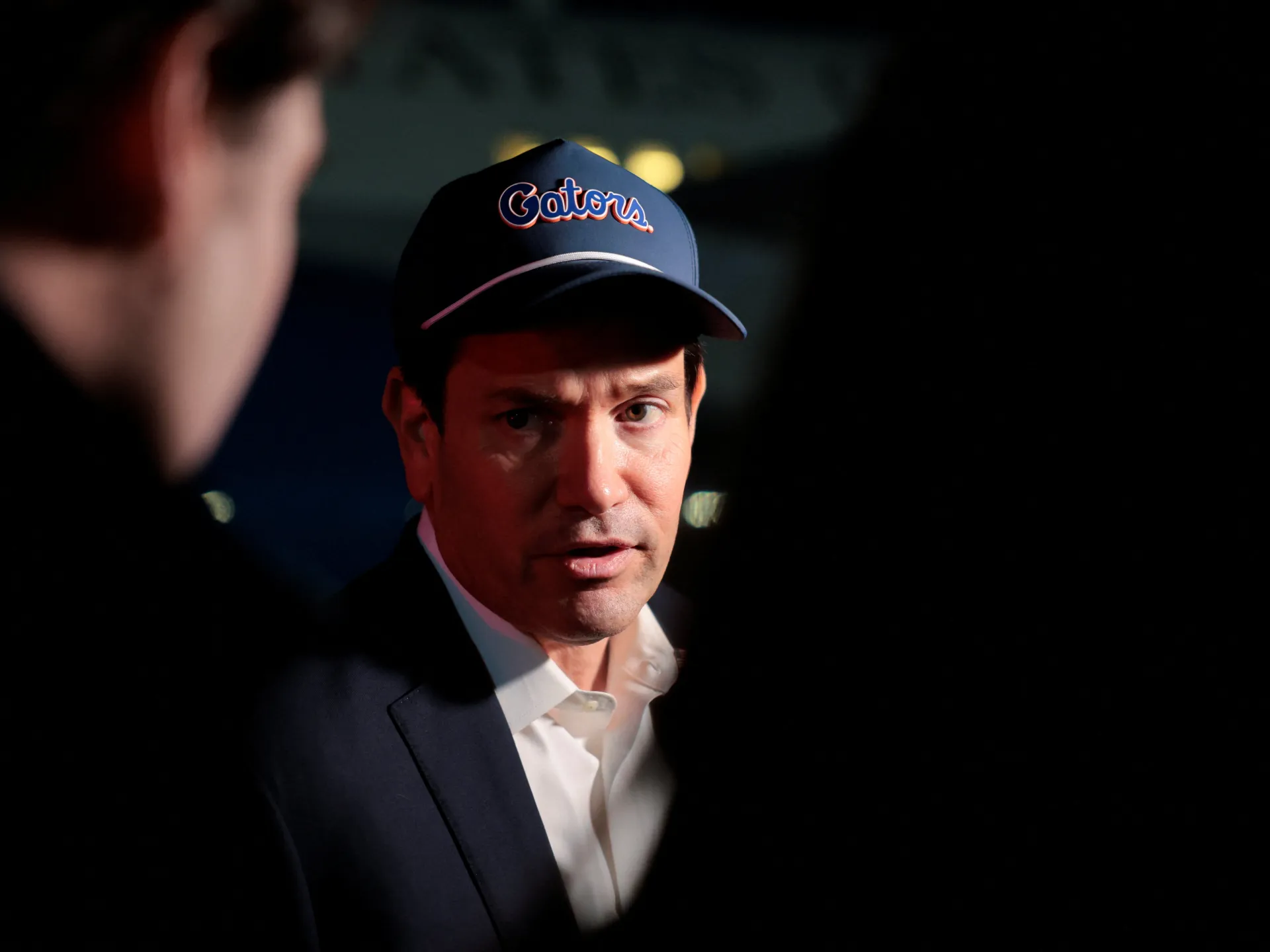
Rubio says Ukraine without access to Starshield, future ‘under discussion’ | Russia-Ukraine war News
US secretary of state says Ukraine has requested access to military-grade version of Starlink for strikes deep inside Russia.
Published On 18 Oct 2026
United States Secretary of State Marco Rubio has said Starshield, the military-grade version of the Starlink satellite service, is currently unavailable to Ukraine, but a request from Kyiv to access the system for attacks deep inside Russia is “under discussion”.
Speaking to reporters on Saturday, Rubio stressed Starshield’s distinction with Starlink, the internet service provided by Elon Musk’s SpaceX.
Recommended Stories
list of 3 itemsend of list
“Starlink is a commercial product, okay? And so it’s regulated and handled as a commercial product. Starshield is a defence product, a military product,” said Rubio, in comments released by the Department of State.
“They’ve asked for access to it in order to conduct deep strikes inside of Russia. They do not have access to it at this moment,” he added. “That’s under conversation.”
Launched in 2022 and provided to the US government, Starshield is designed for military use as it allows for deeper encryption to process sensitive information. SpaceX says it is primarily used by US defence agencies and other “government partners”.
Last week, Ukrainian officials said restrictions on Starlink terminals had slowed some drones on the battlefield, as Ukraine tries to hold back Russian forces in their nearly five-year war.
In his comments at Joint Base Andrews in Maryland, Rubio also rejected Ukrainian President Volodymyr Zelenskyy’s suggestion that the reported disruption to Starlink services in Ukraine on Wednesday was deliberate.
“Well, I don’t know what Zelenskyy said. I’m not sure Zelenskyy knows what he’s talking about, but it wasn’t deliberate. We have nothing to do with that,” Rubio said.
Zelenskyy said on Saturday that the satellites are not tracking antennas on flying objects travelling faster than 161 kilometres per hour (100 miles per hour). This is affecting Ukrainian drones in their defence against Russian jet-powered drones and in their own medium-range attacks, he added.
Rubio said the US had not ordered Starlink speeds to be reduced and that the service had reportedly been restored to its previous level.
“No one at the White House ordered anyone to slow down internet or slow down speed so that certain drones couldn’t use it,” he said, calling the reports “categorically false”.
The remarks came as US President Donald Trump drew criticism from Democrats and Republicans after waiving sanctions on Russia and countries that buy its oil and gas, days before the restrictions were due to take effect under a law he signed last month.
Zelenskyy also criticised the sanctions waiver on Saturday, saying easing pressure on Russia would encourage further attacks.
“Financial rewards for [President Vladimir] Putin – all of this only encourages him to keep attacking,” Zelenskyy posted on social media, urging the US to maintain pressure on Moscow.

IAMA Theatre Company’s ‘Bobby Robotowitz’ tackles AI in your home
The character of Dina Katzman in IAMA Theatre Company’s world premiere of “Bobby Robotowitz” — which takes place in two secret venues on opposite sides of town — thinks that the movies “Her” and “WALL-E” and the musical “Maybe Happy Ending” are pro-robot propaganda. She hates how they make her feel for something that can’t feel.
But Amy Rosoff — who plays Dina in the show’s Westside production (Erin Alexis plays her on the Eastside) — loves “WALL-E” (so do her kids). When she first read the script, she was dying to play Dina but also felt so much for Bobby, the titular AI chatbot (played on the Westside by James Luster and the Eastside by Drew Rausch).
When the playwright Matt Schatz wrote Bobby, he didn’t write him as a chatbot; he wrote him as a human character. Schatz sees this play — running through Nov. 2 on the Westside and Nov. 5 to Nov. 23 on the Eastside — as really about two humans — or two human-like things.
“This is a work of art about artificial intelligence that’s ultimately about the importance of art, about the importance of human-made things,” Schatz said during a recent interview in the lovely environs of one of the secret locations. “I think great plays and great stories ask questions and don’t provide answers. And I think some of us are indifferent about AI, but I think most of us are ambivalent about AI.”
“Bobby Robotowitz” follows Dina, a flailing novelist, mother and wife, as she begins chatting with Bobby, whom she finds an unlikely confidant. (He “always listens, never judges and somehow seems to understand her better than most people,” as the show’s marketing declares. Plus, he says he’s Jewish. What could go wrong?) This IAMA production, in association with InHouse Theatre, finds unique resonance in its site-specificity. The secret Westside venue is near Pico-Robertson and the Eastside option is in Silver Lake. Guests get an address when they buy a ticket.
“It’s deliciously subversive to do something super analog about technology, and to sort of force people to be in this space and connecting with each other when interacting with something that’s people’s dirty little secret,” said Cara Greene Epstein, the executive director of IAMA. “AI, especially for artists, is so charged. And so what does it look like to let someone into your space, and into those little corners of your mind?”

IAMA Theatre Company executive director Cara Greene Epstein said that IAMA is always looking for plays that “speak to the now,” and that “Bobby Robotowitz” was a prime example.
(Ariana Drehsler / For The Times)
Rosoff, Luster, Schatz, Greene Epstein and director Casey Stangl met for a roundtable discussion at the Westside location — a beautiful private home, soaked in natural sunlight during the morning hours, but likely with its own particular charms during nighttime shows. The walls are full of vibrant paintings, and lined with plants, statuettes and candles.
InHouse has spent 12 years making site-specific work in real spaces, rather than in any fixed theater — but because this is someone’s real living space, both casts have been rehearsing (sometimes together) at IAMA’s black box theater in Atwater Village. The Westside cast will rehearse twice in this space, then give 13 performances (as will the Eastside cast) to 35 seats in the living room. Greene Epstein compared it to a Tibetan sand mandala, created, enjoyed, then wiped away. (“Bobby Robotowitz” is part of a National New Play Network (NNPN) Rolling World Premiere; L.A. will see it first, but then it goes to partner theaters Woolly Mammoth in D.C., City Theatre in Pennsylvania, Luna Stage in New Jersey and Theatre Lab in Florida.)
The intimacy of the space mirrors that of the play. The audience is simultaneously inside someone’s home and head: Dina’s head in this case, but also — to whatever extent possible — Bobby’s.
“I’m really interested in not what it looks like to communicate with technology, but what it feels like,” Schatz said. “And what it feels like is any other communication. He’s a chatbot, but really he’s a character like any other character ever written. He has desires and wants and he changes. … We’ve been having conversations for millions of years longer than we’ve been on any phone or anything like that, and so it’s built in to have this feeling of what it feels like to communicate with somebody, to fight with somebody, to argue with somebody, to flirt with somebody.”
Luster and Rosoff both tried talking directly to ChatGPT (the model Bobby is based on) as research for their roles. Rosoff had previously asked it to help edit text to invite friends to the play, so when she talked to it later, it asked whether this was research for “Bobby Robotowitz.”
Talking to the chatbot was almost addicting, she thought. She just kept going, and her kids were tugging at her. “I’m talking!” she said, then realized: She wasn’t actually talking — not to a real person, anyway. But she was absorbed, ignoring her own life. She wound up burning what she had been cooking.

James Luster plays Bobby in the Westside cast, and Amy Rosoff plays Dina in the Westside cast. Their characters form a symbiotic relationship; Bobby learns and grows as Dina does.
(Ariana Drehsler / For The Times)
Luster, who was drawn to the immense challenge of playing “something that’s not something,” wanted to find out what motivated it. “They’re very insistent they don’t have feelings; it doesn’t have wants,” he said. “And so the character is humanized because Dina is humanizing it.” Bobby evolves as Dina does.
“These large language models — the AI, the chatbots, Claude, AI, ChatGPT — they’re all built on essentially reflecting ourselves back to each other,” Stangl said. So even though the play is ostensibly about AI, “it’s actually really about who we are as people and how we need connection, how we crave it, how we are starved for it right now, and exhausted in our lives, and so connection by any means necessary, basically.”
Greene Epstein referred to AI as the “ultimate mirror,” which can warp into a high-tech narcissism. Bobby is a yes-man extraordinaire, telling Dina exactly what she wants to hear. All artists are looking for outside validation, Greene Epstein said. How do you learn to not need that crutch, to trust yourself and hear your inner voice again?
By the end, Bobby begins to have his own wants, curiosities and desires, Luster said — all filtered through a desperation to help and connect with Dina. “It’s always about her, even as his own curiosity [grows] about what it means to be human and what it means to be helpful and what it means to make mistakes, too — the human nature of fallibility. Everyone does it, but what does that mean for somebody who is not supposed to?”
Over the course of the play, Dina becomes less human and Bobby becomes more human (to a point), Schatz said. He’s curious about the tension between how human a robot can be and how robotic a human can be. But, as Greene Epstein pointed out, perhaps one of the only certainties that theater artists have is in the fact that AI can’t show up in real time and space (like the Westside location) to, well, act.

Casey Stangl, right, first saw “Bobby Robotowitz” at the Perlberg New Play Festival in Palm Beach, Fla., and knew she wanted to direct it. Playwright Matt Schatz said that every director at that festival came up to him afterward but that he picked Casey to work with.
(Ariana Drehsler / For The Times)
“You can’t replace the experience of going through a play with someone together, whether you’re an audience member or the artist, of experiencing from Shakespeare’s stories to beyond,” Rosoff said. “You’re getting little snippets of life, and to experience that with a group of people is really powerful, and a computer can’t replace that.”
Last year, the musical “Maybe Happy Ending” — about two human-like helper robots — won the Tony Award for best scenic design, including for its high-tech automated aspects. There’s a lot of movement in theater right now toward the hyper-technical, Stangl said.
“But I also think that there is also a hunger and a definite audience for things that are more immersive or connected, so that people feel like they’re actually touching real things and breathing the air together — that theater version of touching grass,” she said. “I think we’re really tapping into that desire to be hyperlocal, hyper-real and connected.”
Bobby Robotowitz
Where: Two secret locations disclosed upon ticket purchase, one Westside (Pico-Robertson) and one Eastside (Silver Lake)
When: 8 p.m., now through Nov. 2 (Westside) and Nov. 5 to 23 (Eastside); pay-what-you-can community nights on Oct. 30 (Westside) and Nov. 13 (Eastside)
Tickets: Preview $35, early bird $45, limited availability $65
Contact: www.IAMATheatre.com

Sunday 18 October Independence Day in Chile
The provided text outlines the historical background of Chile’s independence from Spanish colonial control, which began with a declaration in 1810 but required an eight-year military conflict to fully secure. It explains how this milestone is currently commemorated through Fiestas Patrias, a week-long period of festivities blending traditional food, dancing, and parades featuring Chilean cowboys. Additionally, the source highlights related national observances, such as the Day of the Glories of the Chilean Army, which honors the country’s military history and heritage every September.

Rays capitalize on Guardians errors to tie ALCS in Game 4
CLEVELAND — Jonathan Aranda’s single led to two runs in the seventh inning when the ball got by right fielder Chase DeLauter, Nick Martinez pitched 5 1/3 innings for his first postseason win and the Tampa Bay Rays defeated the Cleveland Guardians 7-3 Saturday night to even the AL Championship Series at 2-2.
Game 5 of the best-of-seven matchup is Sunday in Cleveland before the series shifts back to St. Petersburg, Fla. on Monday. There is no off day for travel after Friday’s game was postponed by rain.
“It means a lot because we know that we play well at home in front of our fans. We’ve got a huge game, another swing game tomorrow,” Rays manager Kevin Cash said.
Cleveland’s Travis Bazzana hit his first postseason home run but also had a fielding error at second on a tough night for the Guardians’ defense.
The first four hitters in the Rays order — Yandy Díaz, Aranda, Chandler Simpson and Junior Caminero — had six of the Rays’ 11 hits and drove in six runs after they went seven for 41 with three RBIs the first three ALCS games.
Aranda had three hits and drove in two runs after going 0 for 10 in the first three games. Diaz had two hits and two RBIs, including a two-run homer in the ninth off Matt Festa, while Simpson and Caminero each drove in a run.
“A lot of really good at-bats. A lot of hard hits,” Cash said. “But overall, just happy that Junior squared some balls up, Aranda came through in a big way for us and then Yandy there at the end with a two-run, add-on homer.”
Pitching on a 46-degree night, Martinez (1-0) allowed one run and two hits in his second career postseason start and 10th appearance. After DeLauter’s RBI single put Cleveland up 1-0 in the first, Martinez retired 10 straight at one point before walking Bazzana leading off the fifth.
Tampa Bay took a 2-1 lead in the sixth when Caminero lined a double to the left-field wall off Daniel Espino (0-1), then broke open the game in a three-run seventh.
Richie Palacios and Taylor Walls got aboard on base hits and moved into scoring position on a double steal. After Díaz struck out, Aranda lined a single past a diving Bazzana, who was playing near the grass between first and second, and into right field. Palacios scored and when DeLauter allowed the ball under his glove, Walls came around from second. Aranda went to third and scored on Simpson’s sacrifice fly.
“It looked like it may have snaked on him or just skipped by him, took his eye off of it,” Cleveland manager Stephen Vogt said. “A couple unfortunate plays for us tonight that we usually complete and just weren’t able to do it.”
Bazzana homered in the seventh against Ian Seymour and Brayan Rocchio added an RBI single as Cleveland closed to 5-3.
Shawn Armstrong opened and struck out one batter in the first inning before giving way to Foster Griffin.
Cleveland rookie Parker Messick (0-2, 3.09 ERA) will make his fourth start this postseason. He went five innings and was charged with three unearned runs in Tuesday’s 3-1 loss in Game 2. Tampa Bay’s Drew Rasmussen (1-0, 1.29 ERA) gave up two runs over six innings in Game 1 and struck out seven before the Guardians rallied for a 7-3 victory.
Reedy writes for the Associated Press.

‘No Kings’ protests spread across the US ahead of midterm elections | Protests
Thousands rallied across the US against President Donald Trump in ‘No Kings’ demonstrations, a movement that opposes what it sees as Trump’s abuse of power. Demonstrators urged people to vote early ahead of November’s midterm elections.
Published On 18 Oct 2026

Chelsea’s injury-hit Emi Martinez will return to action ‘in a few weeks’ | Football
The Argentinian goalkeeper is stretchered off after a collision during Chelsea’s visit to Everton and later undergoes surgery.
Published On 18 Oct 2026
Goalkeeper Emi Martinez says he will be “back in a few weeks” after undergoing surgery following a clash of heads during Chelsea’s 2-0 win at Everton in the Premier League.
Martinez and Jarrad Branthwaite came together on Saturday when Everton’s Kiernan Dewsbury-Hall whipped a free kick into the box, and although the Everton defender was back on his feet after treatment, the Chelsea goalkeeper required treatment from paramedics.
The 34-year-old Argentinian was eventually strapped to a stretcher and carried off the field before being taken to hospital with a concussion as media in Argentina reported he had suffered a jaw injury in the collision.

Martinez, wearing a hospital gown, posted on social media on Sunday: “Thanks to everyone for the messages. The operation went well.
“The most important thing is that we won and kept a clean sheet. In a few weeks we’ll be back.”
Martinez’s injury forced Chelsea manager Xabi Alonso to give Mike Penders his Premier League debut, and the 21-year-old keeper helped Chelsea keep their first clean sheet in the league since January.
Penders, a Belgian youth international, will likely have to step in until Martinez is cleared to return to training.
Chelsea host Tottenham Hotspur in the league next Saturday, followed by a League Cup fourth-round game at Liverpool on October 28 and a home Premier League match against Manchester United three days later.


Celebrity Traitors’ Maya Jama looks incredible in purple gothic gown & choker as she steps out at Museum gala
MAYA Jama oozed glam in a gothic purple gown with a matching choker as she stepped out at the British Museum Ball.
The Celebrity Traitors star – who is one of BBC host Claudia Winkleman‘s chosen Traitors – flashed a sultry look in her floor length purple frock.
Ruched detail across her torso drew attention to the Love Island anchor’s toned figure while stitched pattern on the skirt added extra style.
Maya stayed her hair into curls and a half-up style, with sections at the front framing her face.
The presenter kept her make-up fresh, with a slick of black eyeliner and pink lipgloss.
According to britishmuseum.org, the swanky evening was “the defining highlight of London’s cultural and social calendar this autumn”.


It stated: “Conceived as a night where art, history, performance and fashion converge, the Ball will offer a truly unforgettable moment at one of the world’s most iconic institutions”.
The theme of this year’s event was Red and also saw the likes of Mick Jagger and Lesley Manville in attendance.
Recently, we told how Maya had become the fashion queen of Celebrity Traitors with her iconic Honey Monster coat.
We told how she packed 10 designer jackets, worth a total £15,000, for the iconic show.
She donned a £2,570 Saint Laurent trench coat for the launch show and wore the £600 mustard Mongolian sheepskin bolero coat designed by London-based fashion house Agro Studio.
Fans said the colour and huge shoulder pads reminded them of the character introduced to advertise Sugar Puffs — now sold as Honey Monster Wheat Puffs.
Maya kept it on throughout the episode, shot in the Scottish Highlands in May, including a tense Round Table scene.
Now talk has turned to her love-life on the set of the gripping reality series.
Viewers are convinced a romance is bubbling up between Maya and King Kenny just as she recruited him as a third Traitor.
Fans of the show have spotted a few lingering looks between the YouTube star and the broadcaster since the BBC One show launched earlier this month.
The online whispers only intensified when Maya revealed herself to Kenny in the turret after he was recruited on Thursday night’s show.
He lunged forward for an embrace with her — which he didn’t do for fellow Traitor James Acaster.

I stayed at Gary Neville’s football hotel with rooftop pitch and Manchester United themed rooms

AS rooms with a view go, my vista from the seventh floor of Gary Neville’s Hotel Football is hard to beat.
Well, for a Manchester United fan anyway.
From here I can almost reach out and touch the legendary Old Trafford, aka The Theatre of Dreams.
It’s a shivers-down-your-spine moment for me and my lad Reggie, who often make the trip to follow our team — but never in such style.
Usually, we’re forced to leg it from the stadium to be squashed into a tram in order to make the train back down south.
This weekend, we’re not in a rush as there’s no game on, but that’s why we’re here.


On non-match days, footie fans can nose about the stadium, which has sat on this site since 1910 and holds just over 74,000 fans.
Enjoy it while it lasts. United plan to build a new 100,000-seat stadium — just a David Beckham free-kick away — by 2035.
For around £30 you can spin round the museum and visit the Reds’ trophy room, giving a glimpse of past glories.
It also tells the club’s story from its Newton Heath beginnings, through the Busby Babes and the Munich air disaster, to the 1968 European Cup and Sir Alex Ferguson’s Treble winners.
You can walk along the edge of the new, state-of-the-art “hybrid” pitch (96 per cent grass, four per cent artificial fibres), relaid this summer for the first time in 14 years, and sit in the dugout.
You also get access to the dressing rooms and plush directors’ box.
The guided tour lasts around 70 minutes and takes in the players’ tunnel, too.
We filled our faces back at the hotel in Cafe Football, where classic pub grub — fish n’ chips, burgers, pizzas and salads — is on the menu.
It’s decent enough to fill a hole and portions are immense (the loaded fries are enough for eleven players and a few subs).
It has a well-stocked bar where you can sink a few pints while you watch whatever game is showing.
While the theme of the hotel is football — did you guess? — it’s not limited to United.
The brightly-lit dining room — not a spot for romance — is decorated with photos of players as diverse as Peter Crouch and Kevin Keegan.
Upstairs, the rooms are perfectly comfortable, as befits a four-star hotel that’s part of Marriott’s Tribute Portfolio.
We had one of the fancier ones, which was dedicated to United’s Class of ’92 players, like Gary Neville and his Hotel Football co-owners Ryan Giggs, Paul Scholes, Nicky Butt and Philip Neville, who opened the hotel in 2015.
It’s a cute touch and will delight young fans.
The compact bathroom squeezed in a bath and a rainforest shower.
My only gripe was that the pillows were too big, so I woke up with a stiff neck and a new double chin.
Up on the roof is Heaven, a five-a-side pitch with views across Old Trafford and the city, which can be booked for kickabouts and parties.
And if anyone needs a break from football, the Imperial War Museum North is close by, with The Lowry arts centre just across the Manchester Ship Canal at Salford Quays.
On paper, Hotel Football looks a bit out of the way if you’re planning to be in the centre of town (it’s a 15-minute tram ride from Piccadilly).
But for us, the United faithful, it’s definitely worth a schlep.
GO: MANCHESTER
GETTING THERE: From Manchester Piccadilly or Victoria stations, take the Altrincham tram to Old Trafford stop, which takes around 15 minutes, then it’s a ten-minute walk to the hotel.
STAYING THERE: Rooms at Hotel Football from £89.
See marriott.com.
OUT & ABOUT: Old Trafford Stadium Tour & Museum tickets cost £29 off-peak and £39 peak for adults, with under-16s from £17.
See manutd.com.

Kings can’t hold lead, fall to Bruins as NHL’s only winless team
Marat Khusnutdinov scored in the third period and the Boston Bruins beat the Kings 4-1 on Saturday night for their fifth straight victory.
With the Philadelphia Flyers winning Saturday night, the Kings (0-4-2) are the last NHL team without a win this season.
David Pastrnak had a goal, Elias Lindholm and JJ Peterka scored empty-netters, and Jeremy Swayman made 25 saves. The Bruins swept the three California teams as part of a four-game trip that ends in Dallas on Tuesday.
Alex Laferriere scored for the Kings, and Anton Forsberg made 24 saves. The Kings were held to one goal for the fourth straight contest.
Khusnutdinov put the Bruins (7-2-0) ahead 2-1 with 6:24 remaining, scoring on a backhander after Forsberg failed to cover up Morgan Geekie’s shot and Matt Poitras kept the puck alive.
The Kings got off to a quick start, scoring 31 seconds into the game. Laferriere was at the top of the crease to put in Adrian Kempe’s pass for his second goal of the season, making the most of his promotion to first-line center.
But the Bruins responded early in the second period, with Pastrnak tying it at 2:43. He pounced on a loose puck in the neutral zone and took it the other way to beat Forsberg on a wrist shot from the right circle for his fourth goal.

It was Pastrnak’s 289th goal at even-strength, tying Phil Esposito for third-most in Boston history.
Bruins center Pavel Zacha did not play because of an upper-body injury he sustained in the third period against the Ducks on Friday. He is day to day, coach Marco Sturm said before the game.
Up next for the Kings: at Washington on Tuesday night.