



Azerbaijan Grand Prix: Lando Norris says Franco Colapinto should be banned for causing Baku accident
World champion Lando Norris has called for Alpine’s Franco Colapinto to be banned for causing an accident at a restart at the Azerbaijan Grand Prix.
Norris was taken out in a chain reaction when the Argentine locked up his brakes and slid into team-mate Pierre Gasly, who then hit Norris. All three cars retired as a result of the incident.
Norris told BBC Radio 5 Live: “Give him a ban. It’s quite simple.”
Colapinto said: “I can be sorry to everyone. It’s been a big mistake, of course. I just locked up and then I was very out of control.”
Briton Norris said he believed governing body the FIA should take such incidents more seriously because of the impact it has on other drivers who are blameless, and the cost in terms of damaged parts.
“The FIA should be more strict and start handing out bans for this kind of stuff,” Norris said.
“It’s careless from people. It costs a lot of money. All my parts are in the bin now, so people should just get banned for this kind of driving. (They) don’t deserve to be in Formula 1.
“If you cause a crash on a restart like this, yeah, you should have at least a one-race ban.”
Egypt to rest Salah in South Sudan AFCON qualifier over pitch concerns | Football
Egyptian FA has decided to rest Salah to protect him from playing on artificial turf, which has a higher risk of injuries.

Published On 26 Sep 2026
Mohamed Salah will not travel with Egypt’s squad to South Sudan for their second Africa Cup of Nations qualifier because the match will be played on artificial turf, the Egyptian Football Association said on Saturday.
Record seven-time AFCON champions Egypt were held to a goalless draw by Angola at Cairo International Stadium on Friday in their opening qualifier.
Recommended Stories
list of 3 itemsend of list
Two-time African Footballer of the Year, Salah, who joined Turkiye’s Trabzonspor from Liverpool last month, started against Angola but did not complete the match after coach Hossam Hassan substituted him midway through the second half.
“The Egypt national team’s technical staff, led by Hossam Hassan, has decided to rest Mohamed Salah for the match against South Sudan scheduled for September 29 because of the playing surface,” the EFA said on social media.
“It was agreed between the national team’s technical staff and Mohamed Salah before the Angola match that he would not play against South Sudan, and the technical staff preferred this approach in order to protect the player,” the EFA added.
Salah has scored 68 goals for Egypt and is just one short of matching coach and ex-player Hassan’s all-time record of 69 for The Pharaohs.
Tuesday’s match between South Sudan and Egypt will be played at Juba Stadium, which has an artificial turf pitch. Such surfaces pose a higher risk of injuries than those with natural grass.
Egypt are in Group B of the AFCON 2027 qualifiers, alongside Angola, South Sudan and Malawi. The 2027 AFCON will be co-hosted by Kenya, Uganda and Tanzania, featuring 24 teams.
Though Egypt are the most successful African side, they haven’t won the championship since 2010.

Manchester City face ‘drastic’ sanctions, says club’s former chairman | Football
Manchester City are understood to be ready to appeal any guilty verdict, but could face ‘severe penalty’ says ex-chair.
Published On 26 Sep 2026
Former Manchester City chairman David Bernstein said the club could face potentially “drastic” sanctions after reportedly being found guilty on all but one of 115 charges for breaching Premier League financial rules.
The Premier League has not made an official announcement over the case and there is no indication of any possible punishment.
Recommended Stories
list of 4 itemsend of list
Abu Dhabi-backed City have always strenuously denied the charges and a club spokesperson said the position had not changed.
It is understood City will appeal should the charges be upheld.
“The club has diligently respected due process for eight years on the basis that the Premier League board and executive would behave as an independent, impartial and fair-minded regulator, free from partisan influence,” the spokesperson said.
City were charged by the Premier League in 2023 following an investigation into alleged breaches of rules between 2009 and 2018.
The club were accused of failing to provide accurate financial information and details of payments to players and coaches, as well as breaches of financial sustainability rules.
They were also charged with failing to cooperate with an investigation.
A hearing by an independent commission started in September 2024.
Man City face ‘severe penalty’
Bernstein, who was City chairman between 1998 and 2003, told Times Radio that “money is not sufficient” in terms of a potential punishment, urging a swift appeal process.
“The appeal process cannot go on for year after year, I think that would be a disaster,” he said, “not just for this particular case but for English football generally. The timing is crucial.
“I can’t give a view on the punishment. If they are found, after the appeal, guilty of [the] charges, my beloved club is going to face a very severe penalty.
“All I would say is that money is not sufficient, it would have to be something, unfortunately, more drastic than that.”
Oasis star and City fan Noel Gallagher described his “shock” at the developments.
Speaking on the Let Me Talk podcast, he said: “Surprised because only that the club have assured us all along that they vehemently denied any of these charges.
“So it was a bit of a shock to find out that we’ve been found guilty of all but one. But really overall just quite sad really. Sad for the fans and for the players.”
UK culture secretary Lisa Nandy described the case as “unsettling” for football fans and called for a swift resolution.
In 2020, UEFA imposed a two-year European ban on City as well as a fine for breaking financial fair-play rules, though that ban was later overturned by the Court of Arbitration for Sport.
If the reported guilty verdicts are confirmed, sanctions could include a severe points deduction and possibly even expulsion from the Premier League.
Everton and Nottingham Forest were both hit by points deductions in the 2023/24 season for single breaches of profit and sustainability rules.
Other Premier League clubs are understood to be taking legal advice about compensation relating to the charges.
Under the ownership of Sheikh Mansour, whose Abu Dhabi United Group acquired the club in 2008, City have become the dominant force in English football.
They have won eight Premier League titles, a Champions League crown and multiple other trophies over the past 15 years.
The latest developments in the case come just months after former City manager Pep Guardiola left the club following a golden decade in charge at the Etihad.
Guardiola always backed the club’s stance on the charges but threatened to walk away if he felt he had been lied to and they were proven to be true.

Iconic SoCal bookstores Vroman’s and Book Soup have a new owner
Stalwart bookstores Vroman’s in Pasadena and Book Soup in West Hollywood announced new ownership on Thursday, after a two-year search for a buyer.
Longtime owner Joel Sheldon, whose family has helmed Vroman’s for more than a century, announced his retirement in 2024. At the time, Sheldon said he was looking for “someone who shares our core values and who is committed to preserving Vroman’s as a community treasure.”
Sheldon said he found that in the new owner, Robert Hoffman, who has worked on tech regulation and other public policy in Washington, D.C., for several decades, but who grew up in Southern California with his family living in the area for generations.
“After talking with Robert and his family, I knew we had found the right stewards. They understand what makes this store special, and they’re committed to preserving that legacy while moving Vroman’s forward for our customers and the Pasadena community,” Sheldon said in a statement posted Thursday to the bookstore’s website.
Hoffman was born in Pasadena and has been visiting Vroman’s since his mother brought him in when he was 5 years old, according to the Thursday announcement.
His mother, in turn, had been introduced to the store by her grandmother, Georgia Bullock, a decades-long Pasadena resident and the first woman to serve as a municipal and superior court judge in California.
Hoffman was born in Pasadena and attended UCLA. He currently heads government relations and regulatory affairs at semiconductor company Advanced Micro Devices, according to his LinkedIn page.
Book Soup, a Sunset Boulevard landmark, was founded in 1975 by Glenn Goldman, a UCLA graduate student who raised investments with his friends to establish the store. Goldman died in 2009 at age 58, and Sheldon acquired the store from Goldman’s estate that year.
A post to Book Soup’s Instagram page said Hoffman and his family are “genuinely invested in this community.”
“Same shelves, same staff, same WeHo icon. Same gratitude for you,” the bookstore said in the social media post.
Vroman’s was founded in 1894 by Adam Clark Vroman, an ex-railroad worker from Illinois who moved to California hoping the sunny weather would improve his wife’s health. His wife eventually died of tuberculosis, and a brokenhearted Vroman, a bibliophile, sold off a chunk of his vast book collection to collect capital to open the store. The Sheldon family stewarded the store after Vroman’s death in 1916.
Vroman’s catered to various clientele and communities, from traveling dignitaries to academics and leisure readers on vacation. When the federal government incarcerated Japanese Americans from the San Gabriel Valley and elsewhere in the 1940s, an activist lugged books from Vroman’s to the Manzanar camp in the Owens Valley. Science fiction author Octavia Butler, who grew up in the area, frequented the bookstore.
Vroman’s second location in Hastings Ranch was forced to close in 2024 after the company was unable to reach a new lease agreement with the property owner. The store was otherwise sustainable, but was forced to close “due to increasing occupancy expenses,” the company wrote in a social media post at the time.
Vroman’s flagship location on Colorado Boulevard remains open. However, the property itself changed hands, with Sheldon selling it to GD Realty Group for $15.5 million amid uncertainty about its future.
The bookstore has a long-term lease with the real estate group, whose chief executive, Arash Danialifar, said in a statement last year to news outlet Pasadena Now that the bookstore was a “staple of the community” and that he hoped it would remain there “for the foreseeable future.”

Top UK holiday parks for mega Halloween activities this October half term from just £2.75pp a night

QUIET beaches, cosy hot chocolates in the caravan, loads of rainy day activities for the kids: October half term is the perfect time for a family getaway.
Especially when you can head off on holiday for as little as £2.75pp a night.
Rather than just offering a cheap bed for the week, these holiday parks are running action-packed Halloween activity schedules, with everything from monster talent shows to good-old pumpkin carving.
Plus we’ve purposely picked out spots with plenty more to do off-site, such as a scare fest takeovers at a seaside theme park and a Halloween steam train ride where kids go free.
Better yet, all of these affordable deals are for holidays within the October half term. Many of them begin from Friday night, meaning you collect the kids straight from school and head straight into half term fun.
From the misty Moray coast in Scotland to seaside Halloween fun in Skegness, here’s our favourite UK holiday parks to visit this October half term – from as little as £2.75pp per night.
Butlin’s October Half Term stays
If you visit to Butlin’s this October half term, expect to find everything fully decked out for Halloween.
The fairground will become the ‘Scareground‘, where monsters lurk in thick fog and you can experience the rides at night in glowing neon green.
The classic ‘Night at Reds’ show held by the Butlin’s redcoats has been given a monster makeover, with Halloween-themed games, sing-a-longs and an ‘Eerily Silent Disco’.
Throw in a mega Halloween Welcome Party, character photo shoots, themed pottery painting and pumpkin-carving sessions, and you’ve got yourself a thoroughly spooky break.
Plus, new for 2026, you’ll find the Skyline Gang Monster Mash – a talent show starring the classic characters with a different winner each night.
We found a four night break at Butlin’s Minehead in a standard family room sleeping four for £44, which works out to £2.75pp per night.
Parkdean Heacham Beach, Norfolk
Head to West Norfolk’s Heacham Beach holiday park for an autumn seaside break packed with plenty of spookiness.
Free themed activities include nighttime guided ghost walks around the park, and ‘Professor Slime’, where kids step into the slime lab to create their own concoctions.
In the evenings, settle down for the Quiz Nation Halloween Special where you can put your knowledge to the test against other holiday parks across the UK.
Or, if you come alive with energy at nighttime, stomp your way over to the Zombie Rave, where you can dance the night away.
If you fancy getting out and about, Church Farm Pumpkins sits on the edge of the village and is the perfect pumpkin patch for pictures and picking your own.
We found a three night stay from October 23 in a Bronze caravan sleeping six for £229, working out to £12.72pp per night.
Parkdean are running Halloween activities across 59 holiday parks between October 2 – November 1, with a more extensive activity program during the half term break.
If you’re looking to stay at another Parkdean resort, the following holiday parks won’t have the Halloween activities: Church Point, Fallbarrow, Gatebeck, Limefitt, and Todber Valley.
Haven Skegness
Whether you want to visit a seaside theme park for a creepy scare fest, or go ghost-hunting along the coast, Haven Skegness is ideal for a family Halloween break.
Haven are running loads of Halloween activities this year across their parks, including crafty activities like Halloween Make a Bear and build your own Halloween basket.
Even the food and drink will receive a Halloween twist, as grown-ups can grab a Ghoula Colada or Cursed Lagoon cocktail.
Make sure to step off-site to visit Fear Island, theme park Fantasy Island‘s scare fest where you can dip in and out of immersive zones like creepy cabins inhabited by clowns.
Fear Island takes place on the following dates: 17-18, 21-25 and 28 Oct October, as well as November 1. If you book ahead online you can save 10%.
We found a deal for a three night stay at Haven Skegness from October 23 in a Saver caravan sleeping four for £205, working out to £12.81pp per night.
Parkdean Node’s Point, Isle of Wight
This Isle of Wight holiday park isn’t just for visiting in the summer, it makes for a fantastic October break, too.
At Havenstreet Station, you can board the Isle of Wight Steam Railway for its magical ‘Witches, Wands and Whistles‘ event (17 – 31 October) where kids go free on a themed train ride (adults £26).
Or for a free afternoon out, go on a ghost hunt around the ancient stone walls of Carisbrooke Castle.
On-site, Milkshake Mornings will take a Halloween twist, with a spooky story time as well as themed arts and crafts.
Older kids can make Halloween tie-dye t-shirts, or take part in The Wizard Academy show.
We found a three night break in a Gold caravan sleeping eight for £259, working out to £10.79pp per night.
Haven Quay West, South Wales
Take a trip to Haunted Haven in pretty South Wales this October with a stay at Haven Quay West.
The holiday park is putting on an ‘Eerie Entertainment’ series, with a fancy dress parade featuring giant pumpkins, spiders and ghosts, as well as a Halloween edition of the Seaside Squad show.
During the day kids can get creative with sand art, pumpkin carving and even a Halloween nature trail, where you’ll get up close to creepy crawlies.
This park is also in an ideal setting for breezy autumn walks, with a woodland trail that leads you directly down to the beach, where you may even spot wild dolphins.
If you time your trip for Halloween night, you can stroll down to the harbour for a huge, free fireworks display which lights up the sky over the waters of Cardigan Bay.
We found a four night break in a Saver caravan sleeping four for £265, working out to £16.56pp per night.
Park Holidays Silver Sands, Scotland
Take an autumn break to the misty Moray Firth coast in Scotland with a stay at Park Holidays’ Silver Sands resort.
If you don’t want to brave a brisk beach walk out in stunning Lossiemouth or Cairngorms National Park, you can stay on-site to make use of the indoor heated swimming pool.
During the October half term, there’ll be everything from ghost storytelling to costume contests and classic pumpkin carving.
During the day, kids activities start from 10am and include bead art classes, Segways and wax workshops.
In the evening, settle down to kids shows from the Krazy Krew or stay late for karaoke, cabaret and bingo.
We found a four night break in a Gold caravan sleeping six for £161, working out to £6.71pp per night.

Azerbaijan Grand Prix result: George Russell holds off Max Verstappen for Baku win
Russell appeared on course for a comfortable win as the race unfolded with few incidents of note in the opening stages.
Piastri moved up from third on the grid to second by passing Ferrari’s Charles Leclerc at the start but the Australian lacked the pace to chase Russell, who edged away into a comfortable lead.
Behind, Piastri soon found himself holding off Hadjar, who won an early battle with McLaren’s Lando Norris and then passed Leclerc to challenge the McLaren.
Meanwhile, Verstappen was making his way up from eighth place after a qualifying session in which a cascade of problems had prevented him qualifying second to Russell.
By lap seven, he was past Hadjar into third place after the Frenchman did not fight him.
The three cars circulated together in a stalemate, with no-one able to pass and the teams all waiting for the expected accident that would lead to a safety car and a cheap pit stop.
That happened on lap 30, when Williams’ Alex Albon crashed at Turn Five.
On the restart, six laps later, Verstappen passed Piastri into Turn One to move into second place.
But the race was almost immediately put back under caution after a pile-up at the first corner caused by Alpine’s Franco Colapinto, who cannoned into team-mate Pierre Gasly, who in turn clattered into Norris.
Behind them, the two Racing Bulls also came together, Arvid Lindblad tipping Liam Lawson into a spin, leading to a sarcastic response from the New Zealander on the radio.
That put Verstappen on to Russell’s tail for another restart but the Briton handled the situation coolly, accelerating early and catching the Dutchman somewhat unawares.
He was unable to shake Verstappen, who was always about 0.5secs behind but never quite close enough to try a move into Turn One, the only significant overtaking place.
There was one last chance for Verstappen on the final lap.
Valtteri Bottas crashed his Cadillac at Turn 15, and after backing off for the yellow flags, Russell lost his turbo which in turn cost him electrical boost.
Verstappen closed in on the run to the line and there was just 0.196secs between them as they crossed the line, the closest green-flag finish to a grand prix since the 2002 United States Grand Prix.
Russell has now finished on the podium in three of the four races since the summer break and asked what has changed for him since then, he said: “I think it’s just having more experience with this new driving style I’ve adopted and every race since the break I feel like I’ve gone from strength to strength. I feel more like myself again.”

The media battle behind Brazil’s election | TV Shows
As Brazilians head into national elections, there’s a familiar name on the ballot: Bolsonaro. Not former President Jair Bolsonaro. It’s his son Flavio, who is presenting himself to the electorate as a more moderate version of his father.
Election coverage has been dominated by a major corruption scandal – the biggest banking fraud case in the country’s history. Brazilians are accustomed to corruption scandals involving political figures. The coverage tends to be framed as: they’re all equally corrupt.
Contributors:
Andrew Fishman – President & co-founder, Intercept Brasil
David Nemer – Professor, University of Virginia
Andre Pagliarini – Professor, Louisiana State University
Natalia Portinari – Reporter, O Globo
On our radar: Donald Trump’s decision to bar three news outlets from the White House appears to have backfired after journalists organised a media boycott and a judge overturned the ban. Tariq Nafi has been tracking the latest duel between the US president and the media.
Spain’s neo-Nazis: spectacle vs reality
A fringe neo-Nazi movement in Spain, Nucleo Nacional, has attracted a growing online following by packaging incendiary and slickly produced content. The mainstream media attention the group has received has made a marginal organisation appear far larger and more influential than it is. The Listening Post’s Elettra Scrivo travels to Madrid – where she comes face-to-face with Nucleo Nacional’s members – to look at the reality that lies behind the spectacle.
Featuring:
Miquel Ramos – Author, ‘Antifascistas’
Urszula Mrozowska – Digital researcher in hate speech and extremism
Published On 26 Sep 2026

The cinema, and other dates where you don’t have to talk to each other
ON A date, but prefer to keep all that getting-to-know-each-other conversation to a minimum? Choosing these will make the evening as silent as a long marriage:
Cinema
Watching a film together quietly will be excellent practice for the rest of your relationship. But since going to an arthouse flick is cooler than slumping in front of Ludwig,you’ll both be able to invest in the fiction that you like each other and are compatible before moving things along to sex.
Theatre
Like the cinema but more so, the theatre only truly exists to persuade couples they’re doing something other than facing in the same direction while not speaking. Doing this as a date? Legitimises your shared pretence you are classy so means you can skip straight to rutting like beasts, because they did in Pretty Woman.
Gig
Trickier, as you need to agree on an artist you both like. Or pick someone entirely unknown and hope the audience is cool enough to validate it. But has the appeal of conversation being impossible and you can hold hands so as to not lose each other in the crowd, and once you’re holding hands you may as well do oral later.
Comedy club
Suggests you’re fun because you like to passively enjoy other people being fun. In reality it’s likely to be either dull (weekday) or drowned out by pissed arseholes (weekend) but at least the poor bastards on stage will be the ones straining to say something interesting, rather than you. And it encourages drinking, which encourages sex.
Ice skating
Introduces very real danger into the equation. Your date will be so busy concentrating on not falling over, making a tit of themselves and breaking an ankle they’ll forget to ask if you have a good relationship with your mother or have any pets. Also they’ll clutch onto you a lot and be so grateful it’s over you’ll be banging as soon as you’re in proper shoes again.
Silent disco
Taking off the headphones is cheating, you explain, adding that it’s also expected to move around the venue and you needn’t stick together. Then groove to your heart’s content, meeting up with them at the end. Remove your headphones and say ‘So, fancy coming back to mine for full intercourse?’ It might work.

I visited the affordable Maldives resort with underwater restaurants and overwater villas
I RAISE my fork to my mouth and lock eyes with Stevie. My heart stops. He’s 6ft, super-muscly and has a cracking set of teeth.
He spends the next hour watching me eat by candlelight, and he’s there again at breakfast the next morning.
But far from being my husband or an admirer, Stevie is a blacktip reef shark simply enjoying his natural habitat at Oblu Xperience Ailafushi — a four-star resort on a tropical island in Male Atoll of the Maldives.
The country is known as the world’s most romantic honeymoon hotspot, but I was there to check out its wilder side,
Of course, this included dining at Only Blu, the largest underwater restaurant in Asia.
Sitting 22ft below sea level, it’s a way to enjoy the diverse ocean life, without getting your feet (or hair) wet.
READ MORE ON THE MALDIVES


It’s not included in Ailafushi’s all-inclusive “Fushi” plan, but it’s well worth splashing out on (prices start from £95 per person).
I was just inches away from blue powder surgeonfish, humbug damselfish and dozens of parrotfish as I tucked into my decadent five-course meal — though I did feel slightly guilty as I stuffed forkfuls of the “reef catch of the day” into my mouth. I hoped I wasn’t eating any of their brothers or sisters!
As several sharks swam by, including the one I nicknamed Stevie, “oohs” and “aahs” spread like a Mexican wave.
This kind of restaurant could be gimmicky. But the food — which included pistachio scallops, tuna poke bowls and decadent chocolate desserts — was genuinely delicious.
Just a 20-minute complimentary speedboat ride from Male airport, Ailafushi is a more affordable choice than many Maldives resorts, with all-inclusive packages starting at £160 per person per night.
But for the comparatively bargain price (most four-star resorts average at £300), you don’t miss out on the luxury.
My over-water villa was stunning — exactly what you picture when you think of a Maldivian suite, with an outdoor shower, private sundeck and stairs that drop you straight into the pale blue Indian Ocean.
Each night, I drifted off to the soothing sound of the waves beneath my floorboards. And every morning, I threw off my pyjamas and jumped directly into them.
It was the same at Ailafushi’s more upmarket five-star sister hotel, Oblu Select at Sangeli, where there’s even a window in the floor for 24-hour ocean life viewing.
But if the idea of sleeping and showering above sharks and stingrays gives you the creeps, both resorts offer beach houses and family suites far enough from the shore to put your mind at ease.
You should get out on the water, though, if your fears allow. Especially as guests can pick up a snorkel and fins to use for free throughout their stay.
I’ve never seen such amazing sea life, with reef sharks, unicorn fish, eagle rays and turtles just feet away.
Like many reefs around the world, the coral is sadly bleached. But there were so many fish displaying vivid colours, it was like being inside a Windows screensaver.
If you’d rather stay above the waves, though, there’s still plenty to see and do on dry land and boat.
Guests can book local island excursions, fishing trips and moonlight cruises.
My favourite was the sunset dolphin cruise. They might be wild animals, but they certainly put on a show, leaping in the air and gliding along the side of the boat.
At one stage, there were so many gasps and pointed fingers, it felt like I was watching a fireworks display. Guests also have access to free pedalos, kayaks and stand-up paddle boards.
And both resorts also have their own spas, ELE|NA Ayur — perfect for while your partner, kids or hungover pals are napping.
At Sangeli, where guests get a free 45-minute treatment for every four nights they stay, a stress-buster massage melted away the tension I built up during the 14-hour journey to get there from London Heathrow via Dubai.
Equally dreamy was the full-body Balinese treatment at Ailafushi, where prices start at $50.
Life is equally indulgent at the more peaceful Sangeli.
Alongside couples’ massages and intimate dinners, there’s a phenomenal free kids’ club with puppet making, cupcake decorating, palm leaf crafts and scavenger hunts.
There’s also a slide that plops you directly into the sea — fun for all ages. I howled with laughter as I sped round the tight bends before crashing into the gentle waves at the bottom.
If you’re feeling energetic — or simply want to work up an appetite for your next meal at one of each resort’s four restaurants — try the over-water gym with one of the best views in the world.
You could also attempt a sunrise yoga class, if you haven’t had too many of the hotel’s unlimited cocktails the night before.
By this point, you’ve probably seen plenty of fish from your villa, perhaps snorkelled with several and spotted them during a boat trip. So why not try catching a couple on a sunset line-fishing trip?
Whether you’re a seasoned fisherman or, like me, have never picked up a rod in your life, it’s the perfect way to spend an early evening.
And you might surprise yourself. I went in thinking I’d have no luck at all, but ten minutes before our time was up, I felt a hard tug on my line and eventually reeled in a giant remora.
I squealed with delight (and perhaps a little fear) as it flapped about in front of my face. But I quickly threw him back into the shimmering water.
Despite being a Muslim country where alcohol is all but banned, booze is freely available at all tourist resorts.
They also take international holidays incredibly seriously.
I’m told Christmas is an extravagant affair with Santa Claus arriving on a flyboard or parasail before descending to the beach with gifts.
I was there for Halloween and they did not hold back — think eyeball cupcakes, a terrifying haunted house, and dark red cocktails served in blood bags.
Four waiters dressed as zombies even carried a “body” in a coffin through the restaurant at dinner.
Yes, it costs more to get there (return flights start at £785 with Emirates) than Ibiza and your hotel will be a little more expensive, but you’ll barely spend a thing once your feet hit the white sands. And truly, it’s worth it.
Forget the White Isle — make the Maldives your next trip.
GO:
GETTING/STAYING THERE: A seven-night all-inclusive getaway to OBLU Xperience Ailafushi is from £1,831pp based on two sharing an Ocean View Room and including flights from Gatwick on November 11. See destination2.co.uk.
A seven-night stay at OBLU Select Sangeli in a Beach Villa is from £2,915pp including flights from Gatwick on November 18. See kenwoodtravel.co.uk.
MORE INFO: See coloursofoblu.com.

Marines Rushing To Equip Amphibious Combat Vehicles With New Anti-Drone Jammers
The U.S. Marine Corps is buying Anduril Pulsar-L electronic warfare jammers to meet an urgent operational need to better protect its 8×8 wheeled Amphibious Combat Vehicles (ACV) from drones. This is part of broader efforts the service is pursuing to boost the ACV’s defenses against uncrewed aerial attackers, as well as incoming anti-tank guided missiles and other threats. Drone threats are real now and have notably sidelined even the most advanced heavy armor in Ukraine.
Marine Corps Systems Command (MARCORSYSCOM) announced it had awarded a sole-source deal to Anduril, valued at $15,711,445.50, for an unspecified number of Pulsar-Ls, yesterday. This follows a statement of intent the Command put out last month. Anduril first unveiled Pulsar-L, a lightweight addition to its larger Pulsar family of electronic warfare systems, in April 2025.
The Marine Corps had 150 baseline personnel carrier variants of the ACV (or ACV-Ps), as well as 21 command-and-control ACV-C versions, in inventory as of April 2026. The default armament for ACV-P currently is just a single .50 caliber M2 machine gun in a remote weapon station on top of the hull. The service’s goal is to eventually acquire 389 ACV-Ps and 33 ACV-Cs, as well as 152 ACV-30s with new 30mm cannon-armed turrets and 34 ACV-R armored recovery vehicle variants. The ACV family has already supplanted the Marine Corps’ previous fleet of tracked Assault Amphibious Vehicles (AAV).

“The Anduril Pulsar-L system is a platform-integrated omni-directional SK C-UAS [soft-kill counter-uncrewed aerial systems] with a combined sensor/jammer package that detects, tracks, identifies, and defeats radio frequency-dependent Group 1 and Group 2 Unmanned Aerial Systems (UASs),” MARCORSYSCOM wrote in a justification for the sole-source contract, which was also released yesterday. “Additionally, the system provides counter positioning, navigation, and timing capabilities.”

Introducing: Pulsar-L
The U.S. military definition of a Group 1 drone is any design weighing up to 20 pounds, that is able to fly up to an altitude of 1,200 feet, and that can reach speeds of up to 100 knots. Group 2 is the next tier up, encompassing types with gross weights between 21 and 55 pounds, that can get up to an altitude of 3,500 feet, and hit top speeds of up to 250 knots. Kamikaze drones and other small weaponized types that fall into Groups 1 and 2 are used on a daily basis in Ukraine to attack armored vehicles, as well as unarmored vehicles and personnel. These are threats that have been steadily expanding to other hotspots globally, and that we will come back to later on.
Furthermore, “the Pulsar-L is the only solution capable of being mounted on the ACV to provide a mobile and organic means to effectively and simultaneously execute the entire kill-chain against hostile UASs in the deployed land and maritime/littoral environment while not exceeding the limited ACV space, weight, and power claim allotted to the SK C-UAS solution,” according to MARCORSYSCOM. “This will provide the ACV with an essential defensive capability, directly contributing to increased survivability and force protection while not sacrificing the mobility and operational tempo of the ACV.”

Pulsar-L is already “in use by the Special Operations Command due to the system’s low weight, proven performance in engaging multiple UASs, and simultaneous execution of the full kill-chain while static or on the move,” the justification document adds. “Additionally, it is the only known commercially available system that meets the minimum requirement to rapidly identify and respond to emerging UAS technologies and tactics without frequent updates to predefined threat data libraries. The Pulsar-L is the only solution that uses machine based learning to continually adapt to these ever-changing threats without requiring vendor updates, allowing the warfighters to continually be effective in the fight.”
The latter point here is a particularly important consideration for electronic warfare systems, in general, which need to be able to accurately detect, categorize, and respond to different waveforms to be most effective. The emergence of new waveforms, as well as changes to how existing ones are emitted, together with new tactics, techniques, and procedures, can all negatively impact a system’s performance. Historically, the process of responding to those developments with updates to built-in threat libraries has been lengthy and complex. The conflict in Ukraine has shown that the cycle of new developments in the electromagnetic spectrum and then the need for new countermeasures can be regularly measured in weeks.
The U.S. military has been heavily investing in so-called cognitive electronic warfare capabilities to help automate and otherwise accelerate various aspects of this process. The ability of a particular electronic warfare suite to adapt autonomously in real-time, even in the middle of operations, has been viewed as the absolute ‘holy grail’ of this concept, which you can read more about here. How exactly Pulsar-L leverages machine-learning and artificial intelligence to this end, and the speed with which it can adapt to changing threats, is still not entirely clear.
Regardless, “there is an unusual and compelling need for the rapid deployment of SK C-UASs to forward-deployed ground units as Marines currently lack the ability to conduct self-defense against emerging UAS threats,” the justification document stresses. “Failure to deliver this capability places Marines at unnecessary risk, potentially leading to mission failure and loss of life, and hampers the Government’s ability to keep them safe during forward deployments.”
MARCORSYSCOM’s justification for the sole-source deal to Anduril does not otherwise elaborate on the urgent requirements that drove the deal, which it says were only formalized on April 7. That is notably roughly a week after the United States and Israel first launched major combat operations against Iran, which is a prolific developer and user of various tiers of weaponized drones. There is no explicit confirmation of any link, but Iranian drones, as well as missiles and other capabilities, have been a real threat to U.S. forces in the region. We have also just gained more insights recently into how forward-deployed Marine Corps elements contributed to those operations. Counter-drone capabilities would also be especially critical in any future amphibious landing operation, wherever it might occur.

All that being said, threats posed by armed Group 1 and 2 drones are not at all limited to Iran and the Middle East, nor are they new. They are only likely to become a more ubiquitous feature in the hands of nation-state armed forces and non-state actors in conflict zones globally as time goes on. The nature of these threats is also expanding significantly in scale and scope, especially when it comes to more automated targeting capabilities, thanks heavily to the increasing democratization of AI-driven technologies, something TWZ has explored in depth in the past.
A number of other significant developments in this arena have emerged from the conflict in Ukraine, where electronic warfare systems are heavily employed against drones. This includes the introduction of physical fiber-optic control links that cannot be jammed, as well as the use of mesh-like and often ad-hoc networks to increase resiliency.
The fighting in Ukraine has also underscored the threat that even small kamikaze drones pose to armored vehicles, including types that are far more heavily protected to start with than the Marine Corps’ ACVs. As mentioned, Ukrainian forces have been sidelining their M1 Abrams and other main battle tanks in the face of constant drone attacks.
MARCORSYSCOM’s justification for the Pulsar-L order makes clear that this is just one part of a larger plan to boost the ACV’s defenses.
“Marine Corps program of record for SK C-UAS is planned to initiate in FY27,” the document mentions toward the very end. “The components of this future program will be procured through full and open competition as it is expected that advanced non-kinetic and SK defeat technologies should be mature by this time.”

Marine Corps officials have also talked in the past about integrating active protection systems (APS), which could be blended together with C-UAS capabilities, and other defensive features to the service’s ACV fleet.
“We’re constantly looking at what the next generation of APS is and how we can get that onto the [ACV] platform in a lightweight form factor,” Chris Melkonian, the Marine Corps’ Program Manager for Advanced Amphibious Assault (PM AAA), told TWZ and other attendees at the annual Modern Day Marine exposition in April.
Improved “situational awareness, that’s kind of a gateway to counter-UAS, in terms of the ability to sense your environment,” Melkonian also highlighted at that time. “Take all that video on board and then be able to feed that into [a] counter-UAS system.”
Additional “overhead protection right now is a critical thing that we’re working on right now for this platform,” he added. The practice of adding on anti-drone armor screens on armored vehicles (and now other platforms), especially to protect against top-down attacks, first emerged in Russia in the lead-up to the all-out invasion of Ukraine in 2022. However, the installation of this kind of so-called ‘cope cage’ type armor has now become a global trend, including in the U.S. military.
The U.S. Marine Corps is also pressing ahead with a larger vision to field several tiers of counter-drone capabilities at all levels of its forces, to better protect everything from static installations at home and abroad right down to individual squads.
When it comes to the Marine Corps ACV fleet, the rush order for Pulsar-Ls is an important new step in boosting those vehicles’ defenses against threats that exist now. At the same time, drones are increasingly calling the role of armored vehicles in future conflicts into question.
Contact the author: joe@twz.com

The Traitors’ Paul Gorton reveals burglars stole items worth THOUSANDS as he opens up about horror robbery
PAUL Gorton has revealed more awful details about his home being burgled, sharing how he’s lost thousands worth in personal possessions.
The star opened up about his home being robbed earlier this month and how he begged for the robbers to return what they have stolen.
Going into more detail now, Paul elaborated on how many items stolen from his home were expensive and/or irreplaceable due to sentimental value.
Speaking to the Daily Mail, Paul said that his “pride and joy” was taken, a bicycle worth roughly five grand.
Paul also shared that his wife Kate’s jewellery box had been ransacked, with her grandmother’s ring missing.
He added: “It was costume jewellery, so it was only a couple hundred pounds worth of jewellery, but it did have Kate’s grandmother’s ring in there, it’s super sentimental.


“Completely worthless but worth everything to Kate, and it’s now gone, I presume it’s just in a bin.”
The BBC One star, who featured on series two of The Traitors in 2024, took to Instagram to share the news of the burglary with his followers.
He penned: “Came home to find our house had been burgled.
“Presume we’ve been watched and the day after we posted that we were on holiday, they broke in. 29th August at 9:30pm.
“The robber or robbers cut the broadband connection (presumably to cut the ring doorbell and any CCTV) and in doing so, told us when they broke in so the police and CSI are on it.
“We’re fine. House isn’t too bad. Robbed my bike. Ransacked my office and wardrobes etc.
“Kate’s jewellery stolen including her grandma’s ring which is probably worth nothing but it was everything to her. All material stuff can be replaced.”
The reality star urged the robbers to seek help as well as to return the items they stole.
He continued: “To the robbers, get off this path you’re on. It goes nowhere and it’s never too late to turn your life around.
“You’ve committed a crime for an unsaleable bike and cheap jewellery.
“PS. If you did rob me, throw the jewellery back on our drive and the bike as both are worthless to you.”

Super League: Warrington reach Grand Final with narrow Leeds win
Watch highlights as Warrington Wolves earn a thrilling narrow Super League semi-final win over Leeds Rhinos to reach their first Grand Final for eight years.
Pictures courtesy of SuperLeague+.
Available to UK users only.
MATCH REPORT: Warrington edge past Leeds to reach Grand Final

Pressure to boycott Israel game grows as Ireland preparations stall | Football News
Ireland are due to play Israel in the Nations League in Hungary on Sunday, but boycott pressure mounts on and off-field.
Published On 26 Sep 2026
The Ireland team’s news conference and training session the day before its first Nations League game against Israel have been delayed as pressure to boycott the matches grows.
Journalists in Debrecen, Hungary – where Israel’s “home” game is to be played Sunday – were left waiting Saturday after being told the news conference was being pushed back until after training. That was 15 minutes before it was supposed to begin.
Training was also significantly delayed, however, with Irish broadcaster RTE reporting the players were still in their hotel more than two hours after the training session was supposed to begin.
RTE reported that some players had decided they did not want to play the games.
“And if they stay to their stated ambition that they have to be all in it together, if one or more want to be out, maybe they will all be out,” reporter Tony O’Donoghue told RTE Radio 1.
The team has been coming under increasing pressure in Ireland, where affinity with Palestinians is strong, to boycott the two games – the first on Sunday and the second, Ireland’s “home” game, in Backa Topola, Serbia, on October 4.
Ireland midfielder Jason Knight said after Thursday’s 1-0 loss in Kosovo that the players were in a difficult situation and that he didn’t think the matches should be going ahead.
Ireland coach Heimir Hallgrimsson previously said “we’re not playing with genocide, we’re playing against genocide. We’re playing against Israel, we’re not playing with Israel” – drawing a furious reaction from the Israeli football federation, which accused the Icelandic coach of “stupidity, ignorance and hypocrisy”.
The Football Association of Ireland (FAI) had resisted calls to boycott the matches, arguing the team could be hit by punishing sanctions by UEFA. Ireland is cohosting the 2028 European Championship with England, Wales and Scotland.
More than 160 Irish sportspeople signed an open letter urging the FAI to reconsider its decision to go ahead with the fixtures.
There were protesters outside the team hotel in Dublin last week calling on the players to boycott the games. The SIPTU trade union displayed a huge poster in central Dublin beside the River Liffey asking the players to “Go with your conscience!” and “Don’t play with genocide” beside an image of a blood-splattered ball.
Former Ireland coach Brian Kerr said the FAI had “lost the respect of the Irish people” for going ahead with the games.
“The Irish people and the soccer-going public don’t want the games to be played,” Kerr said. “I think they’ve made their opinions clear over the last year. The FAI back in November actually went to UEFA and requested that Israel be put out of the tournament on principle. And yet they went against that principle.”
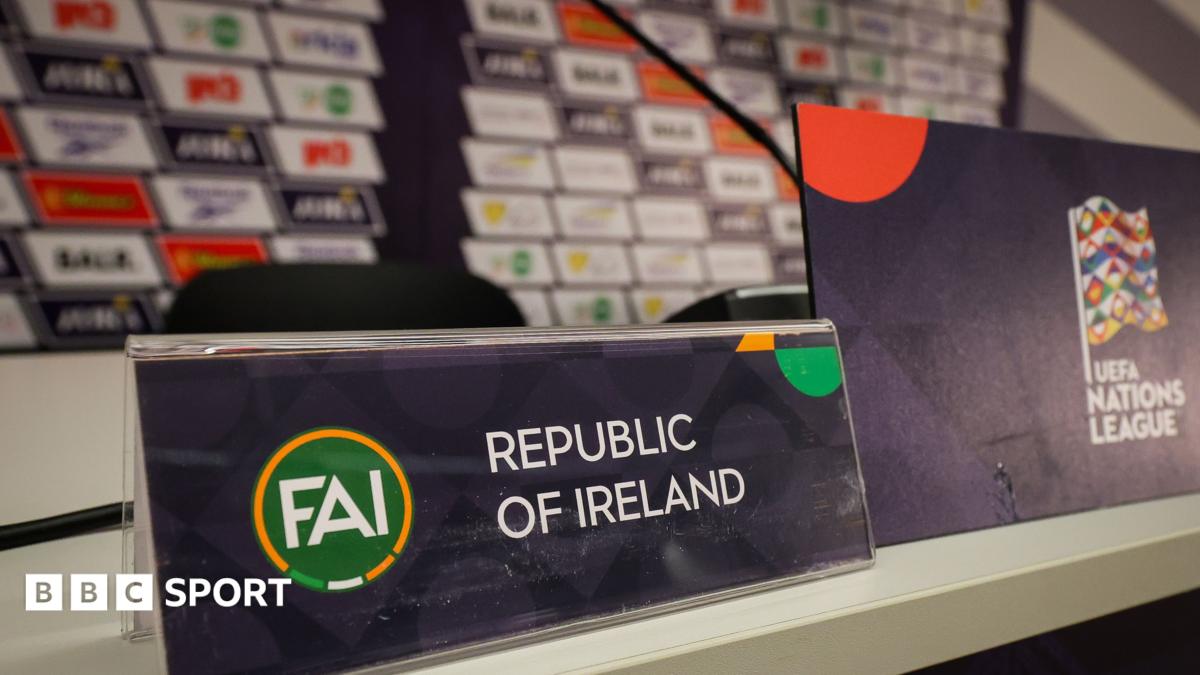
Israel v Republic of Ireland: Republic of Ireland news conference delayed before Israel game
The Republic of Ireland have delayed the pre-match news conference planned for Sunday’s Uefa Nations League game against Israel in Hungary – a fixture campaigners have called on them to boycott.
Heimir Hallgrimsson’s team are scheduled to meet Israel in Debrecen at 19:45 BST, with the return fixture in Backa Topola, Serbia on 4 October.
They have faced calls to withdraw from the games because of the ongoing Israel-Gaza war with a “Stop The Game” campaign – organised by the pressure group Irish Sport for Palestine – gathering pace.
Former Republic of Ireland manager Brian Kerr and ex-international James McClean are among those to have backed calls for a boycott.
However, there are also Irish supporters, perhaps less vocal, who have always believed that the match should be played with supporters in attendance.
Following Thursday’s 1-0 defeat by Kosovo, midfielder Jason Knight opined he didn’t think “the game should be going ahead”, while winger Chiedozie Ogbene urged the public to not “put the pressure on us” regarding their approach to the scheduled game.
Hallgrimsson and a player were scheduled to meet the media at 09:15 BST (10.15 local time), before training, but the conference was delayed shortly beforehand.
A Uefa official entered the room to inform waiting media teams that the press conference was postponed until after training, which would have been about 11:30 BST (12.30 local time).
But shortly afterwards, the Uefa official returned to the media room to announce that the Republic of Ireland’s training session had also been postponed, with no time given for when it might take place. There is also no confirmed time for the news conference.

Funko warned it might not last 12 months. Its new CEO came from Netflix with a plan.
For many celebrities, getting a Funko Pop! doll modeled after themselves is a sign they’ve made it in Hollywood. The 4-inch vinyl “Pop!” figurines, with their oversize heads and black dot eyes, symbolize being ingrained in pop culture — objects fans buy, celebrate and display.
At Funko’s flagship Hollywood store, there are thousands to choose from, ranging from NFL players to Disney princesses and characters from the Netflix period drama “Bridgerton.”
But the publicly traded company behind the popular dolls has been facing significant headwinds.
Funko Inc. last year posted a loss of $67.4 million on sales of $908.2 million, down 13% from the previous year. The company disclosed it had debts of $225 million.
The Everett, Wash.-based company warned investors in filings that there was “substantial doubt” about its ability to generate enough cash to meet its debt payments, citing the effects of tariffs in China, where most of its toys were made, canceled retail orders and loan covenants it expected to breach.

Funko Chief Executive Josh Simon, pictured at the Pokémon convention, says he took over the company at an “inflection point.”
(Carolyn Fong / For The Times)
Now the company is looking to stage a comeback.
Leading the turnaround challenge is Josh Simon, who left his job running global consumer products at Netflix to become Funko’s chief executive in September 2025 — the third person to hold the title in two years.
“Funko was at an interesting inflection point,” said 48-year-old Simon, who lives in Los Feliz. “I felt there was still a lot of really deep fandom and enthusiasm from retailers and at the same time, there were a lot of problems that had to be sorted out at the company. I thought it would be an interesting adventure and hopefully a way to help turn things around a bit and restore it back to that level of fan passion and glory that existed years ago.”
The rise and fall of Funko
Funko began in 1998 when entrepreneur Mike Becker decided bobbleheads would be the next big thing and shipped them out of his garage. After entrepreneur Brian Mariotti bought Funko in 2005, the business began licensing more characters. Sales took off with the launch of its big-headed “Pop!” figurines in 2010.
The company changed ownership over the years, added backpacks and other products, and went public in 2017. Most of its revenue still comes from making licensed characters and selling them through retailers, online and at events.

Funko survived a decline in sales with the rise of kidults — adults who collect toys.
(Carolyn Fong / For The Times)
But Funko’s sales plunged in 2025 following a global trade war.
The company overestimated demand, picked the wrong characters and made too many of dolls, said Gerrick Johnson, senior research analyst at Seaport Research Partners, which has a buy rating on Funko.
President Trump’s heavy tariffs imposed on China substantially raised the costs of making Funko dolls.
Amid lagging sales, retailers marked down the figurines, alienating collectors who want to see items appreciate in value.
“Collectors hate buying things 50% off,” Johnson said. “One of the biggest turnoffs in collectibles is a bargain bin.”
What kept the brand alive through the slump was the rise of kidults — adults who collect toys. Simon was one, picking up Pop! figurines from “Toy Story” and “Back to the Future” long before he worked there. Funko’s job, he said, is to distill what people love about a character into a stylized version of it.
“The number of inbound requests we get from musicians and athletes and celebrities — everyone is excited and pitching us they want a Funko Pop! made of themselves, because in some ways it suggests a mark of establishment in pop culture,” Simon said. “It’s like akin to getting your star on the Hollywood Walk of Fame in some way.”

Convention-goers create custom dolls at a Funko Pop! kiosk.
(Carolyn Fong / For The Times)

One expert said Funko’s job is to distill what people love about a character into a stylized version of it.
(Carolyn Fong / For The Times)
A turnaround plan
Though based in Washington, Funko has a large presence in L.A., where most of its senior leadership is based. They work out of the same offices as the flagship Hollywood store. The company also has employees in Arizona, London, Hong Kong and other markets.
Under Simon, Funko has diversified its supply chain, shifting production out of China to Vietnam and other countries. To improve cash flow, Funko renegotiated the timing of its debt payments and pushed products to market faster.
For example, Funko turned around figurines of the characters from “KPop Demon Hunters” — the Netflix film that became the streamer’s most-watched movie ever after its June 2025 release — in about four months, well ahead of Mattel, whose first items reached stores this spring.
When John Cena stepped into the ring for his final WWE match in December, there were pre-orders for a Funko figure wearing the same outfit down to the shirt reading, “The Last Time is Now,” built from an image Funko received a week earlier. The doll became a bestseller, said Scott Zanghellini, executive vice president of WWE Consumer Products.
“It’s happening in real time and his team being able to move quickly, and us always moving quickly in this world of we have seven hours of programming a week — how do you take advantage of that and give the fans what they want?” Zanghellini said.
Funko is also widening what counts as a license, making figures from “The Folk of the Air,” Holly Black’s fantasy series revived by book lovers on TikTok, as well as creating more original characters that aren’t licensed.
“We really want to make sure that we can be a part of these cultural moments while they’re happening,” Simon said.
Reaching out to fans is another priority. At PokémonXP, the first official Pokémon fan convention held last month at San Francisco’s Moscone Center, Funko ran a Pop! Yourself booth where attendees built custom figures in exclusive Trainer uniforms with a Pokémon of their choice.

“We really want to make sure that we can be a part of these cultural moments while they’re happening,” Funko’s chief executive said.
(Carolyn Fong / For The Times)
Jeff Leu, 40, of San Francisco spent about $100 there on two figures modeled after his kids. He already owns 40 to 50 “The Simpsons” Pop! figures and tracks his collection in a spreadsheet.
“I feel like there is a Funko for everything,” Leu said.
Now he feels the pull of the Pokémon ones.
“As they add more, there’s more pressure to buy it because I like to collect things,” Leu said. “Luckily I have a lot of room to display my toys.”
So far, the turnaround plan has yielded some positive signs.
Second-quarter sales rose 7% to $207.7 million and the company reported net income of $15.4 million, against a $40.5-million loss a year earlier. The quarter, however, included a $25.4-million benefit from expected tariff refunds, without which Funko would have lost money.
Funko’s share price closed Friday around $5.50, up about 1%. The stock has climbed 38% in the last year but is 60% below what it trade at in January 2025.
“It’s way too early to make any sort of calls on Josh at this point, but I like what he’s doing,” Johnson said. “It’s an interesting point in Funko’s history, and it’s a great opportunity for him to grow this business.”

How Rómulo Betancourt Allied with the US Without Surrendering Sovereignty
John F. Kennedy receives Betancourt in the Oval Office on February 19, 1963. White House photograph by Abbie Rowe, JFK Presidential Library and Museum.
In 1898, the United States entered Cuba promising to liberate a nation; the subsequent occupation and the Platt Amendment ultimately granted it the right to intervene in the country’s affairs. A century before chavismo, Juan Vicente Gómez found a different formula: domestic order, foreign capital, and oil, all while leaving the citizenry out of the equation. Rafael Osío Cabrices and Marcus Golding have revisited both precedents to reflect on the Venezuela that would emerge after January 3. These two mirrors are uncomfortable, yet they are not the only ones; a third exists—also born of the relationship between Venezuela and the US—though it is based on a different idea of how to build stability.
During the 1950s, Venezuelan social democrat leader Rómulo Betancourt wrote from exile to convince Washington that its policy toward Latin America was based on a flawed premise. While military dictatorships might declare themselves anti-communist and guarantee a certain level of stability, repression, inequality, and a lack of civic participation paved the way for the very radicalization the US wished to contain. A democracy capable of enacting social reforms could serve as a more reliable ally.
This wasn’t Betancourt’s idea alone. Within the US government, there were already officials who viewed reformist forces as a more effective bulwark against communism. Betancourt’s own contribution lay elsewhere: articulating this argument from within Latin America and attempting to prove its validity while in power. Research by Steven Schwartzberg shows that this approach had begun even before the long exile triggered by the 1948 coup.
Upon returning to Venezuela after January 23, 1958, Betancourt did not ask the White House to build Venezuelan democracy. The major political parties agreed on rules for coexistence and the country held elections, which he won. His government undertook agrarian, educational, and social reforms starting in 1959, all while facing military conspiracies, guerrilla violence, and hostility from neighboring dictatorships. There were abuses, restrictions on civil liberties, and incomplete results. It was not a conflict-free democracy, but a democracy struggling to survive.
Both voting and finding a way out of the economic crisis remain priorities that oil alone cannot resolve.
That experience bolstered Betancourt’s argument before Washington. A State Department report from the time described Venezuela as a hemispheric leader in promoting social reform and economic development within a constitutional framework. This foreign alliance rested on a domestic political foundation: it did not rely solely on oil or on a shared stance against a common enemy.
The Cuban Revolution had made this discussion more urgent since January 1959. Upon arriving at the White House in 1961, John F. Kennedy understood that anti-communism alone was insufficient, and he found an exceptional partner in Betancourt. The Alliance for Progress sought to link development, social reform, and representative democracy. When Kennedy visited Venezuela in December 1961, the two governments issued a joint declaration framing economic cooperation within the context of “the effective practice of representative democracy.” Democracy was not a destination to be reached only when conditions became more favorable. It was an integral part of the journey itself.
1961 versus 2026
We can’t idealize that era. The Alliance for Progress yielded uneven results, and the US continued to tolerate dictatorships when it served its interests. Years later, Betancourt would welcome Jimmy Carter’s emphasis on human rights—as Guillermo Ramos Flamerich notes—precisely because such a stance had never been a constant in US foreign policy, which has historically oscillated between democratic values and the immediate benefits of partnering with governments capable of maintaining order.
That tension has returned. Democratization expert Thomas Carothers argues that the Trump administration has departed from five decades of bipartisan US commitment to promoting democracy, adopting policies that favor autocratic regimes instead. Other intellectual figures such as Ricardo Hausmann and Paul Krugman have also questioned the direction of the process: Hausmann warned that if Trump does not facilitate the transition, Venezuelans will have to oppose his strategy; Krugman criticized the agreement with former members of the Maduro government while the democratic opposition is sidelined.
For her part, María Corina Machado continues to regard Trump as a “key ally” but calls for a democratic transition. Nor does Venezuelan society appear willing to trade its vote for a promise of stability: an in-person poll cited by the Financial Times found greater optimism following Maduro’s removal on January 3, but also revealed that the majority wanted free elections in 2026. After the electoral fraud of July 28, 2024, both voting and finding a way out of the economic crisis remain priorities that oil alone cannot resolve.
On July 24, 2026, Donald Trump stated in the Oval Office that Venezuela was “not yet” ready to hold elections. He praised the “fantastic work” of Delcy Rodríguez and linked his assessment of her to the volume of oil the country is shipping—according to the Republican president—to the US. On September 2, he reiterated that Venezuelans were not ready, while Rodríguez avoided setting an election date during a press conference focused on oil deals.
The solution, however, does not lie in waiting for Trump to become Kennedy. Betancourt did not simply wait for a sympathetic US president, either.
The difference compared to 1961 lies in more than just words. Kennedy and Betancourt framed their cooperation within a shared democratic commitment. Current rhetoric allows oil interests to advance in the present while democracy waits for an undated future. This does not mean Washington has permanently abandoned the idea of Venezuelan elections, but it does reveal its priorities: barrels can be counted, legitimacy can be deferred.
This exemplifies what I termed “asymmetric reconstruction” in a previous article for CEBRI: the recovery of certain economic and geopolitical capabilities, while institutions, rights, and public wellbeing progress at a different pace. Here, the warnings of Osío Cabrices and Golding converge. An intervention can displace the actors who fought for democracy; an opening of the oil sector can coexist with opaque deals, unelected authorities, and power structures that have learned to survive by switching partners.
The solution, however, does not lie in waiting for Trump to become Kennedy. Betancourt did not simply wait for a sympathetic US president, either. He organized a political party, built consensus within Venezuela, formulated a vision for the country, and then sought to alter Washington’s calculations. He understood that while a nation like ours cannot dictate the priorities of a major power, it can present itself to that power as a political actor rather than merely as available territory.
The United States’ best ally will not be the most obedient Venezuela.
Venezuela can once again become a solid ally of the United States. To achieve this, it requires competitive elections with a set date; institutions capable of protecting rights, providing services, and managing resources; and an economy that transforms investment into a better life for its citizens. Oil-driven growth can help. It is no substitute for any of that.
It also requires a mature international relationship. Cooperating with the United States should not mean ceding to Washington the decision of who governs Venezuela or when its citizens are ready to vote. Sovereignty does not consist of isolating oneself from the world. It consists of participating in it without losing one’s identity.
History offers three possibilities: the tutelage experienced by Cuba starting in 1898, the order-without-citizenship of the Gómez era, and the democratic alliance Betancourt sought to build with Kennedy. None can be replicated exactly as they were at the time. Yet, we can still decide which model we wish to emulate.
The United States’ best ally will not be the most obedient Venezuela. It will be the Venezuela that regains legitimacy in the eyes of Venezuelans themselves.

Manchester City charges: Legal fight could spiral out of control, says former executive
Manchester City‘s legal fight with the Premier League has the potential to “spiral out of control”, a former top club executive has warned.
Christian Purslow, a former Liverpool managing director and Aston Villa chief executive, who also held a senior role at Chelsea, said the case could begin a chain of events that would be “appalling for the game”.
City have been found guilty of the vast majority of 115 charges brought forward by the Premier League.
The club were accused of a wide range of rule breaches which centred around claims that they inflated sponsorship revenue from connected companies and made other “off the books” payments to circumvent football’s financial rules.
Premier League clubs are seeking legal advice about compensation relating to the charges, while BBC Sport has been told that City will appeal.
Sanctions on the club are yet to be announced, but repercussions could include a points deduction, expulsion from the Premier League or a huge fine.
Speaking on Radio 4’s Today programme, Purslow appeared alongside football law expert Paul Gilroy KC, who described the case as a “seismic moment for world football”.
Purslow said: “It’s a sort of ‘where does this end?’ because if you look at every single season – the nine seasons which we now know Manchester City breached rules – then all of their 19 Premier League rivals in that season, to differing extents, suffered easy-to-compute loss. Whether it was a place in the Premier League – every place was worth £3m.
“Teams that came fifth who didn’t make the Champions League maybe lost tens of millions of pounds – and of course teams that were relegated. Let’s say the team that finished 18th would’ve finished 17th if Manchester City weren’t there. And they, of course, suffered huge loss.
“If you add all those claims up, over nine years, and that’s just in the Premier League, you can see that the potential here for this to spiral out of control is huge.
“I really hope that common sense prevails here and that there is a comprehensive solution between the authorities and Manchester City that looks at all these issues and tries to draw a line in the sand.
“Because a never-ending waterfall of legal claims and uncertainties for another four or five years would be absolutely appalling for the game.”
Gilroy added that, so far, four clubs have put in protective claims “reserving the right to claim compensation if City are found guilty”.

Ebola spreads in DR Congo, putting neighbouring nations at risk | Ebola
The Ebola outbreak has spread to new areas in the Democratic Republic of the Congo, with 10 neighbouring countries at high risk as officials step up border health measures.
Published On 26 Sep 2026

Latvia To Order Anduril’s Barracuda Cruise Missile For Long-Range Strike Capability
NATO member Latvia is moving toward acquiring Anduril Industries’ Barracuda family of long-range strike missiles, with Latvian President Edgars Rinkēvičs highlighting the effort during a visit to the U.S. defense technology company and a series of new defense-industry cooperation agreements involving Latvia. If the acquisition goes through, Latvia would be the first of the Baltic states to field a strike weapon in this category.
“It was great to visit Anduril to meet with Palmer Luckey and to witness signing of memoranda of cooperation with MOD of Latvia and Origin Robotics,” Rinkēvičs said in a post on X. “Looking forward to complete acquisition of Barracuda long-range missiles and [Latvian-U.S.] defense industry cooperation.”
The statement does not specify the precise Barracuda variant involved, the number of missiles Latvia intends to acquire, the expected delivery schedule, or the value of the prospective purchase. We have reached out to Anduril for more details.
A likely candidate weapon is the Barracuda-500M, one member of Anduril’s family of autonomous, jet-powered cruise missiles, alongside the Barracuda-100M and -250M variants. Official descriptions put its range at more than 500 nautical miles, with a stated speed range of approximately 190 to 500 knots. The missile can be air-launched, for which it has received the official U.S. military designation AGM-189A. But with only a handful of utility biplanes and helicopters in its inventory, Latvia would acquire the surface-launched version, designated SLB-500M.

Introducing: Barracuda-M Family of Cruise Missiles
The announcement points to a potentially significant expansion of Latvia’s precision-strike capabilities as NATO’s eastern flank continues to build out longer-range conventional fires.
Latvia has already ordered the U.S.-made Army Tactical Missile System, or ATACMS, which will be fired from M142 HIMARS launchers. The system is expected to enter Latvian service in 2027 and has a maximum range of about 186 miles.

Latvia’s ATACMS capability will give the country a foundation for ground-launched precision fires, but the broader European trend is toward significantly greater reach.
Ground- and sea-launched cruise and ballistic missile systems capable of hitting targets at between 1,000 and 2,000 kilometers (620 and 1,242 miles) or more are an emerging target for several European NATO members. France, Germany, Poland, Italy, Sweden and the United Kingdom are pursuing combinations of indigenous development and foreign procurement to address this requirement.
Latvia’s neighbor Poland, for example, has been building a layered long-range strike architecture combining JASSM/JASSM-ER air-launched cruise missiles with HIMARS and ATACMS. Warsaw’s ambitions are extending toward ground-launched weapons with ranges potentially reaching 3,000 kilometers (1,864 miles) and the country has previously expressed openness to hosting U.S.-owned nuclear weapons on its territory, too.

Latvian interest in Barracuda fits into the same larger transformation in European conventional strike capabilities.
For NATO’s Baltic members, the logic is particularly straightforward, with mobile, ground-launched weapons providing an additional means of striking military targets at depth without requiring control of the air over the launch area.

The potential Barracuda acquisition would represent another step in a broader European shift toward deep precision strike, a term increasingly used to describe conventional weapons capable of holding targets hundreds or thousands of miles away at risk.
Deep precision strike is widely acknowledged as an increasingly important European capability gap. European NATO members have historically relied heavily on air-launched cruise missiles and other aircraft-delivered weapons, while ground-launched long-range systems have been comparatively scarce.
The deterioration of the European security environment following Russia’s full-scale invasion of Ukraine, together with the 2019 collapse of the Intermediate-Range Nuclear Forces Treaty, are important factors behind renewed European interest in long-range conventional strike.
A key driver behind Europe’s push for longer-range conventional strike is the desire to build a credible deterrent capable of holding targets deep inside Russia at risk, potentially including Moscow. Ukraine’s long-range strike campaign has demonstrated the strategic value of being able to impose costs at significant distances, while also underscoring the importance of having sufficient stocks of precision weapons. For NATO’s eastern flank, systems such as the ground-launched Barracuda could therefore provide not just another fires capability, but an additional means of imposing costs on an adversary without relying exclusively on airpower.
Importantly for Latvia, the emerging European approach is not limited to large air forces. NATO’s prospective deep-strike requirements are likely to place significant emphasis on mobile ground-launched systems because they can be dispersed and offer survivability advantages while avoiding the cost and vulnerability associated with relying exclusively on aircraft or ships as launch platforms.

That makes systems such as the surface-launched Barracuda particularly relevant to countries on NATO’s eastern flank.
Anduril has positioned Barracuda as part of an effort to address what it describes as a shortfall in affordable, producible long-range precision weapons. A prototype surface-launched Barracuda-500 successfully demonstrated its launcher, missile, and booster concept in testing in 2025. Anduril has emphasized that the family is intended to be more producible and affordable than many existing “exquisite” long-range weapons.
The emphasis on production capacity is notable in light of lessons emerging from the war in Ukraine, where both sides have demonstrated the importance of maintaining substantial stocks of precision weapons and relatively inexpensive one-way attack systems.
European governments are increasingly wrestling with the same issue. However, there is a fundamental tension between rapidly filling capability gaps through off-the-shelf purchases and developing indigenous European weapons that can strengthen the continent’s defense-industrial base, which is also a critical political consideration.
Latvia’s emerging relationship with Anduril appears to combine elements of both approaches, by acquiring an American-developed strike capability while simultaneously pursuing industrial cooperation with U.S. defense companies.

There is also a recent European precedent for combining Barracuda procurement with local industrial participation.
In July 2026, Anduril signed a strategic agreement with Polish national maintenance, repair and overhaul provider Wojskowe Zakłady Lotnicze Nr 2 (WZL-2) to establish production of the Barracuda-500M at WZL-2 facilities in Bydgoszcz, Poland. Polish state-owned defence group Polska Grupa Zbrojeniowa said Poland was the first European country to sign such an agreement with Anduril.
Polish officials have also emphasized the missile’s intended low production cost relative to higher-end U.S. cruise missiles. The planned Polish program is expected to progressively increase Polish content and eventually incorporate broader European elements, including software solutions from Anduril.
Latvia has not publicly detailed whether any Barracuda-related production, assembly, or other industrial work would be conducted in the country.
However, Latvia’s Investment and Development Agency says the country’s defense-technology delegation in the United States is seeking opportunities involving joint development, testing, manufacturing, system integration and supply chains. Origin Robotics is among the Latvian companies participating in that effort.
The broader Latvian delegation includes companies working across unmanned and counter-unmanned systems, communications, electronics, sensors, software, artificial intelligence, cybersecurity, and manufacturing.

Exactly how Latvia intends to employ Barracuda, how many missiles it plans to acquire, and whether any portion of the system will eventually be produced or integrated in Latvia remain unclear from the president’s announcement.
For now, the development marks another indication that long-range precision fires are moving from a capability concentrated among Europe’s largest military powers toward a broader requirement across NATO’s highly strategic eastern flank.
Contact the author: thomas@thewarzone.com

Coronation Street star confirms Eva’s fate – but warns ‘jeopardy’ ahead for one family
Coronation Street’s Eva Price actress Catherine Tyldesley has confirmed if Eva Price survives her attack by Sam Blakeman, while teasing some mystery new plots on the way

Coronation Street’s Eva Price actress Catherine Tyldesley has confirmed if Eva Price survives (Image: ITV)
Eva Price’s fate has been confirmed by one Coronation Street star.
With the character feared to be leaving after Sam Blakeman left her to die, actress Catherine Tyldesley, who plays her, appeared to confirm if she dies or not. Speaking to the Mirror and other press, the star told us about things coming up, and the fallout of Sam’s attack.
She teased events for the families involved, and even hinted at some worrying future storylines. This seems to confirm that Eva does not die, and will survive the attack.
Teasing the fallout and whether Eva can support Sam, given his mental health struggles, Catherine said: “What happened really scared her, and once she’s out of hospital, she’s genuinely in a lot of pain. She she’s kind of 50/50 initially, but very much appreciates the fact as well that it takes a while for certain medications to kick in with certain patients that are in the same position as Sam, and she fully understands that.
“In her eyes, she wants to take a step back briefly while she recovers, and hopefully Sam adjusts to his medication, and then her first thing will then be to get the family back together because that that is always at the forefront of her mind.
“She can’t stand any arguing. That’s always her first objective, to keep the family tight.” Catherine wasn’t expecting the attacker to be Sam. She said: “I was really surprised initially.
“But because of where Sam is at and because of his storyline, once I’d read the script, I was like, ‘Ah, okay, this makes a lot more sense’. Eva takes mental health very seriously, after what happened with Aidan.
“That that was the first time she’d come across a situation like that, and the first time that suicide had affected her. And since then, I think it’s really opened her eyes up to how important mental health is.
“It’s a difficult juggle for her because she’s got a family to protect. She doesn’t want to feel scared, but at the same time she feels deeply sorry for Sam, and she just wants him to get better. So it’s finding that balance that trust again, I suppose.”
It seems there could be some big scenes ahead for the Driscoll family too, or perhaps the wider family including Eva’s sister Leanne and Toyah. Catherine didn’t specify who would be involved, but it came after questions about Sam, and Eva’s relationship with Leanne and Toyah.
She teased: “I think we’ve got a few mountains to climb. There’s a couple of storylines coming up with the family at the forefront, and if Eva thinks her family is in any kind of jeopardy, which they certainly are, she turns into mafia wife style.
“She will do anything to defend her family, and that’s what I love about her. It’s my belief that if she had to kill for her kids, if she was pushed that far, she would. I think it’s an interesting part of her personality. She’s a very, very strong character.”
Coronation Street airs weeknights at 8:30pm on ITV1 and ITV X. * Follow Mirror Celebs and TV on TikTok , Snapchat , Instagram , Twitter , Facebook , YouTube and Threads .

Matix Frithsmith rallies Hart past Saugus in Foothill League battle
Sitting on the Hart High bench as the final seconds ticked off the clock in a Foothill League game against Saugus on Friday night, Matix Frithsmith, with his blond hair full of sweat, was asked if he was tired.
“I’m good for anything,” he said.
He wasn’t joking.
Turning in an individual performance that caused Saugus coach Jason Bornn to call him a “generational player” for the Santa Clarita Valley, Frithsmith rushed for 211 yards and four touchdowns to rally Hart to a 34-17 victory.
His 90-yard touchdown run immediately after Saugus turned over the ball on downs at the 10-yard line in the fourth quarter clinched the victory. Frithsmith switched from running back to quarterback late in the third quarter because of an injury to Camren Ketner. The play hadn’t been practiced in two weeks. He took the snap out of shotgun formation and just ran left until he reached the end zone. He got a key block from his baseball teammate, Josh Rogozik, and his legs did the rest.
“It was just fun to go out there and do something we haven’t really practiced a lot,” he said. “I told my offensive line we need something big right here and that’s all on them.”
Frithsmith also caught four passes and pulled off perhaps the biggest save of the night thanks to his coolness under pressure. Hart faced a fourth and one in the first half. Then came a bad snap to the quarterback. Frithsmith, at running back, saw the ball on the turf, picked it up and threw it to Rogozik for a 14-yard gain and first down.
“I knew I had to make a play,” he said. “I just threw it up hoping he’d catch it, trying to make something out of nothing.”
On Harts first offensive play at College of the Canyons, Frithsmith lost the ball on a fumble. Everything after that was him refusing to go down without two or three Saugus players pulling him down.
“He’s pretty special,” Bornn said. “He’s one of the best to come out of the Santa Clarita Valley.”
Helping Hart (4-1) was a strategy to deny the ball to Saugus’ best player, receiver Landon Lattimore, who came in with 12 touchdowns. He had returned two kickoffs for touchdowns against Hart coach Jake Goossen over the past two years, so Goossen was determined to not let it happen again. There was a kickoff that went out of bounds and two punts of 11 and three yards, trying to keep the ball away from Lattimore, who was limited to a 29-yard touchdown in the third quarter on a shovel pass to give Saugus its last lead at 17-14.
The first half was all about keeping the ball out of the hands of Frithsmith and Lattimore. Hart held a 14-10 halftime lead by getting the ball more times in the hands of Frithsmith, who rushed for 83 yards and caught three passes for 24 yards. Lattimore had only one reception until late in the half when he turned short passes into gains of 17 and 26 yards.
Saugus opened the third quarter with an effective drive capped by Lattimore’s touchdown. Frithsmith answered with a one-yard touchdown run and 21-17 lead. Hart’s defense came through with its stop at the 10, and Frithsmith broke off his 90-yard scoring run with 7:29 left.

Silas Tucker of Hart makes a great catch for a 40-yard reception against Saugus.
(Craig Weston / For The Times)
By winning, Hart takes over as the league title favorite waiting for its clash with longtime champion Valencia.
The Hart sideline had royalty wandering around. Former Sherman Oaks Notre Dame coach Kevin Rooney and former Hart coach Mike Herrington, both Hall of Famers who had more than 300 coaching victories, were providing support to Goossen, who played for Rooney. Also there was former St. Bonaventure coach Jon Mack.

England vs Spain: UEFA Nations League – Predictions, teams, head-to-head | Football
Who: England vs Spain
What: UEFA Nations League 2026-27, Group A3 match
Where: Wembley Stadium, London, United Kingdom
When: Saturday, September 26, at 7:45pm (18:45 GMT)
How to follow: Al Jazeera Sport will bring you all the build-up and live updates from 15:45 GMT.
England begin their new Nations League campaign with a heavyweight home fixture against the reigning world champions, Spain.
Recommended Stories
list of 3 itemsend of list
Saturday’s clash at Wembley will be a rematch of the UEFA Euro 2024 final, which Spain won 2-1 in Berlin, Germany.
La Roja, the 2023 Nations League winners, are looking to add a second title to their collection, having also finished runners-up to Portugal in the last edition in 2025.
England, on the other hand, enjoyed their best result in the inaugural 2019 edition, finishing third. They return to League A this time after winning Group B2 in their previous appearance.
Competing in the top division of the structured competition, Croatia and Czechia are the other teams in Group A3 with England and Spain.
What is the UEFA Nations League?
The UEFA Nations League was founded in 2018 to reduce the number of meaningless friendlies and give nations competitive matches against equally-ranked teams.
In this competition, countries from across Europe participate in a league structure, which features promotion and relegation.
England vs Spain: Predictions
Opta’s supercomputer has handed Spain a 40.2 percent probability of victory, while England have a 33.6 percent chance of winning. The odds of a draw stand at 26.2 percent.
When did England and Spain last meet?
Spain have won six of their last nine meetings with England.
England and Spain last met at the UEFA Euro 2024 final, in which goals from Nico Williams and Mikel Oyarzabal handed La Roja a 2-1 championship victory. That result marked a record-breaking fourth European crown for Spain.
England vs Spain: Head-to-head
- Matches: 28
- England wins: 13
- Spain wins: 11
- Draws: 4
England vs Spain: Form guide
(Last five games, latest results first)
England: W-L-W-W-W
Spain: W-W-W-W-W
Which are the top players to watch?
Harry Kane and Jude Bellingham (England): All English hopes will once again rest on captain and Ballon d’Or frontrunner Harry Kane of Bayern Munich, who recently became the fastest player to 100 German Bundesliga goals. Elsewhere, attacking midfielder Jude Bellingham has made an impressive start under new Real Madrid coach Jose Mourinho, producing three goals and three assists in seven La Liga appearances.

Ferran Torres and Lamine Yamal (Spain): La Roja fans will be excited to see Ferran Torres in the national team colours this weekend after he scored a hat-trick in his first Champions League appearance for new club Paris Saint-Germain. His former Barcelona teammate Lamine Yamal, too, is enjoying a strong start this season, with his seven goals rated joint-second-highest in La Liga.
What have the coaches said?
Thomas Tuchel, England coach: “I think the more you analyse Spain and their last matches they played in, you have to admire the way in which they defend. They added this to their game. It’s difficult for every single team in the world to create chances against Spain. But we have a plan, we have ambition, and we want to be the exception to the rule. At the moment, though, they are a very complete team.”
Luis de la Fuente, Spain coach: “I know what these players are made of. We are not satisfied with what we have done so far, I guarantee it. One story is over; now another begins. Another one in which we are very excited. We want to continue doing important things, to continue making records as historic as those that are being achieved.”

England vs Spain: TV channel, livestreaming
- United Kingdom: ITV1
- Spain: RTVE PLAY
- Middle East and North Africa: beIN SPORTS
- India: Sony Sports Network
- South Africa: DStv Stream
- United States: FOX Sports, FuboTV, ViX
England’s team news and predicted lineup
England are without winger Marcus Rashford, who picked up a knock, and attacking midfielder Cole Palmer, who has a muscle injury.
Probable England XI: Jordan Pickford; Trent Alexander-Arnold, Ezri Konsa, Marc Guehi, Nico O’Reilly; Elliot Anderson, Miles Lewis-Skelly; Bukayo Saka, Jude Bellingham, Anthony Gordon; Harry Kane
Spain’s team news and predicted lineup
Centre-back Marc Pubill is sidelined with physical discomfort, and goalkeeper Joan Garcia is out with a knee injury.
Probable Spain XI: Unai Simon; Eric Garcia, Pau Cubarsi, Dean Huijsen, Marc Cucurella; Fermin Lopez, Rodri, Fabian Ruiz; Lamine Yamal, Mikel Oyarzabal, Nico Williams