



Major UK airport to SHUT station for 24 hours as £115million upgrade begins
TRAVELLERS heading to a busy UK airport could face delays as major upgrades are set to get underway.
A £115 million upgrade at the airport’s train station is expected to cause delays as work begins at the end of the year.

For those who catch the train to Manchester Airport, major changes are expected to start as soon as December.
The project will expand Platforms 1, 2 and 3, lengthening them to allow more trains to serve the airport hub.
In addition to this, the track layouts on the approach to the station will be upgraded alongside railway signalling system improvements.
As a result of the improvements, Manchester Airport station will shut down completely on Sunday, December 6, 2026.


Rail minister Lord Hendy said: “Manchester Airport is a vital transport hub and this £115m investment from government will deliver more reliable services, increase capacity, and improve connections for the millions of passengers who use the station every year.
“This is the sort of improvement Great British Railways will be designed to deliver.
“By bringing track and train closer together under public ownership, we can take a more joined-up approach to investing in the railway, improving performance, putting passengers at the heart of every decision and growing the economy in the North.”
The £115m investment will be delivered by Network Rail and contractor Kier, and is expected to be completed sometime in 2028.
Passengers will face travel disruption as the programme gets underway.
Network Rail senior sponsor, Simon Daly, praised the improvement plan and apologised for any disruptions it may cause.
Daly said: “Manchester Airport station plays a vital role in connecting people across the country so these improvements will create more capacity for passengers, allow longer trains to serve the station and improve the reliability of services for years to come.
“The station closure on 6 December is an important first step in delivering these benefits. We recognise that any disruption is inconvenient and have worked closely with our partners to put plans in place, so passengers are kept on the move.”

Beautiful city with great food named best in the US — and it’s not New York or San Francisco
The best big city in the US has been crowned for the tenth consecutive year – and it’s not where you might think

This city is the best big city to visit in the US(Image: Getty)
The finest major city in the US has been crowned for the tenth year in a row – and it might surprise you. When considering American cities, New York typically comes to mind first.
However, according to a Condé Nast Traveler’s survey of over 800,000 respondents, Chicago takes the top spot. It’s the first and only city to claim the accolade for 10 consecutive years, initially securing the honour in 2017.
Since then, the city has experienced a decade of evolution that has seen it triumph time and time again.
Kristen Reynolds, President and CEO of Choose Chicago said: “This historic recognition belongs to the entire city of Chicago.
“From the hospitality professionals who welcome guests each day to the chefs, artists, musicians, entrepreneurs, and cultural leaders who create remarkable, only-in-Chicago experiences, it takes an entire city to sustain this standard for a decade.
“We do not stay at the top by standing still. Chicago is always evolving, always creating, and always giving visitors new reasons to come back”.
According to Condé Nast Traveler it’s “no wonder” the city has triumphed once more.
The article reads: “A world-class destination known for its impressive architecture, first-rate museums, brilliant chefs, and massive brewing scene, it’ll take several repeat visits to get through your list of must-dos.”
Mayor Brandon Johnson added: “This historic recognition reflects the creativity of our residents, the strength of our neighborhoods, and the excellence of the local institutions and businesses that welcome visitors from around the world.
For 10 consecutive years, travellers have recognised what Chicagoans already know: there is no place quite like our city.
“This remarkable milestone is a testament to everything Chicago has to offer and one our entire city can celebrate with pride.”
While Chicago claimed the top spot, New York failed to even crack the top three.
The Big Apple landed in fourth place, trailing behind Boston in third and San Francisco in second.

Millions of Pakistanis get government fuel relief but some miss out | Business and Economy News
Islamabad, Pakistan – More than 9.5 million people have received subsidised petrol under a special fuel relief scheme launched by Pakistan’s prime minister, Federal Minister Shaza Fatima Khawaja told Al Jazeera on Wednesday.
The initiative, aimed at lower-income citizens, comes as the government attempts to help households deal with fuel price increases tied to the war on Iran.
Recommended Stories
list of 4 itemsend of list
The scheme, launched in September, offers 100 rupees ($0.36) off every litre of petrol to owners of motorcycles, rickshaws and small cars, through a text-message system.
Petrol prices have risen by nearly 50 percent since the war began on February 28, adding to Pakistan’s economic hardship and putting further pressure on consumers already grappling with rising inflation.
How the scheme works
Explaining the process, Khawaja, the minister for information technology and telecommunications, said applicants text their national ID number, vehicle registration, and province to 9771. A second message, sent before each visit to a pump, generates a token redeemable anywhere in the country.
Two- and three-wheelers get 500 rupees ($1.80) a week, capped at four tokens a month. Cars with engines of up to 800cc get 1,000 rupees ($3.60) every 10 days, for three tokens monthly.
After complaints, registration, once a paid service, was made free, and a five-litre minimum purchase was scrapped for the same reason.
Khawaja told Al Jazeera the system had been redesigned based on experiences of users on the ground.
Riders no longer need the vehicle to be registered in their own name, as long as they can supply the exact registration date shown on the documents.
“Even in my own house, there’s a bike registered in our name that our cook uses for daily errands,” Khawaja said, explaining why the ownership requirement for two- and three-wheelers was dropped on September 20.
An earlier cash-transfer scheme in April had reached just over a million bike owners, she said, largely because disbursement required a bank account most riders did not have.
‘The relief is decent’
Government officials say that the scheme has been expanded to include wider sections of society, especially those who depend on their vehicles to generate income.
“There’s a benefit; it’s not like there’s nothing,” Shakeel Ahmed, 45, an electrician in Islamabad, told Al Jazeera. “The relief is decent for people who use it normally, for local trips. But for people like us, who put in 1,000 to 1,500 rupees [$3.60-$5.40] of petrol a day, it’s not enough.”
Safiya Aftab, an economist, told Al Jazeera the scheme has reached the people it was meant to.
“The scheme has indeed reached low-income segments of society, people who typically use two-wheelers and 800cc cars. So yes, it’s a good thing that they are subsidising the poor,” she said.
Aftab, however, also pointed to a levy – 114 rupees ($0.41) for every litre – that the government charges. This, she said, was helping the government raise revenue. She said the government is now earning more than 100 billion rupees ($361m) a month from the levy, which is fuelling inflation.
“The levy was originally meant as a sort of environmental tax, to discourage the use of petrol. Now it has become a full revenue earner for the government, one that helps keep the fiscal deficit down,” the economist said.
What it costs and for how long
The Pakistani government has approved 75 billion rupees ($271m) for the scheme’s first three months, through November.
Petroleum Minister Ali Pervaiz Malik put the running cost at 25-30 billion rupees ($90m-$108m) a month at launch. By late September, he said, it had risen to 35-40 billion rupees ($126m-$144m).
Malik has said the government is prepared to run the scheme for up to 10 months, or “until the end of the war”, if needed.
Pakistan is currently under a $7bn International Monetary Fund programme, and an IMF team is in Islamabad this week for talks with the government as it seeks to keep its fiscal commitments on track while responding to the fuel shock.
Officials familiar with the government’s talks with the IMF say the Fund wants relief capped at three months and routed instead through the Benazir Income Support Programme, the country’s main cash-transfer scheme.
Khawaja said the IMF’s position from the outset was that relief had to be targeted, not universal, which was why the scheme was built around actual token use rather than a blanket price cut.
Who it leaves out
But there are claims that the relief is not reaching all. Cars with engines larger than 800cc, diesel vehicles and public transport are excluded entirely, leading some experts to suggest that the subsidy scheme risks missing the most vulnerable sections of Pakistani society.
“A poor household that uses public transport, walks to work, or relies on diesel-powered transport may receive nothing while still facing higher food and transport costs,” Khaqan Najeeb, a former adviser in Pakistan’s Ministry of Finance, told Al Jazeera.
More than 8.1 million tokens had gone to two- and three-wheelers by late September, compared with fewer than 380,000 for cars, Malik said. A November 2024 Gallup Pakistan survey found that 79 percent of respondents, in rural and urban areas alike, said they use public transport such as buses or wagons.

Does the relief go far enough?
At 100 rupees a litre, the maximum monthly saving is 2,000 rupees ($7.20) for a motorcycle user and 3,000 rupees ($10.80) for an eligible car owner, Najeeb said, calling it “useful household relief, but not enough to offset the broader cost-of-living shock”.
Petrol has climbed from 266 rupees ($0.96) a litre before the war to nearly 395 rupees ($1.42), despite a partial rollback in April. Inflation rose to 10.3 percent in September from 7 percent in February, Najeeb said.
Sajid Amin Javed, a senior economist at the Sustainable Development Policy Institute in Islamabad, said the relief was “minimal”, but added that this was understandable given the IMF constraints on Pakistan.
“The relief is minimal, and that is understandable as we are in an IMF programme,” Javed told Al Jazeera, arguing that cutting the petroleum development levy, which still adds 114 rupees to every litre, would deliver broader relief than a capped subsidy.
“The government is using the petroleum development levy to fill its revenue gap, but that comes at a significant cost in terms of inflation, growth and household welfare,” Javed said.
Najeeb, however, argued the scheme should not become a permanent fixture of Pakistan’s energy policy – and should be used only to make oil price shocks “less damaging”.

Katie Price ‘told girl, 13, raped by Kieran Hayler she would make her a “little star” while quizzing her over abuse’

KATIE Price told her ex-husband Kieran Hayler’s alleged child rape victim she would “make her a little star”, a court heard today.
The former glamour model, 48, made the comment in a message while quizzing the girl about whether she had kissed Hayler, jurors were told.
The message exchange happened in May 2017 – eight months after the last alleged attack by Hayler, it was said.
The former stripper is accused of three counts of rape and one count of sexual assault against the girl between June and October 2016 – when she was 13 and Hayler and Katie were married.
In the May 2017 exchange, mother-of-five Katie asked the girl if she and Hayler, 39, had kissed.
Katie wrote: “I WON’T say anything and I PROMISE I’ll protect you!


“I’m only asking as this is a serious allegation to say.”
The girl, who was 14 at the time of the message exchange, replied: “It was just a flirt thing and he knew it was wrong. Nothing happened.”
Katie said: “Was it just a flirt and what did he do to realise it was wrong? Did he try (to) kiss you?
“I won’t bring (it) up anymore (I) just want (the) truth! I will make you a little star.
“Please help and tell me… as long as I know the truth, I won’t say. I PROMISE.”
The girl replied: “I never wanted to have this conversation with you and this was over eight months ago… maybe longer. I’m really sorry.”
Katie then queried if Hayler ever said he “liked or fancied you”, to which the girl responded: “Yes, but I took it as a joke.
“Please don’t get angry at him because of me.”
Asked by defence barrister Arlette Piercy what she took the “little star” message to mean, she said: “I think I just ignored it.”
Ms Piercy asked if she had said it before, to which she replied: “No.”
The girl, now 23, reported her allegations to the NSPCC children’s charity in 2021.
The charity then referred it to police and she was interviewed by cops in December 2021, with Hayler questioned the following month.
The alleged attacks are said to have happened at a West Sussex address.
She claims Hayler described sex as “special” to her before the first alleged rape, and says the third alleged attack happened in a bathroom.
She says that after the third alleged rape, Hayler sent her a text saying: “I love you. Good night”, to which she responded: “I love you too.”
Ms Piercy suggested the messages were never sent but the alleged victim claimed Hayler asked her to delete them.
Giving evidence from behind a screen, she said: “They’ve long gone, some years ago.
“I don’t have them anymore, it was ten years ago.”
She added: “Mr Hayler was asking me to delete my messages.”
The girl, who cannot be named for legal reasons, is not a member of Hayler nor Katie’s family.
Hayler, wearing a white shirt and blue suit jacket in court today split from Katie in 2018.
He denies all of the allegations.
The Lewes Crown Court trial continues.

China Open: Coco Gauff on ‘draining few days’ after online racist abuse
Coco Gauff said she had a “draining” few days after receiving racist abuse online before her fourth-round China Open exit.
The American received an “insane” amount of racist comments and direct messages following an incident in her third-round win over 16-year-old Sun Xinran on Monday.
China’s Sun thought she had hit a winner late in the first set, but Gauff raised her hand to halt play because of a flickering light in the side panels surrounding the court.
After a video review – which players are allowed to request – the point was replayed, with Gauff winning it and subsequently going on to clinch the match.
The 22-year-old posted a lengthy statement explaining what had happened and later condemned the racist abuse she received in response.
Gauff was beaten 6-3 6-3 in her next match against Elise Mertens on Wednesday.
Asked how she had felt over the past 36 hours, Gauff said: “It has been kind of draining, I’m not going to lie.
“I just turn off my phone and move on. I mean, there’s nothing you can do.”
A spokesperson for the Women’s Tennis Association said it was appalled by the abuse. It said it was in contact with Gauff “to offer our full support”.
A statement given to the news agency AFP said the governing body was “seeking action” against the abusive content.
Gauff, who won the title in Beijing in 2024, committed 34 unforced errors and eight double faults against Mertens.
“I was just a bit flat. That’s the main thing,” Gauff said.
“The level was there at some points, I just didn’t sustain it the whole match.”
Belgium’s Mertens will play former world number one Iga Swiatek in the quarter-finals after the six-time major champion beat American teenager Iva Jovic 6-1 6-3.
Elsewhere, Britain’s Arthur Fery beat Marin Cilic 7-6 (7-2) 6-1 in the Shanghai Masters first round.
Fery came back from a break down in the first set before dominating the former US Open champion in the second to claim his first ATP Tour win since August.
The 24-year-old will face Russia’s 26th seed Karen Khachanov next.

Saudi Arabia beat UAE 2-0 to end 22-year wait for Arabian Gulf Cup crown | Football
Goals from Hammam Al-Hammami and Firas Al-Buraikan give the hosts their fourth Arabian Gulf Cup trophy.
Published On 7 Oct 2026
Saudi Arabia have ended a long wait for an Arabian Gulf Cup trophy with a 2-0 win over the United Arab Emirates amid a charged atmosphere at the King Abdullah Sports City Stadium in Jeddah.
The hosts held on to an early lead, thanks to goals from Hammam Al-Hammami and Firas Al-Buraikan, to lift the regional crown on Tuesday.
Saudi Arabia set an early attacking pace in the game and were rewarded when Al-Hammami scored the opening goal in the 11th minute from the edge of the penalty area, setting off wild celebrations in the stands.
The home team’s dream start continued as, two minutes later, Al-Buraikan doubled the score with a close-range shot after a precise assist from Nasser Al-Dosari.

Saleh Abu Al-Shamat almost scored the third goal for Saudi Arabia in the 16th minute, but the ball was deflected off the goalpost after a one-on-one with UAE goalkeeper Khaled Issa.
The UAE’s first attack came in the 24th minute, when Nicolas Gimenez’s shot hit the post.
Six minutes before halftime, UAE’s Bruno thought he had won a penalty, only to be reversed by the video assistant referee.
Saudi Arabia’s head coach Georgios Donis credited his team’s discipline for the long-awaited home win.
“There were many difficulties, but the players showed focus and discipline and gave their best on the pitch,” he said after the match.
“I think we turned those difficulties into a title, and that’s important. We were the best team in this tournament. This title gives us confidence for the future, and we must continue to show the same qualities.”

Asian Cup boost
At the start of the second half, Saudi goalkeeper Mohammed Al-Owais saved a close-range shot from substitute Sultan Adel to maintain his impressive clean sheet in the tournament.
Despite Saudi Arabia’s wastefulness in front of goal, their coach was pleased with the team’s efforts.
“After the World Cup, we realised we made mistakes and went through bad moments, but we learned from that experience,” Donis said.
“We improved our level and developed our style of play. And I think they deserve this result. It reflects our hard work.”
Saudi Arabia have now won four Gulf Cup titles, with the last one clinched in 2004.
The Green Falcons exited the FIFA World Cup 2026 in the group stage but will look at their performance in the Gulf Cup as a foundation for the upcoming AFC Asian Cup 2027.
Saudi Arabia will host the continental tournament from January 7 to February 5, as it gears up to become the second Gulf country after Qatar to host the FIFA World Cup in 2034.

I visited Europe’s biggest pumpkin patch right here in England and was shocked

PUMPKIN patches have always seemed like an unnecessary waste of time and money to me – how can you possibly make a whole day out of a 1-minute chore at the local Tesco?
Well… after a glorious five hours at Tulley’s Pumpkin Festival near Crawley in West Sussex, I am here to preach with the zeal of the newly converted.
My son and I drove over an hour to reach the countryside site, which grows 1.5 million pumpkins over 100 acres in readiness for their autumn extravaganza.
During the drive, my son (and I privately) questioned why on earth we were travelling so far and how it could possibly be worth it.
Within a minute or so of entering their beautifully presented attraction – think huge barrels of autumn-hued flowers, massive crates of pumpkins and specialist gourds in all colours, shapes and sizes – we realised how wrong we were.
Tulleys Farm is HUGE and an absolute masterclass in how to put on a huge event.


First of all… the pumpkin picking. Armed with a wheelbarrow, we set off to the main patch to pick our Halloween masterpiece.
There were insane numbers of them spread out over an enormous field and we spent a good hour searching for both the largest and smallest, which felt like proper old-fashioned family fun.
This year, they’ve also introduced Pumpkin Valley, a new attraction featuring huge sculptures of hot air balloons, guitars, hobbit houses and lakes made of pumpkins.
Pumpkin patches are probably 50 per cent about the pumpkins and 50 per cent an opportunity for a great photoshoot and Tulleys has engineered some fabulous family pics that I’ll be scrolling back to for years.
They also have a lovely illuminated woodland walk, with plenty more photoshoot backdrops, which was so cute we did it twice – even though it was still broad daylight, thanks to our decision to visit in late September.
What’s particularly nice about all of this is how calm it all is, despite the huge crowds it draws.
We did wait in a line for 30 minutes for a £12 chocolate milk in a hollowed-out pumpkin, at my son’s insistence, but other than that I don’t think we waited for longer than a minute for anything.
There is a ferris wheel and a carousel for those looking for an extra bit of fun, but other than that it is all about pumpkin fun.
Musicians roam the site, playing songs to the kids, and also man the stage at a barn where diners have their lunch from a number of food outlets.
The food and drink offering is good, with a standard bar serving beers, wine and cocktails, and companies sell everything from Greek food and pizzas to burgers and pasta, alongside a number of coffee shacks, although plenty of families brought their own picnics in too.
Our last stop was the marketplace area, with the aforementioned, many-coloured gourds.
We had a great time picking out miniature pumpkins – from deep red and dark green to downright ugly, warty ones, all of which are now adorning our living room.
I was slightly concerned about the costs racking up, as we piled 10 of them in the wheelbarrow alongside our giant pumpkin that is so large I can barely carry it 10 feet.
But one of the biggest surprises of all… when we got to the till, the whole lot (based on size) was just £17.
As we finally called it a day, wheeling our treasure to the car, my son proclaimed it was “more than worth the drive and he would have travelled twice as far,” then promptly asked if we could return for the Christmas festival that he’d spotted advertised on the way out.
Tickets to Tulleys Pumpkin Festival daytime tickets cost from £12.95 to £21.95 for adults and children.

These are the world’s BEST cities
THE top cities in the WORLD have been announced from far-flung Asia to the ‘city of love’ that has cheap UK flights.
Readers of Conde Nast Traveller voted for their “favourite urban sprawls across the planet” to decide which ones are the best and it might be time to book that bucket list trip to Thailand.
Taking the number one spot on the list is Bangkok which was praised for its “buzzy markets, glittering palaces and captivating religious sites unite – street food sellers dishing up tasty food between them all, of course.”
When Assistant Travel Editor Sophie Swietochowski visited Bangkok she picked up tasty dishes for the equivalent of £1 – you can also pick up beer for as little as £1.14 according to Wise.
She said: “Within an hour of being in Thai capital Bangkok’s Chinatown we have sampled street food including noodle soup splashed with vinegar, fish sauce and sugar; crunchy corn parcels.
“A bowl of salty critters, displayed next to a row of scorpions on sticks; purple mashed potatoes shaped into doughy, salty balls; and traditional sweet luk chup, made with mung beans.”


She also visited Lebua Hotel’s Sky Bar, which was the filming location from 2011 buddy comedy film The Hangover 2 and it’s home to the “world’s highest open-air whisky bar”, Alfresco 64.
The city coming second on the list is much closer for Brits to visit, it’s Paris.
The French capital is said to have “topped bucket lists of international travellers for centuries thanks to an unrivalled food culture, grand monuments, world-class museums and subtly seductive atmosphere.”
From the UK it’s easy to reach the French capital either on the Eurostar or plane with one-way flights as little as £13.
There’s so much to do in Paris from sight-seeing landmarks like the Eiffel Tower or wandering around the Louvre.
When Travel Reporter Alice Penwill ventured to Paris for an extreme daytrip on the Eurostar she had some suggestions on how to spend time there.

She said: “To start the morning off right, it would be a crime not to pop into one of Paris’ many bakeries, or boulangeries, for a croissant and a coffee.
“Take one to go and stroll along the Seine before heading into the Musée d’Orsay where you can see work by artists like Monet, Renoir and Van Gogh.
“Afterwards, head back along the Seine to see the beautiful Notre Dame which has now reopened to visitors. And if you’re a fan of books, pop across to the famous bookshop, Shakespeare And Company.”
Turkey’s capital, Istanbul was named the third best city in the world which was called “chaotic in all the best ways.”
The publication said: “Centuries of history sit alongside a vibrant contemporary culture, with new waves of artisans luring travellers into chic boutiques after tours of places like Topkapı Palace, the Blue Mosque and the sweet-scented Grand Bazaar.”
Meanwhile, Deputy Travel Editor Kara Godfrey suggests visiting the Karaköy neighbourhood which is set on Istanbul’s European side.
She described it as a “trendy pocket of an otherwise busy, but beautiful city.”
If you wander into Karaköy’s backstreets and climb towards neighbouring Galata, you’ll find that cobbled lanes and historic buildings lead to the landmark Galata Tower.
Head up for spectacular views across the Golden Horn, Bosphorus and historic peninsula – it’s especially beautiful in the late afternoon.
Valletta in Malta comes in at number five and it’s a popular spot for Brits thanks to its 300 days of annual sunshine.
Even in November it can see highs of 18C – and it’s reachable from the UK in just over three hours and flights are as little as £15.
It was voted last year’s top city thanks to its mix of ancient but also modern feel and architecture.
Other popular winter sun destinations that made the list include Cape Town in South Africa which in January and February has highs of 25C – while the UK shivers in highs of 8C.
There’s also no jet lag because Cape Town is either one or two hours in front of the UK – depending on the time of year.
When Head of Travel (Digital) Caroline McGuire visited, she saw Table Mountain, lots of wildlife, vineyards and was impressed with an area called Kalk Bay.
She said: “At the town’s upmarket Harbour House restaurant, we dined on seafood and good wine for the price of a Pizza Hut meal in the UK — all while watching seals swimming in the harbour.
“Our accommodation was the charming Chartfield Guesthouse, staying in a huge two-bedroom apartment. It was bigger than my house back home, and cost only £94 a night.
“Kalk Bay is a prime spot for visiting the endangered African penguins of neighbouring Simonstown – there must have been around 100 on the town’s shoreline.”
These are the top 20 cities according to Conde Nast Traveller…

- Bangkok, Thailand – score 97.68
- Paris, France – score 97.14
- Istanbul, Turkey – score 96.67
- Rome, Italy – score 95.96
- Valletta, Malta – score 95.76
- Shanghai, China – score 95.19
- Tokyo, Japan- score 94.76
- Seoul, South Korea – score 93.76
- Sydney, Australia – score 92.72
- Amsterdam, Netherlands – score 92.44
- Stockholm, Sweden – score 91.17
- Vienna, Austria – score 90.97
- Lisbon, Portugal – score 89.70
- Hong Kong – score 89.47
- Cape Town, South Africa – score 88.33
- Porto, Portugal – score 87.78
- Madrid, Spain – score 87.70
- New York, United States – score 86.47
- Jaipur, India – score 86.22
- Singapore – score 85.85
Henri Kagan, Kenso Soai win chemistry Nobel for ‘mirror image’ breakthrough | Science and Technology News
Scientists honoured for solving mystery of asymmetric ‘mirror image’ molecules that has helped in manufacture of pharmaceuticals.

Published On 7 Oct 2026
Scientists Henri Kagan and Kenso Soai have won the 2026 Nobel Prize in Chemistry for solving a longstanding riddle of asymmetric “mirror image” molecules, a discovery hugely important for pharmaceutical manufacturing.
The Royal Swedish Academy of Sciences said on Wednesday the pair – Kagan, 95, from France; and Soai, 76, from Japan – were honoured “for the discovery of nonlinear effects and autocatalysis in asymmetric organic synthesis”.
Recommended Stories
list of 2 itemsend of list
Their findings showed how chemical reactions can be driven to favour a single molecular mirror image, work that has been key for chemists who design reactions for the manufacture of pharmaceuticals.
Many of the molecules essential to life exist in two forms that are mirror images of each other, like left and right hands. Yet living organisms almost exclusively use only one version, a phenomenon known as “homochirality” – from the Greek word for hand – that has puzzled chemists for more than a century.
“The left-handed version of the drug can have one effect, and the right-handed version can have another effect, and then we need methods for selectively preparing them,” said Peter Somfai, a member of the Nobel Committee for Chemistry.
“In developing such methods, the findings of this year’s laureates are important. They provided powerful tools for that,” he said.
Heiner Linke, chair of the committee, said the two scientists provided “a solution to a chemical mystery that is over a century old: how homochirality can emerge spontaneously”, calling the chemical reactions they developed “spectacular”.
‘Most exciting day’
Soai, speaking by phone to the Nobel Prize news conference, said he had been out shopping when he received the news.
“This is the most exciting day in my life, I am very glad to share this prize with Professor Henri Kagan,” he added.
Last year’s chemistry award went to scientists Susumu Kitagawa, Richard Robson and Omar Yaghi for the development of so-called metal-organic frameworks, molecular constructions that can help tackle challenges such as climate change and lack of freshwater.
The chemistry Nobel is always the third prize to be awarded during Nobel week, following those for medicine and physics.
The literature laureate will be revealed on Thursday, while the keenly anticipated peace prize is due on Friday.
Established in the will of Swedish inventor and businessman Alfred Nobel, the prizes for achievements in science, literature and peace have been awarded since 1901, with a few interruptions mostly due to the world wars.
Nobel, a chemist by trade, amassed huge wealth in the 19th century from inventions primarily tied to warfare, most notably dynamite. The economics prize is a later addition funded by the Swedish central bank.

Coronation Street brings back two stars for Sarah Platt trial after years off screen
Two Corrie stars are making their way back to the cobbles years after their last appearance, as Sarah Platt faces prison for the murder of Theo Silverton

Sarah Platt in Coronation Street
Coronation Street is welcoming two stars back to the cobbles. Ahead of Sarah Platt’s murder trial, both James Weber-Brown and Amelia Curtis will return later this month.
James played prosecution barrister Robin Winchester in 2017 and appeared on the show on and off for the following six years. His character was last seen on Corrie as part of the legal team that put Justin Rutherford (Andrew Still) in prison for ten years after he carried out an acid attack on Daisy Midgely (Charlotte Jordan) and Ryan Connor (Ryan Prescott).
Meanwhile, Amelia, who also played Juliette Holiday on Emmerdale, will return as legal barrister Georgina Romney, appearing on the show for the first time in more than six years.
To see more of the stories you love from The Mirror and to find them easily in Google then make us your preferred source. Free and easy-to-do, just click on the link here to find more from The Mirror at the top of your feed.
Georgina was last on the show in 2020, when Yasmeen Nazir (Shelley King) was on trial for the attempted murder of her abusive husband Geoff Metcalfe.
Both barristers are expected to appear often during a week of episodes about Sarah Platt’s (Tina O’Brien) trial. The character faces prison after she murdered Theo Silverton (James Cartwright).
Theo was a huge villain on the show. He arrived in 2025 and started a relationship with Todd Grimshaw (Gareth Pierce). He often exhibited controlling and abusive behaviour, slowly isolating Todd from his family and friends. During the Corriedale crossover, Theo left Billy Mayhew (Daniel Brocklebank) to die, knowing that Billy had cottoned on to what he was doing to Todd.
Todd and Theo also got married, after which Theo started beating his husband. Todd eventually called the police, but Theo started stalking him. In April, he was discovered murdered outside of the flat he had shared with his husband and a whodunnit ensued.
It was later revealed that Sarah, one of Todd’s closest friends and his ex, had murdered Theo. She hit him to death with a scaffolding pole after Theo taunted her about the dead son she shared with Todd.
A dramatic new trailer teasing what is to come for Sarah Platt has already been released. In the sneak peek, Gary Windass (Mikey North), who helped Sarah cover up her crime by hiding the weapon, is seen insisting that her actions were in self-defence.
Tina O’Brien, who has played Sarah since 1999, said: “Sarah is absolutely terrified, she has been desperate for this day to come, but the reality of being brought up from the cells and standing in the dock is overwhelming.
“As the prosecution’s case is laid out, she is not sure things will go her way.” The dramatic episodes will air from Wednesday, October 14th on ITV, ITVX, STV and YouTube.
When Tina was first cast as Sarah, she was central to a controversial teenage pregnancy storyline and over the years, her character has been kidnapped several times. Her stepfather, who turned out to be a serial killer, infamously tried to drown her and the rest of the family by driving them all into a canal.
Since returning in 2015, Sarah has been married and divorced, and got away with covering up the murder of her drug dealer ex, Callum Logan, who was killed by her now-deceased sister-in-law, Kylie.
Like this story? For more of the latest showbiz news and gossip, follow Mirror Celebs on TikTok , Snapchat , Instagram , Twitter , Facebook , YouTube and Threads .

Could Manchester City be expelled from the Premier League?
A panel of BBC Sport correspondents explore what sanctions Manchester City could face after being found guilty of all charges related to breaches of Premier League financial rules between the 2009-10 and 2017-18 seasons.
WATCH MORE: Your Manchester City questions answered by the experts, external

South Korea’s military service exemption could be cut for athletes | News
South Korea’s government has signalled that the current military service exemption reserved for gold-medal winning athletes could be abolished, after controversial comments made by winners at the Asian games caused public backlash.
Published On 7 Oct 2026

Six fun workplace grudges to carry you through the week
BORED at work? Have you considered hating one of, or all of, your co-workers for reasons they would consider petty but you call unforgivable? This should get you started:
Iain’s lunch had a mild odour
He sits within your line of sight and if that wasn’t bad enough, he dared bring in something more exotic than a cheese sandwich for his dirty little midday meal. And he made you watch. Begin with passive-aggressive sniffing and coughing, and glow with inner fury whenever he strays toward the microwave for eight years thereafter.
Marie used the printer for too long
Despite the fact that everything is now on G-suite, Microsoft 365, or East 17 these days, a fellow employee was at the printer the one and only time you needed to use it. Hogging it. Did she gracefully step aside when confronted with your urgent hover? She did not. So you must deliberately go slowly when she’s waiting behind you from now until 2032.
Louise laughed too hard at a manager’s joke
Pathetic little suck-up. Guffawing, in a meeting, when everyone knows they’re not for fun or productivity but to engender despair, self-loathing and the urge to put one’s hand into a blender. You would never demean yourself by trying to enjoy being at work and it’s well worth resenting that cow for doing so.
Connor drank the last of the milk
It may seem like a small, impolite accident, but this devastating betrayal is in fact worse than Kim Philby, Judas and David Harbour all combined. Two pints is more than a quid now. Act swiftly, rally others to your cause and judge what pitiful over-sweetened pseudo-beverage your nemesis wasted the precious liquid on.
Jill sat at your desk
Technically it isn’t your desk because hot desking. But while its ownership might not be recognised in a court of law, spiritually and emotionally it is your safe harbour and your home. And she thinks she can steal it? F**k about with her chair when she isn’t looking.
That girl who didn’t know who you were
That disrespectful intern is the epitome of why their generation don’t deserve jobs or to ever retire, with their f**king iced coffees. How dare they not recognise how supremely importa

First F-16 Block 72 Has Flown
The first-ever F-16 Block 72 has taken to the air, marking a major milestone for the program and for Morocco’s long-running effort to field what Lockheed Martin describes as the most advanced version of the Viper.
The first of the jets for the Royal Moroccan Air Force (RMAF), a two-seat F-16D, completed its maiden flight at Lockheed Martin’s facility in Greenville, South Carolina, the company announced today. The aircraft will now proceed through flight testing ahead of its delivery to Morocco.
Interestingly, one of the photos of the jet published by Lockheed Martin shows the pilot in the front cockpit wearing a Digital Joint Helmet Mounted Cueing Systems (D-JHMCS). This advanced helmet is not often seen worn by F-16 pilots and it is not clear if it has been ordered by Morocco.
Regardless, Morocco was the first customer to select the Block 72 configuration when the U.S. government approved its purchase in March 2019.
At that time, the Defense Security Cooperation Agency said Morocco was seeking 25 F-16C/D Block 72 aircraft in a package estimated at $3.787 billion. The proposed aircraft were to be equipped with the AN/APG-83 Scalable Agile Beam Radar (SABR), an active electronically scanned array type, new mission computers, Link 16 Multifunctional Information Distribution Systems, modernized navigation systems, helmet-mounted cueing systems, and a range of air-to-air and air-to-ground weapons.

The distinction between the Block 70 and Block 72 is the engine. The Block 70 uses General Electric’s F110-GE-129, while the Block 72 uses Pratt & Whitney’s F100-PW-229, providing fractionally more power. The two configurations otherwise share the same major avionics and systems modernization package.
The F-16 began life as a Pratt & Whitney-powered fighter, with the F100 selected to power the original F-16A/B. But reliability and maintainability problems with early F100s prompted the U.S. Air Force to launch its Alternate Fighter Engine competition in the 1980s, leading General Electric to develop the F110 as an alternative. The resulting “Great Engine War” established two competing F-16 engine families, with Pratt & Whitney’s F100 and GE’s F110 ultimately becoming the principal powerplants for later F-16C/Ds. Although U.S. procurement eventually became heavily concentrated on the GE-powered F-16, Pratt & Whitney continued to supply F100-powered aircraft to international customers.

For Morocco, the choice of the Block 72 is based on ensuring as much fleet commonality as possible. The RMAF already operates F-16C/D Block 52+ aircraft powered by F100 engines, making the new aircraft a natural fit within its existing support infrastructure.
Morocco is also upgrading its existing F-16 fleet to the F-16V configuration, which is broadly similar to the new-build Block 70/72 standard.
That will eventually provide the RMAF with a larger fleet centered around a common, substantially modernized F-16 standard.
A separate notification in March 2019 covered the upgrade of Morocco’s existing 23 F-16C/D Block 52+ aircraft to the F-16V standard.
Morocco’s new and upgraded F-16s could also provide a significant boost to combined operations with its other international partners. In recent years, Moroccan F-16s participated in the campaign against ISIS, while the country has also deployed the aircraft on missions against Houthi rebels as part of the Saudi Arabia-led coalition in Yemen. In 2015, a Moroccan F-16 crashed in Yemen. Although the Houthis claimed they had shot down the aircraft, Moroccan authorities attributed the loss to a technical malfunction.
Outside of combat operations, the RMAF also frequently takes part in exercises with its allies, including the African Lion series, the largest annual, multinational joint military exercise led by U.S. Africa Command (USAFRICOM) and partner nations.

Meanwhile, the new-build Moroccan aircraft also arrives at an interesting point in the F-16 program.
The Block 70/72 has attracted customers across Europe, the Middle East, Asia, and elsewhere, with Bahrain, Bulgaria, Jordan, Peru, the Philippines, Slovakia, Taiwan, and Turkey also having selected the latest-generation Viper configuration. So far, only Block 70s have been ordered, although tbe Block 72 has been offered to some customers and potential customers. There is also apparent U.S. Air Force interest in a version of the Block 70 tailored for its specific needs and referred to by the manufacturer as the F-16G.

Morocco’s position as the Block 72 launch customer means the aircraft now flying is effectively the prototype-standard production aircraft for an export configuration that other countries can now buy.
The Moroccan F-16 program is also increasingly tied to a broader effort to develop the country’s military-industrial and sustainment infrastructure.
Lockheed Martin says it is working with Moroccan industry, including Maintenance Aero Maroc, on an upcoming MRO facility at Benslimane. The more than 86,000-square-foot facility is intended initially to support heavy maintenance and modernization of C-130 Hercules aircraft, with plans to expand into additional platforms, including the F-16.

That could eventually give Morocco a greater role in sustaining its own expanding fleet and potentially supporting other aircraft in the region.
The F-16 program itself is part of a much broader U.S.-Moroccan defense relationship that dates back more than five decades. The Royal Moroccan Armed Forces now operate a range of U.S.-supplied systems, while Morocco is also set to receive HIMARS and has expanded its rotary-wing capabilities with AH-64E Apache attack helicopters.
For the RMAF, however, the F-16 remains central to its combat-aircraft modernization and, once it arrives, it will be the spearhead of the country’s fighter fleet.
Contact the author: thomas@thewarzone.com

Stunning English island on verge of being EVACUATED and closed down due to water shortage
A PICTURESQUE UK island is on the verge of being evacuated as water supply drops to “lowest-ever” levels.
Residents may be forced to leave the area if supplies continue to decrease.

Lundy, located off the north Devon coast, is on the verge of being closed – with all residents evacuated – as a result of a severe water shortage.
The self-sufficient English island relies on a combination of rainwater and groundwater to maintain regular water levels.
However, following the dry conditions of this summer, reservoir levels dropped to their lowest-ever levels, at 13 per cent.
This has led to emergency shipments now being put in place to bring water from the mainland to the island in order to sustain its 28 residents.


Water restrictions have also been placed on tourists – including the removal of plugs to prevent visitors from taking baths.
Pumping water from ponds used by wildlife to a treatment works is being used as a “last resort”, according to Lundy managing director Derek Green.
He told the BBC: “Bringing in pond water is something we’ve never had to do before.
“If we didn’t do this, we would be facing the reality of closing Lundy…it would be devastating for us.
“We’ve got a working farm here and the animals need water every day… so to evacuate those animals, those people and to cancel all those holidays is something that has never happened in the history of Lundy before.”
Green added that there had been “no significant rainfall” on the island since April, contributing to the severe water shortage.
The area is known for its abundant puffin and seal colonies, as well as whale and dolphin spotting.
The 3.1 mile long isle can be reached from Devon’s mainland in less than two hours by ferry, and remains popular among holidaymakers for its picturesque beaches and adventurous hikes.

Ben Gleib built a late-night show in his house — he’s not the only comedian going DIY
A quick glance from the sidewalk shows a midsize home in the Valley. Fallen leaves from a large tree scatter across the neatly trimmed front lawn. It’s just like any other house in a suburban neighborhood outside of Los Angeles.
Inside, there’s a whole network TV operation going on.
The three-bedroom chateau is packed with people. Every inch of space in the house is being used to make “Good Night With Ben Gleib” happen. The living room TV displays the multiple angles of cameras spread across the house. The pantry doubles as a control room while the backyard shed was turned into a venue for the musical guest.
It’s not a traditional late-night talk show. It’s not on a legacy network, it isn’t filmed in a studio, and the U.S. president isn’t calling the host a “deranged lunatic.”

-
Share via
This show is filmed in a room of Gleib’s house that was converted into an 18-seat studio. The host drinks a cocktail as he delivers his topical monologue in front of blue drapes, and after the taping concludes the cameras continue to roll and capture the nightcap, where Gleib mingles with audience members.
Rather than following the traditional path — from stand-up or sketch comedy to eventually landing behind a late-night desk — Gleib built his own opportunity and releases it on YouTube, a trend becoming more prominent in the comedy world.
“The landscape has changed very largely,” Gleib said. “It’s hard to make your mark in TV and a stand-up appearance on late night doesn’t change your career like it use to, you really have to find creative ways to create your dream career.”

Production staff controls the taping of the show “Good Night With Ben Gleib” on Sept. 16.
(Brian Feinzimer / For The Times)
Since “Lazy Sunday” from “Saturday Night Live” hit the airwaves and caught a second wind on YouTube, the comedy landscape “had changed forever,” according to Seth Meyers.
“What made it so great then and still today is that it was an instant hit but also felt DIY in a way things hadn’t for so long,” said the “Late Night” host in an interview with GQ.
Social media platforms like YouTube have helped make it easier for anyone with a camera to create original content and spread it to the masses. The hashtag “comedy” has 20 billion views on TikTok and genres such as stand-up and sketch comedy grow every year, according to Business Insider. Meanwhile, late-night television has taken a dip in audience and ad revenue.
The old guard of comedy is changing and the DIY movement has transformed fame in the comedy world. Comics no longer have to wait to get stage time on a late-night talk show, they just need to get it done, said Nicole Blaine, owner of the Crow comedy club. It is also inexpensive to create digital content. With platforms like TikTok, Instagram and YouTube, the ability to be seen is easier, she added.
“I don’t think you can count on anyone to ‘make it,’” Blaine said. “I think you literally have to make it yourself and I do believe that the industry [is] paying attention behind the scenes in more ways than the artists know.
“You want to be your own showrunner,” she added.

Makeup artist Lisa Lopez gets musical guest Ada Pasternak ready in the kitchen of Ben Gleib’s home, also the set of “Good Night.”
(Brian Feinzimer / For The Times)
Representation comes and goes, but the fan base a comedian creates for themselves stays with them, Blaine said. Creating digital content for social media to back up a career in stand-up demonstrates that success is completely within the control of comics, she continued.
The DIY formula relies on taking advantage of the skills each performer has and using them to self-produce material to build a fan base, a concept that comedian Emmy Browning is putting into practice. Using her background in screenwriting, she pitched “Hands!” to the Elysian Theater and performed it for its Spaghetti Festival, designed to showcase new work, within three months.
“I essentially wrote, cast, directed, produced, got a crew together …,” she said. “It was just a crazy team of people that came together for no money to make this thing happen.”
“Hands!” spoofs FX’s “The Bear,” while satirizing TV conventions, like the will-they-won’t-they romantic plotlines, multicamera operation and filming in front of a live studio audience. Browning’s show was performed live while a camera crew shot different angles that were being projected on screens located on stage.
It made the stream of the show feel like an actual live performance. Now the stream can be seen by anyone, anywhere in the world, at any time. Browning said when her comic friends began to create clips for social media, they were able to travel around the country and perform for the fans they’ve garnered from their content.
“There are so many different ways and opportunities to be seen first,” Browning said. “…If you have the stamina to generate content online that promotes yourself, you can really make a living or create a fan base yourself.”
Self-producing isn’t only about promotion, it’s about creative ownership.
“There’s nothing as creatively freeing as being your own boss and not having to conform to network notes or the comedic ideas and opinions of people who have never been comedians and have never been recognized for their comedy skills,” Gleib said.

Guests are interviewed during the taping of “Good Night With Ben Gleib.”
(Brian Feinzimer / For The Times)
The sentiment is shared by Ron Lynch, a comedian known for voicing Hugo, the neurotic health inspector in Fox’s animated series “Bob’s Burgers,” who’s produced a variety show at the Elysian Theater called “Tomorrow!” for 20 years now.
The show gives participants the opportunity to do whatever they want, within a five-minute time frame. Half the acts are stand-ups, the other half “are just weird.”
“We’re not responsible for sponsors or anything like that,” Lynch said. “We can basically do whatever we want.”
Self-producing allows creators to explore their voice without any limitations.
“What we do is provide entertainment,” Lynch said.
In the new DIY era, it is not a matter of when a performer will make it, but rather how much a performer really wants it, Blaine said. It’s a lot of work that needs to get done, even after a day job, but it will separate the people who want it badly over those not wanting to put in the time, she added.
It isn’t about landing a late-night talk show, it is about creating.
“It isn’t easy,” Blaine said. “But artists will always find a way if we really want to do it.”
The DIY movement also comes with big risks that will not work unless the comedian believes in it, said Gleib. His team is putting a lot on the shoulders of the comedian to reinvent late night and make it a lucrative business.
And if the big swing doesn’t work?
“I’ll have to come crawling back to the traditional entertainment industry, hoping that I still have a place there,” he added.

The Sports Report: Dodgers one win away from advancing to NLCS
From Maddie Lee: The Dodgers’ first few innings Tuesday night were riddled with strikeouts and missed opportunities. But the work they did racking up Atlanta Braves ace Chris Sale‘s pitch count culminated in Kiké Hernández’s big fourth-inning moment in Game 3 of the National League Division Series.
“I felt hitting at the bottom of the lineup, my responsibility was to not chase him around, not give in to what he was trying to get me to do, which was roll over and hit into a double play,” Hernández said after the Dodgers’ 3-1 win against the Braves. “So my mentality was to grind out the at-bat, try to get a good pitch to hit. If not, just be patient so I could turn the lineup over to Mookie [Betts] at the top.”
Hernández let Sale’s first pitch, a changeup in and off the plate, go for a ball. Then, he recognized the pitch again, heading toward the inner third of the plate. And Hernández demolished it, taking three slow steps out of the batter’s box before dropping the bat.
Hernández has too many big postseason moments — a three-homer game against the Cubs in Game 5 of the 2017 NL Championship Series, for example — for a single homer in a non-elimination game to rank at the top. It was his 17th career postseason home run, which accounts for 11% of his home runs over 13 years in the majors, putting him in a category of his own.
It was, however, the biggest offensive moment of the Dodgers’ postseason so far. As the series teetered, in a matchup of rotation aces, all tied up and in Atlanta for the first time, he got his first at-bats of the 2026 postseason and immediately delivered.
“We played tonight like an elimination game,” manager Dave Roberts said. “Collectively it was probably one of our better performances, certainly with the [opposing] starter, as far as 1 through 9.”
Dodgers in control against Braves

Kiké Hernández celebrates after hitting a two-run home run in the fourth inning of the Dodgers’ 3-1 win over the Atlanta Braves in Game 3 of the NLDS at Truist Park on Tuesday.
(Brynn Anderson / Associated Press)
From Bill Plaschke: Scared straight.
Faced with a reality check, the Dodgers got real. Confronted with the end, the Dodgers are just getting started.
Stepping warily into Atlanta’s Truist Park with their five-game division series tied at one game apiece and Braves’ ace Chris Sale waiting for them on the mound Tuesday, the Dodgers marched out three hours later on the verge of another champagne shower.
Yoshinobu Yamamoto was brilliant, showing everyone that they were focusing on the wrong ace.
The Dodger bats were reborn, showing everyone that they still know how to hit in October.
And, yes, the Dodgers finally have a closer, Edwin Díaz entering the ninth and allowing a leadoff double to Ozzie Albies before retiring the next three hitters for the biggest save of his brief Dodgers career.
Shaikin: Yoshinobu Yamamoto’s playoff dominance impresses everyone, especially Tarik Skubal
Swanson: The Braves let Freddie Freeman go. Now he’s making them pay in the NLDS
Remembering Fred Claire

General manager Fred Claire, left, celebrates the Dodgers’ 1988 World Series win over the Oakland Athletics with manager Tommy Lasorda.
(Bill Beattie / Associated Press)
From Bill Plaschke: The Dodgers were spiraling.
Their general manager had been fired for racist comments. Their famous manager had loudly lost his touch.
They had not won a full-season championship in more than two decades. They were just a blip on a Los Angeles sports landscape dominated by Showtime.
The Dodgers were plunging into a purgatory of irrelevance from which seemingly nobody could save them.
A sportswriter saved them.
Fred Claire saved them.
The most forgotten hero in Dodger history stepped out of the shadows in 1987 as their instant general manager and created the miraculous monster that came to be in 1988.
Kirk Gibson’s home run? He contrived it. Tommy Lasorda’s Hall of Fame career? He enabled it. The infamous championship Stunt Men? He formed it.
The resuscitation of a Dodger brand during what was quite possibly its darkest moment? It all started with Fred Claire, the longtime Dodger executive who died Monday in his Pasadena home on his 91st birthday.
Fred Claire, former Dodgers GM whose team won the ’88 World Series, dies
Bob Chesney urges UCLA to ignore hype

UCLA coach Bob Chesney reacts during a win over San Diego State at the Rose Bowl on Sept. 12.
(Griffin C. Hooper / Getty Images)
From Connor Dullinger: No. 21.
Look at it once.
And do not talk or worry about it again.
That is what UCLAcoach Bob Chesney told his team when he showed them their Associated Press Top 25 ranking during Sunday’s team meeting, reminding the Bruins what their priorities are as they come off their bye week and prepare for a showdown in Eugene, Ore., against the No. 13 Ducks.
“If you pay attention to this number it will go away,” Chesney said. “If you pay attention to what you did to get that number, and only focus on that and improve that, maybe the number even gets better. Who knows as time goes on, but that can’t be anything we talk about or worry about, and that’s why I wanted to bring it up one time and that was the end of it.”
The commitment to the process remains Chesney’s top priority as his team stares down its biggest test of the season to date.
Kings fall in home opener

Kings goaltender Darcy Kuemper makes a glove save during the first period against the Florida Panthers on Tuesday.
(Mark J. Terrill / Associated Press)
From Kevin Baxter: Before the first home game of their upcoming 60th anniversary year Tuesday, the Kings honored their past by unveiling a modest Hall of Fame on the concourse of Crypto.com Arena.
An hour later, this season’s Kings took the ice and made some history of their own, though not the kind they had hoped for, falling to the Florida Panthers 2-1 to open a season with three consecutive losses for the first time since 2020.
For Peter Laviolette, the history was even more unwanted since the team’s 0-2-1 start makes him the first Kings coach to go winless in his first three games since Robbie Ftorek in 1987.
Laviolette was a 23-year-old defenseman with the U.S. national team then. He would go on to win 934 NHL games as a coach, the most ever for an American, but he has yet to add to that total with the Kings. It didn’t help that two of the first three games with his new franchise came against Colorado and Florida, popular picks to finish the season in the Stanley Cup Final.
Adou Thiero stands out for Lakers

Lakers forward Adou Thiero looks to pass around Golden State forward Yaxel Lendeborg during the Lakers’ 124-98 preseason loss Tuesday.
(Ezra Shaw / Getty Images)
From Thuc Nhi Nguyen: This was never going to be a game for the Lakers to remember. But with nearly half of the roster sidelined because of injuries or resting, Adou Thiero at least tried to inject some life into a sleepy preseason back-to-back.
Thiero’s towering one-handed dunk over two Golden State defenders provided a highlight in the Lakers’ otherwise forgettable 124-98 preseason loss to the Warriors at Chase Center on Tuesday. The Lakers leaned on their depth to get through their second short-handed preseason game in as many nights.
Guard Quentin Grimes, the only player starting a second consecutive game for the Lakers, had 12 points and three assists. Forward Sandro Mamukelashvili started at center and had 15 points and a trio of three-pointers. Thiero, getting a rare starting moment, scored seven points and grabbed four rebounds while Bronny James had four points and five assists in a starting role.
MLB postseason schedule
DIVISION SERIES
National League
No. 2 Dodgers vs. No. 3 Atlanta
at Dodgers 5, Atlanta 3 (box score)
Atlanta 3, at Dodgers 2 (box score)
Dodgers 3, at Atlanta 1 (box score)
Wednesday at Atlanta, 3 p.m., FOX/FS1/FOX Deportes/FOX One
*Friday at Dodgers, 5 p.m., FOX/FS1/FOX Deportes/FOX One
No. 1 Milwaukee vs. No. 4 San Diego
at Milwaukee 3, San Diego 2 (box score)
at Milwaukee 4, San Diego 3 (box score)
at San Diego 4, Milwaukee 3 (box score)
Wednesday at San Diego, 7 p.m., FOX/FS1/FOX Deportes/FOX One
*Friday at Milwaukee, 1:30 p.m., FOX/FS1/FOX Deportes/FOX One
American League
No. 1 Tampa Bay vs. No. 4 New York
at Tampa Bay 1, New York Yankees 0 (box score)
at Tampa Bay 5, New York Yankees 2 (box score)
Wednesday at New York, 5 p.m., TBS/truTV/UniMas/HBO Max
*Thursday at New York, 5 p.m., TBS/truTV/UniMas/HBO Max
*Saturday, Oct. 10 at Tampa Bay, 5 p.m., TBS/truTV/UniMas/HBO Max
No. 2 Cleveland vs. No. 6 Chicago White Sox
Chicago White Sox 3, at Cleveland 0 (box score)
Chicago White Sox 4, at Cleveland 3 (box score)
Wednesday at Chicago, 1 p.m., TBS/truTV/UniMas/HBO Max
*Thursday at Chicago, 2 p.m., TBS/truTV/UniMas/HBO Max
*Saturday, Oct. 10 at Cleveland, 2 p.m., TBS/truTV/UniMas/HBO Max
* if necessary
NLCS starts Sunday, Oct. 11
ALCS starts Monday, Oct. 12
World Series starts Friday, Oct. 23
This Day in Sports History
1904 — Jack Chesbro registers his 41st victory of the season as New York defeats Boston 3-2.
1916 — Georgia Tech, coached by John Heisman, beats Cumberland 222-0 in the most lopsided college football game in history.
1933 — Baseball World Series: NY Giants beat Washington Senators, 4-3 at Griffith Stadium to clinch 4 games to 1 series victory.
1935 — Baseball World Series: Detroit Tigers beat Chicago Cubs, 4-3 at Navin Field for 4 games to 2 series win; Tigers win first championship in 5 WS appearances.
1945 — The Green Bay Packers score 41 points in the first quarter in a 57-21 win against the Detroit Lions.
1950 — Baseball World Series: New York Yankees beat Philadelphia Phillies, 5-2 at Yankee Stadium to sweep series, 4-0 for 13th WS title in team history; MVP: NY 2B Jerry Coleman.
1952 — Baseball World Series: NY Yankees beat Brooklyn Dodgers, 4-2 at Ebbets Field in Game 7 to tie own record 4th straight WS; MVP: NY 1B Johnny Mize.
1962 — Judy Kimball wins the LPGA championship with a four-stroke victory over Shirley Spork.
1967 — Tulsa wide receivers Ricky Eber and Harry Wood have the best day by a receiving duo in college football history. Eber has 20 receptions for 322 yards and three touchdowns, while Wood grabs 13 passes for 318 yards and three scores in Tulsa’s 58-0 win over Idaho State.
1970 — Willie Shoemaker wins his 6,033rd race to pass Johnny Longden as the winningest jockey. His first race was won on April 20, 1949.
1984 — Walter Payton breaks Jim Brown’s career rushing mark of 12,312 yards and Brown’s career mark of 58 100-yard rushing games in a 20-7 victory over New Orleans. Payton breaks the record on Chicago’s second play from scrimmage in the second half.
1985 — Lynette Woodard, captain of the women’s basketball team that won the gold medal at the 1984 Olympics, is chosen to be the first woman to play for the Harlem Globetrotters.
1995 — Coach Eddie Robinson gets his 400th victory as Grambling beats Mississippi Valley State 42-6.
2000 — Zamir Amin of Menlo College sets an NCAA all-divisions record, passing for 731 yards in the Division III school’s 37-32 loss to Cal Lutheran. Amin, 39-of-66 with four TDs and three interceptions, breaks the mark of 716 set by David Klingler of Division I-A Houston against Arizona State on Dec. 2, 1990.
2001 — San Diego’s Rickey Henderson becomes the 25th player with 3,000 hits with a bloop double in a 14-5 loss to Colorado.
2001 — Barry Bonds wraps up his record-breaking season with his 73rd homer and shatters the slugging percentage record that Babe Ruth had owned for 81 years. He finishes with a slugging percentage of .863, easily surpassing the mark of .847 that Ruth set in 1920.
2006 — Denis Hopovac’s fifth field goal of the game, in an NCAA record-tying seventh overtime, gives North Texas a 25-22 victory over Florida International. The other two seven-overtime games involved Arkansas — against Mississippi in 2001 and Kentucky in 2003.
2011 — Minnesota Lynx beat the Atlanta Dream 73-67 to complete a three-game sweep of the WNBA championship series.
2012 — Drew Brees finishes 29 for 45 for 370 yards with four TD passes and an interception in New Orleans’ 31-24 win over San Diego. Brees breaks the NFL record by throwing a touchdown pass in his 48th straight game. His 40-yard pass to Devery Henderson eclipses the mark of 47 consecutive games set by Johnny Unitas from 1956-60.
2017 — Jarvion Franklin runs in from the 12 to give Western Michigan a 71-68 victory over Buffalo in a record-tying seven overtimes with a record-breaking 139 total points.
2017 — Backup Khalil Tate rushes for 327 yards, an FBS record for a quarterback, and accounts for five touchdowns to help Arizona hold off Colorado 45-42.
2017 — Alex Ovechkin scores four goals to become the first player in 100 years with back-to-back hat tricks to open a season, and the Washington Capitals beat the Montreal Canadiens 6-1.
Compiled by the Associated Press
Until next time…
That concludes today’s newsletter. If you have any feedback, ideas for improvement or things you’d like to see, email me at houston.mitchell@latimes.com. To get this newsletter in your inbox, click here.
Israeli attacks across Gaza kill at least four Palestinians | Drone Strikes News
Israeli air strike kills Palestinian Civil Defence rescue volunteer as he was travelling to help wounded people near Kamal Adwan Hospital in Beit Lahiya, northern Gaza, a medical source says.
Published On 7 Oct 2026
Israeli attacks have killed at least four Palestinians, including a rescue worker, and wounded several others across Gaza.
The Palestinian Civil Defence rescue volunteer was killed in an air strike as he was travelling to help wounded people near Kamal Adwan Hospital in Beit Lahiya, northern Gaza, a medical source said on Wednesday.
Recommended Stories
list of 3 itemsend of list
The Civil Defence identified the victim as Mohamed Tamous.
Meanwhile, an Israeli drone strike in the southern city of Khan Younis killed Hisham Ibrahim Abu Mustafa, 60, and injured several others, Nasser Hospital said.
The body of a 17-year-old Palestinian was also brought to Nasser Hospital after he was killed in an Israeli drone strike in the Qizan Abu Rashwan area south of Khan Younis, Turkiye’s state news agency Anadolu reported, citing a medical source.
A teenage boy died from wounds sustained last month when Israeli forces opened fire east of Khan Younis, Anadolu reported, citing a medical source.
Also on Wednesday, a girl was injured by Israeli gunfire directed at displaced Palestinians’ tents in the Al-Amal neighbourhood, Anadolu reported.
Additionally, in Khan Younis, the Israeli military carried out two demolitions in the northeastern and eastern parts of the city.
The military also carried out demolitions east of Gaza City’s Tuffah neighbourhood.
Israel has killed more than 74,245 Palestinians since it launched its genocidal war on Gaza in response to the Hamas-led October 7, 2023, attack on Israel.

Closed Victorian attraction finally reopens after five years
TWO HISTORIC Palm Houses that are home to hundreds of rare plants have reopened following an ambitious revamp.
The buildings that are almost 200-years-old are part of the Royal Botanic Garden in Edinburgh, but were forced to close for five years to repair leaks and rust.
Plans were first drawn up to upgrade the two Palm Houses in 2017 – but it wasn’t until 2021 when they closed, and then in 2022 the restoration began.
As of October 2, they are now open to the public once again after extensive work costing £23.5million, as reported by The Times.
During the works, more than five thousand panes of glass were replaced, and the ironwork that had been corroding has been repaired and repainted.
The stone work was renovated and a wall that once separated the two houses has been knocked down.


Around 800 rare plants like palms, conifers, ferns and begonias were temporarily moved during the restoration work – luckily the majority of them survived.
However, one 200-year-old Sabal palm tree had grown too tall for the glass house and couldn’t be saved.
But some of its seedlings have been kept.
The oldest of the two Palm Houses is the Tropical Palm House which was first built in 1834 and was the tallest traditional palm house in the UK at the time.
The second is the Temperate Palm House which was built in 1858 and still remains as one of the tallest traditional palm houses in the world.
Talking to the BBC, David Knott, the director of horticulture at the Botanic Garde, said: “For many people in Edinburgh and throughout Scotland and throughout the world, the palm houses in Edinburgh really are one of the most iconic features of the Botanic Garden here.”

The Royal Botanic Garden in Edinburgh is one of the most popular attractions in Scotland and won a Tripadvisor Travellers’ Choice Award.
One visitor said on Tripadvisor: “Absolutely beautiful gardens and a fantastic place to spend a few hours in Edinburgh.
“Everything was incredibly well maintained, with good paths, easy-to-follow maps and plenty of interesting and informative exhibitions along the way.”
Another called it a ‘must-do’ in Edinburgh with a third saying it’s the ‘best place for a walk’ in the city.
For those who want to visit the Royal Botanic Garden, tickets for adults cost £5.50, children age 15 and under go free, and concessions cost £4.70.
For Young Scot card holders and those on Universal/Pension Credit, entry is £1.

Doha Debates: Should We Trust the News?
Is today’s news built to serve the truth?
Source link

Charlotte Dawson and fiancé’s company repays just £10k of huge debt after closure
CHARLOTTE Dawson and her fiancé Matt Sarsfield’s closed beauty business has paid back just £10,000 of an £88,000 debt after its liquidation.
Latest documents for Dawsylicious Ltd, filed in June, confirmed the amount received, which is £5,000 short of the sum agreed with liquidators.
The business was unable to repay the overdrawn director’s loan in full so a reduced sum of £15,000 was agreed upon “taking into account Mr Sarsfield’s personal financial situation”.
Liquidators estimate their total bill for winding down the company will be £9,053.
That sum is repaid ahead of money owed to unsecured creditors, which, in this case, total £53,700 and won’t be paid back.
The company, which was launched in 2020 and counts Charlotte and Matt as its directors, had a rocky ride overcoming numerous compulsory strike-off actions before voluntarily being wound down in 2025.
READ MORE ON CHARLOTTE DAWSON


The Sun has contacted a representative for Charlotte for comment.
Undeterred by the bust business, Charlotte, 34, has launched a new venture, Confidence Curve.
And Charlotte has proudly been showing off her body transformation as proof she knows what she’s talking about.
Mum-of-three Charlotte says on the brand’s site: “I created Confidence Curve because I wanted something real. Something that wasn’t about punishing yourself, being obsessed with the scales or thinking you have to be perfect to feel good in your own skin.
“I’ve had my own ups, downs, wobbles, confidence dips and moments where I’ve thought, ‘Right, I’m starting again Monday!’ And that’s exactly why I wanted Confidence Curve to be different.”
It features two payment tiers: Standard and VIP.
The basic package is £19.99 a month and features access to over 500 recipes, a meal planner,workout plans and more.
While the VIP is £59.99 and has all of the same features but includes one-to-one video calls and consultations with Charlotte.
Fiancé Matt is also part of the team as one of its trainers, along with fitness coach Kelly and nutritionist Sarah Griffiths.
What Steve Hilton doesn’t get about Xavier Becerra’s parents
My maternal grandmother, Marcela Miranda, was born in Arizona’s copper country in 1914 and lived in the United States until she was about 7.
She was part of a generation whose parents were from the rancho of El Cargadero, Zacatecas, and started families in el Norte while waiting out the Mexican Revolution in the 1910s and the Cristero Revolt in the 1920s. Many returned to their home village when things calmed down.
After growing up in Mexico, my grandmother moved to California with my grandfather and their children in the 1960s. Only the American government considered her a native-born U.S. citizen, while society dismissed her as a Mexican. We grandchildren always considered our Mama Chela a doña — a grand Mexican dame who never wore pants and frequently covered her hair with a veil out of modesty. All she remembered from her early childhood in Arizona were snippets of the nursery rhymes “Did You Ever See a Lassie?” and “The Bear Went Over the Mountain.”
The El Cargadero diaspora, which mostly settled in Anaheim, saw our forebears’ American birth as a stroke of provenance allowing them to legally enter the U.S. and give their progeny a head start that other Mexicans could only dream of. It’s a story I’ve repeatedly told over my decades-long journalism career, and no one has yet challenged my description of my grandmother as an immigrant.
If they did, I’d think they had too much time on their hands, or maybe that they were a wackjob contrarian.
Cue Steve Hilton.
The Republican candidate for California governor is trying to make a scandal out of his Democratic opponent, Xavier Becerra, portraying himself as the son of Mexican immigrants. Twice last week during their CNN debate, Becerra said his parents came to California “with $12.” In previous interviews during his decades in the political spotlight, Becerra has shared that his father, Manuel, was born in Sacramento in 1928 and moved to Mexico as a child during the Great Depression, eventually returning to the land of his birth.
Hilton, who has been endorsed by President Trump, has as much a chance of becoming the Golden State’s next governor as Stephen Miller. But he and his supporters have latched on to Becerra’s statement like it was the borderlands version of stolen valor. Critics combed through Becerra’s family genealogy like Indiana Jones searching for the Holy Grail, then posted their findings online — Becerra’s dad grew up in Tijuana before coming back to California, then married in Guadalajara before returning in the 1950s to Sacramento, where Xavier was born — to claim that Becerra is one giant, pandering fraudster.
“Unlike Xavier Becerra, I am an immigrant,” the British-born son of Hungarian refugees harrumphed on social media. He followed up by declaring that Becerra is “LYING” about his family’s American experience “in order to score identity points.”
What more proof do California voters need that Hilton is laughably out of touch with how we live? Many Mexican Americans, including my cousins and me, consider family members raised in Mexico to be immigrants, even if they were born in the U.S. Growing up down south forever shapes your language, work ethic, appreciation for how hard life can be and so much more. When they return to the U.S., such people often find themselves ostracized as paisa — country — and must learn the mores of American life, just like those born abroad.
To argue that calling them immigrants is technically wrong is like getting angry at people who don’t pronounce Los Feliz the Spanish way. For Becerra’s critics to claim he’s stretching his immigrant roots to appeal to Latino voters is an insult to Latinos. We know a cultural faker when we see one, and the Becerra family story isn’t an anomaly; it’s our lives.

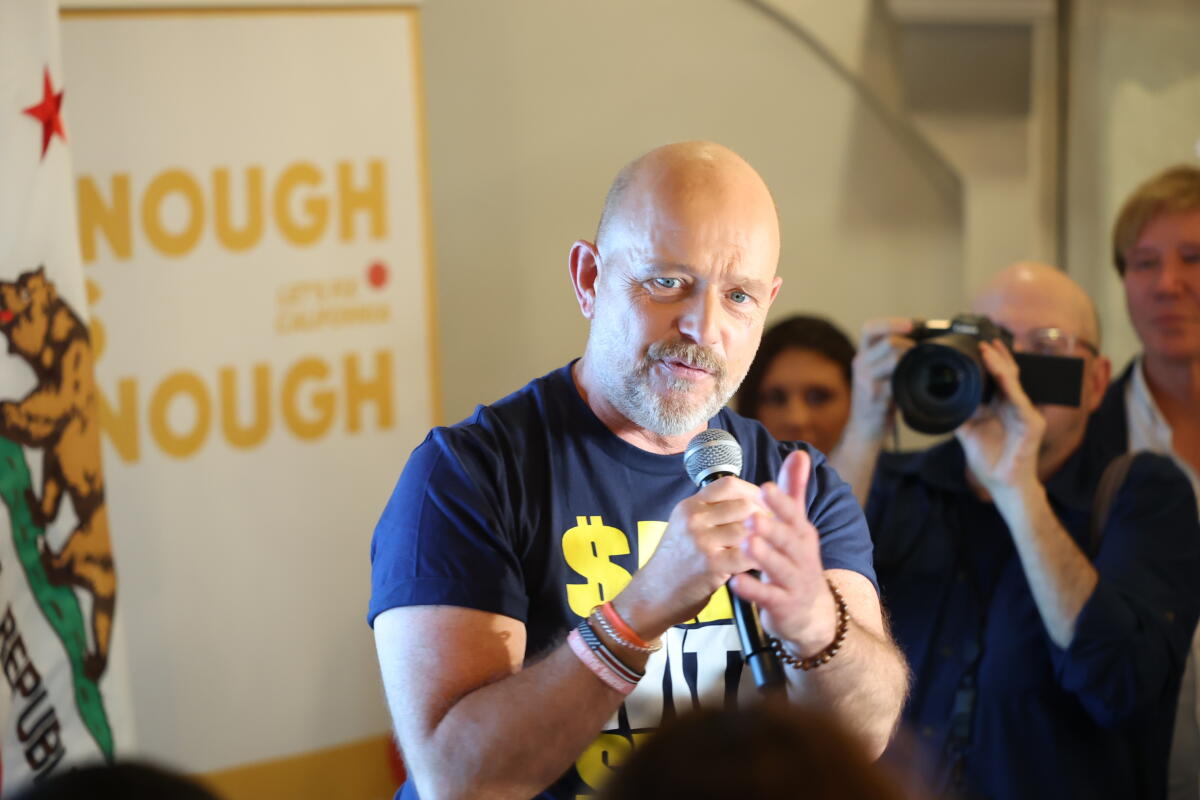
Gubernatorial candidate Steve Hilton addresses patrons at Victorio’s Ristorante in North Hollywood in September.
(Jason Armond / Los Angeles Times)
“It’s a weird gotcha,” said Cal State Fullerton Chicano studies professor Alexandro José Gradilla, whose wife’s grandmother was born in California and raised in Mexico, then bounced between the two countries for the rest of her life. “What’s the dis? Where’s the dunk? It’s so normative, especially of that generation. We cannot have the 2026 definition of immigration, the border and policy apply to a completely different landscape.”
Becerra’s critics subscribe to “this very American bias that an immigrant only moves once to the U.S., the land of opportunity, of hope — all that mythology,” Gradilla continued. During the Ellis Island era, he noted, European immigrants returned to their home countries with their U.S.-born children, and then those children faced many of the same hardships as first-time arrivals when they came back to the U.S. as adults.
“‘We don’t call those people expats or returnees — ‘immigrant’ is the only intelligible label we understand,” the profe concluded. “Until we come up with a better label, Becerra’s dad is an immigrant.”
There are many legitimate reasons to bash Becerra, from his refusal to participate in more debates to his paltry number of public rallies to a platform that sounds like more of what created California’s current woes. His family history isn’t it.
Hilton’s fixation on Becerra’s immigrant bona fides shows how desperate he is to gain some traction, any traction, with Latino voters. He at least has picked up on Latinos’ regard for immigrant success stories. But after bragging about being the candidate of legal immigrants, for Hilton to hold being born here against someone who went back and forth between the U.S. and Mexico is a weak salsa pendejada.
Hilton would have been better off with his conservative base if he had labeled Becerra the son of an anchor baby.
At a press conference with elected officials to oppose Proposition 39, which would mandate voter identification, my colleague Nicole Nixon asked Becerra about Hilton’s attacks on his dad. Becerra finally unlocked the inner cholo so many of us have been waiting to see, instead of the Chicano Ned Flanders he’s been projecting for decades.
“So this is what happens when people who don’t understand immigration start to pontificate,” he responded, summarizing his family story once again and pointing out the discrimination his father faced as someone of Mexican heritage, birthright citizenship be damned.
“Steve Hilton may not know that [Mexican American history] because he’s not from the U.S.,” Becerra said. “Steve Hilton may not know that because even though he’s an immigrant, he hasn’t taken the time to research.”
Wow, the brown Democratic candidate calling the white Republican candidate a dumb immigrant — California politics sure have changed!
But Becerra’s smackdown had a point. Conservatives deeply misunderstand what it is to be Mexican American. We’ve never fit into the American assimilation story and so have created our own narrative, one that people like Hilton refuse to accept at their own peril.
Hilton needs to take a Chicano studies class, where discussions about the fluidity of Mexican identity inevitably come up.
And, wouldn’t you know it, Gradilla planned to bring up that very subject with his students this week — he didn’t even know about Hilton’s attacks against Becerra until I told him.
The profe has had to update his lectures about the forced removal of upward of a million Mexican Americans south of the border during the Great Depression. He relates that history to the present, when many undocumented Latinos are returning to the countries of their birth with their U.S.-born children, either because they’ve been deported or to avoid being arrested and locked up under Trump’s hellfire immigration enforcement regime.
“For Hilton, anyone of Mexican heritage in this country needs to be grateful, you need to be loyal, and you need to be here,” Gradilla said. “Who would ever want to leave the U.S.? Well, some people have to.”