



Steve Hilton sexual ad, attack on Becerra break vulgar new ground
Let’s pretend for a moment you’re a Republican running for governor in the blue, blue state of California.
Your prospect of winning is small. So small, you could peer through a microscope, blink and miss it. How, then do you draw voters to your candidacy and boost your chances?
Actually, let’s not pretend. A very real flesh-and-blood Republican, Steve Hilton, is running for California governor and if your idea for grabbing attention doesn’t involve a make-believe lesbian couple, double entendre and a soft-core porn vibe, you’re very clearly lacking in imagination.
Hilton ran an ad featuring just such elements, garnering coast-to-coast notice, millions of views and ensuring the tagline — “Now lick it” — while not as resonant as, say, “The only thing we have to fear is fear itself,” will forever live in political infamy.
What the spot tries to do, convince folks in this left-leaning redoubt to be venturesome and vote for Hilton, is not the least offensive, though your friendly political columnist, hardly a prude, found the execution a bit, well, icky.
Being a cis white male of a certain age, however, means perhaps we shouldn’t be the one to judge. We’re certainly not the target audience. So we turned to two of the youngish, hippest people we know, Daughters No. 1 & 2, who are both well-accomplished 30-somethings and truly upstanding citizens.
What follows is their spontaneous reaction.
Daughter No. 1: “Stupid, infantilizing.”
Daughter No. 2: “Wtf is this fake woke AI ad? Ew.”
(For the record, Hilton said the ad was not AI generated. He apologized, sort of, to those who took offense.)
We also asked the Fabulous Mrs Z. — who has impeccable judgment, notwithstanding all the years she’s stayed married to your friendly political columnist — for her response. “It’s just so strange and stupid,” she said. “Why would he approve this ad? It makes me question his judgment.”
What do the pros say?
Of course, that’s just four people — one of whom doesn’t even live in California — so it’s not much of a sample.
For more insight, we turned to some political professionals.
And who better to weigh in than Fred Davis, the madcap genius behind another infamous California campaign spot, the so-called Demon Sheep ad he concocted for Carly Fiorina’s 2010 U.S. Senate campaign. The Felliniesque production included lightning bolts, a Roman column and a man covered in sheepskin crawling on all fours and leering with a glowing red eye — the point being that Fiorina’s rival, Tom Campbell, was supposedly a profligate wolf in fiscal-conservative sheep clothing.
Strange, yes, but definitely more memorable than an accountant in green eyeshade laboring over the books.
Anyway, Davis — who’s featured Paris Hilton, bad hair and a giant rat in a crown as part of his out-there oeuvre — loved the new Hilton campaign spot, calling it “super attention-getting, super interesting.” (Which is not the least surprising from a man whose chosen epitaph is, “If you don’t notice it, why bother?”)
“I think it’s a brilliantly done ad,” Davis said, “wonderfully written.” And, he added, “I can’t imagine it gaining him one vote.”
Which was sort of the point, no?
Kevin Spillane also appreciates Hilton’s effort, given his own Sisyphean struggles as a Republican strategist in California.

A screen grab from Steve Hilton’s “Just Try It” ad. Columnist Mark Z. Barabak found execution of the spot a bit, well, icky.
(Steve Hilton for Governor)
“They’re doing something out there and on the edge. I don’t fault them for that,” said Spillane, who supports Hilton and has contributed to his campaign. “It’s a clever concept of trying to get people to do something that they’re not used to doing.”
Which is to say vote for a Republican for statewide office in California.
But Spillane, too, questioned the execution. “I actually was fine with the ad until they got to the ‘lick it’ line,” he said, insisting he is also no prude. “That’s just a little too explicitly sexual.”
Running, not advancing
To his credit, Hilton has been running hard for governor. Much harder than his Democratic rival and the prohibitive front-runner, Xavier Becerra. Hilton has issued an abundance of policy proposals and spoken before pretty much any group or microphone-wielding reporter or podcaster who’ll have him.
None of which has garnered Hilton anywhere near the publicity captured by his racy “Just Try It, California” ad.
Even before the spot aired, Hilton broke new ground during last week’s gubernatorial debate when he noted a former member of the Biden administration had referred to Becerra as a “bitch-ass” — apparently the first time that compound adjective had been used in such a high-falutin’ setting. Hilton shortly followed with a website, “Bitch-Ass” Becerra,” that outlines the alleged failures of the Democrat as President Biden’s Health secretary and during his time as California’s attorney general.
(For the record, Susan Rice, who used the epithet and was accused of creating an “abusive and dehumanizing workplace” as head of Biden’s Domestic Policy Council, responded by stating her support for Becerra’s gubernatorial candidacy.)
It’s hard to see Hilton’s name-calling winning him a great many votes, any more than his risque campaign commercial, but maybe that’s beside the point. Maybe, as my columnizing colleague Gustavo Arellano suggested in his debate review, Hilton is merely auditioning for a return to his old commentator position on Fox News.
Hilton’s edgy attitude and pugnacious put-downs would place him right at home among the network’s collection of trolls, provocateurs and Democrat-bashing gargoyles.
But Hilton should leave the advertising to someone else.
What else you should be reading
Get smart: Meet the Fox News correspondent leading the fight for press freedom at the White House
The deep dive: Trump calls it a war, then a ‘military conflict.’ Why the Iran fighting keeps changing names
The L.A. Times Special: What’s going to happen in the midterm election? Find out here. (Maybe)
Until next time,
mzb
—
Was this newsletter forwarded to you? Sign up here to get it in your inbox.

Yoshinobu Yamamoto’s playoff dominance impresses Tarik Skubal
ATLANTA — Who would you rather have starting an October game for the Dodgers than Yoshinobu Yamamoto?
No one, right? And you wouldn’t be the only one thinking that.
Tarik Skubal thought so too.
When Dodgers manager Dave Roberts told Skubal he would start the team’s playoff opener, Skubal responded with a question.
“Why?”
Skubal was honored with the assignment, but he also was worried.
“I was like, ‘Is Yoshi OK?’” Skubal said Tuesday.
He is, as the Atlanta Braves found out the hard way. Yamamoto pitched the Dodgers to within one game of the National League Championship Series, setting a postseason high with 10 strikeouts in a 3-1 victory.
In seven innings, Yamamoto gave up one run on four hits, all of them singles. In only one of those innings did Atlanta advance a runner beyond first base.
“I just have a lot of respect for him and for what he means here in L.A. and what he has accomplished here,” Skubal said. “I know we have a lot of good starting pitching, and I know there is a lot of thought that goes into it, but I just assumed he would be the Game 1 guy.”
You could say Yamamoto rises to the October occasion, but Mookie Betts would not say that, if only because Yamamoto rises to the occasion on just about every occasion.
“I don’t see it any different,” Betts said. “I think he does it all year, too.
“He just has so many weapons. He throws a lot of strikes with a lot of pitches. He’s hard to hit.”
Skubal, a two-time Cy Young winner, is brilliant in October.

In seven postseason appearances, he has a 1.97 earned-run average. He gave up five runs in one inning, and he has given up five runs in the other 44⅔ innings. The Dodgers’ grand prize from the trade deadline was hardly a reckless choice to start Game 1 of the division series.
Yamamoto has a 2.14 ERA in 11 playoff appearances, the fourth-lowest of any pitcher since 1903 to make at least 10 postseason starts. He drains the life out of an opposing crowd as well as anyone in major league history, with a 1.42 ERA in six road playoff outings.
“I’m a fan of this game as much as I am a player,” Skubal said. “So, when I watch guys do really impressive things and do great things, I understand what it takes because I also play the game.
“When he goes out and performs like he does, it’s almost like I expect it. And now, being a teammate of his, it’s not surprising at all why he goes and performs like he does, because the way he prepares is as good as anybody in this game. It’s just a ton of fun to be on the same side of it.”
Yamamoto admitted to feeling nervous, even if you would never sense it from watching him. That’s part of the way he prepares, too.
“During the preparation and before the game, then I do get nervous,” Yamamoto said through an interpreter, “but at that time, I personally think that’s very important.”
And then the game starts, the nerves dissipate, and the opponent is methodically slayed.
“He just has a way to just make pitches, calm his heartbeat,” Roberts said.

Highlights from the Dodgers’ 3-1 win over the Atlanta Braves in Game 3 of the NLDS.
The Dodgers have played seven postseason series with Yamamoto, and they have won them all.
We’ll always cherish last October. In 76 regular-season starts with the Dodgers, he has one complete game. In back-to-back starts last October, he threw a complete game both times.
Of the Dodgers’ four victories in the World Series, Yamamoto earned three — including Game 6 as a starter and Game 7 as a reliever, with no day of rest in between.
“I got goosebumps watching that,” Skubal said. “I didn’t know how he was doing it. That’s what I was thinking: How is this going to work?
“His stuff looked even better than it did in Game 6, which is insane to say. But it did. When I was watching on TV, I was like, ‘Holy … he looks better today than he did yesterday, and he did pretty well the day before.’ It’s incredible.
“Hopefully, we’re not having to do that again to him.”
That is one big reason why the Dodgers acquired Skubal. If Tyler Glasnow wins Wednesday — and the Dodgers won in all six of Glasnow’s postseason appearances last October — they are off to the NLCS.
The Game 1 starter could be Skubal, followed in Game 2 by Yamamoto. That’s a tall order for opposing batters and, so far, a winning order for the Dodgers.

France halts police use of stun grenades at student protests | Protests News
Prime Minister Sebastien Lecornu to make public address after hundreds of thousands rally to demand more funding for education.
Published On 7 Oct 2026
France has temporarily banned police from using stun grenades at student-led protests, the interior minister said, amid growing accusations of police brutality following several days of student demonstrations nationwide.
The announcement on Wednesday came a day after hundreds of thousands of students and supporters marched across France to demand more funding for education and better conditions in high schools, prompting President Emmanuel Macron to convene an emergency meeting with Prime Minister Sebastien Lecornu and other key ministers to try to defuse the crisis.
Recommended Stories
list of 3 itemsend of list
Lecornu will make a public address later on Wednesday on the school protests as well as the country’s finances, his office said.
Interior Minister Laurent Nunez told radio broadcaster RTL early on Wednesday that he had suspended police use of stun grenades at the protests.
A 15-year-old lost a hand in the northern city of Lens on Monday after police fired a stun grenade.
Earlier, a 14-year-old student was hit in the face by a tear gas grenade at such close range that he lost several teeth. A policeman was charged on Tuesday over the incident in the capital, Paris.
Police have opened 18 internal investigations into allegations of misconduct since the protests began, Nunez said.
Rights groups, students and parents’ groups have accused authorities of using disproportionate force against minors. The government says the protest movement has been hijacked by outsiders and morphed into urban violence.
The Ministry of the Interior said 6,100 people have been arrested since the protests began last month, the overwhelming majority of them minors.
More than 1,800 people are being prosecuted, including 1,483 minors, the Ministry of Justice said, without specifying the crimes.
At least 715 police officers and 215 teenagers have been injured in clashes, according to Lecornu’s office.
Students demand school funding
Protests started in late September with students blocking entrances to hundreds of high schools for 15- to 17-year-olds over complaints of dilapidated facilities and teacher shortages and demands for more funding for education.
Parents, teachers and union workers joined the demonstrations in Paris and other cities on Tuesday amid accusations that police were using disproportionate force.
Sporadic violent clashes have broken out between police and protesters at what otherwise have been largely peaceful demonstrations.
Lecornu on Tuesday condemned the violence and told lawmakers that it would not be tolerated, while also rejecting accusations that the government had ordered “police repression” against protesters.

Wednesday 7 October BOL Establishment Day in Lao
The provided text outlines the historical background of the Bank of Lao, which functions as the nation’s central financial institution. October 7th was officially chosen as the banking sector’s founding anniversary to commemorate the initial printing of the liberated Laotian Kip in 1968. This significant monetary event occurred under the guidance of the Lao People’s Revolutionary Party inside a hidden cave located within the Viengxai district of Hauphanh province. Later on, following the formal formation of the Lao People’s Democratic Republic in 1975, the institution consolidated with the former national bank. Through this merger, the organization successfully established its current role as the central bank for the entire country.

Energy costs: ‘Wear more clothes if it’s cold’, pupils and staff told
Rising energy costs are already affecting households across Northern Ireland.
The impact of the US-Israel war with Iran is one of the factors behind the increase.
The letter from the EA to head teachers said that “recent geopolitical events are expected to have a substantial impact on energy costs across the Education Authority (EA) during the 2026/27 financial year”.
It said that total school gas bills were expected to go up by 60% from £10.7m to £17m by March 2027.
Meanwhile, total school electricity bills are expected to rise by 5% from £23.8m to £25.1m by March 2027.
“Given the scale of the anticipated cost increases, we are asking all schools to review their energy usage and identify opportunities to reduce consumption wherever possible,” the EA said.
Among the measures the authority has suggested to schools are cutting heating use by an hour a day and switching off classroom lights to use natural daylight instead.
Staff and pupils have also been advised to “wear more clothes” rather than turn the heating thermostat up if it is cold.
But principals have told BBC News NI that it is not straightforward for schools to cut heating costs.
The principal of Tullygally Primary School in Craigavon, Kirsty Logan-Hall, said that the school was “committed to promoting responsible energy consumption and regularly reinforce good practice with staff and pupils”.
“However, our ability to achieve significant reductions in energy usage is constrained by the nature of our estate,” she said.
“The school operates from an older building which presents inherent energy efficiency challenges.
“In addition, our site is particularly spread out due to the accommodation and operational requirements associated with our specialist provision.
“This necessitates the heating, lighting and ongoing use of multiple areas across the site throughout the school day to ensure appropriate learning environments, accessibility and pupil welfare.
“It is important to recognise that there is limited scope for reducing energy consumption without adversely impacting the quality of provision, staff working conditions or the wellbeing of pupils, including those with additional needs.”
Emma Quinn from Rathcoole Primary told BBC Good Morning Ulster that the “lack of maintenance” has an impact on schools, adding that pupils have a right to come into a warm school after being outside.
“Putting this pressure onto us at the minute is ridiculous, when we are eco schools, we are doing all of these, we are turning off lights, but yet this lands in on our doorstep and we’re suddenly expected to jump and to fix a problem that is so systemic, it’s just not good enough.”

Big Brother fans ‘raging’ housemate ‘got away with it’ days before eviction
Big Brother viewers spotted an issue with this week’s nominations

Pauline is up for eviction(Image: ITV)
Fans think they have spotted a problem with this week’s nominations.
Big Brother viewers have admitted they have been left “raging” following the most recent episode. It comes after Tuesday’s (October 6) installment of ITV’s reality series saw the housemates choose who they want to be at risk of eviction, face-to-face.
As a result, tensions boiled over, and scenes showed Rochelle and Pauline clashing in the bathroom as they prepared for bed.
Pauline received the second-most nominations, with five, after Rob. The pair now face the public vote, with one expected to be forced to leave on Friday night.
It was the latest incident during the House of Revelations theme to put contestants’ opinions of one another under the spotlight. Frankie, Lynx, Omar, Philip, Rhianna, and Yasmin all picked Rob.
Pauline received five, from Lynx, Philip, Rhianna, Rochelle, and Catrin. Their reasons included her preference to only want to eat organic foods when they are available. Rochelle, however, questioned this as she had “seen her eating a pizza”.
Several fans watching along at home were immediately upset about how the latest nominations played out. Some are even refusing to vote this time around due to the limited choices.
One fan admitted: “Not voting this week – raging Omar got away with it. It’s insane to me. I can’t believe we have to suffer through another week of him.”
Another agreed: “Craaaazy how Rob is up over Rochelle. The things Rochelle has said and done, and we have Rob up? Insane.”
Some believe they have figured out the reason why. The most popular theory was that, because the nominations were face-to-face rather than in the Diary Room, some housemates changed their choices.
As one person explained: “It’s easier to nominate Rob face-to-face than it is Rochelle, even though half of them nominated her in the diary room last week. I was really surprised at Yasmin nominating Rob.”
Meanwhile, one viewer was surprised by Twinks considering her clashes with Omar. They said: “Twinks really annoyed me not nominating him though. If she did it would be 2v1 with a split vote for Pauline and Rob. Omar would have been a goner.”
One person offered a similar view: “I believe if the nominations were behind closed doors, it would’ve turned out differently. Especially with Phillip trying to save face this time, I imagine the same goes for the other housemates too.”
After Pauline suggested she could quit the house before Friday’s eviction, one person hoped that if it happened, it would mean the next highest nominated housemates would be up. They said: “I really want Pauline to walk please cause extra drama, Omar and Rochelle will also be up.”
Big Brother continues tonight at 9pm on ITV2 and ITVX.

Dear Mr. Rubio, Don’t Forget About the Non-Oil Economy
The Venezuelan economic debate has been dominated by headlines over hydrocarbon deals and speculation around the future of the mining sector. The focus is understandable. It’s a petrostate with an abundance of natural resources, capable of propelling us out of the prolonged economic and humanitarian crisis that chavismo inflicted upon us. But as we must continue to discuss the future of the oil, gas and mining sectors, we must not forget the reforms required to allow the non-oil economy to flourish.
Although a large share of the state’s revenues and the country’s GDP is ultimately tied to hydrocarbons, the overwhelming majority of Venezuelans are not oil engineers, geologists or miners. Nor are most Venezuelan companies directly involved in extracting natural resources. The non-oil economy is there, operating under a highly restricted business environment of price controls, extortion, a minefield of a tax system and labour laws hostile to companies. All while facing a contraction in its market due to the migration crisis and severely restricted access to credit.
Venezuela is still among the hardest places to do business in the world. It is time to discuss how to give the sector, which includes formal and informal businesses of all sizes, the breathing space it needs to grow.
Let’s first put the power grid and infrastructure issues aside. The reforms required span virtually every aspect of the business environment, from the institutions that oversee the economy at the macro level, to the banking system and the nitty-gritty of tax and labour law. At the most basic level, the private sector needs confidence that contracts will be respected, property will be protected, and disputes can be resolved through institutions that are predictable and independent. Without these basic reassurances, investing in Venezuela remains a gamble that many businesses and outside investors will simply not be willing to take.
Dollarization without the institutional and financial framework to back it will fail in its mission to stabilize the economy.
As previously explained regarding the macro level, the Venezuelan Central Bank (BCV) needs to regain its independence and establish a credible monetary policy based on transparency and clear rules, supported by a board and president who are not subordinate to Miraflores. Burning through the petro-dollar cash pile to curb the Bolivar devaluation won’t cut it. The central bank is estimated to have used 65% of the oil sale proceeds to shore up the Bolivar. This has proven to be futile without a proper macro framework to support such interventions. It is the BCV’s credibility that is fundamental to correcting the distortions in the FX market and preserving confidence in the Bolivar, in order to lower the still extraordinary inflation rate hovering around 500%.
A credible BCV will also be fundamental to back whichever currency policy the State decides to embrace. Debates over dollarization have spread. However, the measure is not a magic wand, and going for it without the institutional and financial framework to back it will fail in its mission to stabilize the economy. Monetary stability with a functioning BCV will not suffice, but it’s a necessary foundation to correct the distortions that pervade the Venezuelan economy.
Surviving without credit
Reforms aimed at stimulating the non-oil private sector must not stop there.
Venezuela needs its banks to be banks again. The country has by far the region’s lowest credit portfolio relative to GDP thanks to draconian restrictions from regulators, which limit the capacity of banks to function as credit facilitators, and reduce them to mere transactional businesses. A functioning banking system is fundamental for the private sector’s recovery. Venezuelan businesses need the capital, as much as consumers need the credit to finance purchases of the goods and services those businesses produce.
Without a functioning banking sector, the private sector costs of capital increase as businesses either accept higher rates from non-bank lenders or are forced to rely disproportionately on their own cash flow to fuel operations. Ultimately, this leads to firms forgoing investments and lower productivity. The survival-mode resource allocation and corporate planning allowed some firms to surf through the crisis, but still makes it considerably harder for a successful company to scale operations and increase productivity.
Under the right conditions, Venezuela could become fertile ground for a dynamic M&A market.
On the consumer side, there is an important advantage from which to build on. Venezuela has a relatively high degree of financial inclusion and has rapidly adopted digital technologies for payments and money transfers. This provides an infrastructure through which a consumer credit market can develop.
Time for real business-friendly laws
Labour laws and informality must also be addressed. The private sector needs to be able to absorb more workers, particularly those who will eventually transition out of an oversized public sector, without facing excessive legal and financial restrictions associated with hiring. The current system makes formal employment particularly costly for smaller businesses, contributing to informality and limiting the capacity of companies to expand their payrolls and operations.
Venezuelan businesses have performed something close to a miracle by continuing to operate under such dire conditions. But many of the businesses that remain have low productivity and have become costly to scale. The end goal of this debate should be to reduce the cost of capital and frictions that limit businesses from increasing their size and productivity, aiming to allow companies to compete at scale internationally.
We need to keep pushing for reforms across the non-oil economy so that businesses can access credit, hire more workers, invest, consolidate and attract capital.
Under the right conditions, Venezuela could become fertile ground for a dynamic M&A market. Consolidation can allow fragmented industries to achieve economies of scale, invest in technology, professionalize management, employ more people, and eventually compete internationally. Stronger and better equipped companies would become more attractive to foreign investors and better positioned to access global markets.
This is what economic reform should seek to achieve: a private sector made up of larger, more productive, inclusive, and competitive businesses.
The private sector has already demonstrated that it can survive under almost any conditions. The task now is to create the conditions for the windfall from those petro-dollars to run through a private sector that is more efficient, inclusive, and scalable. We need to continue pushing for reforms across the non-oil economy so that Venezuelan businesses can access credit, hire more workers, invest, consolidate, and attract capital. That will allow it to become one of the engines of our economic transformation.

I went on the UK’s cheapest all-inclusive break

AUTUMN and winter family holidays in the UK are a gamble – you could get glorious sunshine and plenty of fresh air, or be stuck inside playing board games on repeat thanks to nonstop rain.
But there’s one chain of seaside resorts boasting such an array of indoor and outdoor activities, it barely matters what the weather is.
Butlin’s has so many indoor activities that you could fill an entire three days without spending any time outdoors.
A school mum and I took our families on the all inclusive break earlier this year, after one too many staycations were marred by huge downpours – and were blown away by the offering (not the wind).
Butlin’s is really hard to get your head around if you haven’t been before – for starters, it’s SO cheap. Well… it is if you go for the cheapest accommodation.
Their base rates start from £49 for four nights for a family of four during October half term at their Minehead site, for example – that’s an astonishing £12.25pp per holiday.
But that’s in their cheapest comfort rooms, which don’t have a kitchen – the cheapest accommodation with a kitchen is £69 in the comfort apartments, and the prices go all the way up to £502 if you’re in the fancier bayside apartments.
At their Skegness site, where we stayed, accommodation over half term ranges from £122 in their standard rooms, up to £515 in the Maple Walk Premium Lodges and £791 in the platinum plus caravans.
We stayed in the Maple Walk lodges that first opened in 2024. The high-end, three-bedroom property featured a sleek kitchen, outdoor decking and a wood- panelled master bedroom.
Maple Walk has its own entrance and even housekeeping, signalling a big departure from Butlin’s main, affordable offering.
But it doesn’t matter where you book – the activities included in the price are the same.
That includes the indoor waterparks, the West-End-style shows and entertainment like wrestling, the Skypark outdoor playparks, the soft plays and certain arts and crafts sessions.
Then if you book during a particular holiday, the resorts often host plenty of extra themed activities for free – for example, at October half term they have free fireworks displays, silent discos and pumpkin carving.
The sites have tons of paid-for activities you can sign up to as well, like laser quest, the fairground, bowling, go-karting, climbing and aerial adventure courses.
The value you get out of a four-night break when factoring in the activities is astonishing.
Let’s say for instance, you went to one of their shows every evening of your stay – for a decent seat at a West End production of a similar standard to the Butlin’s Masked Singer Live show, you’d be looking at around £40pp minimum, while WWE live show tickets cost from £40pp to £150pp for regular arena seats.
If we’re conservative, that’s £120pp for three nights of quality shows already.
And these are top quality performances. The year-round pantomime is so hilarious it had me slapping my thigh, and the Animals and Mythical Beasts production brought tears to my son’s eyes.
The star of the shows for us, however, was the Maximum Pro Wrestling, which included a star turn from one of the celebrity hosts, Jeff Brazier.
Then you have the free soft play – at between £5 and £12 per child across the UK, it’s free at Butlin’s and entry to the water park – which typically costs between £15 to £26pp at decent-sized venues in Britain.
Book yourself into both of those twice over the course of your stay and that averages around £47pp, rising up to £167pp for the value of the free entertainment on offer when you factor in the cost of the shows.
That’s before you add in any of the paid-for activities. During our three-night stay, we played mini golf and laser quest, spent far too many pound coins in the arcade, enjoyed arts and crafts and went to the fun fair.
If you’re planning on going all out on the food and drink, their relatively new all inclusive bundles are great value too.
We opted for the all-inclusive dining and drinks packages. The Premium Dining package costs £33.95 an adult and £19.50 a child (age six to 14) per day, and covers a buffet breakfast and a buffet dinner.
These are full of choice, with Indian, Chinese, roast dinners, cheeseboards, burgers, soft serve and far more on offer for dinner.
At breakfast, there was everything from a Full English (with a fantastic veggie selection), made to order toasted sandwiches and omelettes, cereals, pastries fruit and pancakes.
The drinks package starts from an extra £25.95 an adult per day and £10.50 a child, which includes unlimited booze, soft drinks and Costa coffee.
If you think you’ll get through more than four pints of Madri beer at £6.10 each, or five glasses of house wine at £5.60 each, over the course of the afternoon and evening then it’s well worth shelling out for.
The resorts also have new self-serve bars for the first time too, with beers, ciders, cocktails, spirits and mixers and soft drinks.
If you don’t want to gorge at the buffet like we did every night, the DineAround package includes a buffet breakfast and then you can pick from the other on-site dining options for a two-course lunch or dinner.
This could be pub grub at The Beachcomber Inn or classic American diner-style food. Or you can simply pay as you go or cook in your accommodation.
Prices for all inclusive get even cheaper during termtime, midweek breaks, with all-inclusive food and drink bundles on Showtime Breaks starting from £28 per person, per night for a family of four.
So if you’re paying £39 for a comfort room that sleeps up to 6 people on a midweek break, that’s a further £312.12 for the premium dining and drinks plan – working out at £351.12 in total or £22pp a night for accommodation, activities, and all inclusive food and drink.
It’s almost hard to argue against going out for food at those kinds of prices…

LA28: Why you could represent Great Britain as flag football makes Olympic debut
Flag football is now played by 20 million people in more than 100 countries and the rapid growth of the women’s game was key to it becoming one of five optional sports for LA28.
The sport has been backed heavily by the NFL, which aims to help it earn selection for Brisbane 2032 too.
The decision is due before the end of 2026 so flag football could head into its Olympic debut knowing it will feature in back-to-back Games.
Participation has boomed in Australia and scores of athletes are switching from Australian rules football, netball and rugby, while the American team has recruited basketball players.
GB’s Brittany Botterill (football/softball), Phoebe Schecter (equestrian), Marta Mathews (football), Jochebed Frimpong (athletics), Jess Allen (badminton) and Angelica Tait (athletics/snowboarding) all competed in other sports before playing flag football.
US-born Emily Kemp even became an ultimate frisbee world champion last year, in the same summer she helped GB win the flag Euros.
“We are an elite team already, we’re a potential medal threat at LA28, but we’re really aspirational so we’re looking to widen our talent pool,” said Chad Ehlertsen, chief executive of the British American Football Association (Bafa).
“If you look at the top flag players around the world, they’ve generally come from certain sports. They have good hand-eye coordination, agility, speed, decision-making under pressure. These are the qualities we’re looking for.
“In many ways we’re not looking for elite flag players, we’re looking for elite athletes that have the potential [to transfer] and then our coaches will help them understand the game.”

Head coach Scaloni’s emotional farewell to ‘irreplaceable’ Messi | Football
Argentina’s head coach Lionel Scaloni said it was an ‘emotional day’ as Lionel Messi brought his international career to an end, calling it a ‘dream’ to have coached him. Messi scored in his final game, a 3-0 friendly victory over Benin.
Published On 7 Oct 2026

More than 140 flights to be cancelled at major European airport this WEEK
BRITS heading to or from one major European airport on Friday are set for travel chaos.
Strikes at Brussels Airport in Belgium, are set to cancel around 140 flights on October 9 as ground handling staff walk out.

The strike will be nationwide with the ground handling company Alyzia joining the walkout.
Alyzia provides ground handling services including baggage processing and passenger aircraft ground support for around 20 airlines at the airport.
These include Brussels Airlines – the airport’s main carrier – as well as ITA Airways, Air Arabia and United Airlines.
For passengers flying with these airlines, delays and cancellations may occur.
Read more on travel inspo


However, if you are due to fly with the likes of Ryanair, easyJet, Wizz Air or British Airways – ground handling for these airlines is carried out by another provider at the airport.
The strike action comes as workers protest against governmental policies.
Public transport is also expected to be disrupted in Brussels.
Unfortunately, as this strike is outside of the airline’s control it will be deemed an ‘extraordinary circumstance’, which means if your flight is cancelled you will not be entitled to compensation.


However, airlines do still have a duty of care to passengers.
This means that they should rebook or refund your flight free of charge as well as provide you with food and drink, as well as accommodation if required.
Three years of Israel’s mass dispossession of West Bank Palestinians | Israel-Palestine conflict News
Al-Awsaj, occupied West Bank – On September 23, weeks before Israel’s parliamentary elections, ministers and lawmakers gathered on an occupied West Bank hilltop to inaugurate a new settlement, Metzoke Eretz, illegal under international law. Finance Minister Bezalel Smotrich used the ceremony to salute the settler outpost that made the eventual settlement possible.
“The first pioneering settlers who were here on the farm… we will lift them up as our greatest joy,” Smotrich said. “It shows that the method works: establish a farm, seize the land, prepare it, turn it into a community, move to the next point. There are many, many such heroes – those who prove they are not doing real estate. They are doing Zionism.”
Recommended Stories
list of 3 itemsend of list
Metzoke Eretz was previously an outpost – the name given to the Jewish settlements illegal even under Israeli law – called Netzah Harel, established in 2023 in the middle of al-Muarrajat, a Bedouin community on private Palestinian land east of Ramallah. Alia Mleihat, 29, and others from the community remember those settlers well. “Of course, this outpost played a major role in displacing the Palestinian Bedouin communities in al-Muarrajat and the areas east of Ramallah,” said Alia, now living in a tent in al-Awsaj, a few kilometres away, after her forced displacement in July 2025. “[The Netzah Harel settlers] took part in every attack the settlers carried out on families, and confiscated sheep, under the protection of the Israeli police and army.”
Dror Etkes, founder of Israeli NGO Kerem Navot, said Smotrich’s description of his “method” was spot-on – except for one omission. “The political discourse skips the [Palestinian] expulsion chapter,” said Etkes, suggesting Smotrich and other politicians avoid doing so explicitly to avoid potential scrutiny from international criminal courts. “They want it to happen, and they know that it happens, and they let it happen.”
Haaretz reported that Metzoke Eretz is one of 19 outposts legalised by the Netanyahu government after nearby Palestinians were violently expelled.
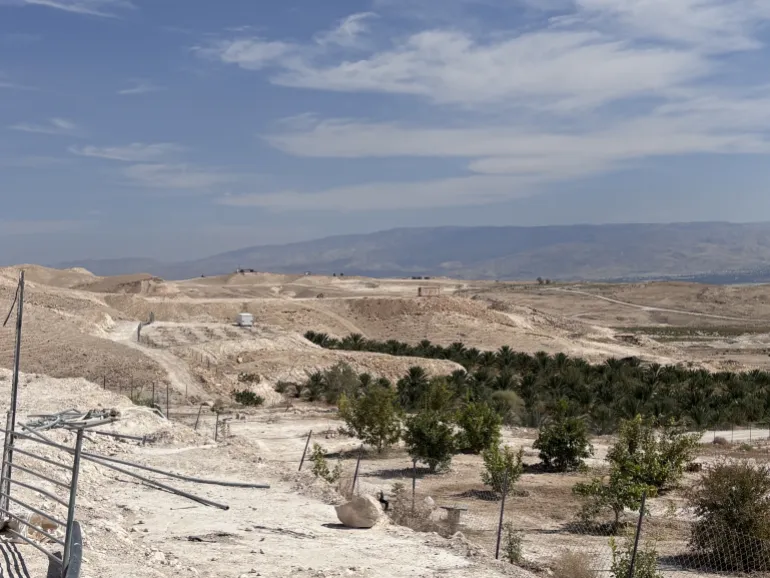
![The view from Muhammad Ghawanmeh’s home in al-Awsaj, looking out towards an Israeli outpost on a hill in the background [Al Jazeera]](https://i0.wp.com/www.aljazeera.com/wp-content/uploads/2026/10/View-from-Muhammads-looking-out-towards-the-outpost-seen-on-hill-in-background-1791321948.jpeg?w=640&ssl=1)
‘Not a single moment of joy’
Jamal Mleihat, Alia’s 45-year-old uncle, sits with eight relatives nestled inside a bare concrete-block house on the ridge in al-Awsaj, with his daughter Sewar hanging off his lap.
Below the ridge, rows of young trees climb a cultivated slope towards a factory at the foot of the hills. The ridge itself is rock and dust, now home to about 25 families from al-Muarrajat, among others forcibly displaced in the past three years.
“Before October 7 [2023 Hamas attack on Israel, and Israel’s subsequent genocidal war on Gaza], we were in the pastures – no harassment, we moved around freely,” said Jamal, a father of seven. “We had healthcare. We had a school. We had water in the same encampment. Life was a million times better than this.”
Since October 7, the Israeli government has stepped up its raids on the occupied West Bank, while settlers have largely been given free rein to pursue a pogrom against Palestinians, with little pushback from within Israel.
Just below Jamal’s shelter, alone on a slope, Muhammad Ghawanmeh lives with his wife and seven children. His toilet does not work; he relies on water tanks and has almost no electricity. The rocky track to the Mleihats’ area is too steep to drive. He built a fence around the house after recent settler attacks, and now faces constant drone surveillance from Israeli settlers.
Ghawanmeh is from Ras Ein al-Auja, which had been the largest Bedouin community in the central Jordan Valley – so robust that humanitarian coordinators told Al Jazeera in October 2023 that the village’s displacement was unlikely. Instead, its more than 600 Palestinian inhabitants experienced the largest single-community expulsion of Bedouins in the last three years, after repeated attacks by settlers from four surrounding outposts.
“From my childhood, the land was open. The water was open. We were living happily. We’d graze 10 kilometres, 15 kilometres with the sheep, and come back,” he said. “Today we can’t go 500 metres from the house.”
His flock has shrunk from about 300 to roughly 100 physically thinning sheep, which he now must buy fodder for, instead of letting them graze on the land, which he now says is largely forbidden by Israeli settlers and the army.
![Jamal Mleihat with his daughter Sewar in al-Awsaj in the occupied West Bank [Al Jazeera]](https://i0.wp.com/www.aljazeera.com/wp-content/uploads/2026/10/Jamal-Mleihat-with-his-daughter-Sewar-1791322462.jpeg?w=640&ssl=1)
‘Nothing was left except this’
A few hundred metres beyond Ghawanmeh’s fence, a white trailer and a few containers mark an Israeli outpost, established about six months ago on a hill overlooking Highway 90 and the displaced families along the ridge. Two months ago, Ghawanmeh said, soldiers came to his house and told him he could no longer pass to the highway. The settlers, he said, “are with the army”.
“You leave this place, go to another one, and it follows you – the same problem, unsolved,” Ghawanmeh said. “Every three months, there’s a displacement operation.”
Al-Awsaj barely existed as an inhabited place before, but Bedouin from different depopulated communities have now converged on this barren ridge, overlooking land largely declared – again – off-limits to grazing.
Allegra Pacheco, head of the West Bank Protection Consortium, calls al-Awsaj “basically a refugee camp, an internally displaced camp, that we see in other countries. But here, there’s no safe space. Wherever people like in al-Awsaj go, they’re chased by settlers or their tents are demolished by the Israelis.”
“It’s been very painful to get the authorities, the Palestinian authorities, the international leaders, to recognise that this is a mass displacement happening in front of us, and people have nowhere to go,” she said.
Project of forced transfer
In the West Bank, the United Nations Office for the Coordination of Humanitarian Affairs (OCHA) counts at least 130 Palestinian communities fully or partly displaced by settler attacks and related restrictions since January 2023, and more than 6,400 people uprooted. According to the Palestinian Colonization and Wall Resistance Commission, since October 7, 2023 there have been almost 15,000 attacks by settlers, with 66 Palestinians killed by settlers. OCHA says the rate of settler attacks increased from about three a day before October 7, 2023, to almost seven per day this year.
The increase in displacement after October 2023 can also be seen in the numbers for that year. Nearly 80 percent of all Palestinians displaced by settler violence in 2023 were uprooted after October 7.
A report by Peace Now and Kerem Navot found that Israeli farm outposts had seized roughly 18 percent of the West Bank by the end of 2025. “We’re talking about a land area bigger than the size of the Gaza Strip altogether,” Pacheco said.
“What we’re seeing is a continuous, sustained project of forced transfer and mass destruction,” she said. “Israeli authority demolitions and destructions by the Israeli army, and Israeli civilians – armed groups – carrying out destructions and sowing fear to push people out.”
Israeli NGO B’Tselem’s September report, “The Elimination Project”, links this to Smotrich’s 2017 “Decisive Plan”, which offers Palestinians three choices: live under Jewish supremacy, leave, or face violent repression.
“The Smotrich Plan has been implemented,” Pacheco said. “He laid out exactly what is going on now, and he’s very proud of his success. He now wants to transfer that success to [other areas of the West Bank], and also in the Galilee [an area in Israel with a large population of Palestinian citizens of Israel]. Wherever there are Palestinians living, he wants to make life so difficult that they will leave.”
With Smotrich exercising broad powers over the West Bank through the Settlement Administration within the Ministry of Defence, and leaders in the Israeli West Bank military command increasingly coming from far-right, settler backgrounds themselves, Palestinians across the West Bank describe a deepening symbiosis of military, police, administration and settlers in exacting Palestinian dispossession. “They all work together, like a cell, one completing the other,” said Jamal Mleihat. “The army, the police, the settlers – they’re the ones who displace, they’re the ones who establish the settlement, they’re the ones who take part in the thefts, in everything. And the army covers for them.”
Al Jazeera has reached out to the Israeli authorities for comment on this piece, but has yet to receive a response.
Worse future
Smotrich has withheld part or all of the tax revenues Israel collects for the Palestinian Authority – roughly 60 percent of its income – for much of the past three years. The PA now struggles to provide the most basic of services. In al-Awsaj and elsewhere, that means classrooms that do not open. “The government school is shut down today, no salaries,” Ghawanmeh said.
There is no school bus; families pay for private transport, and “one day they study, one day they don’t, depending on the mood of the driver,” Jamal said. It has left the displaced alone on an inhospitable patch of rock.
“Palestinians have no protection in the West Bank,” said Pacheco. “They are completely vulnerable to assault, attempted murder, arson, invasion of their homes. The Israeli army is supposed to protect them and doesn’t. The Palestinian Authority can’t come in, and the international community is not protecting them.”
“We started to feel there’s no safety anywhere,” Ghawanmeh said. “Fear. Terror. Persecution. Ethnic cleansing. That’s what we feel.”
Amid the dispossession, Ghawanmeh looks out at the unwelcoming land he knows will not be his family’s refuge – only another transient stop. He sees his own brother now only once every month and a half or two. “The threats to Bedouin life have almost become extinction,” he said. “We now live in enclaves, separated.”
“For three years now, the day that’s passing is better than the one that’s coming,” Ghawanmeh said. “Yesterday is better than today. Today is better than tomorrow.”

BBC Breakfast pays tribute to legend as host says ‘it’s the end of an era’
Jon Kay and Sally Nugent were back on the red sofa for the latest edition of BBC Breakfast

Jon Kay returned to screens on Wednesday(Image: BBC)
The hosts of BBC Breakfast shared some sad news this week.
Jon Kay and Sally Nugent were back in the studio on Wednesday (October 7) to deliver the latest headlines from across the UK and around the world. Later in the show, the presenters announced the death of an acting legend.
Eva Marie Saint, one of the last survivors of Hollywood’s golden age of the 1940s and 50s, has died at the age of 102. Her work on screen spanned six decades. She made her screen debut alongside Marlon Brando in On the Waterfront, and also starred in North by Northwest and Superman Returns.
Representatives of the star said that she died on Tuesday (October 6) of natural causes at her Los Angeles home, surrounded by her loved ones. Sharing the news on BBC Breakfast, Sally said: “Tributes have been paid to one of the last stars of Hollywood’s golden age, the American actor Eva Marie Saint, who has died at the age of 102.”
Jon added: “In a career spanning nine decades, the oldest surviving Oscar winner became best known for her roles in the 1954 hit On the Waterfront with Marlon Brando, and later with Cary Grant in the spy thriller North by Northwest.” BBC culture correspondent Charlotte Gallagher then looked back on Eva’s life.
In the pre-recorded tribute, Charlotte said: “Eva Marie Saint, the ice-cool femme fatale, who meets Cary Grant on a train in Alfred Hitchcock’s Cold War spy classic North by Northwest. She seduces him, betrays him, but ultimately falls in love, after a terrifying escape from enemy spies across Mount Rushmore.”
Eva was the daughter of a tyre salesman from New Jersey. She initially thought of becoming a teacher, but modelling led to a small part in television, alongside former silent screen legend Lillian Gish.
As her acting career took off, Eva became known for appearing in Exodus, The Sandpiper, 36 Hours, and Grand Prix. She soon won a Primetime Emmy Award and an Academy Award.
Back in the studio, Sally then said, “Eva Marie Saint, whose death has been announced. The star of so many incredible films.”
Jon went on to say, “True end of an era stuff,” before Sally agreed, “Yeah.” The hosts then continued with their bulletin.
Tributes have flooded in for Eva, following the news of her death. “Oh no… But what a magnificent life!” one person wrote on X.
Another added: “No! I was just talking about how amazing it was that she was over 100 to my father yesterday!” A third said: “This is such sad news, what a wonderful actress and beautiful lady she was, RIP Eva Marie.”
Someone else echoed the sentiment, saying: “Damn. Not many left. Enjoyed her on Turner Classic. Great actress.” A fifth fan shared: “They just don’t make them like that anymore. What a loss.”
BBC Breakfast airs daily on BBC One at 6am

New passport rules start for Brits TODAY with first UK airport rollout launch
NEW passport rules are being rolled out across the UK which will make travelling MUCH quicker.
The government recently announced its new scheme where passengers arriving into the UK will be able to pass through e-gates without scanning their passport.
It has now opened up to passengers returning to the UK via East Midlands airport – the first to use the system.
The government has said that in its testing, the new contactless system is up to 25 per cent faster than current e-gates.
It will work by passengers having their photo taken at the e-gate – it’s checked by the system, verified against immigration, travel and passport information.
Essentially it takes away the need to both have a picture taken and scan the passport.


Once the checks are complete, the e-gates will open automatically.
If there is a need for further checks, then passengers will need to place their passport on the reader – or they could be asked to see a Border Force officer.
Passengers should still keep their passport with them at all times.
At the moment, the contactless system will be for British citizens only, but will eventually be able to be used by other nationalities.

It’s set to be in place at all airports across the UK by early 2027.
Phil Douglas, Director General of Border Force, said: “This is a win for travellers coming to our brilliant country.
“By using state-of-the-art technology, we are making journeys smoother and faster, all while fully maintaining the UK’s robust border security.
“Our digital transformation also builds on our work this summer to extend eGates to children aged eight and above, making life a little easier for families.”

Tom Pidcock ‘mad’ after team-mates hit by vehicle during Tre Valli Varesine
Tom Pidcock wanted to “stop racing” after saying that two of his team-mates were hit by a police vehicle travelling the wrong way down the course at the Tre Valli Varesine in Italy.
Pidcock finished second at the one-day race in Varese but was left “mad” after Pinarello-Q36.5 team-mates Marcel Camprubi and Thomas Gloag were knocked off their bikes with six laps of the finishing circuit to go.
Spain’s Camprubi was able to continue in the race but Pidcock’s fellow Briton Gloag stopped and required stitches on his knee.
“First of all, I wanted to stop the race, stop racing myself,” Pidcock told Eurosport after the race, which was won by Belgium’s Jarno Widar in a sprint finish.
“I was mad. I had guys all riding in front of me, for me, and then two of them are on the floor.
“This shouldn’t happen. But we continued and got back into the race and I’m happy that I could be on the podium.”
BBC Sport has contacted race organisers and local police for comment.
In August, two-time Olympic mountain bike champion Pidcock won his second cross-country world title at the Mountain Bike World Championships.
He dedicated that win to British cyclist Finlay Tarling, 19, who died on 14 August during the Volta a Portugal following a high-speed collision with a van that had strayed on to the closed road.
Camprubi posted a picture of a broken bike on Instagram Stories, with a caption that read: “Sad that you have to risk your life to race, one month after a tragic accident.”

How has Israel’s genocide changed Gaza? | Israel-Palestine conflict
Gaza City’s port was a hub for fishing and tourism before the genocide. Then Israel destroyed it. Al Jazeera’s Maram Humaid shows what’s left.
Published On 7 Oct 2026
Has Russia’s fuel crisis given Iranian oil an opening in Central Asia? | US-Israel war on Iran News
Countries in Central Asia have begun buying oil from Iran as the Russian fuel supplies they have long depended on run dry amid Ukraine’s mounting attacks on Russian energy infrastructure to degrade Moscow’s war effort.
In August, Tajikistan announced it was receiving oil and petroleum products from Iran as Dushanbe faces uncertainty over its fuel supply from Russia. Tehran also agreed to establish a joint refinery in Kyrgyzstan in August, and supply the country with crude oil.
Recommended Stories
list of 3 itemsend of list
Moscow has been facing fuel shortages due to Ukrainian drone strikes on its refineries as Russia’s war on its neighbour continues to rage.
Can the Russian fuel crisis give Iran a new oil opening in Central Asia?
Here’s what we know:
Which Central Asian countries have been affected by Russia’s fuel crisis?
Ukraine’s offensive against Russian energy infrastructure has caused panic across Central Asian countries like Tajikistan and Kyrgyzstan, which are dependent on Moscow for oil and petroleum products.
Tajikistan has traditionally sourced up to 80 percent of its petroleum products from Russia. Kyrgyzstan also relies on petroleum product imports, sourcing more than 90 percent of its petrol from Russia.
“They’ve been hurt the most,” Galiya Ibragimova, a Moldova-based expert on Central Asia with Carnegie Politika, which has its headquarters in Berlin, told Al Jazeera in an interview in August.
Kyrgyzstan is a member of the Eurasian Economic Union, the free trade bloc of five former Soviet nations dominated by Russia and the Kremlin’s political decisions.
Tajikistan is not a member of the group, but it bought discounted Russian fuel as “payment for political loyalty, not because [Russian President Vladimir] Putin is so kind”, Ibragimova added.
Kazakhstan, meanwhile, boasts three giant, Soviet-era oil refineries. Still, fuel prices in the country have increased by 15.6 percent this year, the UlusMedia website reported on July 10.
Uzbekistan, on the other hand, is less dependent on Russian energy, with domestic production capable of reaching 100,000 tonnes of petroleum products per month, satisfying most of the country’s needs. But due to the increase in oil demand from its regional neighbours, Uzbekistan has also been forced to diversify its imports and has begun striking deals with countries like Georgia and Iraq.
Why is there a fuel crisis in Russia?
Russia has been facing a severe fuel deficit as Kyiv’s drone strikes – launched in an effort to degrade Moscow’s ability to maintain its ongoing invasion of Ukraine – have knocked out an estimated quarter to half of its total oil refining capacity.
To tackle the problem, Russia has imposed fuel rationing. Sales are often limited to about 20-30 litres (about 5-8 US gallons) per vehicle, and drivers must pump fuel strictly into vehicle tanks. Filling jerry cans is largely prohibited.
Earlier, the government banned petrol and jet fuel exports. Officials are now weighing a ban on diesel exports, too. Authorities have loosened fuel-quality regulations, temporarily allowing lower-grade fuel for the domestic market.
A state of emergency has also been declared in Russian-occupied Crimea, which Moscow annexed from Ukraine in 2014. A Russian-owned oil firm in India, Nayara Energy, has reportedly sold petroleum to Russia.
While Russian President Putin acknowledges the crisis, he appears reluctant to end the war on Ukraine and insists the situation is under control.
“These attacks on our facilities certainly create problems – that is obvious. We are currently seeing a certain shortage, though I would say it is not critical,” he said earlier this year.
“First and foremost, we have to rapidly and significantly increase production of air defence systems that are most in demand. We must also continue to improve them… Repairs at refineries must be completed more quickly.”
So, how is Iran helping Central Asia?
Amid Russian fuel shortages, Central Asian countries like Tajikistan have begun striking deals with Iran.
In August, Tajikistan’s Energy and Water Resources Ministry told the Asia-Plus news agency that the country is receiving oil and petroleum products from Iran. The ministry has not disclosed the route used to transport the products, but Tajikistan expects to receive 2.55 million tonnes of oil and petroleum products from Iran.
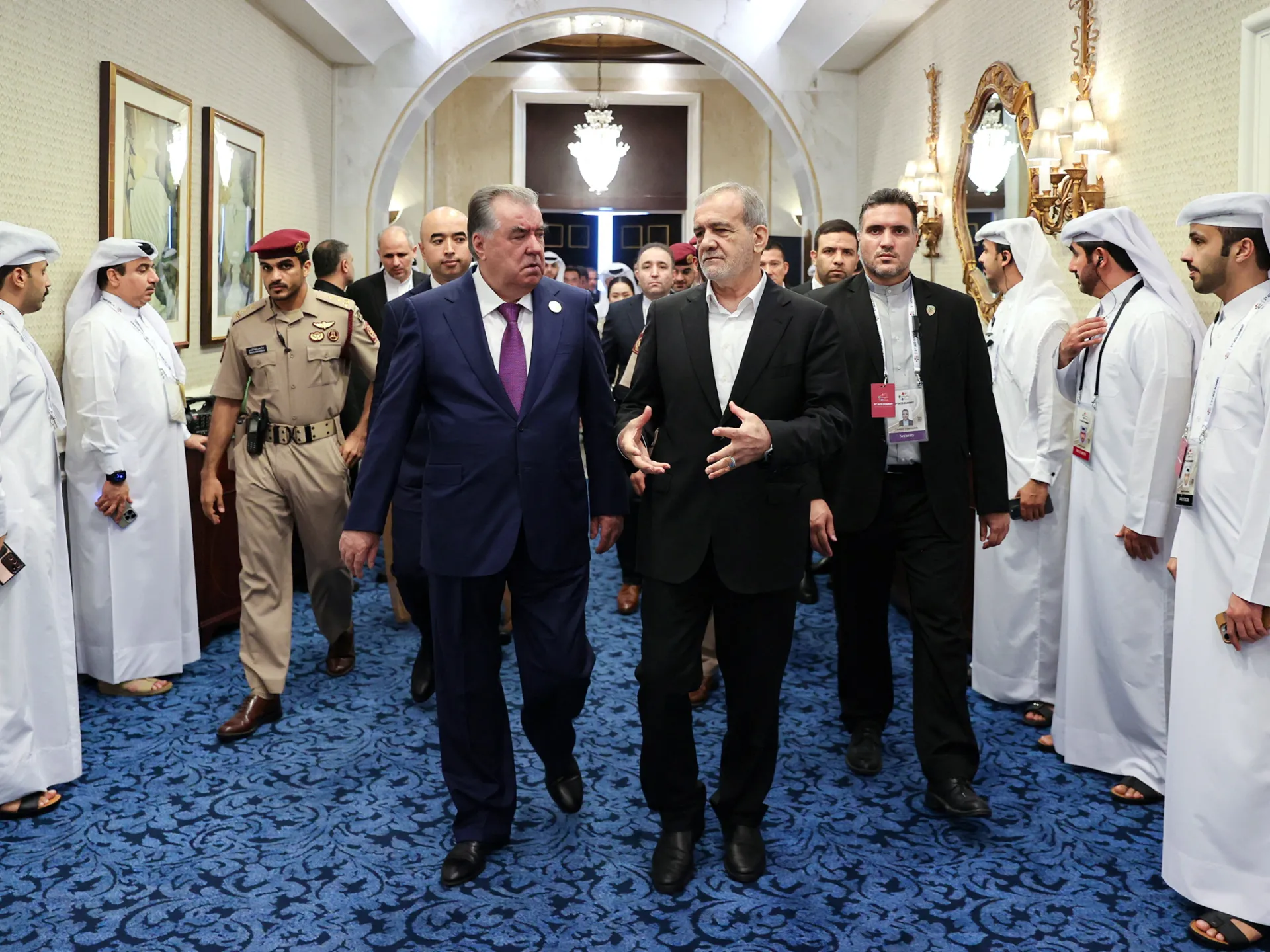
Besides Tajikistan, Iranian President Masoud Pezeshkian welcomed a proposal from Kyrgyzstan in August to establish a joint refinery in the Central Asian country, according to a report by Iran’s Tasnim news agency,
Under the agreement, Pezeshkian said, “The crude oil needed by the refinery can be supplied by Iran, and the products can be divided between the two sides.”
Will exporting oil to Central Asian countries help Iran?
The United States and Israel’s war on Iran has affected Tehran’s oil revenues. Data released by the government-administered Statistical Center of Iran in September showed that gross domestic product (GDP) shrank by 10.1 percent year-on-year between March 21 and June 20, the first quarter of the Persian calendar.
Tehran’s ability to sell crude has also been dramatically curtailed by the US naval blockade of Iran’s ports, imposed for most of the war, which began in late February.
Iranian crude and condensate loadings collapsed from about two million barrels per day (bpd) in March to roughly 740,000bpd in July and just 220,000-255,000bpd in August, according to estimates from Kpler and Vortexa.
TankerTrackers.com told the Reuters news agency in September that 29 tankers, carrying 36.11 million barrels of crude, were trapped in the Strait of Hormuz. Meanwhile, Vortexa estimated that total Iranian crude afloat had fallen from 135 million barrels at the end of July to 107 million barrels by late August.
Amid these challenges, Iran has been scrambling to find new countries to trade oil with. Russian fuel shortages have opened up new opportunities for Iran in Central Asia, at least in the short term, according to analysts.
How does Iranian oil reach Tajikistan and Kyrgyzstan?
Iran does not share a border with either country.
To get to Tajikistan, Iranian “oil and refined products have to cross Turkmenistan and Uzbekistan by rail”, said Frederic Schneider, a nonresident senior fellow at the Middle East Council on Global Affairs.
To get to Kyrgyzstan, Iranian oil would also need to pass through Turkmenistan and Uzbekistan.
Is trading oil with Iran logistically sustainable for Central Asia?
It is unlikely, Schneider said.
“This opportunity [for Iran] depends on Ukraine continuing to hit Russian refineries, which seems unlikely, both given the waning of Ukraine’s strike capability and the US government’s demand to stop the attacks as they put too much strain on global oil markets,” he told Al Jazeera.
He noted that US President Donald Trump has pressed his Ukrainian counterpart, Volodymyr Zelenskyy, repeatedly in September for an “energy truce” with Russia, since diesel prices have become a political problem for Trump ahead of the November midterm elections in the US.
“Those truces have so far collapsed within hours, but the direction is clear. Once the strikes stop, or once Russia repairs its plants, Russian fuel will come back to Central Asia duty-free under Eurasian Economic Union arrangements, and Iran will struggle to compete on price,” he said.
Logistics also favour Russia with respect to importing oil to countries like Tajikistan and Kyrgyzstan, he said.
Unlike Iran, Russia shares a border with both.
“Tajikistan’s own request [for oil] would need around 51,000 rail tank cars, and its main refinery at Dangara has never operated commercially at scale. Russia, by contrast, has decades’ worth of logistics infrastructure, pipelines, rail links, and supply contracts into the region,” Schneider said.
Is Central Asia a big enough market to compensate for Iran’s Hormuz losses?
No, according to Schneider.
Tajikistan’s total demand, Schneider said, was about 50,000bpd.
That is a drop in the ocean compared with the 1.7 million bpd Iran exported by sea a year ago. China reported $9.96bn in two-way trade with Iran in 2025, a figure that does not include some $31.2bn in Iranian oil shipments, according to the US-China Economic and Security Review Commission.
“This suggests that Central Asia can be a useful outlet for Iranian diesel and gasoline, but it cannot replace the Chinese market,” Schneider said.
For Tehran, Central Asia’s importance depends on how the US-Israel war on Iran develops, he said, adding that Tehran also needs to stay on good terms with Russia, with which it has a deep strategic partnership.
“Iran cannot afford to be seen as poaching Russian customers too aggressively, so it will present itself as a stopgap supplier, which, again, limits how much it can earn there,” he said.
What other risks does Central Asia face in buying Iranian oil?
Schneider warned that Central Asian nations could be hit with Washington’s secondary sanctions on Iran.
“Legally, US secondary sanctions apply to any foreign company or bank that conducts a significant transaction in Iranian petroleum, wherever it is based, and the Treasury expanded the list of sanctionable conduct in August. A Treasury official has already warned publicly that anyone in this trade ‘incurs that risk themselves’,” he noted.
But Schneider said that, politically, the US sanctioning Central Asian governments is unlikely.
“Central Asia is the arena of a new ‘Great Game’ between Russia, China and the United States, and Washington is courting the region harder than at any point since the 1990s, chiefly for its critical minerals. Kazakhstan alone holds about half of the minerals the US classifies as critical, including uranium and tungsten,” he said.
“Sanctioning a Central Asian government for buying fuel from Iran would push them straight back into closer ties to Russia and China,” he noted.
“What I would expect instead are targeted designations of individual traders, rail and logistics operators and smaller banks, combined with quiet pressure on the region’s correspondent banks. That alone is enough to raise the cost and slow the trade, but will come at the price of these countries redoubling their efforts to decouple economically and financially from the US.”
Paul Whitehouse hopes heart stents ‘aren’t going to be the cause of my demise’
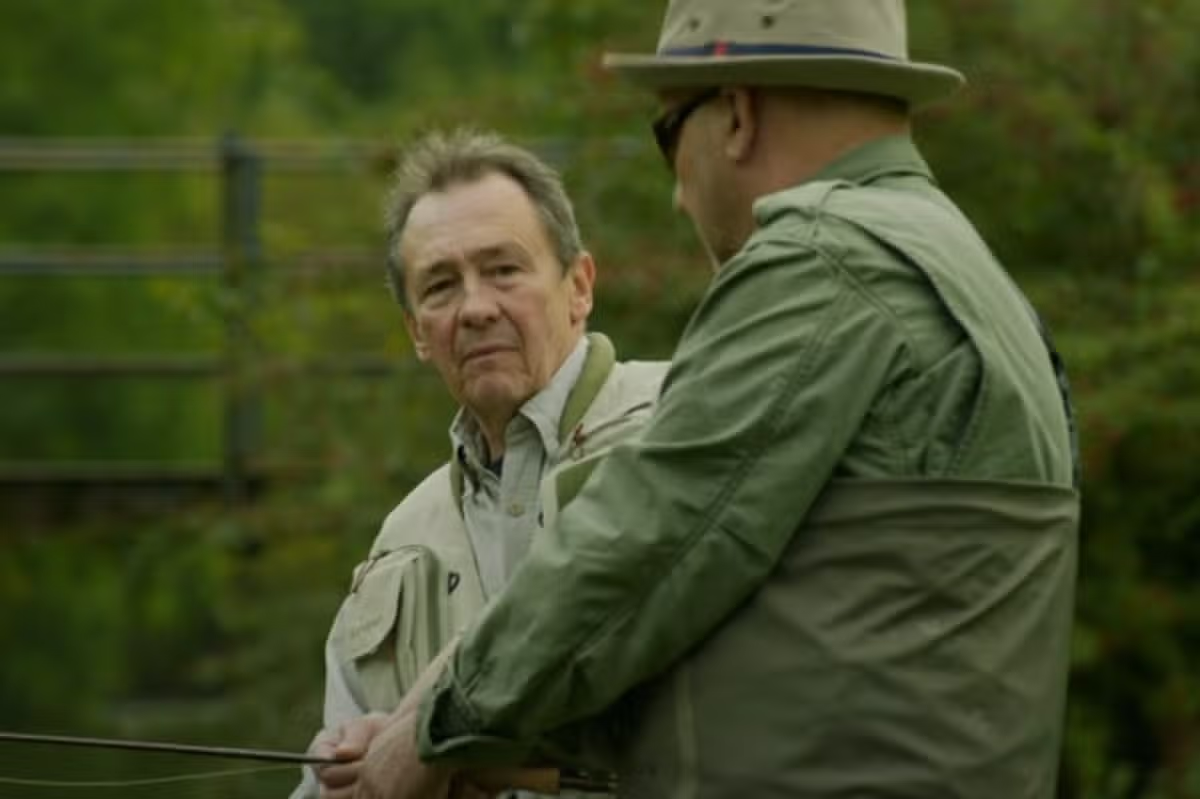
Paul Whitehouse joked his three heart stents would outlast him as he discussed his health with Bob Mortimer on Mortimer & Whitehouse: Gone Fishing.

Paul Whitehouse has been open about his mortality (Image: BBC)
Comedian Paul Whitehouse opened up about the “very difficult” changes he has had to make to his health.
Welsh actor Paul Whitehouse shared his hope that his heart stents would not be the cause of his death during a candid conversation with Bob Mortimer on Mortimer & Whitehouse: Gone Fishing. The comedian, who had three stents fitted in 2015, said: “I think they are going to outlast me.
“Like I bought a sofa recently that’s probably going to outlast me, Bob. And I like to think my stents aren’t going to be the cause of my demise, you know?” His remarks came after Bob suggested that, although the stents needed no upkeep, they might eventually need replacing.
Paul’s heart disease was discovered following life-saving bowel surgery and the conversation surrounding his health featured in the third episode of the BBC programme’s first series, which saw Paul introduce Bob to fly-fishing for wild rainbow trout in Derbyshire. The pair spoke about their diets, before attention turned to Paul’s stents.
Asked how the stents worked, Paul offered a characteristically humorous explanation: “Some sort of very high-tech, futuristic kind of steel sleeve. They put it in, blow it up, leave it. Get on with it. Let this man carry on delighting millions.” Bob was also keen to know what adjustments Paul had been asked to make after his treatment.
“What had to change, obviously, is diet,” Paul admitted. “But it’s very difficult to resist a mini chocolate doughnut, for example, isn’t it?” Both comedians have experienced serious heart problems, and their shared health struggles inspired the fishing series, which is currently being repeated on BBC Two.
Bob had an emergency triple heart bypass in October 2015 after learning that 95% of his arteries were blocked. The pair’s daily health routines also featured in the episode. At the start, Bob played solemn music on his laptop while Paul listed all of his medication as he took it.
Away from the series, Whitehouse has been open about his stents and how he feels “lucky to be alive” after the operation. He told Saga Magazine: “In many ways I was lucky. When I had the heart stents, the guy who did it said, ‘Well I didn’t put them in for you to go and sit by the fire, so get up and go out’.
“I took him at his word, so I do a lot of exercise to keep myself ticking over.” In a Radio Times interview back in 2015, the star was asked whether he reflected on his own mortality, to which he replied: “Well, I should probably die. Although, there is a school of thought that thinks I will live forever.
“I mean obviously there are things in the world that make me very anxious but I don’t worry about illness. I don’t particularly worry about that. I worry much more about mental illness than physical illness. Again I wouldn’t say I lie awake at night worrying about what mental illness I might be afflicted with in future.”
Also previously speaking to GQ Magazine, the comedian said he was keen to be an advocate for heart health awareness, sharing: “It is because it is a heart attack decade. If you don’t get a scare in your fifties, you’re lucky. Because you either have a heart attack and die or you have problems that flag up serious issues.
“As your doctor, Chris Young put it: angina is the heart consultant’s friend because it is a warning sign at least. If you don’t get that, you could get a heart attack, which could be fatal, or you might be one of these people like Glenn Hoddle who think of themselves as fit, but actually get to 60 and discover they have a heart problem.”
The episode of Mortimer & Whitehouse: Gone Fishing airs tonight on BBC Two at 10pm

Blue Owl plans ‘big push’ into insurance capital: FT (OWL:NYSE)
- Blue Owl (OWL) is planning to increase the amount of insurance capital under its management, the Financial Times reported, citing comments from co-chief executive Doug Ostrover at a summit.
- “We’re realising that if we had a bigger pool of capital, meaning

High school flag football: Monday and Tuesday scores
MONDAY’S RESULTS
City Section
Carson 19, Narbonne 12
El Camino Real 12, Cleveland 0
Los Angeles Roosevelt 19, Huntington Park 0
South Gate 26, Bell 22
Southern Section
Alemany 34, Flintridge Sacred Heart 7
Anaheim 38, Rancho Alamitos 7
Aquinas 33, Arrowhead Christian 0
Bellflower 14, Mayfair 12
Bell Gardens 20, Keppel 8
Bishop Montgomery 32, Cantwell-Sacred Heart 6
Bolsa Grande 36, Century 0
California Military Institute 42, San Jacinto Valley Academy 0
Canyon Springs 18, Riverside North 12
Carter 24, Colton 0
Cathedral City 19, Banning 6
Cerritos 30, La Mirada 0
Chaparral 19, Great Oak 0
Compton 25, Long Beach Cabrillo 8
Corona Santiago 21, Norco 14
Covina 33, Rowland 6
Cypress 13, Canyon Country Canyon 12
Eastvale Roosevelt 12, Corona Centennial 6
Eastvale Roosevelt 30, Riverside King 25
Edison 25, Corona del Mar 19
Eisenhower 26, Bloomington 18
El Rancho 7, Schurr 6
El Toro 22, Beckman 12
Etiwanda 68, Los Osos 0
Fullerton 22, Garden Grove 7
Gahr 34, California 18
Garden Grove 28, Savanna 6
Glenn 34, Whitney 0
Godinez 15, Buena Park 14
Hacienda Heights 18, Charter Oak 0
Hemet 13, Hillcrest 6
Heritage 44, Citrus Hill 0
Indio 33, Xavier Prep 6
Irvine 19, Newport Beach Pacifica Christian 12
La Canada 38, Temple City 12
Lakewood 20, Long Beach Jordan 0
Lakewood St. Joseph 40, Quartz Hill 0
La Palma Kennedy 33, Laguna Hills 26
La Quinta 32, Rancho Mirage 0
Linfield Christian 34, Ontario Christian 14
Loara 8, Orange 7
Long Beach Poly 31, Millikan 6
Los Alamitos 40, Marina 0
Los Altos 13, Colony 12
Los Amigos 13, Westminster 6
Montebello 19, Alhambra 7
Moreno Valley 15, Arlington 13
Mountain View 39, El Monte Arroyo 0
Murrieta Mesa 24, Murrieta Valley 2
Newport Harbor 34, Fountain Valley 0
Nogales 6, Garey 0
Norco 33, Corona 24
Norwalk 26, Pioneer 6
Ocean View 7, Katella 0
Orange Vista 19, Liberty 13
Palm Desert 19, Desert Hot Springs 6
Paloma Valley 19, Rancho Verde 15
Paramount 6, Artesia 0
Patriot 50, Norte Vista 0
Placentia Valencia 20, Estancia 0
Pomona 14, Edgewood 0
Ramona 19, La Sierra 7
Ramona Convent 12, St. Bernard 6
Rancho Cucamonga 14, St. Lucy’s 7
Rosemead 6, El Monte 0
San Marino 27, Gabrielino 7
Santa Ana Foothill 26, Garden Grove Pacifica 20
Santa Ana Valley 20, Western 7
Segerstrom 20, Westminster 12
Shadow Hills 18, Palm Springs 6
Sonora 7, Villa Park 0
South El Monte 27, San Gabriel 0
South Hills 45, San Dimas 8
St. Margaret’s 40, Laguna Beach 19
St. Paul 54, Sacred Heart of Jesus 0
Summit 19, Jurupa Hills 6
Sunny Hills 19, El Dorado 13
Upland 7, Chino Hills 0
Temescal Canyon 32, Jurupa Valley 6
Temecula Prep 32, Nuview Bridge 6
Tesoro 33, Dana Hills 0
Tustin 20, Costa Mesa 0
Valley View 19, Lakeside 0
Vasquez 26, Palmdale 6
Victor Valley 36, Fontana 0
Vista Murrieta 18, Temecula Valley 6
Warren 36, La Serna 34
West Covina 21, Northview 0
Whittier 33, Oxford Academy 12
Woodbridge 35, Sage Hill 7
Woodcrest Christian 7, Riverside Notre Dame 0
Workman 30, Bassett 0
Yorba Linda 32, Crean Lutheran 14
TUESDAY’S RESULTS
Southern Section
Adelanto 15, Victor Valley 0
Agoura 14, Oaks Christian 7
Alhambra 39, El Monte 0
Alta Loma 13, Colony 0
Antelope Valley 6, Lancaster 0
Antelope Valley 12, Lancaster 7
Arroyo Valley 6, Indian Springs 0
Banning 19, Entrepreneur 14
Bishop Amat 28, South El Monte 0
Bonita 14, Ayala 12
Brentwood 7, SEED LA 0
Brentwood 33, Shalhevet 6
Cajon 13, Redlands East Valley 12
California Military 32, Riverside Notre Dame 12
Camarillo 38, Moorpark 7
Canyon Country Canyon 20, Golden Valley 12
Capistrano Valley 32, Irvine 26
Castaic 32, Saugus 0
Cerritos Valley Christian 61, Vista Meridian 0
Chaminade 26, Louisville 0
Channel Islands 25, Santa Barbara 9
Chino Hills 38, Los Osos 8
Dos Pueblos 14, San Marcos 6
Eastside 22, Knight 6
Etiwanda 45, St. Lucy’s 0
Glendora 32, Claremont 19
Grand Terrace 26, Carter 13
Hart 14, West Ranch 0
Harvard-Westlake 32, Alemany 14
Hemet 19, Riverside North 7
Heritage 29, Rancho Christian 14
Highland 19, Palmdale 13
Hueneme 39, Santa Paula 27
JSerra 40, Mater Dei 12
Kaiser 13, Summit 0
Loma Linda Academy 53, Calvary Baptist 0
Miller 7, Norte Vista 0
Mission Viejo 7, Trabuco Hills 6
Montclair 20, Chaffey 6
Moreno Valley 40, Lakeside 13
Newbury Park 25, Calabasas 0
North Torrance 19, Long Beach Jordan 0
Ontario 6, Don Lugo 2
Orange Lutheran 18, Santa Margarita 6
Oxnard 54, Rio Mesa 6
Oxnard Pacifica 39, Del Sol 0
Pacific 19, Jurupa Valley 12
Paloma Valley 56, Orange Vista 14
Pasadena Poly 31, Westridge 14
Patriot 24, Ramona 0
Quartz Hill 2, Littlerock 0
Rancho Cucamonga 32, Upland 24
Rancho Verde 35, Citrus Hill 6
Redlands 20, Citrus Valley 13
Rialto 12, San Gorgonio 6
Riverside Poly 31, Hillcrest 12
San Bernardino 46, Rubidoux 0
San Clemente 34, San Juan Hills 14
San Dimas 32, Los Altos 12
Sierra Canyon 41, Sherman Oaks Notre Dame 14
Simi Valley 25, Royal 7
Sr. Bonaventure 40, Oak Park 0
Sunny Hills 38, Loara 6
Tahquitz 25, Elsinore 12
Temescal Canyon 7, West Valley 6
Torrance 19, West Torrance 0
Valley View 27, Vista del Lago 26
Ventura 35, Buena 0
Western Christian 38, Fairmont Prep 0
Westlake 46, Thousand Oaks 0
Windward 54, YULA 0
Yemen’s Houthis attack Aden airport; Saudi forces down missile near Riyadh | US-Israel war on Iran News
Yemeni government says one of the missiles hit Aden airport’s runway minutes before a flight from Cairo was due to land.

Published On 7 Oct 2026
Yemen’s internationally recognised government has accused the Houthis of firing ballistic missiles and drones at the main international airport under its control, as Saudi Arabia said it had intercepted another missile north of its capital, Riyadh.
In a statement on Wednesday, the Ministry of Transport said the Houthis targeted the runway and passenger terminal at the airport with at least two ballistic missiles and several drones.
Recommended Stories
list of 3 itemsend of list
“One of the missiles landed near the runway minutes before the Yemeni flight from Cairo was to land,” it said. “We cancelled the landing of the incoming flight from Cairo [in Egypt] and diverted its route to Jeddah [in Saudi Arabia] to protect the passengers.”
The ministry also said it evacuated the airport terminal and removed two planes from the tarmac during the attacks.
It added, “This incident could easily have turned a civilian flight into a horrific humanitarian disaster, claiming the lives of dozens of innocent people in an instant.”
Aden airport is the main international gateway for parts of Yemen outside Houthi control in the city that has been the seat of the government since the takeover of the capital, Sanaa, by the Iran-supported group in 2014.
The Houthis said in a statement they targeted “Saudi military supplies” arriving at the Badr camp near the airport with ballistic missiles. Saudi Arabia backs Yemen’s government.
Separately, the Saudi-led military coalition fighting in Yemen said it intercepted and destroyed a ballistic missile, launched by the Houthis, north of Riyadh.
In a social media post, Major-General Turki al-Maliki, the spokesperson for the Saudi-led coalition, said it was tracking the launch platform used in the attack via an intelligence system over Sanaa, and promised to destroy it.
The Houthis said in statements on Tuesday and overnight into Wednesday that they had targeted Saudi international airports in Riyadh and Abha.
The intensified fighting in Yemen comes amid mounting regional tensions set off by the US-Israel war on Iran. The Saudi-backed government forces launched a counteroffensive against the Houthis to retake the Red Sea port of Mocha and areas around the Bab al-Mandeb strait.
Fighting has concentrated in the southwestern province of Taiz.
Al Jazeera’s Yousef Mawry, reporting from Sanaa, described “all-out battles to take over the ground, the highlands and the mountains east of Bab al-Mandeb”.
“It’s a battle to take over the strategic western part of Taiz, and whoever controls the wider vicinity will overlook the region and have dominant military control,” he said.
“For the Yemeni government to take control of Mocha and the strategic bases and locations along the Red Sea coast, it first has to drive the Houthis off the mountains east of Mocha.”
Pakistan and Turkiye on Monday agreed to activate “deterrence measures” under their mutual defence pact with Saudi Arabia and rapidly deploy forces to the Gulf kingdom to counter Houthi attacks.
Glaring Holes In UK Air Defense Take Center Stage In New “Britannia Shield” Proposal
The United Kingdom could be heading toward its most significant expansion of ground-based air defense in generations, under a plan announced by the Conservative Party. For now, however, with the Conservatives in opposition, the proposed £10 billion (about $13.3 billion) “Britannia Shield” exists only as a policy commitment rather than an approved government program. At the same time, it highlights the seriousness of U.K. military deficiencies in this area, as the threat from the air continues to grow.
The proposal will move into the U.K. Ministry of Defense acquisition system if the party returns to government following the next general election and then follows through on the funding and procurement decisions required to turn the pledge into an operational capability. The party has proposed spreading the investment over a decade, with an initial capability intended to emerge during the first term of a future Conservative government and the wider network established after that.
Britannia Shield comes with the character of the air threat facing Europe having changed dramatically over the last decade. Russia’s war in Ukraine has demonstrated the scale at which relatively inexpensive drones can be employed alongside cruise and ballistic missiles, while recent fighting in the Middle East has clearly shown the costs involved in maintaining a sophisticated, layered air defense system under sustained attack. At the same time, the threat is no longer confined to weapons fielded by major state militaries. Small, widely available drone technologies can be weaponized with relative ease by non-state actors, providing a cheap and potentially highly scalable means of attack.

For Britain, which has traditionally relied heavily on fighter aircraft, naval air defense, and the protection provided by geography and NATO, it is increasingly doubtful whether those capabilities provide enough coverage for the infrastructure that would be most important to keep functioning during a major conflict.
While a party press release refers to it directly, Conservative leader Kemi Badenoch has made efforts to distinguish Britannia Shield from a British version of Israel’s Iron Dome.
Iron Dome has become one of the best-known elements of Israel’s layered air defense network, having been developed primarily to deal with short-range rockets, artillery, and mortar rounds threatening populated areas. The system has evolved, however, and newer configurations can also engage threats including cruise missiles and drones. Importantly, Israel’s Iron Dome systems protect a country a twelfth of the size of United Kingdom and deal with only a portion of the potential threats in critical areas.

Iron Dome
Mention should also be made of the U.S. Golden Dome missile defense initiative, which envisions integrating sensors, interceptors, and other defensive capabilities as part of an enormous architecture with a greater emphasis on protecting the U.S. against a range of aerial and missile threats, up to and including intercontinental ballistic missiles.
Talking to the BBC, Badenoch argued that Britain does not face the same kind of persistent rocket and missile threat as Israel and therefore does not require an equivalent level of coverage. Instead, the Conservative proposal is intended to combine improved radar, command and control, interceptor missiles, and counter-drone capabilities into an integrated network designed around the threats Britain is considered most likely to face.
Britain already has some of the components that such a system could leverage. Royal Navy Type 45 destroyers — when they are available — provide a highly capable long-range air-defense layer through Sea Viper missiles, while the Army’s Sky Sabre system uses CAMM missiles for shorter-range engagements. The RAF provides combat aircraft and airborne surveillance capabilities, and Britain is integrated into NATO’s wider air and missile defense architecture. The problem is that these capabilities were not designed to provide a dense, permanent defensive umbrella over critical infrastructure, and the ground-based component in particular remains relatively limited when compared with the scale of the potential target set. There is also the reality that these assets are required to defend locales far from the British Isles themselves.

The government’s own 2025 Strategic Defense Review acknowledged that changing threat environment, allocating up to £1 billion in new funding for homeland air and missile defense and calling for improvements to the United Kingdom’s wider integrated air and missile defense architecture. Britannia Shield would therefore be a much larger political commitment to expanding and integrating capabilities that already exist, while adding new layers intended to deal with the growing drone and missile threat.
The £10 billion figure provides little idea of the scope of capabilities. The scale of the proposed system will determine whether that additional money represents a major expansion or simply the beginning of a much larger requirement.
Gen. Sir Richard Barrons has previously estimated that an entry-level system of the kind outlined could cost around £80 billion over a decade, illustrating how quickly the cost can rise once the requirement expands from protecting selected sites to providing something approaching comprehensive national coverage.
Badenoch’s description of the threat instead points toward a system in which Britain would identify the infrastructure and military facilities most important to national resilience and then build increasingly dense layers of protection around them. That would include major airbases, ports, energy infrastructure, communications facilities, and other critical nodes, rather than attempting to create a continuous defensive bubble over the entire country.

Such a system would also have to account for the fact that the location of the launch platform can be as critical as the weapon itself. Badenoch described a scenario in which an adversary could operate in the English Channel to launch drones or missiles against targets in Britain. The resulting reduction in warning time would place greater demands on sensors and command systems, but it would also mean that the defensive problem could begin well before an incoming weapon reached British airspace. Maritime surveillance, intelligence collection, fighter aircraft, and naval forces could all potentially contribute to detecting or disrupting a launch platform before it had the opportunity to fire.

That broader approach is particularly important because the economics of countering drones are fundamentally different from those associated with conventional air defense targets. A system that responds to inexpensive drones by firing a sophisticated interceptor costing hundreds of thousands or millions of dollars would rapidly become unsustainable during a large attack. Any serious British architecture would therefore need several layers, with electronic warfare, guns, low-cost interceptors, and other counter-drone systems, potentially including directed-energy weapons, dealing with the lower end of the threat wherever possible. Meanwhile, more expensive surface-to-air missiles would be preserved for cruise missiles, aircraft and other targets that cannot be economically engaged by cheaper means.

The recent situation at RAF Fairford adds another dimension to that problem. The United States recently withdrew a dozen B-1 bombers from the Gloucestershire base amid reported concerns about a possible Iran-backed attack, after U.S. officials said commanders had received new information about a potential plot. British authorities maintained that the base was safe, while British sources reportedly questioned whether Iran could reproduce the kind of complex operation carried out by Ukraine against Russian airfields in 2025. The episode nevertheless demonstrated the degree to which even a major military installation can become a concern when an adversary is believed to be looking for unconventional ways to reach it.

That brings Operation Spiderweb into the discussion, although there is no public evidence that Iran is preparing a comparable operation against Britain. Ukraine’s June 2025 attack was prepared over roughly 18 months and involved small drones being moved deep into Russia inside containers carried by trucks before being launched remotely against military airfields. The operation illustrated that once relatively cheap drones have been positioned close to their targets, the defender may have little opportunity to intercept them through traditional long-range air defense means. This is exactly a scenario we have been warning of for many years.
For Britannia Shield, that means protecting an airbase such as RAF Fairford cannot simply be a matter of installing missile batteries. Physical security, counter-intelligence, surveillance of access routes, low-level drone detection, electronic warfare and the ability to identify suspicious activity before an attack begins would all become part of the same defensive problem. Hardened infrastructure would also be essential, helping to protect aircraft, fuel, munitions, command facilities and other critical assets from attacks that penetrate the outer layers of the defense. The distinction is increasingly important as military aircraft themselves become more valuable and as relatively inexpensive unmanned systems demonstrate their ability to threaten aircraft on the ground without ever having to penetrate the surrounding air defense network.
The new British proposal also becomes more complicated because its intended coverage extends beyond the British mainland. Badenoch has specifically referred to defending installations in Cyprus and the Falkland Islands, which introduces a very different set of operational and logistical requirements. A network supporting critical infrastructure in Britain can draw on dense communications infrastructure, nearby industrial support and the wider NATO system, whereas a defensive capability at RAF Akrotiri or in the Falklands requires its own radar coverage, launchers, personnel, ammunition stocks, and sustainment arrangements. Extending the same architecture across those locations would therefore consume considerably more resources.

A similar problem exists with ammunition stocks. Ukraine has repeatedly demonstrated that sophisticated air defenses can come under sustained pressure during large missile and drone attacks, while Western countries have struggled to replenish some categories of precision-guided weapons at anything approaching wartime consumption rates. A British system that looks impressive on paper but has only a small stockpile of interceptors would provide much less meaningful protection during a prolonged campaign, particularly if an adversary deliberately attempted to exhaust the defenses through repeated attacks using inexpensive drones.
Ukraine also offers lessons for how Britain could organize such a network. Mobile air defense teams, distributed sensors, acoustic detection systems, and digital applications that connect air defense operators with military units and civilian spotters have all become increasingly important in Ukraine, where defenders have had to detect and respond to large numbers of drones and missiles across a wide area. There are echoes here of the distributed air defense networks developed during World War II, when observers, radar operators, fighter controllers, and anti-aircraft units were linked together to provide early warning and direct defensive responses. As in 1940, Britain would need an air defense network that is distributed, mobile, and adaptable to new threats.

The most revealing details of Britannia Shield are yet to be provided. The number of defended sites, the types and numbers of radars, the number of launchers, the size of interceptor stocks, and the proportion of the budget devoted to counter-drone capabilities all remain unclear for now. The same applies to the money required for training, maintenance, software, communications, and replenishment across the life of the system.
There is also a straightforward political limitation to the proposal. The Conservatives have pledged to invest in Britannia Shield as part of a broader plan to increase defense spending, but that money is not currently sitting in a government procurement account waiting to be spent and defense budgets are increasingly stretched by other big-ticket programs. The Conservatives would first have to return to government, establish the program as a formal requirement, and then make the associated spending and procurement decisions. Even if those steps were taken quickly, the most capable elements of the system would take years to design, procure, integrate, and deploy.

Whether £10 billion would ultimately be sufficient depends on the mission the future government assigns to the system. If Britannia Shield were expected to provide nationwide protection against sustained attacks involving ballistic missiles, cruise missiles, and large numbers of drones, the budget would fall far short, particularly once interceptor stocks and long-term sustainment are included. If it is designed as a layered network protecting a defined group of critical infrastructure sites and military bases, integrated with the RAF, Royal Navy, Army, and NATO systems already in place, the proposal becomes more realistic, but it wouldn’t address higher-end threats, like longer-range ballistic missiles.
That limitation is particularly significant when considering Russia, which remains the most serious military threat to the United Kingdom and its European allies. From what we know so far, Britannia Shield is heavily focused on drones and shorter-range missile threats, but Russia possesses a much broader strike arsenal that includes ballistic missiles, cruise missiles, and hypersonic weapons. A British air defense program that concentrates primarily on the lower and middle tiers of the threat therefore leaves a significant gap at the upper end of the spectrum.

The United Kingdom is also not considering this problem in isolation. Across Europe, governments are increasingly pursuing multinational efforts to strengthen air and missile defenses, as the return of large-scale state-on-state warfare and the experience of the war in Ukraine have made the vulnerability of European infrastructure and military forces much more tangible. Nearly three decades after the end of the Cold War, ballistic and cruise missile defense has once again become a central European security requirement. Britannia Shield would therefore need to be considered not only as a national counter-drone and air-defense program, but as part of a much broader European effort to rebuild layered air and missile defenses against the full range of modern threats.
The experience of Ukraine and the Middle East suggests that Britain is unlikely to solve this problem simply by buying more surface-to-air missiles. Increasingly, air warfare relies on complex networks that find the attacker, identify the weapon, choose the appropriate response, and undertake this all at a cost that can be sustained throughout a conflict. That network also has to extend beyond the airspace itself, because the threat may involve a launch platform approaching the coast, a drone operator operating near a military installation, or small drones already hidden inside the defender’s security perimeter.

With their proposed reorientation of Britain’s air defense priorities, the Conservatives have put a financial value and a recognizable name around a capability gap that has become increasingly difficult to ignore. If they return to government, there will be many tougher questions to address, including which sites should receive protection, how many layers are required, how much ammunition must be held in reserve, and how the system can be sustained on a wartime footing.
The recent concerns surrounding RAF Fairford, together with the lessons of Operation Spiderweb, underline why that question is becoming more complicated. The next serious attack on a British military installation may not arrive as a large formation of aircraft or a visible wave of missiles crossing the Channel. It could involve a mixture of long-range weapons, cheap drones, electronic warfare, and hybrid warfare activity taking place much closer to the target. A future Britannia Shield would have to be designed around that reality, and would come with a price tag to match.
Contact the author: thomas@thewarzone.com