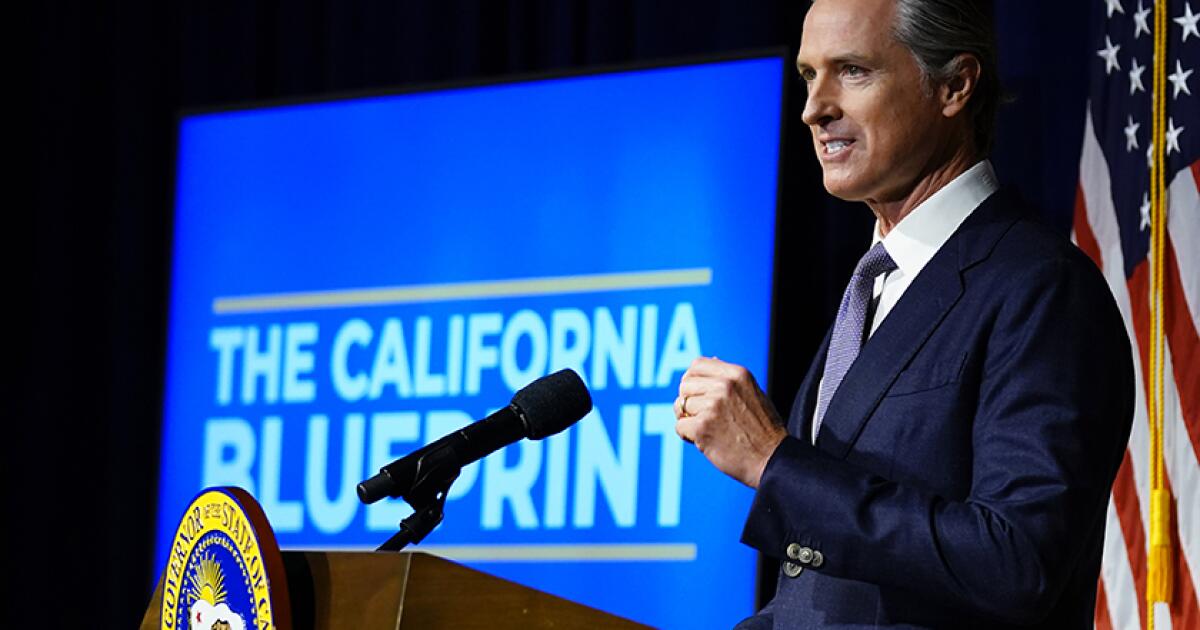
SACRAMENTO — Gov. Gavin Newsom plans to spend $19 million promoting California and dispelling “myths driven by misinformation and political rhetoric” in a marketing campaign that would run through the final months of his administration as he weighs a potential run for president.
The new contract, which is in the bidding process, comes as Newsom’s political future and national standing are closely tied to how voters view California’s economy, crime and quality of life — issues that have become central to attacks from President Trump and conservative media outlets.
The Governor’s Office of Business and Economic Development is seeking a contractor to design a statewide taxpayer-funded “California Brand Campaign,” with two-thirds of spending under the proposal to be used for paid advertising and media placements. Bidding on the contract opened Feb. 24 and is expected to end March 13.
The solicitation frames the campaign as an effort to push back on what Newsom has often described as misleading narratives about California. The campaign would launch during a period of financial uncertainty for the state, with Newsom’s January budget projecting a $3-billion deficit next fiscal year.
“California and its business climate have been falsely and maliciously maligned for years, and the state has a right to tell the true story — California is a great place to do live, work, invest and visit,” said Newsom spokesperson Tara Gallegos. “Setting the record straight will benefit every business, worker and resident of this state.”
Newsom is contemplating a run for president in 2028 and says he remains undecided about whether he will pursue the Oval Office.
State Sen. Roger Niello (R-Fair Oaks), who is vice chair of the Senate budget committee, said the language of the proposal request is concerning. He said it would make it easier to stifle criticisms of policies that he says make it difficult to do business in California.
“This is clearly part of the Gavin Newsom for President campaign, but what is most troubling to me is that this is a program to be developed by some private-sector contractor to define what is acceptable speech in the state of California,” Niello said. “That scares the stuffing out of me.”
The negative image of California — homeless encampments lining the streets, smash-and-grab robberies at malls and an exodus of residents and businesses fleeing high taxes and nanny-state governance — could be a liability for Newsom if he runs for president.
Newsom has seen his popularity surge in the last year after his fight-fire-with-fire approach to countering Trump’s rhetoric. The two-term governor has used his expanding platform, including a podcast and nationwide book tour for his recently released memoir, to repeatedly push back on Trump’s criticisms of California. He argues that California remains one of the world’s largest and most dynamic economies and the envy of other states.
The tone of the marketing campaign bid request itself echoes that message, with its introductory paragraph pulled directly from Newsom’s State of the State speech in January.
“California has never been about perfection,” it reads. “It’s about persistence. The courage of our convictions and the strength to embody them. That’s the California Way.”
Mike Madrid, a Republican strategist who runs the research nonprofit Latino Working Class Project, said scrutiny of the campaign will depend on whether the ads veer into politics or overtly promote Newsom in the way federal border security ads showcased the now ousted Homeland Security Secretary Kristi Noem.
“You have to ask why now?” Madrid said of Newsom’s timing for the California ad campaign. “He’s in the eighth inning of a nine-inning baseball game. Timing and tone are everything when considering the appropriateness.”
The use of taxpayer dollars to combat negative publicity about the state and the governor isn’t new under the Newsom administration.
Newsom tapped an employee in his communications office to serve as his “deputy director of rapid response” in 2024. Staff member Brandon Richards, who made $136,000 last year, is tasked with quickly dispatching responses to information the governor’s team deems inaccurate or misleading that is spread on social media and in the media.
When right-wing accounts claimed in February that Newsom allows dogs to vote in California, Richards responded with a CBS News article reporting that a woman was charged with five felonies for registering her canine. Richards and the governor’s office pushed back on false assertions that Newsom and his wife, First Partner Jennifer Siebel Newsom, were stealing money from the state through her office that same day.
Newsom’s frustration reached a boiling point over claims about the state’s response to the Los Angeles wildfires last year. President Trump publicly blamed Newsom and “his Los Angeles crew” for the disaster, though the Republican’s claims that a lack of water in Southern California led to a shortage for firefighters were widely debunked.
Newsom’s political team launched a website in January 2025 to fight misinformation about the L.A. fires, which he said at the time would “ensure the public has access to fact-based data.” The site, www.californiafirefacts.com, no longer appears to exist.
At one point, however, it redirected viewers to the redistricting campaign website for Proposition 50, according to internet archives. Newsom championed the successful redistricting ballot measure to add more Democrats to California’s congressional delegation, a direct response to Trump urging Texas and other Republican states to reconfigure their congressional boundaries to elect more Republicans to Congress.
Newsom adopted an even more aggressive social media strategy last summer after Trump deployed the National Guard and U.S. Marines to California during federal immigration sweeps. The governor directed his team to match the brash communication tactics emanating from the White House. His aides continue to shoot down criticism and launch their own snarky assaults on Trump and his allies.
The new ad campaign appears to be an extension of his work to refute the anti-California narrative.
The request for bids says “some look at this state and try to tear down our progress. They attack our values and caricature our culture. They distort the data to diminish our accomplishments.”