Californias

California’s plastic bill faces challenges from federal court and GOP attorneys general

California’s landmark single-use plastic law is slowly being eroded by pressures within the state. Now legal attacks from outside threaten to kneecap it entirely.

Earlier this month, a federal district court judge in Oregon put parts of its single-use plastic law, which is similar to California’s, on hold while he decides whether it violates antitrust and consumer protection laws.

At the same time, 10 Republican attorneys general sent letters directly to companies that are taking part in plastic reduction campaigns, telling them to stop.

They threatened legal action against Costco, Unilever, Coca-Cola and 75 other companies for participating in the Plastic Pact, the Consumer Goods Forum and the Sustainable Packaging Coalition. These efforts all include industry as an active partner in reducing plastics, but the letters say the companies are colluding against consumers “to remove products from the market without considering consumer demand, product effectiveness, or the cost and impact on consumers of a replacement product.”

Charges of corporate collusion and conspiracy are central to both cases.

Anti-waste advocates and attorneys well versed in packaging say the lawsuit and the letters to Costco and the other companies highlight vulnerabilities in several of California’s waste laws, including the seminal Senate Bill 54 — the Plastic Pollution Prevention and Packaging Producer Responsibility Act. At issue are what are known as Extended Producer Responsibility laws.

These put the cost of cleanup and waste disposal on the companies that make materials — plastic, paint or carpet — rather than on consumers, cities and municipalities.

In 2024, a report from California Atty. Gen. Rob Bonta estimated that collectively, the state’s cities spend more than $1 billion each year on litter management. In 2023, 2.9 million tons of single-use plastic (or 171.4 billion pieces) were sold or distributed, according to one state analysis.

These producer responsibility laws emphasize the idea of “circular economy”: that the producer of a material must consider its fate — making sure it can be reused or recycled, or at least reduced.

The laws organize companies into entities, called Producer Responsibility Organizations (PROs), that generally oversee the management of the laws, set fees and collect them from members.

In the Oregon lawsuit, the National Assn. of Wholesaler-Distributors alleges a state-sanctioned product responsibility organization levied fees on trade group members that were onerous and opaque.

“Their fee structure was designed in secret by board members of the PRO,” said Eric Hoplin, president and chief executive of the group.

“Oregon is attempting to build a statewide recycling system by granting vast authority to a private entity to impose what amount to hidden taxes on businesses and consumers,” said Brian Wild, chief government relations officer for the wholesalers. “This law raises prices, shields decision-making from scrutiny, and advantages large, vertically integrated companies at the expense of smaller competitors.”

The group he references, the Circular Action Alliance, is the same one that oversees California’s single-use plastic law. Amazon, Colgate-Palmolive, General Mills and Procter & Gamble are part of it.

Others, however, say California’s laws are strong.

People shop at Costco in Glendale, Calif.

People shop at Costco in Glendale, Calif., on April 10.

(Damian Dovarganes / Associated Press)

“Extended Producer Responsibility laws are public policies passed by legislatures and implemented with government oversight,” said Heidi Sanborn, the executive director and CEO of the National Stewardship Action Council, which advocates for the laws and a more circular economy.

She helped craft many of California’s waste laws, including SB 54 and was also involved in Oregon’s law. “They create clear, consistent rules so all producers contribute fairly to the cost of recycling and waste management,” she said.

Sen. Benjamin Allen (D-Santa Monica), who wrote SB 54, said California’s plastic bill was designed to avoid violating antitrust laws.

CalRecycle declined to comment.

Some advocates actually hope the California laws fall. They include Jan Dell, of Last Beach Cleanup, an anti-plastic group based in Laguna Beach.

Extended Producer Responsibility “programs are based on the false premise that plastic is recyclable and are counterproductive because they green wash plastics and preempt proven solutions like strategic bans on the worst forms of plastic pollution (e.g. single use bags, six pack rings),” Dell wrote in an email.

Even those, however, can be problematic if they’re not enforced. Dell pointed to SB 54’s de facto ban on polystyrene, which went into effect on Jan. 1, 2025.

“There is still Styrofoam stuff sold in 250 Smart and Final stores across the state!” she said. “It is totally noncredible and outrageous to claim that CalRecycle will ever enforce regulations on thousands of types of packaging when they can’t enforce the regulations on JUST ONE!”

Source link

California’s Congress members’ plans for Trump’s State of the Union address

Boycotts. Prebuttals. Rebuttals. Historic guests.

California members of the U.S. Senate and the House of Representatives’ approach to President Trump’s State of the Union address Tuesday night are as varied as their politics and their districts.

Before the speech, Sen. Adam Schiff described Trump as an out-of-control and corrupt president who has ignored pressing issues such as climate change in order to enrich himself and punish his political enemies, including by turning the U.S. Department of Justice and the rest of the federal government into a “personal fiefdom,” unbound by the law.

“From the birth of our nation, our founders were obsessed with preventing tyranny and the emergence of another king, another despot. They created checks and balances, separation of powers, an independent judiciary. They understood that the greatest threat to liberty wasn’t foreign invasion, it was the concentration of power in the hands of one person or faction,” Schiff said on the floor of the U.S. Senate. “This president has systematically dismantled these safeguards in his second term.”

Schiff is among the Democrats boycotting the speech. Other Californians include Reps. Robert Garcia (D-Long Beach), Sara Jacobs (D-San Diego), Sydney Kamlager-Dove (D-Los Angeles) and Julia Brownley (D-Westlake Village).

Sen. Alex Padilla, the son of immigrants who was tackled in Los Angeles last year when he attempted to ask Homeland Security Secretary Kristi Noem a question during the immigration raids, will deliver a Spanish-language response after Trump’s address on television and online.

California has the largest congressional delegation in the nation, so its elected officials frequently have an outsized presence in the nation’s capital. An especially memorable moment was when then-House Speaker Nancy Pelosi (D-San Francisco) ripped up a copy of Trump’s speech after the 2020 State of the Union address.

It’s unclear whether California elected officials plan anything as dramatic tonight. But their guests are notable.

Though Garcia is not attending the speech, his guest at the event is Annie Farmer, a woman who was abused at the age of 16 by sexual predators Jeffrey Epstein and Ghislaine Maxwell. Rep. Eric Swalwell (D-Dublin), who is attending, is bringing Teresa J. Helm — another Epstein abuse survivor.

Others plan to bring constituents from their districts — Rep. Ken Calvert (R-Corona) is bringing Ben Benoit, the Riverside County auditor-controller who is a longtime friend.

Pelosi’s guest is the Rev. Devon Jerome Crawford, senior pastor of historic Third Baptist Church of San Francisco. And some have surprise guests who will be unveiled later tonight.

Source link

In 50-year fight to protect California’s coast, they’re still at it in their 80s

Mike and Patricia McCoy answered the door of their cozy cottage in Imperial Beach, a short stroll from crashing waves and several blocks from the Tijuana River Estuary, where California meets Mexico and the hiking trails are named for them.

They offered me a seat in a living room filled with awards for their service and with books, some of them about the wonders of the natural world and the threat to its survival. The McCoys are the kind of people who look you in the eye and give you their full attention, and Patricia’s British accent carries an upbeat, birdsong tone.

A sign shows coastal conservationists Mike and Patricia McCoy as young adults "Making a Difference" at the estuary.

A sign shows coastal conservationists Mike and Patricia McCoy as young adults “Making a Difference” at the estuary.

(Hayne Palmour IV / For The Times)

In the long history of conservation in California, few have worked as long or as hard as the McCoys.

Few have achieved as much.

And they’re still at it. Mike at 84, Patricia at 89.

The McCoys settled in Imperial Beach in the early 1970s — Mike was a veterinarian, Patricia a teacher — when the coastal protection movement was spreading across the state amid fears of overdevelopment and privatization. In 1972, voters approved Proposition 20, which essentially laid down a hallmark declaration:

The California coast is a public treasure, not a private playground.

Four years later, the Coastal Act became state law, regulating development in collaboration with local government agencies, guaranteeing public access and protecting marine and coastal habitats.

During that time, the McCoys were locked in a fight worth revisiting now, on the 50th anniversary of the Coastal Act. There had been talk for years about turning the underappreciated Tijuana River Estuary, part of which was used as a dumping ground, into something useful.

Mike McCoy knew the roughly 2,500-acre space was already something useful, and vitally important. It was one of the last major undeveloped wetlands in Southern California and a breeding and feeding site for 370 bird species, along with fish, reptiles, rabbits, foxes, coyotes and other animals.

In McCoy’s mind, it needed to be restored, not repurposed. And certainly not as a giant marina, which would have destroyed a habitat that was home to several endangered species. At a 1977 Imperial Beach meeting packed with marina supporters, Mike McCoy drew his line in the sand.

The Tijuana Estuary in Imperial Beach is seen on Friday.

The Tijuana Estuary in Imperial Beach is seen on Friday.

(Hayne Palmour IV / For The Times)

“I went up there,” McCoy recalled, pausing to say he could still feel the heat of the moment, “and I said, ‘You people, and I don’t care who you are, you’re not going to put a marina in that estuary. That’s sacrosanct. You don’t mess with that. That’s a fantastic system, and it’s more complex than you’d ever believe.’”

The estuary won, but the McCoys weren’t done. As I began talking with them about the years of advocacy that followed, Patricia’s modesty blushed.

“We don’t want to be blowing our own trumpet,” she said.

They don’t have to. I’m doing it for them, with the help of admirers who were happy to join the symphony.

Patricia went on to become a member of the Imperial Beach City Council and served for two years on the Coastal Commission, which oversees implementation of the Coastal Act. She also helped Mike and others take the estuary restoration fight to Sacramento, to Washington, D.C., and to Mexico.

“This is what a real power couple looks like,” said Sarah Christie, legislative director of the Coastal Commission. “They wield the power of nature and the power of the people. You can’t overstate their contribution to coastal protection.”

The McCoys’ signature achievement has been twofold, said Jeff Crooks, a San Diego wetlands expert. They helped establish the estuary as a protected wildlife refuge, and they also helped build the framework for the estuary to serve as a research center to monitor, manage and preserve the habitat and collaborate with other managed estuaries in the U.S.

“It’s been a living laboratory for 40-some years,” said Crooks, research coordinator for the Tijuana River National Estuarine Research Reserve.

Sewage and debris flow from Tijuana are an ever-present threat and decades-long source of frustration and anger in Imperial Beach, where beaches have been closed and some residents have planted “Stop the Stink” yard signs. Crooks said there’s been some progress on infrastructure improvements, with a long way to go.

Coastal conservationist Mike McCoy looks at a new interpretive sign at the Tijuana Estuary in Imperial Beach.

Coastal conservationist Mike McCoy looks at a new interpretive sign at the Tijuana Estuary in Imperial Beach on Friday.

(Hayne Palmour IV / For The Times)

But “even though we’re beating it up,” Crooks said of the pollution flowing into the estuary, it’s been amazingly resilient in part because of constant monitoring and management.

Chris Peregrin, who manages the Tijuana Estuary for the state park system, said the nonprofit Tijuana Estuary Foundation has been a good partner, and the president of the foundation board is guess who:

Mike McCoy.

The foundation ”fills gaps that the state cannot,” Peregrin said. “As one example, they run the research program at the reserve.”

For all their continued passion about the mission in their own backyard, the McCoys fret about the bigger picture — the alarming increase in greenhouse gases and the biodiversity decline. Through the estuary window, they see a planet in peril.

“They both think big like that,” Crooks said. “Mike especially comes from the mindset that this is a ‘think globally and act locally’ kind of thing.”

“Restoration is the name of the game, not intrusion,” Mike told me, and he wasn’t talking just about the estuary.

On the very week I visited the McCoys, the Trump administration delivered a crushing blow to the environmental movement, repealing a government finding that greenhouse gas pollution is a threat to the planet and public health. He called those claims, backed by overwhelming scientific consensus, “a giant scam.”

It’s easy to throw up your hands at such knuckle-dragging indifference, and Mike told me he has to keep reaching for more stamina.

But Serge Dedina, a former Imperial Beach mayor who was inspired by the McCoys’ activism as a youngster, sees new generations bringing fresh energy to the fight. Many of them work with him at Wildcoast, the international coastal conservation nonprofit he founded, with Patricia McCoy among his earliest collaborators.

“I wouldn’t be a conservationist and coastal activist without having worked with Patricia and Mike and being infused with their passion,” said Dedina. ”I think sometimes they underestimate their legacy. They’ve had a huge impact on a whole generation of scientists and conservationists and people who are doing work all along the coast.”

We can’t underestimate the legacy of the citizen uprising of 1972, along with the creation of an agency dedicated to coastal conservation. But it’s only fair to note, on the 50th anniversary of the Coastal Act, that not everyone will be reaching for a party hat.

The Coastal Act has been aggressively enforced, at times to a fault in the opinion of developers, homeowners, commercial interests and some politicians. Former Gov. Jerry Brown, who signed the act into law, once referred to Coastal Commission agency staffers as “bureaucratic thugs” for tight restrictions on development.

There’s been constant friction, thanks in part to political pressure and the clout of developers, and one of the many future threats to the core mission is the need for more housing throughout the state. The balance between new construction and continued conservation is sure to spark years of skirmishes.

Costal conservationists Mike and Patricia McCoy on a trail named after them at the Tijuana Estuary Visitor Center.

Coastal conservationists Mike and Patricia McCoy on a trail named after them at the Tijuana Estuary Visitor Center in Imperial Beach.

(Hayne Palmour IV / For The Times)

But as the Coastal Commission website puts it in marking the anniversary, the major achievements of the past 50 years include the “wetlands not filled, the sensitive habitats not destroyed, the access trails not blocked, the farms and ranches not converted to urban uses, the freeways and gated communities and industrial facilities not built.”

In the words of the late Peter Douglas, who co-authored Proposition 20 and later served as executive director of the Coastal Commission, the coast is never saved, it’s always being saved.

Saved by the likes of Mike and Patricia McCoy.

I had the pleasure of walking through the estuary with Mike, past the plaque dedicated to him and his wife and “all who cherish wildlife and the Tijuana Estuary.” We also came upon one of the new interpretive signs that were to be dedicated Friday, including one with a photo of Mike and Patricia as young adults “Making a Difference.”

Mike pointed a finger here and there, explaining all the conservation projects through the year. We saw an egret and a rabbit, and when I heard a clacking sound, Mike brightened.

“That’s a clapper rail,” Mike said, an endangered bird that makes its home in the estuary.

The blowing of the trumpet isn’t just for the McCoys.

It’s a rallying call to those who might follow in their footsteps.

steve.lopez@latimes.com

Source link

Column: Knives are out for California’s golden goose

California may be headed toward killing the billionaire birds that lay the golden eggs needed to nourish this Golden State.

The English fable about the farmer and his wife who foolishly whack their golden goose comes to mind when I think about the proposed billionaire tax in California.

The couple possessed a bird that laid a golden egg every morning, but they slaughtered it for one fat meal.

The billionaire tax — or wealth tax — would generate a one-time bounty for the state government of up to $100 billion collected over five years, according to its promoters. But its many critics say it would drive billionaires out of California, costing the state lots more in tax revenue over the long run.

You’re reading the L.A. Times Politics newsletter

George Skelton and Michael Wilner cover the insights, legislation, players and politics you need to know in 2024. In your inbox Monday and Thursday mornings.

By continuing, you agree to our Terms of Service and our Privacy Policy.

These birds are capable of flying off to anywhere, after all.

Here’s how the nonpartisan Legislative Analyst’s Office summarizes the proposal’s fiscal effects:

  • “Temporary increase in state revenues … probably would add up to tens of billions of dollars spread over several years.”
  • ”Likely ongoing decrease in state income tax revenues of hundreds of millions of dollars or more per year.”

The golden goose is replaced by a mud hen.

Whether billionaires fly the coop or are forcibly penned in by the measure, as its drafters intend — and whatever the policy’s merits — it just seems like bad PR for California.

We might as well run TV ads and erect billboards along the border proclaiming: “Welcome to California, the land of opportunity. Make a fortune so state politicians can grab a sizable chunk.”

We’ve already got by far the highest income tax rates in the nation, topping out at 13.3%. The top 1% of earners pay between 40% and 50% of the entire state income tax collected annually. The top 0.1% kick in about 20%.

California is infamous for its unfriendly business climate, with byzantine regulations and an agonizingly slow permitting system.

“It sends out the worst possible message to the people we need in the state, the people who produce jobs,” says Rob Lapsley, president of the California Business Roundtable.

Democratic strategist Garry South says: “Bleating about ‘tax the billionaires’ is a good applause line at Democratic gatherings, but it appears oblivious to the fact they’re already being taxed …

“Our revenue base is disproportionately dependent on capital gains and other income sources unique to the well-off.”

This wealth tax is not being pushed by Sacramento Democrats.

Love from labor, spurned by Newsom

Gov. Gavin Newsom is adamantly opposed. “It is not something that will allow us to be competitive,” he says.

And the governor asserts: “You would have a windfall one time, and then over the years you would see a significant reduction in taxes because taxpayers will move.”

Most Democratic candidates for governor oppose the ballot initiative.

“Driving out the entrepreneurs and innovators who have enriched California is not the answer to the pressing societal question” of how to address the “growing concentration of wealth,” says the latest gubernatorial entry, San José Mayor Matt Mahan.

The initiative is being led by a labor organization: the Service Employees International Union–United Healthcare Workers West, which represents 120,000 healthcare workers. It intends to spend up to $14 million to collect nearly 875,000 voter signatures by June 24 to place the measure on the November statewide ballot.

It would impose a one-time 5% tax on the net worth of California’s 200-plus billionaires, based on their wealth as of Jan. 1 this year. The tax would be due in 2027, but it could be paid in installments over five years.

That’s assuming state bureaucrats can even figure out the billionaires’ worth. And the new tax law isn’t tied up in courts for many years, as it surely would be.

Band-Aid for Republican healthcare cuts

The measure’s purpose is to make up for the billions of dollars in federal cuts to California healthcare programs, especially Medi-Cal. Of the total tax take, 90% would go to healthcare and 10% to education.

“If we don’t do something about [the federal cuts], we’re going to see devastating consequences,” says Suzanne Jimenez, the union’s chief of staff.

Unless the billionaires are taxed extra, she says, money will need to be seized from other programs — such as education and public safety — to salvage healthcare.

It’s just the opposite, critics argue: If billionaires flee the state to avoid the wealth tax, all programs will suffer in the long run because the golden geese no longer will be producing billions in annual tax revenue.

Actually, a better, more reliable solution than the billionaire tax for Democrats is to flip the House of Representatives in November. Win enough seats to seize control from Republicans. Maybe take over the Senate, too. Then restore adequate federal healthcare funding.

Some political infighters suspect that the union is using the threat of a ballot initiative to negotiate more healthcare money from the state budget.

“I think this whole thing is a bluff,” says Mike Murphy, a veteran political consultant who has been helping the opposition. “If you don’t want to see this thing on the ballot, make me happy by putting more money in the budget.

“But they picked the wrong time to rob an empty bank.”

The state government is running on red ink, with deficit estimates ranging from $3 billion (Newsom’s figure) to $18 billion (the legislative analyst’s). Even deeper holes are projected for the future.

Jimenez denies the measure is being used as a negotiating hammer.

“No,” she says. “Our focus is to qualify this for the ballot.”

If it does, there will probably be flocks of golden geese voting by absentee ballot in other states.

What else you should be reading

The must-read: A political earthquake in mayor’s race makes election a referendum on L.A.’s future
Gavin’s exit, stage right: Tax billionaires, cut rents and other takeaways from California’s first gubernatorial debate
The L.A. Times Special: Real, fake or overblown? Sorting fact from fiction in fraud allegations surrounding Newsom, California

Until next week,
George Skelton


Was this newsletter forwarded to you? Sign up here to get it in your inbox.

Source link

Supreme Court rejects GOP challenge to California’s new election map

The Supreme Court ruled Wednesday that California this fall may use its new election map, which is expected to send five more Democrats to Congress.

With no dissents, the justices rejected emergency appeals from California Republicans and President Trump’s lawyers, who claimed the map was a racial gerrymander to benefit Latinos, not a partisan effort to bolster Democrats.

Trump’s lawyers supported the California Republicans and filed a Supreme Court brief asserting that “California’s recent redistricting is tainted by an unconstitutional racial gerrymander.

They pointed to statements from Paul Mitchell, who led the effort to redraw the districts, that he hoped to “bolster” Latino representatives in the Central Valley.

In response, the state’s attorneys told the court the GOP claims defied the public’s understanding of the mid-decade redistricting and contradicted the facts regarding the racial and ethnic makeup of the districts.

Gov. Gavin Newsom proposed re-drawing the state’s 52 congressional districts to “fight back against Trump’s power grab in Texas.”

He said that if Texas was going to redraw its districts to benefit Republicans so as to keep control of the House of Representatives, California should do the same to benefit Democrats.

The voters approved the change in November.

While the new map has five more Democratic-leaning districts, the state’s attorneys said it did not increase the number with a Latino majority.

“Before Proposition 50, there were 16 Latino-majority districts. After Proposition 50, there is the same number. The average Latino share of the voting-age population also declined in those 16 districts,” they wrote.

It would be “strange for California to undertake a mid-decade restricting effort with the predominant purpose of benefiting Latino voters and then enact a new map that contains an identical number of Latino-majority districts,” they said.

Trump’s lawyers pointed to the 13th Congressional District in Merced County and said its lines were drawn to benefit Latinos.

The state’s attorneys said that too was incorrect. “The Latino voting-age population [in District 13] decreased after Proposition 50’s enactment,” they said.

Three judges in Los Angeles heard evidence from both sides and upheld the new map in a 2-1 decision.

“We find that the evidence of any racial motivation driving redistricting is exceptionally weak, while the evidence of partisan motivations is overwhelming,” said U.S. District Judges Josephine Staton and Wesley Hsu.

In the past, the Supreme Court has said the Constitution does not bar state lawmakers from drawing election districts for political or partisan reasons, but it does forbid doing so based on the race of the voters.

In December, the court ruled for Texas Republicans and overturned a 2-1 decision that had blocked the use of its new election map.
The court’s conservatives agreed with Texas lawmakers who said they acted out of partisan motives, not with the aim of denying representation to Latino and Black voters.

“The impetus for the adoption of the Texas map (like the map subsequently adopted in California) was partisan advantage pure and simple,” Justice Samuel A. Alito Jr. wrote in a concurring opinion.

California’s lawyers quoted Alito in supporting their map.

Source link

Tax billionaires, cut rents and other takeaways from California’s first gubernatorial debate

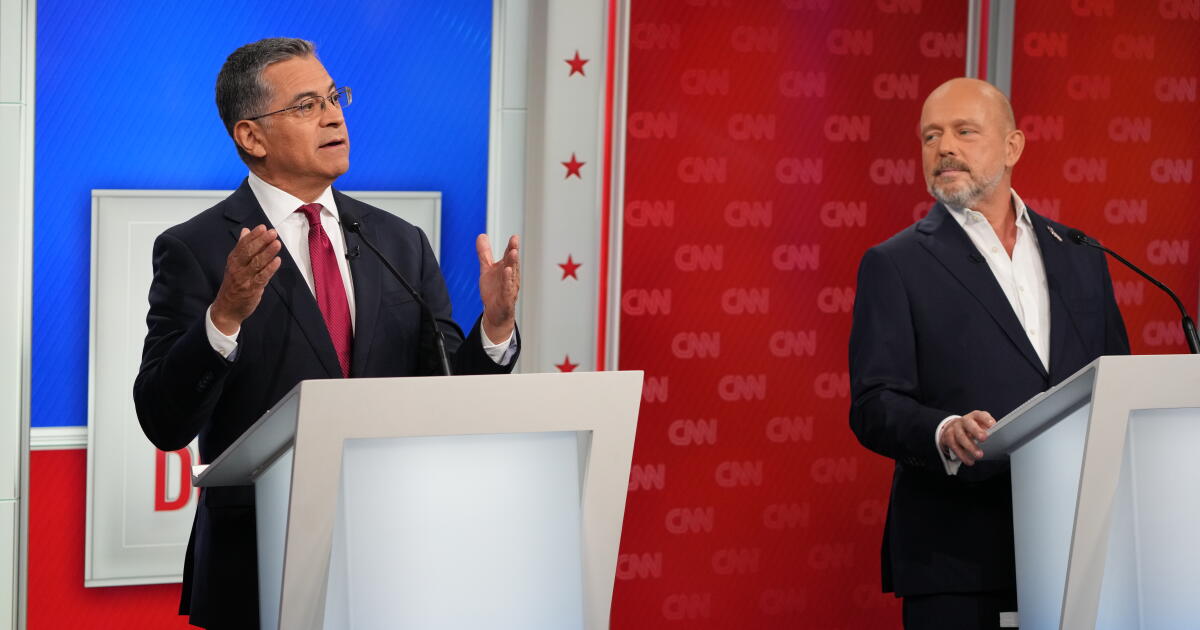
Gov. Gavin Newsom, barred from running for reelection, still took heat Tuesday during the first debate in California’s 2026 race for governor.

Six Democrats and one Republican on the stage in Newsom’s hometown of San Francisco took direct aim at the governor’s record on homelessness, efforts to ban the sale of new gas-powered cars and opposition to an anti-crime ballot measure that Californians overwhelmingly passed two years ago.

Former Los Angeles Mayor Antonio Villaraigosa, who unsuccessfully ran against Newsom for governor in 2018, pointed to state spending on homelessness as an example of ineptitude.

“We spent $24 billion at the state, along with billions more from the counties and the cities throughout the state, and homelessness went on,” he said. “We cannot be afraid to look in the mirror.”

The televised debate revealed the schism between the moderate and progressive Democrats hoping to replace Newsom, as well as efforts by Steve Hilton, the sole Republican who took part, to coalesce the conservative vote.

Hilton, a former Fox New commentator and British political strategist, called on his top GOP rival, Riverside County Sheriff Chad Bianco, to drop out of the race.

“My Republican colleague Chad Bianco is not here tonight to face these Democrats or his record in 2020, during the Black Lives Matter riots,” Hilton said at the event, which was co-sponsored by the nonprofit Black Action Alliance, which was founded to give Black voters a greater voice in the Bay Area.

Bianco “took a knee when told to by BLM, now he says he was praying,” Hilton said. “Chad Bianco has got more baggage than LAX.”

Bianco was invited to the debate but said he was unable to attend because of a scheduling conflict. His campaign did not respond to requests for comment about Hilton’s attacks.

The, at times, feisty debate came amid a gubernatorial race that thus far has lacked sizzle or a candidate on either side of the aisle who has excited Californians. Public opinion polls show that most voters remain undecided.

Seven of the dozen prominent candidates running to replace Newsom participated in the gathering at the Ruth Williams Opera House in front of a live audience of about 200 people. Rep. Eric Swalwell (D-Dublin) was scheduled to participate but canceled, citing the need to go back to Washington, D.C., for congressional votes. Former Rep. Katie Porter (D-Irvine) also did not attend the debate.

The two-hour clash, at times plagued by audio issues, was hosted by two local Fox News affiliates and moderated by KTVU political reporter Greg Lee and anchor André Senior, as well as KTTV’s Marla Tellez.

Five takeaways from the debate:

Making California affordable again

When grilled about how they planned to tackle the high cost of living in the state — gas prices, rent, utility bills and other day-to-day financial challenges — most of the candidates prefaced their answers by talking about growing up in struggling households, often with immigrant parents who worked blue-collar jobs.

Former U.S. Health and Human Services Secretary Xavier Becerra said he would stabilize rents and freeze utility and home insurance costs “until we find out why they’re increasing.” California Supt. of Public Instruction Tony Thurmond said he would raise taxes on billionaires and create tax credits to help families afford the high cost of living.

Villaraigosa and Hilton said they would lower gas prices by cutting regulations on California’s oil refineries.

Hilton blamed the state’s high cost of living squarely on Democratic policies. “They’ve been in power for 16 years,” he said. “Who else is there to blame?”

Billionaire hedge fund founder turned climate activist Tom Steyer said he favors rent control. Steyer and former state Controller Betty Yee said they would prioritize zoning and permitting reform to build more housing, particularly near public transit. Both Steyer, a progressive, and San Jose Mayor Matt Mahan, a moderate, spoke about using new technology such as pre-fabricated homes to build more affordable housing.

Protecting immigrants

In the wake of the Trump administration’s chaotic immigration raids that started in Los Angeles in June and have spread across the nation — recently resulting in the shooting deaths of two people by federal agents in Minneapolis — the Democrats on stage unanimously voiced support for immigrants who live in California. Some pledged that, if elected, they would use the governor’s office to aggressively push back on President Trump’s immigration policies.

“We’ve got to say no to ICE, and we’ve got to take on Trump wherever he raises his ugly head,” Villaraigosa said.

Steyer, whose hedge fund invested in a company that runs migrant detention centers on the U.S.-Mexico border, and Thurmond both said they support abolishing Immigration and Customs Enforcement, and Thurmond and Mahan said they support a pathway to citizenship for undocumented immigrants.

Politicians politicking

Antonio Villaraigosa, left, talks to Betty Yee

Antonio Villaraigosa, left, talks to Betty Yee during the California gubernatorial candidate debate Tuesday in San Francisco.

(Laure Andrillon / Associated Press)

Amid the debate’s dodging, weaving, yammering and spicy back-and-forth, there were a few moments when the candidates rose above the din.

Villaraigosa, the former two-term mayor of Los Angeles and a former speaker of the California Assembly, insisted that the moderators call him “Antonio” instead of Mayor Villaraigosa.

“It’s my name, everybody. I’m just a regular guy,” he said, prompting a laugh.

Mahan, on the other hand, tried mightily to portray himself as being above the dirty business of politics.

“The truth is that our politics has been oversimplified,” he said. “It’s become this blood sport between populists on both sides, and you deserve real answers, not the easy answers.”

Yee, who has been running on her background as controller and a member of the California Board of Equalization, cast herself as the financial savior the state needs in trying economic times of budget deficits and federal cuts.

“We have not been accountable or transparent with our dollars for a long time,” she said. “Why are we right now and [in successive] years spending more than we’re bringing in? This is where we are. So accountability has to be a tone set from the top.”

The rich guy and the new guy

Steyer, who paints himself as a repentant billionaire devoted to giving away his riches to make California a better place for all, did not directly answer a question about his position on a controversial proposed ballot measure for a new tax on billionaires to fund healthcare. But he said he supported increasing taxes on the wealthy and boasted of having the political backing of bus drivers, nurses and cafeteria workers because he was the rich guy willing to “take on the billionaires for working families.”

Mahan, the latest major candidate to enter the race, wasn’t impressed.

“Tom, I’ve got about 3 billion reasons not to trust your answer on that,” he said, an apparent reference to Steyer’s net worth.

Although he supports closing tax loopholes for the wealthy, Mahan said he opposes the billionaire tax because “it will send good, high-paying jobs out of our state, and hard-working families, in the long run, will all pay more taxes for it.”

Money also spoke Tuesday

Although the battle over campaign fundraising didn’t overtly arise during Tuesday’s debate aside from Mahan’s comment about Steyer, it still was getting a lot of attention. Campaign fundraising disclosures became public Monday and Tuesday.

Unsurprisingly, Steyer led the pack with $28.9 million in contributions in 2025, nearly all of it donations that the billionaire spent on his campaign. Other top fundraisers were Porter, who raised $6.1 million; Hilton, who collected $5.7 million; Becerra, who banked $5.2 million; Bianco, who received $3.7 million in contributions; Swalwell’s $3.1 million since entering the race late last year; and Villaraigosa’s $3.2 million, according to documents filed with the California secretary of state’s office.

Mahan, who recently entered the race, wasn’t required to file a campaign fundraising disclosure, though he is expected to have notable support from wealthy Silicon Valley tech honchos. Former state Controller Betty Yee and state schools chief Tony Thurmond were among the candidates who raised the least, which spurs questions about their viability in a state of more than 23 million registered voters with some of the most expensive media markets in the nation.

Yee defended her candidacy by pointing to her experience.

“All the polls show that this race is wide open. You know, I think voters have had enough. I’ve been around the state. I’ve spoken to thousands of them,” she said. “Enough of the lies, the broken campaign promises, billionaires trying to run the world. You know, look, I’m the adult in the room. No gimmicks, no nonsense, straight shooter, the woman who gets things done. And we certainly can’t afford a leader who thinks grandstanding is actually governing.”

Mehta reported from Los Angeles and Nixon reported from San Francisco. Data and graphics journalists Gabrielle LaMarr LeMee and Hailey Wang contributed to this report.

Source link

Why California’s fight over ticket fraud has become a proxy war against Ticketmaster and Live Nation

A year ago, Colorado firefighters Rick Balentine and Tim Cottrell were driving trucks carrying donations from Aspen to Los Angeles for victims of the Eaton and Palisades fires.

As they headed west, they planned to stop in Las Vegas and, while there, made a spontaneous decision to see the Eagles’ residency at the Sphere. Balentine and Cottrell bought resale tickets on StubHub for around $400 each. Cottrell used his credit card and received a confirmation email. But once they arrived to the venue, they weren’t allowed in. The seller failed to send the tickets.

All Cottrell could find was an email that said his tickets had been canceled, moments before the concert was to start. Other than getting their money back, there was no further explanation.

“We knew they were aftermarket tickets,” Balentine said, “but never in a million years did I think that tickets could get canceled.”

“I was very disappointed. There needs to be more protection out there, both for consumers and for artists, so people aren’t getting ripped off all the time.”

The rising demand for tickets has spurred a growing marketplace for all kinds of high-profile live events, including music tours and sports series like the upcoming World Cup. Whenever fans are unable to secure tickets on the primary market, through sellers like Ticketmaster or AXS, many will turn to the secondary market for resale tickets. Those tickets are typically sold through platforms like StubHub, SeatGeek and Vivid Seats. Customers who bought their passes directly from Ticketmaster can also resell them on that platform.

The majority of secondary-market transactions can be easy, leaving both the reseller and the customer satisfied. But with the rise of speculative or fake tickets, like the ones Balentine and Cottrell bought, securing valid tickets from the resale market has become more challenging.

What are speculative tickets?

Speculative tickets are offered by resellers who list concert passes they don’t yet have in their possession, with the intention that they will ultimately acquire the tickets and deliver them to the buyer. According to 2025 data from Live Nation, one in three Americans has fallen victim to a ticketing scam. But under California’s bill, AB 1349, selling speculative tickets could be banned on all resale platforms in the state. On Monday, the bill passed in an assembly vote and is headed to the state Senate for review.

Thousands of fans enjoy Shakira's performance at SoFi Stadium

Thousands of fans enjoy Shakira’s performance at SoFi Stadium in August.

(Jason Armond/Los Angeles Times)

Speculative tickets usually pop up as soon as a major artist announces a tour. Most recently, K-pop boy band BTS announced a world tour that includes four stops at SoFi Stadium. Before the general sale began Jan. 24, some sellers on Vivid Seats had already started listing tickets for over $6,000. Listings like these usually create a greater sense of scarcity, which can drive up ticket prices even more.

If enacted, the proposed legislation in California would require sellers to have event tickets in their possession before offering them for sale. The listing must include the location of the seat and specific refund rights. It prohibits a person from using software that automatically purchases more tickets than the specified limit, and it would raise the maximum civil penalty for each violation from $2,500 to $10,000.

The live music industry is a vital part of the state’s economy, contributing over $51 billion to California’s GDP and supporting over 460,000 jobs, according to the database 50 States of Music.

Ticketing fraud tends to affect more than just the consumer. Whenever an unknowing fan shows up to a venue with a fake ticket, it often falls on the venue and its staff to deal with the situation. Stephen Parker, the executive director of the National Independent Venue Association, said that if speculative tickets are banned in California, venues could save up to $50,000 in staffing expenses.

A general view of a portion of the stadium interior

Los Angeles’ SoFi Stadium, where many concerts and ticketed live events are held.

(Icon Sportswire/Icon Sportswire via Getty Images)

“They have to deal with fans who are crying, who are angry, who are upset because they thought they were going to go see their favorite artists that night, and they paid [over the] ticket’s face value only to not get a ticket that works or to not get a ticket at all,” said Parker.

Fighting ticket fraud and reining in a ticketing giant

There are currently dozens of legislative bills throughout the U.S. focused on event ticketing issues. Some states like Maryland, Minnesota and Maine have already passed restrictions on speculative tickets.

The action comes after both the Department of Justice and the Federal Trade Commission sued Ticketmaster and its parent company, Live Nation Entertainment, in 2024 and 2025. The DOJ’s lawsuit suggests breaking up the company, which it accuses of engaging in monopolistic practices. The complaint also alleges the company forces venues into exclusive ticketing contracts and influences artists to use only its services.

Founded in 1976, Ticketmaster has been the industry’s largest ticket distributor since 1995, with around 80% of live concerts sold through the site. The company merged with Live Nation in 2010.

Ticketmaster has also acquired a growing share of the resale market, under the platform Ticketmaster Resale. The site allows consumers to list, sell or find tickets to live events. The business functions similarly to other resale sites, but Ticketmaster does not allow speculative ticket sales on its platform.

The Federal Trade Commission is currently suing the company on accusations that it engaged in illegal ticket vendor practices for its resale business, like misleading artists and consumers with so-called “bait-and-switch pricing,” where advertised prices are lower than the actual total. Following the FTC’s complaint, the ticket seller made changes to its policies.

Additionally, Ticketmaster is no longer allowing users to have multiple accounts, which made it easier to purchase more tickets than the specified limit, and it is shutting down Trade Desk, the controversial software that helps resellers track and price tickets across several marketplaces.

Hundreds enjoy a performance by Banda Los Lagos during Jalisco Fest at the 2025 Santa Fe Springs Swap Meet.

Hundreds enjoy a performance by Banda Los Lagos during Jalisco Fest at the 2025 Santa Fe Springs Swap Meet.

(Genaro Molina/Los Angeles Times)

“The FTC case against us is very frustrating because we think they’re sort of blaming the victim here. We’re the ones that are dealing with millions and millions of bots attacking us every day,” said Dan Wall, Live Nation’s vice president of corporate and regulatory affairs. “We’re trying to convince the federal government and state governments to get on the same page of recognizing where the problem is, which is overwhelmingly in the resale industry, and trying to do something about it.”

“We’re a much more artist and consumer-focused company, and so we don’t engage in the different kinds of business practices that are sketchy and unfair to the fans. We try to be a much more honest, legitimate outlet for getting resale tickets,” said Wall.

Critics find that the surge of anti-speculative ticketing bills around the country is a way for Ticketmaster to divert attention from its own legal troubles and shift attention onto the resale market. Live Nation is a key supporter of the California bill. Diana Moss, the director of competition policy at the Progressive Policy Institute, called AB 1349 “overkill” when it comes to the provisions and restrictions it places on the secondary market.

Fans cheer Sexyy Red at the Rolling Loud concert at Hollywood Park in March.

Fans cheer Sexyy Red at the Rolling Loud concert at Hollywood Park in March.

(Michael Owen Baker/For The Times)

“A lot of these bills in the states are a vehicle to disable the resale markets and hinder how they operate. Resale markets are important to consumers,” said Moss. “If you disable the resale market, then fans have no place to go — but back to Ticketmaster. That’s the whole game, disable the resale markets with legislation and regulation, and then everybody has to go back and deal with Ticketmaster and pay their monopoly ticket fees.”

Provisions in AB 1349 deem a ticket a license. The question of whether a ticket is a right or a license is an ongoing controversy in the ticketing world. Opponents of the bill are fearful that this change would give more power to Live Nation, as they could impose restrictions on how the ticket can be used, such as whether you’re allowed to sell your ticket on other platforms or if you can transfer it at all. Meghan Callahan, from the Empower Fans Coalition, a group that opposes the bill, equates this licensing change to taking a lease out on the ticket.

“Ticketmaster’s goal is to create less competition. This bill imposes restrictions on everybody else but themselves,” said Callahan. “They are trying to use consumer-friendly concepts and sneak in these other provisions to embolden their monopoly.”

Wall at Ticketmaster said that nothing on the consumers’ end would change if this bill were to pass, adding that tickets are already licenses “from the venue for you to come on the property during the time of the show and sit in that seat.”

“Honesty doesn’t favor one person or another. That’s what this [bill] is about,” said Wall.

Source link