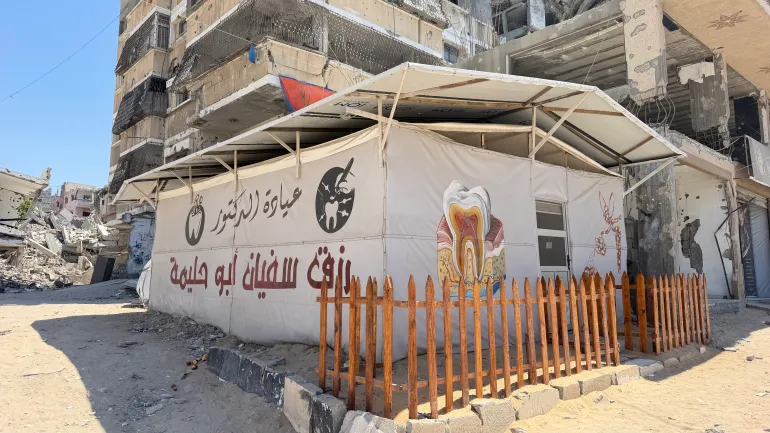
Gaza City, Gaza Strip – In the stifling heat of Gaza City, Dr Rizq Sufyan Abo Halima sits in a small tent pitched in an alleyway, waiting for his next patient.
The tent was a last resort for the doctor, given that the high demand and low supply of properties in the Gaza Strip as a result of Israel’s genocidal war have made finding an affordable surgery impossible.
Recommended Stories
list of 3 itemsend of list
“The stifling rise in temperatures was my first challenge,” he told Al Jazeera. “I had to adjust the corners of the tent and lift it at the ends to allow air to pass through.”
His old clinic, Smile One, in Sheikh Zayed City in northern Gaza, was bombed during the early days of the war in 2023.
The 31-year-old built a new clinic in May last year, next to where his current tent is pitched, in Gaza City’s al-Nasr neighbourhood. But three months later, it too was destroyed when Israeli forces assaulted the area, just weeks before the ceasefire last October.
He is now forced to conduct operations and other emergency dental procedures in the tent close to the ruins of his former surgery. When the electricity supply stops, which is frequent, there is little he can do but sit in his tent and wait for the power to come back on.
Finding another office would be the obvious solution, but residential and commercial units are hard to find in Gaza and those few that remain are unaffordable.
More than four in five buildings in Gaza City and northern Gaza have been completely destroyed or severely damaged in Israel’s war, according to the United Nations Satellite Centre (UNOSAT).
Fewer than one in five buildings in Gaza can still be used and Israel’s ban on building materials has made repairs impossible. That has created a skewed supply situation, which has made prices of office spaces or homes unaffordable.
“Before the war, I used to rent an entire apartment for my clinic for 500 shekels ($166) a month, but today I cannot afford the prices of remaining apartments at all,” he said. Now, the cost is closer to $1,000.

Heat is better than high costs
Using a tent is the cheapest alternative Dr Abo Halima could find, and he does not want to pass on what he calls the excessive price of building rent to his customers, who are already suffering immense personal and financial hardships.
“If I had rented an apartment for my clinic instead of a tent, the cost of one filling to teeth would have doubled for the patient,” Dr Abo Halima said.
“I am here, enduring the harsh summer heat, so that I can protect people from the high prices that I will inevitably have to charge if I rent an apartment, in addition to the fact that I have no other options at all.”
Dr Abo Halima treats his instruments with care. He sterilises them regularly to protect them from dust and germs and hires a security guard. After all, the thin canvas walls offer little protection from thieves.
Despite his best efforts, the collapsed, resource-starved economy in Gaza means that dental care is a luxury for many patients.
One of them, 25-year-old Yousef Abo Halima, sums up the situation in a few simple words: “I can handle the harsh heat inside the tent, but I certainly cannot afford the high costs of fillings at clinics that operate inside apartments”.

Difficult choices
After Heba Rihan, 23, graduated from Al-Aqsa University with a major in general nursing, she struggled to find work in her field.
So she made an arduous daily journey from the south of the Gaza Strip to the west on foot, looking for work. She eventually found Dr Abo Halima’s clinic in May and began working there.
Now, one of the most regular parts of her job is explaining to patients that the high cost of treatment is due to the scarcity of materials and other issues related to the war and Israel’s siege on Gaza.
“One day [a patient] came in deep pain… When he asked how much the filling cost and was told it was 350 shekels ($116), he didn’t have the money. He asked directly about the tooth extraction, which is only 50 shekels ($17),” she said.
“He decided to extract his original tooth because he could not bear the pain or the cost. That was the most painful moment I’ve ever had here.”