A US charity announced it will use an AI-software to monitor Gaza classrooms for ‘anti-Semitism’ and ‘hate speech’, while Israel airstrikes kill Palestinians across the strip.
Sanaa, Aden and Marib, Yemen – As fighting intensifies across Yemen between the government and the Houthis, millions of people are confronting another battle far from the front lines: the deteriorating living and economic conditions in the country.
With salaries for large segments of the workforce either unpaid or irregularly disbursed – and the prices of goods and services rising – Yemen’s economic struggles have been compounded by a divided banking system that has made moving money between different parts of the country increasingly complicated.
Recommended Stories
list of 3 itemsend of list
From Aden’s struggling shoppers to displaced families in Marib and unpaid public-sector workers in Sanaa, Yemenis are being forced to make difficult choices about what they can afford, and what they must go without.
Aden: Food costs swallow salaries
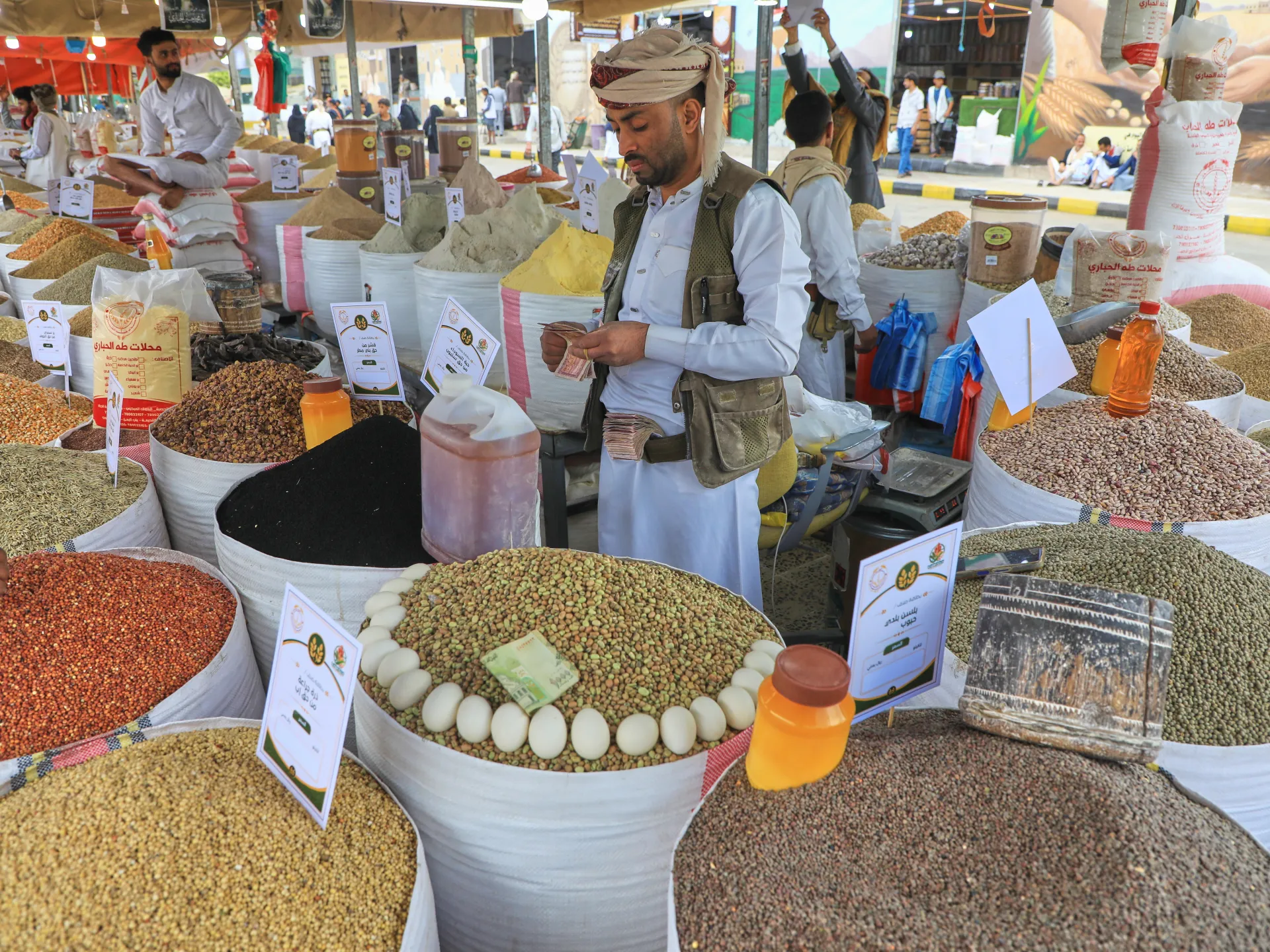
In Aden, the internationally recognised Yemeni government’s interim capital in the south, the problem is not so much a shortage of goods in markets as people’s inability to afford them.
Salaries have failed to keep pace with the rising costs of food, rent, healthcare and transport, leaving workers with little money left over at the end of the month.
The consequences are evident in the smaller quantities and cheaper products that now make up shoppers’ baskets, and the decisions they are forced to make about what to cut back on.
Bushra Abdullah Abdulwarith is a government employee in Aden. She earns 78,000 Yemeni riyals ($50) a month at the black market exchange rate while typical household food costs in government-held areas run about 130,366 riyals ($83), according to estimates by the Yemen Economic Tracking Initiative. And that’s before she factors in the cost of rent, transport, healthcare and other household expenses.
The economic difficulties facing Yemenis like Bushra illustrate how more than a decade of war has devastated the economy. According to the World Bank, real GDP per capita has fallen by approximately 58 percent since 2015.
The fragmentation of Yemen’s monetary institutions between the government and the Houthis – who have operated their own institutions since seizing the capital, Sanaa, in 2014 – along with the disruption of oil exports, and declining international assistance have all contributed to the economic decline.
Bushra told Al Jazeera that rising prices have forced many households to give up almost all non-essential purchases and cut back on some expensive basics, particularly meat. Other families, she said, have resorted to buying food in smaller quantities, sometimes on credit or loans.
Reduced demand
The impact of rising prices is reflected not only in economic figures but also in the way people shop.
Ayman al-Maqtari, who works at a shopping centre in Aden’s Mansoura district, said that his customers now rarely buy non-essential items.
When it comes to the essentials such as rice, sugar, flour, and cooking oil, he has noticed that customers size up the price of each item before putting it in their baskets. They are also buying smaller quantities, for example, opting for a 5kg (11 pound) over a 40kg (90 pound) bag of rice.
“Many people have come to live day by day, or week by week,” Ayman told Al Jazeera, adding that more families are buying on credit when they run out of money before the end of the month.
The decline in purchasing power is also affecting commercial activity.
Across several streets and shopping centres in Aden, advertisements for discounts and special offers have become increasingly visible in shop windows and on retailers’ social media pages, as businesses attempt to attract customers and boost sales.
Weak demand, retailers say, is particularly evident for items that households can put off buying, such as clothing and household goods. A growing share of family income is spent on food, rent, healthcare and transport.
Limited pay increase
The Yemeni government approved a 20 percent cost-of-living allowance in May for public-sector employees in an attempt to ease the pressure of rising prices. But the amount is calculated based on each employee’s base salary, rather than their total pay, meaning the actual increase is relatively small for many workers.
Bushra, the government employee in Aden, said the increase has done little to improve her family’s financial circumstances. She described the allowance as “a temporary painkiller that does not reflect the scale of the actual pressure on people’s living standards”.
Her experience is far from isolated. In early October, the World Food Programme said its latest monitoring in accessible government-controlled areas showed that 74 percent of households were unable to meet their basic food needs.
One of the places where the crisis is evident is Marib, a government-controlled city east of Sanaa that is home to hundreds of thousands of displaced people. The sharp increase in the population over the war years, in what was previously a provincial backwater, has led to pressure on the city’s housing, employment and public services.
Government employees in Marib see their salaries disappear within the first few days after being paid, labourers struggle to find more than a few days of work and displaced families are forced to choose between buying water and milk.
Salah al-Zuhaifi works for a government institution in Marib. He said the war has separated him from his parents, who live in Houthi-controlled territory.
Alone in Marib, al-Zuhaifi said that inflation had eroded much of his salary’s purchasing power.
“No matter how much you earn, it will not be enough to meet your needs,” he said.
Abu Mohammed Nasser al-Asbahi, another government employee, described a similar struggle.
He told Al Jazeera that he earns 400,000 riyals ($250) a month, but more than half of that goes towards his rent, leaving little for his other expenses.
“We don’t even get to the first one-third of the month before the salary is gone,” he said, explaining that his family spends the rest of the month relying on loans and credit from local shops.
The healthcare sector in Marib has also been affected by widespread household spending cuts.
Pharmacist Khaled Mohsen told Al Jazeera that the rising price of medicines has prompted many patients to decline parts of their prescribed treatment and purchase only what they consider most essential.
People with chronic illnesses, meanwhile, have increasingly begun reducing their medication doses to make their supplies last longer before having to buy more, which creates serious health risks.
Houthi areas
Residents of Sanaa and other areas of Yemen’s populous northwest, controlled by the Houthis – an armed group also known as Ansar Allah (Arabic for Supporters of God) – since 2014, are also facing a worsening economic and cost-of-living crisis similar to that affecting Yemenis elsewhere in the country.
Several factors are driving the crisis, particularly unpaid public-sector salaries, declining purchasing power, rising prices for goods and services, and the continuing consequences of the division of Yemen’s currency and banking systems in the early years of the war.
Many public-sector employees in Houthi-controlled areas have gone years without receiving regular salaries, with some sectors only receiving limited payments or half-salaries at irregular intervals.
Even when payments are made, they cannot cover families’ basic needs amid the rising cost of living.
Meanwhile, private-sector workers and business owners face growing pressures as a result of declining economic activity, multiple fees and levies, and a shortage of employment opportunities. The conditions have undermined incomes and job security.
The Yemeni riyal’s exchange rate in Houthi-controlled Sanaa is more stable than in areas controlled by the government. The Houthis have imposed strict monetary controls, banning the circulation of newer banknotes printed by the Yemeni government, and have also enforced a largely fixed exchange rate.
However, that does not necessarily translate into stronger purchasing power. Markets face difficulties caused by cash shortages and the division between monetary and banking systems operating in different parts of the country, including increased costs for moving funds.
That directly affects the many households relying on domestic and international remittances.
For residents in Houthi-controlled areas, the result is an economy in which the currency may be relatively stable, but livelihoods are precarious. Years of unpaid salaries and limited employment opportunities have left many families struggling to afford basic necessities, with few options beyond borrowing, cutting spending or relying on support from relatives.
Gaza City – More than 80 percent of Gaza’s buildings have been damaged or destroyed since Israel launched its war on the besieged enclave in October 2023, according to the Palestinian Central Bureau of Statistics, turning whole neighbourhoods into rubble and wiping out much of its infrastructure.
For generations, Gaza’s streets, markets, schools, hospitals and public spaces formed the backdrop to everyday life. They were places where people worked, studied, shopped, met friends and family, and built memories.
Many of the city’s familiar landmarks also carried a much longer history, reflecting Gaza’s thousands of years as a crossroads of different civilisations.
The war has also changed the face of Gaza by damaging or destroying many of those historic and recognisable landmarks.
UNESCO has verified damage to 164 cultural sites since October 2023, including 128 buildings of historical or artistic interest, 14 religious sites, nine monuments, eight archaeological sites, two museums and three depositories of movable cultural property.
Among them are the Great Omari Mosque, Gaza’s oldest mosque, Qasr al-Basha, the ancient Samaritan Bathhouse, al-Qissariya Market and the Church of Saint Porphyrius complex.
Some of these places have been reduced to ruins, while others remain standing but heavily damaged. The destruction has altered not only individual buildings but the streets and neighbourhoods around them, removing landmarks that once helped people recognise and navigate their city.
This photo series contrasts archive images of some of Gaza’s most recognisable streets, markets and public buildings with new photographs taken three years into the war, showing how these familiar places have changed after years of bombardment and destruction.
Islamic Relief calls for international action as Gaza endures deadly Israeli attacks and worsening humanitarian conditions.
Published On 8 Oct 20268 Oct 2026
Israeli attacks have killed or wounded a Palestinian in Gaza every 90 minutes on average since the ceasefire was announced in October last year, the aid group Islamic Relief says.
Islamic Relief, a United Kingdom-based charity, said on Thursday that at least 1,454 Palestinians were killed and more than 5,000 wounded over the year. At least 320 of those killed were children, close to one a day.
Recommended Stories
list of 3 itemsend of list
Gaza’s Health Ministry reported that 1,471 Palestinians have been killed and 5,189 wounded since the ceasefire, including four killed and 28 wounded in the past 24 hours.
Israel has killed at least 74,254 people since October 2023, the ministry added.
On Thursday, Israeli forces killed a Palestinian southeast of Deir el-Balah, in central Gaza, and an Israeli air strike on a house in central Khan Younis wounded several people, the Palestinian news agency Wafa reported.
In the occupied West Bank, a 13-year-old boy was shot in the foot during an Israeli raid on Yamoun, west of Jenin, the Palestinian Red Crescent said.
Islamic Relief said Israel has used the so-called Yellow Line, which marks the area under Israeli military control, to push Palestinians out of 65 percent of Gaza, crowding its nearly 2.1 million people into the remaining 35 percent.
According to the report, an Islamic Relief aid worker in Gaza whose name is withheld for their safety said: “There is no ceasefire in reality. They target displacement camps and crowded areas, so there is still a lot of fear.”
Israel continues to block shelter materials, fuel and medical supplies, the group said.
About 82 percent of Gaza’s structures are damaged or destroyed, more than half of health services have shut down and more than 20,000 severely ill patients are denied permission to leave for treatment.
The charity urged world leaders to increase pressure to protect civilians and uphold international law.
“A ceasefire in name only cannot be an excuse for international inaction,” it said.
When Huda Helassa, 20, left her home in Tal al-Hawa, southern Gaza city, in the first hours of the war, she took a signed T-shirt from the Access Microscholarship Program, a United States-funded programme that provides English-language and cultural education to young people.
Her classmates had signed the shirt on September 15, 2023, during their final class, two years before she graduated on September 27.
“When we left our home on the first day of the war, the T-shirt was one of the first things that came to my mind,” Huda says.
She put it in her bag almost instinctively, wanting to hold on to something from a part of her life that had ended just days earlier.
[Abdelhakim Abu Riash/Al Jazeera]
Huda and her family first moved to her grandmother’s house in Gaza City, then were displaced south, walking part of the way, and eventually reached Rafah in the south of the Palestinian territory.
In May 2024, they were displaced again, this time to Khan Younis. When they returned to Gaza in January 2025, they found their home completely burned.
“There was nothing left of the life we had there,” she says. “No belongings, no photographs, no memories we could hold onto, just the blackened walls.”
They were displaced again in April 2025, moving to Remal and then Tal al-Hawa, before moving to az-Zawayda in September and returning to Gaza in October. They are currently in Tal al-Hawa.
For Huda, the T-shirt remains a link to the life she had before the war, a period of learning, friendships and experiences that shaped her.
Israeli air strike kills Palestinian Civil Defence rescue volunteer as he was travelling to help wounded people near Kamal Adwan Hospital in Beit Lahiya, northern Gaza, a medical source says.
Published On 7 Oct 20267 Oct 2026
Israeli attacks have killed at least four Palestinians, including a rescue worker, and wounded several others across Gaza.
The Palestinian Civil Defence rescue volunteer was killed in an air strike as he was travelling to help wounded people near Kamal Adwan Hospital in Beit Lahiya, northern Gaza, a medical source said on Wednesday.
Recommended Stories
list of 3 itemsend of list
The Civil Defence identified the victim as Mohamed Tamous.
Meanwhile, an Israeli drone strike in the southern city of Khan Younis killed Hisham Ibrahim Abu Mustafa, 60, and injured several others, Nasser Hospital said.
The body of a 17-year-old Palestinian was also brought to Nasser Hospital after he was killed in an Israeli drone strike in the Qizan Abu Rashwan area south of Khan Younis, Turkiye’s state news agency Anadolu reported, citing a medical source.
A teenage boy died from wounds sustained last month when Israeli forces opened fire east of Khan Younis, Anadolu reported, citing a medical source.
Also on Wednesday, a girl was injured by Israeli gunfire directed at displaced Palestinians’ tents in the Al-Amal neighbourhood, Anadolu reported.
Additionally, in Khan Younis, the Israeli military carried out two demolitions in the northeastern and eastern parts of the city.
The military also carried out demolitions east of Gaza City’s Tuffah neighbourhood.
Israel has killed more than 74,245 Palestinians since it launched its genocidal war on Gaza in response to the Hamas-led October 7, 2023, attack on Israel.
Rescuers halt operation off the coast with no survivors found, following a Black Sea attack that also damaged a second vessel.
Published On 7 Oct 20267 Oct 2026
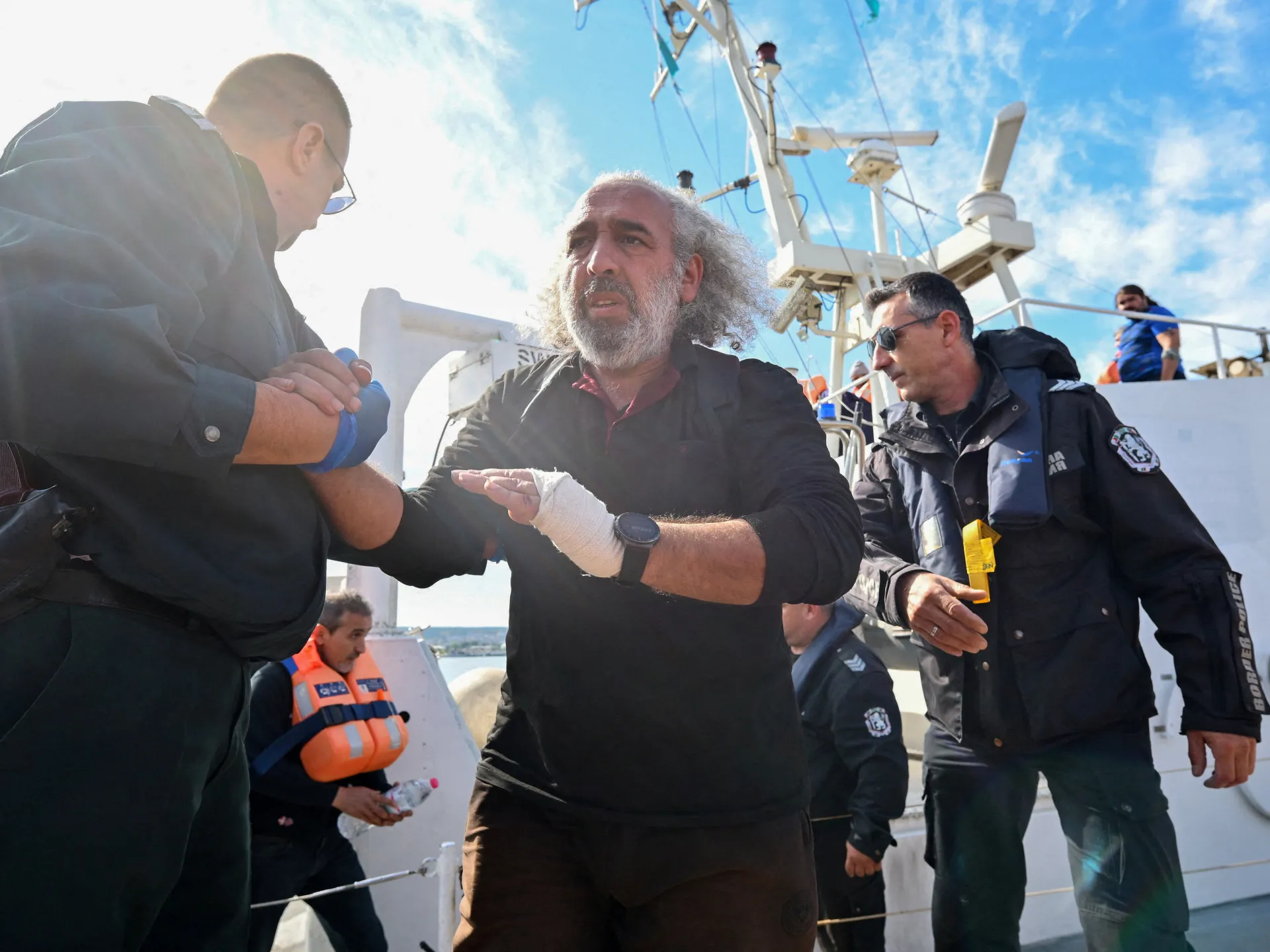
Bulgarian authorities have ended search operations after confirming no survivors were found following a drone strike that sank a ship off the country’s coast.
“There is no trace of the sailors,” Rumen Nikolov, the head of the country’s Maritime Search and Rescue Coordination Centre, told reporters on Wednesday.
The search stopped late on Tuesday and would not continue, he added.
Eighteen Turkish and Indian crew members were rescued from the ship that caught fire, but the crew members from the vessel that sank remain missing.
Authorities have not said how many people are missing, but according to the Maritime.bg specialised website, 10 people were on board the ship.
Nikolov said the incident occurred in a so-called “responsible search and rescue zone” and not in the country’s territorial waters, which extend to 12 nautical miles off the coast.
“What was found from the sunken ship was one overturned boat, three life rafts and debris from the ship’s equipment that was floating on the surface of the sea,” he said.
Asked whether any debris from the drones had been recovered, Nikolov said: “I have no information about drone debris.”
Prime Minister Rumen Radev has described the attack as “absolutely unacceptable”.
European Union chief Ursula von der Leyen has also condemned the incident.
Bulgarian authorities have said they are not yet able to determine the origin of the drones.
A distress beacon signal from the ship that sank was received at 2:54am on Tuesday (23:54 GMT on Monday), while the distress signal from the other ship was received at 3:23am (00:23 GMT), Nikolov said.
Both commercial ships were managed by Turkiye-based companies, according to the Equasis merchant shipping database.
They were hit about 80 nautical miles (150km) east of the Bulgarian coastal town of Byala.
The strikes came a day after another ship caught fire and sank off the Romanian coast on Monday, killing two people. Ukraine blamed Russia for the drone attack.
At least 10 civilians were killed in West Kordofan and 5,500 displaced in Blue Nile as clashes widened on Tuesday.
Published On 7 Oct 20267 Oct 2026
Sudan’s military chief, Abdel Fattah al-Burhan, has promised to seize “every inch” of territory under the control of the paramilitary Rapid Support Forces (RSF), rejecting negotiations to end three and a half years of war.
Al-Burhan made the comments on Tuesday while addressing a gathering in Village 5, located in the northern Sudanese locality of Merowe, according to the Sudan News Agency.
Recommended Stories
list of 2 itemsend of list
He said the “military option” would continue until the RSF was removed from Sudan.
The Sudanese army and the RSF have been fighting since April 2023 after leaders of the groups fell out over plans to integrate the paramilitary force into Sudan’s army. The conflict has killed tens of thousands of people and displaced around 13 million, according to UN and international estimates.
Al-Burhan’s pledge to continue fighting came as 10 civilians were killed and several others were wounded in an attack by the RSF in Sudan’s West Kordofan state, according to a local charity group.
Women gather for a meal in al-Rahmaniyah camp for displaced people, near the city of el-Obeid in Sudan’s North Kordofan state, on July 7, 2026 [File: AFP]
In a statement, the Dar Hamar Emergency Committee accused the RSF of multiple violations against civilians in Abu Ajal village in the southeastern countryside of En Nahud.
The RSF has been massing in West Kordofan as Sudan’s army advances towards the cities of En Nahud and Al Khuway after gains in neighbouring North Kordofan.
In Sudan’s Blue Nile state, more than 5,500 people were displaced from villages over three days amid deteriorating security, the International Organization for Migration (IOM) said on Tuesday.
Meanwhile, an envoy of US President Donald Trump said Sudanese parties must take the lead in talks to end the war.
In a post on X on Monday, Massad Boulos, the US senior adviser for Arab and African affairs, said peace could be achieved “through an inclusive Sudanese-owned and Sudanese-led national dialogue, transition toward a civilian-led government”.
The US State Department said last month that neither the Sudanese Armed Forces, the RSF, nor their respective leaders “represent legitimate, constitutional governance for Sudan”.
Aden, Yemen – In this coastal city long accustomed to sweltering, humid summers, the absence of electricity can reshape an entire day.
When the power cuts out, fans and air conditioners fall silent. Sleep becomes difficult. Students race to finish their homework before darkness arrives. Children spill onto the streets while young men drift towards the sea in search of moving air and cooler waters.
Inside hospitals, where treatment cannot be postponed until the lights come back on, electricity carries a different weight altogether.
Yemen’s power crisis predates the current war. Even before the conflict, only about 55 percent of the population had access to electricity from all sources, which is among the lowest rates in the Middle East and North Africa.
Since 2015, damage to infrastructure, fuel shortages and ageing generation and distribution systems have left supplies even more fragile.
In Aden, power stations continue to face repeated shutdowns, leaving residents without electricity for long periods. Insurance premium increases on tankers carrying fuel to Aden have also reportedly made the crisis worse.
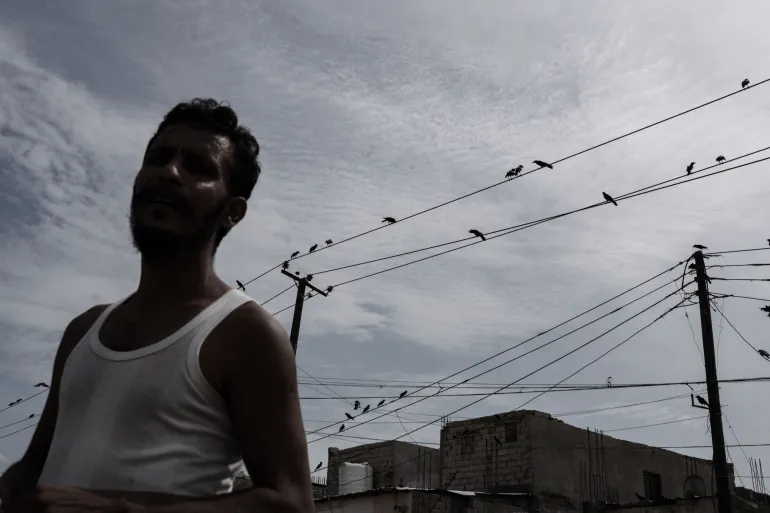
A man walks beneath a web of power lines in a neighbourhood in Aden, where long and frequent power cuts have become part of daily life. [Belal Khaled/Al Jazeera]
An assessment by the International Monetary Fund (IMF) published this year said Aden was receiving just two to six hours of electricity a day as structural weaknesses and fuel shortages caused frequent outages.
As the sun sets over the city, a second part of the day begins. Homes and businesses slip into darkness, punctuated only by small lights powered by batteries and solar systems. Residents often do not know how long the latest blackout will last, or how long the power will stay on once it comes back.
During the summer, when temperatures in Aden climb towards 40 degrees Celsius (104 degrees Fahrenheit), the consequences are hard to escape. Residents in the city interviewed in the middle of the year said their homes had become almost unbearable during the prolonged power cuts that plague the city. The heat does not always disappear when the sun goes down.
After the sun sets in Aden, most of the city falls into darkness with only scattered lights coming from devices powered by batteries or alternative energy systems. [Belal Khaled/Al Jazeera]
“Sometimes the power comes back while we are asleep, so we wake up to use it. Our lives have become tied to when electricity comes and goes,” one resident said. For her family, an outage is measured not just in hours but in problems. Children are unable to sleep, food spoils in warm refrigerators and housework must wait.
When the heat inside becomes too much, Youssef heads for the coast. The sea, he said, is no longer just a place of recreation but a refuge from the unbearable heat of the city.
“When the electricity is off for hours, it is very difficult to stay inside,” he said. “There is no fan and no air conditioning, and the humidity makes the heat worse, so we come to the sea.”
Towards the end of the day, young men and families gather along the waterfront. Some swim. Others simply sit beside the water and wait for the city to cool. But the sea cannot solve Aden’s electricity crisis. Hours later, Youssef returns home and sometimes finds the house exactly as he left it.
“Sometimes we get back and the power is still out, and we start waiting all over again,” he said.
For children like Mohammed, Saeed and Abdullah, blackouts have changed where childhood takes place. When their homes become too hot, they move into the street, running between houses or sitting with other children until late.
A child walks through a neighbourhood in Aden, where a generation has grown up knowing electricity as something that comes and goes rather than being a constant part of daily life. [Belal Khaled/Al Jazeera]
“It gets hot inside the house, so we come down and play in the street,” one of the boys said. “We play football or sit with our friends. Outside is better when the electricity is off.”
For them, a blackout is not an extraordinary event. It is part of the life they have grown up with.
The effects follow them into the classroom. In Aden, the United Nations Development Programme documented more than 7,000 students and teachers struggling in dark, stifling classrooms during power cuts. The installation of solar systems at eight schools and an education office has helped. One teacher reported that some students had fainted due to the heat.
At home, preparing for exams can depend on a rechargeable lamp or a small solar system if they have one.
In hospitals, there is no option but to simply wait out the darkness. Operating theatres, intensive care units, laboratories, medical refrigerators and dialysis machines all depend on continuous power.
The World Health Organization (WHO) says recurring power cuts disrupt lifesaving health services across Yemen, forcing facilities to rely on combinations of grid electricity, generators and solar systems.
In 2025, the WHO supplied about 4.33 million litres (1.14 million gallons) of fuel to 177 health facilities across the country to keep generators and essential equipment running.
An incubator inside a hospital in Aden. At health facilities, power cuts disrupt operating rooms, intensive care units, incubators, laboratories and vital equipment that depend on continuous electricity. [Belal Khaled/Al Jazeera]
Zeina Ahmed, a kidney patient, watches tubes carry her blood to a dialysis machine.
“For people at home, a power cut means heat and darkness. For us here, the first thing we think about is whether we will be able to have our dialysis or not,” she said.
“I come to the hospital knowing that I need this session. If it is delayed, I keep thinking about when I will get it and whether the machines will continue to work.”
After years of unreliable grid supply, solar panels, batteries and generators have become familiar parts of Yemen’s landscape.
They sit on rooftops, providing power to the homes, businesses and schools that can afford them.
More than half of Yemen’s homes now rely on solar power in some form, according to the WHO, while hospitals and other health facilities are increasingly adopting solar systems to keep essential services running.
Families who can afford to buy larger panels and batteries can power more appliances. Others might have just enough electricity for a light, a fan or a phone charger – a fragile shield against the dark and the heat.
No warning given before Israeli deadly strike hit Rimal area, one of Gaza City’s most densely populated neighborhoods.
Published On 3 Oct 20263 Oct 2026
An Israeli air attack on a residential apartment in western Gaza City has killed at least five people and severely wounded at least six others, according to medical staff at al-Shifa Hospital.
The strike hit the al-Asala building in the Remal neighbourhood early on Saturday without prior warning, according to Al Jazeera’s Hani al-Shaer, reporting from Khan Younis.
Recommended Stories
list of 3 itemsend of list
Remal is one of Gaza City’s most crowded residential areas, home to thousands of displaced people sheltering in makeshift camps across the neighbourhood.
Al-Shaer said the attack came in the middle of the night, when residents were asleep.
“We heard fighter jets getting louder, then three strikes followed, hitting the apartment and killing those inside,” he said.
The strike penetrated the targeted apartment and tore through the floors below, causing further destruction throughout the multi-storey building.
Fires burned for at least an hour before Palestinian Civil Defence crews managed to put them out.
Al-Shaer described the scene as “horrific”, with people buried under the rubble as they slept.
Civil defence crews were still searching the site for missing people and bodies, he said, as Israeli drones continued flying over the area and fighter jets were heard flying low across the Strip.
Al-Shifa Hospital said the dead included four women, among them an elderly Christian woman and her daughter.
The six wounded were taken to al-Shifa Hospital for treatment.
Kuala Lumpur, Malaysia – The phone hasn’t stopped ringing in recent days. Raf*, a leader of refugees from Myanmar who are living in Malaysia, receives more than 100 calls a day, and they follow a common pattern.
“They are crying, asking me to do something,” Raf told Al Jazeera.
The Malaysian government on Tuesday deported nearly 1,500 refugees, part of its stated plan to send back at least 5,000 refugees as part of a deal with the military government of Myanmar. That move, from a country that had long taken in the refugees, has sparked fear among the tens of thousands of other refugees from Myanmar in the country, who have one question at the top of their minds: Who might be next?
The deportation was carried out during escalating raids on refugee communities by immigration officials, which have led to the detention of more than 50,000 refugees this year alone. Those working with refugees in Malaysia said the frequency of the raids has increased since June when Prime Minister Anwar Ibrahim announced the repatriation agreement with Myanmar.
“[We’ve seen] a sharp increase. Raids are happening every single day. There’s up to 50 raids or more happening every day,” said Heidy Quah, founder and executive director of the Malaysian nonprofit Refuge for the Refugees.
Minister of Home Affairs Saifuddin Nasution told local media that the government has conducted more than 9,700 such operations from the beginning of this year until September 17. That’s an average of 37 operations a day.
There are now more than 10,000 Myanmar nationals in Malaysia’s immigration depots, according to the Ministry of Home Affairs.
In all, Malaysia is home to more than 215,000 refugees, according to the Office of the United Nations High Commissioner for Refugees (UNHCR). Nearly 194,000 are from Myanmar. There are more than 126,000 Rohingya refugees in Malaysia, where they have been the target of widespread hate speech on social media in recent months. Apart from the Rohingya, the Myanmar refugees in Malaysia include nearly 16,000 from the Chin community and 33,000 from other Myanmar communities. The non-Myanmar refugees in Malaysia include small numbers of Pakistanis, Yemenis, Somalis, Afghans, Syrians, Sri Lankans, Palestinians and Iraqis.
The Myanmar refugee community in Malaysia has yet to identify any Rohingya among the first nearly 1,500 people deported on Tuesday, community leaders told Al Jazeera. Instead, many are from Myanmar’s other ethnic minorities, who are more likely to have valid national identification documents, community leaders said.
“The Rohingyas are a problem for deportation because Myanmar denies their citizenship,” Raf said. “So I don’t think that Myanmar will agree and accept all those Rohingyas.”
Myanmar officially treats the Rohingya as Bangladeshi immigrants despite the community’s long roots in Myanmar and their distinct ethnic identity. The Myanmar army has repeatedly cracked down on the Rohingya minority, including a wave of violence in 2017 that many rights groups have described as genocide. It set off a major refugee crisis when hundreds of thousands of Rohingya fled to Bangladesh, Malaysia, India and other neighbouring nations.
Myanmar community leaders also said the raids this year appear to have targeted locations highlighted in anti-refugee videos on social media in which content creators filmed refugee-populated areas, portraying them as hubs of chaos. These videos have been shared thousands of times on platforms such as Threads, TikTok and Facebook.
Al Jazeera contacted the Immigration Department to verify the link between the videos and raids but had not received a response at the time of publication. Accounts that had posted and shared antirefugee sentiment also did not respond to requests for comment.
Decline in resources
The increase in hostilities towards refugees in Malaysia coincides with a sharp decline in the capacity of local and international aid groups to support them, especially since the closure of the United States Agency for International Development in July 2025.
In Malaysia, this severely shrank resources for organisations helping refugees with basic needs, such as healthcare, Quah told Al Jazeera.
“Then slowly, United Nations organisations were being defunded, and even within the UN High Commissioner for Refugees in Malaysia, they lost a lot of staff,” Quah said. The job cuts reflected global retrenchments by UNHCR last year.
The agency continues to struggle with a funding crisis, saying on Tuesday that it faces a $5.79bn funding gap and, as of July, has received 32 percent of the funds it needs this year.
In Malaysia, this has led to even less protection for refugees and higher rates of exploitation, Quah said.
“Even UNHCR cardholders are arrested and remanded for about 14 days [while the] cards are verified,” she said.
For instance, an asylum-seeking woman who had scheduled an appointment to meet UNHCR representatives this month was recently detained, and immigration authorities demanded a letter from the organisation to prove that she was an asylum seeker, Quah said.
Although UNHCR confirmed the woman was seeking asylum, she remains in detention, Quah said.
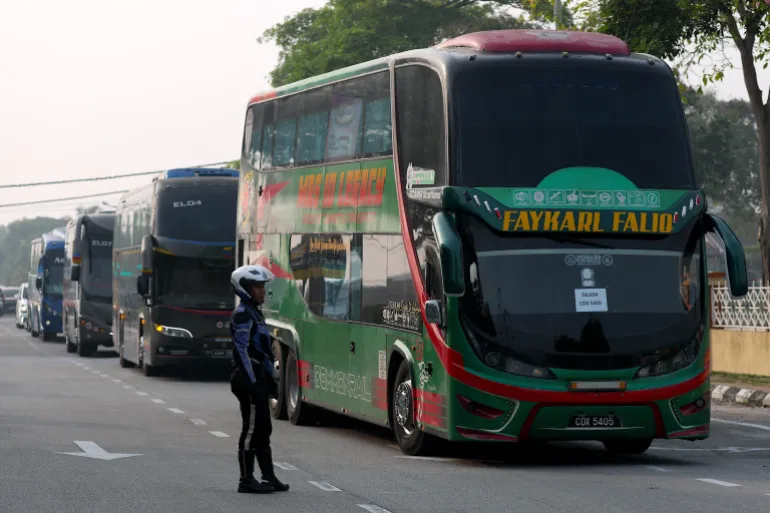
An initial group of 1,476 people from Myanmar are deported from Malaysia on September 29, 2026, first my bus and then by Myanmar navy ships [Fazry Ismail/EPA]
Ongoing violence in Myanmar
UNHCR and rights groups in Malaysia have urged the Malaysian government to stop the deportations as violence continues in Myanmar.
A day before Malaysia’s deportation of the refugees on Tuesday, an air strike by Myanmar’s military was reported to have killed at least 33 people in Rakhine state, the historical home of the Rohingya. The Arakan Army group said the victims included vendors, shoppers and pedestrians. In June, the UN said Myanmar’s military was responsible for more than 700 civilian deaths over a six-month election period that started in August last year.
The Human Rights Commission of Malaysia (SUHAKAM) said that while Malaysia is not a party to the Refugee Convention of 1951, the principle of nonrefoulement has become part of customary international law and Malaysia, therefore, is bound to abide by it. The principle protects people from being returned to a place where they face a real risk of persecution, torture or other serious harm.
Particular attention should also be given to children, SUHAKAM said, highlighting that Tuesday’s deportation included 27 children, some reportedly as young as eight years old.
“No child should be returned to danger. Their safety, dignity and best interests must come first,” it said.
Myanmar community leaders in Malaysia told Al Jazeera the ships that departed on Tuesday will arrive in Yangon on Sunday.
“After that, we will [learn] whether they are allowed to leave the port safely [or are detained],” said one community leader who requested anonymity due to the increase in violence towards refugees in Malaysia.
Still, even those who are allowed to leave the port may need to spend months or years in Yangon because it is unsafe to travel across the country, the community leader said.
Rohingya refugees face evictions from their homes in Malaysia amid rising local tensions and online misinformation [File: Hasnoor Hussain/Reuters]
Call for independent access
Rights groups further criticised the Malaysian government’s framing of the deportations as “voluntary”, saying individuals should have sufficient information about conditions in their home countries before making such a decision.
“While authorities say the returns are voluntary, those returned had been held in immigration detention. This raises serious questions about whether decisions to return were genuinely free and informed,” UNHCR Assistant High Commissioner for Protection Edem Wosornu said.
The Malaysian government said people were selected for deportation based on a list of names shared by the Myanmar government in an official diplomatic note.
“Such [a] ‘voluntary’ decision must be determined by an independent authority, such as the UNHCR, and not by the Immigration Department,” SUHAKAM said .
UNHCR told Al Jazeera that it was not involved in the latest return process and did not have access to the individuals concerned. “[We were,] therefore, not in a position to independently ascertain the voluntariness of their decisions to return,” it said.
“We continue to encourage the government to ensure that return processes include individual assessments, access to protection procedures and safeguards to ensure that any decision to return is free, informed and genuinely voluntary,” it said.
Malaysian Prime Minister Anwar Ibrahim has long positioned himself as a champion of human rights but now faces criticism for the expulsion of Myanmar refugees [File: Rafiq Maqbool/AP]
Malaysia registering refugees
The deportations come at a time when Malaysia is simultaneously positioning itself as welcoming to refugees and their needs.
In 2015, the Malaysian government launched a Refugee Registration Document (DPP) programme. On paper, it is supposed to help register refugees, giving them official documentation.
Raf welcomed the DPP as long as the registration and documentation of refugees in Malaysia leads to access to work, education and healthcare.
“If these three things are provided, I think that’s a good solution for temporary refugees staying here.”
But the Malaysian branches of Amnesty International and Asylum Access said the latest deportations raise profound concerns about the purpose of the DPP. The programme should not be used to fast-track unlawful deportations, the groups said in a joint statement.
*Name changed to protect the individual’s identity
Gaza’s health toll mounts, with 1,439 dead and 5,052 injured since the ceasefire began in October 2025.
Published On 1 Oct 20261 Oct 2026
An Israeli drone strike has killed a Palestinian man and wounded several others in southern Gaza while settlers shot dead another Palestinian man near Ramallah in the occupied West Bank.
The body of Tamer al-Hamayda, 42, and three wounded people were brought to Nasser Medical Complex on Thursday after the strike hit a tent sheltering displaced Palestinians in the al-Mawasi area, west of Khan Younis on the southern coast of the Gaza Strip.
Recommended Stories
list of 3 itemsend of list
Another Palestinian succumbed to wounds sustained in an earlier Israeli drone strike on Tuesday that targeted a gathering of Palestinians in Jabalia refugee camp in northern Gaza, according to medical personnel in Nasser Medical Complex.
Israeli forces also carried out a large-scale demolition operation targeting buildings east of Gaza City’s al-Tuffah neighbourhood.
The Gaza Health Ministry reported eight new deaths and 26 wounded over the past 24 hours, putting the toll since the “ceasefire” took effect in October 2025 at 1,439 killed and 5,052 wounded, with 834 bodies recovered from the rubble.
Israel’s war on Gaza has killed at least 74,040 Palestinians and wounded 175,168 since October 2023, the ministry said.
Occupied West Bank pogroms
In the occupied West Bank, Israeli settlers shot dead a Palestinian man and wounded another during a raid on the village of Yasuf, north of Ramallah, on Thursday.
51-year-old Mashhour Yassin was shot dead by settler gunfire, the Palestinian Health Ministry said.
Describing the attack, the Palestinian Ministry of Foreign Affairs said Israeli forces had detained an ambulance, seizing its key and throwing it aside, “in a crime that reflects clear coordination between the settlers and occupation forces.”
It said the killing “falls within the framework of a serious and continuous escalation in organised settler crimes,” saying Israel gives free rein to settler “terrorism against our people in the service of settlement, annexation, forced displacement and ethnic cleansing plans.”
Yasuf Mayor Jumaa Abdel Fattah told the AFP news agency that dozens of Israeli settlers armed with sticks and firearms had attacked the village, which lies between four Israeli settlements.
“Yassin was at his doorstep when the settlers attacked the village homes. He went out to defend his house,” Abdel Fattah said, adding that Yassin’s nephew was also wounded in the attack.
Abdel Fattah said the settlers had come from Havat Anton, an illegal Israeli settlement established in July that has previously attacked the village’s residents.
Palestinians in the occupied West Bank have reported a surge in settler pogrom attacks in recent months.
More than 500,000 Israelis live in West Bank settlements considered illegal under international law.
According to the UN, at least 1,112 Palestinians in the occupied West Bank have been killed by Israeli forces or settlers in the territory since October 2023, including at least 37 killed by settlers.
Coffins containing the remains of those killed will be carried in a funeral procession involving family members.
Published On 1 Oct 20261 Oct 2026
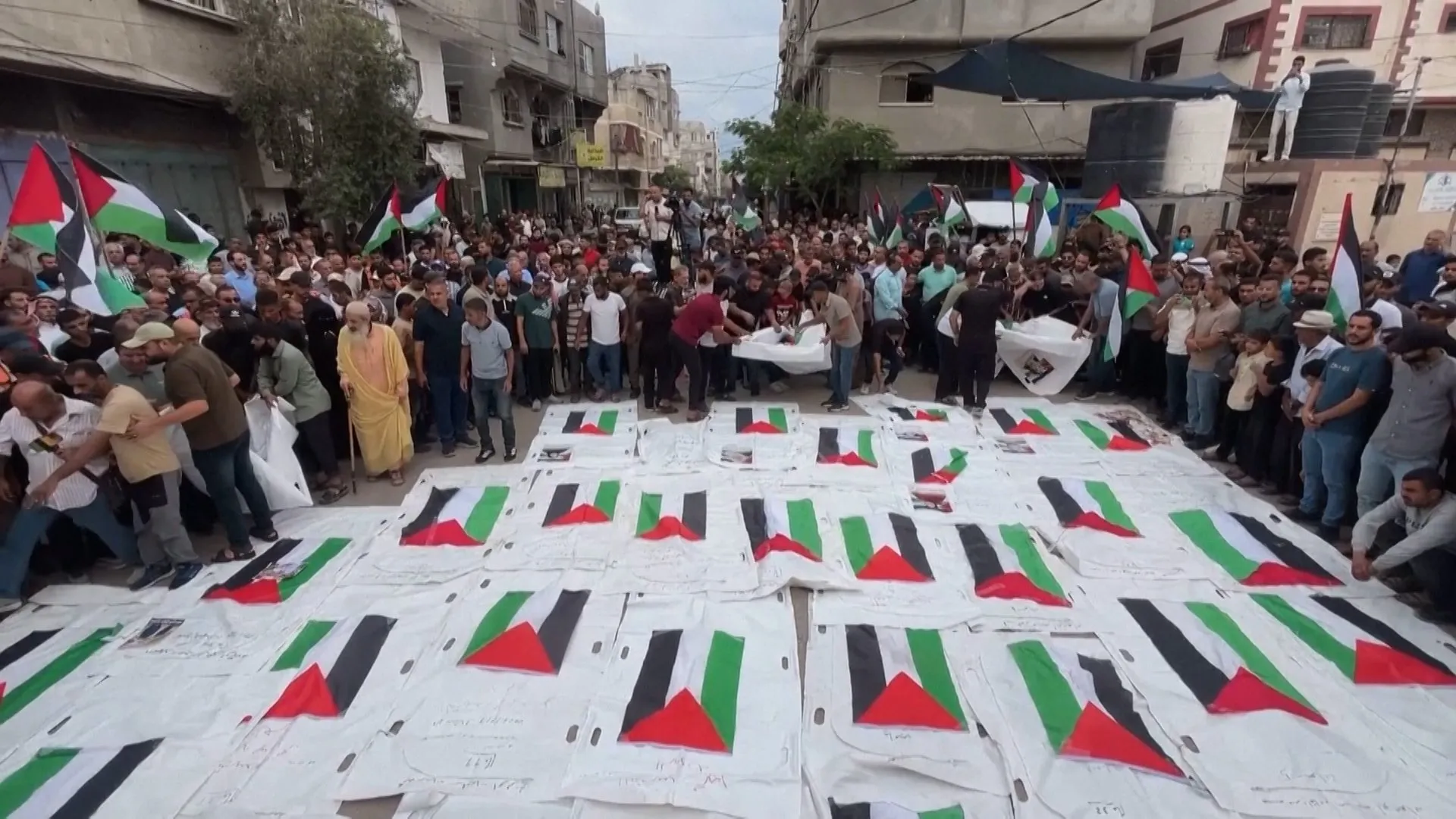
Palestinians are preparing to bury the remains of 105 people killed in a devastating Israeli attack on Gaza City in October 2023.
The victims were killed in a series of Israeli air strikes involving at least 20 bombs that levelled the seven-storey Al Taj 3 building and destroyed several other residential buildings in the Yarmouk Square neighbourhood on the afternoon of October 25, 2023.
Recommended Stories
list of 3 itemsend of list
Coffins containing the remains of those killed will be carried in a funeral procession involving family members on Thursday, the General Directorate of Civil Defence said.
The remains will be buried in the Sheikh Radwan cemetery, northwest of Gaza City.
Gaza’s civil defence said the recovery operation was carried out in coordination with an Egyptian committee.
Al Jazeera correspondent Ibrahim Khalili, reporting from Gaza City, said the recovery operation was the fifth largest of its kind since Israel launched its genocidal war against Palestinians in Gaza in October 2023, in terms of the number of bodies recovered.
Civil defence operations director Abdul al-Majdalawi said it had been “impossible” to reach the bodies at the time of the attack.
“Bulldozers, excavators and other heavy machinery used by civil defence teams in Gaza were directly and deliberately targeted,” he said.
Osama Sharaf said 37 members of his family were killed in the attack.
“We recovered some of them at the beginning of the war, and today [Wednesday] 16 more were recovered, including my father, my mother, and all of my siblings. My sister’s son was also there with them,” he said.
Dozens of mourners in Gaza grieve the loss of their loved ones as they bury the fragmented remains of relatives killed in an Israeli strike in October 2023.
Tehran, Iran – Iranians are stocking up on food and medicines as fears grow that the country will face dire shortages as the United States tightens an embargo on the country.
The Iranian government had managed to keep household staples flowing during the early months of the war. But a US naval blockade and pivot to draconian sanctions have led to fears that imports will be limited.
Addressing the United Nations General Assembly last week, Iranian President Masoud Pezeshkian condemned Washington for its blockade on his country, saying it will prevent food and medicine from reaching the Iranian people.
On Saturday, US President Donald Trump rejected Iran’s offer for a seven-day truce that would see it reopen the Strait of Hormuz in exchange for economic relief and other conditions.
As the war enters its eighth month and hopes for a diplomatic solution dim, Al Jazeera looks at how some Iranians are faring under a US embargo.
Consumers
Tehran’s stores remain stocked, but shoppers are keeping an eye on shop shelves. Their anxiety has deepened since a flurry of social media posts urging people to ensure they have several days of food before a possible new round of fighting with the US.
At one shopping centre, Ali, 51, was loading a trolley packed with rice, flour, pasta, pulses, cooking oil and canned food.
He is stocking up because he is convinced that Iran’s adversary is seeking to “starve” the people to push them to turn on their government.
“This is not a war in the traditional sense. It targets the people to put pressure on the authorities,” he said.
With flights to some nearby countries suspended, imports of certain medicines and mobile phone headsets are hard to find. The prices of those still available in shops have been pushed up.
Haj Pasandideh, a 71-year-old grocer, said he believed warehouses were well-stocked with basic goods at the moment. But the problem lies in the daily price increases due to Iran’s weakening rial, prompting him to bulk-buy goods before the expected hikes.
He sometimes caps cooking oil at one bottle per sale to ensure as many customers can purchase the goods as possible.
Exporters crushed
Farmers are also on edge due to the embargo, unable to ship out their produce and forced to sell to local markets.
The war has worsened the economic situation, even after years of sanctions that have pushed the country from being a regional exporter of agricultural and food products to being one of the region’s main importers.
Mehran, an apple grower, told Al Jazeera that due to the difficulties of exporting, he had sold only a third of this year’s harvest, all of it inside Iran.
Some neighbouring countries have halted trade with Iran in recent months, he said, while trucks now spend days at crossings they once cleared in a day, causing fruit to spoil before it reaches buyers.
“The blockade has not only closed the sea and air but also the land routes but in an undeclared manner,” he said.
Pharmaceutical shortages
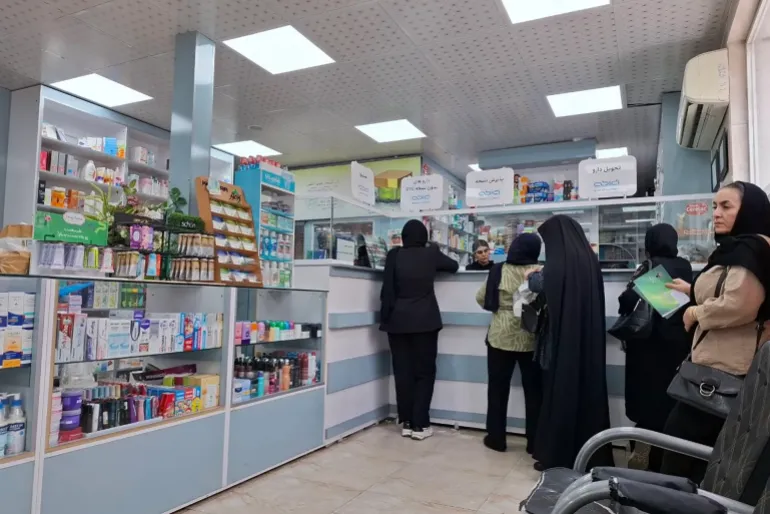
The war has also deepened an already-dire shortage of medications. Some pharmacies Al Jazeera visited in southern Tehran had run out of infant formula and dozens of other types of medications.
Although officials have assured Iranians that substitute products were available, pharmacy staff expressed concern about the increasing number of customers searching for infant formula in vain.
“Imported medicines are disappearing fast, and lately people have been coming in to buy certain items before they need them for fear they will run out in future,” Mahsa, a 23-year-old pharmacy assistant, told Al Jazeera.
She said the health authorities had introduced “smart systems” to track the quantity and type of medication each person buys.
Women queue at a pharmacy in Tehran [Al Jazeera]
Breaking the blockade
The prospect of a prolonged siege and deteriorating economic conditions have driven some Iranians to call for a military solution.
On Tehran’s main thoroughfare, several people told Al Jazeera that another round of fighting with the US was unavoidable. Some urged the government to break the blockade by force before it is tightened further.
Mohsen, a 23-year-old economics student, believes Washington’s goal is to strangle the Iranian economy and the cost will ultimately be felt by Iranian citizens.
Iran possesses many strong cards that it must use to break the air and sea blockade before they develop into a land blockade that would completely choke Tehran, he said.
Alireza Taghavinia, an Iranian international relations expert, told Al Jazeera that the gap between Washington and Tehran was too wide to be bridged. “The siege imposed by force will only be lifted by force,” he said.
In a worst-case scenario, falling living standards could bring protesters onto the streets, he added.
“The enemy is counting on stirring up chaos inside Iran because it believes no military strike will achieve its objectives without internal unrest,” he said.
Fatalities reached 3,901 across the DRC as health workers battle community anger and a vaccine-resistant strain.
Published On 28 Sep 202628 Sep 2026
The Democratic Republic of the Congo (DRC) has recorded over 8,000 cases of Ebola, including almost 4,000 deaths, amid the worst outbreak in the country’s history, according to government data.
The latest report, published on Monday by the DRC’s public health institute, put the number of cases at 8,067 and deaths at 3,901, representing a fatality rate of 48.4 percent.
Recommended Stories
list of 4 itemsend of list
People’s mistrust and anger towards government policies have become a major obstacle in limiting the outbreak since it was officially declared on May 15. A senior member of the ruling UDPS party was beaten to death after raising awareness about the epidemic on radio, a party representative said on Monday. The killing happened on Sunday in Butembo in North Kivu province, which has become a hotspot in the ongoing Ebola outbreak.
The number of cases has levelled off after a rapid increase, according to the African Union’s health agency, Africa CDC, though it still considers the outbreak “not under control”.
Several treatments and vaccines are being trialled against the Bundibugyo strain of the Ebola virus, for which there is no approved vaccine or treatment.
The current outbreak, which is the DRC’s 17th, has spread rapidly. Experts say that weak health infrastructure, the region’s remoteness and ongoing conflict near the DRC’s borders with South Sudan, Uganda and Rwanda have damaged efforts to respond to cases quickly and effectively.
Those issues have also hindered the government’s efforts to fight the outbreak, increasing public mistrust and anger towards its suggested prevention measures.
Marie-Celestin Karondwa, acting president of the UDPS party’s federal executive committee in Butembo, was attacked by local residents after appearing on a radio show where he discussed Ebola prevention measures, according to the Congolese health authorities.
In their latest case report, authorities highlighted a “low capacity” to treat cases at health centres in Ituri province and described a “complete shortage” of stocks of an experimental vaccine against the Bundibugyo strain in the northeastern province of Tshopo, where cases have been recorded.
The World Health Organization has said the outbreak is “far from over” and on track to surpass the regional 2014-2016 West Africa Ebola outbreak. It killed more than 11,000 people, primarily in Guinea, Liberia and Sierra Leone.
The United States announced last week that it was releasing a further $267 million to help fight Ebola. It is hoping for pledges from other countries to meet a target of $2 billion to fight the disease, mainly found in the DRC.
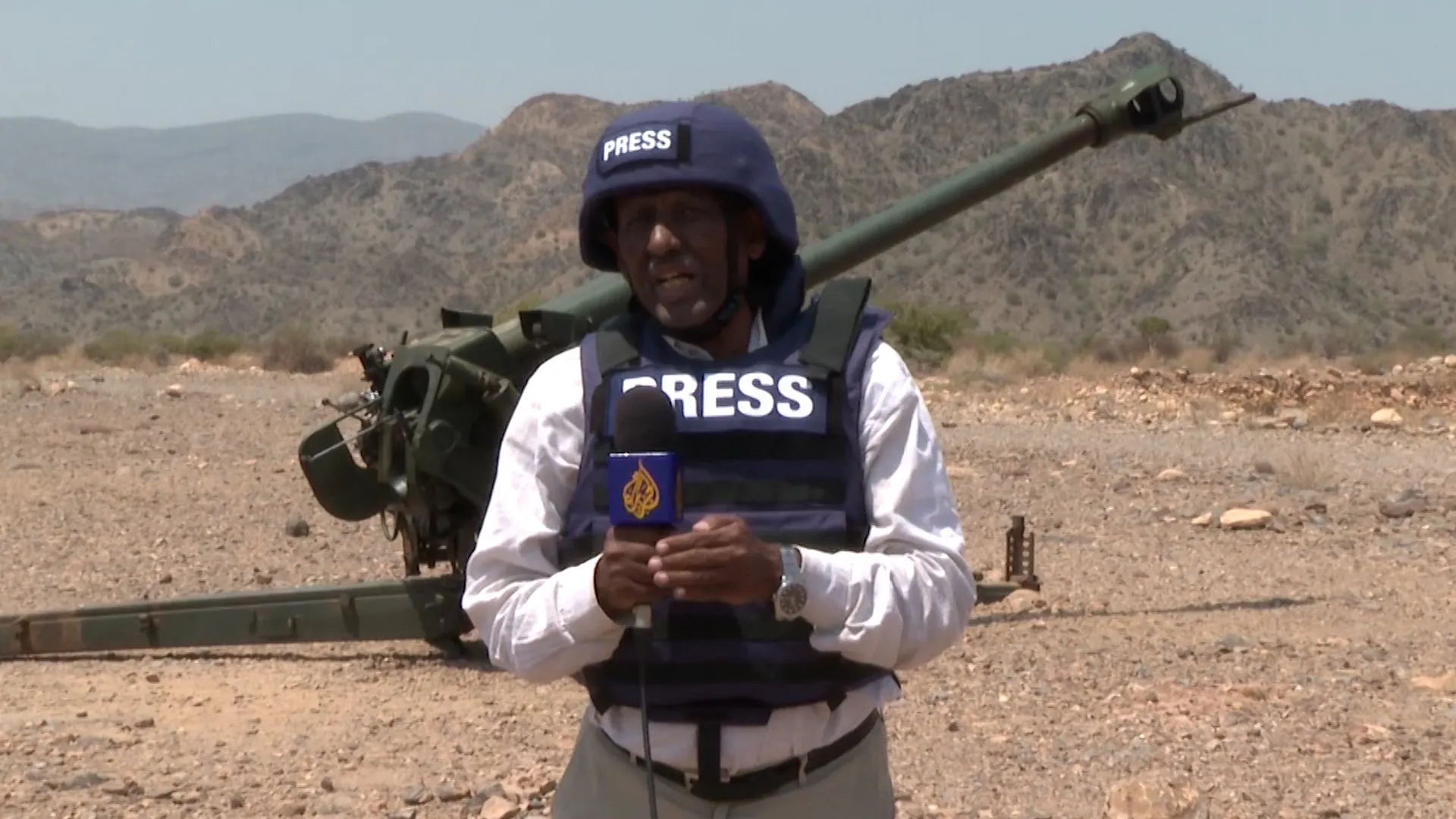
Al Jazeera’s Mohamed Tawakul is near a front line in Ethiopia’s Afar region, where fighting has spread after rebel groups formed an alliance to try to oust the government of Prime Minister Abiy Ahmed.
Ukrainian President Zelenskyy says Moscow launched nearly 4,000 drones, aerial bombs and missiles against his country in past week.
Published On 28 Sep 202628 Sep 2026
A Russian military strike on northeastern Kharkiv, Ukraine’s second-largest city, has injured at least 22 people, including children, less than a day after eight people were killed in attacks nationwide.
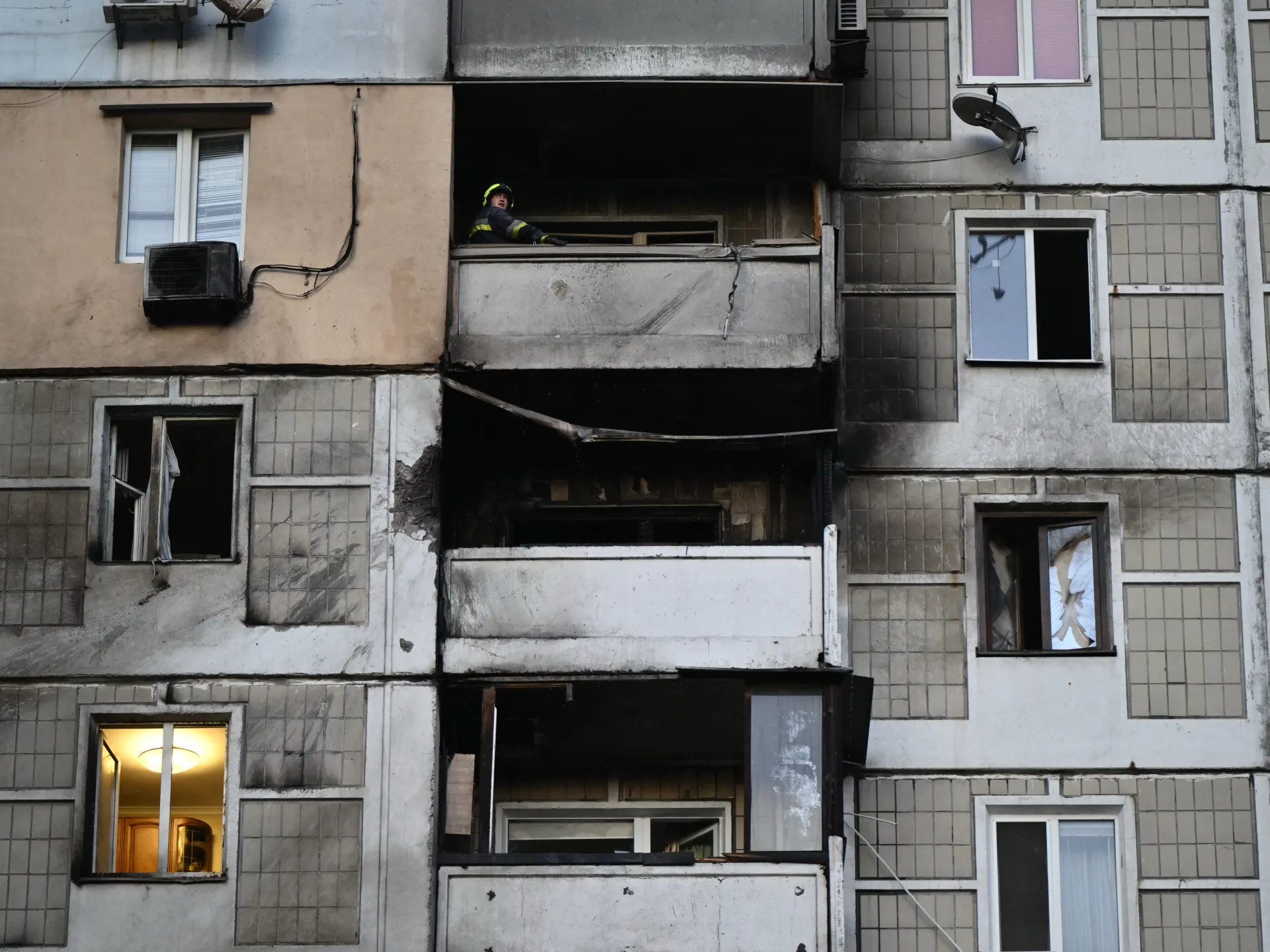
Kharkiv Mayor Ihor Terekov said on his Telegram account that a guided Russian aerial bomb hit an apartment block early on Monday, destroying two floors of the multistorey building.
Recommended Stories
list of 3 itemsend of list
He said six children were among the injured.
Russian attacks were also reported across Ukraine on Sunday.
Ukrainian Minister of Internal Affairs Ivan Vyhivskyi said three people, including a 16-year-old girl, were killed in air strikes that damaged a children’s centre in the northern city of Sumy.
Authorities in the Odesa region, meanwhile, said a “massive strike” on the south of the Black Sea region killed one person and damaged residential buildings, a shop, a hotel, a medical building, and a grain warehouse.
And in the capital, Kyiv, Mayor Vitali Klitschko said a woman and two 16-year-olds were injured and hospitalised.
“The enemy continues to relentlessly attack the Kyiv region with strike drones,” the city’s administration said.
“Sixteen sites have been damaged”, including 12 houses, a warehouse and a production facility, it added.
Ukrainian President Volodymyr Zelenskyy said on Sunday that three people were killed in strikes in the southern Zaporizhia region and that a Russian drone strike had killed one man in Kyiv.
Zelenskyy said in a post on his X account that Russia had launched more than 2,200 attack drones, 1,630 aerial bombs and 38 missiles of various types against Ukraine in the past week.
“If Russia were truly preparing for any real steps towards de-escalation, as it claims, particularly to American negotiators, this wave of Shahed terror would not be happening,” Zelenskyy said in later comments, referring to the Iran-developed drones Moscow has used against Ukraine.
In Moscow, Russia’s Ministry of Defence said it had bombed a Kyivstar data centre in Kyiv and another belonging to the Omega Telecom company. It said that the firms were providing services to the Ukrainian army.
Russian Minister of Foreign Affairs Sergey Lavrov told the United Nations General Assembly in New York on Saturday that Moscow intended to continue its military campaign “to the end”.
Ukrainian drones struck an oil depot in Russia’s Krasnodar region on Monday, according to local reports.
Ukrainian Telegram channel Exilenova+ published footage of a large fire and identified the facility as the Pavlovskaya oil depot.
No injuries have been reported so far.
Ukraine has intensified its targeting of Russian oil infrastructure in recent weeks.
United States-led talks to end the war, which began with Russia’s full-scale invasion of Ukraine in February 2022, have failed to produce a breakthrough, and the UN has highlighted the growing civilian toll.
Yemen’s government forces have conducted multiple air and ground operations in the southwestern governorate of Taiz in 24 hours as they intensify attacks against the Iran-backed Houthi group.
The government’s military media centre on Sunday claimed a number of operations against the rebels, including air strikes on Houthi positions in five locations across the governorate.
Recommended Stories
list of 4 itemsend of list
More than 146,000 people have been displaced since the fighting erupted in July after a period of relative calm since a United Nations-brokered ceasefire in 2022.
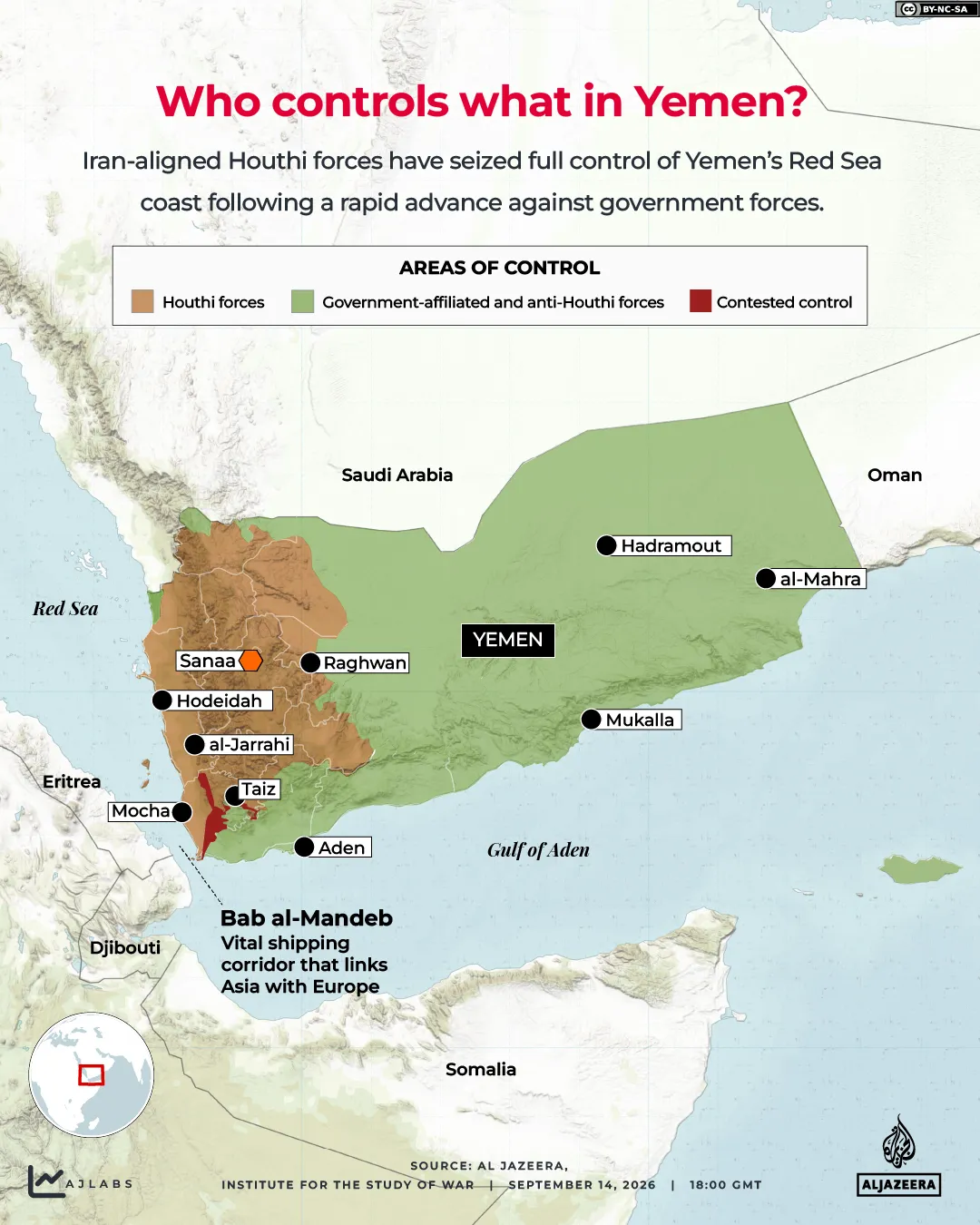
In recent weeks, the Houthis have made dramatic territorial gains against the government forces, seizing the strategic Red Sea coastal city of Mocha and expanding their control over the Bab al-Mandeb strait, a global maritime chokepoint connecting Europe to Asia.
Rashad al-Alimi, the head of the Presidential Leadership Council, has called on citizens to mobilise and join the fight against the Houthis as the government has stepped up its attacks against the Iran-backed group in an effort to stop their advance and regain lost territory.
Meanwhile, Saudi Arabia, which has faced Houthi attacks on its soil since fighting escalated further this month, has been turning to its allies, including Pakistan and Turkiye, for support.
Saudi Arabia backs Yemen’s internationally recognised government.
Here’s what we know about the latest fighting and the humanitarian conditions the impoverished country faces:
What to know about the latest fighting
According to the military media centre on Sunday, dozens of Houthi fighters, including field commanders, were killed or wounded in the previous 24 hours of fighting near Taiz’s capital, which is also named Taiz.
Government forces have carried out operations in several areas of the governorate, including the al-Waziiya district in the west, weapons sites and ammunition depots at Mafraq Mawiya and al-Dhukrah in the east, a Houthi gathering in the Hayfan district in the south and against military vehicles in the Gurab area in the northwest.
Government forces also thwarted infiltration attempts on the al-Ahtoub front and in Hadran as they carried out shelling of Houthi gatherings on the al-Kadha and al-Aqroud fronts, the media centre said.
It added that several Houthi military vehicles were damaged in the attacks.
Al Jazeera could not verify the battlefield claims.
“Government forces say they have made advances in the southern Taiz governorate, taking control of several areas and higher ground. Among them is Jabal Bazel, a mountaintop that places Houthi supply lines within target range,” Al Jazeera’s Maha Ali said on Saturday, reporting from Taiz.
“These developments point to significant and potentially decisive ground operations in recent hours.”
Ali said al-Alimi expressed confidence that government forces were capable of restoring control over the whole country. Houthis currently control vast swaths of northern and western Yemen while the government controls the south and east.
Since the current fighting erupted, the Houthis have accused the Saudis of carrying out attacks in Yemen and promised to prevent Saudi tankers from passing through Bab al-Mandeb, which Riyadh has been using as an alternative shipping route to the Strait of Hormuz. Tehran in effect has closed the Strait of Hormuz since the United States and Israel began a war on it in February. Before the conflict, a fifth of the world’s oil supplies had passed through that waterway.
Government forces, meanwhile, accused the Houthis of using Iranian air defence weapons and said they pose a danger to aircraft.
“These Houthi weapons pose a serious threat to international flight paths over the Red Sea and operate using a heat-tracking system,” Brigadier General Majed al-Nazili, the official spokesperson for the Yemeni government forces, said on social media.
“The weapons employed are capable of attacking military or civilian targets without the ability to distinguish between them, thereby endangering the safety of civil aviation and the lives of passengers.”
Early on Saturday, a Saudi-led coalition in Yemen said its air defence systems intercepted and destroyed two ballistic missiles and two drones launched by the Houthis towards Riyadh and Khamis Mushait in Saudi Arabia.
What has been the regional response to the conflict?
On Saturday, Saudi Foreign Minister Faisal bin Farhan Al Saud, addressed the UN General Assembly and called on the international community to condemn Houthi actions against the kingdom and in Yemen.
At the same forum, Yemeni Vice President Abdullah Abdulkader al-Alimi-Bawzer warned that the Houthis were using shipping security “as a tool for blackmail”.
“It is taking hostage the entire global economy,” he said.
The secretary-general of the Gulf Cooperation Council (GCC), Jassim Mohammed al-Budaiwi, on Saturday strongly condemned the recent Houthi attacks against Saudi Arabia.
“This dangerous escalation constitutes a flagrant violation of the Kingdom’s sovereignty and poses a direct threat to the security and safety of civilians and the stability of the region,” al-Budaiwi said in a statement.
Iran has denied it has any role in the Yemen conflict. Iranian President Masoud Pezeshkian told Al Jazeera that the actions of the Houthis were not connected to Iran and Tehran stands in solidarity with “everyone subjected to injustice”.
He urged the Houthis and Saudi Arabia to resolve their differences through dialogue, saying “a brother should not fight his brother,” and offered Iran’s help in ending the dispute. “We will not be warmongers,” he said.
On Friday, Iran delivered a ceasefire offer, which US President Donald Trump has rejected. It included Yemen and Lebanon. Tehran offered to open the Strait of Hormuz if the US fulfils its conditions, which include the lifting of Washington’s naval blockade on Iranian ports, a sanctions waiver and the release of Iran’s frozen assets.
(Al Jazeera)
Could Saudi allies join the conflict?
Saudi Arabia’s allies have rallied behind it amid intense fighting between the Yemeni government forces and Houthis.
Saudi Defence Minister Khalid bin Salman said on Saturday that there would be continued joint efforts with Pakistan to confront attacks against the kingdom in accordance with the Mecca Joint Defence Agreement signed last month.
He held talks with Pakistani Field Marshal Asim Munir on Thursday. A day earlier, the military chiefs of Saudi Arabia, Pakistan and Turkiye jointly reviewed threats facing Saudi Arabia at a meeting in the Saudi capital.
Multiple Saudi cities, including Riyadh, have been hit by drones and missiles attributed to the Houthis.
Meanwhile, France confirmed on Friday that it was sending troops to guard the major oil terminal at Yanbu, a Saudi port city on the Red Sea, but added that it was not joining the conflict. Yanbu has major oil storage and refining facilities and is connected by the East-West Pipeline, which can carry up to seven million barrels a day. The pipeline was damaged in a drone attack carried out from a group based in Iraq.
The US has so far not pledged military involvement, but the Saudi foreign minister said the kingdom was “continuing to work with our partners in the US”. On September 14, the commander of the US military’s Central Command, Brad Cooper, met the de facto Saudi ruler, Crown Prince Mohammed bin Salman, in Jeddah in the wake of the Houthis’ seizure of Mocha.
What’s the state of humanitarian conditions?
At least 146,000 people have been displaced in the Arab region’s most impoverished country over the past three weeks, most of whom were uprooted from or within Taiz governorate, according to Yemen’s UNICEF country representative, Akhil Iyer.
The number of casualties is still not confirmed as the rival sides have made conflicting claims. As per media reports, the death toll runs into the hundreds.
UNICEF has verified that at least 15 children have been killed and 14 injured in the conflict since early September while three have been reported missing.
According to the UN Office for the Coordination of Humanitarian Affairs, more than 22 million people in Yemen require humanitarian assistance and protection services; 18.3 million people face acute food insecurity; and more than 2.2 million children under five are acutely malnourished.
About 100 people, as well as cargo, were reportedly on board the vessel when it sank on Lake Tanganyika.
Published On 25 Sep 202625 Sep 2026
At least 41 people have died, and 49 others have been rescued, after a boat capsized on Lake Tanganyika in the Democratic Republic of the Congo (DRC).
Norris Mulongoyi, the provincial transport minister for DRC’s Tanganyika province, told The Associated Press news agency that search operations were under way to locate the remaining passengers.
Recommended Stories
list of 3 itemsend of list
The boat was reportedly carrying about 100 people and cargo when it capsized near the Congolese village of Mapera.
The vessel was travelling from the port of Kigoma in Tanzania to the city of Kalemie in DRC when it sank on Thursday.
A survivor identified as Annie Moyoni told Radio Okapi, a UN-backed Congolese broadcaster, that passengers were awakened at about 1am and found the boat tilting to one side.
It is unclear what caused the vessel to capsize, but hundreds of people have been killed in boat disasters in the DRC in recent years, according to the AP. Vessels are often overloaded and lack life jackets.
For many in the DRC, travelling by boat is the cheapest and most affordable way to get around. The country is one of the poorest in the world and lacks sufficient infrastructure for its more than 100 million people.
The sinking was the second loss of a Congolese vessel on the Kigoma-Kalemie route in less than a month.
On August 28, the Congolese vessel MV Pacifique caught fire and exploded at the port of Kigoma while loading fuel, according to Radio Okapi.
Six crew members were killed, and a seventh was reported missing, Radio Okapi said, citing port authorities. The vessel operated between Kigoma and Kalemie and was used to transport fuel.
At least 20 people also died when a wooden boat carrying students returning from state exams sank in central DRC in July.
Canada pledges 100 million Canadian dollars ($71m) in aid for Palestinians as the UK and France call for action against Israeli settlement expansion in the occupied West Bank.
Published On 23 Sep 202623 Sep 2026
Canadian Prime Minister Mark Carney has announced that Canada is pledging 100 million Canadian dollars ($71m) in international assistance for Palestinians in an effort to preserve “the possibility of a two-state solution”.
Speaking on the sidelines of the United Nations General Assembly (UNGA), Carney outlined that 80 percent of the funding will go towards direct humanitarian aid. The remaining 20 percent will be allocated to “support peace and security”, including Canada’s multiyear initiative to train Palestinian police in the occupied West Bank.
Recommended Stories
list of 3 itemsend of list
Carney prefaced the pledge by noting that Palestinians in Gaza continue to endure “immense human suffering”, while Israelis confront “existential threats from Hamas and from Iran and its proxies”.
The prime minister was also critical of Israel’s E1 settlement project, with the “intention to bring forward trade restrictions targeting goods produced in those illegal Israeli settlements”.
Canada is one of the 12 states that announced restrictions on trade in goods with settlements in the occupied territory.
Since the beginning of Israel’s genocidal war on Gaza, Ottawa has pledged more than 600 million Canadian dollars ($426m) in aid for Palestinian civilians.
‘Shame on all of us’
Carney was not the only Western leader to speak on Palestine. French President Emmanuel Macron also slammed world leaders for restrictions on aid in a UNGA speech on Tuesday.
“There are those who claim that peace has been achieved, but this has not opened the way for humanitarian aid deliveries. This sight is shameful. Shame on all of us,” he said.
“But what is our credibility worth if we remain inactive in the face of Gaza?” he added.
British Prime Minister Andy Burnham with French President Emmanuel Macron in London, UK [File: Leon Neal/Reuters]
British Prime Minister Andy Burnham said failure to deliver a two-state solution will “corrode trust” in politicians who have talked about the issue but not taken action.
Burnham told delegates from dozens of countries that the UK has also banned trade with illegal Israeli settlements in the West Bank because the E1 settlement expansion plan is “a deliberate attempt to block a two-state solution”.
“We all live in an era of low trust in politics. Many people in this room, many politicians around the world, have spoken for decades about a two-state solution. But if we fail to back those words with deeds, we will further corrode trust in the political, diplomatic and international process,” Burnham added.
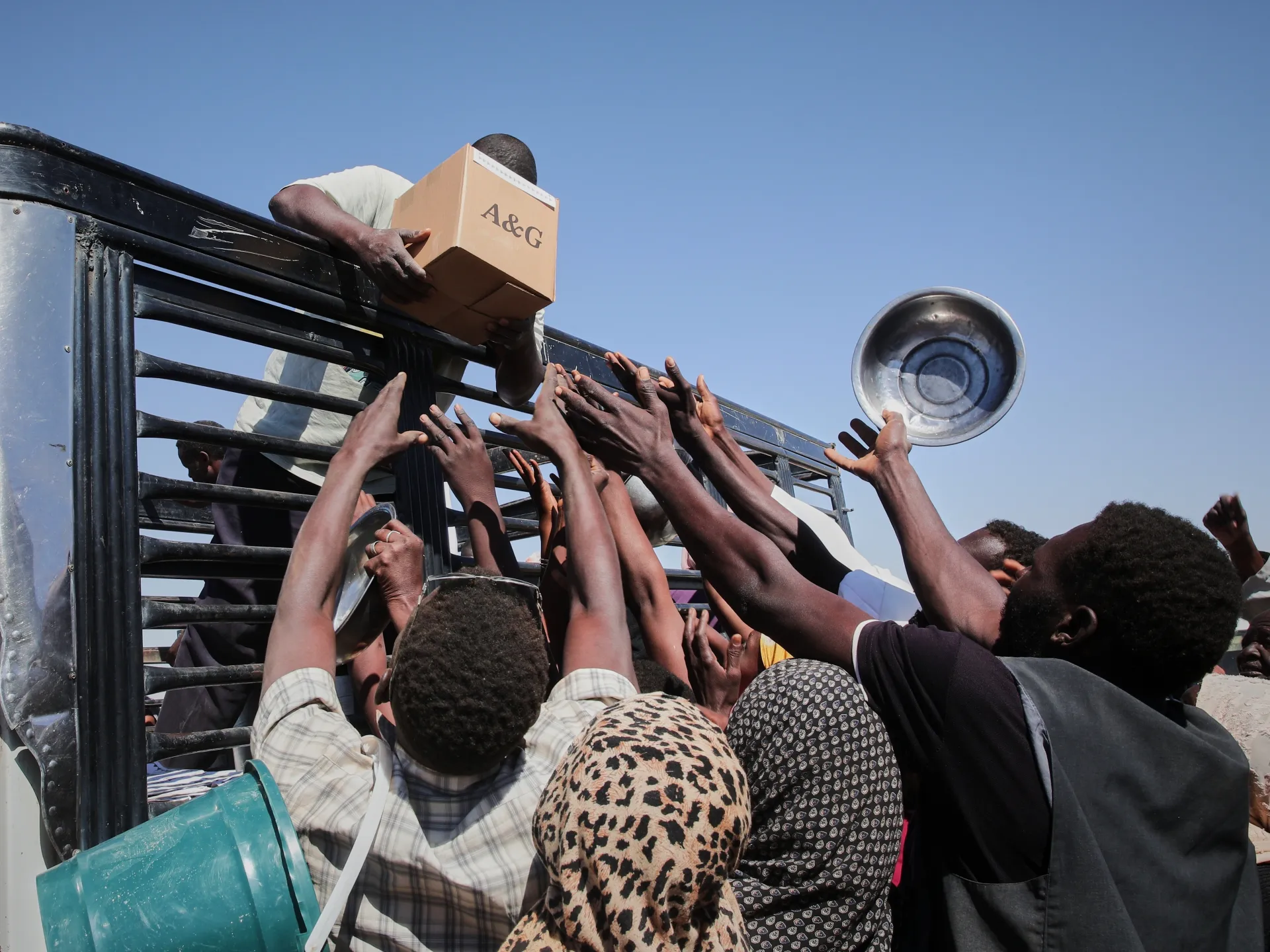
Sudan’s collective memory has long carried stories of famine-induced tragedies. Now, as war pushes the country deeper into a catastrophic food crisis, historians and humanitarian activists fear that some of those horrors are being repeated.
The ongoing war between the Sudanese army and the paramilitary Rapid Support Forces, which erupted in April 2023, has plunged the country into one of its worst modern food crises, with conditions deteriorating sharply since 2024.
Recommended Stories
list of 3 itemsend of list
Sudan has endured severe famines before, often triggered or made worse by drought and other environmental shocks. However, the current hunger crisis, which has triggered famines in Sudan in 2024 and 2025, has been brought on by a man-made factor: war.
Past starvation
One of the earliest recorded major food crises in what is now Sudan occurred in 1684, during the Funj Sultanate. The crisis, which lasted several years, brought severe grain shortages across central Sudan. Historical accounts describe people driven to desperation, and in some cases forced to eat dog meat. The hunger triggered mass displacement, as well as a deadly smallpox outbreak.
Similar climate-driven crises were recorded in 1750 and again between 1835 and 1838 during a period of Ottoman-Egyptian rule, exacerbated by severe drought and low water levels in the River Nile.
The famine most deeply embedded in Sudanese popular memory occurred between 1888 and 1889, during the rule of Khalifa Abdullahi al-Taashi.
Drought, locust infestations and conflict combined to cause widespread hunger and death. Some historical estimates put the death toll at more than one million people, although precise figures from the period are difficult to establish. The crisis was reported to have been so severe that some families shut themselves inside their homes to die rather than going out to beg for food.
Sudan experienced more periods of food shortages during the 20th century. Droughts and poor harvests during the colonial period of the first half of the century forced the authorities at times to import grain from abroad.
Then, in 1984, during the rule of President Jaafar Nimeiri, a devastating drought hit western Sudan, including Darfur and Kordofan, where there were widespread crop and livestock losses, displacing hundreds of thousands of people from rural areas to the capital, Khartoum.
Man-made catastrophe
Unlike many of those historical crises, the current famine is distinctly man-made.
War has disrupted agricultural production and trade, forced farmers to leave their land, and made it difficult to move food and humanitarian aid across the country.
Abdullah al-Tijani, a social historian and humanitarian activist, noted the unprecedented scale of the current disaster.
“Most previous famines were often confined to specific regions, as happened in 1984, or areas in southern Sudan before its secession in [2011], while the capital and major cities continued to have the necessities of life and services,” al-Tijani told Al Jazeera.
This time, he said, hunger and the collapse of basic services have spread across the entire country.
“A comprehensive food crisis has struck the heart of major urban and agricultural centres in the states of Khartoum, Gezira, Sennar, Darfur, and Kordofan, causing millions of citizens to be displaced inside and outside the country,” al-Tijani added.
He pointed to what he described as the “systematic destruction of infrastructure, disruption of large agricultural projects, and targeting of markets, bakeries, and crops, along with disrupting the banking system and communication networks, which isolated entire regions”.
Al-Tijani also cited the “restrictions on humanitarian access and delays in granting transit permits for relief workers”. He accused the warring parties of using control over food supplies as a tool of war, while warning that international funding has fallen short of the size of the crisis.
Lost agricultural potential
The scale of the crisis is stark because of Sudan’s agricultural potential. The country has immense resources, including roughly 200 million acres (81 million hectares) of arable land, abundant water from the Nile, and extensive livestock resources, but Sudan’s potential as a global breadbasket remains unfulfilled.
Mohammed Abdul Rahman, an economic researcher, explained that the current food security crisis reflects a clear development gap, and a longstanding weakness in Sudan’s agricultural sector compounded by war.
“Wars and armed conflicts are among the most influential factors on food production,” Abdul Rahman said, “along with the displacement of farmers from their lands, the absence of political stability and agricultural policies, weak funding and government guarantees, and reliance on traditional farming methods.”










![Rohingya refugees facing evicted from their homes amid rising local tensions and online misinformation, Kuala Lumpur, Malaysia, July 27, 2026 [Hasnoor Hussain/Reuters]](https://i0.wp.com/occasionaldigest.com/wp-content/uploads/2026/10/2026-07-27T123715Z_206813602_RC2BMMA6AR5R_RTRMADP_3_MALAYSIA-REFUGEE-1787872480.jpg?w=640&ssl=1)

![Women queue at a pharmacy in Tehran [Al Jazeera]](https://i0.wp.com/www.aljazeera.com/wp-content/uploads/2026/09/1arann-1790588624-1790672728.jpeg?w=640&ssl=1)


![British Prime Minister Andy Burnham looks at French President Emmanuel Macron as they pose for photos ahead of a bilateral meeting at 10 Downing Street on September 3, 2026 in London, UK [Leon Neal/Reuters]](https://i0.wp.com/occasionaldigest.com/wp-content/uploads/2026/09/2026-09-03T133923Z_1327001305_RC2MBNAX5ATT_RTRMADP_3_BRITAIN-FRANCE-1788466043.jpg?w=640&ssl=1)