Features

Joy and desire for change as Gaza’s Deir el-Balah holds elections | Elections News

Deir el-Balah, Gaza – Early this morning, Salama Badwan, his wife and daughter headed to a polling station in Deir el-Balah, central Gaza, to participate in the municipal elections, which are taking place for the first time since 2006.

The 43-year-old said he was delighted to be casting a vote after such a long absence, and overjoyed that his daughter, who recently turned 18, could vote for the first time in her life.

Recommended Stories

list of 3 itemsend of list

The vote is also the first since a “ceasefire” took effect in Israel’s genocidal war against Palestinians in the Gaza Strip. The war has affected all aspects of life, including the electoral process itself. With many of Deir el-Balah’s buildings damaged or destroyed during the war, polling stations have been set up in temporary fibreglass tents on open land.

“I am very happy today, because this is a truly Palestinian democratic celebration. Many generations have been deprived of it for more than 21 years, and today my daughter is voting for the first time,” Badwan told Al Jazeera.

For him, the importance of the elections is providing Palestinians in Gaza with a chance to achieve change through peaceful and democratic means.

“We must change everything through the ballot box … whoever wins, it is their right, but not through inheritance … change must be in the hands of the people.”

Dunia Salama, 18, came to vote in her first-ever election experience in Deir Al-Balah [Abdelhakim Abu Riash/ Al Jazeera]
Dunia Salama, 18, came to vote in her first-ever election experience in Deir el-Balah [Abdelhakim Abu Riash/ Al Jazeera]

But despite this enthusiasm, the reality in Deir el-Balah, in central Gaza, remains complex amid the ongoing “ceasefire”.

The city, which Badwan describes as “always calm,” has become a refuge for hundreds of thousands of displaced people from across Gaza, putting unprecedented pressure on its infrastructure.

“The city received large numbers of displaced people, each coming with different ideas, circumstances, and harsh suffering … This created enormous pressure on water networks, sewage systems, and waste management, and exhausted the previous municipality.”

Deir el-Balah was given the opportunity to hold elections because its infrastructure was less damaged than that of other cities in Gaza during the war.

Badwan places his hopes on a new municipal council capable of handling the scale of the crisis left by the war, away from the political divisions that have swept the Gaza Strip between Hamas and Fatah, the two main rival factions.

“We want a very strong municipal team that does not belong to any faction … one that can secure support from donor countries and meet people’s needs, because today Deir el-Balah is hosting all.”

On the street, he describes the atmosphere of the elections as “positive and enjoyable”, despite general frustration with the political class.

“People are fed up with politicians and unfulfilled promises,” he says, adding that he encouraged those around him to participate in the elections in the hope of creating change.

“I told my friends and children we must go and vote … we cannot just sit at home and wait for change.”

Awda Abu Baraka, 73, votes at a polling station center in Deir al-Balah [Abdelhakim Abu Riash/ Al Jazeera]
Awda Abu Baraka, 73, votes at a polling station centre in Deir el-Balah [Abdelhakim Abu Riash/ Al Jazeera]

‘I finally have a voice’

Standing beside her father, Dunia, Salama’s 18-year-old daughter, did not hide her joy at casting a vote, despite the exceptional circumstances surrounding her.

“I’m very happy that I can vote in my country and my city, Deir el-Balah … and that I, like others in my generation, can finally participate and have a voice,” said Dunia, a first-year nursing student at Al-Aqsa University.

“Honestly, I had never voted before and didn’t have a clear idea … but when the elections came, my father explained how things work and how our voices could help change the difficult reality we live in, even a little,” she said.

Around 70,000 voters are eligible to participate in the elections held in Deir al-Balah [Abdelhakim Abu Riash/ Al Jazeera]
Approximately 70,000 voters are eligible to participate in the elections held in Deir el-Balah [Abdelhakim Abu Riash/ Al Jazeera]

Like many of her peers, Dunia’s motivations are practical and directly tied to daily life, which has sharply deteriorated since Israel launched the war in October 2023. She chose a candidate list composed mostly of young people, describing them as “capable and experienced in their work,” reflecting her hope for a more efficient municipal administration.

“The reality the city is living after displacement is far from stable… the situation is tragic, especially cleanliness, public streets, healthcare, and even education … everything is in very bad condition.”

“I hope these elections help create a situation where students return to schools, and new housing alternatives and camps are provided for displaced people instead of using schools,” she said.

“We want things to go back to how they were … schools should return to students instead of being shelters, hospitals should improve, and streets should be cleaned,” she says.

A long-delayed moment

For Awda Abdel Karim Abu Baraka, 73, the elections represent an opportunity to choose those capable of “reviving society and institutions that have been stalled for years”.

He believes that the local elections could carry broader significance beyond Deir el-Balah. “They are part of a larger system … the West Bank and Gaza,” he explains.

“Holding elections today in Deir el-Balah shows the world that we are a democratic people, and we choose our representatives without imposition,” he adds, expressing hope that “the international community will support this path.”

He also stressed the need for the winners of the vote to respect the city’s residents who have suffered for years amid Israel’s war. “There must be real programmes, not high slogans that later fall … the citizens must be respected, and their dignity and humanity – violated by war – must be restored.”

Despite recognising the scale of challenges, he remains committed to gradual change. “We know the challenges are big and that change takes time … a long journey begins with a single step, and hopefully, this is the first step on the way.”

‘Born out of nothing’

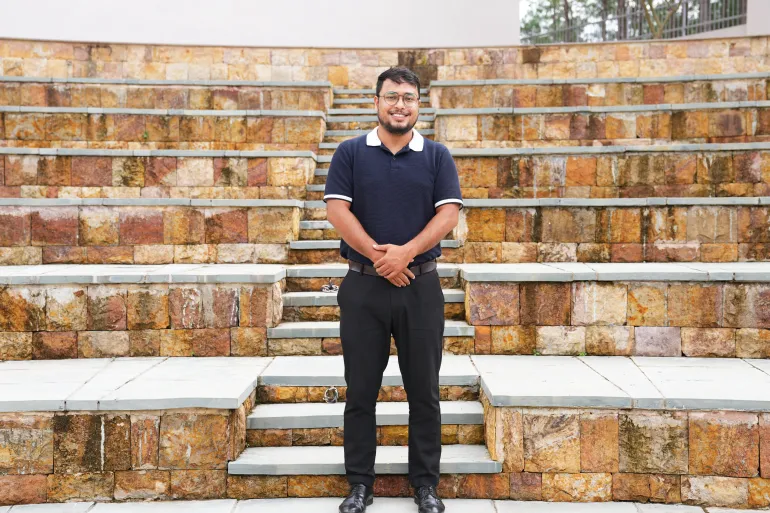
Meanwhile, Mohammad Abu Nada, coordinator of the Deir el-Balah electoral district, moved between voters and staff inside tents set up in place of school polling stations, describing an electoral process that was “born out of nothing”.

He recalls greeting the initial announcement of the elections by the Central Elections Commission in the West Bank with a mix of surprise and a sense of responsibility.

“At first, the news was unexpected … there was joy that we were returning to work after two and a half years of suffering under war, but at the same time, there was a strong sense of responsibility.”

That feeling quickly collided with the complex logistical reality in a city suffering from widespread destruction and severe shortages of resources.

“Capabilities are extremely limited … even this place was just empty land. We relied on tents from international organisations to use as polling stations,” he says, noting that most schools have been turned into shelters for displaced people.

Mohammad Abu Nada, coordinator of the Deir al-Balah electoral district [Abdelhakim Abu Riash/ Al Jazeera]
Mohammad Abu Nada, coordinator of the Deir el-Balah electoral district [Abdelhakim Abu Riash/ Al Jazeera]

Despite these challenges, polling centres were set up across the city, in a task he describes as far from easy.

The difficulties did not stop there. Essential electoral materials, usually transported from Ramallah, were prevented from entering Gaza.

Abu Nada explains the challenges in securing logistical items such as ballot boxes, stamps, papers, and campaign materials.

“We had to rely on our local capabilities … ballot boxes were designed and manufactured here in Deir el-Balah, and they served the purpose fully.”

Even electoral ink was unavailable after being denied entry by Israeli authorities. “We used ink previously used by the World Health Organization during vaccination campaigns … we tested it, and it stays on the finger for days and worked well,” he explains.

Amid shortages and soaring prices – “multiplied 10 times” – work continued intensively.

“We worked day and night … everything was difficult, from papers to stamps, but in the end we managed,” he says, noting that approximately 70,000 voters are eligible in the city.

While turnout appeared to be limited in the early morning, it picked up later in the day, Abu Nada said, attributing the slow start to people’s focus on meeting basic needs.

“People are standing in lines for water and bread … but we expect turnout to increase.”

The choice of Deir el-Balah for holding elections was not random, but due to its relatively better conditions compared to other areas.

“It is impossible to hold elections in completely destroyed areas like northern Gaza or Khan Younis … so the decision was to start in an area with minimal capacity, hoping to expand later.”

Still, the challenges facing the upcoming municipal council remain significant.

“Deir el-Balah today is not what it was before the war … population pressure is huge, and expectations from the new municipality are high,” he says.

As for the campaign, Abu Nada explains it was conducted in record time and with intense efforts.

“We worked like a beehive … organised more than 20 awareness workshops, worked with local institutions and influencers, and distributed posters and materials explaining how to vote and encouraging participation.”

At the end of his remarks, he expresses a sense of achievement despite the difficulties.

“Today, in front of everyone, we are exercising our electoral right despite all conditions … and that in itself is a success,” he says.

“And hopefully, this is the first step on a longer road.”

Source link

Dismissive, frosty and likened to Tasmanian Devil

STRUTTING the red carpet at The Devil Wears Prada 2 premiere, dazzling Anne Hathaway was like a different woman.

Gone was the so-called “in-authentic” air that critics once claimed she exuded, leading to her being branded “Hollywood’s most hated woman”.

Anne Hathaway’s successful Hollywood career has been marred by a battle to win the affection of the public Credit: Luigi & Iango for Vogue Australia
Anne Hathaway and Meryl Streep stepped out to celebrates the premiere of new movie The Devil Wears Prada 2 Credit: AP
Fans turned against Anne by accusing her of being overly dramatic when she hosted the Oscars with James Franco Credit: Getty

Instead, more than a decade after the trolling began, 43-year-old Anne appeared determined to shake off her difficult reputation once and for all.

Not so long ago, it could be argued she was best known for snapping at interviewers, snubbing fans and even, it is claimed, rubbing some co-stars up the wrong way.

A campaign known as “Hathahate” had kicked off in 2011, when Anne was panned for her Oscars hosting performance with James Franco.

Two years later, as she picked up awards for playing Fantine in the 2012 film adaptation of Les Miserables, her acceptance speeches were widely dubbed overly dramatic and insincere.

The hate spiralled from there. But Anne, who wore a sexy, cutaway Versace gown to The Devil Wears Prada 2 premiere, appeared to be launching a charm offensive as she flashed her Hollywood smile at the paparazzi in Leicester Square on Wednesday night.

Her shiny, orchestrated comeback was almost derailed this week when she was accused of “playing Muslim” by casually dropping “Inshallah” — the Arabic phrase for God Willing — into an interview.

The online hatemongers immediately went into overdrive.

In the viral interview with People magazine, Anne — who has been married to jewellery designer Adam Shulman since 2012 and has two sons with him — was asked about her plans for the future.

Without hesitation, she responded: “I want to have a long, healthy life. Inshallah, I hope so.”

While the phrase is widely used, Anne’s decision to say it has sparked debate.

One person questioned: “Is she playing Muslim now?”, while another moaned: “Anne Hathaway and her Inshallah clickbait make me not want to see Devil Wears Prada 2 and I had been looking forward to it.

“It’s not a religious thing. It’s the obvious clickbait as a marketing tactic. It’s insulting.”

As she signed autographs at the premiere in London this week, Anne was gifted a copy of the Qur’an, an Islamic religious text.

She replied: “Thank you so much. That’s very kind,” before moving on.

But insiders tell us that drama over her use of the word “Inshallah” is the last thing she would have wanted.

A source revealed: “Anne, like many people, uses that expression all the time and meant no offence.

“She has spent years stepping on eggshells and she just wants this press run to be smooth sailing without everyone hating her again.”

Anne’s every move has not always been so heavily scrutinised.


She has spent years stepping on eggshells and she just wants this press run to be smooth sailing without everyone hating her again


Source

Her breakthrough role as Mia Thermopolis in the 2001 Disney hit The Princess Diaries is still a fans’ favourite and later, she was revered by her peers following roles in the likes of Brokeback Mountain and The Devil Wears Prada.

But then the tide turned. In an interview with Vanity Fair in 2024, she revealed that she once Googled herself and the top article was titled, “Why does everyone hate Anne Hathaway?”.

She claimed the backlash affected her work, telling the magazine: “A lot of people wouldn’t give me roles because they were so concerned about how toxic my identity had become online.”

According to an LA-based source who has worked with Anne in the past, interactions with her can be tricky, and her mood depends on whether people are in or out of her favour.

They said: “The thing with Annie is, if she likes you, you’re golden.

“If she doesn’t, you’ll know about it fast. A lot of people complain about her attitude. She often comes across as frosty because she is so focused on work and she can’t stand time-wasters.

“After all, there are not many Hollywood actresses who take their work so seriously they would shave all their hair off just a couple of months before their wedding, like she did for Les Miserables.

“When Annie is in that mode, the advice is usually to steer well clear.”

Anne’s breakthrough role as Mia Thermopolis in the 2001 hit The Princess Diaries is still a fans’ favourite Credit: Alamy
Comic book fans were divided over whether Anne was sexy enough to plan Catwoman in The Dark Knight Rises Credit: Alamy
Anne was obsessed with becoming an actress on stage and screen from an early age Credit: GC Images

Anne was born in Brooklyn, New York, to stage actress mum Kate and lawyer father Gerald.

She says she knew she wanted to be a star aged three after watching Kate play Eva Peron in Evita.

By eight, Anne was obsessed with becoming an actress, further inspired by her mother playing Fantine in a US tour of Les Miserables — a role Anne later portrayed on the big screen.

She has previously told how she got an agent at 11 and landed her first major TV role at 16 in comedy drama Get Real.

Anne had starred in a string of movies before her 2011 Oscars debacle, which followed a plan to team her with co-host James Franco in a bid to pull in younger viewers.

‘Needed a break’

It backfired spectacularly and their lack of chemistry was widely mocked, as was Anne for having eight outfit changes.

Afterwards, Anne admitted she was “slightly manic and hyper-cheerleadery on-screen”.

Meanwhile, Franco, who stepped away from the spotlight after settling a $2.2million class action sexual misconduct lawsuit in 2021, said: “I think the Tasmanian Devil would look stoned standing next to Anne Hathaway.”

From then on, Anne’s reputation for being difficult grew.

Much of the criticism was ridiculous and unfounded.

Comic book fans even moaned when she was cast as Catwoman in Christopher Nolan’s The Dark Knight Rises because they did not think she was sexy enough.

But other complaints seemed to hold more weight. In a 2012 interview, which resurfaced and went viral in 2024, journalist Kjersti Flaa called her “dismissive” for providing short, unenthusiastic answers during a Les Mis press day.

When asked, “Do you believe people loved more passionately back then?” and, “Do you remember your first crush?”, the star bluntly replied, “No”.

Anne followed up with an apology to Kjersti for being so curt, attributing her behaviour to personal circumstances.

Anne’s career went from strength to strength with a series of hits including Brokeback Mountain in 2005 Credit: Alamy
A year later she hit new heights in The Devil Wears Prada, an overnight success at the box office Credit: Alamy
Anne continued to win several awards – but even her acceptance speeches were panned Credit: Getty Images – Getty

The actress went on to win a slew of awards for her performance in Les Mis, including an Oscar, a Bafta and a Golden Globe. But her acceptance speeches were criticised for being too rehearsed or self-absorbed.

Following her Golden Globes victory, Anne said: “Thank you for this lovely blunt object that I will forevermore use as a weapon against self-doubt.”

Later, she was accused by many on Twitter of putting on “The Anne Show”. Amid the fierce backlash, she stepped away from the public eye, and said in 2014: “My impression is that people needed a break from me.”

Curt answers

By 2022 the actress was back, in movie Armageddon Time, but was yet again called out online over a video of her refusing to pose for photos with fans as she left a Valentino fashion show.

Other clips included a red carpet chat in which Anne was asked what Vogue editor Anna Wintour — the inspiration for The Devil Wears Prada’s fictional magazine editor Miranda Priestly — had said about the movie.

The actress first appeared frosty as she retorted, “Why would I tell you?”, before laughing raucously.

When the interviewer pressed, “Because I’m a fan and I need to know”, Anne said, “I know, but you weren’t there”, followed by another cackle — leading to claims she was trying to pass her curt answers off as banter.

Anne is determined that there are no distractions in the press run for The Devil Wears Prada 2 Credit: Alamy

The original Devil Wears Prada was an overnight success when it was released in 2006, and saw fans obsessed with Meryl Streep’s character Miranda Priestly — the editor of fictional magazine Runway.

The sequel centres on Miranda navigating the decline of traditional print media as she finds herself at odds with former assistant Emily Charlton, played by Emily Blunt, now a powerful executive at a luxury group controlling crucial advertising revenue.


I think the Tasmanian Devil would look stoned standing next to Anne Hathaway


James Franco

Andy Sachs, played by Anne, is a features editor who reunites with Miranda in an attempt to save Runway.

As the stars hit the red carpet on Wednesday night, Anne exuded a glow that bore no resemblance to her frosty past demeanour.

She smiled for fans and appeared gracious when stopping to chat to press on the red carpet — desperate to prove she was more darling than devil.

But as mixed reviews of the trailer for The Devil Wears Prada 2 flood in before the full movie even hits cinemas, has Anne done enough to silence the Hathahaters?

Maybe it’s better the devil you know

By Dulcie Pearce, The Sun’s film critic

IT’S been 20 years since they bitched, backstabbed and brought the house down in feisty fashion film The Devil Wears Prada.

During that time, the much-loved comedy has become a cultural reference, with the characters becoming household names.

But after two decades, has The Devil Wears Prada 2 lost its bite?

Well, one thing is for sure, the cast of Anne Hathaway, Meryl Streep, Emily Blunt and Stanley Tucci have clearly found the formula for time travel, as they all look younger than they did in 2006.

Taking to the very red carpet at the European premiere in Leicester Square on Wednesday night, the foursome eradicated wrinkles and turned up their smile wattage to ultra.

They also, clearly, had to get on board with the film’s “partners” Diet Coke, with three-time Oscar-winner Streep’s outfit – red, white and black with a metallic sheen – looking like it was inspired by a can of the sugar-free pop.

Those attending were all given their own DC to sip on, too, and I don’t think it’s a spoiler to say that it’s the beverage of choice for characters throughout the film.

Audiences seeing early showings of the much-anticipated sequel also signed paperwork ensuring the film cannot be reviewed until a day and a half before it hits cinemas on Friday, May 1.

So no one is giving much away, with red carpet responses being, “It was so much fun” from Hathaway, and Streep saying: “This is a fun fashion movie. There’s a lot of music; there’s a lot of laughs.”

It hasn’t gone unnoticed that, as part of the excessive publicity campaign, Streep has joined forces with Vogue editor-in-chief Anna Wintour, who her character, Miranda Priestly, is based on.

The pair cosied up together on the cover of this month’s Vogue magazine, which is a huge contrast to the first film, which Wintour had nothing to do with.

So much so, designers and fashion figures were scared to be linked with the movie in case they offended her.

Streep recalls in the Vogue interview: “Everybody was afraid of Anna on the first one, so we couldn’t find any clothes.”

Fans fear the film has hung up its devil horns and slipped on some heavily branded wings.

Source link

West Bank scepticism as Palestinians doubt local elections will change much | Israel-Palestine conflict News

Ramallah, occupied West Bank – Hani Odeh has spent four and a half difficult years as mayor of Qusra, southeast of Nablus.

Surrounded by illegal Israeli settlements and outposts, the small Palestinian town of approximately 6,000 in the northern West Bank faces relentless settler attacks that left two residents killed last month.

Recommended Stories

list of 4 itemsend of list

Many are unable to access their agricultural fields as settlers repeatedly damage the village’s water pipes. But when his Palestinian neighbours go to the polls for municipal elections on Saturday, he will not be on the ballot.

“The resources are limited, the demands are many, there’s the settlers, the army – the problems don’t stop,” he says. “You can’t do anything for them. I’m exhausted. I just want to rest, honestly.”

Only three months ago, the Palestinian Authority (PA) announced that there would be local elections on April 25 for municipalities and village councils, the first such elections in nearly five years. There have been no national elections since 2006, keeping the Fatah-ruled PA in power in the West Bank more than 17 years after its initial mandate expired.

Odeh, who will be stepping down, doesn’t believe there is much point to the vote. “It won’t change the reality,” he says, pointing out that the gate to enter Qusra has been shut by the Israeli military for two years.

Meanwhile, the PA civil servants that Odeh relies on to run Qusra receive salaries of just 2,000 shekels ($670), a fraction of what they are owed, as Israel continues to withhold tax revenues earmarked for the Palestinians.

According to the Palestine Elections Commission, 5,131 candidates are competing across 90 municipal councils and 93 village councils on April 25, with nearly a third of the electorate between the ages of 18 and 30.

Across the West Bank, many agree with Odeh, and express doubts that these elections can move the needle on anything that actually matters.

olive trees with buildings in the background
The gate to enter Qusra has been shut by the Israeli military for two years [Al Jazeera]

‘Sense of futility’

In the days leading up to the vote in Ramallah, there have been no campaign posters hanging along the streets. That is because Ramallah – the city where the PA is headquartered – is not holding competitive elections this Saturday. Neither is Nablus, another major city in the West Bank.

Instead, both cities are being decided through a process known as acclamation, in which a single list of candidates is elected without a formal vote. Across the West Bank, 42 municipal councils and 155 village councils will be filled this way – a majority of local administrative authorities.

Historically used in small villages where extended families agreed on candidates, the process is now being applied in major cities that are PA strongholds – such as Ramallah and Nablus – where Fatah mobilisation has discouraged challengers.

“There is definitely a sense of futility in certain places,” says Zayne Abudaka, cofounder of the Institute for Social and Economic Progress (ISEP), which regularly surveys Palestinian sentiments and views, “and I think that makes it easier for places to just not have an election.”

Fatima*, a businesswoman who runs an education centre in el-Bireh, says she hasn’t voted in an election since the last Palestinian national election 20 years ago – and she doesn’t plan to this time, either. “They will choose a new group of decisionmakers, and I believe they will do the same according to the old decisionmakers,” says Fatima. “We don’t see any difference between them. It is not fair.”

Sara Nasser, 26, a pharmacist who commutes to Ramallah for work from the village of Deir Qaddis, west of the city, says she has simply grown accustomed to elections not happening and will not vote. “It’s been since before I was aware that there were significant elections,” she says. “We’ve always lived like this.”

Man sits at a desk
Muhammad Bassem, a restaurant owner in Ramallah [Al Jazeera]

Some hopeful, others less so

Not everyone is so pessimistic. Iyad Hani, 20, works at a children’s store and is enthusiastic to vote for the first time in his life in el-Bireh. “Hopefully, the one coming is better than the one who left,” he says. “There should be construction in the town and fixing the streets – that’s the most important thing.”

Muhammad Bassem, who is a restaurant manager in Ramallah, is also showing up to the polls, optimistic for what change may bring. “It is the new faces that bring about change for the better – always for the better,” he says. “We want our country to be beautiful, clean and to offer plenty of comfortable employment opportunities, tourism and development.”

Others are not so sure. Amani, who is from Tulkarem but works in Ramallah as a receptionist, watches the campaigns play out on her phone, though she does not plan to vote. “Right now, they keep saying, ‘we’re going to do this, we’re going to do that,’” she says. “But I don’t know if any of it will actually yield results.”

The Tulkarem issues she is thinking of, such as inadequate waste management, no parks for children and roads in disrepair, fall squarely into the kinds of changes that local elections might have an impact on, she suggests. “I just hope that something genuinely new and positive comes out of this.”

Sunset over Ramallah
The Palestinian Authority is based in Ramallah [Al Jazeera]

‘There isn’t a credible setup’

Underlining the question of these specific elections is a broad disillusionment with the PA that colours nearly every conversation about Palestinian political life.

Fatima says she and her whole family are politically aligned with Fatah, the effective governing party of the PA. “We don’t hate Fatah,” she says. “We hate the decisions they are taking right now.” While she says her business has contracted 85 percent in recent years, the PA still charges her 16 percent VAT.

That same disillusionment extends even to the elections in small localities like Qusra, which Mayor Odeh calls “a family affair, not a political affair”.

“People have lost faith in the parties, lost faith in the [Palestinian] Authority, lost faith in the whole world,” he says, expecting low turnout on Saturday. While most candidates in Qusra are politically aligned with Fatah, Odeh says no candidates in Qusra’s election this Saturday are doing so officially. “If they run under political affiliations, no one will support them.”

According to the Palestine Elections Commission, 88 percent of those on the ballots this year are doing so as independent candidates.

While polling suggests roughly 70-80 percent of Palestinians distrust the PA as an institution, Obada Shtaya resists framing this simply as a PA problem, considering the PA’s hobbled finances and its shrinking autonomy in Areas A and B under Israeli occupation. Israel continues to expand settlements and military raids in the West Bank, and the PA has no power to respond, with the prospect of a Palestinian state increasingly distant.

“Pessimism, lack of hope, helplessness – it is beyond the classical distrust in the PA,” he says. “It is looking at the PA and potentially understanding that these people also don’t have much that they can do to help themselves.”

A new amendment to the local elections law, requiring all candidates to affirm their commitment to agreements signed by the PLO – widely understood as a measure to exclude Hamas and other opposition factions – now threatens to taint how people perceive these elections. “If you want to run, you need to pre-agree to things at the national level,” says Shtaya. “But this is about local service delivery. Why am I having to sign things that deal with agreements between the PA and Israel?”

Despite the many naysayers in this election, “Palestinians are thirsty for democracy,” says the pollster, including those in Gaza. What is missing is not the will, he says, but the proper architecture for it: elections announced years in advance, a functioning legislature, and accountability that extends beyond voting day.

“There isn’t a credible setup that shows people their vote makes a difference,” says Shtaya. Without that, sporadic elections take place at what he calls the surface level: real enough that some people show up, but shallow enough that not much changes underneath.

Soon to be relieved of his mayoral duties, Hani Odeh plans to open a toy shop and set up a house for himself. “Let people breathe,” he says. “We’re here. We’re not going anywhere.”

Source link

How Alison Hammond REALLY lost 13st

AFTER literally breaking the scales, Alison Hammond has spent recent years vehemently denying fat jabs helped her to shed 13st. 

And we can reveal her astonishing weight loss is actually the result of an adventurous gym routine, a toyboy boyfriend and a £2.85 supermarket secret.  

Alison Hammond insists her 13st weight loss isn’t down to fat jabs but a strict fitness regime, a younger boyfriend and a £2.85 supermarket snack Credit: Getty
The star has lost 13st since appearing on Strictly in 2015, above Credit: Shutterstock Editorial
Alison on a night out with boyfriend David Putman Credit: Darren Fletcher

A close pal said: “Alison was mortified when she stepped on the scales in 2020 and her weight was so high the sensor broke. 

“It stopped at anything over 29st, so she has no idea exactly how much she weighed back then. 

“It was a real wake-up call and she began a strict diet that day. 

“People are constantly accusing her of cheating and saying that she’s on fat jabs, but she’s not.

“They weren’t even around then.”  

Instead, the Great British Bake Off host, 51, has been munching on Itsu crispy seaweed thins — with just 24 calories in a pack.  

Her mate added: “When shoppers see her in Tesco the trolley is usually packed high with boxes of Itsu seaweed snacks.

“She eats about four packs a day.

“Instead of toffees she’s addicted to seaweed.” 

It is a far cry from the terrifying moment a few years ago that kickstarted her bid to get healthy. 

The scale shock prompted her to visit the doctor, who confirmed she was prediabetic and needed to slim down or face an early death

Being prediabetic — the point where your blood sugar is higher than normal but not high enough yet to be diabetic — genuinely terrified her as it can bring serious health problems.  

Following her doctor’s grave warning in November 2020, and in a desperate bid to reverse her diagnosis, the popular This Morning host made a plea to viewers live on air.  

Begging for help 

“I need some help,” she said bravely.

“I’ve really got to change my ways, if you guys see me out there buying sweets or chocolates, please I’m begging you, I’m not allowed to have it. 

“It’s serious now.”  

Viewers were quick to react, messaging the show in their droves with supportive comments and sharing their own struggles too.  


I thought, ‘I have to be an adult about this’. The sweets had to stop and the fatty foods.


Alison of changing her life

“Ali knew she was morbidly obese and was genuinely concerned that she was going to die,” says her pal.

“But the encouragement from viewers really touched her.

“It inspired her to make changes.” 

She previously said that her mother Maria, who died in January 2020 from lung and liver cancer, influenced her decision to overhaul her lifestyle. 

“My mum had type 2 diabetes,” she said.

“She was worried for me, so when I then found out I was prediabetic, that was frightening.  

“I thought, ‘I have to be an adult about this’. 

“The sweets had to stop and the fatty foods.”  

It was not the first time Alison had tried to lose weight.  

She had a gastric band fitted after a chair broke underneath her while she was interviewing actor Matt Damon in 2007.  

Alison has hit back at ‘fat jab’ claims, explaining she has swapped sweets for low-calorie seaweed snack itsu Credit: Supplied
Alison, pictured in 2022, now works out three to five times a week with her personal trainers Credit: Getty

However, following the op, Alison experienced complications and “couldn’t keep anything down”. 

After two years, she decided to have the procedure reversed.  

Then, ten years later, she appeared on TV show Sugar Free Farm, which followed celebs as they embraced a sugar-free diet and farm work. 

While she managed to lose two stone on the show, the side effects from the sugar withdrawal left her feeling dizzy and sick.  

Now Alison, who is mum to Aidan, 21, works out three to five times a week with her personal trainers Lui Mancini and Ellis Gatfield.  

She combines strength training, boxing and Pilates rather than cardio and when she is busy working she enjoys walking.

A video posted by Lui displayed her hard at work with kettlebells, medicine balls and a punching bag. 

But no doubt also helping Alison’s confidence — and her weight loss — is her lover.  

She met David Putman, 29, a former Russian model, when she booked in for a massage in 2023.

The couple kept their relationship secret for about a year but now it is very much out in the open and despite the 22-year-age gap they are desperately in love.  

“It was pretty much love at first sight,” said her pal.

“She fell totally head over heels with David and he’s besotted with her.

“When you see them together it’s so sweet.

“He gets on really well with her son too.” 

But a change in her diet has had the most dramatic effect on her.

In a bid to reverse her prediabetes she has cut back on sweets and fatty foods — which has not been easy, especially as the host of C4’s Great British Bake Off, where she is surrounded by temptation.  

“Ali was completely addicted to toffees,’ says her pal.

“She would eat bags of them.” 


For people who need to use them, weight-loss jabs are a good thing. But for me, as soon as I hear any scare story, I get frightened.


Alison on using fat jabs

But these days she relies on seaweed.

The salty snack, combined with a rigorous exercise regime, has seen her weight drop to under 17st.  

She now drinks two litres of water a day and has a high-protein diet with lots of chicken and turkey mince bolognese.  

“She eats half of what she used to eat,” revealed her friend. 

Alison, who also hosts Your Song on Channel 4, previously told how weight loss jabs were not for her because she was “frightened” by “scary” stories surrounding them. 

She said: “For people who need to use them, weight-loss jabs are a good thing.

“But for me, as soon as I hear any scare story, I get frightened. 

“So I haven’t wanted to use them, but that’s not to say I wouldn’t in the future, and I certainly wouldn’t look down on anyone who did.” 

But industry insiders have warned there could be an issue if her slimdown becomes too extreme, especially as she vies for the presenting gig on Strictly.  

“There’s a fear that if she gets too skinny she might not be as popular with her fans,” said another source.  

Pals insist Alison has no intention of losing her curves or trademark sparkle.

Her journey has never been about fitting into a certain dress size but building a healthy life.  

During an interview on Loose Women last year, she summed up her attitude perfectly: “You know what, all I can do is be me.

“I can’t do anything else. 

“I’m a black, big, bubbly woman, who is slowly deflating a little bit.” 

Only time will tell if Alison’s next steps will be into the ballroom. 

But one thing is for certain, it will be seaweed, and not Ozempic, in her handbag. 

Alison says ‘scary’ stories put her off using weight-loss jabs Credit: Getty

Source link

‘I need to document America at this pivotal time in history’, says Tori Amos as she returns to London with new album

MORE than three decades after London helped launch her career, Tori Amos is back in the city, headlining the Royal Albert Hall for a tenth time. 

The US singer is chatty and upbeat despite staying up until 5am, still riding the high of her gig the night before. 

Tori Amos is back with her 18th album, In Dragon Times Credit: Kasia Wozniak.
Tori playing London’s Albert Hall on Tuesday Credit: Getty

With her striking red hair falling in waves and her vivid green eye make-up, Maryland-raised Tori, who has called Cornwall home since the late Nineties, looks every inch the star. 

“London was the place that gave me my big exposure explosion,” she says.

“It really did shake my life up. And here we are again. 

“London broke Silent All These Years in the autumn of 1991, and then launched [debut album] Little Earthquakes, which rippled out to the States and the rest of the world.

plug pulled

Brit band cancel gig at final hour after ‘unexpected medical situation’


singing sensations

Where the Osmonds are now: About 70s group as Alan Osmond dies at 76

“America really discovered me through London, and then the UK did, too. From there, it just kept rippling outwards.” 

On her forthcoming 18th album, In Times Of Dragons, Amos turns political dread, female resistance and personal storytelling into something unique and mythic.  

She says: “I’m very reclusive at home and I’m not very sociable there so when I’m on tour I go from this insular life, where I do a lot of reading, music and writing, and step into this much more exposed life.” 

The contrast between Amos’s secluded home life and her role as a performer feeds directly into an album shaped by both personal reflection and political unease. 

The record is a response to the current political climate in America because, as a songwriter “a lot of my work is documenting time,” she tells me. 

“That’s what I did with Little Earthquakes, which followed my time of failure after [her synth band] Y Kant Tori Read when I had to go back to play piano bars.  

“I have a history of documenting things — my miscarriage in 1998 and that journey, then my 2002 album Scarlet’s Walk which documented 9/11 when I actually wrote some of it on the tour bus.” 

The idea for In Times Of Dragons came through the muses — otherworldly entities — that Amos believes bring her music.  

She has spoken widely about these guiding forces, which she says have inspired her songwriting since childhood.

And last year she published children’s book Tori And The Muses, all about them. 

She says: “This message came to me through the muses that I needed to document America at this pivotal time in history. 

“And I had to personalise this.

“It came to me a year ago that I needed to be me in the story and be closely connected to one of these people, and what that would look like, because they are personally affecting us. 

“I had to turn the volume on that to create this narrative, whatever turning into a dragon looks like.” 

The album follows the story of Tori trapped in a world run by billionaire tech moguls and lizard dragons, who threaten democracy through corporate greed and authoritarianism. 

Amos says: “Jane Mayer writes about the genesis of this in Dark Money, which is one of the most important books people need to read if they’re asking, ‘How did we get here?’. 

“This has been going on since the Seventies.

“As Mayer documents, figures like the Koch brothers — and I use that as an umbrella term for a wider movement — helped shape it, along with super PACs [organisations that spend millions supporting political candidates] and all the rest. 

“It seems there was an understanding that progressive teaching in universities had to be excavated, cut back and penetrated by a very tight right-wing philosophy that is now upon us. 

“And I’m not just talking about Republicans and Democrats. I’m talking about tyranny versus democracy.

“If you had asked me about this even around the Scarlet’s Walk era, I was already going after it through that record, and then through [2007 album] American Doll Posse during the Bush-Cheney administration with the wars, the manipulation, all of that. 

“Then there was a period of relief, when a different, more inclusive philosophy came in, whatever your politics are. 

“For me, it’s about the philosophy.

“As a songwriter, I’ve been tracking that through my career. 

“On this record, I had to take a personal journey and look at the effects of what this very small cabal of men is doing — and there are women involved too, we can’t get confused about that. 

“There’s Cambridge Analytica, the involvements of the Mercers, Rebekah Mercer [the right-wing US heiress and political donor] and all those interconnections.” 

The album’s story sees Amos’s character flee and reunite with her daughter.

This part is played by her real-life daughter Natashya, who co-wrote tracks Veins, Strawberry Moon and Stronger Together — the latter of which she also sings backing vocals on, and is one of the most emotional songs on the record. 

“She was in DC at the time, in law school, and she graduates in a few weeks,” says Amos proudly.  

“She’s going into criminal law and really had her finger on the pulse. 

“On a daily basis she’s seeing things that the wider public probably isn’t, unless you’re a political journalist. 

Tori in a shoot for the new album. An actress portrays her daughter, who co-wrote three songs and sings backing vocals Credit: Unknown

“We’re so inundated that the little freedoms being quietly taken away can be missed. 

“Criminal law is her calling.

“So, writing these songs with her, with her understanding of what’s happening in the field she’s chosen, and her exposure to the shock of what is being torn to pieces, was hugely important. 

“She says we are past constitutional crisis and what’s going on is absolutely shocking.” 

The final song, written last- minute for the album, is Ode To Minnesota — a response to the deaths caused by ICE agents there. 

She says: “Heinous, atrocious crimes are being committed and so this is the world of the record.”  

Amos, 62, has a long history of addressing America in song, and In Times Of Dragons continues that while exploring wider patterns of male power

It’s also a reminder of her role as a feminist icon and the influence she’s had on artists such as Lady Gaga, Florence Welch and St Vincent (real name Annie Clark).  

“Annie’s one of my dear friends,” she says of St Vincent.

“She’s fabulous. We have a giggle and I’m thrilled for her, for her art, and for the way she’s balancing motherhood so beautifully. 

“It’s lovely to see people who came to my shows when they were younger. 

“She’s talked to me about Choirgirl [Tori’s 1988 album From The Choirgirl Hotel] and what it meant to her when she first heard it, and we’ve had laughs about that. 

“And it’s the same with the guys too. 

“I’m off to an event later and the guy doing the Q&A used to stand by the stage door as a teenage gay kid.  

“To see these people grow up, and to still be able to bask in their creativity and development, is a beautiful thing to witness.” 

But while Amos is moved by the artists and fans who have grown up with her work, she is hesitant to define her own feminist legacy. 

She says: “It’s not for me to say, that’s more for other people to decide. 

“Believe it or not, I’m a bit introverted about that.

“What I think I’ve tried to do, and what I have done, is there for those who know it. 

“What’s important to remember is that there was no social media then.

“When people ask, ‘Was it easier back then?’, well, in some ways no, and in others yes. 

“We did have a music business with a few women in record companies, though only a few in executive positions.

“One or two could balls their way through, but you really had to.

“And if you didn’t have that tenacity in the Nineties — especially to get played on radio — it was tough. 

“At an alternative station in the States, they might add two women out of 64 slots, and the other 62 would be men.  

“I’ve spoken about that with some of my contemporaries over the years, Alanis [Morissette] being one of them, and it was not a good feeling — knowing that talented women with very good records were simply not being added to the station. 

“And touring took money. 

“That’s why I never had tour support.

“In the early days, I went out with just a piano, my tour manager and a sound guy. That was it. 

“We kept the costs down, and luckily the shows sold out, because the Press had really got behind me.” 

Today, Amos points to Dolly Parton as proof that women can keep evolving, performing and owning the stage on their own terms as they get older.

“She is fantastic and she’s aware we are a different generation that played this game and played it well,” says Amos.

“There are women who are still playing the game beautifully, and they still have the physicality and the health to do it.  

“I used to have a three-and-a-half octave range when I was doing those one-woman shows.

“But with the change of life — becoming a dragon, if that’s the menopause analogy — you adapt or you collapse.

“For me, it wasn’t a crisis in the way it has been for some women we’ve read about in the Press, and I have huge empathy for that.

“But vocally, I did have to make changes. 

“I didn’t want to alter the top lines of songs with those very high, wide-ranging melodies, so on the last tour I simply didn’t play them.  

“Then I thought, ‘No, that isn’t what I want.

“I want the whole catalogue available to me as a storyteller’. 

“So, I decided to bring in backing singers who could hit those notes.

“It was a strategic, compositional choice.

“I didn’t want to be in a position where I could only perform 40 per cent of my catalogue because of range. 

Tori at the 1992 MTV Video Music Awards in Los Angeles Credit: Getty

“And we’re having a blast. 

“They’re amazing singers. 

“I’ve gained four notes at the lower end and I feel like I’m down there rocking with Nick Cave, but that’s the trade-off. 

“I gained more on the lower end, while recognising that if I want to play those songs, you can only transpose them down so far before they lose their essence. 

“I have so much respect for Nick Cave.

“I used to run into him in the early Nineties.

“His work has always been a beacon of beauty and darkness — expansive work that makes you think.” 

Like Cave, Amos remains restlessly creative, and she is already thinking about where to go next.  

“After something as demanding as this, I’m doing a prequel to children’s book Tori And The Muses — that will be out next year,” she says.

“Her journey as a little girl with her muses.  

“It’s due next April — and there may be music to go with it too.” 

  •  In Times Of Dragons is out on May 1. 
Tori Amos’  In Times Of Dragons is out on May 1 Credit: Kasia Wozniak.

TORI AMOS 

In Times Of Dragons 

★★★★☆

Source link

Why Niall Horan & Harry Styles are ‘no longer close’ and have ‘nothing in common’ after another feud tears them apart

THEY were once ‘like brothers’, touring the world together and dealing with global superstardom after being propelled into the spotlight aged just 16.

But now in their early 30s, Niall Horan and Harry Styles are “worlds apart” and living “vastly different lives”. Here, an insider tells us why the relationship has soured between the pair, and how the rest of One Direction are keeping their distance.

Niall and his girlfriend Amelia are often spotted walking their dog in London Credit: MJ-Pictures.com
Harry tends to wear disguises and use fake names Credit: BackGrid

Fans first noticed cracks between the pair last month when Niall, 32, made barbed remarks about the cost of fame on an American podcast just days after Harry, also 32, said he found his superstardom “deeply isolating”.

Speaking on the Zach Sang show earlier this month, Niall cheerfully revealed how delighted he is to be living a “completely normal life” in London, travelling on the tube, walking his dog and going for beers with his mates in local boozers.

When asked if he minds being stopped by fans, the Irish singer remarked: “You cannot have your f***ing cake and eat it”.

Fans were quick to point out that the comment came shortly after Harry spoke about the cost of superstardom – and wondered if it was a dig in his direction.

Speaking to Runners’ World magazine for their May cover, Harry said that he found fame ‘deeply isolating’ and felt the need to withdraw from public life to protect himself.

As part of this, he moved to Italy, because it allows him to ‘live a quiet life’ and ‘reset’.

But the differing attitudes toward fame are part of reason why the pair are no longer close.

A source tells us: “The boys used to be like brothers, they were the best of friends and used to joke about what life would be like when they were old men and still hanging out together.

“Now they are about a million miles from that. They have gone their separate ways and are all living such different lives. 

“Niall is a real homebody; he loves being at their place in London with Mia and the dog, or with his family in Ireland. He’s not a kid anymore; he feels settled now, while Harry still jets all over the world and never seems to stay in one place for long.

“The pair of them hardly have anything in common now, and while Niall would never come straight out and criticise Harry, some things he says definitely make Niall’s eyes roll.”

While the Irish singer songwriter, who is worth £52 million, is completely at ease with being recognised when he’s out and about, scared Styles recently admitted all the unwanted attention left him wanting to become a recluse.

Speaking to US media, Niall claims he can live carefree in London. He says his life with long-term girlfriend Amelia Woolley – known as Mia – is not built around his work schedule and fame.

He added that he’s never minded being mobbed by One Direction’s devoted army of fans: “I don’t ever want it to be like, poor me. That was just the way it was – there were a lot of people around. 

“I just get out and do it, and people are going to come up to you and say hello. And that’s fine. 

“I used to be nearly afraid of that. I love it now. I basically live a completely normal life, really, apart from the fact that if I walk in somewhere, someone’s going to come up and say hello, that’s fine. 

“I walk the dog every day and go on the tube and go into town and go for beers. There’s nothing special.

“It’s a great thing. It’s something that when you were younger, you yearned for.

“We all want that normalcy in effect. You cannot have your f****ing cake and eat it, though, either. 

“I want to be out there doing my thing and getting up on stage. It’s the best f***ing thing in the world.”

This latest spat between the pop legends comes after we revealed Zayn Malik punched Louis Tomlinson in the face during a vicious row, cutting his head and leaving him concussed.

The former pals’ bruising clash came as they filmed a three-part road trip for a nostalgic Netflix documentary about the band, which has since been scrapped.

It emerged that Zayn had made a scathing remark about Louis’ mum, Johannah Deakin, who died of leukaemia in 2016.

Our front page splash on Saturday revealed details of the fight Credit: Not known, clear with picture desk
Harry goes out of his way to avoid being recognised Credit: BackGrid
Back in 2011 the boys said they were as close as brothers Credit: Getty

Despite the frenzy of worldwide adulation, Niall says that down-to-earth fashion buyer Mia, 28, from Birmingham, keeps his feet firmly planted on the ground.

He went on: “You can sit at home and go like, it’s hard for me to do these things.

“But at times, it being uncomfortable or something can be a reason why you don’t do them. Or you can choose for that to not be a reason and you can do them anyway.

“When you shut out a lot of the things that are assumed can be negative, you also just unconsciously shut out a ton of positive things.

“We live a completely normal life outside of this.

“It’s like someone’s pressed pause on a stopwatch, and then when it clicked back in, I was just this different person. It’s really cool. It happened gradually, but when I think about it in hindsight, it felt like just night and day.


I basically live a completely normal life, if someone’s going to come up and say hello, that’s fine


Niall Horan

“My life just went from being all encompassing to having this good divide.

“I love it. I like having the balance. It’s pretty cool.

“I’ve gotten very good at. When I’m at home, I’m completely at home. I’m not doing anything. I just want to be at home.

“But I like going to work now and then being at home, I like it that way.

“Hopefully, I can keep doing that because it’s a nice little balance I’ve got going on. And it takes time to get to that.

“Amelia’s got her own life. She’s been doing her thing, and everything can’t be just surrounding me.

“It’s already weird enough that she used to fly to Amsterdam to come in on a five o’clock flight on a Friday. It can’t be like that all the time. 

Niall’s new album Dinner Party is about the night he met fashionista Amelia Credit: Goff
Amelia and Niall at Wimbledon last summer Credit: Getty

“Bringing her into that is a really cool thing. And she feels that sense of pride and looks at the fans and sees the way they’re thinking and things like that. 

“It’s such a cool thing for her if I play her a song; she’s never had that before. It’s not like people were coming home in the evening from work and going, ‘Hey, I wrote you a song today.’

“That’s a new thing for her, too. The whole thing is a shock to the system, but our life is just not all about that.”

Niall previously dated Hailee Steinfeld and Ellie Goulding – resulting in Ed Sheeran writing the hit track Don’t about an apparent love triangle between the trio.

But Harry, who rented a mansion outside Rome and ran marathons using pseudonyms, feels very differently.

He explained recently: “A large part of the last couple of years has just been about, honestly, learning to like myself away from having so much of my value baked into whether other people are enjoying me or not.

“Learning that fears and feelings aren’t facts, and you can have a feeling about yourself and taking the time to be able to see what that is and see where that comes from.”

Louis was cut on the head and left concussed while filming in America Credit: London News Pictures
After receiving medical treatment, Louis left for the UK, while Zayn returned to his farm in Pennsylvania Credit: Getty – Contributor

Source link

New Low-Cost Cruise Missile Features Tomahawk-Like Range

A new, longer-range version of the Rapidly Adaptable Affordable Cruise Missile (RAACM) has been unveiled by CoAspire at the Sea-Air-Space 2026 exposition near Washington, D.C. The development comes just days after the U.S. Air Force launched market research for its Family of Affordable Mass Missiles — Beyond Adversary’s Reach (FAMM-BAR), reflecting the service’s interest in low-cost, long-range strike weapons, specifically for anti-surface warfare.

Jamie Hunter of TWZ spoke about the RAACM-ER (RAACM pronounced ‘rack-em;’ ER for Extended Range) with Doug Denneny, founder, CEO, and owner at CoAspire.

A frontal view of the RAACM-ER. Jamie Hunter

First off, it’s worth looking at the original RAACM, a modular, low-cost cruise missile that leverages 3D printing to bring down cost and enable rapid production ramp-up.

“When we designed the original RAACM, we knew that it was going to be the size of a GBU-38,” Denneny said, referring to the 500-pound version of the Joint Direct Attack Munition (JDAM), which is 92.6 inches long and has a wingspan of 14 inches.

An official video promoting the original RAACM:

RAACM Rapidly Adaptable Affordable Cruise Missile thumbnail

RAACM Rapidly Adaptable Affordable Cruise Missile


“When you go to that size, there are great reasons to do it, but it doesn’t go as far as a larger variant could do,” Denneny continued. “We really wanted to take everything we learned and now have an extended-range version. And what’s beautiful about the additive manufacturing that we use is that we can really optimize fuel tank volume, which means this can go very far.”

According to the manufacturer, the RAACM-ER has a range greater than 1,000 nautical miles.

This is especially remarkable considering the relatively compact size of the weapon. Indeed, when it comes to anti-ship missiles, the only weapon in the U.S. inventory that comes close is the BGM-109 Block V Maritime Strike Tomahawk (MST). This can be launched from destroyers, submarines, and the U.S. Army’s Typhon system. Like the RAACM-ER, it is subsonic, but a single round costs $3.64 million, according to the Navy. While the RAACM-ER clearly has a degree of low observability, it is not to the same degree as on the MST.

A full battery set of four Typhon launchers, as well as the trailer-based command post. U.S. Army

Like RAACM, the extended-range model is designed for launch from aircraft, as well as from the ground and from naval vessels. For surface-launched applications, the RAACM-ER adds an additional rocket booster behind its turbojet, meaning it can be propelled out of its launch canister.

Despite the nomenclature, the RAACM-ER is a new design, rather than a modification of the RAACM.

Denneny explained: “Our engineers came to us and said, ‘Hey, if we’re going to make a bigger one, should we make it look just the same?’ I mentioned earlier that RAACM was made that shape just to ease integration. We’re an engineering company, so we said, ‘Let’s optimize fuel volume, let’s optimize survivability features, let’s optimize physics so that this thing can go as far as possible and take the sensors needed. That’s why it’s in this slightly different shape.”

The RAACM-ER is somewhat reminiscent of the AGM-158 Joint Air-To-Surface Standoff Missile (JASSM), in terms of appearance and capabilities, but Denneny is keen to avoid direct comparisons.

Stealthy AGM-158 JASSMs loaded onto an F-15E. U.S. Air Force/Photo by Airman 1st Class Susan Roberts Stealthy AGM-158 JASSMs loaded onto an F-15E. JASSM uses an imaging infrared seeker — seen in the hexagon-shaped window on the missile’s nose — to match the target in its databank and fine-tune its terminal attack run. (Photo by Airman 1st Class Susan Roberts)

“Physics is physics,” he added. “When people look at shapes, they look similar, but just like an Airbus looks like a Boeing, but what they have different inside is really what matters, and that’s how we differ in many ways.”

In terms of sensors, the RAACM-ER is currently fitted with a GPS navigation system, suitable for air, ground, and surface launch.

“Both our RAACM and our RAACM-ER also have a long-wave infrared sensor in the nose,” Denneny continued, “so we have the opportunity to search and find targets as well.”

Unlike the JASSM and similar cruise missiles, however, the RAACM-ER, like the RAACM before it, is optimized for low cost.

For Denneny, “the most important thing is affordable mass. [This] means keeping the cost down, so that the nation and our allies can purchase these at scale. That’s number one. Number two is to use as many commercial off-the-shelf parts, so that we’re we are not locked into a single supplier for anything. The final thing is to have something that can survive enemy countermeasures, and also hit the target, whether it’s stationary or moving. Those are the main requirements.”

Jamie Hunter

When it comes to price point, CoAspire has optimized mass rather than the highest-end capabilities. This is a reflection not only of the sheer number of targets that the U.S. military and its allies would face in a potential conflict with China, but also the fact that a considerable proportion of missiles won’t make it to their targets anyway. Still, as recent conflicts have shown, the ability of lower-end drones, especially, to overwhelm adversary air defenses when fielded in large numbers is significant. After all, quantity has a quality all of its own.

Denneny confirmed that CoAspire plans to test-fly the RAACM-ER “very soon.”

The original RAACM has already undergone flight trials aboard a contractor-operated A-4. CoAspire is now under contract to the U.S. government for RAACM, and the weapon is in production at the company’s plant in Manassas, Virginia.

In the past, we’ve learned that both the Air Force and the Navy have funded work on the RAACM project. It has also been reported that CoAspire is one of two companies producing Extended Range Attack Missiles (ERAM) for Ukraine — this may well involve the RAACM or a related weapon.

Two candidate weapon prototypes competing for the US Air Force’s Extended-Range Attack Munition program 👇. Both Coaspire and Zone 5 Technologies were awarded contracts late last year in support of the #ERAM program. Both are expected to enter testing this year. https://t.co/9cGBuB9z3s pic.twitter.com/gc3ZDtX54m

— Air-Power | MIL-STD (@AirPowerNEW1) February 9, 2025

As for the RAACM-ER, this was unveiled only a week after the Air Force launched market research for its Family of Affordable Mass Missiles — Beyond Adversary’s Reach (FAMM-BAR).

“The potential procurement objective is to produce an inventory for the [U.S.] Government and Foreign Military Sales. The expectation is that the annual production orders will range from 1,000 to 2,000 units per year for five years (procurement numbers will vary by year),” the Air Force says in the request for information.

The FAMM-BAR program lists five desired attributes for the potential weapon: a range of at least 1,000 nautical miles, a speed of at least 0.7 Mach, the option of palletized delivery from a cargo aircraft, the ability to receive midcourse navigation updates, and the manufacturing capacity to produce more than 1,000 rounds annually. The main target set for the weapon is “slow-moving maritime” vessels.

A video showing a demonstration of the Rapid Dragon air-launched palletized munitions concept, using surrogate weapons delivered from the cargo holds of a C-17A and an EC-130J:

Rapid Dragon Flight Test thumbnail

Rapid Dragon Flight Test


This requirement reflects the growing focus on anti-surface warfare as the U.S. military plans for a high-end conflict in the Pacific, especially against China. The U.S. military is increasingly investing in a diverse mix of anti-ship capabilities, part of a broader strategic shift driven by China’s growing maritime power. At the same time, real-world operations have exposed how rapidly missile stockpiles can be depleted, intensifying concerns that sustaining the massive volumes of anti-ship fires required in a China conflict will demand significant expansion of U.S. production capacity and inventories.

At the same time, the RAACM-ER would be useful for striking static land targets during an Indo-Pacific war, too. With such a considerable range, the weapon will also be better able to deal with increasingly far-reaching air defenses, something that the Pentagon is increasingly concerned about, including the likelihood of enemy missiles that can target its aircraft at ranges as great as 1,000 miles.

It should be noted that there are already other FAMM programs underway, namely the FAMM-Palletized and FAMM-Lugged cruise missiles for the Air Force. However, these require ranges of 250-500 nautical miles.

At this point, the low-cost, long-range strike weapon field is becoming increasingly crowded. Other contenders include designs from Anduril, General Atomics, and Zone 5 Technologies. From the last of these companies, the Rusty Dagger recently underwent release tests from an Air Force F-16 as part of the FAMM-L effort.

A U.S. Air Force F-16 takes off carrying a Rusty Dagger, from Zone 5 Technologies, as part of the Family of Affordable Mass Munition — Lugged tests. U.S. Air Force photo by Tech. Sgt. Thomas M. Barley

Global Technical Systems is also pitching a cruise missile with a range of 1,200 nautical miles and an anti-ship warhead.

However, with the original RAACM already in production, and proven in flight tests, the new RAACM-ER looks well-positioned to go far — figuratively and literally — in the FAMM-BAR program.

Contact the author: thomas@thewarzone.com

Thomas is a defense writer and editor with over 20 years of experience covering military aerospace topics and conflicts. He’s written a number of books, edited many more, and has contributed to many of the world’s leading aviation publications. Before joining The War Zone in 2020, he was the editor of AirForces Monthly.


Source link

Bad optics? Israel jails soldiers who smashed Jesus statue in Lebanon | Israel attacks Lebanon News

Footage of an Israeli soldier attacking a Christian statue depicting the crucifixion of Jesus in southern Lebanon with a sledgehammer was difficult for Israel’s political establishment to ignore. The country has long tried to frame itself as a defender of Christians, and is allied with the powerful Christian Zionist movement in the United States.

But as Israel continues to lose support in the US and the West for its genocidal war in Gaza and attacks in Lebanon and Iran, support among Christians has also dipped – even before the video of the desecration of the Christian statue surfaced.

Recommended Stories

list of 3 itemsend of list

Responding to the footage on Monday, a day after it first went viral, Israeli Prime Minister Benjamin Netanyahu pushed his regularly repeated line that Israel respects all religions, even as critics point out that his government regularly does the opposite.

But, with even some of Israel’s supporters voicing anger at the soldier’s actions, Israel announced on Tuesday that he had been jailed for 30 days, along with another soldier who had been filming him. Six other soldiers have been summoned for questioning.

The decision to pursue action against the two soldiers stands out because it is in marked contrast to Israeli military investigations conducted into violations by soldiers, which overwhelmingly find them not to have been at fault. In fact, no Israeli soldier has been charged with killing a Palestinian this decade, despite the thousands killed even outside of the Gaza war context, including the 2022 killing of Al Jazeera’s correspondent in the occupied West Bank, Shireen Abu Akleh, who was herself a Christian.

Yossi Mekelberg, a senior consulting fellow with Chatham House, noted that it was important for the Israeli government to ensure that its response to the attack on the statue of Jesus was visible, particularly in light of the important role Christian supporters of Israel – including the US ambassador to Israel, Mike Huckabee – play in the administration of US President Donald Trump.

Those supporters frequently justify their support for Israel by relying on Christian Zionist interpretations of the Bible, and emphasising a “Judeo-Christian” value system and shared cultural heritage.

But official Israeli action in this case makes inaction in other cases more glaring.

“This [attack on the statue of Jesus], and the attacks upon mosques by settlers and the killing of Palestinians are all war crimes,” Mekelberg said. “The problem is that we don’t know how widespread it is. We only know about this one because they filmed it.”

History of violence

Through much of the conflicts in Gaza and Lebanon, observers and analysts have pointed to the stark difference in Israeli government responses to attacks on Christian symbols and places of worship and what has been the large-scale destruction of Islamic sites.

In March, Netanyahu found himself having to explain the decision to block the passage of Cardinal Pierbattista Pizzaballa, the Latin patriarch of Jerusalem, from entering the Church of the Holy Sepulchre to mark Palm Sunday, one of the holiest days of the Christian calendar. Before the end of the same day, Netanyahu had posted to social media, explaining that there had been “no malicious intent whatsoever, only concern for his safety”.

Last July, Netanyahu again found himself apologising for a strike on a third church in Gaza following pressure from the Trump administration, when three of the hundreds of people sheltering there were killed and several others injured, including the parish priest who regularly spoke to the late Pope Francis.

In a statement issued through his office, the Israeli prime minister claimed he deeply regretted the strike on the church, which he said was an accident.

“Every innocent life lost is a tragedy. We share the grief of the families and the faithful,” he said, without referencing the almost 60,000 men, women and Palestinian children his forces had killed by that point in the war.

Throughout the war, Israel’s defenders have emphasised the concept of Judeo-Christian values in an effort to justify Israel’s attacks and its repeated breaking of international law. But evidence of a shared civilisational bond is thrown into question by attacks on Christian symbolism, such as in Lebanon, and by Israel’s long-standing treatment of Palestinian Christians, who face the same dispossession and occupation as their Muslim neighbours.

“I think a lot of Israel’s defenders in the West like to portray it as being ‘us’, just over there, as if ‘over there’ is some form of dark jungle,” said HA Hellyer, a senior fellow at the Center for American Progress and senior associate fellow at the Royal United Service Institute.

“So, they can make excuses for Israelis killing Arabs in their thousands,” Hellyer said. “They can even make excuses for them killing Christians. But when you see Israeli soldiers destroying Christian symbols, it becomes much harder to defend those actions and to stem the growing trend of US supporters, both Democrat and Republican, moving away from Israel.”

What’s next for Israel’s relationship with Christians?

While the Israeli government has been keen to preserve evidence of the Judeo-Christian bond, complaints of harassment by Christian groups within Israel are growing, particularly with the increase in strength of the Israeli far right, including in government.

In 2025, the interreligious Rossing Center for Education and Dialogue recorded 155 incidents targeting Christians in Israel, a marked increase from the previous year. While physical assaults were the most common, comprising 39 percent of incidents, there were also accounts of spitting, hitting, and pepper-spraying.

Christian holidays, specifically those around the time of Easter, have become particular sources of tension, the report noted, with priests and nuns wearing visible Christian clothing in West Jerusalem and occupied East Jerusalem facing the risk of harassment every time they enter public spaces.

“We’ve entered a period of what [Australian genocide studies scholar] Dirk Moses called ‘permanent security’, where anything different, anything that might be a threat, or could even be a threat in the future, has to be destroyed,“ prominent Israeli sociologist Yehouda Shenhav-Shahrabani told Al Jazeera.

That difference is inherent to the Christian faith.

“It’s not about left or right,” Shenhav-Shahrabani explained. “It even goes to language. In everyday Hebrew, people refer to Jesus as Yeshu, which is a curse word, rather than Yeshua, which is correct.”

“That’s commonplace. That’s how it’s used in everyday media,” he continued. “If that’s where you begin, it doesn’t matter if it’s stupidity or ignorance, it all leads to the same place.”

Source link

Inside Jack Whitehall’s ‘mystery feud’ with Freddie Flintoff & James Corden after dodging £250k wedding & Instagram snub

WHEN Jack Whitehall decided to leave Sky’s A League of Their Own in 2018 to try and crack America, he feared it would leave his friendship with his co-stars James Corden and Freddie Flintoff in tatters.

Fast forward eight years, and it appears Jack’s prophecy may have come true. Both Flintoff and Corden skipped his £250k nuptials on Saturday –  with Flintoff posting photos of himself on the golf course in Slough instead.

Freddie Flintoff’s absence from Jack Whitehall’s wedding has raised eyebrows and sparked rumours of a feud between the former best mates Credit: Alamy
When Jack left A League Of Their Own, he feared his friendships with co-stars would be left in tatters Credit: Alamy
James Corden was at Jack’s stag do, but didn’t make the star-studded wedding Credit: CLICK NEWS – DEAN

And neither Corden 47, who attended the stag do in London on March 30th, nor Flintoff, 48, – who was involved in a horrific and life-changing crash while filming the BBC’s Top Gear – have congratulated Jack and his new wife Roxy Horner online. 

Their absence at the bash raised eyebrows – and sparked rumours of a feud between the former best mates.

One guest tells us: “Of course, people noticed that Freddie and James weren’t there. They were huge parts of Jack’s life for so long.

“But Freddie has been through so much over the last few years, and people suspected he just didn’t want to be at such a public event. 

“All the guests were photographed for Vogue, and it was actually quite a big spectacle, so it wouldn’t be surprising if Freddie didn’t want to be part of the circus.

“Why James missed it is another matter and very bizarre considering he was at the stag do.”

‘Very bizarre’

Other guests, including Jamie Redknapp, who also worked on the Sky show, shared gushing posts about the nuptials on Instagram. Corden however, is no longer following Whitehall. 

Meanwhile, Redknapp certainly made his presence known; he posted his Vogue snaps from the big day and gushed: “Congratulations to Jack and Roxy on your big day. I honestly couldn’t be happier for you both. I think the world of you guys, and I’m so proud to be there to see it all

“Jack, you’re like a little brother to me, although somehow still my favourite man baby. And Roxy, fair play… you’ve taken on a lifelong project there.

“Wishing you both a lifetime of laughs, love, and just enough chaos to keep things interesting. Have the best day, and an even better life together.”

Roxy sent a pointed response, saying: “Thank you so much for being there on our special day x”

Whitehall, known for Fresh Meat, tied the knot with Roxy at Euridge Manor in Wiltshire over the weekend, with their daughter Elsie by their side.

His stag do took place at the end of March in London and saw him joined by fellow celebs Jamie Redknapp and James Corden as well as ex-rugby star, Lawrence Dallaglio.

The boozy day out, which Whitehall says started at 11am with a Guinness, ended up getting so rowdy that the comedian can barely remember what happened.

Whitehall tied the knot with Roxy at Euridge Manor over the weekend Credit: anna_longford / Instagram
Roxy and Jack’s wedding took place in the grounds of £12million stately home Euridge Manor, near Chippenham, Wilts Credit: Instagram/Roxyhorner
Jack Whitehall starred alongside James Corden, Jamie Redknapp and Freddie Flintoff on the hit Sky show A League Of Their Own Credit: Handout

The lads sank pints at The Devonshire pub, before visiting the infamous and very sexy nightclub The Box, which is believed to have put on a private show just for Whitehall and his rowdy group of mates.

They then moved on to mini-golf hotspot, Swingers and ended the night with drinks at the Soho Hotel bar.

Images from the night showed Whitehall staggering down the street with Corden and Redknapp,  but Flintoff was absent.

The four mates started working together in 2012, at the time Whitehall was a relative unknown, while Flintoff and Redknapp were sporting legends, and Corden had made his name in comedy Gavin & Stacey.

‘Breaking up the friends’

Whitehall’s career started to take off, and despite League of Their Own being a huge hit, he decided to quit in 2018 to pursue a career in America like Corden.

He admitted at the time he was worried about leaving his mates behind and said: “It was very sad ­sitting down with Jamie and ­Freddie and telling James on the phone. Jamie wept.

“I’m the b*****d breaking up the friends. But I think they still like me.

“I think we’re all still pals, it will probably help going forward with our friendship as we won’t see each other all the time.”

His career skyrocketed from there, and a few years later, Corden quit A League of Their Own and then Flintoff left a year later. 

Jamie Redknapp, pictured, and James Corden attended Jack’s boozy stag do in London – but Flintoff gave it a miss Credit: CLICK NEWS – DEAN
Flintoff posted photos of himself on the golf course in Slough on Jack and Roxy’s big day Credit: Instagram

Former cricket star Flintoff landed a place on Top Gear in 2019 but in December 2022, he was involved in a terrifying accident while filming the BBC show.

He was airlifted to hospital after his three-wheeled Morgan flipped, leaving him with devastating facial injuries, which meant he needed reconstructive surgery, as well as suffering some broken ribs.

He became a social recluse, not leaving the house for over six months, and struggled with his mental health, including suffering from PTSD, flashbacks, and anxiety.

Whitehall appeared in Flintoff’s 2025 Disney+ documentary about his accident and recalled their first meeting, he said: “I remember being quite intimidated. I was meeting Freddie Flintoff, who I looked up to a lot as a kid, for the first time.

“So many people think of him as so strong and so alpha, but he’s definitely fragile.”

Asked if he had a message for Flintoff, whose friendship with Top Gear co-host Paddy McGuinness also struggled post-crash, Whitehall replied straight-faced: “Answer my texts.”

Source link

My dreams in Iran were already dead before the ceasefire came | US-Israel war on Iran News

Sina* is a 28-year-old video editing assistant who fought hard to build a life in Tehran. After completing mandatory military service, he refused to return to his hometown of Neyshabur in eastern Iran, knowing opportunities for a young man with a background in film editing and independent student theatre were bleak there. Through a college friend, he found his footing at a video content creation studio in the capital, climbing from camera assistant to assistant video editor within six months, before losing his job as a result of the US-Israel war on Iran. As told to Arya Farahand. 

It has been a few days since the guns fell silent, and the sliver of hope I felt when the ceasefire was announced is already fading. Out of all the resumes I sent in desperation, only one company called me for an interview. The salary they offered would not cover the bare minimum to survive. My family keeps calling from Neyshabur, repeating the same line: “Come back, there’s work for you here.” What they intend as a lifeline feels like salt in the wound.

Recommended Stories

list of 3 itemsend of list

I had stopped taking money from my father, my salary grew, and I was buying gifts for my two sisters. I was, for the first time in my life, truly independent. Now, I am sitting in my grandmother’s empty apartment in Tehran, staring at a phone with almost no internet, waiting for a job offer that’s not coming.

This is what the war has done to me. Not a scratch on my body, but everything else – gone.

Croissants on the roof

The morning the war started, we were in a briefing meeting, drinking tea. A colleague had brought fresh croissants. Then we heard the roar of a fighter jet, a whistle, and seconds later, an explosion.

Our initial instinct wasn’t terror, but naive curiosity. Against every survival guide we had read from the previous war, we piled into the elevator and went up to the roof, mugs still in hand. Pillars of smoke were rising across the city. Then, another explosion hit, deafeningly close. We sprinted for the stairs.

Our manager sent us home. The city had seized up. My driver called to say he couldn’t get through the gridlock, so we started walking – 40 minutes under the glaring sun, past stranded people and stalled cars. At one point, a middle-aged driver lost his nerve, swerving into the bus lane against traffic. A bus appeared head-on and deadlocked the lane. Trapped, he looked ready to explode. I didn’t stick around. I just kept walking.

I went to my grandmother’s house. Hard of hearing, she hadn’t heard a single blast and was simply overjoyed to see me. I drank tea, sat in front of the television, tried to process what was happening, then ate lunch and slept.

The city hollowing out

When I woke up, I reached for my phone, only to be reminded that the internet was dead. I am someone who fills every spare moment with online gaming or Instagram. Without either, the boredom was stifling. I couldn’t smoke in front of my grandmother, and the forced abstinence only added to my agitation.

In the days that followed, the city hollowed out. Whenever I stepped into the alley – using a quick errand as a pretext to sneak a cigarette – I saw fewer and fewer people. In our building, only five of the 12 units remained occupied. I could tell by the empty spaces in the parking garage.

When my cigarette supply ran out, the corner shop didn’t have my brand and the supermarket was charging double. With no certainty that my March salary would be paid, I settled for a cheaper, unknown brand. It was like inhaling truck exhaust.

The days blurred: the unemployment anxiety, the stifling boredom, the desperate secret cigarettes. I tried buying VPNs twice. The first worked for a single day. The second – the seller blocked me the moment I transferred the money.

The closest I have come to death

The true nightmare came on the night of March 5. A mild explosion jolted me awake around 4m. I walked to the kitchen for water. Then a blast ripped through the air – a sound seared into my brain for life. I froze. My grandmother stumbled out of her bedroom in terror. I pulled her into the kitchen.

Then came the barrage. More than 10 consecutive explosions, each less than 10 seconds apart. My grandmother sat on the floor beside me, arms wrapped tightly around my leg, head buried. It was the closest I have ever felt to death.

When it finally stopped, the windows held. My grandmother, shaken, recalled how during the Iran-Iraq war, sirens had warned them in time to reach shelters. What she found most painful about this war was the absolute lack of warning – no sirens, no shelters. Just sitting, waiting for the next blast. With tired legs, she climbed back into bed. I did not sleep until morning.

Ten voices in my head

Through all of it, I kept telling myself, “Hold on”. Our manager had hoped this war, like the previous conflict, would end in under two weeks. Whenever my parents called, begging me to return to Neyshabur, I said no.

On March 17, we had our final online meeting. The studio’s debts were mounting, invoices unpaid, and our manager saw no end in sight – for the war or the internet blackout. For the new Iranian year, starting on March 21, only 200 resources staff would remain. The rest of us were laid off, without pay.

As the call ended, it felt like 10 different voices were screaming in my head. I couldn’t rely on my grandmother’s meagre pension. My father was already supporting a family of four. The calculation was merciless: move back to Neyshabur and work at my uncle’s supermarket. Instead of planning how to improve my life, I was plotting survival.

I packed up and left. It was a gruelling 10-hour bus ride through eerily quiet roads. What haunted me most were the final moments in Tehran. The city felt hollow, silent, swallowed by a darkness I had never seen before.

The void

From Neyshabur, I called my manager, hoping against hope. He laid out the brutal math. During the previous war and the December protests, waiting out the shutdowns had been viable. But a relentless year of economic bleeding, capped by this blackout, had driven revenue to zero. Even if the internet were restored tomorrow and we worked nonstop for months, it wouldn’t be enough. The studio hadn’t paused. It had collapsed.

I updated my resume, bought a return bus ticket, and went back to my grandmother’s apartment. There was nothing to go back to. I just needed to feel like I was doing something.

When the ceasefire was announced, I felt a sliver of hope. It lasted about a day.

My life used to be a blur of motion: the studio, independent theatres, cafes with friends, early mornings and late nights. Now, my entire existence has shrunk to four walls. The war has ended, at least for now. The internet remains largely throttled, the economy is in ruins, and the job market that existed before February 28 has not returned with the ceasefire.

Outside, people are beginning to move through the streets again. For them, perhaps, something is resuming. For me, there is nothing to resume.

I don’t know how much longer I can hold out.

*Name changed for security reasons

Source link

Cash shortages grip Yemen despite currency stabilisation | Business and Economy News

Mukalla, Yemen – The Yemeni government’s measures to curb the devaluation of the Yemeni riyal have finally borne fruit, but they have created another problem: A severe liquidity crunch.

The government’s central bank, based in the southern city of Aden, has shut down unauthorised exchange firms it says were involved in currency speculation, centralised internal remittances under a controlled system, and formed a committee to oversee imports and provide traders with hard currency.

Recommended Stories

list of 3 itemsend of list

These measures have helped curb the riyal’s freefall, from about 2,900 to the United States dollar months ago to about 1,500 today, a move that was initially welcomed. But the gains have been short-lived, as public frustration has grown over a worsening shortage of cash in riyals.

People across government-controlled cities such as Aden, Taiz, Mukalla and others have said they are facing an unprecedented shortage of Yemeni riyals in the market. Many, particularly those holding US dollars or Saudi riyals, said local banks and exchange firms are refusing to convert foreign currency, or are limiting daily exchanges to as little as 50 Saudi riyals per person, citing a shortage of local cash.

This has left many Yemenis unable to access cash or use their savings in hard currency at a time of mounting economic pressure, paralysing businesses and giving rise to a black market where traders exchange foreign currency at more unfavourable rates to the customer.

Businesses grind to a halt

Mohammed Omer, who runs a small grocery shop in Mukalla, said he has spent hours crisscrossing the city’s exchange firms trying to convert a few hundred Saudi riyals he received from customers. “I’ve gone from one exchange to another, and they refuse to exchange more than 50 riyals,” said Omer, a man in his early 50s with a salt-and-pepper goatee. “It’s a waste of time and effort – I’ve had to close my shop.”

Yemen has endured an economic meltdown for more than a decade, stemming from a war between the Saudi-backed government and the Iran-aligned Houthis that has killed thousands and displaced millions.

Alongside the fighting on the battlefield, the warring sides have targeted each other’s main sources of revenue, leaving both the Houthis and the government strapped for cash, struggling to pay public-sector salaries and fund basic services in areas under their control.

At a board meeting in March, the Central Bank in Aden said it was aware of the cash shortage and had approved several unspecified “short- and long-term” measures to address the problem, noting that it is pursuing “conservative precautionary policies” to stabilise the riyal and curb inflationary pressures.

Government employees have also complained that the cash-strapped Yemeni government is paying salaries in low-denomination banknotes – mainly 100 riyals – forcing them to carry their wages in bags.

Munif Ali, a government employee in Lahj, took to Facebook to express his frustration, posting a video of himself sitting beside large, tightly packed bundles of 100- and 200-riyal notes that he said he received from the central bank. Munif, like many Yemenis on social media, said traders are refusing to accept large quantities of low-value notes. “Merchants are refusing to recognise this,” Munif said, referring to the stacks of 100- and 200-riyal notes in front of him. “Legal action should be taken against them.”

People who have kept their savings in Saudi riyals, the de facto currency in parts of Yemen, as well as Yemeni expatriates who send remittances in hard currency to their families, and soldiers paid in Saudi riyals, are among those most affected by the cash shortage.

Finding workarounds

To cope with cash shortages and the refusal of exchange firms to convert hard currency, Yemenis have adopted a range of workarounds. Some rely on trusted shopkeepers who allow delayed payments, while others exchange foreign currency at local groceries or supermarkets, often at lower, unfavourable rates. Banks and exchange firms have also introduced online money transfers, which have helped ease the crisis for some.

In rural areas, where internet access is limited and exchange shops are scarce, the problem is even more acute.

Saleh Omer, a resident of the Dawan district in Hadramout, told Al Jazeera that he received a remittance of 1,300 Saudi riyals sent from Saudi Arabia. But the exchange firm that handed him the money refused to convert it into Yemeni riyals, citing a lack of cash, and advised him to try nearby shops.

With the official exchange rate at about 410 riyals to the Saudi riyal, a shopkeeper agreed – after repeated appeals – to exchange only 500 riyals, and at a lower rate of 400. “I nearly begged the shopkeeper to exchange 500 riyals,” Saleh said. To convert the remaining 800 riyals, he added, he would have to return another day and go from one shop to another. “We are suffering greatly just to convert Saudi riyals into Yemeni riyals.”

Connections matter

Well-connected individuals are often better positioned than others to navigate the cash shortage, with some relying on personal contacts at banks and exchange firms to access cash. Khaled Omer, who runs a travel agency in Mukalla, said most of his business transactions are conducted in Saudi riyals or US dollars. But when he needs Yemeni riyals to pay employees or cover utilities, he turns to a trusted contact at a local exchange firm. “We work with a money exchange trader when we need riyals to pay salaries or meet basic expenses,” Khaled told Al Jazeera. “Exchange companies say they are facing a liquidity crunch.”

On social media, Yemenis say some patients have been denied medication as health facilities refuse to accept payment in Saudi riyals, while exchange firms decline to convert the currency into Yemeni riyals.

In Taiz, Hesham al-Samaan said a local hospital refused to accept Saudi riyals from a relative of a patient, forcing him to roam the city in search of someone to exchange the money to pay for treatment. “Is there any justice for the people, oh government? Will anyone hold accountable those who refuse to exchange currency and exploit people’s needs?” al-Samaan wrote in a Facebook post that drew dozens of comments from others reporting similar experiences, including being denied medical services because they did not have local currency.

For traders who import goods from Saudi Arabia, the cash crisis has become something of a blessing in disguise, as Saudi riyals are increasingly available at discounted rates. A clothing trader in Mukalla told Al Jazeera that he accepts payments in both Yemeni riyals and Saudi riyals, partly to attract customers and partly to secure the foreign currency he needs for his business. “As a businessman who sells goods in Yemeni riyals, I benefit from the cash shortage,” he said on condition of anonymity. “Exchange companies that need local currency I hold sell me Saudi riyals at lower rates.”

Source link

Trump claims on Iranian concessions trigger questions, rejections in Tehran | US-Israel war on Iran News

Tehran, Iran – United States President Donald Trump’s announcements about securing major concessions from Tehran have riled supporters of the Iranian establishment, prompting rejections and clarifications from the authorities.

Several current and former senior officials, state media and the Islamic Republic’s hardcore backers expressed anger, frustration, and confusion after the US leader made a series of claims, with days left on a two-week ceasefire reached on April 8.

Recommended Stories

list of 4 itemsend of list

Trump on Friday said Iran and the US would jointly dig up the enriched uranium buried under the rubble of bombed Iranian nuclear sites, and transfer it to the US. He claimed Iran had agreed to stop enriching uranium on its soil.

He also said the Strait of Hormuz had been opened and would never be closed again, while the US naval blockade of Iran’s ports remained in place, and sea mines were removed or were in the process of being removed.

Trump also emphasised that Iran would not receive billions of dollars of its own frozen assets abroad due to US sanctions, and that the 10-day ceasefire between Israel and Lebanon was completely unrelated to Iran.

Amid Pakistan’s ongoing efforts to mediate another round of negotiations, Iran’s Parliament Speaker Mohammad Bagher Ghalibaf, who led the Iranian delegation to the Islamabad talks earlier this month, rejected all of Trump’s claims.

“With these lies, they did not win the war, and they certainly will not get anywhere in negotiations either,” he posted on X early on Saturday.

By Saturday noon, the Khatam al-Anbiya Central Headquarters of the Islamic Revolutionary Guard Corps (IRGC) released a statement, saying the Strait of Hormuz is once again heavily restricted and under “strict management” of the armed forces. It cited continued “acts of piracy and maritime theft under the so-called label of a blockade” by Washington as the reason.

‘Haze of confusion’

In the hours it took between Trump’s flurry of announcements on Friday and official responses from Iranian authorities, supporters of the establishment voiced serious concerns about any major concessions.

“Is there no Muslim out there to talk to the people a bit about what is happening?!” Ezzatollah Zarghami, a former state television chief and current member of the Supreme Cyberspace Council that controls the heavily restricted internet in Iran, wrote on X.

Alireza Zakani, the hardline mayor of Tehran, said if any of Trump’s claims are true, then the Iranian establishment must beware “not to gift the vile enemy in negotiations what it failed to achieve in the field”.

A fan account on X for Saeed Jalili, an ultrahardline member of the Supreme National Security Council who has opposed any deals with the US for decades, said “dissent” may be at play. It said Supreme Leader Mojtaba Khamenei, who has not been seen or heard from outside of several written statements attributed to him, must release a voice or video message to confirm what is happening.

Jalili’s main account distanced itself from the comment, saying the fan account – which was subsequently deleted – was a sign of “infiltration” by enemies of Iran who were trying to sow discord.

Iranian state media released another written statement attributed to Khamenei on Saturday to mark Army Day, but made no mention of the political drama unfolding hours earlier, or the negotiations with the US.

The dissonance was clearly on display on state television and other state-linked media on Friday, especially those affiliated with the IRGC.

Multiple state television hosts and analysts harshly attacked Foreign Minister Abbas Araghchi because he tweeted on Friday that the Strait of Hormuz was “declared completely open for the remaining period of ceasefire, on the coordinated route as already announced by Ports and Maritime Organisation”.

One of the hosts demanded Araghchi must immediately clarify. Another said the top diplomat’s tweet was in English, and since the Iranian people do not have access to X due to the state-imposed near-total internet shutdown for seven weeks, the message was not directed at the people.

With a huge Hezbollah flag in the background, a furious presenter on state television’s Channel 3 claimed that Araghchi was somehow “the representative of the people of Lebanon, Yemen and Iraq” because they are a part of Iran’s “axis of resistance” of armed forces, so he should demand concessions on their behalf from Trump.

Morteza Mahmoudvand, a representative for Tehran in the Iranian parliament, went as far as saying Araghchi would have been impeached had it not been for “the excuse of war”.

The Fars and Tasnim news sites, which are affiliated with the IRGC, also heavily criticised Araghchi and called for further explanations on Friday evening, with Fars arguing that “Iranian society was plunged into a haze of confusion.”

Armed supporters in the streets

Critical comments from supporters of the Iranian government also flooded social media, including local messaging applications and the comments section of state-run sites.

“We took to the streets every night with clear demands, but you shook hands with the killer of our supreme leader and handed our strait to the Zionists,” one user wrote on Friday in the local app Baleh, in reference to Israel.

“After all these years of sanctions and war and costs imposed on the people, if you are to give up the uranium and the strait, then why did you play with the people’s livelihoods and the blood of the martyrs for so long?” another user wrote.

A large number of analysts and media personalities, including Hossein Shariatmadar, the head of the Kayhan newspaper, who was appointed by late Supreme Leader Ayatollah Ali Khamenei, also voiced criticism and demanded answers on Fars and other outlets.

Regardless of whether there will be more mediated negotiations in Pakistan or whether the war will continue, Iran continues to encourage and arm backers to take to the streets to maintain control.

State media on Friday aired footage of more armed convoys moving through the streets of Tehran while waving the flags of Lebanon’s Hezbollah, Iraq’s Hashd al-Shaabi and other groups. The video below shows women and children crewing heavy machineguns mounted on the back of pick-up trucks during a rally in downtown Tehran.

With no end in sight to the state-imposed internet shutdown that has wiped out millions of jobs in Iran, in addition to steel factories and other infrastructure that were destroyed, the Iranian economy continues to suffer.

The timing of the back-and-forth between Trump and the Iranian officials meant that oil prices dropped before Western markets closed on Friday, and the Iranian currency experienced more volatility.

The rial was priced at about 1.46 million against the US dollar on Saturday morning, the first day of the working week in Iran. But it shot back up to about 1.51 million after the IRGC announced the repeated closure of the Strait of Hormuz.

Source link

Writer’s block is a lonely feeling…but Marcus Mumford gave me great advice, says Noah Kahan ahead of fourth studio album

AFTER the whirlwind success of No1 hit Stick Season, Noah Kahan didn’t rush back into the studio.

In fact, he stopped completely. Facing writer’s block and still processing everything that had happened, he stepped away for six months, forced to rethink not just the music, but what success meant.

Noah Kahan is back with a new album, The Great Divide Credit: Patrick McCormack
Noah’s 2022 album Stick Season sold over four million copies and had billions of global streams Credit: Stephen Keable

His 2022 album Stick Season — rooted in Vermont and exploring mental health, identity and small-town life — transformed the singer from a cult folk artist into a global name.

Topping the charts in the UK, the record was also certified multi-platinum in the US, where it sold over four million copies and had billions of global streams.

Kahan was nominated for a Grammy for Best New Artist and the emotionally raw, nostalgic and deeply personal record was widely seen as one of the defining albums of the decade.

“I just couldn’t write for a while,” he confesses. “When I first got off the road, I didn’t make any music in a long time.

speaking out

Victoria Beckham breaks silence on Brooklyn feud for first time


BAY BEAUTY

Iconic Baywatch star signs up to reboot alongside Brooks Nader and Livvy Dunne

“I spent months not doing anything and it was painful because I like to be busy.

“It took so much strength for me to push that feeling away.

“I’m aware of how rare the moment was, how big the moment was and how lucky and fortunate I was, but my whole life I was trying to prove to people that I had a place here. So when the huge moment was happening, instead of being like, ‘Yeah, I made it’, I was like, ‘Oh my god, how am I going to stay here?’.”

That pressure quickly took its toll. Kahan said: “Writer’s block is such a lonely feeling — it makes you feel like your value’s been taken away. I felt completely unable to open up about it, but I ended up reaching out to friends.

“Marcus Mumford really helped. He understood what it’s like to be under a lot of pressure and afraid of failing and gave me great advice.”

Kahan also had to redefine success. It was not chasing numbers — just being able to make music was enough.

He says: “I learned the hard way about burnout. Success is a double-edged sword. I’ve always said if I had any, or if my tour sells out, I’d be happy. But the second it sells out, you’re looking at the next thing to achieve.

“Starting off this new album was really scary. I had to realise I didn’t need to be the biggest artist in the world or where Stick Season took me. I didn’t need to be successful to be loved.”

Kahan is in London for a few days to promote The Great Divide, his fourth studio album, which is out next Friday.

Taking time off to reset both mentally and emotionally was essential to writing again.

“I’ve struggled with my mental health,” he says candidly.

“But I was struggling more than anybody knew. I’ve struggled with anxiety, depression and body dysmorphia, but it was the OCD that I hadn’t figured out.

“I was diagnosed with OCD last year. It’s not about washing my hands a thousand times — it’s obsessive thinking. I was struggling with a lot of self-esteem and confidence issues, but I’d never dealt with anything so acutely like OCD. I’m supposed to be the singer who’s open about his mental health, but I felt so much shame.

“I needed medical intervention and therapy, and I didn’t want to be open about that because I was afraid. It was frightening as I’d been stripped of

this thing I loved.

“I couldn’t express myself through music any more, and so I didn’t tell anybody and it came to a breaking point.”
Through help and time, Kahan started to recognise his disorder in ways he hadn’t before.

“Now I wake up knowing my day is not going to be decided by what I see on my phone,” he says when discussing how therapy has helped him.

“Before, I’d have 700 brilliant words of praise, but it would be the one negative word that would shatter me. For a long time, I thought I was crazy.”

Kahan is focused on bringing his album to the stage Credit: Patrick McCormack

In August 2025, Kahan married his longtime partner Brenna Nolan, bringing a new sense of stability to his life.

The singer has also made a Netflix documentary — Noah Kahan: Out Of Body. It captures this difficult period, which he sees as part of his healing.

He says: “Making the film was a strange but amazing process. Having people follow you around took time to get used to, but they captured a really honest moment for me. Watching it back with my family was emotional. It showed how we really are.

“It was hard seeing how unhappy I was then, but in the end, it told a beautiful story.”

He adds: “My family are on the new record. I love the song American Cars. It’s about my sister.

“Whenever things were tough at home, she’d drive up from New York in a rental car, sunglasses on, just a total badass.

“She’s a surgeon, she just gets things done. She’d come back and help us through it, and the song came from that. Like, you need to come home and help fix this.”

The Great Divide is an album about friendship, miscommunication, regret and personal growth, and the title track became the guiding, emotional “north star” of the record.

He says: “Yeah, The Great Divide is really about a friendship that didn’t work out — one where I wasn’t able to express myself.

“And then there’s a song, Dan, which is about the opposite — being open, telling each other how much you care, facing hard truths. It ends in a way that really encapsulates the whole record. It’s probably my favourite song we made.

“There are a lot of stories,” he adds.

“It’s very emblematic of my childhood and a lot of people’s, young men in particular. Talking about feelings or asking difficult questions can feel like more discomfort than it’s worth, but the consequence is you don’t really know someone as well as you think you do.”

Noah says of his new album: ‘The Great Divide is really about a friendship that didn’t work out — one where I wasn’t able to express myself’ Credit: Patrick McCormack

It’s an expansive album with 17 tracks, including the gorgeous We Go Way Back, Willing And Able, Haircut and Porch Light.

He adds: “I can’t wait to see crowds singing back Willing And Able, and Haircut started from that idea of someone coming back to town changed — like they’ve outgrown it. I felt like I’d become that person, only going home for inspiration instead of really being there.

“The song is almost someone singing to me, saying, I’m glad you’ve figured things out, but at least I’m still here and still real. You’ll leave again, and we’ll still be here. That’s what it’s about.

“Then, Porch Light is really about my biggest fear — how I’ve changed.

“I worry about going home and feeling like people see me differently, like I’ve become this ‘Hollywood’ version of myself, too big for where I’m from. That my relationship with Vermont has been changed by success and leaving Vermont for Nashville.

“But my family has always kept me grounded. They’re so happy for me. I wanted to write about that fear you have in your head before you even pick up the phone.

“You’re always anticipating what people might think. But there’s a silver lining in Porch Light. It’s about people saying, ‘We still care about you, we’ll still be here — but you need to figure things out first’.”

And that sense of place runs throughout the album.

“Yeah, the first and last songs really frame the album — I wanted them to feel like an intro and an outro,” Kahan says.

“The first track, End Of August, is this big, building track about that time of year in Vermont . . . It’s that moment when the tourists leave and the people who live there can finally come out of hibernation — like, ‘They’re gone’.”

He’s been working with Stick Season collaborator Gabe Simon, The National’s Aaron Dessner — best known for his work with Taylor Swift, Bon Iver and, more recently, Gracie Abrams — plus Ed Sheeran and Mumford & Sons.

Kahan says: “Gabe and I are really close — we went through a lot making Stick Season, so on this album we leaned on each other. He’s like a brother and the perfect person to go through this with.”

Noah will be in the UK, including three nights at London’s O2 in November Credit: Patrick McCormack

Aaron Dessner brought calm, structure and creative balance to the process.

“Aaron came in early on, but I was intimidated at first,” admits Kahan. “I looked him up on Wikipedia and was terrified of his success. This guy’s a legend.

“This was where Taylor Swift writes and Justin Vernon (Bon Iver), who works with Aaron, is my hero. Aaron has a magic to his music — a real understanding of what an artist is trying to say. But he’s a sweet, calm man who lives a very humble life in upstate New York on a farm.

“I needed him to stabilise me creatively. He is regimented in how he makes music and I need a routine. He is an amazing producer and this album sounds so f*****g cool because of what Aaron did.”

The sound on the new album is more expansive than Kahan’s earlier music and includes horns, guitar and richer production.

He says: “Honing on a sound and a theme started the process. Aaron’s place had dirt bikes, fishing rods and skeet shooting — all the things that I grew up doing.

“We couldn’t make the music in Vermont this time and the setting was really important, feeling connected to nature and beauty.

“It’s hard for me to make music in a city. Whenever I’m in a city, all I write is, ‘Get me out of the city’ songs.”

He adds: “We were also still in the middle of touring and I was over the Stick Season songs.

“There’s a lot of electric guitar on the new record, and bouzouki and mandocello, instruments we haven’t really used before. It’s a new confidence, but having spent three years on the road, I just want to make music that’s exciting to play live.”

It’s the connection with his audience that remains key.

He says: “I love it when I see fans singing back my songs as it means they’re feeling it.

“I’m always honoured when someone says my music has helped them to reach out for help. Though it can be overwhelming when people tell me they’re struggling with difficult thoughts.

“I don’t always feel equipped to handle that and I worry I’m not helping in the way they need. It’s hard when you feel you’re letting someone down.”

Now, his attention is focused on bringing the album to the stage.

He says: “I’m looking forward to playing these new songs. This record tells a story, so we’re working on the stage design, setlist and lighting to tell that story. We’re playing stadiums now, but I want fans to still have an intimate experience.”

Kahan returns to historic Boston baseball stadium Fenway Park, the home of the Boston Red Sox, for four nights this July.

He will also be back in the UK, including three nights at London’s O2 in November.

He says: “I’m excited about those dates, but my dream is to play Stamford Bridge.

“It’s my favourite sport and I love Chelsea FC. But I was told you can’t play there. I’ve achieved so much already, but that is my ultimate dream.”

  • The Great Divide album is out next Friday, April 24.

NOAH KAHAN – The Great Divide

★★★★★

Noah Kahan – The Great Divide, his fourth studio album, is out next Friday

Source link

How Madonna became the queen of cool aged 67 with club-inspired album, a hot toyboy and a new Gen Z fanbase

SHE was 35 and in her prime when Smash Hits magazine published images of her parading the stage in a skimpy bra – and scoffed: “Calm down, grandma!”

But the cutting headline, which accompanied a review of her Girlie Show tour in 1993, did nothing to deter the uniquely stylish Madonna.

In a career spanning more than 40 years, Madonna became the hottest female singer in the world, selling over 400million records Credit: Rafael Pavarotti
The Queen of Pop has faced intense backlash over her appearance through it all Credit: Instagram
Madonna with her boyfriend, former footballer Akeem Morris, 29 Credit: instagram

In a career spanning more than 40 years, she became the hottest female singer in the world, selling over 400million records.

But through it all, the Queen of Pop faced intense backlash over her appearance.

Critics have judged everything from her cone bra in 1990 to her Met Gala “bondage”-style outfit in 2016, when she was 57.

But now, as Madge prepares to return to the spotlight with her 15th studio album, she has done what many thought would never be possible.

speaking out

Victoria Beckham breaks silence on Brooklyn feud for first time


BAY BEAUTY

Iconic Baywatch star signs up to reboot alongside Brooks Nader and Livvy Dunne

Aged 67, she is finally cool again.

The Vogue singer confirmed this week that she will release her first record in seven years this July — a sequel to her 2005 smash Confessions On A Dance Floor.

The original, inspired by disco and Eighties electropop, shifted more than 10million copies.

It featured No1 singles Hung Up and Sorry, and ushered in a new era of dance music.

Now, Confessions On A Dance Floor: Part II is promising to be a continuation of the project.

And Madonna is still not letting her age define her fashion, posing in a blue leotard, fishnets, a silver jacket and shades in a defiant photo to promote the record.

The Vogue singer confirmed she will release her first record in seven years this July — Confessions On A Dance Floor: Part II Credit: AP
Madonna guest DJ’s with producer Stuart Price Credit: instagram/madonna

A music insider said: “Madonna has locked in for this project and it’s not at all what you’d expect from any other woman who is nearly 70.

“It has roots in New York house music and rave culture and her record label believes it will usher in a whole new generation of fans.

“Confessions 1 showed Madonna at her coolest and, after straying into other genres on her last few albums, this feels wonderfully authentic.”

Madge is yet to release the album’s first single, but she has been steadily building a Gen Z fanbase, who have been discovering her back catalogue.

Last month, her 1985 chart-topper Into The Groove returned to the Top 20 after going viral on TikTok.

Cruz Beckham, KSI, Aitch and Sam Thompson were among those who shared videos of themselves dancing to the song 41 years after it was a No1 hit.

Madge is yet to release the album’s first single, but she has been steadily building a Gen Z fanbase, who have been discovering her back catalogue Credit: Getty
Sabrina Carpenter said: ‘She’s so lovely and so exactly how you expect her to be — just, like, so magnetic’ Credit: Getty

And she is heavily tipped to make a live return tonight at the buzziest festival of the year alongside one of the world’s hottest young pop stars, Sabrina Carpenter, 26.

The Espresso singer will headline the second weekend of Coachella in California and has extended her set by ten minutes, further fuelling industry whispers that Madge may join her on stage.

It would be the veteran pop star’s first performance there in 20 years. She delivered a memorable set in 2006 following the release of her first Confessions album.

Sabrina idolises Madonna as a blueprint for pop music — and there are suggestions they may have collaborated on a song.

In 2024, she paid tribute to Madge by attending the MTV VMAs in a vintage strapless gown previously worn to the Oscars by her musical hero in 1991.

Sabrina said of Madonna last year: “She’s so lovely and so exactly how you expect her to be — just, like, so magnetic.”

Madonna plays an epic set at Coachella Festival 20 years ago Credit: Getty
Stuart Price was musical director on her 81-date Celebration Tour in 2023 and 2024 Credit: Getty

Many of the current crop of pop starlets have named Madonna as their top inspiration.

Dua Lipa has said her 2020 No1 album Future Nostalgia was heavily influenced by Madge, and she worked with her on a remix of her song Levitating.

Jade Thirlwall said last year: “She is one of the best pop stars we will ever get.”

In fact, Madge has such pulling power, supermodel Kate Moss, plus film stars Benedict Cumberbatch and Gwendoline Christie, are set to have cameos in her comeback music video.

It is a sea-change from previous generations who used Madge as a verbal punching bag.

When asked to name the most overrated person in pop, Lily Allen once said: “Madonna. She might have meant something once, but I don’t know many people my age who care.”

A Smash Hits magazine headline pouring scorn on her style back in 1993 Credit: Unknown

And Lady Gaga insisted she could not be compared to the megastar, explaining: “I play a lot of instruments. I write all my own music . . .  I’m a producer. I’m a writer. What I do is different.”

On Wednesday, Madonna released a snippet of upcoming track I Feel So Free, which heavily samples the 1989 house tune French Kiss by Lil Louis.

The original features more than two minutes of sex noises — something which seems fitting for pop’s most notorious provocateur.

For Confessions II, Madonna has teamed up again with British producer Stuart Price, who was musical director on her 81-date Celebration Tour in 2023 and 2024.

Meanwhile, her boyfriend, former footballer Akeem Morris, 29, is regularly seen dancing and larking around with her in videos on TikTok, where her clips have been liked over 45million times.

Last month, Madonna was in Venice shooting for the second series of the Apple TV show The Studio, in which she will appear opposite Julia Garner.

But now it is full steam ahead with her music, after re-signing with Warner Records — her label for the first 24 years of her career.

Madonna said of her new album: “When Stuart Price and I first started working on this record, this was our manifesto: We must dance, celebrate and pray with our bodies . . .  To rave is an art. It’s about pushing your limits and connecting to a community of like-minded people.”

Gen Z will not know what has hit them . . . 

Source link

‘Sent to be killed’: How Russia forces migrants to fight in Ukraine | Russia-Ukraine war News

Kharkiv, Ukraine – Hushruzjon Salohidinov, 26, was working as a courier in Saint Petersburg, Russia’s second-largest city and President Vladimir Putin’s hometown.

But last year, the Tajik man and practising Muslim says he was arrested while picking up a parcel which police claimed contained money stolen from elderly women.

Salohidinov says he never interacted with the alleged criminals, but nevertheless spent nine months in the Kresty-2 pre-trial detention centre about 32km (20 miles) from the city, while a judge refused to start his trial because of the “weak evidence” against him.

But instead of releasing him after that, prison wardens threatened to place him in a cell with HIV-infected inmates who, they said, would gang-rape him – unless he “volunteered” to fight in Ukraine.

“They said, ‘Oh, you’ll put on a skirt now, you’ll be raped,’” Salohidinov, who has raven black hair and a messy full beard, told Al Jazeera at a centre for war prisoners in northeastern Ukraine, where he is now being held, having been captured in January this year by Ukrainian forces.

Using a carrot-and-stick tactic, the wardens also promised him a sign-up bonus of 2 million rubles ($26,200), a monthly salary of 200,000 rubles ($2,620) and an amnesty from all convictions.

So, in the autumn of 2025, Salohidinov signed up as he “saw no other way out”.

Officials in Kresty-2, St Petersburg’s prosecutors’ office and Russia’s Ministry of Defence did not respond to any of Al Jazeera’s requests for comment.

Russia migrants
Hushruzjon Salohidinov, 26, a Tajik man forced to fight for Russia, at a prisoner of war facility [Mansur Mirovalev/ Al Jazeera]

‘Catching migrants’

Salohidinov is just one of tens of thousands of labour migrants from Central Asia coerced by Russia to become soldiers as part of the Kremlin’s nationwide campaign, according to human rights groups, media reports and Russian officials.

Hochu Jit, a Ukrainian group that helps Russian soldiers surrender, has published verified lists of thousands of Central Asian soldiers like Salohidinov.

“They are literally sent to be killed, no one considers them soldiers that need to be saved,” the group wrote in a 2025 post on Telegram. These soldiers’ life expectancy on the front line is about four months. “Losses among them are catastrophic,” the group reported.

With its low birthrate and large oil wealth, Russia has for years been a magnet for millions of labour migrants from ex-Soviet Central Asia, especially Tajikistan, Uzbekistan and Kyrgyzstan.

The campaign by the Kremlin to force Central Asians to fight in Ukraine dates back to 2023 – the year after Russia’s invasion of Ukraine – when police began rounding up anyone who didn’t look Slavic and charging them with real or imagined transgressions such as a lack of registration, expired or “fake” permits or blurred stamps on their documents. Sometimes, migrants are simply bused straight to conscription offices.

In 2025, Al Jazeera interviewed another Tajik man who said he had been detained with an expired work permit and was then tortured into “volunteering” while being subjected to countless xenophobic and Islamophobic slurs from his officers.

Migrants say they are abused, tortured and threatened with jail or having their entire families deported.

“The main way of recruiting as many migrants as possible is pressure on them with threats of deportation,” Alisher Ilkhamov, the Uzbekistan-born head of the London-based Central Asia Due Diligence think tank, told Al Jazeera.

Sometimes, migrants are simply duped.

Salohidinov said one serviceman in his squad was an Uzbek who “didn’t speak a word of Russian” and was fooled into “volunteering” while signing papers at a migration centre.

In their reports about “catching” migrants, officials frequently use derogatory terms about them, and also when they describe men who have obtained Russian passports but skipped registration at conscription offices. Since the Soviet era, such registration has been obligatory for all men and, since 2024, a newly naturalised Russian national can lose his citizenship if he fails to do it.

“We’ve caught 80,000 such Russian citizens, who don’t just want to go to the front line, they don’t even want to go to a conscription office,” chief prosecutor Alexander Bastrykin said in May 2025, referring to the migrants’ alleged patriotic sentiments.

He boasted that 20,000 Central Asians with Russian passports were herded to the front line in 2025.

The year before, he said 10,000 Central Asians had been sent to Ukraine.

Such remarks resonate with the Russian public that lives with “a high level of xenophobia in the stage of fear and helplessness,” Sergey Biziyukin, an exiled opposition activist from the western city of Ryazan, told Al Jazeera.

“For them, such phrases from Bastrykin are a form of sedative.”

What makes Central Asians easy targets is that they hail from police states, which depend on Moscow politically and economically, observers say.

“While the migrants are frightened into signing contracts, their motherland doesn’t really pay any attention,” Galiya Ibragimova, an Uzbekistan-born, Moldova-based regional expert, told Al Jazeera.

Despite hefty signup bonuses and relentless propaganda, the number of Russians who want to fight in Ukraine fell by at least one-fifth this year, and Moscow will strive to recruit more Central Asians, she said.

Russia conscripts
Russian conscripts called up for military service attend a ceremony marking their departure for garrisons from a recruitment centre in Saint Petersburg, Russia, on October 15, 2025 [Anton Vaganov/Reuters]

‘We’ll have our fingers broken’

After signing the contract and leaving his debit card with his sign-up bonus with his parents, Salohidinov was sent to the western city of Voronezh for three weeks of training that did little to prepare him for the war.

“We just kept running back and forth with guns,” he said.

Their drill sergeants, he says, told the conscripts that the standard-issue flak jackets, helmets, boots and flashlights were of subpar quality and urged them to pitch in a million rubles ($13,100) each for “better” gear.

The incident corroborates reports on dozens of similar cases in Russian military units.

Salohidinov was ordered to work in a kitchen – and was verbally abused and beaten for the slightest transgression.

Of 28 men in his unit, 21 were Muslims – but their ethnic Russian officers ignored their pleas not to have pork in meals, repeating a decades-old practice of ignoring religion-related dietary restrictions dating back to the Soviet army.

The commanders demonised Ukrainians, telling them “that if we surrender, we’d be tortured, have our fingers broken, maimed, get [construction] foam up our a**, have our teeth yanked out one by one, have our arms broken”, Salohidinov says.

In early January this year, the conscripts were bused to the Russia-occupied Ukrainian region of Luhansk.

Salohidinov says he was tired, frightened and disoriented – Ukrainian drones were “always” above them and a grenade explosion nearby damaged his left eardrum.

Ukraine prisoner swap
A woman waits for news about a missing loved one as some Ukrainian soldiers return during a prisoner of war (POW) swap, amid Russia’s attacks on Ukraine, in an undisclosed location in Ukraine, on April 11, 2026 [Thomas Peter/Reuters]

‘Glad I got captured’

On the fourth day of his service, Salohidinov was ordered to run beyond Ukrainian positions as part of Russia’s new tactic to send two or three servicemen to infiltrate the porous front line.

The mission was suicidal because the terrain was open, dotted with landmines and the bodies of dead Russian soldiers, while Ukrainians were firing machineguns and flew drones above them.

“I ran and ran and saw we were being shot at,” he said. “Me and my commander decided to surrender voluntarily instead of dying for nothing.”

They detached their assault rifles’ magazines, raised their hands and yelled they were surrendering.

What followed was “a calm feeling, beautiful”, he said. “They fed us, let us have a smoke, gave us food and water and even cake.”

Now, Salohidinov hopes to return to Tajikistan and panics at the thought of being made part of a prisoner swap – these have taken place several times each year – and returning to Russia because he would be sent back to the front line.

Tajikistan and other Central Asian nations have never endorsed Russia’s war in Ukraine, but nor have they openly criticised it.

In August 2025, Tajikistan’s Prosecutor General Habibullo Vohidzoda declared that no Tajik national would be charged for fighting in Ukraine.

So, what Salohidinov needs right now is an extradition request.

“I’m even glad that I got captured, because I’m not fighting anyone now, not risking anything,” he said. “I’ll even say thanks to Ukraine for taking me prisoner.”

The Tajik embassy in Kyiv did not respond to Al Jazeera’s request for comment.

Source link

Inside Molly-Mae’s plan to ‘Fury-proof’ her £22m fortune with prenup ‘cheating clause’ & spare mansion after Tyson snub

AFTER becoming the first Love Island star to make Forbes’ 30 Under 30 list, savvy Molly-Mae Hague has a nifty plan to ‘Fury-proof’ her finances.

With a staggering £22million in the bank and a second baby with boxer fiancé Tommy on the way, there are whispers that a watertight pre-nup featuring a “loyalty clause” is in the works.

Molly-Mae took Tommy Fury back a year ago after their shock split in 2024… but she’s determined to make sure he’s 100% dedicated to herCredit: Getty
Tommy surprised Molly with a romantic Ibiza proposal in 2023Credit: Instagram

Molly, 26, took the shamed boxer back a year ago after cheating allegations against him led to their shock split in 2024.

And while her £600,000 engagement ring is back on and she is pregnant with a sibling for three-year-old Bambi, there is no sign of a wedding on the horizon.

Now sources close to the business-minded beauty say she is determined to make sure Tommy, 26, is 100 per cent dedicated to her before tying the knot.

An insider explained: “Molly has more than proved she knows a thing or two about making money and she knows full well what marriage could mean for her wealth.

“There’s been talk that she would want him to sign a contract before they commit any further, which would have a cheating clause and allow her the access to her money she feels she might need to move on.”

Molly was already a popular influencer when she appeared on Love Island in 2019 and met Tommy but her rise to super stardom and extreme wealth after the show is unprecedented.

‘Old home is back up’

She did not just land a fast fashion deal like other Islanders. She became Pretty Little Thing’s creative director, earning a reported £400,000 per month.

She also secured deals with huge companies such as L’Oreal and Fairy.

And recently she is said to have been paid more than £2million to collaborate with Adidas.

Molly would not be the first woman to demand a cheating clause.

Catherine Zeta Jones is said to have included a similar one in the pre-nup prior to her 2000 wedding to fellow actor Michael Douglas.

It was reported that if he ever cheated he would have to pay ­Catherine £1million for every year they were married.

Justin Timberlake and Jessica Biel also allegedly have a clause in their prenup that would entitle Jess to £400,000 if he cheated.

It was late in the summer of 2024 that Molly dumped Tommy, telling her followers: “Never in a million years did I think I’d ever have to write this.

“After five years of being together I never imagined our story would end, especially not this way.”

The couple had been planning to move into a £5million mansion but after Tommy was accused of kissing a blonde beauty on a lads’ holiday to Macedonia, Molly stayed put in her £4million Cheshire home and booted Tommy out.


There’s been talk that she would want him to sign a contract before they commit any further, which would have a cheating clause


Insider

But the couple were seen sharing a kiss at a New Year’s Eve party and officially reunited in May 2025.

And while they now live in their new family home, we can reveal Molly has kept hold of her first mansion, which is solely in her use.

Molly was already a popular influencer when she appeared on Love Island in 2019 and met TommyCredit: Rex
Molly has started wearing her huge engagement ring againCredit: mollymae/Instagram..

Our insider said: “Molly has been very reluctant to sell the Cheshire home and knows it’s probably wise to keep hold of it as a back up.”

At the start of the year fans were shocked when Molly quietly announced she was expecting another baby with Tommy, and was already six months pregnant.

Pals say the star opted to have another child with Tommy because she was keen that her children all have the same father.

Another source adds: “Molly is very traditional in lots of ways and Tommy is, of course, also very old school, so they wanted to have more children together.”

A blended family was not an option for Molly, the source said.

Molly’s dream

“She wants her kids to have ­consistency like she had growing up. It’s one of the main reasons she got back with him.”

Casting doubt over their relationship, Tommy’s dad John Fury said in the family’s Netflix show, At Home With The Furys: “Molly is a lovely person, but she can’t help the life she’s been brought up in, it’s contrasting to ours.

“But she’s put up with some s*** hasn’t she, so fair play to her – she’s not a bad girl.

“I’m also going to be there to support them. Let’s see what happens.”

Tommy’s half brother and former world heavyweight boxing champion Tyson has also been critical of Molly’s career.


She wants her kids to have consistency like she had growing up. It’s one of the main reasons she got back with him.


Source

In the new series of his show he appears mocking of influencers, warning his daughter Venezuela: “If you are an influencer your private life is non-existent. Look at Tommy and Molly. If you want to make money out of doing nothing, ­basically privacy doesn’t exist.

“I’ve done a million-thousand achievements. I can write a table full of them. We’re just in an era where you can get famous for what? Getting our tits out on telly.”

But Molly, a dropout from the London College of Fashion, has come a long way since Love Island.

Forbes might have put Tyson at No3 in its ranking of the highest-paid athletes in the world, with his earnings being estimated at £120 million, but Molly is hot on his heels (wearing her sold-out Adidas shoe collection).

Pals say Molly opted to have another child with Tommy because she was keen her children all have the same fatherCredit: Instagram
Molly has been very reluctant to sell the Cheshire home to keep it as a back up, revealed our insiderCredit: Refer to source

Source link

Historic but not enough? Colombia’s Gustavo Petro defends cocaine seizures | Drugs News

Pushing back on Washington

Petro, however, has highlighted his interdiction efforts as a means of refuting Trump’s claims that he has allowed cocaine to flow unchecked.

The subject reportedly came up during a call between the two heads of state in January. Petro suggested that Trump had been unfamiliar with the amounts of cocaine Colombia has seized.

“The United States doesn’t know anything about that,” he told CBS News after the call.

At other times, Petro has leaned on his interdiction record to push back on Trump’s hardline anti-narcotics policy.

In September, Trump and his allies announced a campaign to bomb boats suspected of carrying drugs, arguing the strategy was more efficient than interdiction.

“Interdiction doesn’t work,” US Secretary of State Marco Rubio said. “What will stop them is when you blow them up, when you get rid of them.”

Since then, the US military has bombed 47 boats, killing at least 163 people. Petro has condemned the strikes as “murders”, arguing they violate due process and international law.

He has also held up his own interdiction strategy as a more effective model.

When Colombia and the US led a joint maritime operation in February that resulted in nearly 10 tonnes of cocaine seized, Petro touted the outcome as proof that anti-narcotics efforts need not be lethal.

“The Colombian Navy seized the submarine without killing anyone,” Petro said during a cabinet meeting.

Still, experts have pointed out that Petro has bent to US demands in other areas.

While Petro had pledged not to target coca farmers, he announced in December that security forces would deploy drones to spray crops with glyphosate, an herbicide.

That plan — to forcibly eradicate coca crops by air — faced strong local opposition due to concerns over the herbicide’s health and environmental impacts.

Rueda said the move, which has yet to be implemented, signalled that Petro, like many presidents before him, had yielded to US pressure.

“The US government always wins,” said Rueda. “It always has more power over us, and we end up having to give in — and so does Petro.”

Whether Petro’s decision holds weight with his electoral base is less certain. While protests initially erupted in coca-growing regions, they subsided after meetings with his administration.

Rueda suspects officials reassured protesters they wouldn’t carry out the fumigations, which could have cost Petro in the upcoming elections.

“Petro’s decision highlights his inconsistencies when it comes to the policy he put forward,” Rueda said. “But in the end, the fumigations never happened, so the political impact likely wasn’t as significant as it could have been.”

Source link

Refugee in my own city: Surviving Tehran’s bombing, with my cat for company | US-Israel war on Iran News

Sana* is a 27-year-old woman living with her roommate, Fatemeh, in a two-bedroom apartment in western Tehran. The economics master’s student and risk control analyst at an investment firm had already survived the June 2025 Israel-Iran war. When the latest war began in late February, she promised herself she would not run away from the city again. As told to Ariya Farahand. 

The night before the war, every piece of news arriving on my phone had two possibilities: Either they strike, or they don’t. I stayed up late, waiting. Previously, the strikes had come around midnight, so I kept watching. When nothing happened, I put on some Persian music, poured myself a drink to take the edge off, and went to bed. I told myself the night had passed without an attack.

Recommended Stories

list of 3 itemsend of list

I was wrong.

It was 9:40am on February 28 when the first missiles hit Tehran. I was caught between sleep and wakefulness in my apartment in the west of the city. My neighbourhood hadn’t been targeted yet. I hadn’t heard any explosions. I didn’t know what to expect.

My phone began chiming with text messages I couldn’t bring myself to get up and check. When it started ringing, I realised that it was urgent. It was my boyfriend, his shaky voice enquiring if I was OK. Before I could answer, he blurted out: “They struck. They attacked.”

He didn’t need to elaborate further.

Within minutes, my mother, my father and my younger sister were calling from Sari, 250 kilometres (155 miles) north in Mazandaran province, where they’re based, begging me to leave the capital. I stared at my cat, Fandogh (Hazelnut). She stared back. I made myself a promise: No matter what happens, I am not leaving Tehran.

The 12-day war last June had broken something in me. On its third day, my family’s pressure forced me out of the city. The drive to Sari was miserable, and my parents’ house was crowded; none of us found peace. This time, I refused. My boyfriend urged me to go somewhere safer. I said no.

By mid-afternoon, my roommate Fatemeh had finally made it home from work, the gridlock traffic making her typical hour-and-a-half journey take four hours. She walked in, still wearing her coat, sat down in the middle of the living room, and wept – the first explosion, she told me, had hit right near her office.

Routine

The war settled into a grim routine. We learned to anticipate strikes during certain windows: early morning, the afternoon, and after 11 at night. The bombings were never predictable enough to be safe, but those were the hours we instinctively braced. We relied on supermarket deliveries to avoid going outside. If we absolutely needed something, we made a frantic dash to the shops and rushed straight back.

The internet was another kind of suffocation. When friends who had emigrated abroad heard there was “no internet”, they assumed it meant social media was blocked. But, for most people, it was a total blackout – we couldn’t even load Google. We kept buying virtual private networks (VPNs) that would work for a day and then stop. My daily life ran on podcasts and YouTube. Now there was nothing. I downloaded foreign TV series from local servers that were still operating just to keep my mind occupied. I read. I found a copy of Baghdad Diaries (a 2003 book recounting the war in Iraq), and its mirroring of my own reality sent a chill through me. You could write a whole book, I kept thinking, about what we were living through.

March 16 was one of the worst nights of my life – though it had started gently enough.

At my friends’ urging, I had gone to a nearby cafe that evening, the first time in weeks that anything felt briefly, superficially normal. I got home about 9pm, did some light cleaning, and was asleep by 11.

At 2:30 in the morning, a massive explosion tore through the silence. The force of it jolted me upright. Fatemeh was already awake. We stumbled into the hallway, peered out the window – and then an intense flash of light flooded the apartment, followed by a blast so violent we both screamed. Still in our pyjamas, without stopping to grab our phones, we sprinted down the fire escape to the lowest level of the parking garage. Several neighbours were already there.

Seven or eight more explosions followed. They were bombing near Mehrabad airport, close to us. I genuinely thought I was going to die.

When I finally went back upstairs, my cat was hiding in the wardrobe, trembling. My family and boyfriend had been calling and texting, without response, for hours, watching the news reports about strikes near the airport and imagining the worst. Guilt washed over me for leaving my cat behind. I called everyone to say I was alive.

Attempting normality

I felt like a refugee in my own city.

The days had already been darkening before that night. One day, an oil depot was struck. I had stepped out to do some shopping at the corner of the street. I stopped and looked up. It was the middle of the day, but the sky had turned black. Pitch black. Like the end of the world.

April 4 was my first day back in the office – and the day we would find out whether our contracts were being renewed or not. When I arrived, a colleague was already standing in the hallway, termination letter in hand, crying about how she would pay her rent, how she was supposed to find work in the middle of a war. I will never forget her tears. By midday, half the staff – 18 out of 41 – had been laid off. Nobody did any work.

I kept my job. Three days later, on my commute home, the streets were nearly empty – a journey that once took more than an hour took less than 20 minutes. The only queues were at petrol stations, snaking down deserted roads, after US President Donald Trump threatened to strike Iran’s energy infrastructure and destroy our “whole civilisation”. In the lift, my neighbour stepped in, carrying two large packs of bottled water and talked anxiously about pooling money for a building generator. That night, Fatemeh went to bed early, claiming she didn’t care about any of it. She had been biting her nails all evening. She showered before bed – so that she would be clean, she told me, if the water was cut off after an attack.

When the ceasefire was announced, I couldn’t believe it. I waited for the denial that never came. When it was finally clear the war was on pause, it felt as though a 100-kilogramme weight had been lifted from my chest.

I pulled the blanket over my head, but found I still couldn’t sleep. What happens next?

The first thing I did the following morning was book an appointment to get my hair cut and my nails done. The second thing I did was buy a high-grade VPN – expensive, about $4 a gigabyte — and scroll through Instagram for the first time in weeks.

Small things. The kind that makes you feel human again.

*The names used in this article are pseudonyms chosen for security reasons

Source link

Peru holds presidential election amid a decade of political tumult | Elections News

Congress versus the presidency

Experts like Tuesta argue that the last decade of political instability has all but rendered Peru’s executive branch a secondary power.

By contrast, its unicameral Congress has expanded its might, though its members are largely unpopular among Peruvians.

Part of its influence comes from its impeachment powers. Peru’s Congress can remove presidents for “moral incapacity”, a catch-all term that has been used to denounce anything from undisclosed meetings to security crises.

Paulo Vilca, a researcher at the Institute of Peruvian Studies, explained that the shifting power dynamics have made it difficult for presidents to remain in office.

“In the past, we used to elect presidents for five years. Now, what’s more likely is that they will not last five years,” said Vilca.

But Peru’s unicameral Congress will come to an end this year. On Sunday, Peruvians will vote for a second congressional chamber, a Senate, for the first time since 1990.

Vilca argues that the congressional election may be even more important than this year’s presidential race. But it will also likely deepen Peru’s ongoing political crisis, he added.

He predicts that Congress’s chambers will soon be in conflict with each other, as well as with the president, in a three-way battle for power.

“It is very likely that those who are elected deputies, for example, will not be very satisfied with having a subordinate position in front of the Senate,” Vilca said. “So we’re going to move from a crisis of two to a crisis of three.”

Pedestrians pass campaign signs before the weekend's presidential election in Cuzco, Peru, Wednesday, April 8, 2026. (AP Photo/Martin Mejia)
Pedestrians in Cuzco, Peru, pass campaign signs on April 8 [Martin Mejia/AP Photo]

The Senate was eliminated in 1992 by the late President Fujimori, Keiko Fujimori’s father, after he dissolved Peru’s bicameral Congress and implemented military rule.

The younger Fujimori has sought to build on her father’s legacy, and her right-wing party, Fuerza Popular, has become a deciding force in the unicameral legislature.

Keiko Fujimori even pledged to use her party’s power to “govern from Congress” after her defeat in the 2016 presidential race.

Since then, analysts have argued that Fuerza Popular has led efforts to change governmental processes to maintain or expand its power, even at the expense of democratic participation.

One change that it championed and passed in 2025 requires parties to earn at least 5 percent of the overall vote and a minimum of seven seats in the lower chamber to maintain their official political registration. For the Senate, parties must get at least three seats and 5 percent of votes.

Critics have said the measure creates a nearly insurmountable threshold.

“This whole system has been designed by the parties that are currently in Congress. And in particular, the one that has controlled the Constitutional Committee all these years has been Fuerza Popular,” said Vilca.

“I think the purpose of designing this whole model has been to maintain a status quo, which the Fujimori wing has also created in the last five years.”

Vilca is not optimistic that a new Senate will resolve the erosion of power away from the presidency. If anything, he anticipates more conflicts to come.

“My most likely scenario is that the crisis continues,” he said, “that whoever is elected president will enter into confrontation with the Senate”.

Source link

Makeshift Gaza university offers chance to resurrect academic studies | Israel-Palestine conflict News

The new academic semester kicked off in Gaza in late March. But the mornings no longer carry the familiar vibrance of students waiting for buses, crossing cities towards universities and colleges.

That feeling has instead been replaced by the hardship of displacement.

Recommended Stories

list of 3 itemsend of list

Israel’s destructive campaign has reduced Gaza’s academic institutions to rubble, many now repurposed as crowded shelters for displaced families. With campuses gone, in-person education has largely disappeared, forcing universities to shift to online learning. But for students living in tents, struggling to secure food, water, electricity, and internet, attending a lecture, even online, has become a privilege.

Amid this chaos, a glimmer of hope has materialised.

In the densely crowded area of al-Mawasi in southern Gaza’s Khan Younis, a new academic initiative is taking shape. Scholars Without Borders, a US nongovernmental organisation, has established what it calls “University City”, a makeshift academic space designed to bring students back into lecture halls.

Built from wood, metal sheets, and whatever materials could be sourced locally, the site stands as a modest reconstruction of what Gaza’s academic life once looked like.

“Despite the hardships, our mission is to bring education closer to students in a better environment,” said Hamza Abu Daqqa, the organisation’s representative in Gaza.

“We designed this space to serve multiple academic institutions and as many students as possible,” he added. “There are six halls here, accommodating up to 600 students a day. It may look simple, but it creates a sense of normal academic life, something students have been deprived of.”

The space includes internet access powered by solar panels, improvised green areas, and even a small business incubator aimed at helping students engage on their own prospects.

According to the organisation, University City operates on a rotating weekly schedule, with each day allocated to a different academic institution. This system allows multiple institutions to share the limited space, ensuring the widest possible access for students.

Given the constraints, universities prioritise courses that require in-person instruction the most, such as practical and discussion-based classes.

Gaza’s prominent universities, such as the Islamic University and Al-Azhar University, have begun using the site, alongside other colleges like the Palestine College of Nursing.

But behind this modest structure lies a far heavier reality.

Dr. Essam Mughari giving a lecture. (Courtesy of the Scholars Without Borders team)
Dr Essam Mughari, a professor at the Palestine College of Nursing, gives a lecture at Gaza’s University City [Courtesy of Scholars Without Borders]

A glimpse of what was lost

Across Gaza, universities have been systematically damaged or destroyed since Israel began its genocidal war in October 2023. In the south, all institutions have been rendered inoperable. A limited number of campuses in northern Gaza have been partially restored, but their capacity remains extremely restricted.

The Palestine College of Nursing, for example, has been surrounded by ruins after falling within the “yellow line” where the Israeli military continues to be based since the October ceasefire, cutting off students from their classrooms entirely.

For a generation of students, university life has simply not existed, as they instead battled to survive.

Each academic year is usually marked by new beginnings, especially for freshmen stepping into a new phase of independence and discovery. But for two consecutive years, thousands of Gaza’s students have been denied that experience.

Now, inside University City, they are encountering it for the first time.

‘It feels like a real university’

Mariam Nasr, 20, a first-year nursing student displaced from Rafah, sat in one of the makeshift halls, reflecting on what the space meant to her.

“Before the genocide, everything we needed to study was available; our homes, electricity, materials, and most importantly, safety,” she said. “But for more than two years, our lives have been completely disrupted.”

Mariam began her final year of high school just as the war started. It took more than a year to complete her exams under difficult conditions before she could finally enrol in the university.

“I always dreamed of studying medicine,” she said. “But the circumstances affected my results. My late grandfather told me that healing people isn’t limited to one path, so I chose nursing.”

Still, her degree requires in-person courses, something she had never experienced until now.

“When I saw this place, I was amazed,” she said. “It was the first time I attended classes in a space that actually feels like a university. We are all excited. It feels different; it feels real.”

For students like Mariam, their first year was spent behind screens, if they were lucky to have one in their tents, disconnected from the academic environment they had hoped for.

Amr Muhammad, 20, another first-year nursing student from al-Magahzi Camp in central Gaza, shared a similar reaction.

“I expected something much simpler, just tents and basic setups,” he said. “But this was different. Being here with other students, discussing and engaging in class makes a huge difference.”

Amr Muhammad, 20. A first-year nursing student. (Courtesy of Scholars Without Borders team)
Amr Muhammad, a 20-year-old first-year nursing student at Gaza’s Palestinian College of Nursing [Courtesy of Scholars Without Borders]

Academia under fire and siege

The experience faced by students in this small space reflects a much larger tragedy.

Israel’s destruction of Gaza’s academic sector has been described by UN experts as scholasticide; the systematic dismantling of education through the targeting of institutions, students, and academic life itself. Universities have been destroyed, professors and students killed, and reconstruction efforts obstructed.

More than 7,000 university students and academics have been killed or injured by Israeli attacks, while more than 60 university buildings were completely demolished by Israeli aerial attacks or ground detonations, according to the Euro-Med Human Rights Monitor and information shared by Palestinian officials.

As a result, hundreds of thousands of students have been cut off from formal education, forced into alternatives that are not able to match their former experiences.

And those alternatives, such as University City, face enormous difficulties in just getting their work started.

“All the materials you see here were sourced from inside the Gaza Strip,” Abu Daqqa said, gesturing around the site. “We had to work within what was available, with rising costs and scarcity of resources. But we were determined to create something that gives students a sense of normalcy.”

Under the October ceasefire, Israel is obliged to allow reconstruction materials to help restore shelter, essential services for Palestinians. But Israel has not adhered to that stipulation and has continued to impose restrictions, while carrying out deadly attacks across Gaza.

And for many students, reaching the University City is itself a challenge.

“I am displaced in al-Mawasi, so I’m supposed to be relatively close, but even getting here is difficult,” Mariam said. “My classes start at 9am, and I wake up at 5 just to find transportation.”

With roads damaged and fuel scarce, options for students are limited to worn-out vehicles and donkey or horse carts.

“Getting cash is frustrating. Taxis and carts only accept coins. My father barely got me eight shekels [$2.64] today, but I couldn’t find a ride,” she said. “So I walked nearly four kilometres[2.5 miles] with my friends.”

For Amr, the journey is even longer.

“I left at 6am and waited for two hours before finding a crowded vehicle,” he said. “It was the only way to get here.”

And once the day ends, the challenges resume.

“This space is only for a few hours,” he added. “The rest of the week, we go back to struggling with electricity, internet, and basic needs. We can’t even print materials or access online lectures properly.”

Students rely on shared or damaged devices, unstable connections, and limited resources, making consistent learning difficult.

“Back in the tent, I rely on my father’s old phone just to follow lectures when I can,” Mariam said. “Most days, there’s no stable internet or power. I try to hold on and keep going, but I often wish for something as simple as a steady power source and a better device like an iPad to study properly and not fall behind.”

Holding on to education

Despite everything, a scene of resilience unfolds as students continue.

Inside the halls, discussions resume, notes are taken, and a sense of academic life slowly returns, even if temporarily.

“For medical education, in-person learning is essential,” said Dr Essam Mughari, a professor at the Palestine College of Nursing. “It’s quite hard for online education to replace practical engagement.”

He described the emotional significance of meeting students again.

“After everything they’ve been through, being able to gather, interact, and learn together, it restores something vital,” he said. “We have a responsibility to support them, despite the circumstances, because tomorrow they will be in our place”

For Mariam, that determination is deeply personal.

“Some people might think it’s impossible to study in these conditions,” she said. “But I want to continue. My cousin was a nurse. An Israeli air strike levelled her family’s three-storey house in Gaza City, killing her and several others. I remember her to remind myself why I hold onto this path to heal others and serve my people.”

The University City now serves hundreds of students each day. But thousands more remain without access to similar spaces.

Scholars Without Borders says the initiative is only the beginning of a mission that is still crippled by the Israeli siege.

“Our work is ongoing,” Abu Daqqa said. “We have established dozens of makeshift schools and established this university city, but the need is far greater. This is what we were able to build under blockade,” he said. “Imagine what could be done if the truly needed resources are allowed.”

Source link

‘We are empaths, not sociopaths,’ says Broken Social Scene singer Kevin Drew ahead of comeback album Remember The Humans

Collage of twelve individual photos of the members of Broken Social Scene.
Broken Social Scene PR SUPPLIEDCredit: Supplied

BROKEN Social Scene is more than just a band, it is a community.

The Canadian collective is at the beating heart of Toronto’s freewheeling indie music scene.

Jill Harris and Kevin Drew perform at the 2022 Ohana Music Festival in 2022Credit: Getty
Kevin Drew, second left, top row, says the Broken Social Scene ‘invited everybody in without rules’Credit: Supplied

If you attempt to count the combined total of active and inactive members, you arrive at a mind-boggling approximation somewhere between 20 and 30.

“What I love about this band is that it’s an open door,” affirms singer and guitarist Kevin Drew.

Since forming Broken Social Scene in 1999 with Brendan Canning, Drew has been its lynchpin . . . albeit one with an unerringly democratic approach.

“We invited everybody in and we didn’t have rules,” adds the 49-year-old frontman. “And we went out and did our f***ing best.”

WONDERHAUL

Guitar Noel Gallagher used to write Oasis’ Wonderwall on sale at auction


HEALTH BATTLE

Matt Willis gives James Bourne update after ‘life extending’ surgery post

Over the years, notable collaborators have included an array of Canada’s finest singers, including solo artist Feist, Amy Millan of Stars and SFTW’s other interviewee this week, Emily Haines of Metric.

Drew cemented his place at the centre of the scene by co-founding progressive label Arts & Crafts in 2003 and has known many of the artists since he was a teenager.

Now, Broken Social Scene are back with their first album in nine years, Remember The Humans, a typically multi-layered affair but one that never loses touch with a winning melody.

Through words and music, it serves as a telling reminder that in this dislocated tech-driven world, we are still mere mortals with very human feelings.

Drew is at home outside Toronto and I’m in London when we hook up for a video call this week.

Before we discuss Broken Social Scene’s welcome return to the fray, he balances his phone on a copy of Irma Rombauer’s hefty culinary classic, The Joy Of Cooking, to bring his face into full view.

He apologises for appearing a bit flushed and says with a big smile: “Sorry, I just took a sauna.”

I quickly discover that Drew is a disarming character with a refreshingly open take on life.

“My dad was from London originally,” he continues. “I said, ‘Hey Pops, I’m gonna speak to The Sun’, and he went, ‘Oh, my gosh, I remember The Sun — it used to have the pin-ups!’ ”

I inform Drew that one of my earliest reviews for SFTW was Broken Social Scene’s self-titled breakthrough third album, released in 2005. “So, we have a long relationship together, which I love,” he responds without a trace of irony.

Introductions out of the way, he’s ready for me to ask why it’s the right time for a new album, as well as a triple headliner tour with Metric and Stars, which is coming to the UK in September.

“We came to a realisation through playing shows after the pandemic that this IS our life,” he says. “This is something we have spent so much of our lives working on.

“We still find much joy in melody and we are part of the muscle memory business now.

“At the age we’re at and with what we’ve achieved already, we made a firm choice to continue.

“Between us all, we have had so much loss of family and friends, but we found that grief made us grateful for what we’ve got.”

Drew is thrilled to be heading out with his comrades from Metric (particularly Jimmy Shaw) and Stars, a trek that summons “the true spirit of what we have been from the beginning”.

Audiences can expect some band-hopping, meaning that Drew can’t really say how many people will be on stage with him.

“I haven’t a clue,” he says. “But I do know there will be a LOT.” The latest chapter in the Broken Social Scene story probably began in 2022 with a 20th anniversary tour of their second album, You Forgot It People, and its songs that still resonate today.

Drew and his fellow travellers realised they might provide some solace in a world where “identity is at war, fear is prominent at every turn” and where “hope is a very tired word”.

He says: “We thought, ‘Let’s do our tiny little protests, let’s continue to demonstrate community’. After all, it’s not hard for us to make music because there’s so many of us.

“Just by being around for 25 years, we have our own sound.”

One song from You Forgot It People — Anthems For A 17-Year-Old Girl, with Metric’s Haines on lead vocals — has acquired a new audience, as Drew explains.

“Thanks to the [2024] film I Saw The TV Glow, the trans community has brought that song into their lives and embraced it.

Broken Social Scene are returning with their first album in nine yearsCredit: Supplied
Over the years, notable collaborators have included an array of Canada’s finest singers, including Emily Haines, aboveCredit: Getty

“It went viral on TikTok, then suddenly all our listens went up. It was the greatest award we’ve ever been given. We were so touched.”

For Drew, it was proof positive that “music helps to build your identity, to find your own people and to express yourself. Right now, that is something to hold on to”.

With its layers of horns, guitars and synthesisers as well as various distinctive voices, new album Remember The Humans is a triumph for freedom of expression.

There’s also a strong feeling of Broken Social Scene coming full circle, enhanced by the return of original producer David Newfeld.

Drew picks up the story: “I moved out of the city, just half an hour away from where Dave had moved 18 years ago.

“He started coming over for dinner and there was a lot of laughter. He’s so old school — still has a flip phone because he doesn’t think smart phones are smart.

“I reached out to him about working together again. I missed his sound and his passion, which were so unpredictable.

“Next thing I knew, I was on a two-and-a-half-year journey of starts and stops — and loss. I lost my mom and he lost his, so we bonded over that.”

It’s clear that the new album’s heartfelt opening song Not Around Anymore is, among other things, a product of their grieving process.

Drew adds: “Dave also latched on to the song And I Think of You. If you put it through headphones, you are hearing his grief over his mom. He records that thing, mixes it and he takes you on a journey.

“His mom was his world — they talked three times a day. Once he’d lost her, I realised it would help him to put love and loss into some of this music.”

We move on to other key contributors, firstly Feist, who resurrects What Happens Now, a song that reportedly didn’t make the cut for Broken Social Scene’s 2017 album Hug Of Thunder.

“Leslie Feist is a different entity because she’s so solo in her success,” says Drew. “There’s us, Metric and Stars, but she became the biggest of all on her own.”

He adds that Feist has “an open invitation” to be part of Broken Social Scene’s endeavours.

“I always tell her, ‘You’re welcome at this home any time you help build it. In fact, you’ve got your own wing!’ ”

Over acoustic strums, atmospheric electronica and occasional swells of horns, Feist’s ghostly delivery turns What Happens Now into a standout moment. “I’m honoured we were able to put it on this record,” says Drew. “It fits the theme.

“I love the cadence of Leslie’s vocals, the way it seems as if she is drowning before she becomes so clear. It’s so Feist.”

Another singer to make a significant contribution is Hannah Georgas, who became involved in Broken Social Scene’s world through being a support act.

Drew says she made Only The Good I Keep her own, and adds: “She neurologically removed my topline [lead vocal melody] — but we need people to have ownership.

“At first, I called Hannah and said, ‘This is great, but I’ve got something I can’t get in’. Two days later, I couldn’t even remember what I was saying and all I could hear was her version.”

Broken Social Scene regular Lisa Lobsinger brought the song Relief into the mix — providing another insight into the band’s democratic process.

Drew reports: “We got this email out of the blue from Lisa saying she kept singing a song in her head while meditating, and she thought it was by Social Scene.”

Lobsinger realised she was making up Relief by herself in that moment, so she submitted it.

“We sent it to the crew, and everyone loved it,” continues Drew. “So, I said, ‘Oh my God, Lisa, let’s do it!’ ”

Before we go our separate ways, Drew leaves me with telling observations about more general topics related to his home country.

Audiences can expect some band-hopping, meaning that Drew can’t really say how many people will be on stage with himCredit: Getty

Much as he appreciates iconic Canadian artists like Leonard Cohen, Joni Mitchell and Neil Young, he singles out some of the lesser-known trailblazers who inspired him — “Thrush Hermit, Sloan, Hayden and Godspeed You! Black Emperor”.

And he has this to say about Donald Trump’s wacky idea of making Canada the 51st US state.

“I say to the younger members of the band, ‘Don’t listen to this man. In fact, don’t listen to men in general — if they have a microphone, they won’t do you any favours, including rock singers!’ ”

It’s a typical comment from someone for whom community spirit means everything.

In Broken Social Scene, decides Drew, “we are empaths, not sociopaths. No one has their identity wrapped up in this band”.

BROKEN SOCIAL SCENE
Remember The Humans

★★★★★

Broken Social Scene – Remember The Humans

Source link

Jennifer Aniston’s secret wedding plans revealed as pals tell how ‘glowing’ star is ‘besotted’ with therapist lover

JENNIFER ANISTON could be destined to marry her hypnotherapist boyfriend – as she is convinced they are soulmates who met in a past life, it is claimed.

The Friends star and wellness guru Jim Curtis are said to be so in love, they have begun scouting locations for their wedding.

Jennifer Aniston could be destined to marry hypnotherapist boyfriend and wellness guru Jim CurtisCredit: Instagram/Jennifer Aniston
Jen is convinced they are soulmates who met in a past lifeCredit: Getty

Sources claim the smitten couple have also had regression therapy, designed to open up old memories, and firmly believe they knew one another in a previous incarnation.

Now, they are keen to “complete their journey” by marrying in front of loved ones at a lowkey ceremony — possibly in Europe.

An insider said: “Jen is glowing. She feels like she has waited a lifetime to find a love this easy and in a way, she believes she has.

“They’ve done intensive regression therapy together, and Jen and Jim believe they met in a past life.

“They feel their souls were destined to find each other again in this timeline to complete their journey.

“It’s all very woo-woo and spiritual, but it absolutely works for them.”

After two failed marriages — first to Brad Pitt, then Justin TherouxJennifer, 57, is apparently convinced she has found The One in Jim, 50.

The insider said: “Jen has never been so happy.

‘Clicked instantly’

“They’ve been discussing a small wedding away from the Hollywood circus, and Europe is top of the list.

“Jen does not like big crowds and would ­prefer an intimate ceremony with just a handful of their closest confidantes.”

The couple regularly split their time between Jen’s £15million Bel Air mansion in Los Angeles and her £12million Montecito retreat. But it appears they may be ready to move in together.

Jim has listed his £1.2million pad in Manhattan, and the pair are said to have been hunting for a luxury New York apartment.

They have been spotted looking at a block where prices start at £5million.


Jen is glowing. She feels like she has waited a lifetime to find a love this easy and in a way, she believes she has.


Insider

A source said: “They have been viewing apartments on the Upper East Side. This will be their first joint home.”

Jen and Jim have grown close amid their shared passion for spiritual healing.

But I am told they also bonded over their shared love of dogs.

The Friends star and Curtis are said to be so in love they have begun scouting locations for their weddingCredit: Instagram
The couple are said to have also bonded over their shared love of dogsCredit: Instagram
One of the wellness coach’s social media postsCredit: instagram/jimcurtis1

Jen’s fans will be delighted to see her so happy after previous devastating break-ups.

Her 2000 marriage to actor Brad ended in divorce in 2005 amid rumours he had an affair with Angelina Jolie. After brief romances with Vince Vaughn and John Mayer, Jen wed actor Justin Theroux in 2015.

But they announced their split in 2018. Since then, the Morning Show star has kept her romantic life fiercely guarded, focusing on her career, rescue dogs and tight-knit circle of friends — until Jim walked into her life.

The master hypnotherapist, transformational coach and best-selling author built a career guiding clients through trauma and emotional recovery.

He has more than a million Instagram fans and posts daily affirmations. The pair were introduced through mutual friends in 2024. Jen was already a fan of his self-help literature and they clicked instantly, ­leading to clandestine dinner dates at their homes.

They have since been spotted on a romantic getaway at the exclusive ­Ventana Big Sur resort in Northern California and on a yacht in Majorca.

Written in stars

Instagram photos shared by Jen on Easter Sunday showed the couple embracing, and there was a snap of her with Friends co-star and pal Courteney Cox.

Jim has had a turbulent love life, too. In his book, The Stimulati Experience, he told of past struggles to “keep” a girlfriend and his divorce from his ex-wife.

According to one source, Jim was “Jen’s rock” as she was plagued by an alleged stalker who began bombarding her with messages and voicemails in 2023.

In 2025, the man crashed into the gates of her home while she was inside. He was later charged but was deemed mentally incompetent to stand trial.

“Jim kept her grounded throughout what was a very traumatic and stressful time,” said one source.


They have been viewing apartments on the Upper East Side. This will be their first joint home


Source

Meanwhile, Jen has been uncharacteristically open about her deep admiration for Jim. Last November, on his 50th birthday, she shared a black and white photo of them on Instagram. On her wedding finger was a diamond ring, prompting speculation she was engaged. But her team refused to comment.

Shortly after, Jen told Elle magazine Jim was “quite extraordinary”, and “very special”.

Now, it seems that with a spiritual connection written in the stars — or perhaps a past life — Jen’s search for The One is finally over.

Jennifer’s reps were asked to comment.

Jim built a career guiding clients through trauma and emotional recoveryCredit: instagram/jimcurtis1
He has over a million Instagram fans and posts daily affirmationsCredit: instagram/jimcurtis1
A snap of Jennifer with Friends co-star and pal Courteney Cox on Easter SundayCredit: Instagram

Source link