This article contains many spoilers for “Heartstopper Forever.”
In the early minutes of “Heartstopper Forever” — the feature film finale of Netflix’s hit teen romantic dramedy series — Charlie Spring (Joe Locke) notices a crooked photo strip on his boyfriend Nick Nelson’s (Kit Connor) bedroom wall. Gently pulling down the pictures, taken on the beach day they made their relationship official, Charlie smiles wistfully at their younger selves: “We look like babies.”
It’s a line that applies to the characters as much as it does to Locke and Connor. Four years after being catapulted into global stardom, the pair are bidding a bittersweet farewell to the roles that have defined their own coming of age.
“Season 1 does feel like an immensely long time ago that I do look back and think, ‘Yeah, we do look like babies,’” Connor says, with Locke nodding in agreement next to him on a recent video call from London. “‘Heartstopper’ itself was this tiny little show that was clearly something quite special to us, but we didn’t really think or know anyone was going to watch. And, suddenly, it became this thing that was immensely important to a lot of people.”
Adapted by Alice Oseman from her own bestselling graphic novels, which originated as a webcomic in 2016, “Heartstopper” chronicles the endearing love story between high-strung, gay overthinker Charlie and kind-hearted, bisexual rugby player Nick at an all-boys’ school in England.

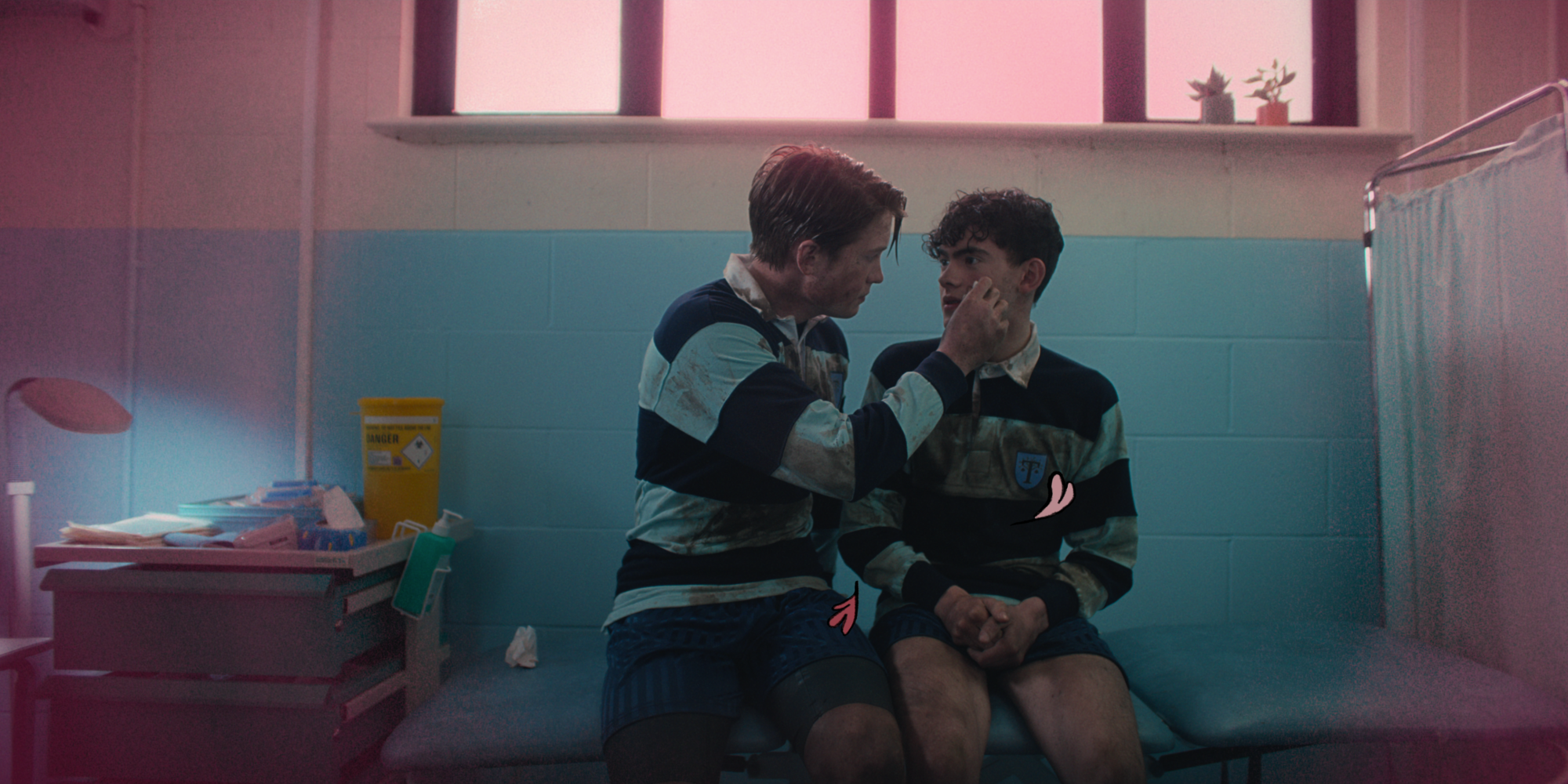
Nick (Kit Connor) and Charlie (Joe Locke) in a scene from Season 1 of “Heartstopper.”
(Netflix)
Upon its debut in 2022, the show was lauded for its unabashedly joyful, tender portrayal of queer youth — a refreshing departure from the trauma-heavy narratives that dominate other teen dramas. Even as “Heartstopper” ventured into darker thematic territory, such as Charlie’s history of eating disorders and struggles with self-harm, Oseman’s writing never lost its deft, light touch.
From the outset, Oseman knew she wanted to end “Heartstopper” with Nick going off to university in Leeds and Charlie, who is a year younger, finding independence as head boy at school. But with her cast growing increasingly more in demand every year, the author-turned-screenwriter says it would have been logistically difficult to make a fourth and final season.
After Netflix greenlit a two-hour finale instead, Oseman elected to zero in on her protagonists — not unlike her comics — rather than give each character their own, heavily condensed arc. “I think that was definitely the right decision, because we really get to spend a lot of time with Nick and Charlie and not feel like we’re missing anything,” she says.
Directed by Wash Westmoreland (“Colette,” “Still Alice”), “Forever” finds the first loves grappling with the reality of an impending long-distance relationship, leading to a rash breakup and, ultimately, an emotional reconciliation. In a surprising role reversal, as Charlie confidently steps into a leadership role as an advocate for other LGBTQ+ students, Nick is left to discover his own identity and self-worth outside of being the protective, supportive boyfriend.

On the set of “Heartstopper Forever” as Connor and Locke film a scene from the movie.
(Samuel Dore / Netflix)
Connor, who also executive produced the film with Locke, felt Charlie and Nick’s romance would be better wrapped up in a feature-length format. “There were a few very important and crucial, but short and intense [plot points] — the breakup and the time apart, and the eventual makeup and the two of them discovering who they are without one another,” he explains. “Doing it in a shorter period, I thought, would make those things hit that much harder and feel that much more visceral.”
Unlike previous seasons in which she could rely on her existing comics as storyboards for the show, Oseman was working simultaneously last year on the sixth and final volume of the “Heartstopper” comics, released earlier this month, and the “Forever” screenplay.
Juggling the same story in two different formats turned out to benefit each end product. “When I finished writing the first draft of the script, it actually made me do a really big rewrite of the comic, because it helped me see which moments were really important and which moments didn’t need to be there,” she says. (One of the pivotal scenes was the Pride parade, filmed on the last morning of production.)
As first-time producers, Locke and Connor also provided script notes that directly influenced the story. For instance, “there was no scene between Charlie and Mr. Ajayi in the original script,” says Locke, referring to the gay art teacher, played by Fisayo Akinade, whose classroom became Charlie’s safe haven from bullying before he befriended Nick. “I was like, ‘That scene in Season 1 with them is so pivotal to the story. It would be really lovely to have just a little moment for them in the film that circles on that chapter of their relationship.’ And straight away, Alice was like, ‘Yeah, great idea. Let’s do this.’”
For his part, Connor always feared that the show’s “rose-tinted” approach, though part of the story’s appeal, “would not be nuanced enough to talk about the complexities of being human and being young.”

Locke says he proposed a scene with Fisayo Akinade, who plays art teacher Mr. Ajayi, as a way to circle back on their relationship.
(Netflix)
“There was one moment where I was like, ‘Oh God, I hope these young people watching “Heartstopper” don’t suddenly forget that these kids are human, and that these kids can make mistakes and still be lovely, delightful and good people,’” Connor says. With Oseman and Locke, Connor was adamant about “finding the place [where] these characters were being treated in a way that we all felt good about.”
According to Oseman, Locke and Connor were also heavily involved in selecting a new intimacy coordinator, Robbie Taylor Hunt. Over the years, the amount of sex — or lack thereof — in “Heartstopper” has been the subject of much discourse. “It always annoyed me slightly that people were like, ‘Oh, this is so unrealistic. They’re not having sex.’ They were underage. What do you want us to do?” Locke says with a wry laugh.
Oseman has learned to tune out that online chatter, accepting that she cannot please everyone — let alone represent the entire spectrum of the young queer experience. With each season and now this film, her creative team chose to age up the story slightly. After Charlie and Nick lost their virginity to each other at the end of Season 3, the film uses physical intimacy to reveal more about their maturing relationship.
Locke says those scenes were necessary to the plot. “The pier sex scene is this carnal lust between these two people who need to get it out. The sex scene in the pillow fort is a moment of connection for them,” he says. “And the big sex scene at the end of the film is the reconciliation of their relationship.”
In the end, Nick and Charlie decide to give their relationship another shot, confident that their love can defy the conventional wisdom that teen romances rarely last. But what they learn during their split is “that you can’t put all of your hopes and dreams, your mental health and your ability to survive into one person, because it’s not fair on yourself and on that other person,” Connor says.

Over the years, the amount of sex, or lack of it, in “Heartstopper” has been the subject of online discourse. The film shows more physical intimacy.
(Netflix)
The film’s epilogue, like in the comics, offers a brief glimpse of Charlie visiting Nick for a weekend in Leeds, ending with the two of them looking through the pages of a scrapbook that still has room for new photos. While Oseman has her own vision of Nick and Charlie’s future in 10 years — they’d be newly married with a dog, she believes — the actors who play them aren’t so sure.
“I feel like the beauty of ‘Heartstopper’ is that we get to see a chapter of these two young men’s lives, and it ends in a way that doesn’t promise anything,” Connor says. “Even if they were to not end up together eventually, it wouldn’t make the experience that they shared together any less special or pivotal to who they are as people. I think that’s kind of beautiful.”
Locke is reluctant to divulge his own interpretation of the characters’ future, preferring instead to let viewers make sense of the hopeful ending. “I hope they’re happy,” he says simply. (But for the record, the actors both believe that Charlie and Nick will stay together. “Of course, we all hope so,” Connor clarifies.)
Although she is ready to tell new stories, Oseman believes that she will be revisiting Nick and Charlie, who first appeared in her 2014 debut novel “Solitaire,” “in small ways for the rest of my life.”
“I think there definitely won’t be another 10-year-long webcomic — probably not — but I love thinking about what Nick and Charlie might be up to when they’re 40 or 60,” Oseman says. However, she adds, “I think the main story of ‘Heartstopper’ has concluded, and I do feel good about that.”
Like their high school characters, Locke and Connor are ready to graduate from the “Heartstopper” universe. Wary of being typecast, they have established themselves as versatile stage actors, making their Broadway debuts in “Sweeney Todd” and “Romeo + Juliet,” respectively. Onscreen, Locke joined the Marvel universe in “Agatha All Along,” while Connor has explored vastly different cinematic genres — his next major project, the film adaptation of the dark fantasy video game “Elden Ring,” will reunite him with “Warfare” director Alex Garland.
Even on the day of our interview, Connor and Locke looked a world away from Nick and Charlie. Locke wore an all-black designer outfit, while Connor — dressed in a light blue striped button-down over a white tank and khakis — had traded Nick’s signature floppy hair for designer stubble. Yet both actors have made peace with the reality that they will forever be linked to each other and their roles. “That’s part and parcel of the job,” Connor says.
Fittingly, the last scene Connor and Locke filmed as Nick and Charlie was the anniversary scene in the park where there is a fallen tree with the letters “N+C” carved into the trunk. “It was lovely because it was back to how a lot of the ‘Heartstopper’ experience has been, which is just me and Joe,” Connor says.

“I love thinking about what Nick and Charlie might be up to when they’re 40 or 60,” says creator Alice Oseman. However, she adds, “I think the main story of ‘Heartstopper’ has concluded, and I do feel good about that.”
(Netflix)
Would they be open to revisiting Charlie and Nick’s love story as older adults? “In 10, 15, 20 years, who knows? Maybe,” Connor says. “Even if Alice were to decide that they wanted to make a TV show about another character in the universe of ‘Heartstopper’ and they wanted us to cameo or something, then, hey, maybe.”
While the “Heartstopper” team expected the series to resonate with younger audiences, they have been particularly moved by the reactions of older queer viewers, who have marveled at the strides in LGBTQ+ representation onscreen. Coming from the world of young-adult fiction — where she notes stories of queer joy are abundant — Oseman recalls being surprised that “Heartstopper” was treated as an anomaly in mainstream media. Still, she is proud to have helped move the needle on LGBTQ+ representation, particularly when such characters remain underrepresented.
“My hope is that people will be able to look back … and say, ‘Hey, “Heartstopper” did really well. Let’s make another queer show that’s got the [same] ‘queer joy’ vibes,’” Oseman says. “I hope it’s been able to give that encouragement to the people in power to let there be more stories out there because we just need more, different kinds of queer stories.”
Connor believes that anyone can enjoy the show because “Heartstopper” simply captures the universality of “human beings being happy and being in love.”
“Obviously, the [queer] representation is incredibly important. I think that the very existence of the show and the comfort and safety that it can bring people is one of the things that makes it so special,” Connor says. And the demand for such stories “isn’t going to change,” he adds. “Queer people are always going to exist.”