In June 1967, when the sun was rising over the Eastern Mediterranean Sea, Israeli fighter squadrons skimming through the coastlines at low altitude struck Egyptian airbases with a devastating blow. Within barely a couple of hours, most of the Egyptian air forces were destroyed. Operation Focus was not a mere initiation of the Six-Day War, but it determined the final outcome of the war. When the ground offensives advanced across the Sinai, Gaza, the West Bank, and the Golan Heights, Israel had already established its critical military superiority, namely, air supremacy. The Six-Day War remains a typical case of how a short, incisive, and highly compressed conflict could overturn the premise of regional deterrence and restructure the long-term strategic reality.
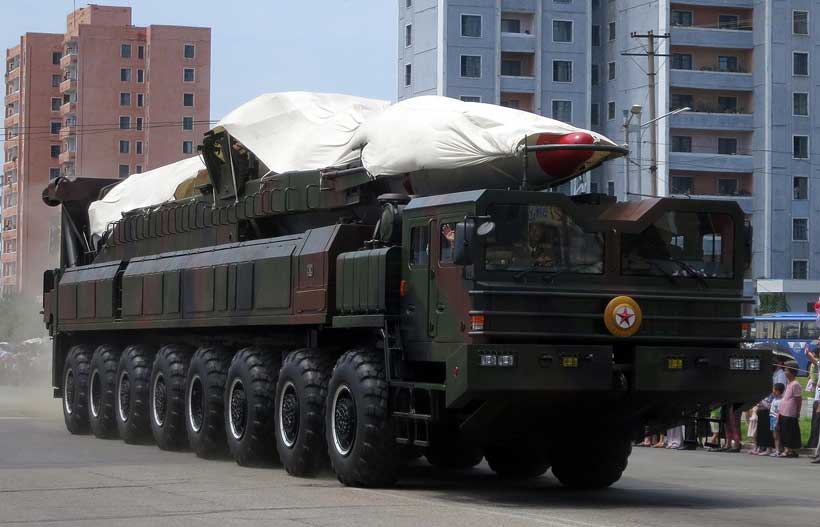
Almost 60 years later, a very different state is studying similar lessons. Based on its nuclear and missile capabilities and deepened defense cooperation with the Russians, nuclear-armed North Korea is refining tools that could enable its own version of a swift and high-impact attack. North Korea’s KN-23 and KN-24 series—quasi-ballistic missiles modeled upon the Russian Iskander-M—have irregular, low-altitude trajectories that are designed to complicate missile defense. Through their recent use by Russia against Ukraine, North Korea has gained invaluable live-fire battlefield data, accelerating improvements in precision, reliability, and mobility during flight. In addition, thanks to Russian assistance—advanced technology, training assistance, and potential space-oriented targeting support—North Korea is securing capabilities that were unattainable in the past.
The strategic risk lies not in whether Pyongyang could literally replicate Operation Focus. Instead, the genuine risk lies in Kim Jong-un drawing wrongful lessons from the Six-Day War and the Russia-Ukraine War: that surprise, speed, and concentrated firepower could overwhelm the opponent before activating an effective response. If Pyongyang is convinced that a blitzkrieg is achievable or judges that nuclear blackmail could suppress the US and Japan’s intervention for a certain timeframe, the incentives for war could increase.
Ways That North Korea Could Attempt a Six-Day War-Style Blitzkrieg
Such perception—that momentum has changed—endangers the nowadays Korean Peninsula. North Korea’s nuclear capabilities are expanding both in terms of magnitude and precision. Meanwhile, North Korea’s SRBM and MLRS systems could strike almost all major airbases and C2 nodes located within South Korea. North Korean SOF, who have long trained themselves with penetration operations via tunnels, submarines, and UAV drops, are carefully analyzing Russian tactics used in the Russia-Ukraine War, ranging from loitering munition to precision targeting of critical infrastructures. Pyongyang may imagine that by combining missile salvos, swarm drones, electronic jamming, SOF penetration, and nuclear escalation, it could paralyze South Korea’s initial response in the first few hours of the war and create a meaningful fissure in alliance coherence.
Here the Six-Day War offers a second powerful lesson. The opening phase of the war has greater importance than other phases. In 1967, Israel’s preemptive strike wiped out Arab air forces on the ground, granting unlimited air dominance to the IDF. Although North Korea could not attain air superiority, it could attempt something functionally similar—denying the US, Japan, and South Korea’s ability to conduct operations normally in the initial hours of the war. This could include simultaneous missile saturation on air defense batteries, fuel depots, hardened aircraft shelters, runways, and long-range sensors. Meanwhile, missiles with irregular trajectories might avoid radar detection and try to penetrate interception layers comprised of PAC-3, L-SAM, THAAD, and Aegis destroyers. Swarm drones could overwhelm short-range air defense or neutralize petroleum, oil, and lubricant (POL) depots and movable C2 vehicles. Cyber operations and GPS jamming would complement such a kinetic assault, creating friction and delays in the alliance response cycle.
Eventually, Pyongyang could conduct its own version of Operation Focus ‘in reverse,’ not to secure air dominance but to prevent opponents from achieving air supremacy. This is to enable North Korea to conduct SOF penetration, a limited armored push in and around the DMZ, and nuclear blackmailing to prevent reinforcement. Such an operation would be based on the similar logic—the ideal mixture of shock, speed, and confusion—that Israel showcased in Sinai and the Golan Heights.
Deterring Blitzkrieg: Lessons for the US, Japan, and South Korea
By using the Six-Day War as a reference, the US, Japan, and South Korea could figure out ways to deter North Korea’s aforementioned provocations. Israel’s victory in 1967 was not achieved solely by air supremacy but also through resilience in its mobilization system and the adaptability of its reserve forces. Once securing air dominance, the IDF swiftly mobilized its reserve forces, stabilized major frontlines, and executed critical maneuvers before Arab countries coordinated with one another. Meanwhile, North Korea might use an intensive SOF operation in the initial phase of the war to wreak havoc on South Korea—recreating the chaos that Israel’s opponents had to experience in 1967—by attacking leadership, transportation centers, and communication nodes.
The solution is clear. If South Korea could prevent internal paralysis in the first 24 to 48 hours of the war, North Korea’s ambitious surprise attack would be largely unsuccessful. Therefore, Seoul should treat protection against SOF, city defense, and civil-military resilience at a level equivalent to ‘air superiority.’ This means diffusion of C2, reinforcement of police and reserve forces, hardening communication, and ensuring that local governments could fully function even under missile strikes and SOF infiltration. Irrespective of the high intensity of an opening barrage, state function should be able to survive, maintain consistency, and prepare for countermeasures.
The political aftermath of the 1967 war is also an important lesson. Israel’s swift victory engendered long-term strategic burdens: the occupation problem, regional backlash, and disputes on legitimacy. It well demonstrates that a short and decisive war could create unpredictable, long-term spillover effects. Applying it to the Korean Peninsula, the US and its allies should have a clear picture regarding North Korea’s failed surprise attack or a regime change. Issues like securing WMD, China’s intervention, refugee flow, humanitarian stabilization, and restructuring North Korea’s political order cannot be managed in an impromptu manner.
The strategic task for Washington, Tokyo, and Seoul is to deny Pyongyang any illusion of a short war. Deterrence should be based on the confidence that North Korea cannot achieve within 6 hours what Israel achieved in 6 days. To make that happen, integration of missile defense systems, real-time intelligence sharing, enhancing the survivability of air bases, diffusion of key assets, and rapid counter-strike capabilities are necessary. Moreover, the US and its allies should establish a political foundation that could withstand a war of attrition—a type of conflict that North Korea cannot tolerate.