North Korea

South Korea: North Korea test launched ballistic missiles into East Sea Sunday

This image, released on March 20, by the North Korean Official News Service (KCNA), shows North Korean leader Kim Jong Un and his daughter, Kim Ju Ae, observing a military exercise involving tanks, drones, and other munitions. File Photo by KCNA/UPI | License Photo

April 19 (UPI) — South Korea’s Defense Ministry said North Korea test launched multiple, short-range ballistic missiles into the East Sea, also known as the Sea of Japan, Sunday morning.

“Detailed specifications are currently under close analysis by South Korean and U.S. intelligence authorities,” officials in Seoul said in a statement, according to ABC News.

“Our military is closely monitoring North Korea’s military activities under a firm combined defense posture and maintains an overwhelming capability and readiness to respond to any provocation.”

The Japan Times said the Defense Ministry of Japan also confirmed the activity.

“North Korea’s series of actions, including the repeated launches of ballistic missiles and other weapons, threaten the peace and security of Japan, the region and the international community,” the ministry said in a statement.

Newsweek said Pyongyang has increased its ballistic missile testing and nuclear weapons development since the conflict between the United States, Israel and Iran began nearly two months ago.

Sunday’s missile launches appear to have come from Sinpho, a coastal city in North Korea where submarines capable of launching such weapons are built.

Sakie Yokota, mother of Megumi Yokota, who was abducted by North Korea, speaks during a rally demanding the immediate return of all abductees in Tokyo on November 3, 2025. Photo by Keizo Mori/UPI | License Photo

Source link

North Korea launches ballistic missiles towards sea off its east coast | Kim Jong Un News

Multiple ballistic missiles fired from eastern Sinpo area in seventh such test this year.

North Korea has launched multiple ballistic missiles towards the sea off its eastern coast, according to South Korea and Japan.

The incident on Sunday marked North Korea’s seventh ⁠ballistic missile launch this year and its fourth in April.

The missiles were fired near the city of Sinpo on North Korea’s east coast at about 6:10am on Sunday (21:10 GMT, Saturday), South Korea’s military said in a statement. It added that South Korea had bolstered its surveillance posture and was closely exchanging information with the United States and Japan.

Japan’s ⁠government posted on social media that the ballistic missiles were believed to have fallen near the east coast of the Korean Peninsula. No incursion into Japan’s exclusive economic zone was confirmed.

South Korea’s presidential office said it has held an emergency security meeting, according to media reports.

Such tests violate United Nations Security Council resolutions against North Korea’s missile programme. The diplomatically isolated country rejects the UN ban and says it infringes on its sovereign right to self-defence.

The launches come as China and the US prepare for a summit in mid-May, ⁠in which Chinese President ⁠Xi Jinping and his US counterpart, Donald Trump, are expected to discuss North Korea.

North Korea has made “very serious” advances in its ability to turn out nuclear weapons, with the probable addition of a new uranium enrichment facility, ‌International Atomic Energy Agency chief Rafael Grossi said on Wednesday.

Late last month, North Korean leader Kim Jong Un said his country’s status as a nuclear-armed ‌state ‌was irreversible and that expanding a “self-defensive nuclear deterrent” was essential to national security.

Source link

Two Americans sentenced over North Korea IT worker scheme

SEOUL, April 16 (UPI) — Two U.S. nationals were sentenced to federal prison for helping North Korean operatives obtain remote IT jobs with American companies in a scheme that generated millions of dollars for Pyongyang’s weapons programs, the Justice Department said Wednesday.

New Jersey residents Kejia “Tony” Wang, 42, and Zhenxing “Danny” Wang, 39, operated so-called “laptop farms” that made it appear as though overseas workers were based in the United States, allowing North Korean IT personnel to secure jobs using stolen American identities.

The scheme used identities from at least 80 individuals and generated more than $5 million in revenue for the North Korean government, the department said in a press release.

Kejia Wang was sentenced to nine years in prison by U.S. Senior District Judge Nathaniel M. Gorton in federal court in Boston, followed by three years of supervised release, after pleading guilty to conspiracy charges including wire fraud, money laundering and identity theft.

Zhenxing Wang was sentenced to seven years and eight months in prison by the same court, followed by three years of supervised release, after pleading guilty to conspiracy to commit fraud and money laundering. He was also ordered to pay $200,000 in restitution.

The two were additionally ordered to forfeit $600,000 in proceeds tied to the operation.

“This case exposes a sophisticated scheme that exploited stolen American identities and U.S. companies to generate millions of dollars for a hostile foreign regime,” U.S. Attorney for Massachusetts Leah B. Foley said. “By operating so-called ‘laptop farms,’ these defendants enabled overseas actors to infiltrate U.S. businesses, access sensitive data and undermine our economic and national security.”

Prosecutors said the scheme ran from about 2021 through October 2024, with the defendants and their co-conspirators using stolen identities to obtain remote jobs at more than 100 U.S. companies, including several Fortune 500 firms and a defense contractor.

Companies incurred at least $3 million in losses from legal fees, network remediation and other damages, the Justice Department said.

The operation also exposed sensitive data, including export-controlled information governed by International Traffic in Arms Regulations, after an overseas co-conspirator accessed systems belonging to a California-based defense contractor, according to court documents.

Kejia Wang acted as the U.S.-based manager for the operation, overseeing multiple facilitators who hosted hundreds of company-issued laptops at their residences. He also traveled to China in 2023 to meet overseas co-conspirators, including a North Korean national, according to court filings.

Zhenxing Wang was among the facilitators who hosted company laptops and enabled remote access by connecting them to specialized hardware devices.

The two were charged in June 2025 alongside eight foreign nationals who remain at large and are wanted by the FBI.

In a related move, the U.S. State Department on Wednesday offered a reward of up to $5 million for information on the eight co-conspirators, as well as one suspected North Korean IT worker, leading to the disruption of the scheme’s financial networks.

The case comes as North Korea, under heavy international sanctions, has increasingly turned to cybercrime and illicit IT work to generate revenue for its nuclear and ballistic missile programs.

An October report by the 11-country Multilateral Sanctions Monitoring Team described North Korea’s cyber operations as “a full-spectrum national program operating at a sophistication approaching the cyber programs of China and Russia.”

The report said nearly all of the country’s cyber activity, illicit IT work and financial operations are carried out under the direction of entities sanctioned by the United Nations over Pyongyang’s weapons programs.

The U.S. Treasury Department said in November that North Korea had stolen more than $3 billion over the previous three years through cyberattacks on financial institutions and cryptocurrency platforms.

A 2022 Treasury advisory estimated that North Korean IT workers generate hundreds of millions of dollars annually, with some individuals earning more than $300,000 a year.

The Justice Department has stepped up enforcement as part of an inter-agency effort in recent years, announcing multiple related prosecutions, including the sentencing of three Americans in March and a Ukrainian national in February.

Source link

Top admirals of S. Korea, U.S., Japan discuss trilateral cooperation in Seoul

South Korean Chief of Naval Operations Adm. Kim Kyung-ryul (L) and U.S. Pacific Fleet Commander Adm. Stephen Koehler (R) hold talks in Seoul on Wednesday. The two were also set to meet with Japan’s top naval commander for trilateral talks on strengthening maritime cooperation. Photo courtesy of South Korea Navy

Top naval commanders of South Korea, the United States and Japan gathered in Seoul on Wednesday to hold a series of talks aimed at strengthening their trilateral maritime security cooperation, the South’s Navy said.

The gathering brought together Chief of Naval Operations Adm. Kim Kyung-ryul, U.S. Pacific Fleet Commander Adm. Stephen Koehler and Adm. Akira Saito, chief of staff of the Japan Maritime Self-Defense Force, for bilateral talks and a trilateral dinner meeting, according to the armed service.

The meetings came amid heightened tensions in the Middle East, raising speculation over whether their talks would address the ongoing U.S. blockade of Iranian ports.

U.S. President Donald Trump earlier called on South Korea, Japan and others to send warships to the Strait of Hormuz to help secure shipping lanes.

In the bilateral talks between Kim and Koehler held earlier in the day, both sides exchanged opinions on the robust South Korea-U.S. combined defense posture as well as cooperation in the area of naval maintenance, repair and operations, the Navy said.

Kim and Saito, meanwhile, held in-depth discussions on expanding personnel exchange and resuming joint maritime search and rescue exercises (SAREX) as discussed in a ministerial meeting between their defense chiefs earlier this year, it added.

In January, Defense Minister Ahn Gyu-back and his Japanese counterpart, Shinjiro Koizumi, met in Japan and agreed to resume joint SAREX drills for the first time in nine years as part of efforts to strengthen bilateral defense cooperation.

The top admirals of the three countries were set to attend a dinner meeting later Wednesday to likely discuss trilateral coordination measures to respond to and deter North Korea‘s advancing nuclear and missile threats.

Copyright (c) Yonhap News Agency prohibits its content from being redistributed or reprinted without consent, and forbids the content from being learned and used by artificial intelligence systems.

Source link

Kim Jong Un oversees cruise, anti-ship missile tests from warship

North Korea test-fired strategic cruise missiles and anti-warship missiles from the destroyer Choe Hyon, state media reported Tuesday. The missile test, as seen in this image, took place Sunday from an undisclosed location. Photo by KCNA/EPA

SEOUL, April 14 (UPI) — North Korean leader Kim Jong Un oversaw the test-firing of strategic cruise missiles and anti-ship missiles from a 5,000-ton naval destroyer, state media reported Tuesday, as he called bolstering nuclear deterrence the country’s “most important priority task.”

The North’s Choe Hyon destroyer launched two cruise missiles and three anti-ship missiles at island targets in the Yellow Sea on Sunday, the official Korean Central News Agency said.

The cruise missiles flew for roughly two hours and 12 minutes before striking their targets, KCNA said, while the anti-ship missiles flew for about 33 minutes.

The test was “aimed at checking the launching control line of the warship’s integrated weapon commanding system … as well as confirming the accuracy and the rate of hits of the improved active anti-jamming navigation system,” KCNA reported.

Pyongyang described the cruise missiles as “strategic,” a term it typically uses for systems capable of carrying nuclear warheads.

Kim observed the test-firing alongside senior defense officials and naval officers, KCNA said. Images published by state media showed Kim and the officials watching from an unspecified pier.

KCNA quoted Kim as saying the North’s “most important priority task [is] to steadily and unlimitedly bolster up the powerful and reliable nuclear war deterrent.”

“He clarified the important tasks for further strengthening the strategic and tactical attack capability, a key component of the nuclear war deterrent,” KCNA added.

Kim observed a pair of similar test launches last month, involving cruise missiles only.

Sunday’s expanded test may indicate the destroyer is nearing deployment, an official from South Korea’s Unification Ministry told Yonhap News Agency and other local reporters.

“It appears to be a final check of the weapons system if the test took place before the delivery of the Choe Hyon to the Navy,” the official said.

Pyongyang launched the Choe Hyon, its first 5,000-ton destroyer, last April, as Kim called for strengthening the country’s naval capabilities. Photos released by state media show the ship’s missile and radar systems resembling those found on Russian vessels, prompting speculation that Pyongyang received technical assistance from Moscow.

North Korea has deployed troops, artillery and weapons to support Russia’s war in Ukraine and is believed to be receiving financial support and advanced military technology in return.

A second destroyer, the Kang Kon, suffered an accident during its launch ceremony last year that left it listing on its side before it was repaired and relaunched in June.

KCNA said Kim was also briefed on plans for the weapons systems of two more destroyers currently under construction.

South Korean Rep. Yoo Yong-won of the People Power Party said earlier this month that commercial satellite imagery showed North Korea accelerating construction of a new warship at a shipyard in the western port city of Nampho.

“North Korea appears to be accelerating the modernization of its navy on the back of military technology assistance from Russia,” Yoo said.

Kim Jong Un has ordered a third 5,000-ton destroyer to be completed by Oct. 10, the anniversary of the founding of the ruling Workers’ Party of Korea.

Source link

Unification minister calls resuming tourist railway to border with N. Korea starting point for peace

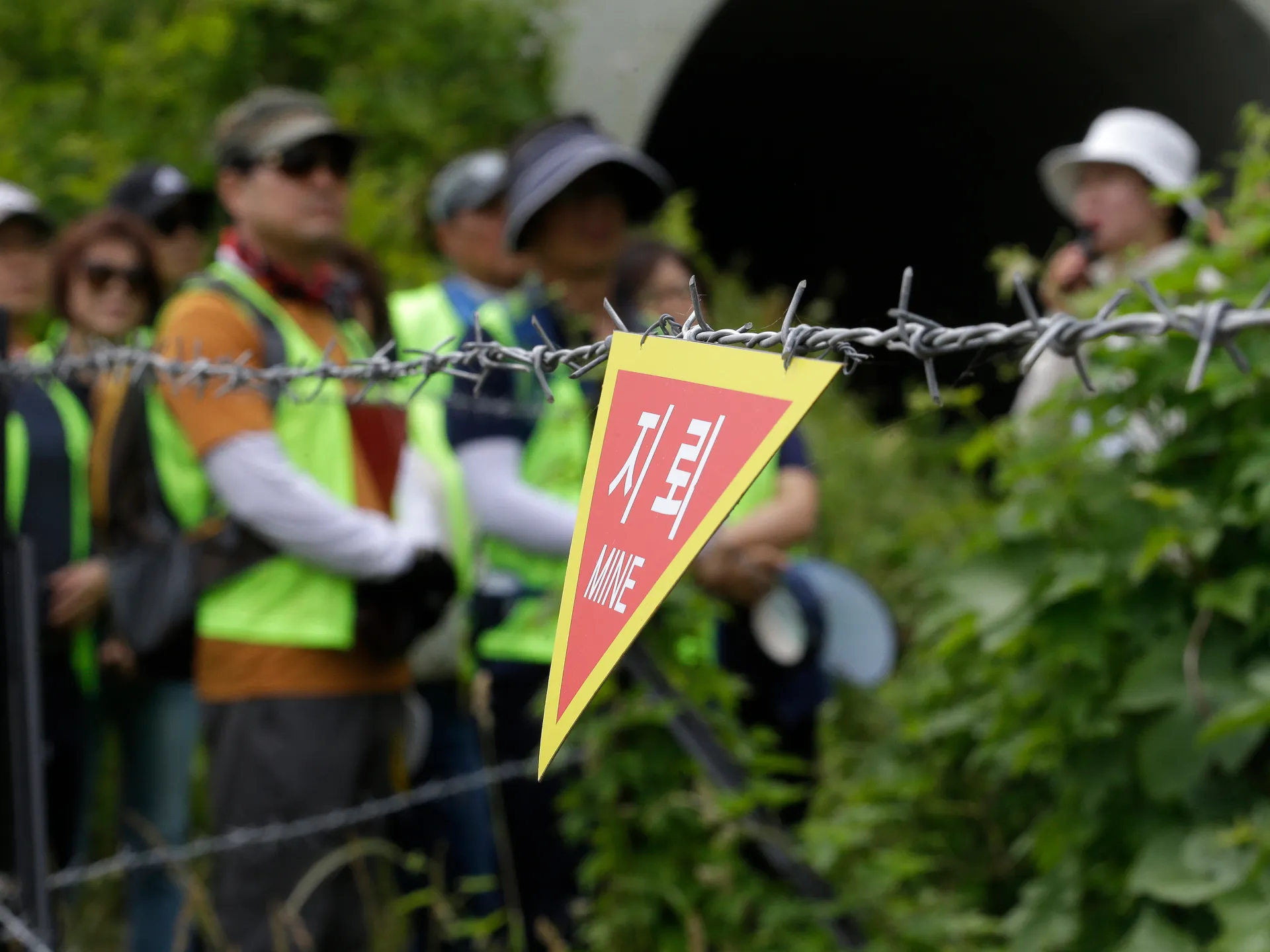
A train enters Dorasan Station near the border with North Korea on Friday. South Korea resumed tourist rail service to the border station for the first time in over six years. Pool Photo by Yonhap

Unification Minister Chung Dong-young said Friday the resumption of tourist rail service to the border with North Korea is a “small” starting point for establishing peace with Pyongyang, as Seoul reopened a long-closed border rail station.

Earlier in the day, South Korea resumed tourist rail service to and from its northernmost Dorasan Station in the border city of Paju, which is a symbol of inter-Korean cooperation that once connected the two Koreas.

“The resumption of train service is a small starting point toward establishing everyday peace, allowing people to experience it in their daily lives,” Chung said in a ceremony marking the event.

“When tourists can visit, see and experience the site of peace at Dorasan Station, peace will finally become an everyday language that breathes in our lives, rather than grand discourse,” he said.

The station, the northern endpoint of South Korea’s rail network just south of the inter-Korean border, was established after the then South and North Korean leaders agreed to connect their railways at a 2000 summit held amid a period of reconciliation between the two Koreas.

Freight trains once ran through Dorasan Station between the two Koreas, carrying materials and finished goods to and from the Kaesong Industrial Complex, a jointly operated factory park in North Korea that was shut down amid inter-Korean tensions in 2016.

Since then, the station had served tourist trains carrying passengers in South Korea to border areas, before closing completely in late 2019 due to the COVID-19 pandemic.

The resumption of the border station comes as Seoul continues efforts to resume dialogue and engagement with North Korea to reduce military tensions and establish peace, despite Pyongyang’s repeated rebuffs.

“Only peace and coexistence, as well as reconciliation and cooperation, are the path to mutual prosperity for the South and the North, not worthless animosity and confrontation,” Chung also noted.

He said he believes the two Koreas can surely establish new relations that accommodate the changing international situation and their respective national interests, expressing hope that their railways could be reconnected in the future.

The resumption of rail service to the station will allow tourists to travel by train beyond the Civilian Control Line, which restricts public access near the Demilitarized Zone (DMZ) separating the two Koreas.

The train, named “DMZ Peace Link,” departs from Seoul Station and stops at Unjeong and Imjingang before reaching Dorasan Station, where tourists can visit a nearby observation post and a tourist village.

It runs once on the second and fourth Fridays each month till May, before expanding to every Friday from June.

Going forward, the government, municipalities and the rail agency plan to add more tourist destinations near the border station to provide various programs aimed at promoting peace on the Korean Peninsula.

Source link

North Korea tests electronic warfare systems, cluster-bomb missile

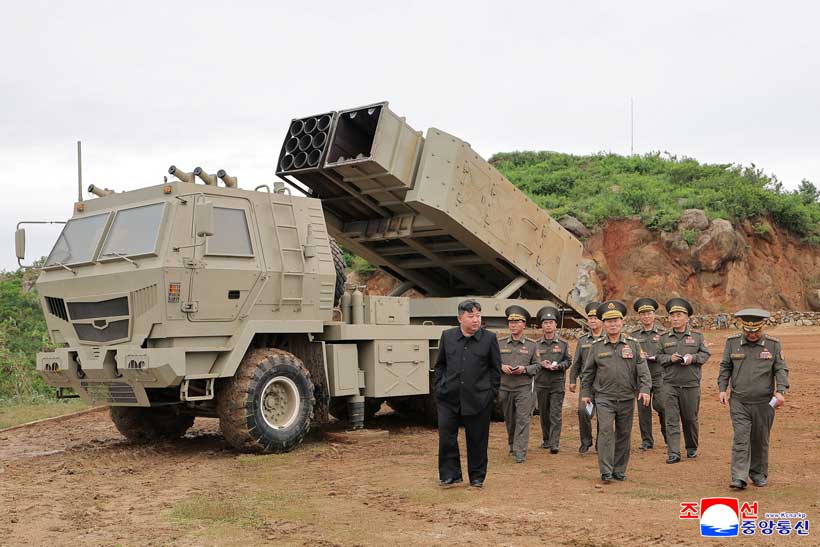
North Korea said Thursday it conducted a series of weapons tests this week, including missiles tipped with a cluster-bomb warhead and electronic warfare systems. This January file photo shows the North’s test-fire of a multiple-rocket launcher system. File Photo by KCNA/EPA

SEOUL, April 9 (UPI) — North Korea said Thursday that it carried out a series of weapons tests this week, including a tactical ballistic missile with a cluster-bomb warhead as well as electromagnetic and other electronic warfare systems.

The tests, conducted from Monday to Wednesday, were part of efforts to assess the performance and battlefield use of several new weapons systems, the North’s official Korean Central News Agency said.

KCNA said that its surface-to-surface Hwasong-11Ka missile was tested with a cluster-bomb payload capable of striking targets over a wide area, claiming it could “reduce to ashes” targets spanning roughly 16 to 17.2 acres.

The Hwasong-11 missile, also known as the KN-23, is a highly maneuverable short-range ballistic missile similar to Russia’s Iskander.

The report came one day after South Korea’s Joint Chiefs of Staff said it detected multiple missile launches on Wednesday from the coastal Wonsan area toward the East Sea. The military also reported the launch of an unidentified projectile from the Pyongyang area on Tuesday.

In addition to the missile tests, North Korea said it conducted trials of an electromagnetic weapon system and carbon-fiber bombs, as well as a mobile short-range anti-aircraft missile system.

The tests were overseen by Kim Jong Sik, a senior official involved in the North’s missile development programs.

Kim said the electromagnetic weapon and carbon-fiber bomb are “special assets of strategic nature” that can be combined with various military systems.

Carbon-fiber bombs — also known as graphite bombs— are designed to disable electrical grids by dispersing fine conductive filaments to short-circuit power infrastructure, causing widespread outages without physical destruction.

Electromagnetic weapons, meanwhile, emit high-energy pulses that can disrupt or damage electronic systems, including communications networks, radar and computing infrastructure.

KCNA also said engineers conducted a test to measure the “maximum workload” of a missile engine using low-cost materials.

The reported mix of electronic weapons systems and cost-efficient production methods points to ongoing efforts to modernize and expand the North’s hybrid warfare capabilities.

The tests came after South Korean President Lee Jae Myung on Monday expressed regret over unauthorized drone incursions into the North.

His remarks drew a rare response from Pyongyang, as Kim Yo Jong, the influential sister of leader Kim Jong Un, described Lee as “frank and broad-minded.”

Seoul’s Unification Ministry called the exchange a positive signal, saying it represented “meaningful progress toward peaceful coexistence on the Korean Peninsula.”

North Korea’s first vice foreign minister, Jang Kum Chol, later rejected that interpretation, calling it a “hope-filled dream reading” and insisting the South remains “the enemy state most hostile to the DPRK.”

The Democratic People’s Republic of Korea is the official name of North Korea.

A South Korean military official said the allies are continuing to track developments in the North’s weapons programs.

“We maintain the ability and readiness to overwhelmingly respond to any provocation under a solid South Korea-U.S. joint defense posture,” Jang Do-young, public affairs director of the Joint Chiefs of Staff, said at a press briefing Thursday.

Source link

Ex-Trump official predicts Trump-Kim summit could take place this fall

Fred Fleitz, former chief of staff of the NSC, predicted Wednesday that U.S. President Donald Trump could meet with North Korean leader Kim Jong-un for a summit sometime this fall. Fleitz made the comment at the Asan Plenum in Seoul. Photo courtesy of Asan Institute of Policy Studies

A former Trump administration official predicted Wednesday that U.S. President Donald Trump could meet with North Korean leader Kim Jong-un for a summit sometime this fall, citing Trump’s continued indications of interest in resuming dialogue with the reclusive leader.

Fred Fleitz, a former chief of staff of the National Security Council under the previous Trump administration, made the remarks as speculation persists that Trump and Kim may resume dialogue around the time when Trump visits China for summit talks with Chinese President Xi Jinping, in May.

“I believe there is a good chance of a Trump-Kim summit this fall,” said the vice chair of the America First Policy Institute at a press event on the sidelines of a forum hosted by the Asan Institute of Policy Studies.

“President Trump has often indicated that he wanted to resume a successful personal diplomacy … It is something that Trump believes in that this was a big success that he has to build upon,” he said.

Fleitz pointed out that although Trump is open to meeting Kim again, he would not back away from the U.S. demand for denuclearization.

“The Trump administration might join talks with North Korea but will be pushing for denuclearization,” he said. “I would strongly advise the Trump administration that another progress should be that North Korea has to stop sending weapons (to Russia for its war) in Ukraine.”

“They are helping a disastrously bloody war and I don’t think it’s a lot to ask for Trump to say that to Kim Jong-un.”

On a similar note, Victor Cha, Korea chair at the Center for Strategic and International Studies, gave an outlook of a “more than 50 percent chance” that Trump will meet Kim, after he meets Xi in Beijing.

“I don’t think Xi Jinping will want a meeting (between Trump and Kim) before his summit with Trump,” he said. “There is a greater than 50 percent chance that they could meet after their (Trump-Xi) meeting in Beijing.”

Cha also noted that unlike the approach to China, Russia or Iran, Trump shows that he puts North Korea in a “different basket” in terms of his potential engagement with Kim.

“I think he clearly wants to engage with him, which is just fascinating,” he said.

Copyright (c) Yonhap News Agency prohibits its content from being redistributed or reprinted without consent, and forbids the content from being learned and used by artificial intelligence systems.

Source link

North Korea conducts multiple missile launches over two days, Seoul says

North Korea launched short-range ballistic missiles toward the East Sea on two occasions Wednesday, Seoul’s military said. In this March photo, people watch reports of a North Korean launch at a train station in Seoul. File Photo by Jeon Heon-Kyun/EPA

SEOUL, April 8 (UPI) — North Korea fired short-range ballistic missiles on two separate occasions Wednesday, Seoul’s military said, marking three launches over two days after South Korean President Lee Jae Myung expressed regret over a drone incursion.

At 8:50 a.m. Wednesday, the North launched several short-range ballistic missiles from its coastal Wonsan area toward the East Sea, Seoul’s Joint Chiefs of Staff said in a text message to reporters.

The missiles flew approximately 150 miles, the JCS said, adding that South Korean and U.S. intelligence authorities are analyzing their exact specifications.

“Under a steadfast South Korea-U.S. combined defense posture, the military is closely monitoring North Korea’s various movements and maintaining the capability and readiness to overwhelmingly respond to any provocation,” the JCS said.

North Korea later fired a single short-range ballistic missile from Wonsan toward the East Sea at 2:20 p.m. Wednesday, the JCS said in a separate message. The missile flew approximately 435 miles.

The launches came one day after the South’s military detected an unidentified projectile fired from the Pyongyang area. The JCS said South Korean and U.S. intelligence officials are still analyzing its detailed specifications.

Hawaii-based U.S. Indo-Pacific Command said it detected both days’ launches and was consulting with regional allies and partners.

“Based on current assessments, this event does not pose an immediate threat to U.S. personnel or territory, or to our allies,” the command said in a statement.

The launches came after a statement by Kim Yo Jong, the powerful sister of North Korean leader Kim Jong Un, describing President Lee as “frank and broad-minded” after he expressed regret over unauthorized drone incursions into the North.

Lee had addressed the drone issue earlier Monday during a Cabinet meeting, following last week’s indictment of three individuals accused of carrying out incursions between September and January.

“Although this was not an act by our government, I express regret to the North Korean side over the unnecessary military tension caused by such reckless behavior,” Lee said during the meeting.

While Kim’s remarks struck a less hostile tone than recent statements from Pyongyang, she still included a warning to the South to “stop any reckless provocation against the DPRK” and to “refrain from any attempt at contact.”

The Democratic People’s Republic of Korea is the official name of North Korea.

North Korea’s first vice foreign minister, Jang Kum Chol, later dismissed Seoul’s positive interpretation of the remarks, calling them a “hope-filled dream reading.”

In a statement released late Tuesday and carried by the official Korean Central News Agency, Jang said that the South’s identity as “the enemy state most hostile to the DPRK can never change with any words or conduct by its chief executive.”

Victor Cha, president of the geopolitics and foreign policy department at the Center for Strategic and International Studies, cautioned against reading into the timing of the launches relative to Kim’s drone statement.

“I’m more and more of the view that the recent missile demonstrations we’ve seen by North Korea are not testing and they’re not political statements — they’re exercising,” Cha told UPI during a press briefing at the Asan Plenum policy forum in Seoul.

“I don’t think [North Korea] had any notion of when the South Koreans were going to convey communications on the drone activity,” Cha said. “If anything, these [launches] just happened to be on parallel tracks.”

North Korea last fired ballistic missiles toward the East Sea on March 14 as the United States and South Korea held their annual springtime joint military exercise. Pyongyang later said the launches were part of a firepower strike drill involving 600mm multiple rocket launchers overseen by Kim Jong Un.

Source link

North Korea keeping Iran at arm’s length, reports Seoul | US-Israel war on Iran News

Seoul says Pyongyang has not been supplying Iran with weapons in the hopes of being able to reopen diplomatic dialogue with the US.

North Korea appears to be distancing itself from longtime partner Iran in the hopes of forming a new relationship with the United States, South Korean intelligence believes.

Seoul’s National Intelligence Service (NIS) sees no signs that North Korea has sent weapons or supplies to Tehran since the US-Israel war on Iran began at the end of February, lawmaker Park Sun-won, who attended a closed-door briefing held by the NIS, said on Sunday.

Recommended Stories

list of 3 itemsend of list

While Iran’s other allies China and Russia have frequently issued statements on the US-Israel war on Iran, North Korea’s Foreign Ministry has only issued two toned-down statements so far, said the NIS.

While Pyongyang did condemn the US and Israeli attacks on Iran as illegal, it did not issue public condolences after Supreme Leader Ayatollah Ali Khamenei’s death or send a congratulatory message when Khamenei’s son, Mojtaba Khamenei, succeeded him.

The spy agency said Pyongyang is likely adopting this cautious approach to position it for a new diplomatic chapter with the US once the Middle East conflict subsides, said Park.

The NIS also told lawmakers that it now believes Supreme Leader Kim Jong Un is grooming his teenage daughter as his successor, citing a recent public display of her driving a tank.

The NIS said the imagery was intended to highlight the supposed military aptitude of the youngster, who is believed to be around 13 and named Ju Ae.

Such scenes are intended to pay “homage” to Kim’s own public military appearances during the early 2010s, when he was being prepared to succeed his father, Park said.

Kim’s powerful sister, Kim Yo Jong, was earlier thought to be a leading candidate to succeed her brother.

On Monday, she was in North Korean headlines as she welcomed an apology issued by South Korean President Lee Jae Myung on Sunday over a January drone incursion.

“The ROK [Republic of Korea] president personally expressed regret and talked about a measure for preventing recurrence. Our government appreciated it as very fortunate and wise behaviour for its own sake,” Kim Yo Jong said in a statement carried by the official Korean Central News Agency.

Seoul initially denied any official role in the January drone incursion, with authorities suggesting it was the work of civilians, but Lee said a probe had revealed government officials had been involved.

“We express regret to the North over the unnecessary military tensions caused by the irresponsible and reckless actions of some individuals,” Lee said.

Lee has sought to repair ties with North Korea since taking office last year, criticising his predecessor for allegedly sending drones to scatter propaganda over Pyongyang.

His repeated overtures, however, have gone unanswered by the North until now.

Lee’s expression of regret follows Kim’s labelling of Seoul as the “most hostile state” in a policy address in March in which he vowed to “thoroughly reject and disregard it”.

Source link

Lee expresses regret over drone flights by individuals into N. Korea

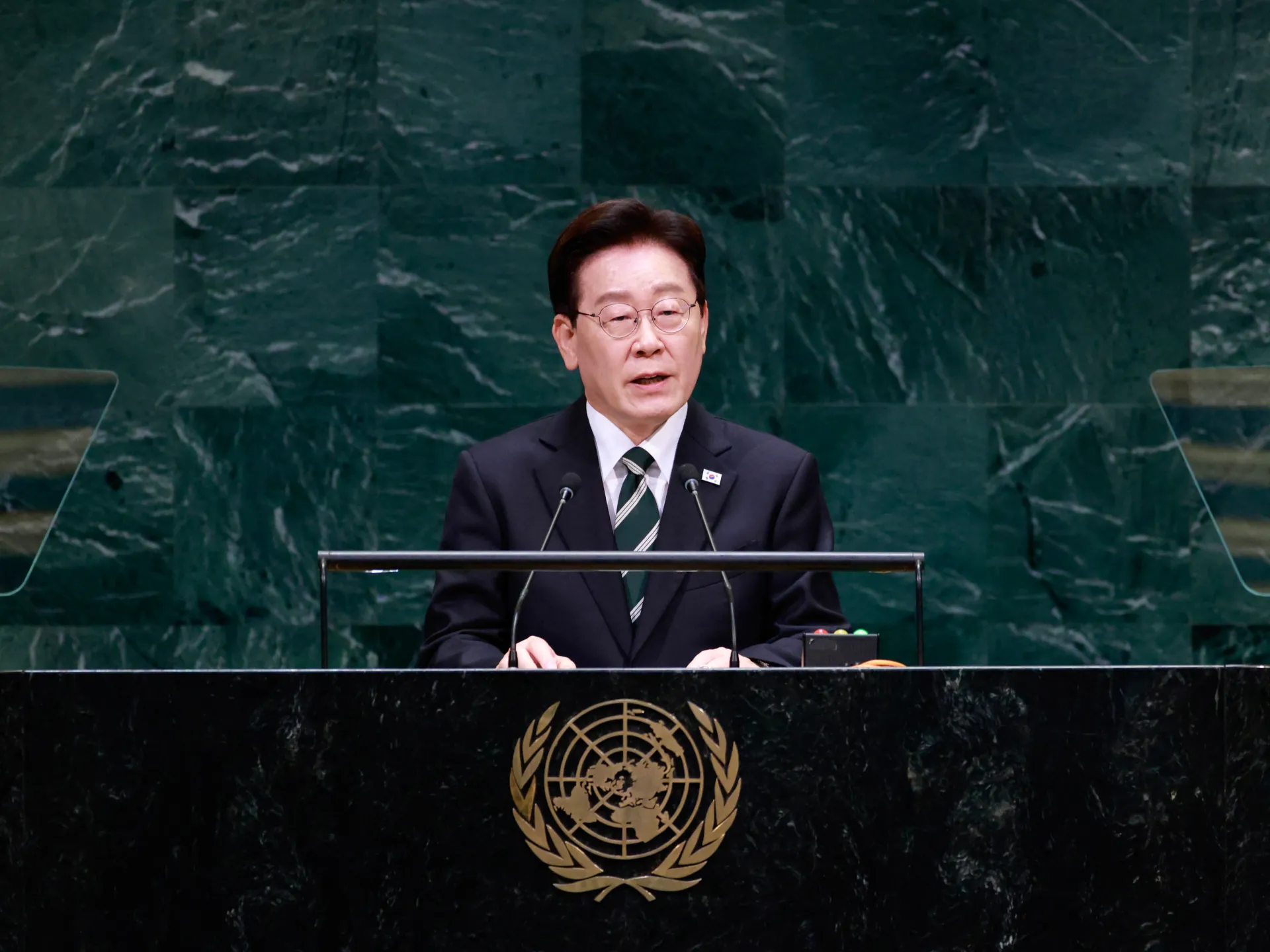
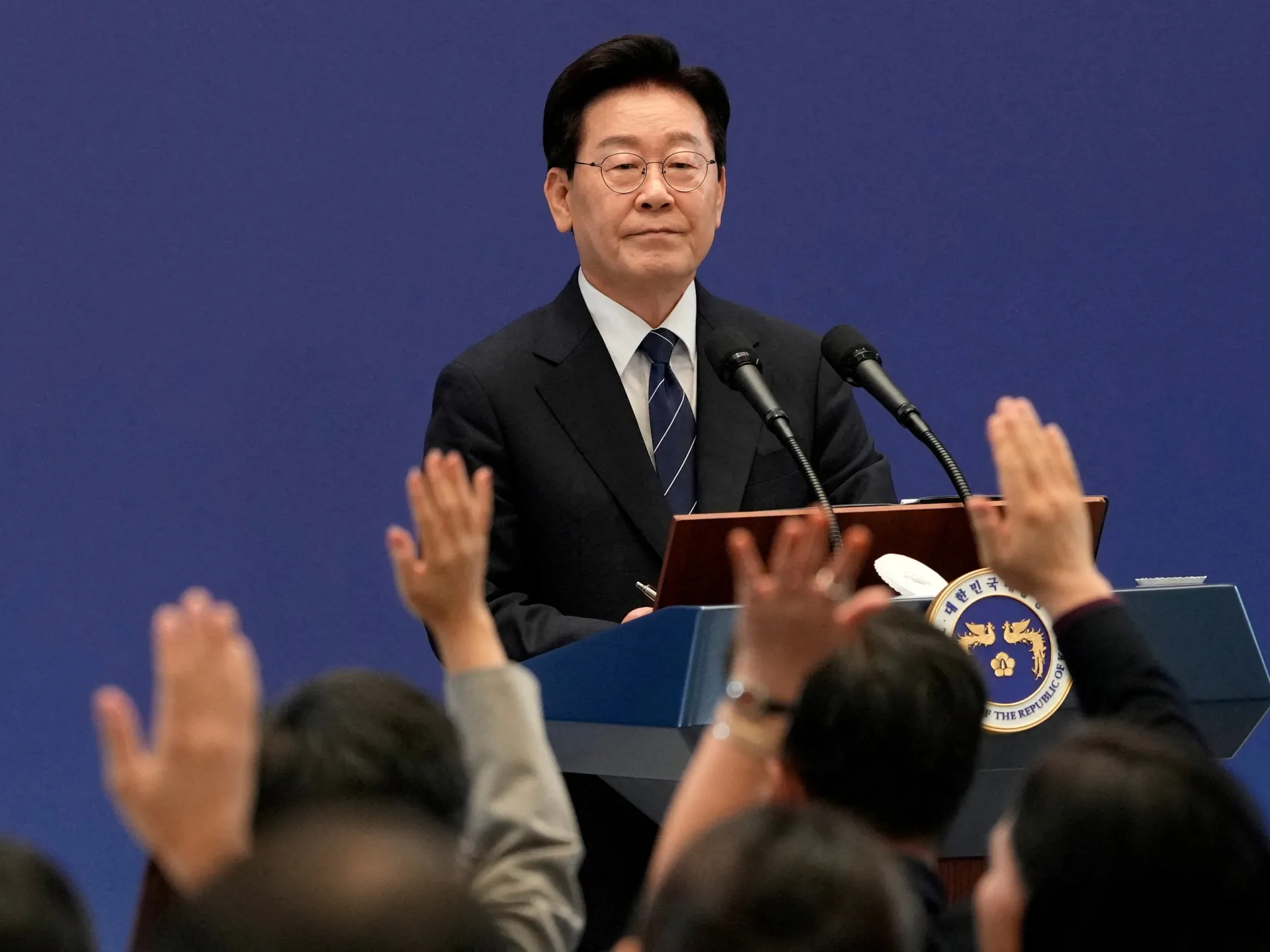
South Korean President Lee Jae Myung, seen here speaking at a Cabinet meeting on Monday, expressed regret over drone flights by individuals into North Korea. Pool Photo by Yonhap

President Lee Jae Myung on Monday expressed regret over drone flights by individuals into North Korea, saying that such behavior has caused unnecessary military tension with Pyongyang.

Lee made the remarks during a Cabinet meeting, after prosecutors last week indicted three individuals accused of flying drones into North Korea between September and January.

Those indicted include a graduate student in his 30s, an employee of the National Intelligence Service and a military officer.

“Although this was not an act by our government, I express regret to the North Korean side over the unnecessary military tension caused by such reckless behavior,” Lee said.

Lee has previously criticized the drone incursions on several occasions, but this marks the first time he has expressed regret directly to North Korea.

He said civilians are prohibited from engaging in unauthorized, private acts that could provoke North Korea, stressing that even when such actions are deemed necessary for national strategy, they must be handled with the utmost caution.

“It is deeply regrettable that individuals carried out such provocative acts toward North Korea on their own,” he said, calling such actions “unacceptable.”

Lee also addressed concerns among residents near border areas, noting that the incident had caused significant anxiety.

“We need to carefully consider who such actions are really meant to benefit,” he said, urging relevant ministries to revise regulations and take swift measures to prevent recurrences.

Amid a rapidly shifting global landscape, Lee emphasized the importance of Seoul’s responsible role in maintaining peace and stability on the Korean Peninsula.

“We should closely monitor the changes in the harsh international order, which requires more responsible action to ensure peace on the Korean Peninsula,” he said.

Lee has extended an olive branch to resume dialogue with Pyongyang since taking office in June 2025, but North Korea has rebuffed those overtures, formally describing South Korea as the “most hostile state” in a parliamentary speech last month.

Copyright (c) Yonhap News Agency prohibits its content from being redistributed or reprinted without consent, and forbids the content from being learned and used by artificial intelligence systems.

Source link

Saturday 4 April Chungmyung Day in North Korea

Chungmyung Day falls on one of the 24 divisions of the year and represents the sky clearing up for spring.

Traditionally the day is spent tidying up graves and doing home repairs that could not be done during the winter months.

It takes place on the same date as the Ching Ming Festival (Tomb-Sweeping Day) in China which also shares rituals about ancestor worship.

Despite the rich history of the traditions of this day, it has only been an official holiday since 2010, when Kim Jong Eun declared this day as a holiday so that the people could spend it conducting traditional rituals.

Along with New Year’s Day, Lunar New Year’s Day, Dano (May 5th) and Chuseok, Hansik is one of the five ‘folk holidays’ offically commemorated in North Korea, but are not viewed as important as Kim Jong Il’s and Kim Il Sung’s birthdays, which both are normally celebrated with three days of holidays.

U.N. Human Rights Council adopts North Korea resolution

The U.N. Human Rights Council adopted a resolution condemning North Korea’s human rights violations during a session in Geneva Monday. The Council’s 61st session opened on Feb. 23, as seen in this file photo. File Photo by Valentin Flauraud/EPA

SEOUL, March 31 (UPI) — The United Nations Human Rights Council adopted a resolution condemning North Korea’s human rights violations, with South Korea joining 49 other countries as a co-sponsor despite speculation it might withhold support as it seeks to improve relations with Pyongyang.

The resolution was adopted by consensus at the Council’s 61st regular session Monday in Geneva. It expresses “deep concern about the systematic, widespread and gross human rights violations in the Democratic People’s Republic of Korea [and] the pervasive culture of impunity and lack of accountability for such violations.”

The measure urges Pyongyang to undertake sweeping reforms, including dismantling political prison camps, ending forced labor and ensuring freedom of expression and movement.

The Council has adopted a North Korean human rights resolution every year since 2003.

South Korea had reportedly weighed opting out of co-sponsorship this year, as the administration of President Lee Jae Myung pursues renewed engagement with the North and seeks to ease tensions on the Korean Peninsula.

However, Seoul ultimately decided to join as a co-sponsor “following in-depth consultations among relevant government agencies,” Foreign Ministry spokesman Park Il said at a press briefing Tuesday.

He pointed to the resolution’s references to humanitarian issues such as abductions and reunions for separated families, as well as language supporting dialogue and engagement.

“It was by taking all these aspects into account that we decided to participate as a co-sponsor,” Park said.

South Korea also backed a similar U.N. resolution at the General Assembly in November. Seoul had co-sponsored such measures from 2008 through 2018, but stepped back during a period of inter-Korean detente between 2019 and 2022 under then-President Moon Jae-in.

The latest resolution comes as Seoul weighs how to balance engagement with Pyongyang against pressure to address its human rights record.

President Lee has taken conciliatory steps since taking office in June, including restricting activist groups from sending propaganda leaflets across the border.

Last week, Human Rights Watch and more than two dozen organizations and individuals urged Lee’s government to continue supporting the resolution, warning in an open letter that recent policy moves “signal a troubling shift away from support for the victims of the North Korean government repression.”

“Sustainable peace on the Korean Peninsula cannot be achieved by excluding human rights,” the letter said. “Dialogue and engagement need to go hand in hand with the protection of human rights and accountability.”

North Korea has long rejected such resolutions as hostile acts, accusing the United Nations and Western countries of using human rights as a pretext to undermine its government.

Speaking at a session ahead of the vote Monday, North Korea’s deputy permanent representative to the United Nations in Geneva, Kang Myong Chol, said Pyongyang “categorically rejects” the measure.

“We condemn it as a falsified document motivated by ulterior political objectives of undermining the dignity of my country and discrediting its ideology and system,” Kang said.

A recent report by the U.N. special rapporteur found that the country’s human rights situation has “shown no improvement” over the past decade and in many cases has worsened, despite limited engagement with international mechanisms.

The report cited persistent restrictions on movement, expanded surveillance and the continued use of forced labor, as well as growing difficulty for citizens attempting to leave the country.

The resolution was adopted without participation from the United States, which withdrew from the Human Rights Council after President Donald Trump signed an executive order ending U.S. membership in February 2025.

Source link

NATO: All allies met defense spending target for first time last year

March 27 (UPI) — All 32 NATO nations met or exceeded the alliance’s target for defense spending last year, Secretary-General Mark Rutte said, as Canada and several ally nations increased their investment in defense amid war in Europe and the Middle East.

“We see clearly that our world is constantly changing. And we are adapting to ensure we remain prepared,” he said during a press conference in Brussels, as he released the alliance’s 2025 Annual Report.

“The threat picture across 2025 made clear that we need to do more. And throughout the year, NATO continued to come together to ensure that we are ready and able to respond to any threat, across all domains, both now and in the future.”

The defensive military alliance has called on member states to invest at least 2% of their gross domestic product in defense since at least 2006, with allies in 2014 pledging that those below the guideline would move toward it within a decade — though few nations did so for years.

Amid what he described as a more dangerous security environment — including Russia’s war against Ukraine, the Kremlin’s support from China, Iran, North Korea and Belarus, as well as the broader instability centered on Iran — countries are stepping up, he said, calling 2025 “a landmark year for NATO.”

Amid the protracted war in Europe and uncertainty about the United States’ cooperation with the alliance, defense ministers last year made a commitment to investing 5% of GDP annually in core defense requirements by 2035.

Among nations Rutte highlighted for reaching the 2% benchmark was Canada, which, under the Liberal government of Prime Minister Mark Carney, has sharply increased its defense spending as its once iron-clad relationship with the United States has frayed under the weight of U.S. President Donald Trump‘s incendiary rhetoric, threats of annexation and tariffs.

In the last 10 months of the Carney government, Canada has spent more than $23.8 billion on defense and security, pushing it over the 2% threshold for the first time since the end of the Cold War — and well ahead of the 2032 pledge made by former Defense Minister Bill Blair in 2024.

“As a result of our efforts, this morning, NATO confirmed that Canada has achieved its 2% defense expenditure target — half a decade ahead of the original schedule,” Carney said during a press conference held Thursday aboard a Royal Canadian navy vessel in Halifax Harbor.

“Canadians are responding to our renewed commitment and call to serve.”

The Liberal leader described the 2% target as “the foundation” for further investment in the country’s defense expenditure, as he announced a further $2.1 billion defense package for Atlantic Canada.

“Over the past 11 months, one of our government’s key priorities has been to reinvest in rebuilding and rearming the [Canadian Armed Forces] to provide you with the support you need to achieve mission success,” he said.

“We will continue our efforts with the same speed and determination that we have shown from the very beginning.”

Source link

Gabbard tells Senate panel only Trump can determine imminent threats

1 of 2 | Director of National Intelligence Tulsi Gabbard prepares to testify during a Senate Intelligence Committee hearing on worldwide threats in the Hart Senate Office Building on Capitol Hill in Washington, D.C., on Wednesday. Photo by Annabelle Gordon/UPI | License Photo

March 18 (UPI) — Director of National Intelligence Tulsi Gabbard defended U.S. military strikes on Iran during a Senate Intelligence Committee hearing Wednesday, calling them a strategic success.

Senators challenged Gabbard to reconcile the words of President Donald Trump with the intelligence her department has received on Iran. When pressed, Gabbard yielded that Trump has the final say on what threats the United States faces.

When the United States performed strikes on Iranian nuclear facilities in June, Trump said Iran’s nuclear capabilities were “obliterated.” Earlier this month, he said Iran’s development of nuclear weapons posed an imminent nuclear threat to national security, justifying military action.

Gabbard affirmed Wednesday that Iran’s nuclear enrichment program was “obliterated” in the June strikes.

“It is not the intelligence community’s responsibility to determine what is and is not an imminent threat,” Gabbard said. “That is up to the president, based on a volume of information he receives.”

Gabbard was once a vocal opponent of engaging in a war with Iran, even selling shirts that read “No War With Iran” in 2019 while she campaigned for the Democratic presidential nomination.

Iran is one of the United States’ top adversaries, the Office of the Director of National Intelligence’s “Annual Threat Assessment” said. China, Russia and North Korea are also on that list.

In the 19 days since the war with Iran began, Gabbard said the Iranian regime “appears to be intact but largely degraded.”

“Even so, Iran and its proxies remain capable of and continue to attack U.S. and allied interests in the Middle East,” Gabbard said. “The IC assesses that if a hostile regime survives it will seek to begin a yearslong effort to rebuild its missiles and UAV forces.”

President Donald Trump receives a bowl of shamrocks from Irish Taoiseach Micheal Martin to celebrate St. Patrick’s Day at the White House on Tuesday. Photo by Yuri Gripas/UPI | License Photo

Source link

N. Korea, China resume cross-border passenger train service for 1st time in 6 yrs

A passenger train linking North Korea and China crosses the Amnok River bridge, also known as the Yalu River bridge, on the border between two countries on Thursday. Photo by Yonhap

North Korea and China resumed an international passenger train service linking their capitals Thursday for the first time in six years, with a train spotted crossing the border bridge between the two countries.

A nine-car train traveling from Pyongyang to Beijing was seen by Yonhap News Agency passing over the Amnok River bridge, also known as the Yalu River bridge, connecting North Korea’s Sinuiju and China’s Dandong, at around 4:23 p.m.

Some train cars had closed curtains, while passengers were visible in others.

According to China’s Xinhua News Agency, a five-car passenger train departed from the Chinese border city of Dandong at 10 a.m. and was scheduled to arrive in Pyongyang at 6:07 p.m.

The Dandong-Pyongyang passenger line will operate daily in both directions, Xinhua said, quoting a Chinese official as saying the service will serve as a “dynamic link strengthening the friendship between these two nations.”

Also on Thursday, North Korea and China were set to resume a rail route connecting their capitals, Pyongyang and Beijing.

The resumption marks the first cross-border passenger train service between the two countries since operations were suspended in 2020 following the outbreak of the COVID-19 pandemic.

Last year, North Korea resumed direct flight and train services between Pyongyang and Moscow, Russia’s capital.

The reopening of the North Korea-China rail services comes as the two countries appear to be aligning more closely as they seek to repair relations frayed by Pyongyang’s military cooperation with Russia, amid speculation that the United States may seek to reengage Pyongyang for talks.

Copyright (c) Yonhap News Agency prohibits its content from being redistributed or reprinted without consent, and forbids the content from being learned and used by artificial intelligence systems.

Source link

Kim Jong Un, daughter Ju Ae test pistols at munitions factory

In this image released Thursday by state media, North Korean leader Kim Jong Un’s daughter Kim Ju Ae fires a pistol during an inspection of a munitions factory with her father. Photo by KCNA/EPA

SEOUL, March 12 (UPI) — North Korean leader Kim Jong Un inspected a munitions factory that produces light arms, state-run media reported Thursday, where he test-fired newly developed pistols alongside his daughter Ju Ae.

Kim visited the factory on Wednesday accompanied by officials from the ruling Workers’ Party, according to the official Korean Central News Agency. The report did not specify the location of the facility.

During the visit, Kim stopped at the factory’s shooting range to test-fire a pistol that he said was “superior in its structural performance, rate of hits, concentration fire and combat utility,” KCNA reported.

Kim “expressed satisfaction over the development of a really excellent pistol,” the report said.

The handgun was approved for production at a meeting of the party’s Central Military Commission last month, according to KCNA. The factory operates under North Korea’s Second Economy Commission, which oversees the country’s weapons production and defense industry.

While Ju Ae was not mentioned in the KCNA report, photographs released by state media showed her accompanying her father during the inspection. The pair wore matching leather jackets and fired pistols at the factory’s indoor range alongside senior officials.

Ju Ae, believed to have been born around 2013, has appeared alongside her father at public events with increasing frequency, including missile launches, military demonstrations and major political gatherings.

On Wednesday, she was also seen beside Kim as he oversaw the test-firing of strategic cruise missiles from a naval destroyer via a video feed.

South Korea’s National Intelligence Service said last month that Ju Ae appears close to being designated as Kim’s successor.

The factory visit comes in the wake of last month’s Workers’ Party congress, where Kim outlined defense priorities for the next five years. While Pyongyang continues to prioritize the expansion of its nuclear arsenal, the North Korean leader has also emphasized strengthening conventional weapons production.

During the congress, Kim presented newly developed sniper rifles to senior officials and military commanders, with state media releasing images of Ju Ae inspecting and firing one of the weapons.

During Wednesday’s visit, Kim stressed the importance of factories producing pistols and other light arms to strengthen “the combat efficiency of the army, public security forces and militia forces,” KCNA said.

He also announced plans to convene a meeting of the party’s Central Military Commission next month to review plans for modernizing munitions factories and allocating funds to upgrade three key defense production facilities.

The inspection comes as the United States and South Korea conduct their annual Freedom Shield joint military exercise, which Pyongyang routinely condemns as a rehearsal for invasion. Earlier this week, Kim Yo Jong, the powerful sister of the North Korean leader, warned the drills could bring “unimaginably terrible consequences.”

Source link

South Korea Says It Can Deter North Even if U.S. Shifts Weapons to Middle East

South Korea said it remains capable of deterring threats from North Korea even if the United States redeploys some weapons stationed on the Korean peninsula to the Middle East amid the war involving Iran.

The comments by South Korean President Lee Jae Myung come after reports that key U.S. missile defence systems and military assets could be moved from Asia to support operations linked to the Iran conflict.

The potential redeployment has sparked concern among Asian allies that shifting military resources could weaken regional deterrence against China and North Korea at a time of heightened geopolitical tensions.

Seoul Says Deterrence Remains Strong

Speaking at a cabinet meeting, Lee acknowledged that reports about the relocation of U.S. military equipment had triggered controversy in South Korea.

He said that while Seoul had expressed opposition to the removal of certain weapons, it could not dictate U.S. military decisions.

However, Lee emphasised that South Korea’s own defence capabilities are strong enough to maintain deterrence against North Korea even if some American systems are temporarily relocated. He noted that South Korea’s defence spending and conventional military strength significantly exceed those of the North.

South Korea hosts about 28,500 U.S. troops as part of the long-standing alliance designed to deter aggression from nuclear-armed North Korea.

Missile Defence Systems May Be Redeployed

Officials have indicated that the U.S. and South Korean militaries are discussing the possible redeployment of Patriot missile defense system batteries to the Middle East.

South Korean media reported that some missile batteries may have already been shipped from Osan Air Base and could be redeployed to U.S. bases in Saudi Arabia and the United Arab Emirates.

There were also reports that parts of the Terminal High Altitude Area Defense (THAAD) system could be moved from South Korea to the Middle East.

While Patriot systems provide lower-tier defence against shorter-range missiles, THAAD systems are designed to intercept ballistic missiles at high altitude.

United States Forces Korea declined to comment on the possible relocation of equipment, citing operational security.

Analysts Warn of Miscalculation Risks

Military analysts say that although South Korea possesses strong military capabilities, the presence of U.S. forces and weapons in the country serves as a crucial signal of Washington’s commitment to the region.

According to Choi Gi-il, a military studies professor at Sangji University, the removal of some systems could carry strategic risks.

He warned that North Korea might interpret the redeployment as a weakening of allied defences and could attempt limited provocations to test the alliance’s response.

North Korean leader Kim Jong Un has recently signalled a more aggressive posture, pledging to expand the country’s nuclear arsenal and describing South Korea as its “most hostile enemy.”

Wider Regional Impact

The redeployment of U.S. assets reflects the broader strategic impact of the Iran conflict on global military posture.

Japan, which also hosts major U.S. bases, has seen two U.S. guided-missile destroyers stationed in Yokosuka deployed to the Arabian Sea to support operations linked to the Iran campaign.

The movements have raised concerns in Tokyo as well, with opposition politicians questioning whether U.S. forces stationed in Japan should be used for operations outside the region.

The developments highlight how the conflict in the Middle East is beginning to reshape global military deployments, drawing resources away from Asia and prompting questions about the balance of security commitments across different regions.

With information from Reuters.

Source link

Kim Jong Un oversees cruise missile launch amid U.S.-South Korea drills

North Korean leader Kim Jong Un (R) oversaw the test-fire of strategic cruise missiles from the naval destroyer Choe Hyon, state-run media reported Wednesday. In the photo, Kim watches the launch via video feed with his daughter Kim Ju Ae. Photo by KCNA/EPA

SEOUL, March 11 (UPI) — North Korean leader Kim Jong Un oversaw the test-firing of strategic cruise missiles from a naval destroyer, state media reported Wednesday, as the United States and South Korea began a large-scale joint military exercise this week.

The North’s Choe Hyon destroyer launched the missiles at island targets in the Yellow Sea on Tuesday, the official Korean Central News Agency said, with Kim watching via a video feed. The missiles flew for roughly two hours and fifty minutes before striking their targets, KCNA said.

Pyongyang described the weapons as “strategic,” a term it typically uses for systems capable of carrying nuclear warheads.

The launches came days after North Korea conducted a similar cruise missile test from the destroyer ahead of its commissioning.

The test also coincided with the start of the allies’ annual Freedom Shield exercise on Monday, an 11-day program of command-post simulations and field training drills.

North Korea has long condemned the joint exercises as rehearsals for invasion. On Tuesday, Kim Yo Jong, the powerful sister of Kim Jong Un, warned that the drills could destabilize the region and lead to “unimaginably terrible consequences.”

After observing the launch, Kim praised the “superiority of the destroyer’s integrated combat system,” according to KCNA.

“The components of our war deterrent are now being included in the very sophisticated operational system … and the country’s nuclear forces have made a switch to the phase of multifaceted operation,” Kim said.

Images released by state media showed Kim watching the test alongside his daughter Ju Ae, who has appeared frequently with her father at major events. South Korea’s spy agency said last month that Ju Ae, believed to have been born in 2013, appears close to being designated as Kim’s successor.

Pyongyang launched the Choe Hyon, its first 5,000-ton destroyer, last April as Kim called for strengthening the country’s naval capabilities. North Korean reports say the vessel carries a range of weapons, including nuclear-capable cruise missiles and tactical ballistic missiles.

Photos released by state media show the ship’s missile and radar systems resembling those found on Russian vessels, prompting speculation Pyongyang may have received technical assistance from Moscow.

North Korea has deployed troops, artillery and weapons to support Russia’s war in Ukraine and is believed to be receiving financial support and advanced military technology in return.

A second destroyer, the Kang Kon, suffered an accident during its launch ceremony last year that left it listing on its side before it was repaired and relaunched in June.

Kim has ordered another 5,000-ton destroyer completed by Oct. 10, the anniversary of the founding of the ruling Workers’ Party of Korea.

Source link

Deterrence posture against N. Korea won’t be hindered regardless of potential shift of USFK’s assets

South Korea’s defense posture against North Korea will not be hindered by the shift of U.S. military assets to the Middle East, a senior presidential official said Wednesday. In this photo, taken Tuesday, air defense launchers are seen being dismantled at a U.S. THAAD base in Seongju. Photo by Yonhap

The deterrence posture against North Korea will not be hindered regardless of a potential shift of military assets owned by the U.S. military stationed in South Korea, a senior official at Cheong Wa Dae said Wednesday, amid media reports that the U.S. Forces Korea (USFK) has shipped out some of its air defense assets from the Korean Peninsula.

“Given our level of military capability, defense spending, defense industry capacity and the high morale of our troops, there is no problem with deterrence against North Korea regardless of whether some USFK assets are relocated overseas,” the official said.

The official, however, declined to comment on media reports that parts of a Terminal High Altitude Area Defense (THAAD) system and other air defense units owned by the USFK were moved from South Korea amid a raging war in the Middle East.

“It is not appropriate for our government to comment on military operations between Korea and the U.S.,” the official said.

The official said South Korea and the U.S. have remained in close coordination to maintain a robust combined defense posture.

“Korea and the U.S. will maintain a robust combined defense posture to contribute to peace and stability on the Korean Peninsula and in the region,” the official said. “To that end, the two countries will continue close communication and coordination.”

Copyright (c) Yonhap News Agency prohibits its content from being redistributed or reprinted without consent, and forbids the content from being learned and used by artificial intelligence systems.

Source link