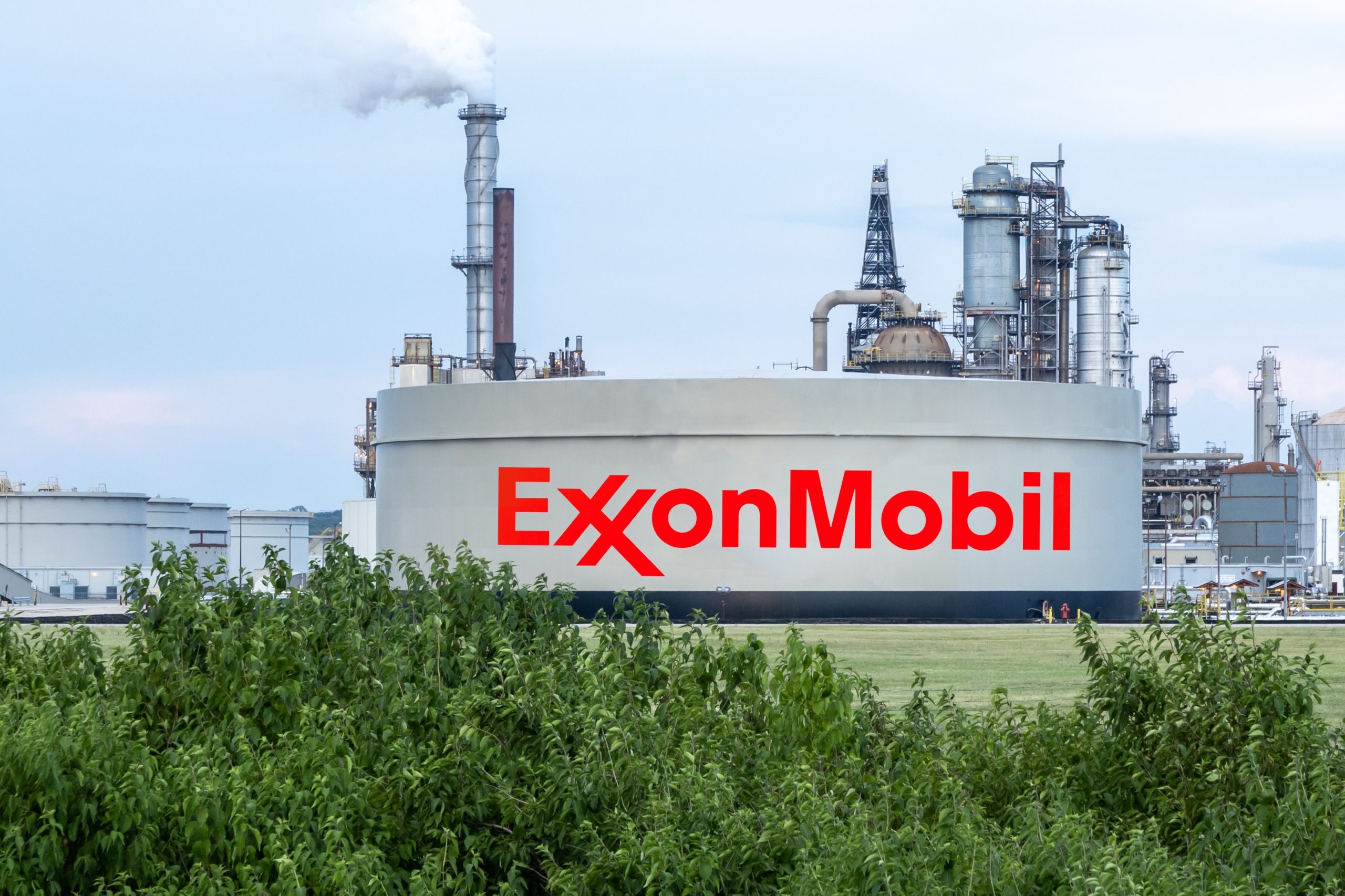
Rodríguez assured ExxonMobil executives of “legal guarantees” for investments. (Archive)
Caracas, November 11, 2026 (venezuelanalysis.com) – The acting Delcy Rodríguez government and ExxonMobil signed a memorandum of understanding on Monday as the oil giant prepares to return to Venezuela nearly two decades after having its assets nationalized.
“We welcome [ExxonMobil] back, hoping that synergy will develop and produce benefits for Venezuela and the United States,” she said in a televised broadcast.
Rodríguez stated that the “very important” agreement followed “months of negotiations.”
“This return takes place under very favorable conditions, in a context of legal guarantees for foreign investments,” she added. The acting president also saluted US Chargé d’Affaires John Barrett, who attended the ceremony
For his part, Dan Ammann, president of ExxonMobil Upstream Company, expressed confidence that the firm’s “unique capabilities” and Venezuela’s “extraordinary results” would yield “significant benefits for all parties involved.”
ExxonMobil CEO Darren Woods had previously called Venezuela “uninvestable” and demanded industry reforms before the talks leading to the company’s imminent return.
ExxonMobil left Venezuela in the late 2000s after refusing to comply with reforms introduced by the Hugo Chávez government to assert state sovereignty over the oil industry. The Texas-based multinational refused compensation offers and pursued international arbitration after its assets were nationalized. The company received a US $908 million arbitration award from the International Chamber of Commerce, significantly below its demands. It is likewise attempting to enforce a separate $985 million award.
Caracas had likewise denounced ExxonMobil after it spearheaded offshore drilling projects in the territorial waters of the disputed Essequibo Strip.
The Venezuelan government and ExxonMobil have not disclosed the projects under consideration. But reports suggest the company will take over its former projects, light and medium-crude La Ceiba in the Maracaibo Lake Basin and extra-heavy-crude Cerro Negro in the Orinoco Oil Belt, later relaunched as Petromonagas. The oil giant is also linked to Carabobo block oilfields adjacent to the latter.
According to Petroguía, ExxonMobil is eyeing concession-type “Productive Participation Contracts” and has engaged in negotiations with Russian state-owned company Roszarubezhneft to acquire its 40 percent stake in the Petromonagas joint venture.
Since the January 3 US attacks and kidnapping of President Nicolás Maduro, Venezuelan authorities have enacted a pro-business overhaul of the energy industry in consultation with Washington, while signing dozens of agreements with Western corporations. Chevron, Repsol, and Shell are among the companies to have struck new deals or renegotiated old ones to expand their foothold in the country.
Rodríguez has also radically shifted Caracas’ foreign policy, including reestablishing ties with Israel.
Recent reports have revealed that NewMed Energy, a subsidiary of the multi-billion Delek Group conglomerate and one of Israel’s largest energy firms, is negotiating a 60 per stake in an unnamed Venezuelan “oil-producing company.”
NewMed has an exclusivity window to negotiate with the Venezuelan counterpart until January 1, 2027. The undisclosed firm is said to hold “onshore oil rights” as well as additional “onshore and offshore oil and gas assets.”
Venezuelan legislation imposes a state-owned majority in any joint ventures. However, the recent reforms allow foreign corporations to take over operations and sales in concession-type agreements despite being minority shareholders.
Notwithstanding the opening of the industry to foreign capital under exceedingly favorable conditions, Venezuela’s oil output has stagnated in recent months. The latest monthly OPEC report placed October’s production at 1.158 million barrels per day (bpd) according to secondary sources. The figure is on a par with the previous month’s 1.147 million bpd output.
Venezuelan authorities had pledged to reach 1.3 million bpd before the end of the year.
In addition to overseeing legislative changes and mediating oil agreements, the US has taken control of Venezuela’s export revenues, with Trump officials deciding when and how much of the funds to return to Caracas.
A New York Times article published on Tuesday claimed that, according to a report from auditing firm KPMG, the Trump administration has managed $12 billion of Venezuelan export revenues through the end of September, with nearly all the funds returned to Caracas to be supplied to the private sector via commercial banks.
Traders Vitol and Trafigura, which secure Venezuelan crude below market price before reselling it, have been the biggest depositors into the US Treasury account at Citibank.
However, the total figure contradicts a previous Financial Times investigation that estimated $13 billion of US-controlled Venezuelan funds in the first half of the year alone. Additionally, Venezuelan government advisor Luigi Pisella stated that the Trump administration deducted around $4.7 billion from the revenues to cover the costs of its January 3 military operation.
Edited by Lucas Koerner in Philadelphia, USA.