Podcaster and mental health activist Jennifer Eckhart, who sued ex-Fox News anchor Ed Henry for sexual assault in 2020, died by suicide on Saturday, according to authorities.
Eckhart was found in her Florida home on Saturday morning, according to an incident report issued by Martin County Sheriff’s Office, People reported. Her mother discovered her body inside a bathtub with a knife nearby, according to TMZ.
“This death has been ruled a suicide,” Christine Christofek, a spokesperson for the sheriff’s office, said in a statement to People.
Eckhart worked as an associate producer on Fox News Media’s Fox Business Network from 2013 to 2020. She sued Henry for sexual assault in 2020, and Fox News was named in the suit, accused of failing to take action against Henry for harassing women. The news division was later removed from the suit in March 2025.
“Fox News can … be held liable for Henry’s actions only if its management or supervisors knew or should have known about that purported misconduct yet failed to prevent Henry from harming Eckhart,” Judge Ronnie Abrams said in her March 2025 ruling. “On this record, the Court agrees that no reasonable jury could make that finding.”
Eckhart revealed that her lawyers were appealing Abrams’ decision in an October 2025 Instagram post.
“This case was never just about me,” she wrote. “It has always been about accountability and forcing corporations to answer for the cultures of abuse they protect, enable, and excuse behind power, money, and silence. For more than five years, my former employer Fox News has spent millions resisting accountability in my [rape] lawsuit. But what’s at stake is far bigger than me, one woman, one man or one company.”
The appellate court upheld Abrams’ decision, Eckhart’s lawyer Michael J. Willemin, a partner at Wigdor law firm, said.
“We were deeply saddened to learn of Ms. Eckhart’s passing, and our thoughts are with her family at this time,” Willemin told The Times.
Eckhart filed the harassment complaint against Henry after Fox News fired her in 2020. Following a subsequent sexual misconduct investigation, Fox News fired Henry that same year. The anchor, who now works at Newsmax, had previously taken time off in 2016 after a woman who claimed they had been having an affair while he was married released embarrassing correspondence between them, per People.
Suicide prevention and crisis counseling resources
If you or someone you know is struggling with suicidal thoughts, seek help from a professional or call 988. The nationwide three-digit mental health crisis hotline will connect callers with trained mental health counselors. Or text “HOME” to 741741 in the U.S. and Canada to reach the Crisis Text Line.
Born in Miami, Eckhart graduated from the University of Florida with a bachelor of science degree in telecommunications-news, according to her biography. She previously served as an ESPN Radio correspondent and an anchor for Gainesville, Fla., PBS affiliate WUFT-TV. In addition to her news and podcast experience, Eckhart also founded the Reinvented Project, which provided “support for trauma survivors through animal-assisted healing.”
Despite adversity, Eckhart was determined in her October 2025 post.
“I know the risks of speaking when silence would have been the safer, easier option. But I also know this: regardless of the outcome, history will not remember me as a woman who kept her mouth shut,” she wrote. “And I am completely at peace with that.”
Four days before they’re set to play the first-ever concert by their new band, Dhani Harrison and Nigel Godrich sit down to enjoy a post-rehearsal libation in the parking lot of a North Hollywood practice space.
“Is there an opener?” asks Godrich, who holds a bottle of fancy root beer. Harrison, who’s clutching a Sapporo, grabs his friend’s drink and neatly pops the top off using his own bottle.
“I went to Brown,” he says with a little smile. “That’s what they teach you in the Ivy League.”
Harrison, 48, is the son of the late Beatles legend George Harrison; long before college, he got a priceless musical education from his father, whose final solo album — 2002’s Grammy-winning “Brainwashed” — Dhani helped complete after George’s death in 2001. Godrich, 55, made his name working in the studio with Radiohead on game-changing records like “OK Computer” and “Kid A”; he’s also produced for Beck, Paul McCartney and Roger Waters and played with Thom Yorke and Flea in Atoms for Peace.
Now the two have teamed up in Dragonflies, a spacey and atmospheric art-rock duo with a self-titled debut album due Friday from Dark Horse Records, the label George Harrison founded in 1974 and Dhani Harrison relaunched in 2020. This weekend, Harrison and Godrich will celebrate the LP’s release with two shows at Hollywood Forever’s Masonic Lodge, where they’ll be joined by guitarist Nick Valensi (of the Strokes) and drummer Joey Waronker (who’s played with Beck, R.E.M. and Oasis).
Asked how exactly the group came together, Godrich and Harrison look at each other across a picnic table and shrug. “The real reason we did it was as a vehicle to hang out,” Godrich says of the two, who’ve been pals since both were living in Los Angeles in the early 2000s and who both found themselves back home in England a few years ago.
Yet “Dragonflies” has plenty to offer the rest of us: Built around Harrison’s high, sighing vocals, the music moves with a funky rhythmic propulsion rooted in Godrich’s signature tape loops; lush string arrangements by David Campbell (also known as Beck’s dad) add a touch of slightly spooked romance to songs about nature and friendship.
Harrison describes the band’s sound as “a bit creaky” and compares it to the feeling of being out on the water. “I always thought that’s a cool place to start — like you’re on a sinking ship,” he says.
Godrich laughs and adds, “Well, I hope not.”
For Harrison, working with Godrich provided a kind of full-circle moment nearly two decades after he caught one of Atoms for Peace’s first gigs at downtown L.A.’s Orpheum Theatre in 2009.
“I remember it made me want to quit music,” he says, which draws a frown from his bandmate.
“That’s not a great review,” Godrich says.
“No, that concert blew me away,” Harrison replies. “I went home and I was like, Oh, they’ve already done all the things I want to do. So I just went and sulked for a few days.”
Dragonflies began after Harrison returned to England, where he’d grown up on his father’s Friar Park estate, following the death of his grandmother, who famously raised George Harrison’s widow, Olivia Harrison, in Hawthorne. “I was still here basically to be around her,” says the musician, who formed the bands Thenewno2 and Fistful of Mercy while in L.A. “When she passed, that was the last of my grandparents. My mom was living in England, and so I just thought, Well, time to go.”
Harrison sought out Godrich for help on his 2023 solo album, “Innerstanding”; later, he lent the producer one of his dad’s old tape machines — “They did ‘Shankar Family & Friends’ on it,” he points out — which led to a series of casual jam sessions at Godrich’s studio in London’s Brixton neighborhood.
“It was like, ‘Hey, you want to get some Japanese food and make some tape loops?’” Harrison recalls.
Godrich notes proudly that “the way the record was made was completely mechanical,” meaning nothing was programmed on a computer but instead recorded “live on the fly” using older equipment.
“Fortunately, we both own a ridiculous amount of analog gear,” Harrison adds. “Because we’re nerds.”
“I’m not a nerd,” Godrich says. “I hate gear chat.”
“That’s true,” Harrison says. “He doesn’t nerd out about that stuff — I’m the nerd. He won’t even let me use six Kaoss Pads onstage.”
What’s a Kaoss Pad?
“You don’t want to know,” Godrich replies.
Gearhead or no, the producer was adamant that Dragonflies not rely on prerecorded backing tracks when it starts playing live.
“No computers were harmed in the making of this show,” Harrison says — thus the extra players.
(Brian Feinzimer / For The Times)
Waronker is an old friend of Godrich’s who played drums in Atoms for Peace and on Beck’s “Sea Change” and “Morning Phase” (not to mention Beck’s brand-new “Ride Lonesome,” which Godrich mixed); the producer has known Valensi since he “didn’t work with the Strokes,” as he puts it, in 2003, when Godrich tried a couple of sessions with the New York garage-rock band before deciding it wasn’t a good fit.
Godrich says he plays bass in the live group because it’s easy. But also: “Bass is such an important part of the sound that if somebody else was doing it, they would never do it the same as me, and it would annoy me.”
Top three bass players of all time, according to Dragonflies?
“McCartney’s good, isn’t he?” Godrich asks.
“Les Claypool,” says Harrison. “I’m a huge Primus fan.”
“I like David J from Bauhaus,” Godrich says. “He’s an incredibly innovative bass player — always did very interesting things. Stylistically, he’s someone that I probably copy a lot from. It’s just the root notes, but whoever’s in control of the root notes is in control of everything.”
“It really is a power move to be the bass player,” Harrison says.
“I don’t want to be at the front — that’s not my thing,” says Godrich. “I don’t want to be the guy.”
Does Harrison?
“It takes me a while to get warmed up,” he says. “I don’t really look at people when I’m playing a show. I’m not sure if that means I’m mildly spectoral. I took the test, actually — I scored highest in my old band. I know a lot of neurodivergent people who perform.” He shrugs. “Sometimes you don’t get to choose if you’re the guy, but you’re the guy.”
In addition to his father, one of Dhani’s mentors was George’s friend and latter-day creative partner Jeff Lynne, who for all his musical genius has never seemed particularly comfortable onstage.
“He’s brilliant at what he does, but you talk about in-ear monitors or the sound onstage or the lighting or something, and it’s over,” Harrison says. “It’s too much input. That’s why Jeff wears the Spider-Man goggles,” he adds, referring to the ELO frontman’s ever-present aviator shades. “He has too much Spider-Sense. My dad was the same way. He definitely was like, ‘Look at him — don’t look at me!’”
After Dragonflies’ Hollywood Forever shows, Godrich and Harrison have dates scheduled in Europe for November and hope to play more in the future, depending on when Godrich finishes a couple of records he’s producing. (To give a sense of the stress he’s under, he mimes putting a gun to his head.) The duo already has enough material for a second album too.
How much time does Harrison intend to dedicate to the project?
“As much as I can, really,” he says. “How much do you want to hang out with your mate? I got bored of being Dhani Harrison anyway — I like being Dragonflies now.”
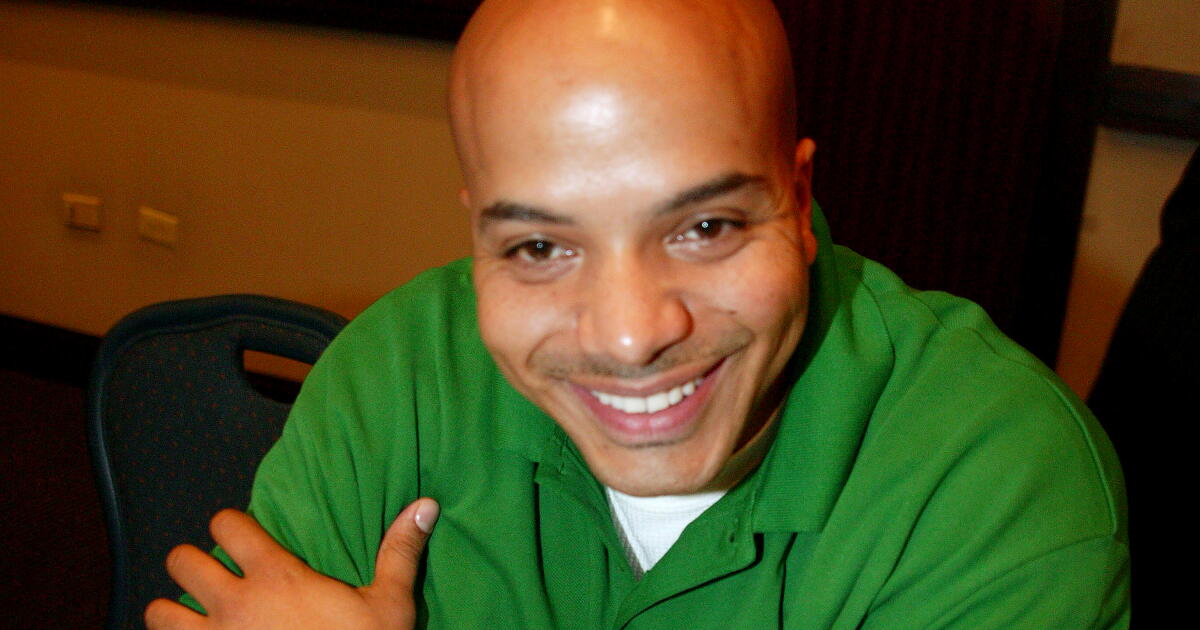
Tone Capone, the Bay Area producer whose smash hit “I Got 5 On It” for Luniz defined his region’s hip-hop sound, has died. He was 59.
The producer’s death was first reported by KQED. Capone had most recently lived in Las Vegas. No cause of death was given.
Capone, born Anthony Douglas Gilmour in Berkeley, learned to DJ while attending Berkeley High School. He often performed at college and house parties with his close friend Nick Peace, who became an accomplished hip-hop producer as well. While Bay Area hip-hop was famously independent and insular, Capone produced singles for major-label groups like the R&B combo SWV and the Oakland group Capital Tax, rooted in his love of ‘70s soul and hard-edged funk.
His sound — soulful yet martial, with a distinct, emphatic downbeat — yielded some of the region’s most beloved and distinct hip-hop hits, including Mac Dre’s “Fire” and “Not My Job,” E-40’s “Ring It,” 3xKrazy’s “Keep It on the Real” and cuts by Celly Cel, Andre Nickatina and countless others.
He’ll be best known for Luniz’ 1995 hit “I Got 5 On It,” a slinky, spooky track riffing on the Club Nouveau song “Why You Treat Me So Bad,” which entered the canon of ageless west coast hip-hop. The song hit the Billboard top ten, and recently resurfaced in a slow, eerie remix for Jordan Peele’s 2019 horror film “Us.”
Capone’s slow-rolling sound also traveled well to Houston, he worked with Scarface, Devin the Dude and more. His productions on Scarface’s 1997’s “The Untouchable” helped it go platinum, with “Smile” sporting one of the last verses recorded by Tupac Shakur.
On Sept. 11, 2001, there were no smartphones and no social media. What the country watched that morning — a jet airliner colliding with the south tower of the World Trade Center, the ash rolling through the streets, the paper still falling in the afternoon — was through a television set and the journalists who had to deliver the unfathomable details.
The jarring images shattered the peacefulness of a sunshine-filled late summer morning in New York.
“Everything seemed so perfect,” said MS NOW’s Chris Jansing, reflecting on the moments before anchoring her network’s continuous coverage. “It was another day of doing a job I loved, living in a city I loved.”
By nightfall, nearly 3,000 people were dead in lower Manhattan, at the Pentagon and in a field outside Shanksville, Pa. The experience of covering the terrorist attacks and their grim aftermath transformed Jansing and other journalists who were there. Twenty-five years later, it’s never far from their minds.
“It’s with me in ways large and small,” said NJ Burkett, a correspondent who covered the tragedy for New York station WABC. “When I look at my phone and it says 9:11, it takes me back.”
The Times asked five of the on-air personalities who are still working today to look back on the day they were called to cover the tragedy and its lasting impact.
Bret Baier: “I just said yes to everything.”
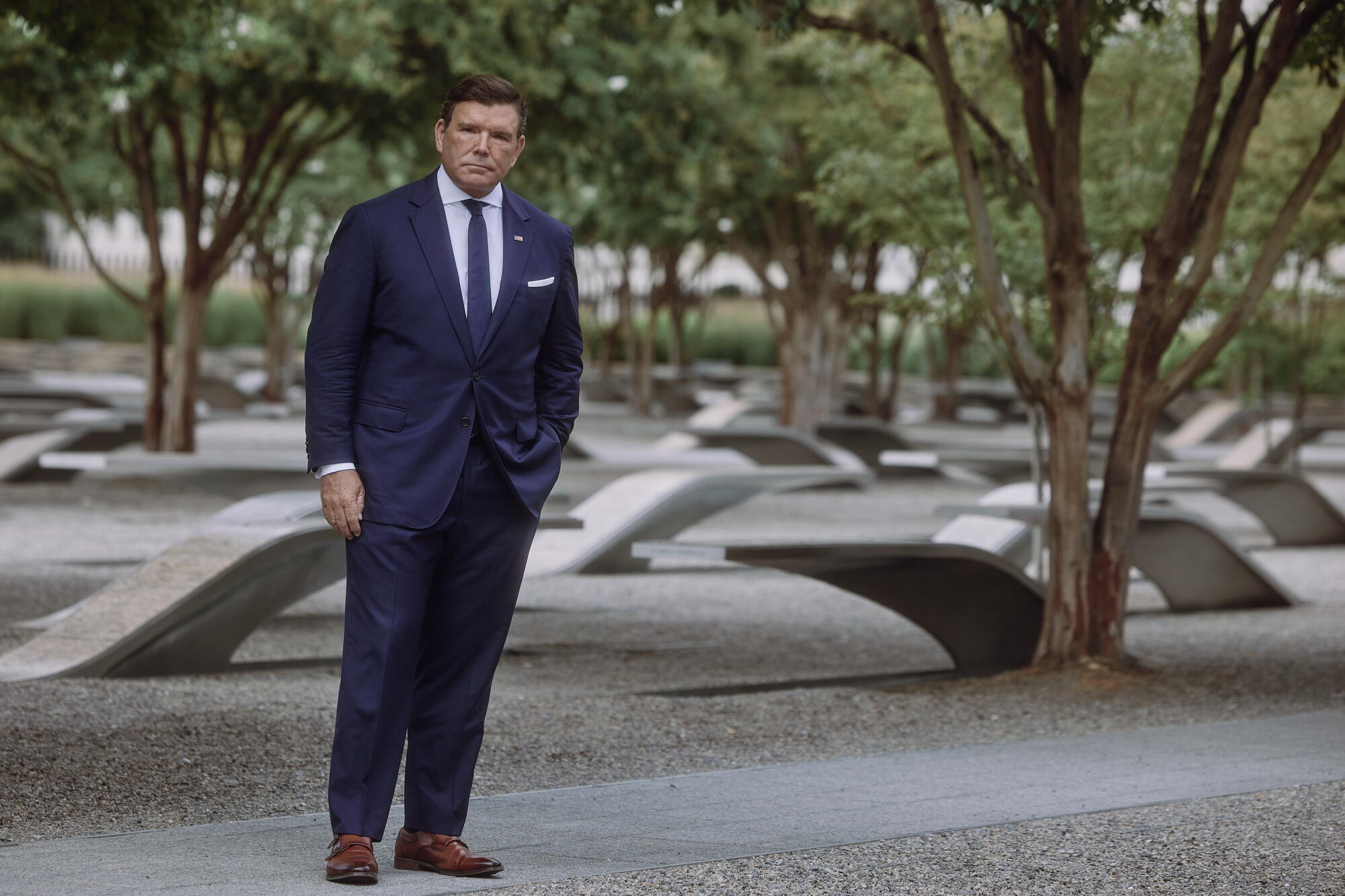
Fox News anchor Bret Baier at the National 9/11 Pentagon Memorial in Arlington, Va., on Aug. 25, 2026.
(Jared Soares/For The Times)
On every anniversary of Sept. 11, Fox News anchor Bret Baier uses the hashtag #NeverForget. He can recall every moment of that day.
Baier, 56, was driving to the Fox News bureau in Atlanta when he first heard on his car radio that a plane had hit the World Trade Center. He was a 31-year-old correspondent for the network, covering stories throughout the southeast U.S. and Latin America. When he arrived at the office, a call came from New York headquarters telling him to book a flight to the city so he could file reports from the World Trade Center site for Fox TV affiliates around the United States.
After a second plane hit the south tower of the World Trade Center 17 minutes later, all flights in the U.S. were halted. Baier and his producer were told to get a car and start driving.
“I just remember going really fast when I was driving,” Baier said. “I remember thinking what is happening with the world, and how big this story is. How big this moment is.”
By the time the duo reached northern Georgia, their plans changed again. A jetliner struck the Pentagon while a San Francisco-bound United Airlines flight crashed in Shanksville, Pa. Fox News executives told Baier and his producer to reroute to Arlington, Va.
After the 10-hour drive, Baier started the first of 10 straight days of reporting on the recovery efforts at the site. While the World Trade Center provided the most dramatic and enduring pictures of the stunning attack, the loss of life at the Pentagon was staggering as well, as 125 people died along with the 64 passengers and crew members on American Airlines Flight 77.
Baier was eventually pulled into the larger military story that followed 9/11. Fox News, just 5 years old, did not have a full-time Pentagon correspondent. Baier was offered the job while traveling overseas with Defense Secretary Donald Rumsfeld, who was making the case for war against Afghanistan.
“I called a buddy on a satellite phone to get me an apartment in Washington,” he said. “Fox packed up my stuff in Atlanta.”
But the unplanned move changed Baier’s life. In six years on the Pentagon beat, he traveled to 74 countries. He was embedded with the military in war zones. “I just said yes to everything,” said Baier, who has anchored Fox News’ Washington newscast “Special Report” since 2009.
Baier recalled it was in the weeks after Sept. 11 that he first wore an American flag pin on his lapel. He never felt conflicted about it, even though such displays were prohibited at other network news divisions. “I thought I could report on America, ask tough questions and still be an American, pulling for us to win,” he said. “I wanted to be tough but fair, but also show that as a country we were standing together against this horrible attack.”
Byron Pitts covering the terrorist attacks in lower Manhattan for CBS News on Sept. 11, 2001.
(CBS)
Byron Pitts: “It’s the only story I think about every day.”
A newcomer to New York 25 years ago, Byron Pitts, then a CBS News correspondent, admitted it took him a few moments to understand the massive scope of what happened the morning of Sept. 11, 2001. He arrived early at the network’s headquarters on the West Side of Manhattan to screen an interview he did with entertainer and civil rights icon Harry Belafonte. Shortly after he started, a producer knocked on his door and told him there was a plane crash at the World Trade Center.
Pitts, 65, acknowledged the producer but kept working. “I thought it was a novice pilot bumping into a building,” he recalled. “I thought it would be three hours out of my day and it won’t make television.”
The producer came back shortly and said, “You need to go down there.”
An irritated Pitts hailed a cab and headed down the West Side Highway. While in the car, he learned a second plane had hit the south tower. Traffic was stopped and he had to head downtown by foot.
As Pitts got closer to the site, he tried to use his past experiences covering fires and other disasters during his career to judge the severity of the situation.
But the horrible scenes that unfolded before him were incomparable. One was a lifeless body near the lobby of the north tower. He thought it was a homeless man until he saw a uniform. He later learned it was Father Mychal Judge, the chaplain of the New York Fire Department killed by fallen debris. Judge’s body was later carried away by a group of first responders. Pitts saw a woman and a man standing at a window of one of the towers holding hands, and then jumping.
“Gravity takes over and their hands split, and he moves a little faster than she does,” Pitts said. “And we see them on the ground. That was the moment I realized something significant was going on.”
Pitts crossed paths with Mika Brzezinski, then a CBS News correspondent, now the cohost of MS NOW’s “Morning Joe.” As debris came down and smoke filled the air, they headed into an elementary school that Pitts believes was a command post for the fire and police departments. They took turns calling into CBS News on a hard-line phone, one delivering accounts of the unfolding catastrophe while the other looked outside to gather details amid the blinding smoke and dust.
Pitts said from that day forward, he never went to a story assignment without a handkerchief.
Pitts was awed not just by the enormity of the event, but also by how despite the rigid hierarchy of CBS News, he was “the new kid on the block” who had to present the story on Dan Rather’s evening newscast that night.
“My approach became almost childlike, so I would not become overwhelmed,” he said. “I tried to make it as simple as possible. I said, ‘Dan, I’ve never heard New York City this quiet.’ I was thinking — what simple thing can I say that you would understand if you’ve never been in New York.”
A few weeks later, Pitts headed off to Afghanistan to cover the U.S. military action. His evening news report on Sept. 11 won an Emmy Award and his star rose at CBS News, leading to “60 Minutes” and then ABC News in 2014, where he is currently a co-anchor of “Nightline.”
Pitts knows the good fortune he’s had in TV journalism is linked to the tragedy that started with a producer’s knock on his door 25 years ago. “I feel some measure of guilt but mostly gratitude,” he said. “It’s the only story I think about every day.”
Pitts said he uses his 9/11 experience to provide perspective. “When we’re discussing politics, a mass shooting, or the latest awful day in Iran, I know for a fact there is one guy in the room who has seen worse and who can say, ‘we’ll be OK,’ ” he said.
Chris Jansing: “You had to balance the news response with the human response.”
Chris Jansing paid her dues as a local reporter in upstate New York before she joined MSNBC (now called MS NOW) as a daytime anchor in 1998. She loved living in Manhattan, and took friends from out of town to the World Trade Center observation decks and Windows on the World, the restaurant on the 106th floor of the north tower.
“It was so iconically New York,” she said. “And I was proud to live in the city.”
Jansing, 69, had little time to process her emotions when she was told to “get in the chair” before 9 a.m. that morning at MSNBC’s Secaucus, N.J., studios after the first plane hit.
“You had to balance the news response with the human response,” she recalled.
For several hours, Jansing co-anchored the network’s coverage alongside Gregg Jarrett. The look of 24-hour cable news evolved that day, as the tsunami of information led to Fox News, MSNBC and CNN all adding running tickers at the bottom of the screen.
Jansing went to the roof of the network’s building after Brian Williams took over the anchor chair. Trauma centers in the area had been alerted, and she was told to watch for ambulances. “There was still a hope and a prayer that there would be injured folks who would overwhelm the hospitals in New York and would need to be brought to New Jersey,” Jansing recalled. She saw none.
Jansing has never watched the coverage of that day, which is now on YouTube. She had real-life reminders every day in her Manhattan neighborhood when she walked by the Rescue Company 1 firehouse that lost half its battalion at the crash site. She adopted a dog left behind by a 9/11 victim, a Dachshund named Baron. She remains friends with every producer she worked with on the story. The experience also reinforced her purpose in a career approaching its 50th year.
“I will always think that those moments are what keep you going,” said Jansing, currently chief political reporter for MS NOW. “They were an affirmation that’s kept me in the job,”
NJ Burkett, a correspondent for WABC, on the 13th floor of the Walt Disney Co. offices in Manhattan on Aug. 31, 2026.
(Roshni Khatri/For The Times)
NJ Burkett: “I put myself in increasingly dangerous situations.”
Burkett, 64, recalls how pedestrians were gathered around WABC’s windowed street level studio on the Upper West Side of Manhattan when he arrived for work on 9/11. He presumed the crowd was there for a big name guest on “Live with Regis and Kelly.” They were actually watching monitors showing news reports of the first plane that hit the north tower.
As Burkett and his cameraman Marty Glembotzky headed downtown in a truck, he already knew it was a terror attack. He recalled covering the 1993 terrorist bombing of the World Trade Center and regretted not getting footage of the firefighters’ rescue efforts. This time around he wanted to go inside the buildings and document their heroism.
A police officer stopped Burkett and Glembotzky before they could get in, likely saving their lives. A short time later, they would escape death again.
Burkett was doing a second take for a taped report that would set the scene for viewers when he heard the rumbling that “sounded like Niagara Falls.” It was the south tower of the World Trade Center coming down behind him. “A huge explosion now raining debris on us — we better get out of the way,” he said in what may be the most terrifying video clip from that morning.
Burkett and Glembotzky took cover in an adjacent building. “We open up the door and in a weird way it’s sort of providential, right?” he said. “The door is a metaphor. It’s like the door into the rest of your life. If we had to run for half a block, we’d be dead.”
Glembotzky was so shaken by the experience, he stepped away from his career as a cameraman and became a wine seller before eventually returning. But Burkett took on more dangerous assignments in the Middle East, heading to Israel to cover the Palestinian uprising known as the Second Intifada. He later headed to Iraq to cover the run-up to the U.S. invasion in 2003.
Burkett won a George Foster Peabody Award for his work on 9/11. In retrospect, he believes he took on assignments in war zones to avoid dealing with the trauma of the day.
“I would put myself into increasingly dangerous situations,” he said. “Looking back, I was running from 9/11. That was my way of coping. Sometimes I wonder did I allow myself feel it enough. Or did I just run too far and too hard and it will all come down and crash on me one day?”
Occasionally he worries about 9/11-related illnesses. “If I start to cough — the slightest little cough — I’ll think ‘is this it?’” he said.
But as a New York TV fixture since 1989, Burkett still feels the appreciation from viewers for his efforts. “To this day, almost 25 years later, people will come up to me on the street and ask to hug me and say ‘NJ Burkett I’m glad you’re alive,’ ” he said.
Carson Daly at NBC’s “Today” show studio at Rockefeller Plaza in Manhattan on Sept. 3, 2026.
(Roshni Khatri/For The Times)
Carson Daly: “I remember how motionless the room was.”
As continuous news coverage of the Sept. 11 attacks saturated television for days, the makers of entertainment shows had to decide when it would be appropriate to go back to work. Carson Daly and the MTV executives mulled over the situation as their wildly popular program “Total Request Live” remained off the air for three days since the attacks.
“We had such a massive audience that the question was raised, ‘do we have a responsibility to simply show up?’ ” Daly, 53, recalled in a recent interview.
Daly, now a feature anchor on NBC’s “Today,” was not a journalist by trade. But he understood the trust that young viewers had in him and “TRL,” a live show that counted down the most popular music videos of the moment. The show had dealt with tragedy a few years before after the high school shooting in Columbine, Colo.
But 9/11 happened on the home turf of “TRL,” which aired from New York City’s Times Square. With the bridges and tunnels closed, getting a crew to the studio was a challenge.
“Everybody wore multiple hats,” said Daly, who also served as an executive producer.
By Sept. 14 of that week, the MTV studio on Broadway was filled with young “TRL” fans, but lacked the energy viewers were used to seeing on the screen. “They were frozen,” Daly recalled. “That was in such stark contrast to what the show was every day. I remember how motionless the room was and feeling like, ‘What am I doing on television?’ ”
Carson Daly shows a tattoo he got after the 9/11 attacks in New York.
(Roshni Khatri/For The Times)
Daly leaned on the MTV News team to update the audience on the 9/11 story developments. Music stars including Jay-Z, Justin Timberlake and Kid Rock called into the program to share their thoughts with Daly. Instead of music videos, the screen showed email messages from viewers expressing their feelings about the tragedy.
MTV News personality Sway delivered a music news report that noted how two new CD releases — “Party Music” by the American hip-hop group The Coup and Dream Theater’s “Live Scenes from New York” — were delayed because both used cover artwork that depicted the destruction of the World Trade Center.
Daly has a permanent remembrance of the week. When he arrived at the MTV offices the day before “TRL” returned, the building was evacuated after it received a bomb threat.
“I remember walking around Hell’s Kitchen,” he said. “I ended up getting a tattoo. A red, white and blue NYC on my right wrist.”
“Obsession,” the indie horror movie written and directed by Curry Barker, has proved to be one of this year’s most successful films. Made for a reported budget of about $750,000, it has earned more than $500 million at the global box office since Focus Features released it in May — the biggest hit in the distributor’s history, according to a new lawsuit.
But one of its producers, Leonora Ann Darby, is claiming she hasn’t received her share of the profit.
Darby, who rose to become one of three producers at Tea Shop Productions, the U.K. company behind the movie, sued Tea Shop, its Delaware affiliate The Tea Shop & Film Company, and co-founders James Harris and Mark Lane in Los Angeles County Superior Court. The 135-page complaint lays out 10 causes of action — among them, breach of contract, retaliation for wage complaints, whistleblower retaliation and unfair competition — and describes a seven-year pattern of “unequal treatment and broken compensation promises.” Darby has demanded a jury trial.
Harris and Lane allegedly treated Darby “as their subordinate, including in a highly demeaning and gendered manner,” and continually refused to compensate her properly, “culminating in ruthlessly cutting Darby out of the overall net profits” for “Obsession,” the lawsuit says.
“Ms. Darby has brought serious and substantial claims, supported by a detailed factual record,” Darby’s lawyer Thomas K. Richards of the Beverly Hills firm Singh, Singh & Trauben, said in a statement. “She is confident in her case and intends to pursue it fully.”
Tea Shop has already rejected the core of her claim. In an Aug. 13 letter attached to the complaint as an exhibit, the company’s lawyer wrote that Darby “was an employee and, subsequently, a consultant” who has never been a member, shareholder or owner of Tea Shop, and therefore has no right to inspect the company’s financial records. The parties’ written agreement, the letter says, does not entitle her to profit participation or collection-account status on “Obsession” or on any other film not previously identified in writing, and she “has been compensated in accordance with the parties’ agreement.” Tea Shop Productions did not respond to a request for comment.
Darby is credited on screen as an executive producer of “Obsession,” rather than as a producer — a decision she says the company made despite Lane’s absence from the production in 2025 and limited involvement with the film. She claims she functioned as a lead producer under Tea Shop’s own internal definition, a distinction at the center of the case, because the profit deal she is suing over applies only to films she lead-produced.
The complaint alleges that she stepped in at a point when the edit had been taken away from Barker and handed to a new editor, leaving the movie “mired in an edit that was not working.” She “provided fundamental and critical creative and structural notes that changed the course of the film,” “advocated heavily” for the edit to be returned to Barker, and recommended the reshoots that followed, according to the suit. She then took on the post-production, credits, clearance and delivery work that got the film finished in time for its Toronto International Film Festival premiere, where Focus bought it for about $16.2 million — well above the $14 million to $15 million that trades were reporting during negotiations.
Once the value of the movie became apparent, the lawsuit alleges, she was iced out. She wasn’t invited to the Los Angeles premiere and was “deliberately” cut out of major trade articles and interviews, the suit says, including a May profile of Harris and Lane that didn’t name her. Her name was added to that piece in August, after she complained.
Darby first started working at the company in 2019, as a development and production executive. In this role, the lawsuit said, she was responsible for originating and developing projects, attaching filmmakers, assembling financing and producing films from preproduction through delivery. She originated and produced movies including “A Banquet,” “Tornado” and “The Surfer,” which stars Nicolas Cage.
In 2024, she and Tea Shop allegedly reached an agreement raising her salary to 100,000 pounds and entitling her to a third of the net profits Tea Shop itself receives on films she lead-produced, “together with direct participation in the applicable collection account management agreements” — the deals that govern how money from a film is divided among its participants.
Tea Shop has allegedly honored that arrangement on other films. On “Obsession,” the complaint says, Darby was paid $300,000 out of the film’s initial minimum guarantee after Tea Shop directed her company, Runt Productions, to invoice for “Services: Obsession.” That payment, the suit argues, was fixed compensation for her producing services — not a settlement, release or buyout, with no writing calling it full and final.
In addition to her share of Tea Shop’s profits on “Obsession,” Darby is seeking a full accounting for several projects as well as unpaid wages, expenses and relief for retaliation.