eyes

Army Eyes Drone Tankers To Refuel Its New MV-75 Cheyenne II Tiltrotors

  • Army considers drone tankers for MV-75A refueling. The U.S. Army is exploring the use of drone tankers like the MQ-25 Stingray to refuel its new MV-75A Cheyenne II tiltrotors mid-flight.
  • MV-75A to replace Black Hawk helicopters. The Army plans to replace a significant portion of its H-60 Black Hawk fleet with the MV-75A, enhancing range and speed capabilities.
  • 160th SOAR to receive refueling-capable MV-75s. The elite Night Stalkers regiment will get a special operations version of the MV-75 with in-flight refueling capabilities.
  • MQ-25 could operate from land bases. Although designed for carriers, the MQ-25’s long endurance makes it suitable for land-based operations, potentially aiding Army refueling needs.
  • Army lacks organic tanker capacity. The Army currently has no in-house tanker capability, making drone tankers a viable solution for its expeditionary operations.

Bottom line: The U.S. Army is exploring the integration of drone tankers like the MQ-25 Stingray to refuel its new MV-75A Cheyenne II tiltrotors, aiming to enhance operational range and flexibility. This move could address the Army’s lack of organic tanker capacity and support its future air assault strategies.

The U.S. Army is considering configuring at least a portion of its new MV-75A Cheyenne II tiltrotors to be able to refuel in flight using the probe-and-drogue method. This, in turn, has raised the question of how the service will ensure there is adequate tanker capacity to support that capability. Army officials and the MV-75A’s prime contractor, Bell, have both now pointed to a future where tanker drones like the U.S. Navy’s forthcoming MQ-25 Stingray could help extend the Cheyenne II’s reach.

Army Maj. Gen. Clair Gill discussed aerial refueling capability for the MV-75A, as well as other aspects of the Cheyenne II, during a talk yesterday at the Army Aviation Association of America’s (AAAA) 2026 Warfighting Summit, at which TWZ is in attendance. Gill is currently the service’s Program Acquisition Executive for Maneuver Air. The Army plans to replace a substantial portion of its H-60 Black Hawk helicopters with the MV-75A in the coming years.

A rendering of a pair of MV-75As without in-flight refueling capability. Bell

“Our last chief used to talk to me all the time about aerial refueling. We think that’s something. Maybe we don’t get all of them [the MV-75As] configured for that, but they’ll have the capability,” the Army’s top aviation acquisition officer added. “For industry, I want you to think about how are we going to refuel ourselves, right? One of the challenges, even the Regiment will tell you, and make it top priority – their challenge isn’t you know how good they are on par, their challenge is getting somebody to give them the gas.”

The “Regiment” that Gill refers to here is the Army’s elite 160th Special Operations Aviation Regiment (SOAR), also commonly known as the Night Stalkers. The 160th is expecting to eventually receive a special operations-specific configuration of the MV-75, which will include in-flight refueling capability by default, as you can read more about here. Existing Night Stalker MH-60M Black Hawk and MH-47G Chinook special operations helicopters also have the ability to refuel in flight via probe-and-drogue. However, Army Black Hawks and Chinooks assigned to conventional units do not have this capability.

A rendering of a special operations configured MV-75 that the Army showed at this week’s AAAA conference. Jamie Hunter

“The Navy’s got some pretty good unmanned ideas there if you want to kind of follow where we’re going,” Gill noted yesterday.

Gill did not specifically name Boeing’s MQ-25, but this is the only uncrewed tanker the Navy is currently pursuing, at least that we know about. Furthermore, Bell released a new computer-generated MV-75 promotional video yesterday around the AAAA conference, seen below, wherein a Cheyenne II is clearly depicted linking up with a Stingray, or an extremely similar-looking variant or derivative thereof.

Meet the Cheyenne II thumbnail

Meet the Cheyenne II


A screen capture from the video above showing an in-flight refueling-capable MV-75A linking up with an MQ-25, or a variant or derivative thereof. Bell capture

The MQ-25 is in development now primarily as a carrier-based platform, but there is no reason why it could not also operate from bases on land. Boeing has itself previously presented a concept for an enlarged, land-based derivative of the design that could help meet future U.S. Air Force tanking needs.

A rendering of an enlarged, land-based derivative of the MQ-25 refueling from a KC-46 Pegasus tanker. MQ-28 Ghost Bat drones are also shown flying alongside. Boeing

The MQ-25 by itself promised to offer very long endurance and extreme range, which could make it attractive in the land-based role, as well as when operating from carriers. TWZ has previously explored how those capabilities open the door to the Stingray being utilized as much more than a tanker, as well.

A demonstrator drone, known as the T1, used in the development of the MQ-25 refuels an F-35C Joint Strike Fighter during a test. USN

Currently, the U.S. Air Force provides probe-and-drogue aerial refueling capacity using KC-135 and KC-46 tankers, as well as HC-130J Combat King II combat search and rescue aircraft and MC-130J Commando II special operations tanker/transports. The U.S. Marine Corps and Navy also have C-130 variants that can be employed as tankers, as well as transports. Navy carrier air wings currently rely on F/A-18F Super Hornet fighters carrying buddy refueling stores and drop tanks to provide organic aerial refueling support.

A US Marine Corps KC-130J tanker/transport prefers to refuel an MV-22 Osprey tiltrotor. USMC

Shortfalls in aerial refueling capacity, even to meet peacetime demands, have been an increasingly concerning issue for years now. The Air Force just recently developed a system that allows A-10 Warthog attack jets to refuel via probe-and-drogue to create new operational flexibility for those aircraft, as you can read more about here. The A-10 was originally designed to refuel in flight using the boom method, which the Air Force prefers for fixed-wing aircraft.

On top of all this, the Army has no organic tanker capacity at present, at all. Furthermore, the formal division of roles and missions with the Air Force means that the service does not operate fleets of larger fixed-wing aircraft like the C-130 that could be readily adapted to this role. All of this would point to an uncrewed platform like MQ-25 as the most viable path to establishing an Army tanker force, which could also align better with its expeditionary air assault concepts of operations.

Army MV-75As could still make use of other tankers during joint operations, as well. There could be other organic air refueling options available to the service, too, including the possibility of adapting MV-75 itself to act as a buddy tanker.

The Army is separately advancing plans to acquire fleets of uncrewed aircraft capable of performing a variety of missions in close collaboration with the MV-75A and its existing fleets of crewed helicopters.

For the Army, demands for greater range and ability that cover those distances faster were key factors in the decision to acquire the MV-75A in the first place. The service sees these capabilities as particularly critical in the context of any future fight against China across the sprawling expanses of the Pacific.

“MV-75, as I mentioned, that’s our signature system,” Gen. Gill said yesterday. “Unmatched range, unmatched speed, unmatched mission flexibility.”

Another rendering of a pair of MV-75A Cheyenne IIs. Bell

During a separate talk at the AAAA conference yesterday, Army Maj. Gen. David Gardner, head of the 101st Airborne Division, the service’s premier air assault formation, also highlighted a recent training exercise that included Marine Corps MV-22 Osprey tiltrotors. He said that was done specifically “to help our Division understand the operational reach that it will possess with the MV-75 Cheyenne.”

Units within the 101st are set to be the first to receive operational MV-75As, with or without aerial refueling capability. The Army had previously said that fielding would begin next year as part of a major acceleration of the program. However, it has now stepped back from any fixed timeline for the first flight of the Cheyenne, let alone when Bell will begin delivering production examples.

“It’s going to happen when it’s going to happen. So we are moving as fast as we can,” Gen. Gill told TWZ and other outlets ahead of the AAAA conference this week. “If I was king, and I had all the money in the world and all the engineers, and there were no limits, we probably would be able to do it in a matter of months.”

As an aside, integrating aerial refueling capability onto the MV-75A, and working to pair it with tanker drones like MQ-25, could make the Cheyenne II, or variants thereof, attractive to other potential operators. The Marine Corps is now early in the process of refining requirements for a successor to the MV-22. The Navy has also said it is leveraging work the Army has done on the MV-75A to inform its plans for a Future Vertical Lift-Maritime Strike (FVL-MS) family of systems to succeed its MH-60R and MH-60S Seahawks, as well as the MQ-8C Fire Scout drone helicopter. Bell has presented concepts for variations of its V-280 Valor tiltrotor, on which the MV-75A is based, optimized for supporting amphibious assault and other naval missions in the past.

A rendering of Bell previously released showing a navalized V-280 variant. A V-247 Vigilant tiltrotor drone is also seen in the background. Bell

As it stands now, the Army does not appear to have made a final decision on the extent to which it expects to integrate in-flight refueling capability in its future MV-75A fleet. That will have a direct impact on any pursuit of an organic tanker capability.

Still, the Army and Bell are already pointing to the MQ-25 as an example of what could be on the horizon to help further extend the reach of the Cheyenne II.

UPDATE: 5:08 PM EDT –

Maj. Gen. Clair Gill has now offered some additional comments on aerial refueling support for the MV-75A to TWZ and other outlets at a roundtable today on the sidelines of the AAAA conference.

“We’re also thinking creatively about if we put aerial refueling – which you’re gonna see on the SOCOM [U.S. Special Operations Command] variants – if we put that on a conventional variant, then how do we refuel it?” he explained. “So we’re thinking through, do we need to develop a requirement for aerial refueling for ourselves now that we have really enhanced our capability?”

“One of the things that our special operations aviators – one of their most challenging tasks is helicopter aerial refueling. A lot of times people say, you’re telling me the challenge is the training of that, because it’s a pretty hard task,” he added later on in response to a direct follow-up question on this topic from our Jamie Hunter, who also called attention to what was seen in Bell’s video. “And I would say yes, but it’s actually the asset, the availability [of the] asset, to do the training. And we don’t have those organic to the Army. So I think we need to solve our own problems, and think about how do we do our own, let’s call it logistical resupply in the air, of an MV-75. So that’s where that concept photo or video was pointing.”

“We don’t have a requirement written right now, but I’ve talked with Army leaders,” Gill also noted.

Contact the author: joe@twz.com

Joseph has been a member of The War Zone team since early 2017. Prior to that, he was an Associate Editor at War Is Boring, and his byline has appeared in other publications, including Small Arms Review, Small Arms Defense Journal, Reuters, We Are the Mighty, and Task & Purpose.


Source link

Turkiye’s Roketsan eyes top 10 exporter rank amid Middle East conflict | Business and Economy News

Modern warfare has dramatically changed as we have seen from the Russia-Ukraine war, conflicts involving Gaza, India and Pakistan, and the recent US-Israeli strikes on Iran. At the centre of this shift is a surging global reliance on drone and missile technology as well as advanced air defence systems.

Turkiye, one of the largest military powers in the Middle East, is increasingly positioning itself as a major supplier in the global defence sector. Central to this effort is Roketsan, a company founded in 1988 to supply the Turkish Armed Forces, which has since evolved into the country’s primary manufacturer of missile and rocket systems.

Recommended Stories

list of 3 itemsend of list

Currently exporting to approximately 50 countries, the firm is one of the fastest-growing defence companies globally.

So how did Roketsan secure a large share of the global arms trade?

Bypassing Western embargoes

Turkiye’s defence expansion was largely accelerated by restrictions placed upon it. Western embargoes aimed at halting its military advancement meant Ankara could not acquire the necessary technical systems or components.

In 2020, the United States imposed Countering America’s Adversaries Through Sanctions Act (CAATSA) restrictions on Turkiye – a key member of the transatlantic military alliance NATO. These sanctions targeted Turkiye’s military procurement agency, its chief Ismail Demir, and three other senior officials. Washington also ejected Ankara from the F-35 stealth jet programme in July 2019.

The measures came after Ankara purchased Russia’s S-400 missile defence system, which was seen as a potential threat to NATO security. The European Union also prepared limited sanctions and discussed restricting arms exports following energy exploration disputes in the Eastern Mediterranean.

To circumvent this, the country built an integrated, domestic defence ecosystem. Today, Turkiye relies on a vast supply chain of nearly 4,000 small and medium-sized enterprises (SMEs) scattered across the country. As a result, the Turkish defence industry now operates with a local production rate exceeding 90 percent.

Türkiye's defense industry now operates with a local production rate exceeding 90 percent, bypassing long-standing Western embargoes. [Al Jazeera]
Türkiye’s defence industry now operates with a local production rate exceeding 90 percent, bypassing long-standing Western embargoes [Al Jazeera]

This shift has yielded significant financial returns for Ankara. In 2025, Turkiye’s defence industry reported $10bn in exports. Roketsan’s General Manager Murat Ikinci told Al Jazeera that the company currently ranks 71st among global defence firms, with ambitions to break into the top 50, then the top 20, and ultimately the top 10.

To support this expansion, Turkish President Recep Tayyip Erdogan inaugurated several large-scale facilities last week, including:

  • Europe’s largest warhead facility.
  • new research and development (R&D) centre housing 1,000 engineers.
  • the “Kirikkale” facility dedicated to rocket fuel technology.
  • new infrastructure for the mass production of ballistic and cruise missiles.

These projects represent a $1bn investment, with the company planning to inject an additional $2bn to expand mass production capabilities.

The ‘Tayfun’ and modern warfare

Roketsan’s R&D strategy – which employs 3,200 engineers and makes the company the third-largest R&D institution in Turkiye – is heavily influenced by data gathered from ongoing global conflicts.

According to Ikinci, the war in Ukraine highlighted the impact of cheap, first-person view (FPV) and kamikaze drones supported by artificial intelligence. In response, Roketsan developed air defence systems like “ALKA” and “BURC,” alongside the “CIRIT” laser-guided missile.

The regional landscape was further complicated during the US-Israel war on Iran, as cheap Iranian-designed Shahed drones – recently upgraded by Russia with “Kometa-B” anti-jamming modules – overwhelmed defences and even struck a British base in Cyprus in March 2026. During the same month, NATO air defences were forced to intercept three Iranian ballistic missiles that entered Turkish airspace.

Meanwhile, the recent conflict between Israel and Iran showcased the use of complex attacks combining ballistic missiles with “swarms” of kamikaze drones designed to overwhelm air defences. This environment makes hypersonic technology a critical asset.

This brings the Tayfun (Typhoon) project into focus. Tayfun is a developing family of long-range ballistic missiles. Its most advanced iteration, the Tayfun Block 4, is a hypersonic missile engineered to penetrate advanced air defence systems by travelling at extreme speeds.

When Al Jazeera asked for specific details regarding the Tayfun’s exact operational range, Ikinci was elusive. “We avoid mentioning its range; we just say its range is sufficient,” he noted.

Similarly, historical Western sanctions have pushed Turkiye to form new cooperation initiatives, effectively accelerating an “Eastern shift” away from Western defence dependence. Turkish drones are now being used by a growing number of countries, including by Pakistan during its war against India last May.

Based on these threat assessments, Roketsan has prioritised five key areas of production:

  1. long-range ballistic and cruise missiles.
  2. air defence systems, including the “Steel Dome”, Hisar-A, Hisar-O, and Siper.
  3. submarine-launched cruise missiles, utilising the AKYA system to leverage Turkiye’s large submarine fleet.
  4. smart micro-munitions designed specifically for armed drones.
  5. long-range air-to-air missiles, a need highlighted by the brief India-Pakistan skirmish.

A strategic export model

Unlike traditional arms procurement, Turkiye is marketing its defence industry to international buyers as a strategic partnership.

“Our offer to our partners… is as follows: Let’s produce together, let’s develop technology together,” Ikinci stated.

İkinci emphasizes that Roketsan's international strategy is based on "partnership models" rather than simple sales. [Al Jazeera]
Rokestan’s General Manager Murat İkinci, right, emphasises that Roketsan’s international strategy is based on ‘partnership models’ rather than simple sales [Al Jazeera]


By establishing joint facilities and R&D centres in allied nations across the Middle East, the Far East, and Europe, Turkiye is attempting to secure long-term geopolitical alliances rather than purely transactional sales. Ikinci highlighted Qatar as a prime example of this model, describing it as a benchmark for technological, military, and security cooperation in the region.

Filling the global stockpile gap

This rapid expansion comes at a critical time for the global arms trade. Ongoing wars have severely depleted the stockpiles of advanced weapon systems worldwide.

During the recent US-Israel war on Iran, Washington relied heavily on multimillion-dollar Patriot and Terminal High Altitude Area Defense (THAAD) systems to intercept cheap Iranian drones targeting US assets across Qatar, Kuwait, Bahrain, Saudi Arabia, and the United Arab Emirates. With growing concerns that US interceptor supplies could run low, Gulf states – which have collectively detected over 1,000 drones in their airspace – are actively seeking alternative defence technologies, creating a highly lucrative opening for Turkiye’s missile industry.

Defence analyses indicate that even military superpowers like the US will require significant time to replenish their current air defence inventories due to the complexity and massive infrastructure required to build them.

Turkish defence officials view this shortage as a strategic opening. Having localised its supply chain, Turkiye claims it can manufacture and export these highly sought-after complex systems independently.

As global demand for air defence and ballistic technologies rises, Roketsan is aggressively reinvesting its revenues into production infrastructure to expand its footprint in the international arms market.

Source link

Venezuela: Trump Administration Issues Banking Licenses as Rodríguez Eyes ‘Long-Term’ US Energy Ties

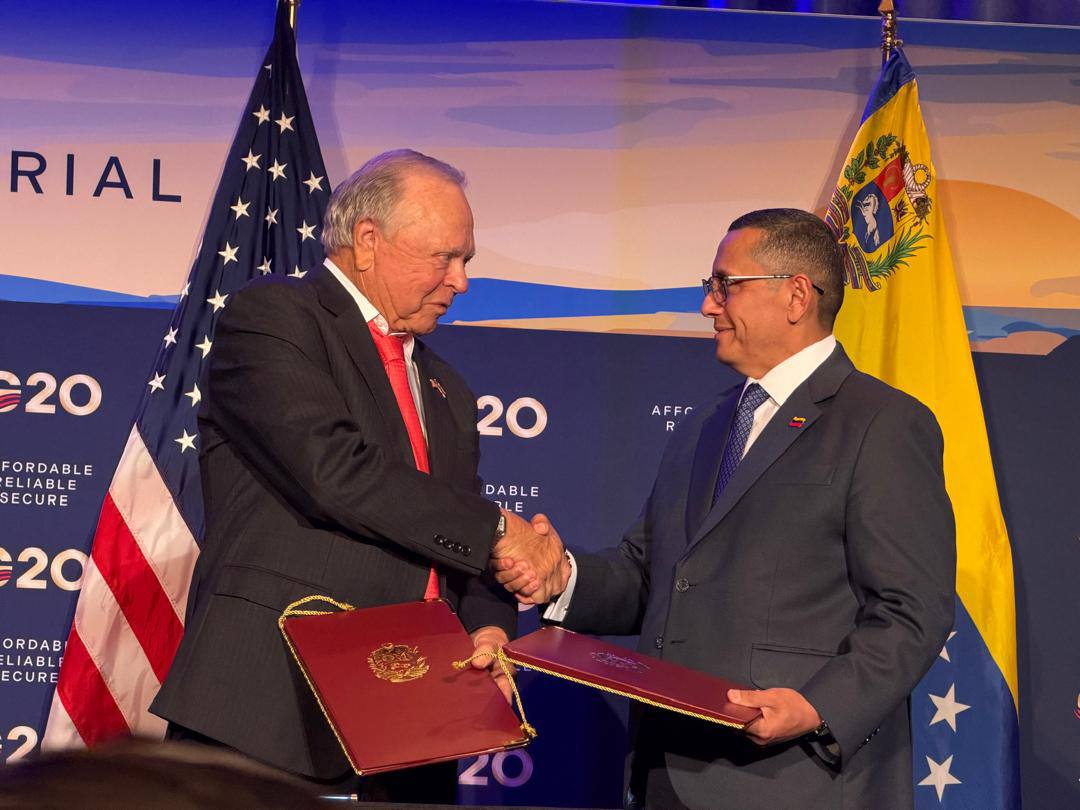
Rodríguez hosted US Energy Assistant Secretary Kyle Haustveit at Miraflores Palace. (Presidential Press)

Caracas, April 15, 2026 (venezuelanalysis.com) – The US Treasury Department’s Office of Foreign Assets Control (OFAC) issued two new general licenses on Tuesday facilitating transactions with Venezuelan state institutions.

 for Venezuela on Tuesday: a commercial license (No. 56) and a financial license (No. 57), signaling a partial easing of restrictions while maintaining key controls.

General License 56 (GL56) authorizes US entities to negotiate and sign “contingent contracts” for future commercial operations in Venezuela. This allows firms to move forward with agreements, investments, or projects, though their final execution remains subject to separate OFAC approval.

The waiver maintains important restrictions, including a ban on payments in gold or cryptocurrencies, as well as prohibitions on transactions involving China, Russia, Iran, North Korea, and Cuba. It likewise forbids transactions involving Venezuelan debt and does not unblock currently frozen Venezuelan assets.

For its part, General License 57 (GL57) permits a broad range of financial operations with the Venezuelan Central Bank (BCV), as well as Venezuela’s public banks: Banco de Venezuela, Banco Digital de los Trabajadores, Banco del Tesoro, and entities in which these institutions hold a 50 percent or greater stake.

The allowed transactions include opening and managing accounts, conducting US dollar transfers, issuing loans, and providing banking services. The BCV was sanctioned in April 2019, effectively isolating Venezuela from international financial circuits and increasing costs for basic transactions.

The latest sanctions waivers are expected to facilitate financial flows to the Venezuelan economy, including the transfer of Venezuelan oil revenues that are currently controlled by the Trump administration. US authorities have returned a confirmed US $500 million out of an initial deal estimated at $2 billion, while US and Venezuelan officials have confirmed the purchase of US-manufactured medicines and hospital equipment using Venezuelan funds.

Analyst Hermes Pérez warned that reincorporation into the SWIFT system and establishment of US-based accounts could take several months due to security and technological requirements. Other economists argued that GL57 could allow the Central Bank to stabilize the Venezuelan foreign exchange system.

For several years, a parallel exchange rate between the US dollar and the Venezuelan bolívar has coexisted with the official one set by the Central Bank, often with a gap above 50 percent that fueled distortions in retail activities and currency speculation.

Since the January 3 military strikes and kidnapping of Venezuelan President Nicolás Maduro, the Trump administration has issued several licenses to expand US influence in the Caribbean nation, particularly in key economic sectors such as hydrocarbons and mining.

In parallel, Venezuelan authorities have promoted several pro-business reforms, while multiple Trump officials and corporate executives have come the South American country and held meetings with the acting government led by Delcy Rodríguez.

The latest waivers coincided with the visit to Caracas of a US Department of Energy delegation led by Assistant Secretary Kyle Haustveit. Rodríguez hosted the official on Wednesday in a work meeting at the presidential palace.

During a short, televised intervention, Rodríguez argued that OFAC licenses do not provide sufficient “legal certainty” and reiterated calls for Trump to lift unilateral coercive measures against the country.

“An investor requires greater legal certainty. A license does not provide long-term legal guarantees because it is subject to temporality,” she argued. Rodríguez claimed Washington and Caracas have “enough maturity” to establish “long-term” energy cooperation ties.

“We are working very hard on changes that can attract investment, and which can build an energy cooperation agenda with the United States,” she said.

Rodríguez additionally disclosed recent meetings with representatives from ExxonMobil and ConocoPhillips, stating that authorities have “taken into account recommendations” from oil majors in recent legislative overhauls. Both ExxonMobil and ConocoPhillips refused to accept hydrocarbon reforms under former President Hugo Chávez in the 2000s, later securing multi-billion-dollar arbitration awards against the Caracas as compensation for the nationalization of their assets.

Haustveit and the Energy Department delegation were also present on Monday during the signing of agreements with Chevron that granted the Texas-based conglomerate an increased stake in the Petroindependencia joint venture and awarded an additional extra-heavy crude bloc for exploration to the Petropiar mixed company. Chevron owns minority stakes in both joint enterprises with Venezuelan state oil company PDVSA.

Shell, Eni and Repsol are among the other energy giants to have recently advanced in deals with the Venezuelan government under the improved conditions of the new Hydrocarbon Law.

US Chargé d’Affaires in Venezuela Laura Dogu was also present at the Chevron deal-signing ceremony and the meeting with Haustveit’s delegation. However, the White House announced Wednesday that her post will be taken over by veteran diplomat John Barrett.

Barrett, who previously served as chargé d’affaires at the US Embassy in Guatemala since January 21, 2026, was recently accused by Guatemalan President Bernardo Arévalo of interference during judicial elections for the Constitutional Court held in March.

Edited by Ricardo Vaz in Caracas.

Source link

Falkirk: Boss John McGlynn eyes Scottish Cup final pinnacle

Manager John McGlynn says leading Falkirk out at a Scottish Cup final would represent the “pinnacle” of his career as the club prepare for a crucial last-four tie against Dunfermline Athletic this weekend.

The Scottish Premiership side face Neil Lennon’s men at Hampden on Saturday at 12:30 BST – live on the BBC – with a place in May’s showpiece at stake.

McGlynn has already led Falkirk to a top-six finish in the Premiership this term after securing back-to-back promotions from the third tier of Scottish football.

However, the 64-year-old is determined to cap a stunning season with the first major silverware of his managerial career.

“It would be a great honour to take the team out in a Scottish Cup final,” McGlynn told BBC Scotland. “For myself, [assistant coaches] Paul Smith and Steven McGinn, and all the backroom staff, it would reflect all the work that’s been put in.

“To take the team into the Premiership, be in a strong position and reach a Scottish Cup final – that would be the pinnacle of our careers.

“We know we’ll have to work extremely hard to get there and maybe need a bit of luck along the way, but walking out at Hampden for a final would be a very proud moment.

“We can’t look beyond Dunfermline. If we get through, then anything can happen.”

Source link

Pakistan eyes narrow window to resuscitate US-Iran talks after breakdown | US-Israel war on Iran News

Islamabad, Pakistan – More than 12 hours of face-to-face negotiations between the United States and Iran ended without agreement in Islamabad on Sunday, leaving a fragile two-week ceasefire as the only barrier between diplomacy and a return to war.

Pakistan, which spent weeks positioning itself as a mediator and succeeded in bringing both sides into the same room, emerged with its role intact. But officials acknowledge the harder phase now begins — getting American and Iranian negotiators back into talks before their differences explode into full-fledged war again.

Recommended Stories

list of 4 itemsend of list

“Pakistan has been and will continue to play its role to facilitate engagements and dialogue between the Islamic Republic of Iran and the United States of America in the days to come,” Pakistan’s Deputy Prime Minister and Foreign Minister Ishaq Dar said in a statement after the conclusion of the talks.

The talks, the highest-level direct engagement between Washington and Tehran since the 1979 Islamic Revolution, faltered over differences surrounding Iran’s nuclear programme.

“The simple fact is that we need to see an affirmative commitment that they will not seek a nuclear weapon, and they will not seek the tools that would enable them to quickly achieve a nuclear weapon,” said US Vice President JD Vance, who led the American delegation alongside special envoy Steve Witkoff and US President Donald Trump’s son-in-law Jared Kushner.

However, Vance left a narrow opening for the resumption of talks.

“We leave here with a very simple proposal, a method of understanding that is our final and best offer. We’ll see if the Iranians accept it,” Vance said, tapping the podium for emphasis, before ending his brief remarks, which lasted for less than five minutes.

Pakistani and Iranian sources confirmed that the Iranian delegation met senior Pakistani officials later on Sunday before departing for Tehran, though details of those discussions remain unclear.

What is clear is that Pakistan isn’t giving up yet.

Washington’s red lines

US officials said that Iran had entered negotiations misreading its leverage, believing it held advantages that, in Washington’s assessment, it did not.

.
US Vice President JD Vance speaks during a news conference after meeting with representatives from Pakistan and Iran, on Sunday, April 12, 2026, in Islamabad, Pakistan [Jacquelyn Martin/Pool via Reuters]

According to these officials, Vance spent much of his time during the talks correcting what they described as Iranian misperceptions about the US position — asserting that no deal would be possible without a full commitment on the nuclear issue.

Officials also suggested that Trump’s subsequent announcement of a blockade in the Strait of Hormuz was not an impulsive reaction, but a pre-planned step aimed at removing the waterway as an Iranian bargaining tool and forcing the nuclear issue back to the centre of any future talks.

But the US officials, speaking on background, also acknowledged that the gulf in the positions between Washington and Tehran that they failed to bridge extended to issues beyond Iran’s nuclear programme.

In essence, they said, the two sides failed to agree on six key points: ending all uranium enrichment; dismantling major enrichment facilities; removing Iran’s stockpile of highly enriched uranium; accepting a broader regional security framework involving US allies; ending funding for groups Washington designates as “terrorist” organisations, including Hamas, Hezbollah and the Houthis; and fully reopening the Strait of Hormuz without tolls.

Hours after the talks ended, Trump acknowledged partial progress, but underscored the central impasse.

“The meeting went well, most points were agreed to, but the only point that really mattered, NUCLEAR, was not,” he wrote on Truth Social.

“Effective immediately, the United States Navy, the Finest in the World, will begin the process of BLOCKADING any and all Ships trying to enter, or leave, the Strait of Hormuz,” Trump said. “Iran will not be allowed to profit off this Illegal Act of EXTORTION.”

Iran has effectively controlled access to the Strait of Hormuz, through which roughly 20 percent of global oil supplies pass, since the US-Israeli attacks began on February 28.

Iran’s Islamic Revolutionary Guard Corps (IRGC) has imposed what analysts describe as a de facto toll system, requiring vessels to secure clearance codes and transit under escort through a controlled corridor.

The disruption has pushed oil prices above $100 per barrel at times, unsettling global markets and placing sustained pressure on energy-importing countries across Asia and Europe.

Tehran has framed its control of the strait as both a security measure and a key negotiating lever, one it has shown little willingness to relinquish without a broader settlement.

Tehran’s point of view

Iran’s account of the breakdown differed sharply.

In a post on X early on April 13, after returning to Tehran, Iran’s Foreign Minister Abbas Araghchi said his country had engaged in “good faith”, only to face shifting demands.

Pakistani Prime Minister Shehbaz Sharif meets with Iranian Parliament Speaker Mohammad Bagher Ghalibaf, as delegations from the United States and Iran are expected to hold peace talks, in Islamabad, Pakistan, April 11, 2026. Pakistan's Prime Minister Office/Handout via REUTERS THIS IMAGE HAS BEEN SUPPLIED BY A THIRD PARTY. BEST QUALITY AVAILABLE. REFILE - ADDING NATIONALITY 'PAKISTANI PRIME MINISTER SHEHBAZ SHARIF'.
Iranian Parliament Speaker Mohammad Bagher Ghalibaf, left, meets with Pakistani Prime Minister Shehbaz Sharif, right, in Islamabad on April 11, 2026 [Handout/Prime Minister’s Office via Reuters]

“When just inches away from an Islamabad MoU, we encountered maximalism, shifting goalposts, and blockade,” he wrote. “Zero lessons learned. Good will begets good will. Enmity begets enmity.”

The reference to an “Islamabad MoU”, a memorandum of understanding, was the clearest public signal yet that the two sides had come closer to a formal agreement than either government had previously acknowledged.

Iran’s Parliament Speaker Mohammad Bagher Ghalibaf, who led the country’s delegation, said his team had proposed “forward-looking initiatives”, but failed to secure trust.

“Due to the experiences of the two previous wars, we have no trust in the opposing side,” he wrote on Sunday.

Foreign Ministry spokesperson Esmaeil Baghaei also pointed to partial progress but unresolved differences.

“On some issues we actually reached mutual understanding, but there was a gap over two or three important issues and ultimately the talks didn’t result in an agreement,” he said.

Tehran’s key demands, including an end to Israeli strikes on Lebanon, the release of $6bn in frozen assets, guarantees on its nuclear programme and the right to charge vessels transiting the Strait of Hormuz, remained unmet.

Iran’s ambassador to Pakistan, Reza Amiri Moghadam, however, offered a more measured view — suggesting that Tehran was not closing the window on talks.

“The Islamabad Talks is not an event but a process,” he wrote in his message on X on Sunday. “The Islamabad Talks laid the foundation for a diplomatic process that, if trust and will are strengthened, can create a sustainable framework for the interests of all parties.”

Pakistan’s balancing act

For Pakistan, analysts say, the outcome represents a setback but not a failure.

Officials were careful to describe the talks as “an important opening step in a continuing diplomatic process”, stressing that issues of such complexity cannot be resolved in a single round.

The emphasis, they said, was on keeping the channel open.

Muhammad Obaidullah, a former Pakistan Navy commodore who has served in Iran as a diplomat, said expectations of a breakthrough were always unrealistic.

“The mere fact of bringing both parties face to face is a significant diplomatic achievement in itself,” he told Al Jazeera. “The diplomacy is not dead.”

Ishtiaq Ahmad, professor emeritus of international relations at Quaid-i-Azam University in Islamabad, went further.

“The talks did not collapse; they concluded without agreement but with a defined US offer on the table and the channel still intact,” he said.

“Pakistan’s role was to move the crisis from escalation to structured engagement, which it achieved. The absence of convergence reflects structural differences between the US and Iran, not a failure of mediation.”

Both Trump and Iranian officials have praised Pakistan’s Prime Minister Shehbaz Sharif and Chief of Army Staff Field Marshal Asim Munir for their efforts to secure the ceasefire, and for hosting the talks in Islamabad. That, say analysts, suggests that they remain open to further Pakistan-brokered negotiations.

Sahar Baloch, a Germany-based scholar of Iran, said that trust remains Pakistan’s most valuable asset.

“The real test of credibility is not preventing breakdowns, but remaining relevant after them,” she said.

U.S.-Iran peace talks in Islamabad
A man walks past a billboard announcing peace negotiations as delegations from the United States and Iran hold high-level talks in Islamabad, Pakistan, April 11, 2026 [Asim Hafeez/Reuters]

Fragile ceasefire

The immediate threat to Pakistan’s role comes from the evolving situation in the Strait of Hormuz and in Lebanon.

Iran has already warned that continued Israeli strikes on Lebanon could render negotiations meaningless. Iran’s President Masoud Pezeshkian has framed such attacks as a direct challenge to the ceasefire.

Trump’s blockade announcement now adds pressure from a second front.

Ahmad, a former Pakistan chair at Oxford University, warned that a collapse of the truce would sharply narrow diplomatic options.

“If the ceasefire collapses, the immediate consequence is the loss of the diplomatic window,” he said. “A second round becomes far more difficult because both sides would return to negotiating under active escalation, where positions tend to harden rather than converge.”

Obaidullah drew a historical parallel with the US naval quarantine of Cuba during the 1962 missile crisis. What if China were to use its own ships to import Iranian oil? Would the US attack them?

“The world will again be watching who blinks first,” Obaidullah said. “However, it may turn into a far greater conflict if neither side does.”

The Cuban Missile Crisis of October 1962 brought the US and the Soviet Union to the brink of nuclear war, after Washington discovered Moscow had installed nuclear missiles on Cuban soil, within striking distance of the American mainland.

The US blocked the Soviets from providing more equipment to Cuba, and eventually, a diplomatic settlement was reached, with the Soviets agreeing to withdraw the missiles in exchange for a US pledge not to invade Cuba.

Baloch, the Berlin-based scholar, agreed that the situation remains volatile.

“The ceasefire risks becoming more symbolic than substantive,” she said. “But paradoxically, escalation can sometimes force a return to talks, even if under more urgent and less favourable conditions.”

What is the road ahead?

Pakistan’s room for manoeuvring is also shaped by its economic fragility.

The disruption in the Strait of Hormuz has driven up energy prices, compounding pressures on an economy already under strain before the conflict.

Ahmad said this creates both urgency and limits.

“Economic exposure, especially to energy shocks and external financing, creates urgency for Pakistan to prevent a prolonged conflict,” he said.

“But it also reinforces a constraint: Pakistan cannot afford escalation with either side. Its leverage is not coercive; it is positional. It comes from being the only channel acceptable to both sides, not from the ability to impose outcomes,” Ahmad said.

Eight days remain until the end of the initial two-week truce, a window Pakistani officials said privately represents a genuine opportunity for further technical and political alignment, if both sides choose to use it.

Ahmad suggested that any breakthrough would depend on creating a sequence of steps acceptable to both sides.

“The US is asking for early nuclear commitments; Iran is asking for guarantees and relief first,” he said.

Pakistan’s role, he added, would be to help “structure this sequencing, keep both sides engaged, and prevent breakdown at each stage”.

Islamabad won’t be the one drafting a deal itself, he emphasised, noting, “At this point, maintaining the channel is as important as the substance of the deal itself.”

Source link

Huntington Beach’s MAGA revolution sets its eyes on Sacramento

Michael Gates is basing his run for California attorney general on his decade-long reign as Huntington Beach’s top lawman.

When we met at a Starbucks a block away from City Hall, he rattled off his hometown’s bona fides: A drop in crime and homelessness. Tourists from across the world. A thriving Main Street. A small-town feel “almost like the Midwest.”

His biggest obstacle in trying to convince voters that he should replace Rob Bonta, besides his Republican Party membership? Um, Huntington Beach.

For years, Surf City conservatives like Gates have reveled in playing the burr in the saddle of deep blue California. From a torrent of lawsuits against Gov. Gavin Newsom’s administration to protests against COVID restrictions to the City Council’s vote to place a plaque outside the public library spelling out “MAGA,” Huntington Beach’s GOP leadership has yet to meet an anti-liberal stunt they didn’t characterize as a stance against tyranny worthy of Bunker Hill.

Their antics made Huntington Beach a national laughingstock — but Gates and his pals so far have had the last giggle.

They ran as a slate in two elections that transformed the City Council from a narrow Democratic majority in 2022 to an all-Republican body in an era when Orange County is turning more and more purple. The takeover became a sensation among California conservatives looking for victories in a state where Democrats maintain a supermajority in both legislative chambers and have held every statewide office for 15 years.

“We’ve morphed into this epicenter of fighting back,” said Mayor Casey McKeon, a third-generation Huntington Beach resident who’s up for reelection this year. “We are the model every city can follow. If I were running for state office, I’d run it on that.”

That’s exactly what the architects of MAGA-by-the-Sea plan to do this November.

In addition to Gates’ bid, gadfly-turned-Councilmember Gracey Van Der Mark is seeking an Assembly seat. Her former council colleague Tony Strickland won his state Senate seat last spring and is the co-author of a proposed state ballot initiative that would require voter ID for all elections. Huntington Beach voters approved a similar initiative in 2024, which was later struck down by the California Supreme Court.

The Huntington Beach red revolution now includes conservative commentator Steve Hilton, who launched his campaign for governor last spring near the city’s world-famous pier — even though he lives in Silicon Valley.

Hilton told me he has long loved Huntington Beach because it reminds him of Brighton, the seaside British town where he grew up. His affection for Surf City deepened the more he talked to people like Gates and Strickland, who sold him on their vision to stick it to Sacramento.

“There’s such a joy about it — it’s a place where it’s well-run and clean and orderly,” said the candidate, who has consistently led in polls as his Democratic opponents cannibalize each other’s share of the vote. “When I was thinking where to launch my campaign, it made sense [in Huntington Beach], because it felt like home.”

Tony Strickland and Gracey Van Der Mark

Then-City Council candidates Tony Strickland, left, and Gracey Van Der Mark attend a “meet and greet” event in Huntington Beach in 2022.

(Allen J. Schaben / Los Angeles Times)

Better not tell anyone in H.B. you’re an immigrant, Steve!

California Republican Party Chairwoman Corrin Rankin is confident the Huntington Beach crew can win.

“What happened there proves that conservative leadership works,” she said. “Currently, we have a former mayor of San Francisco who’s the governor. You look at the contrast of how each of those cities are.”

Strickland, who is Hilton’s campaign chair, swears that he and his former colleagues didn’t plan to take their crusade statewide, but “when you do a great job, other opportunities present themselves.”

“I think California is on the wrong track — most think that,” he added. If his team pulls off a November sweep — governor, attorney general, Assembly seat and the voter ID proposition — “it would be known as the major turnaround in the Golden State that made it golden again.”

Does drinking Surf City’s water grant you magical powers, too?

It’s easy to dismiss what Strickland, Gates and the others have created as a lucky local run that’s about to crash into the reality of running statewide as a Republican. Even in Huntington Beach, residents tired of perpetual culture wars rejected two ballot measures last year seeking to give the City Council more control over a municipal library system that Van Der Mark long claimed was essentially providing pornography to children.

But if there’s one thing I’ve learned while tracking H.B.’s ever-aggrieved conservatives for a quarter century, it’s to never underestimate them — the more you do, the more they fume, the more they scheme. They plan with the discipline of a Dodgers World Series team and brawl like hometown hero and mixed martial arts legend Tito Ortiz, who was on the council for a few months in 2021 before stepping down because he said the job “wasn’t working for me.”

Gates, 51, is so Huntington Beach that he looks it: Bull-necked. Blue-eyed. Bro-y. No-nonsense haircut. An aw-shucks countenance barely hiding a righteous anger that seeks to pile-drive progressive California into submission.

“I know what it looks like to be from a working-class family, a hardworking family, and find it very difficult to make ends meet,” said Gates, noting that his Irish American parents sometimes had to grab food and diapers for their children from the St. Bonaventure Catholic Church pantry. “So frankly, let’s take control away from the government and give control back to the working-class people.”

Fullerton College political science professor Jodi Balma teaches her students about Huntington Beach as an example of how “the power of a slate can really work” in an era of polarization. But when I asked if she thought the Surf City insurgents could upend California politics, the professor quickly said, “No.”

A majority of California voters think the state is heading in the wrong direction, and the number of undecided voters in elections ranging from California governor to the L.A. mayor’s race is putting the fear of God into Democratic leaders. But how deluded can Strickland and company be to think that aligning themselves more with President Trump — who just endorsed Hilton — is a winning strategy in a state where Democrats outnumber Republicans by nearly 2 to 1? And propping up Surf City — a wealthy beach town so full of itself that it makes Santa Monica seem as humble as Santa Ana — as the last, best hope to save California?

Hilton demurred when I asked if he agreed with everything his pals on the City Council have done over the years. “I’m not there, so I don’t see the day-to-day operation,” was his weak salsa reply.

Gates was more forthright.

“I think probably everybody in city leadership would admit the library thing got out of control,” he said. By then, Gates was working for the Department of Justice in Washington as a deputy assistant attorney general in the civil rights division, resigning after just 10 months because he said he missed home.

Someone wrote "Trump Time" on the sand at Huntington City Beach

Sand art at Huntington City Beach in 2020.

(Raul Roa / Los Angeles Times)

Gates talked a good talk for most of our hourlong conversation. He and Hilton are pushing especially hard for Latino voters — they “can save California because they understand that new leadership can turn the state around.”

But for everything Gates said that might appeal to a frustrated Democrat like me, his Huntington Beach braggadocio continually won out.

He alternately hailed his own political astuteness (“You be patient, bide your time, be disciplined, keep your mouth shut. The long game will win.”), brought up transgender issues (“I want to protect our young girls. I want to stop all the mutilation surgeries happening in hospitals to our young people.”) and inveighed against out-of-control Democrats (“[Californians are] abused. And honestly, we’re pissed off. We’re getting really mad.”).

Most of all, Gates proclaimed time and time again just how darn special Huntington Beach is.

“We love our freedoms. We love flying our American flags,” he said. “We love our beach. I don’t know, it’s a different culture here.”

Good luck selling Californians on it.

Source link

Artemis II crew set eyes on parts of the moon humans have never seen before

1 of 3 | A photo of the moon, taken by the crew on day 4 of the Artemis II mission, shows the South Pole at the top and parts of the lunar far side, as well as the Orientale basin on the right edge of the lunar disk. The mission will mark the first time that humans have seen the entire basin. Photo by NASA/UPI

April 5 (UPI) — The four astronauts of the Artemis II mission were woken on Sunday by the sounds “Working Class Heroes (Work)” by CeeLo Green, and they will go to sleep as their spacecraft enters its sphere of gravitational influence.

Day 5 of NASA’s first journey to the moon in more than 50 years remained on course Sunday morning after maneuvering the Orion space capsule in its precise course to ricochet around the far side of the moon before heading back to Earth.

The crew is roughly half-way through its ten-day mission to test the abilities of the Orion space capsule and make direct observations of the far side of the moon, all of which will take them farther from Earth than any human has previously traveled.

The crew’s work for Sunday includes a full sequence of space suit operations and preparations for their approach to the moon, as well as their responsibilities during the five-hour trip around its back side, NASA said.

“We’re going to work!” NASA said in a post on X around 12:30 p.m. EDT on Sunday that the astronauts were hearing the day’s wake-up song, which the agency has been announcing each day of the mission.

In addition to the wake-up song, the astronauts were greeted this “morning” with an audio message from Apollo 16 astronaut Charlie Duke, who in 1972 became the 10th person to walk on the moon at age 36.

“Below you, on the moon, is a photo of my family,” Duke said in the 46-second recording, which the crew posted to X. “I pray it reminds you that we, in America, and all of the world, are cheering you on. Thanks for building on our Apollo legacy with Artemis.”

The suits are designed to protect astronauts during “dynamic” phases of space flight, can keep them alive should the Orion’s cabin depressurize and are designed to provide life support after splashing down in the ocean when they return to Earth.

The demonstration, like many of the other tasks the Artemis II crew is conducting, are meant to inform later Artemis missions to land on the moon and eventually build a human base there.

Although the crew was able to skip two other planned correctional burns on the way to entering the moon’s gravitational influence, an outbound trajectory correction burn is still planned for later today.

The final lunar science targets that the astronauts will be inspecting, photographing and analyzing will be sent from mission control and the crew will prepare to actually enter the moon’s gravity.

NASA’s Space Launch System rocket carrying the Artemis II crew is launched from Complex 39B at Kennedy Space Center in Florida on April 1, 2026. Photo by Joe Marino/UPI | License Photo

Source link

Celine Dion eyes concert return after stiff-person syndrome diagnosis

It’s all coming back to Celine Dion.

The French Canadian singer may be making her return to concert performances this fall, according to Variety. In 2022, Dion canceled her North American tour due to muscle spasms and later revealed that her diagnosis with stiff-person syndrome, an autoimmune neurological disorder, would prevent her from performing.

Montreal newspaper La Presse reported that fans were speculating Dion would return to the stage, after Parisians spotted posters referencing titles of Dion’s songs like “Power of Love” and “Pour Que tu M’aimes Encore” throughout the city. La Presse also reported that Dion will likely perform two concerts a week throughout September and October at the Paris La Défense Arena, a venue that seats 40,000 spectators.

Dion has not headlined her own show since her Courage World Tour in 2020, which was postponed and then canceled due to her health issues. She sang an emotional cover of Édith Piaf’s “Hymne à l’amour” during the closing ceremony of the 2024 Olympics. Last November, she performed her songs “I’m Alive” and “The Power of Love” during the 1001 Seasons of Elie Saab fashion show in Riyadh, Saudi Arabia.

The singer publicized her battle with SPS in her 2024 documentary, “I Am: Celine Dion.” In the film, Dion discussed how she’d been experiencing health issues for 17 years before her diagnosis. SPS affected Dion’s ability to sing by causing a strain on her vocal cords, making her voice sound more nasal.

“Sometimes I would point my microphone towards the audience and I would make them sing it. There’s moments where I cheated and I tapped on the microphone, like it was the microphone’s fault,” Dion explained in her documentary.

Even with her diagnosis, the singer made it clear in her documentary that she intended to continue pursuing her love of music.

“If I can’t run, I’ll walk. If I can’t walk, I’ll crawl, but I won’t stop.”

Dion’s representatives did not immediately respond to a request for comment. La Défense Arena declined to comment.

Source link

U.S. eyes Chile’s dominant global rhenium supply

SANTIAGO, Chile, March 18 (UPI) — The United States is continuing efforts to secure supplies of critical minerals deemed vital to national security. Alongside copper, lithium and silver, one lesser-known metal is drawing increased attention: rhenium.

Used primarily in the aerospace, energy and petrochemical industries, rhenium plays a key role in high-performance applications. Experts say it also holds potential in the global energy transition because it can act as a catalyst in producing green hydrogen.

Chile is the world’s largest rhenium producer, accounting for about 50% of global output. The metal is atomic No. 75 on the Periodic Table of Elements.

Since Friday, Chilean officials have held consultations on critical minerals and rare earth elements with the administration of President Donald Trump, seeking a bilateral agreement to strengthen supply chains and promote strategic investment.

“Chile controls nearly half of a mineral that the United States and China cannot produce in sufficient quantities. Washington reinstated rhenium to its critical minerals list in 2025 and explicitly included it in the bilateral mining agreement with Chile. That makes it a genuine geopolitical asset, not just a mining one,” mining market specialist Víctor Pérez, an engineering professor at Adolfo Ibáñez University, told UPI.

Manuel Reyes, a mining engineering professor at Andrés Bello University, said the United States considers rhenium a national security priority because of its critical role and a lack of substitutes in aerospace and defense.

“Although rhenium does not carry the financial weight of copper or lithium, it functions as a reputational asset that keeps Chile on global strategic radars. More as a necessary logistics partner than as a decision-making power,” he said.

Pérez said Chile’s rhenium exports are expected to range between $100 million and $200 million this year, compared with an estimated $60 billion in copper exports. Still, he said its strategic importance is unique “because it has no real substitute in aerospace and defense applications.”

Chile holds the world’s largest reserves at 1,300 metric tons, followed by the United States with 400 metric tons, Russia with 310 metric tons and Kazakhstan with 190 metric tons, according to Reyes.

Rhenium trades at about $2,000 per kilogram, though prices have climbed in 2026 to roughly $6,000 per kilogram, he said.

About 70% to 80% of global rhenium is used in superalloys for aviation and defense turbines. “It is the metal that allows aircraft engines and military turbines to withstand extreme temperatures without deforming,” Pérez said.

Rhenium is known as a by-product mineral because it is not found alone, but rather extracted from copper-related ores, which makes production complex. Chile’s large-scale copper mining operations enable its recovery, as processing captures gases released during molybdenum concentrate roasting and chemically extracts the metal.

Reyes said Chile remains highly dependent on external demand.

“Reserve management and supply continuity depend on the technical and national security requirements of powers such as the United States, which ultimately drive demand,” he said.

Source link

Ukraine eyes money and tech in return for Middle East drone support | US-Israel war on Iran News

Ukraine’s leader previously said advisers were sent to Qatar, the UAE, and Saudi Arabia to help thwart Iranian drone attacks.

Ukraine wants money and technology as payback after sending specialists to the Middle East to help down Iranian drones during the ongoing Israel-United States war with Iran.

President Volodymyr Zelenskyy told reporters on Sunday that three teams were sent to the region to undertake expert assessments and demonstrate how drone defences work as countries in the Middle East continue to be targeted by Iran over hosting US military bases.

Recommended Stories

list of 4 itemsend of list

“This is not about being involved in operations. We are not at war with Iran,” Zelenskyy said.

Earlier this week, Ukraine’s leader announced military teams were sent to Qatar, the United Arab Emirates, Saudi Arabia, and a US military base in Jordan.

But he explained that more long-term drone deals could be negotiated with Gulf countries, and what Kyiv gets in return for its assistance still needs to be established.

“For us today, both the technology and the funding are important,” Zelenskyy said.

Throughout the four-year Russia-Ukraine war, Moscow has widely used Iranian Shahed-136 “suicide” drones, giving Kyiv expertise in knowing how to down the unmanned aerial vehicles through cheap drone interceptors, electronic jamming tools, and anti-aircraft weaponry.

However, US President Donald Trump has said he does not need Ukraine’s help in taking down Iranian drones attacking American targets.

INTERACTIVE - SHAHED 136 drone

‘Rules must be tightened’

Zelenskyy said he doesn’t know why Washington hasn’t signed a drone agreement with Kyiv, which it has pushed for months.

“I wanted to sign a deal worth about $35bn–50bn,” he said.

Still, as the Russia-Ukraine conflict continues with no end in sight, Zelenskyy raised concerns that the ongoing war in the Middle East will impact Kyiv’s supplies of air defence missiles.

“We would very much not like the United States to step away from the issue of Ukraine because of the Middle East,” he told reporters.

But as interest has grown for Ukrainian drone interceptors in light of the war, Zelenskyy said Kyiv’s rules to buy the drones must be tightened, with foreign countries and firms being unable to bypass the government and talk directly to manufacturers.

“Unfortunately, representatives of certain governments or companies want to bypass the Ukrainian state to purchase specific equipment,” Zelensky told reporters.

“Even in some free countries, we do not initially receive contracts from the private sector. A contract comes to me through the political channel. Only then does the private sector start negotiating with us.”


Source link

Cheltenham Festival 2026: Harry Redknapp eyes Jukebox Man win in Gold Cup

From “sticking a pen in a couple” while having a youthful flutter to owning a King George VI Chase winner and potential Cheltenham Gold Cup victor, Harry Redknapp has come a long way in horse racing.

The FA Cup-winning football manager’s love of the sport can be traced back to his grandmother Maggie Brown, who was a bookmaker’s runner in London’s East End, at a time when betting shops and off-course betting were illegal.

On Friday, his horse Jukebox Man will attempt to add the Cheltenham showpiece to his King George win in December.

The King George VI Chase is considered the biggest jumps race of the season before the Cheltenham Festival, while the Gold Cup is described by the Jockey Club as the most prestigious steeplechase in the world.

After claiming a photo-finish victory at Kempton Park on Boxing Day to topple 2024 King George winner Banbridge and 9-4 joint-favourite Gaelic Warrior, Redknapp said: “We’ve come into the Champions League today.”

But can he win jump racing’s equivalent of the Champions League?

“We have a chance, but it is a tough race,” Redknapp told BBC Radio 5 Live:

Among those standing in his way are Gaelic Warrior, Jango Baie, Haiti Couleur and last year’s winner Inothewayurthinkin.

Redknapp said: “Just to have a runner in the Gold Cup is a dream come true.

“We have had so much fun with Jukebox Man, which won the King George on Boxing Day, which is one of the most iconic races in the racing calendar.

“To go to the Gold Cup and to have a runner with a bit of a chance is great.”

Victory would be the crowning moment of a 70-year love affair with the sport that began during childhood.

“My nan would take the bets,” he said. “I’d come out for my school dinner when I’m eight or nine and she was getting put in the back of a police van and taken to Poplar police station.”

Redknapp’s nan would tell him to “stick a pen in a couple“ that would be her bets for the day.

Despite his love of the sport, he has never been tempted to ride – “not for all the money in the world”.

”They get injured, these jump jockeys, and then they come back about three weeks later, he said.

“They’re not like footballers, are they?”

Redknapp owns shares in 26 horses.

“You’re not always successful,” he said.

“For every Shakem Up’arry and Jukebox Man and Taurus Bay, there’s lots of others that never really did anything.”

Source link