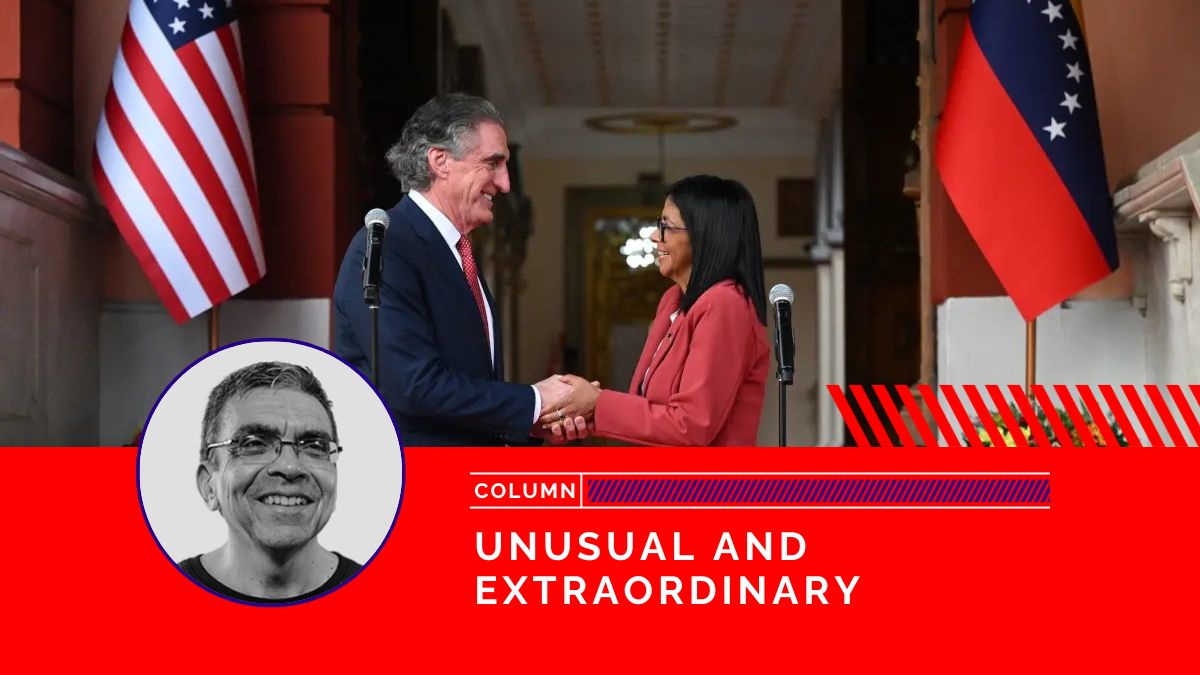
Delcy Rodríguez with US Interior Secretary Doug Burgum, one of several Trump officials to visit Caracas in recent months. (Archive)
As far as we know, the US invading forces that attacked the country on January 3 did not plant any mines on Venezuelan soil. But, figuratively speaking, they did, because every day, here and there, a situation erupts that is clearly a consequence of the bombing and the kidnapping of President Nicolás Maduro and First Lady Cilia Flores.
Some of these explosions even appear far more precise than the military operation – a term its proponents insist on using to describe it, despite the fact that it left more than a hundred people dead and caused significant material damage. In the four months that have passed since that traumatic morning, the country has witnessed what appear to be controlled demolitions at the very foundations of Venezuela’s 21st-century anti-hegemonic policy: the return of the US embassy; visits by high-ranking officials (including the head of the CIA); reintegration into the International Monetary Fund; reforms to fundamental laws; and even actions that appear motivated by a desire for symbolic humiliation, such as the removal of uranium from a historic but decommissioned nuclear reactor located on the outskirts of Caracas or Donald Trump’s alleged intention to annex Venezuela as the 51st state.
Every “mine” that explodes deepens a wound that, strictly speaking, is far from healing because it was inflicted on Venezuelan pride and hurts, above all, the Chavista base, but also people from other political camps who share a strong sense of nationalism.
Managing this systematic destruction of icons has been one of the most demanding challenges for the acting government, especially in terms of responding to its own supporters and to real internal power brokers, both within the sphere of popular power and within the military and police forces.
Peace and continuity
One of the most surprising aspects of the political period marked by the events of January 3 is that the country – which was invaded, bombed, and had its president kidnapped – has managed to maintain internal peace. Even more astonishing is that Chavismo, subjected to such a decapitation operation, has remained in power and has swiftly reestablished diplomatic and even cordial relations with the aggressor power.
This strange phenomenon was immediately exploited by internal and external opponents of the Bolivarian Revolution to disseminate accusations of treason. Those accused have responded by arguing that this was not a voluntary compromise, but rather concessions that any rational person would make in a hostage situation and under the threat of even worse attacks and reprisals.
In an unusual move, United Nations Secretary-General António Guterres weighed in on this debate, voicing his suspicion that there was internal collusion in the military operation against Maduro.
A significant portion of Chavismo understands the need to reject these hypotheses and agrees that national peace is well worth the sacrifice of some of the slogans that propelled this movement to rise and remain at the pinnacle of political power.
The conflict arises when it becomes clear that, for many revolutionary activists, these slogans embody fundamental principles and values.
The controversy surrounding this issue lies dormant beneath the surface, like a geological fault line that became active following the bombing. At times, it surfaces in the form of minor tremors, through the critical attitudes of figures associated with Chavismo. The ground also trembles from the doubts and unanswered questions in the daily lives of sectors affiliated with or sympathetic to the United Socialist Party of Venezuela (PSUV).
One of the voices that has been speaking out from the ranks of the organic intelligentsia is that of Luis Britto García, who has raised objections to the reforms of the Hydrocarbons and Mining Laws, which, in his view, will allow for the unfettered plundering of Venezuela’s abundant natural resources and enable any disputes to be settled by foreign courts. He also rejects the return of the IMF, given the role that this and other multilateral organizations have played in imposing economic policies that are fundamentally anti-popular.
Britto García is unwavering in his ideological and legal objections, but he is also extremely careful not to present himself as an internal opponent of the acting president. Drawing on his immense moral authority, he has taken on the role of being the public voice for many who lack the ability or opportunity to express their views.
Meanwhile, some who clearly do not wish to be named say they have chosen to contribute through their silence, as the timing is highly inappropriate for taking sides.
Others, however, have chosen to openly dissent. Prominent among them is journalist Mario Silva, who built his career as an opinion-maker on the provocative television show La Hojilla and was later elected to the 2017 National Constituent Assembly and the 2021–2025 National Assembly. With his opposition to the oil and mining reforms as well as amnesty policies for opposition figures who participated in insurrections and riots, Silva has stirred up controversy, particularly among segments of the grassroots Chavista movement that identify with his dramatic and incisive style, which was once strongly supported by Commander Hugo Chávez.
In the vacuous yet highly topical realm of social media influencers, “dissidents” have also emerged, such as Diego Omar Suárez, “Michelo,” an Argentine YouTuber and TikToker who moved to Venezuela in 2024 and had been a key figure in the online discourse on these and other social media platforms, supporting the government of Nicolás Maduro and, in the early weeks, that of Delcy Rodríguez. However, he changed his stance to speak out against treason and collusion with the US. (1)
The Pilgrimage strategy
These disruptions have further obstructed the path of the interim government, which is grappling with a very difficult economic situation; they have become additional “landmines” along the way, forcing the government to move forward with extreme caution while navigating these threats.
One of the strategies designed to maintain popular support and mobilization has been the Pilgrimage against the blockade and the unilateral coercive measures or sanctions imposed by the US and its allies.
The Pilgrimage sought to mobilize support from the Chavista parties, which in the days immediately following January 3 had taken to the streets demanding the return of the presidential couple. That demand was redirected toward calling for a Venezuela free of economic sanctions.
Beyond giving new momentum to the Chavista camp, the mobilization sought to broaden the government’s support base by prioritizing the elimination of the blockade and sanctions.
To achieve this new consensus, the acting president has capitalized on the groundwork laid by the Amnesty Law, the Program for Peace and Democratic Coexistence, and other reconciliation initiatives, such as the one established for labor issues, which allowed her to get through May 1 by decreeing increases in bonuses without committing to meaningful wage hikes.
Fundamental in this regard has been the willingness of Chavismo to cede institutional spaces – such as the Office of the Ombudsman, the Ministry of Higher Education, several vice ministries, and several embassies – to figures from the moderate opposition. It is clear that the support obtained outside the Chavista camp has been the result of these prior concessions.
What about the opposition?
In this complex political landscape, the opposition forces appear, now more than ever, to be watching the game from the sidelines, standing around the table, while the pieces are moved by the acting government and the United States.
The moderate opposition, which participated in the 2025 parliamentary elections and entered the new National Assembly that began its term on January 5, has since January 3 wavered between capitalizing on the moment by supporting the so-called “reinstitutionalization” of the country and reverting to old obstructionist tactics that are largely ineffective given the overwhelming majority that Chavismo holds in the national legislature.
From the perspective of public opinion, everything seems to indicate that this opposition faction has failed to present itself to the country as a genuine option for change, with a platform capable of rallying the masses to follow its leaders.
At the other extreme is the faction led by María Corina Machado, clearly identified as the one that demanded (and continues to demand) most vehemently that the country be sanctioned, blockaded, and attacked militarily, based on the premise that she would automatically be called upon to head a de facto government resulting from the bombing and the kidnapping of the constitutional president.
Donald Trump’s surprising support for Delcy Rodríguez’s government has left Machado high and dry. Neither her obsequious submission to the US president nor her lobbying of the Western corporate elites has done her any good so far, as she remains relegated to the sidelines – a situation that must be particularly humiliating for her.
Under the current circumstances, Machado appears more a part of the internal US political diatribe than of the Venezuelan political scene. Following her failed efforts to secure Trump’s endorsement (to whom she gifted her Nobel Prize), she seems to be actively working with the Democrats and elements of the Deep State with the aim of inflicting a defeat on the Republican president in the midterm elections.
It seems her allegiances have shifted, creating a bizarre paradox: Venezuela’s radical opposition is betting against Trump, while Chavismo feels more secure if the president who ordered the brutal military aggression does not emerge too battered from the November contest.
It appears, then, that the “metaphorical landmines” planted by the US during its brief invasion are also exploding, one after another, on the grounds of the right and the far right.
(1) Editor’s note: this article was written before the May 16 handover of former minister and diplomatic envoy Alex Saab to US authorities.
Clodovaldo Hernández is a journalist and political analyst with experience in higher education. He won the National Journalism Prize (Opinion category) in 2002. He is the author of the books Reinventario (poetry and short stories) De genios y de figuras (journalistic profiles) and Esa larga, infinita distancia (novel).
The views expressed in this article are the author’s own and do not necessarily reflect those of the Venezuelan editorial staff.