As we head into August and look to the fall, two burning questions are front and center when it comes to the Dodgers.
Will they win a third straight World Series championship?
And will the $500-million proposal to ferry fans by gondola from Union Station to Dodger Stadium remain aloft or crash and burn?
I can’t answer the first question, although I wouldn’t bet against a three-peat.
As for the second question, if I were former Dodgers owner and aerial tram godfather Frank McCourt, I’d fasten my seat belt, because the gondola is about to hit some heavy turbulence.
The gondola would slice through a section of L.A. State Historic Park, wipe out dozens of trees and trample a space that was carefully designed with years of community input. And the mounting opposition now includes seven former state park officials and four former members of the state Park and Recreation Commission.
The former staffers have sent “don’t you dare” letters to the commission, and one of them argued that the view of the downtown skyline would be cluttered and commercialized.
“Gondola cars encased in digital ads, flying 26 feet overhead every 25-30 seconds would irreparably impair the vista, and the sense of calm and escape from urban life,” wrote former state parks director Ruth Coleman.
The four former commissioners have signed a joint letter arguing that the gondola proposal “would enable a private development to permanently and irreparably shrink, degrade, and destroy the integrity of a state park.”
They’re speaking up now because the state is considering an amendment to the park’s general plan that would allow for “consideration and review of the proposed Los Angeles Aerial Rapid Transit (LA ART) gondola project.”
That was McCourt’s brainchild, back in 2018, and he’s a guy with lobbying muscle and friends in high places. McCourt later handed off the project to an environmental group, but the idea is still to deliver fans to Dodger Stadium, where he has financial interests.
A hearing on the matter is expected in the fall, and it’s sure to be a cage fight. Last December, throngs of supporters and foes squared off at a raucous Metro board meeting. The board ultimately green-lighted the gondola, which the L.A. City Council has almost unanimously opposed. So the showdown scheduled for this fall could be at least as interesting as the World Series.
For the record, I’m not anti-gondola. They’re fun, right?
But I’m not buying the proponents’ claim that this is a public transit project. They say several thousand people would soar up to Chavez Ravine and help relieve the miserable traffic in and out of parking lots, which McCourt took part ownership of after selling the team back in 2012 for a cool $2 billion.
But how much is gained if gondola riders ditch the free shuttle buses that now run to the ballpark from Union Station?
Then there’s a much bigger question, which my colleague Bill Shaikin explored in 2022: Is the gondola phase one of a plan to develop stadium property into some kind of Dodgertown commercial extravaganza?
Unclear, but let’s not be naive.
A Dodgers executive told Shaikin the Dodgers support the gondola project, although they are “really not involved” in it. But we’re talking about fabulously wealthy people whose only real job is figuring out how to make more money.
Team McCourt has suggested the gondola will be built with private money, perhaps from selling advertising rights, and that rides will be free to Dodger ticket holders.
But how would any of that pencil out with Dodger Stadium closed most of the year, and with gondola traffic chipping away at revenue from parking fees that start at a monstrous $40?
There’s something they’re not telling us, and if you think there’s no threat of taxpayers getting dinged one way or another at some point, you’ve either been hit in the head by a line drive or you’ve had too many $18 beers at Dodger Stadium.
If you want more details on the history of the gondola gambit, I suggest you check out all the reporting by Shaikin, who has been on the case for years, and offered up a far better idea than a gondola: Make it easier for fans to walk or bike to the ballpark.
But let’s get back to L.A. State Historic Park.
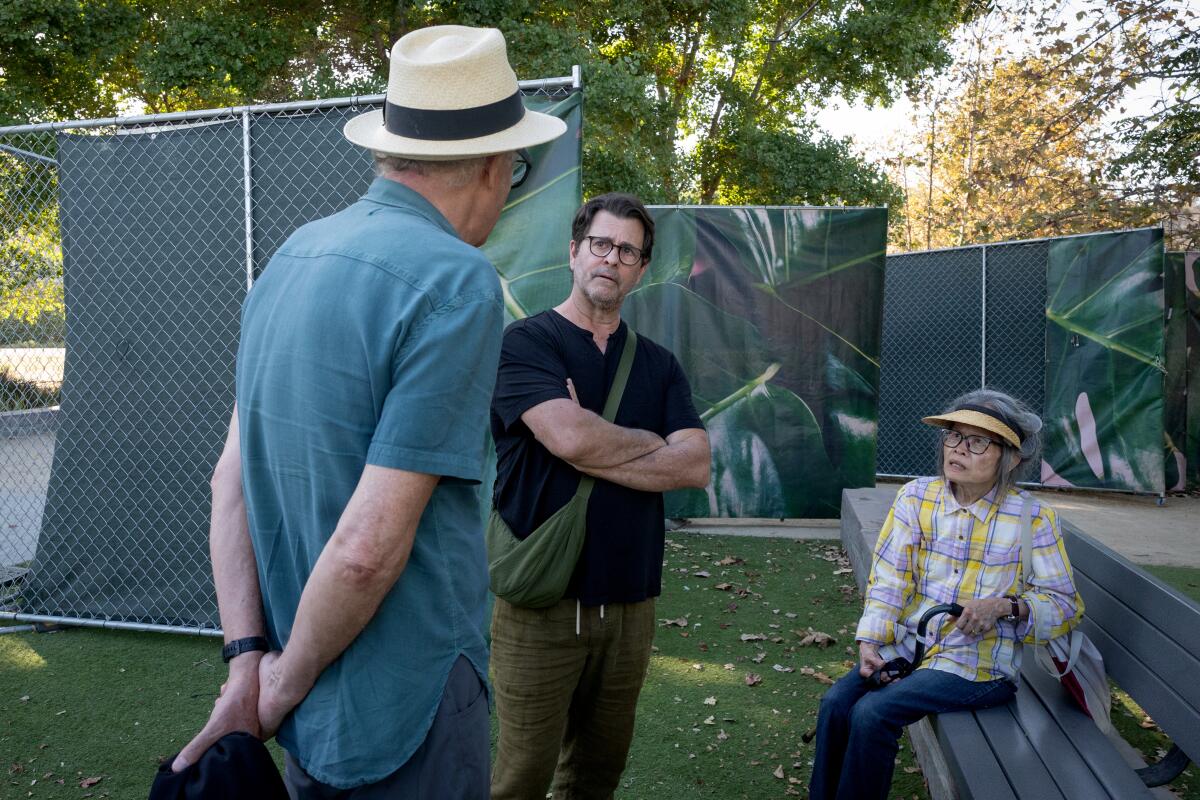
Much of the early gondola opposition was from Chinatown residents who didn’t like the idea of living under what would resemble an amusement park ride. But on Wednesday evening, I met with some people whose focus is the impact on the park.
“All of these trees would be gone,” said Sean Woods, a former state parks employee who penned one of the letters to Sacramento, and who was involved in some of the 65 public meetings and workshops at which community members helped with the design and mission of the park.
We were in a shady spot, where the gondola would run parallel to the existing Metro train tracks. There’d be supporting towers on park property, with cables dangling overhead, and a gondola station just outside the park. The gondola would occupy only a small slice of the 32-acre space, but it would be a visible distraction from every inch of the park.
“I think it’s a betrayal of California State Parks’ commitment to the communities that surround this park, that fought dearly for this park,” Woods said.
He was reflecting on a time when the former railyard was destined to become a giant industrial warehouse complex. And this followed the history of Chinatown having been relocated to make way for Union Station, and residents of Chavez Ravine being relocated to make way for Dodger Stadium.

Jon Christensen, Sean Woods and Susan Lai chat at Los Angeles State Historic Park.
(Eric Thayer / Los Angeles Times)
Joining us was Susan Lai, who along with Woods represents Friends of Los Angeles State Historic Park.
Lai is small in stature, but she swings for the fences.
“This is called a historic park for a reason,” she said, “and McCourt … has no historical connection to the park, no community connection to the park, and no cultural connection to the park.”
Lai is steeped in the archaeology of the park, the Gabrielino establishment here, the Zanja Madre irrigation line that served the early pueblo.
As we strolled, she told me this is another case of politically connected profiteers trying to impose their will on the local community, and she won’t stand for it. Lai is carrying a torch lit by her husband, Collin, who died last year at the age of 96 after years of fighting to make the park a reality.
“She’s brought an extra fire to this whole effort, and really inspired a lot of young people,” said Jon Christensen, gondola foe and co-founder of the Los Angeles Parks Alliance.
Christensen led Lai, Woods and me to the top of a grassy hill. When the park opened in 2006, I thought it seemed too flat and shapeless, too hemmed in by Broadway and Spring. But it later expanded, the trees filled in and the whole park grew on me as a place to see and feel Los Angeles.
I loved two things most of all.
The unstructured activities enjoyed by a broad mix of people picnicking on the grass, napping under a tree, kicking a ball around or doing what 10 guys were doing Wednesday evening — playing a game of Frisbee football in the meadow below us.
And the unfettered skyline view, which could soon be lost. And consider the optics: Dodgers fans soaring over a public park enjoyed by families who might need to hit the lottery to afford tickets to a game.
It was almost Dodger game time, and if the gondolas were up and running, they’d be close enough overhead that you could hit one with a tomato.
Not that I’m recommending that.
steve.lopez@latimes.com