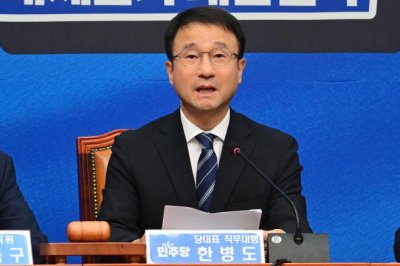

Han Byung-do, acting leader and floor leader of South Korea’s Democratic Party, speaks Friday during a Supreme Council meeting at the National Assembly in Seoul. Photo by Asia Today
July 31 (Asia Today) — South Korea’s National Assembly passed legislation Friday eliminating prosecutors’ authority to conduct direct and supplementary investigations, advancing a major restructuring of the country’s criminal justice system.
Han Byung-do, acting leader and floor leader of the governing Democratic Party, said before the vote that the revision to the Criminal Procedure Act would mark the beginning of a new system rather than the end of prosecution reform.
“Today’s revision of the Criminal Procedure Act is not the end of prosecution reform but the beginning of a new criminal justice system,” Han said during a party Supreme Council meeting.
He said the government and governing party must prevent investigative gaps and ensure that crime victims and other citizens remain protected during the transition.
The legislation passed later Friday after lawmakers ended a filibuster by the opposition People Power Party.
Under the revised law, prosecutors will no longer be allowed to conduct their own investigations, including additional investigative work after receiving cases from police.
Prosecutors will instead be permitted to request supplementary investigations from judicial police officers.
Police generally must complete the requested work within one month and report the results to prosecutors. The period may be extended for up to one additional month when necessary.
The legislation also requires investigative information to be recorded in South Korea’s criminal justice information system.
Han said the Democratic Party would take responsibility for completing the regulations and institutional arrangements needed to launch the Public Prosecution Office and the Serious Crimes Investigation Agency on Oct. 2.
The new Public Prosecution Office will be responsible primarily for indictments and maintaining prosecutions in court. The Serious Crimes Investigation Agency will investigate major offenses formerly handled directly by prosecutors.
“We will take responsibility until the end so that the two agencies can begin operating in a stable manner,” Han said.
Opposition lawmakers and some legal professionals have warned that eliminating prosecutors’ supplementary investigative authority could create delays, weaken oversight of police investigations and leave victims with fewer avenues for redress.
The Democratic Party says the legislation includes safeguards intended to prevent cases from being ignored or delayed and to preserve the rights of victims and complainants.
Governing party promises further legislation
Han said the governing party would continue pursuing legislation dealing with public welfare and political reform.
“We will respond to people’s livelihoods with speed and to reform with results,” he said.
Han cited legislation authorizing a special counsel investigation of the National Election Commission and a proposal to shorten the review period for bills designated for fast-track consideration.
The fast-track proposal would reduce the maximum review period from 330 days to 90 days, including 60 days for consideration by the relevant standing committee and 30 days for review by the Legislation and Judiciary Committee.
The People Power Party opposes the change, saying it would weaken opportunities for negotiation and allow the parliamentary majority to rush controversial bills through the legislature.
Han said the Democratic Party would work to create a more productive National Assembly in which legislation affecting people’s livelihoods is reviewed and passed without unnecessary delays.
“We will not avoid the responsibility entrusted to us by the public,” he said.
Party vows to address stock market volatility
Han also said the Democratic Party and the government would work together to reduce uncertainty in South Korea’s capital markets.
The comments followed heightened volatility linked in part to leveraged investment products tied to individual stocks.
Han said officials would examine whether adequate investor protections were in place when the products were introduced.
“We recognize the current market conditions and investors’ concerns with the utmost seriousness,” he said. “We will calmly and transparently review the introduction process and whether investor protection measures were sufficient.”
Han urged the People Power Party not to use investors’ concerns as political ammunition.
“Using investor anxiety for political attacks and increasing market uncertainty through unverified claims can undermine confidence in the South Korean stock market and cause serious harm to investors,” he said.
He said lawmakers should instead identify the causes of instability and develop effective measures to address them.
The Democratic Party’s special committee on South Korea’s capital markets will communicate with financial regulators and industry officials to evaluate policy measures and market reactions, Han said.
The party will also continue efforts to improve corporate value and governance at publicly traded companies, he said.
— Reported by Asia Today; translated by UPI
© Asia Today. Unauthorized reproduction or redistribution prohibited.
Original Korean report: https://www.asiatoday.co.kr/kn/view.php?key=20260731010011686