Much was made of South Africa’s run to the 2025 World Test Championship final at Lord’s.
They played only 12 Tests – no team played fewer – and qualified after drawing at home against India and losing in New Zealand, before beating West Indies, Bangladesh, Sri Lanka and Pakistan.
Mitigation for this latest Test also comes from the fact this is their first in almost a year and the majority of their batters played one domestic red-ball match to prepare.
Australia recently came off an eight-month break of their own and lost to Bangladesh in home conditions, as Conrad was keen to point out.
And last summer’s famous win over Australia and a 2-0 success in India proves they can beat the world’s top teams.
However, this Test only reinforced a worrying trend among South Africa’s batters.
Tristan Stubbs and Ryan Rickelton are fine white-ball players, but Stubbs’ two Test centuries have come against Sri Lanka and Bangladesh, and Rickelton’s against Sri Lanka and Pakistan.
This was an obvious step up.
In the first innings, Stubbs, two overs after Wiaan Mulder had been bounced out, top-edged a pull to fine leg, and in the second he played a loose drive on one.
Opener Rickelton drove and edged at a wide ball late on day two and nicked through a pull in the fourth over on day four.
Similarly, Mulder scored 367 not out against Zimbabwe last year, but Bangladesh are the only other side he averages more than 30 against. His 110-ball stay for 29 on the final day before being strangled down the leg side was at least encouraging.
Wicketkeeper Kyle Verreynne, in contrast, lasted only three balls before nudging Matt Renshaw’s part-time spin to slip. His Test average of 30.14 drops to 28 against Australia and 15 against both England and India.
Conrad said that “a few of the guys need to step up”.
“The real disappointment was the batting in the first dig on a really good wicket,” Conrad said.
“Yes, a world-class attack, but quite a few guys getting starts and not kicking on.”
Bangkok has officially been declared a disaster zone after relentless rains triggered widespread flooding in the Thai capital. Up to 300 millimetres of rain fell in some areas overwhelming the city’s canals and drainage system.
Nonstop rain since Thursday has submerged Thai capital’s roads and canals, sending water into many homes and stores.
Published On 26 Sep 202626 Sep 2026
Bangkok authorities have declared a disaster zone across all 50 districts of Thailand’s capital after three consecutive days of rainfall caused heavy flooding.
The disaster designation, which gives local organisations authority to take action, came on Saturday after Governor Chadchart Sittipunt said almost 300mm (11.8 inches) of rain had fallen since Thursday afternoon.
Recommended Stories
list of 4 itemsend of list
The nonstop rain inundated roads and canals with water, sending water into many homes and stores alongside them, according to reports. Photos and videos showed major roads submerged and cars abandoned after drivers were unable to move through the rising water.
Chadchart said the east of the city was most impacted and warned that more rain was forecast again on Saturday. He added that flooding should recede once the rain subsides, as city officials work to drain floodwaters as quickly as possible.
“The rain keeps falling and we are doing our best. We are trying to pump the water out, but the water in canals are full,” he said on social media. “The risk areas are those who live near canals. Every canal is now filled.”
Later on Saturday, the government said the flooding situation had “stabilised” but added it would still take two or three days for the water to drain, as long as the rain held off. “If more rainwater doesn’t fall in the area, it will be solved,” he said.
People walk past abandoned vehicles on a flooded Phetchaburi Road in Bangkok on September 26, 2026 [Lillian Suwanrumpha/AFP]
Chadchart also advised residents to move their cars to higher ground, as Bangkok’s public transport authority offered free access to MRT train “park and ride” carparks to store their vehicles until October 2.
Reporting from a flooded street in Bangkok, Al Jazeera’s Tony Cheng said the Thai capital is no stranger to heavy rain during the monsoon season, but the continuous rainfall had locals worried.
“What usually happens is we get heavy downpours for a couple of hours, then you’ll see the street often flooded but it would flow away into the drains quickly, and it would only happen in isolated areas too,” he said.
“What’s happening here is … happening all across the city. This is not a flash flood; this is persistent heavy rain since Thursday evening, and it shows no sign of letting up.”
Somkid Pheuk-ngam, 67, a vendor who lives near a canal just north of central Bangkok, said she had to close her shop for two days.
“The water keeps coming in. It’s hard to go out now. It’s at my waist level,” she told the AFP news agency. “I cannot go anywhere,” she said, adding that this was “worse than the 2011 flood.”
Widespread flooding across Thailand in 2011 killed more than 500 people and damaged millions of homes.
The Department of Disaster Prevention and Mitigation has warned of low pressure across eastern, northeastern and central Thailand until Sunday, saying there was a risk of flash floods, forest runoff, mudslides and river overflow.
Heavy rains could cause life-threatening flooding and landslides on Mexico’s Pacific Coast, the US National Hurricane Center warned.
Published On 24 Sep 202624 Sep 2026
Hurricane Polo has sent heavy rain and strong waves across Mexico’s Pacific coast, while Tropical Storm Nolo is approaching Hawaii with the potential for catastrophic flooding.
Early on Thursday, the hurricane was swirling about 130 miles (209 kilometres) south-southwest of the Mexican city of Zihuatanejo. It was moving northwest at 7mph (11kph) and forecast to turn west-northwest later in the day, taking it further out to sea, before turning northwest on Saturday.
Polo was forecast to maintain Category 5 strength as it moves along Mexico’s coast over the next few days.
While the eye and the strongest winds were expected to remain at sea, the heavy rains could cause life-threatening flooding and landslides, warned the US National Hurricane Center in Miami.
A hurricane watch was issued for Hawaii county and disaster preparations are under way because Tropical Storm Nolo could hit the island on Friday or Saturday, warned the National Weather Service.
John Bravender, a weather service warning coordination meteorologist, said during a news conference on Wednesday afternoon that the tropical storm could develop into a major hurricane.
Hawaii County Mayor Kimo Alameda told residents in a video message that they should start preparing for the storm. He urged them to put together emergency kits with food, water and medications, as well as trim vegetation and clear drains.
“This is a very serious situation,” he said. “We do believe that the rain is going to come. It’s coming already.”
Governor Josh Green’s office said public schools and state and county offices across Hawaii’s Big Island will close on Thursday and Friday, while Maui County will shut them on Friday ahead of the threat of heavy rain, winds and flooding.
China’s Chengdu Aircraft Corporation continues to press ahead with the development of its ‘J-36’ next-generation tailless heavy tactical jet. Recent flight testing has offered interesting new views of the still-evolving stealthy design from the top and behind, prompting discussion about the aircraft’s features. There has also been talk recently about whether the jet might receive a laser directed-energy weapon at some point in the future.
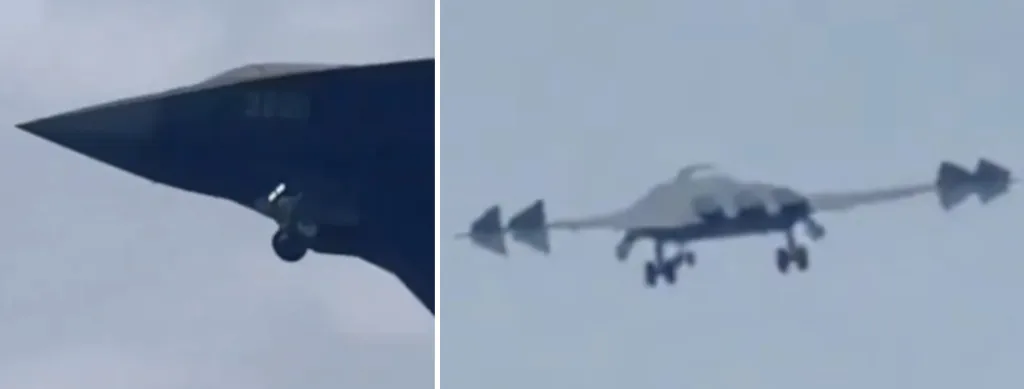
The most recent video of a J-36 test flight, seen in the social media post below, began circulating online yesterday. The footage shows the aircraft coming in to land, providing good general views of the uniquely three-engined jet with its two-seat, side-by-side cockpit configuration, especially from the rear aspect. What is seen underscores a previously observed total revision of the exhausts from a trough style to a two-dimensional thrust-vectoring configuration akin to what is found on the U.S. F-22 Raptor. This and other significant changes to the design, including the addition of divertless supersonic intakes (DSIs) all around, not just on top, first emerged last year. The clip also offers a good reminder of just how wide the aircraft is overall.
Obviously one of the best video recordings of the J-36 so far seen during landing approach … But can anyone read the number under the cockpit? 😉 https://t.co/cmQ0AkdsdO
As this particular J-36 passes by, it can be seen to have a lighter-colored radome, as well as at least one relatively large lighter-colored section on top of the dorsal air intake. A similarly colored radome was first spotted on what is said to be the fourth prototype back in July. This coloring could point to the installation of actual radar in the aircraft’s nose. In TWZ‘s first in-depth analysis of the J-36 back in 2024, we assessed that the jet’s very broad radome area could house an absolutely massive primary array.
The lighter section on top of the fuselage could be an aperture for a conformal antenna tied to a beyond-line-of-sight communications and data-sharing suite. In 2024, we posited that the heavyweight J-36 could serve as an intelligence-gathering and communications relay platform in addition to performing tasks more typically associated with tactical combat jets. Reliable and multi-faceted connectivity would be key for employing the J-36 as an airborne controller for advanced air combat drones, as well.
Captures from the video above highlighting the lighter-colored radome and section on top of the center of the fuselage. Chinese internet captures via X
Another J-36 flight testing video that emerged on Monday, seen below, offers an additional view of the top of the jet, showing multiple lighter-colored sections that would appear to be additional conformal apertures for various antennas. There is a lighter-colored rectangular outline painted around part of the intake on top of the center of the fuselage, as well. The jet’s full paint scheme includes lighter-colored leading and trailing edges, which are critical structures on low-observable (stealthy) designs that often contain additional antenna arrays. Overall, the two-tone coloring is very much in line with what is seen on operational J-20 fighters in Chinese service today. The original J-36 prototype, at least, has notably worn a splinter-type camouflage paint scheme.
China’s J-36 sixth-gen fighter asserting its dominance in the sky.
My prediction, the J-36 will gain initial operational capability before the American F-47 take its maiden flight. pic.twitter.com/SLmjqZ76Aw
A stock shot of a J-20 fighter with its two-tone scheme. PLAAFA view of the first J-36 prototype with its splinter-type camouflage scheme. Chinese internet via X
Whether or not the two recent video clips show the same J-36 prototype is unclear. The possibility has now been raised that Chengdu may be using a single serial number (36011) on at least some of the J-36 prototypes, a decision that could have been made for counter-intelligence and/or deliberate misinformation/disinformation purposes.
Much still remains unknown about the current or expected future capabilities of the J-36. Aviation Industry Corporation of China (AVIC) did have a placard at its booth at the 14th China International Defence Electronics Exhibition earlier this month that has prompted questions about whether the jet could be equipped with a laser directed-energy weapon. Chengdu falls under the umbrella of AVIC, which is a state-run enterprise. The Chinese-language placard in question describes a “laser weapon tracking system” with a power rating of “*00” kilowatts and a weight of “less than” 837.7 pounds (380 kilograms), per a machine translation. The way the power rating is written appears to mean that it is in the hundreds of kilowatts, which would put it firmly in a class capable of doing physical damage to objects, such as incoming missiles and drones.
Furthermore, an associated graphic shows a turreted system and a computer-generated rendering of a J-36 projecting a beam. The render appears to be from a video that depicts a J-36 using a laser to destroy other aircraft. Another computer-generated video that shows a J-36 using retractable lasers to shoot down incoming missiles has been circulating online since at least last year.
AVIC showed this at the 14th China International Defence Electronics Exhibition earlier this month. Chinese internet via X
It is not immediately clear how official either of the clips depicting laser-armed J-36s might be, or whether they at all reflect real planned capabilities. The full placard presented at the China International Defence Electronics Exhibition, as seen in the video below, shows a variety of different laser systems, and not just for aerial applications.
Despite important U.S. strides more recently when it comes to fielding ground-based and naval laser weapon systems, “there’s nothing that’s on the shelf right now that we are ready to put onto an airplane,” U.S. Air Force Brig. Gen. Douglas Wickert, the commander of the Air Force Research Laboratory (AFRL), told TWZ and other outlets just last week at a roundtable at the Air & Space Forces Association’s (AFA) 2026 Air, Space & Cyber Conference on Tuesday. “The solid-state lasers and the power density and the different ways that you actually – there’s actually a lot of secret sauce in that. How do you make the beam, and how do you form the beam, and how do you pulse the beam, and all that’s in development.”
‘There’s development of the laser itself, but now the power and thermal management system has progressed so much that we can provide the power needed,” Dr. Michael Gregg, head of AFRL’s Air Warfare Directorate, said at the same roundtable. “We’ve also had new designs and engines that we know have the power … to direct that power in certain areas. So, from a system perspective, it’s much more feasible because everything has matured over the last decade.”
A rendering of a US Air Force F-16 fighter with a podded laser directed-energy weapon. Lockheed Martin A rendering of a US Air Force F-16C Viper fighter with a podded laser directed energy weapon. Lockheed Martin
China has certainly made substantial investments of its own in laser and other directed-energy weapon capabilities across domains in recent years, and this is clearly an area of interest for the People’s Liberation Army (PLA), in general. When it comes to the J-36 specifically, TWZ has explicitly highlighted in the past how the three-engine configuration could be particularly useful for producing sufficient power to support a host of advanced and electricity-hungry sensors and other capabilities, including directed energy weapons.
Larger questions remain about the exact set of roles the J-36 is expected to fill, as well. The basic design is certainly optimized for straight-line performance, combat radius, and payload rather than maneuverability and agility. The jet has already caused a significant amount of debate just when it comes to taxonomy, as it does not seem to fit inside traditional definitions of ‘fighters’ and ‘bombers,’ something we have explored in detail previously.
A composite of other views of the J-36 that have emerged since 2024. Chinese Internet via X
“According to Yang Wei – chief designer of the J-20 –, the new [J-36] fighter can penetrate heavily defended airspace that the J-20 and comparable F-22s or F-35s must avoid, placing it a generation ahead,” Andreas Rupprecht, an analyst specializing in Chinese military aviation and TWZ contributor, wrote in a post on LinkedIn last week. “With lower RCS [radar cross section], high speed, and the capacity to control more drones, it could act as a node and command center for systems including J-20s and, especially, unmanned aircraft, while attacking high-value targets from stand-off range with long-range weapons.”
“The type could therefore represent a new class of ‘fighter,’” he added. “Online terms include ‘theater-level deep-penetration command combat aircraft’ and ‘high-performance fighter,’ analogous to a cruiser ranking above a destroyer within the Navy. Recent evidence gives this theory new weight and warrants continued monitoring.”
A rendering the US Air Force has released of the F-47. USAF
As an aside, based on what has emerged publicly to date, there are signs that the F-47 may reflect a distinctly different design philosophy that puts greater emphasis on maneuverability compared to the J-36, and even likely the J-XDS. As mentioned, the J-36 certainly seems much more focused on payload, range, and level flight performance. In July, TWZ published a deep dive exploring why the U.S. Air Force would pursue a sixth-generation fighter with rear-swept wings, canards, and other features despite steady trends in the opposite direction visible in Chinese designs and ones elsewhere globally.
Regardless, U.S. officials have downplayed questions about China’s gaining ground in the air combat arena, or even surging into the lead in certain areas, in the past. “Chinese sixth-generation aircraft are in the nascent stages of development and expected to be operational by 2035,” the Pentagon wrote in its most recent annual report on military and security developments in China, which was published in December 2025.
In the meantime, the J-36’s design is already steadily being refined, and the total fleet of prototypes has been growing, offering new insights into the aircraft’s expected capabilities and roles.
Recurring floods disrupt daily life in Tunis, raising questions about drainage, transport and flood preparedness.
Published On 18 Sep 202618 Sep 2026
Tunis, Tunisia – Heavy rain brought parts of Tunisia’s capital to a standstill on Thursday, flooding roads and homes, trapping people in cars and disrupting electricity and internet services.
Home to nearly three million people, the Greater Tunis region has faced repeated flooding in recent years. Thursday’s flooding came only months after severe January rains caused widespread disruption across the capital and other parts of the country, leaving several people dead and causing significant damage.
Weather warnings had been issued in advance, but the decision to suspend classes in Tunis was announced only shortly before it took effect. Parents rushed to schools to collect their children as the rain intensified and traffic backed up across the capital.
Videos shared online showed flooded streets, cars stranded in rising water and what appeared to be power lines catching fire. Residents also reported power and internet cuts and water entering homes.
‘The road became almost unrecognisable’
Fatma, a 35-year-old employee in Tunis, said the situation deteriorated quickly as she struggled to get home safely.
“At about 4pm, the road became almost unrecognisable. The tunnel leading to Bab Saadoun was completely closed because of the rain,” she told Al Jazeera.
“Most people were stranded by the roadside for hours, waiting for public transport that never came. I saw three cars that filled with water and broke down, and people carrying their children on their shoulders.”
“Every season, the same thing happens. Roads close and traffic comes to a complete standstill. All the drains start overflowing with waste,” she said.
The National Institute of Meteorology had warned of locally heavy thunderstorms on Thursday, including heavy rain over short periods that could cause flooding, disrupt traffic and overwhelm drainage networks. It also warned of potential power cuts.
Residents question flood preparedness
“Tunisia has become used to these disasters. Every year, we end up flooded even when there is little rain,” said Intissar, 33, from the Lafayette area of Tunis.
She blamed local authorities for failing to carry out preventive work before the rainy season.
“This is work that should have been done during the summer,” she said.
But she also acknowledged the role of residents.
“We cannot deny the responsibility of citizens who dump waste that blocks drainage channels,” she said.
At a government meeting in August, officials called for drainage networks and waterways to be cleaned and flood-protection work to be accelerated. The government said 29 flood-protection projects were under way across the country.
The flooding comes as Tunisia prepares for a national march in Tunis on Saturday, with organisers calling for the release of four activists detained in connection with the Al-Soumoud Flotilla. The march is scheduled for 5pm, as rain is forecast to continue through Saturday.
A struggle to get home
Fatma said the lack of reliable public transport, combined with repeated flooding, was making it increasingly difficult for people to manage without cars.
“The problem makes people look for their own solutions. That is why most people are trying to find a way to buy a car, because it has become difficult to live without one with these recurring problems,” she said.
The flooding also came as students returned to schools and universities this week, adding pressure to roads and public transport.
For Fatma, the disruption is becoming a familiar pattern.
“This shows that the state has no vision. It is caught off-guard just like citizens are,” she said.