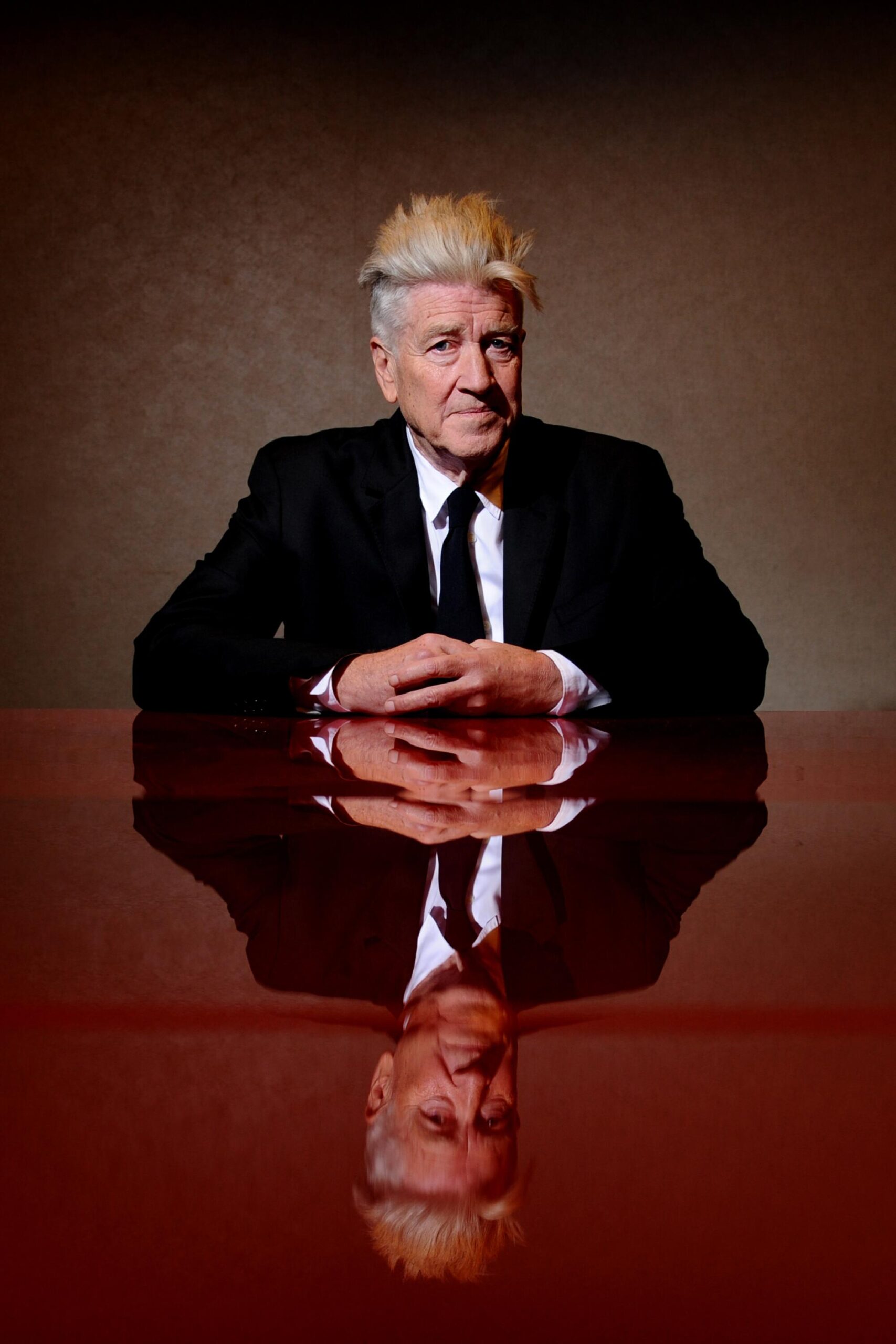
When David Lynch moved from Philadelphia to Los Angeles in the summer of 1970, he was stunned by the sunshine that radiated onto the city — the “most beautiful light I’d ever seen in my life,” he wrote with Kristine McKenna in his 2018 memoir “Room to Dream.” In that book, he described his first morning walking out of an apartment on San Vicente Boulevard.

David Lynch in 2016.
(Wally Skalij / Los Angeles Times)
“I kept kind of moving around with my arms outstretched and I almost got hit by a car wandering into the street,” he wrote.
That light — and Los Angeles itself — continued to inspire and energize the filmmaker and artist throughout his five-plus decades of calling L.A. home, until his death last year at the age of 78. In “Room to Dream,” he wrote about the “magical street” of Mulholland Drive and all its twists and turns: “It’s really got a history, and if you’re in Los Angeles long enough you start hearing stories about things that have happened on it that get your mind going.” In an interview with the Filmographers, he told the story of how his character in “Twin Peaks” was a name plucked from Billy Wilder’s
“Sunset Boulevard,” which very well may have been inspired by Wilder’s
commute to Paramount that passed the Hollywood streets Gordon and
Cole. And the dissolve from Naomi Watts’ face in “Mulholland Drive” to rows of palm trees has become a classic shot for representing his work and his love for the city, hopeful and drenched in his beloved sunlight.
Much like L.A., the artistic legacy of Lynch is difficult to encapsulate — trying to describe his work is like attempting to explain a dream. His films so strongly defied categorization that they necessitated an eponymous term: Lynchian.

The Hollywood Sign, as seen from Beachwood Drive. (Myung J. Chun / Los Angeles Times)

Palm trees, which Lynch often used as a symbol in his films, tower above the city. (David McNew / Getty Images)
Unsettling to many, beloved by more, he refused to explain his work, allowing and challenging his audience to parse through it and imbue their own meanings and discoveries. The reward, for him, was in the doing, in taking a daydream and forming it into an idea that he could shape into something real in the world, blending the mundane and the macabre.
Here are some places around L.A. that offer a glimpse into Lynch’s world.
Note: the Lynch compound and all other residential locations mentioned are all private residences, and not to be disturbed.
Classic diners, especially Bob’s Big Boy Burbank

Lynch would often to go to Bob’s Big Boy in Burbank to meet with creative collaborators, or simply sit and think
(Jill Connelly / For The Times)
Lynch was fond of the straightforwardness of a diner, and he considered them to be ideal for creative thinking and work meetings. In his book “Catching the Big Fish,” he said: “I’d have a milkshake and sit and think. There’s a safety in thinking in a diner. You can have your coffee or your milkshake, and you can go off into strange dark areas, and always come back to the safety of the diner.”
One of the most viscerally terrifying scenes of “Mulholland Drive” takes place behind the dumpster at the abandoned Caesar’s diner in Gardena. And he liked having meals with his family at what is now the Denny’s in Gower Gulch, a place where aspiring cowboy actors once congregated. But the most significant diner in Lynch’s legacy is Bob’s Big Boy in Burbank. He spoke of going to Bob’s almost every day from the mid-’70s until the early ’80s. In an interview with Charlie Rose, Lynch claimed he saw a man at the counter who inspired the Frank Booth character in “Blue Velvet.”


Signs of Lynch at Bob’s Big Boy: His headshot displayed alongside actors Kyle MacLachlan and Laura Dern; a milkshake at the counter. (Stephanie Breijo / Los Angeles Times)
Lynch’s order included a chocolate milkshake and coffee, the cold sugar and caffeine fueling his ideas. He believed 2:30 p.m. was the perfect time to order the milkshake, specifically ”after the lunch rush when the machine had enough time to chill, the silver goblet would be frosted when it arrives at the table, and the ice cream is almost like butter, like cold butter, it’s almost solid, and it has specks of chocolate in it, and it almost gets a frost on it when it arrives,” he said in a conversation with the Filmosophers.
Today there is a framed photo of Lynch over the door of the Burbank location, indicating that his love for the restaurant was mutual. After his death, Bob’s became the de facto location for fans needing to pay homage to the beloved director, piled high with tributes of cigarettes, cans of Coke, donuts, slices of pie and tear-stained letters of gratitude.
Franklin Canyon Park

Leaves illuminated by sunlight under a canopy of trees in Franklin Canyon.
(Blake Fagan / For The Times)
Franklin Canyon Park was once a summer retreat for the Doheny family, who built a Spanish-style home at the base of the canyon in the 1930s. The 605 acres were purchased by the National Park Service in 1981.

A frame overlooks the water in Franklin Canyon, which stood in for many interstitial woodsy scenes in “Twin Peaks.”
(Blake Fagan / For The Times)
The mysterious woods are an essential element in Lynch’s world of “Twin Peaks.” While the pilot for the TV drama and the film prequel “Fire Walk With Me” were filmed in Washington (and there’s lots of scenic footage from the Pacific Northwest throughout the series), much of the show was filmed on Southern California soundstages. And for the many interstitial scenes in the woods, Franklin Canyon and its lush forest stood in. Lynch and co-creator Mark Frost opened an esoteric window to prime-time viewers with the concept of the Black Lodge. The filming location of its entrance, known as Glastonbury Grove in the show, is in Franklin Canyon Park.
Doheny landmarks
In an interview with Charlie Rose, Lynch stated that “everybody is a detective and the unknown is a magnet.” He invited his audiences to look at a door and investigate what lurks behind it. This philosophy ties to his connections with an L.A. legacy, one that contains its own mysteries and contrasts: the Doheny family and its historic properties:
The Doheny Mansion


Glimpses of the Doheny Mansion, clockwise from left: the music room; a stained glass sky light; a sculpture adorns a table in the Pompeian Room. (Blake Fagan / For The Times)
The sprawling and opulent Doheny Mansion, now part of the Mt. St. Mary’s campus, was built in 1899 by architects Theodore Eisen and Sumner Hunt. Patriarch and oil baron Ed Doheny and wife Estelle acquired the home in 1901 and the Doheny family made it their home for nearly 60 years. Lynch used the mansion as the home for Laura Dern’s character in his 2006 film “Inland Empire,” and also filmed an Armani commercial there in the 1990s.
Greystone Mansion

The central courtyard at the Greystone Mansion.
(Blake Fagan / For The Times)
In the 1970s, Lynch was a fellow at the newly founded American Film Institute, based at Greystone Mansion at the time. He eventually took over the mansion’s stables, converting them into a production studio and occasionally (and illegally) living there while he filmed his debut feature, “Eraserhead.” He slept in the room that became the bedroom for the character Henry. “I’d lock myself in there in such a way that from the outside it looked as if no one could possibly be inside,” Lynch said in Mark Altman’s 1990 book “Twin Peaks: Behind The Scenes.” “We’d put these special blankets up on the walls to deaden the sound for shooting and it was quiet.”


Scenes from the Greystone Mansion. (Blake Fagan / For The Times)
Greystone Mansion carried an air of secrecy in itself. Built in 1928 by Gordon Kaufmann, and a gift from Edward Doheny to his son Ned and his family, the stately Tudor Revival was home to a horrific tragedy. Months after moving in, Ned and his lifelong friend and personal secretary, Hugh Plunkett, were found in a guest bedroom, victims of a murder-suicide. While their motives were never defined for certain, the accepted belief was the tragedy was tied to their involvement in the Teapot Dome political corruption scandal and Plunkett’s looming testimony that could’ve implicated the Dohenys.
The city of Beverly Hills purchased the grand manor in 1965 and installed an underground reservoir, and leased the property to the newly formed American Film Institute in 1969 for $1 a year, with the agreement that the school would maintain the property. Greystone was dedicated as a public park in 1971 and is now listed on the National Register of Historic Places.
L.A.’s Transcendental Meditation centers
After moving to Los Angeles, Lynch started visiting the Spiritual Regeneration Movement Center in Santa Monica and it altered his life. Here he learned the methods of Transcendental Meditation, developed by Maharishi Mahesh Yogi, with the focus of seeking enlightenment. His first meditation session was July 1, 1973, and from there, he practiced twice a day, every single day.
“Before I started meditating I worried that doing it would make me lose my edge, and I didn’t want to lose the fire to make stuff,” Lynch wrote in “Room to Dream.” “I found out it gives you more fire to make stuff and more happiness in the doing and way more of an edge. People think anger is an edge, but anger is a weakness that poisons you and the environment around you.”
Lynch became a staunch devotee of Transcendental Meditation and spoke about the positive effects he believed it could have for everyone, particularly veterans, those suffering from PTSD and women who have survived violence. He started the David Lynch Foundation for Consciousness-Based Education and World Peace in 2005 to offer children throughout the world the opportunity to learn to meditate. The foundation recommends several Transcendental Meditation centers in Los Angeles, including the center on Hillhurst Avenue in Los Feliz.
The Pink House, David Lynch’s compound in Hollywood Hills and his final resting place at Hollywood Forever

The historic Tower Theater, built in 1927, was converted into the Apple Tower Theatre.
(Mel Melcon / Los Angeles Times)
On screen, Lynch loved the old glamour of Los Angeles — the majestic Tower Theater in downtown Los Angeles was used in “Mulholland Drive,” “Inland Empire” and “Twin Peaks: The Return.” His characters lived in equally memorable spaces, with the women of “Mulholland Drive” going from the grandeur of the Il Borghese apartments (architect Charles Gault, 1929) to meet tragic endings in the fairy-tale-esque “Snow White” apartments (architect Ben Sherwood, 1931) that are believed to have also inspired Walt Disney. (It’s worth noting that this theater has been refurbished into an Apple store. A beautiful achievement of preservation work, but it’s hard not to see the consumer-driven sleekness and think about a theme in Lynch’s work: the terrors lurking inside a changing America.)
Personally, Lynch loved modern architecture, and experienced love at first sight with the home he purchased in the mid-’80s in the Hollywood Hills. The Pink House, as Lynch referred to it, was designed by Lloyd Wright Jr. for writer Beverly Johnson in 1963. Lynch commissioned Eric Wright (Lloyd’s son and Frank Lloyd Wright’s grandson) to add a pool and pool house in 1991. He told the Wall Street Journal that he preferred Lloyd Wright’s work over his father’s, explaining, “Lloyd Wright is more minimal. More pure. But just as beautiful.”
The house is semi-secluded against a lush hill, beneath the actual Mulholland Drive, and has a subtle chevron pattern detail that runs throughout the house, similar to the floor of the “Twin Peaks” red room. Lynch loved this house and spent much of his time in Los Angeles here, particularly in his later years. He gradually added two neighboring properties to form what would become the Lynch compound.

A “Twin Peaks” coffee cup that was gifted to David Lynch by a fan.
(Chris Pizzello / Invision / AP)
When filming began on “Lost Highway,” he struggled to find the right location for the home of the lead characters, Fred and Renee Madison. This set piece would be crucial to building their sense of dread. Lynch then had an idea: He would use the Brutalist structure in his compound. He transformed the interior and altered the exterior windows, making it difficult for the characters to see the dangers circling outside. “Some people open windows of houses, but I like interiors and don’t care about windows,” Lynch wrote in “Room to Dream.” “I like to go deeper into a house and find things underneath things.”
For the next two decades, the compound was Lynch’s dream space where he could create anything he imagined, including his 2000s-era daily weather reports for local radio stations and his website, a hobby he revived during 2020. Homebound the last few years because of emphysema, he was forced to relocate during the Sunset fire in January 2025, and died shortly after. David Lynch’s final resting place is at Hollywood Forever, across from the Fairbanks Lawn where movies are shown, under the stars.