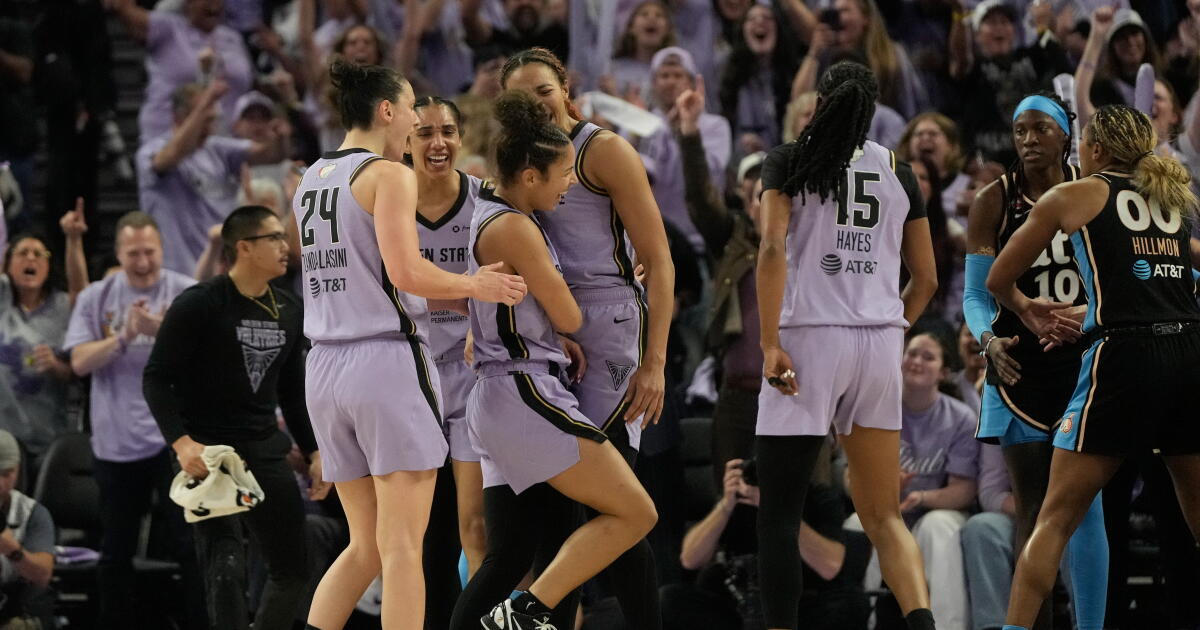
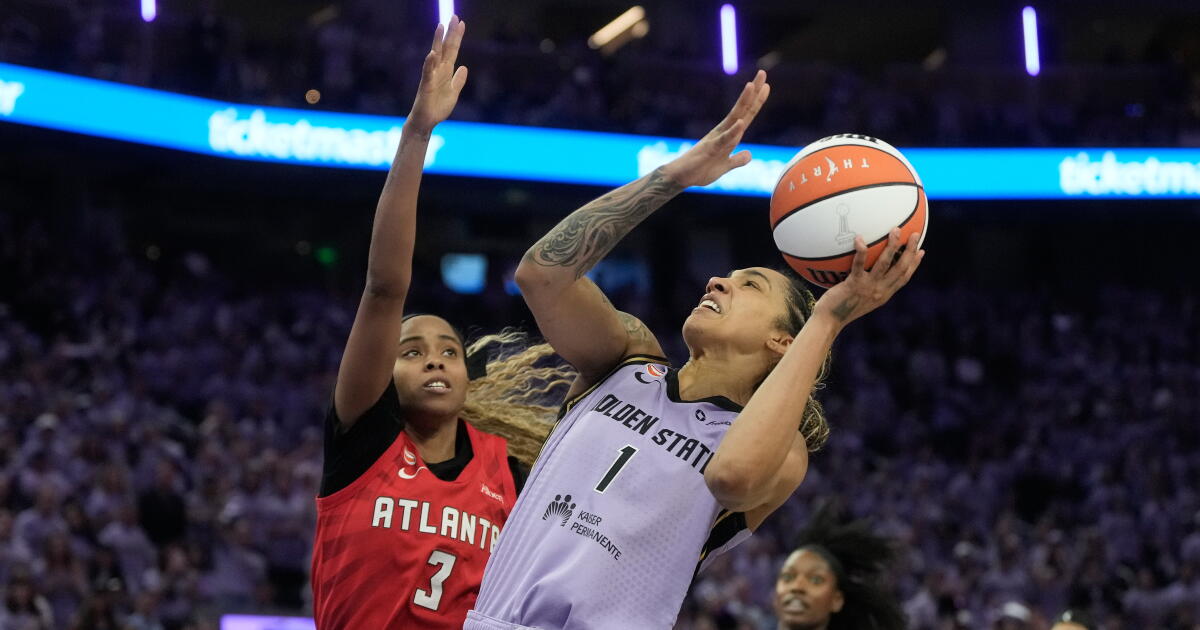
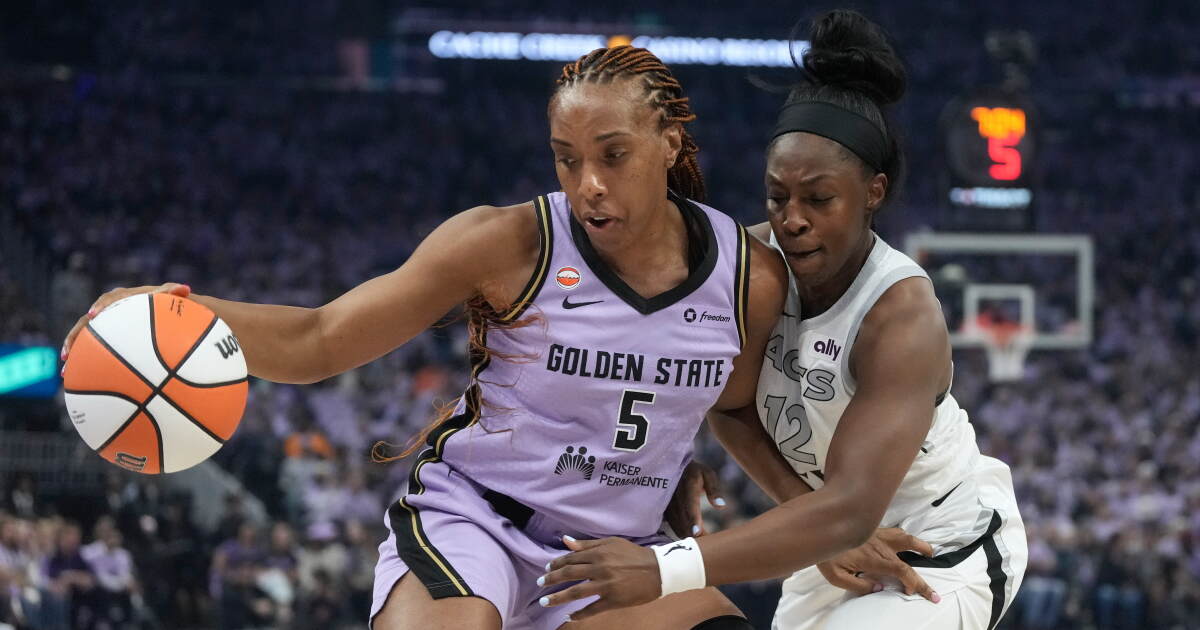
SAN FRANCISCO — Kiah Stokes had 13 points, eight rebounds and three blocked shots as the Golden State Valkyries moved within one win of a championship in their second season, beating the Atlanta Dream 64-55 in Game 5 of the WNBA Finals on Monday night.
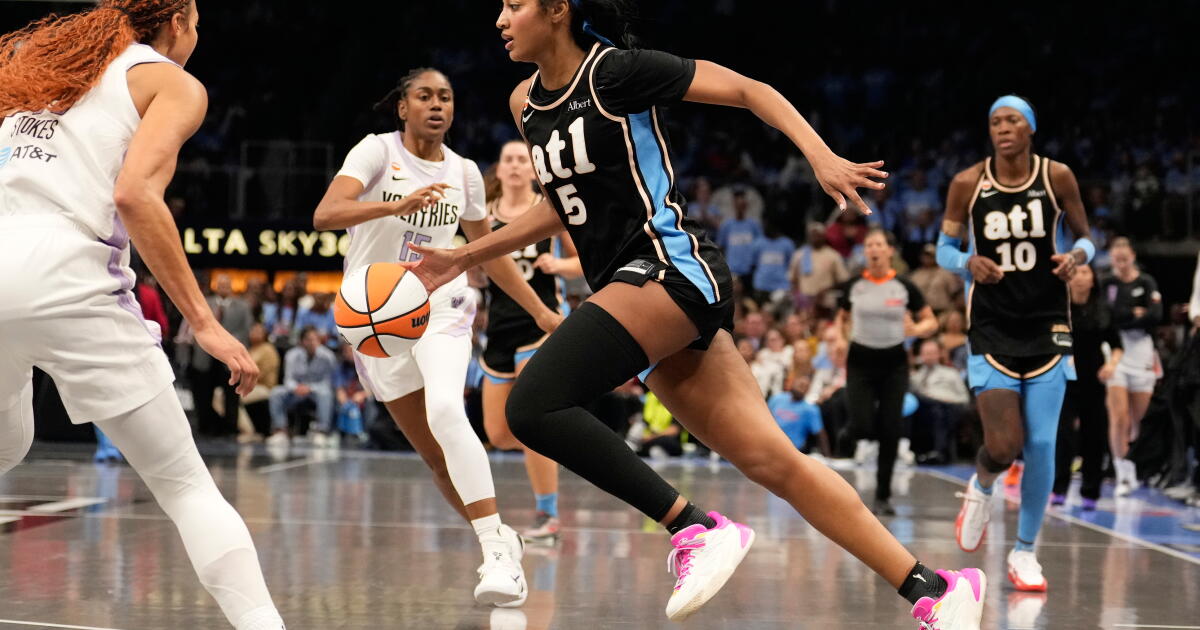
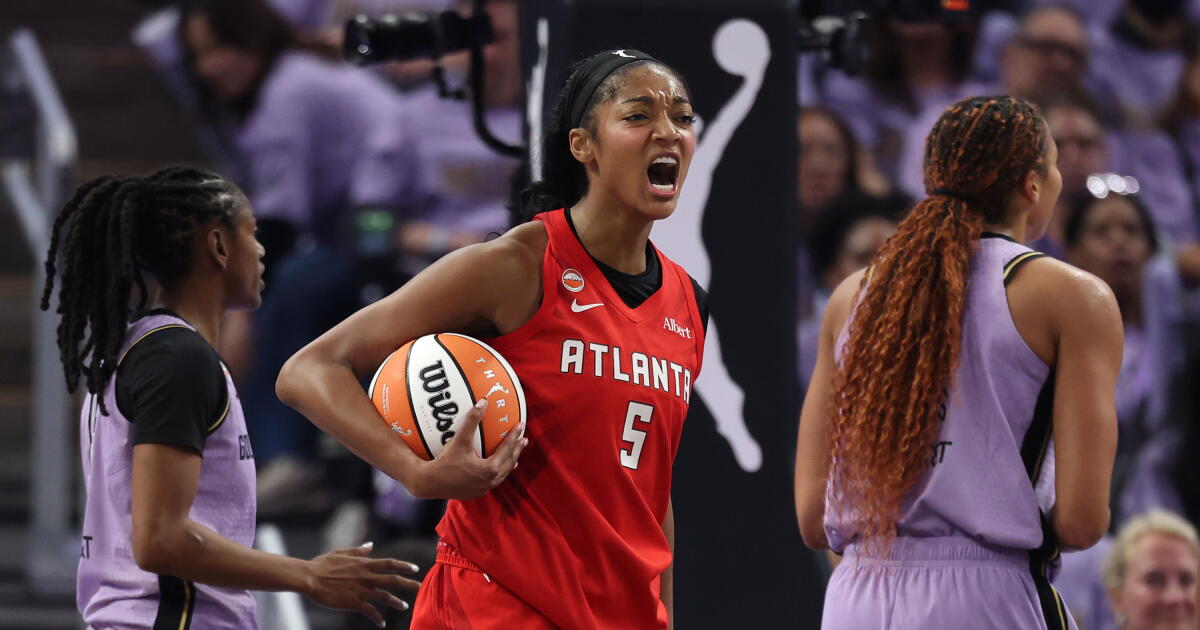
Angel Reese finished with seven points, 15 rebounds and five assists — a big difference from her two standout performances in the first two games of the series at Chase Center. Reese shook her head when whistled for the second of her three offensive fouls with 7:43 to play.
Fans screamed and clapped thunder sticks following the final buzzer as Stokes spoke from the floor to chants of “MVP!”
“We appreciate you,” a smiling Stokes said. “We got one more.”
On a night leading scorer Gabby Williams struggled to find her shooting touch, Golden State found the “strength in numbers” mantra that coach Natalie Nakase has praised all season long and everybody made an influence. Veronica Burton had 13 points and eight rebounds.
On Saturday, Nakase had changed up her lineup for a 67-62 Game 4 win by inserting Tiffany Hayes and Kaila Charles into the starting five. She stayed with those two Monday night, and it worked again. Hayes, who played 10 seasons for Atlanta and came out of retirement two years ago, had 12 points — and Nakase has said she wants to win it all for the veteran guard.
Williams began two for 11 and missed all four of her three three-point tries, but she converted a three-point play with 9:08 remaining to put the Valkyries ahead 49-42 and finished with nine points on three-for-14 shooting and six rebounds.
Atlanta will now try to stave off elimination at home Thursday in Game 6 and force a deciding Game 7 back at Chase Center on Saturday. The Dream hurt themselves with 17 turnovers that led to 21 points for Golden State.
Stokes hit a key three-pointer with 2:46 to go in the third quarter and another with 7:21 left in the game, which ignited chants of “Ki-ah! Ki-ah!” from the crazed, rally towel-waving “Ballhalla” home crowd at Chase Center.
Stokes has recorded three or more blocks in six straight games, tying her with Lisa Leslie in 2003 for the longest such streak in a single WNBA postseason.
The Valkyries used a dominant second half after they led 25-22 at the break, the lowest scoring first half combined score in WNBA Finals history.
Rhyne Howard’s three-point play with 4:59 left in the third pulled Atlanta within 34-31, but after that it was Stokes, Burton and the Valkyries coming up with all the crucial plays on both ends.
Golden State owner Joe Lacob promised a championship within five years in a bold declaration when the expansion franchise was granted to the Bay Area three years ago, yet this season has exceeded even what he could have envisioned.
Neither team could find a flow from three-point range in the first half as the teams combined to shoot five for 29 from deep — three of 16 by Golden State and two for 13 by Atlanta.
Earlier Monday, the league announced Game 6 would be played at 17,000-seat State Farm Arena in Atlanta starting at 12:30 p.m. EDT on Thursday — a time when many fans on both coasts will be working.
“I’d like to see it be a national holiday for all WNBA championship games so whatever somebody can do,” Dream coach Karl Smesko said. “I hope everybody gets to see it somehow and I know that for some people it’s not realistic, they have jobs and won’t be able to make it. So I’m disappointed for that but I’m really hopeful that as many people can see the game as possible.”
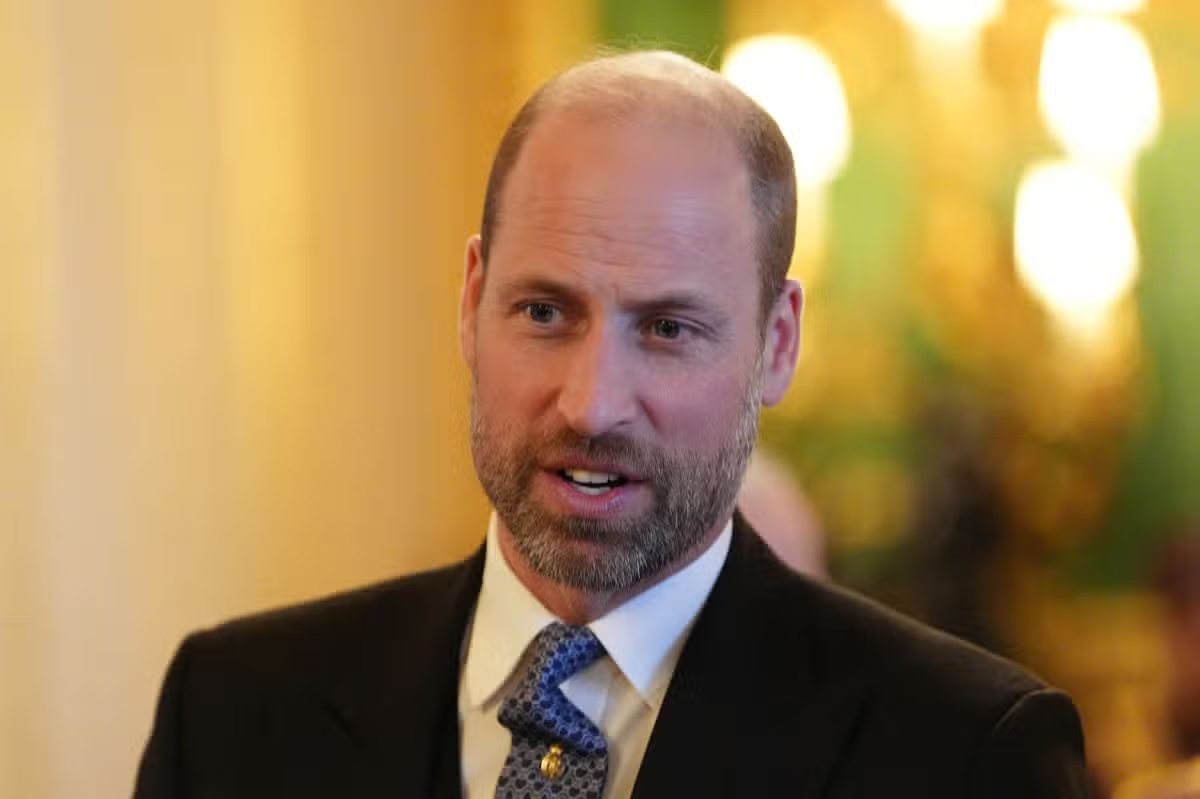
Prince WIlliam once dreamed about being a policeman before he turned his hand to DJing – but The Prince of Wales has been brutally honest about his talents during a surprise TV interview
Prince WIlliam grew up with hopes and dreams just like every little boy(Image: POOL/AFP via Getty Images)
Prince WIlliam has revealed his childhood dreams of becoming a DJ live on TV.
He joined Cate Blanchett, Robert Irwin and Hannah Waddingham on The Graham Norton Show last night. During the episode William was asked whether he had wanted a different career growing up, other than becoming the future King, to which he surprised the audience by saying he had.
His dream role was once to be a policeman, and he even said he wanted to be a DJ. He said: “I did want to be a policeman when I was younger; I thought I could make a good policeman.” Graham interjected saying: “Well, you’re tall.” Then Robert chipped in: “There’s a bit more to it than that mate.”
Graham continued: “Well, you’d look good in the uniform and the hat.” Prince WIlliam added: “I wasn’t on the catwalk. Yeah, being a policeman I thought was quite cool and then I went through a phase of wanting to be a DJ – which didn’t go very well and I came up with a name, I was called DJ Xara with an ‘X’, it wasn’t good.”
Graham asked: “Did you DJ at school parties?” To which Prince William said: “No, I didn’t, I never got that good.”
To see more of the stories you love from The Mirror and to find them easily in Google, then make us your preferred source. Free and easy to do, just click on the link here to find more from The Mirror at the top of your feed.
The audience is heard laughing along, prompting many royal fans to take to X to comment on the prince’s sense of humour, with many referring to William as “funny”.
One fan commented: “Prince William is articulate, funny and an intelligent decent man,” another added: “Prince William is pretty funny and bet he would look good in a police uniform.”
Another added: “I [red-heart emoji] seeing people realise just how charismatic and funny Prince William is, and that he has absolutely no problem laughing at himself. This clip of him on The Graham Norton Show is the perfect example of that. The poor man was absolutely red in the face from laughing so much.”
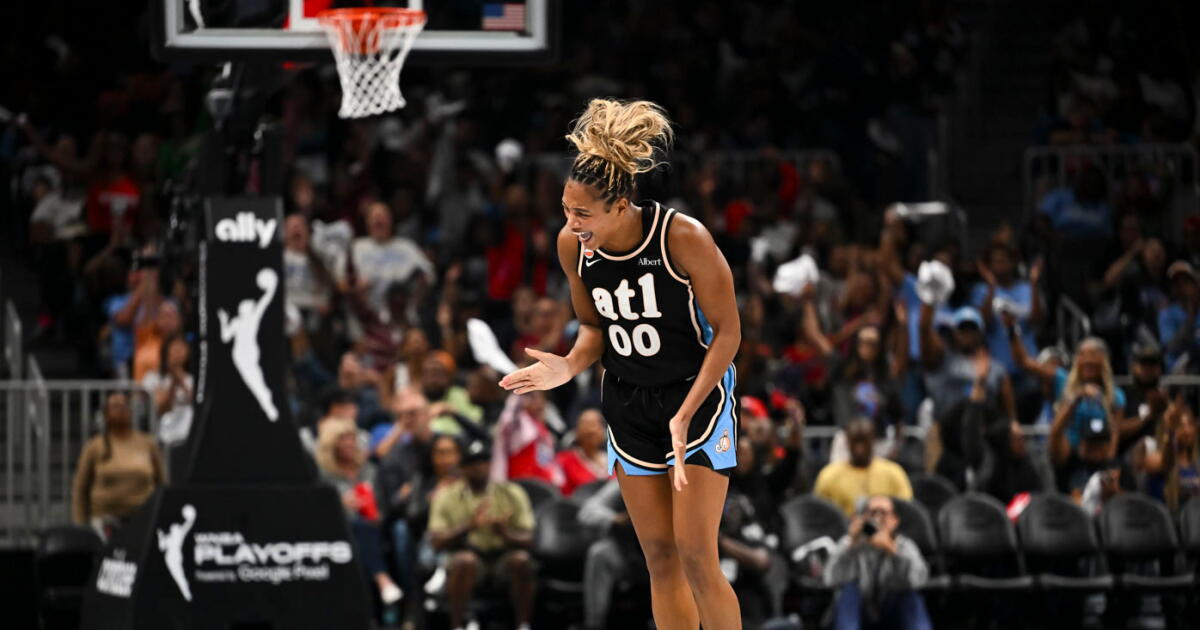
Rhyne Howard added 16 points and Naz Hillmon had 15 for the Dream, who host Game 4 on Saturday.
It was the second straight strong game for Reese, who had 30 points and 16 rebounds in Game 2, which the Dream also won for their first victory ever in the Finals. She now has a double-double in each game of the Finals.
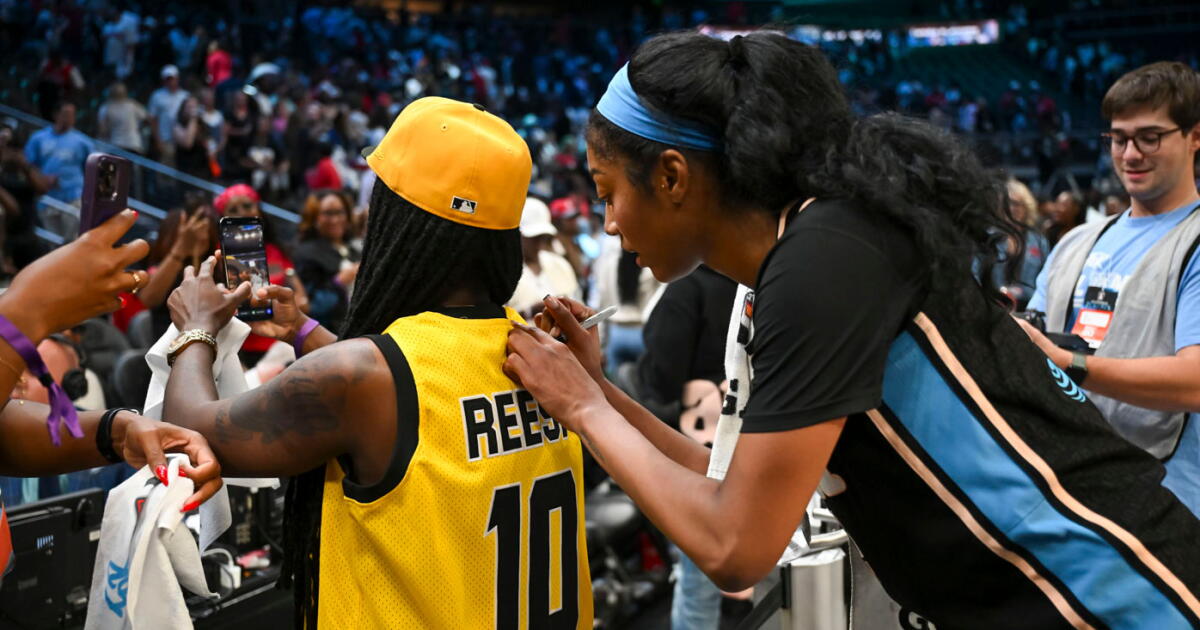
“It feels good when you’re in the Finals. It’s a long season and you play against everybody and go through and push through, but when you can do it at the highest level, this is what you live for, this is what the offseason is for,” Reese said. “I put the work in for this moment and I’m just happy I could lead the team to a win. We’re feeling good going into Saturday.”
With the score tied at 49 in the third quarter, Atlanta scored eight straight, including four by Reese. Golden State got within 59-55 on Tiffany Hayes’ layup, but could get no closer as Atlanta closed the quarter scoring 12 of the final 14 points.
Atlanta has dominated the third quarter so far in the series, outscoring Golden State 63-35 in the three games.
This game was originally scheduled to be played on Thursday at the Gateway Center Arena, where the Dream play most of their home games. The league was able to work with the Atlanta Hawks and State Farm Arena to play the next two games of the championship series there so that they could have a much bigger crowd. Gateway seats 3,500 fans while State Farm Arena can seat more than 17,000.
Wednesday night’s game was sold out, as is Game 4 on Saturday, which will also be played at State Farm Arena.
SAN FRANCISCO — Angel Reese had 30 points and 16 rebounds, Allisha Gray added 18 points and the Atlanta Dream stymied Golden State on both ends in the second half, beating the Valkyries 79-65 on Monday night to even the best-of-seven WNBA Finals at one game apiece.
Rhyne Howard set a Finals record with six steals, while Jordin Canada contributed 13 points, 10 assists and seven rebounds as the Dream earned the franchise’s first Finals victory after going winless in three previous trips — 0-10 overall. They now head home having salvaged a split in front of the boisterous “Ballhalla” crowd at Chase Center.
“This environment is tough to play in. Shoutout to the fans. Shout out my team, though,” Reese said. “We came and fought. I mean, that Game 1 was tough for us. But we moved on.”
Reese became the third player with at least 30 points and 15 rebounds in a Finals game, joining Jonquel Jones for Connecticut in 2019 and Breanna Stewart for Seattle in 2020.
“She was definitely way more aggressive, she had a great game,” Valkyries center Kiah Stokes said. “We let everyone kind of have their way.”
Game 3 is Wednesday in Atlanta, where the next two matchups were moved to the NBA Hawks’ State Farm Arena so more fans could attend. It holds more than 17,000, as opposed to the Dream’s regular home, Gateway Center Arena, which accommodates only 3,500.
Chase Center holds 18,064 and has sold out every game since the Valkyries began playing last year.
Gabby Williams finished with 14 points on three-for-15 shooting after she was the only Golden State player to score in double figures with 26 points in Saturday’s 68-64 Game 1 win. The Valkyries shot 34.4% and went seven for 24 from three-point range.
“We shot terribly,” point guard Veronica Burton said. “We missed shots that we make all the time.”
Foul trouble almost did in the Dream this time — but Reese simply wouldn’t have it. She went scoreless in the second half of the opener but delivered the big baskets and key defensive stops two days later, finishing 10 for 16 from the floor while dishing out three assists and blocking two shots.
“We watched film and saw the things that we messed up on. When I said that they didn’t do anything to mess us up, it was literally just us,” Reese said. “And we can see that tonight. And we’re gonna carry that over in Atlanta. Atlanta, y’all better pull up and pop out, I’m looking forward to it.”
Atlanta scored 24 points off Golden State’s 19 turnovers to hand the Valkyries their first loss in regulation since a 73-70 defeat at Chicago on Aug. 21. The Dream had just eight points off turnovers in Game 1 but returned to the defensive formula that advanced Atlanta this far.
HAVE you been dreaming of that bucket-list Orlando holiday? Well, it’s about to get a whole lot cheaper.
AttractionTickets.com are launching a massive Black Friday sale, where you can save up to hundreds of pounds on visits to Walt Disney World, Universal Orlando Resort and more.
The mega Black Friday sale is AttractionTickets.com’s biggest of the year, with huge discounts on Disney, Universal and moreCredit: Not known, clear with picture desk
Sign up to the AttractionTickets.com Black Friday sale and receive an EXTRA discount
The sale will include theme park and attraction tickets, as well as combo tickets and holiday packages with hotel or villa stays.
And you’ll want in on these Black Friday deals, as this is the website’s biggest sale of the year.
Sign up for the Travel newsletter
Thank you!
If you pre-register for the sale ahead of time, you’ll score yourself an EXTRA discount, which will land in your inbox on November 5.
This means that those pre-registered for Black Friday will have access to the absolute cheapest holidays and attraction tickets available on the website all year long.
Click here to sign up to the Black Friday sale so you’ll be among the first to know as soon as these deals drop.
Last year’s mega Black Friday sale saw 20% off all Orlando tickets, so theme park fans are already expecting big discounts again this year.
The deals will be for 2027 holidays, with major savings to be had during the school summer holidays.
While the exact offers are tightly under wraps until the big day, Attraction Tickets have revealed that the average customer will save hundreds of pounds on their holiday, based on the website’s typical orders.
So where could you go and what could you do with a holiday booked through AttractionTickets.com?
If you’re looking for a Florida holiday, you will be able to bag discounts on Disney, Universal, the Kennedy Space Centre and more, plus hotels and villas if you want to extend the magic by staying on-site.
Save on Disney World attraction tickets or bag a hotel and attraction combo offerCredit: Not known, clear with picture desk
Sign up to the AttractionTickets.com Black Friday sale and receive an EXTRA discount
The site also offers handy combo ticket deals – which are great if you want to tick off Walt Disney World and Universal Orlando Resort in one trip, for example.
2027 is the ideal time to visit Disney World, with new upgrades including a Muppet takeover of the former Rock ‘n’ Roller Coaster as well as the brand new Magic of Disney Animation zone in the Hollywood Studios park.
At Universal Orlando Resort, new coaster Fast & Furious: Hollywood Drift is set to launch in 2027, and the previews of this coaster have excited theme park fanatics around the world.
And if you’re wanting to visit California, now’s the time to get planning. You’ll also be able to save on tickets for Disneyland Resort California and Universal Studios Hollywood in this sale.
Disneyland Resort California is home to Cars Land, which you won’t find in Orlando, plus you can tick off the world-famous studio tour at Universal Studios Hollywood.
If you prefer a Spain or Tenerife holiday, you’ll be able to bag discounts at PortAventura World, Siam Park and Loro Parque.
Just make sure to pre-register ahead of the Black Friday deal to bag an extra discount to make your trip even cheaper.
You can also save on resort hotel and villa stays in the Black Friday saleCredit: AttractionTickets.Com
Sign up to the AttractionTickets.com Black Friday sale and receive an EXTRA discount
What will be included in the Black Friday sale?
Here are some of the top attractions included in the AttractionTickets.com Black Friday sale:
Williams scored 26 points as the Golden State Valkyries came back to take the lead at home against the Atlanta Dream.
By AFP and The Associated Press
Published On 18 Oct 202618 Oct 2026
Gabby Williams scored a game-high 26 points, including four key free throws in the final 78 seconds as the Golden State Valkyries held off the Atlanta Dream 68-64 in game one of the WNBA Finals.
Williams, runner-up to Atlanta’s Angel Reese in Defensive Player of the Year voting, has emerged as an offensive force for the Valkyries in the playoffs and carried the scoring load on a tough shooting night for the hosts, who did not have another player score in double figures on Saturday.
Reese blocks the shot from Williams during the game [Noah Graham/Getty Images via AFP]
The French star took some time to warm up, going scoreless in the first quarter as the Valkyries got off to a tentative start in front of a raucous crowd at Chase Center.
“Once we all started having fun and the excitement got out, we started to kind of find our way,” Williams, who erupted for 16 points in the second quarter, said in an on-court interview.
“There was a lid on that basket tonight, but that’s why we rely on our defence,” she said.
Golden State trailed by one with 1 minute and 18 seconds remaining when Williams seized the rebound off a miss by Atlanta’s Allisha Gray and was fouled by Reese.
Williams made both free throws to put the Valkyries up 65-64 and added another pair of free throws to seal the win with 4.1 seconds left.
“It came down to getting stops and that’s been our bread-and-butter all year,” noted Williams, whose team has allowed 335 fewer points than any other in the WNBA this season. “That’s why we harp on it so much, because we’ve built such great defensive habits.”
Gray, the Dream’s leading scorer, returned after missing two games with a hand injury and scored 19 points, but she was scoreless in the fourth quarter, when Atlanta made just two of their 19 attempts from the floor.
Angel Reese of the Atlanta Dream reacts after the 68-64 loss [Ezra Shaw/Getty Images via AFP]
Reese added 14 points and 12 rebounds, and Rhyne Howard scored 12 for Atlanta.
Atlanta scored just two in an overall eight-point fourth quarter, where Gray was scoreless over the final 10 minutes and Reese scored all of her 14 points in the first half.
“I don’t think they really did anything,” Reese said. “Maybe that was just on me; I wasn’t aggressive enough with the ball and trying to get the ball and get to my spot. I’m definitely going to do a better job of that next game.”
The Valkyries will host game two of the best-of-seven series on Monday.
Both teams are chasing a first WNBA title. The Dream have come up empty in three prior trips to the Finals, most recently in 2013.
The Valkyries, who last year became the first WNBA expansion franchise to reach the playoffs in their inaugural season, are now contending for the title in their second.
Golden State Valkyries players celebrate at the end of game one [Jeff Chiu/AP Photo]
SAN FRANCISCO — Gabby Williams converted two free throws with 1:18 left to put Golden State ahead, two more with 4.1 seconds to go and finished with 26 points facing constant pressure from Atlanta’s stingy defense, and the Valkyries held off the Dream 68-64 in Game 1 of the WNBA Finals on Saturday.
Williams scored 16 of her points in the second quarter and no other Valkyries reached double figures as they shot 32.1% and seven of 33 from three-point range.
“We always knew we were going to find a way somehow,” Williams said on the microphone postgame as fans chanted “Gabby! Gabby!”
Rhyne Howard missed a three-point try with 1:09 left but Angel Reese made a steal moments later. Naz Hillmon missed from deep. Kiah Stokes missed the first of two free throws with 23.8 seconds left. Then Allisha Gray missed a three with nine seconds left.
Williams then hit the free throws a few seconds later to seal the victory.
Game 2 in the best-of-seven series is Monday night back at Chase Center, where the ear-piercing noise from a raucous “Ballhalla” crowd made for the exact hostile environment Valkyries coach Natalie Nakase requested from the home fans.
One of these two franchises will capture its first championship, and if the first game is any indication it’s going to be an all-out defensive fight.
Gray returned from injury to score 19 points, Reese added 14 points and 12 rebounds.
Jordin Canada contributed eight points, seven assists and five rebounds for the Dream, hitting a timely 13-foot jumper with 4:23 remaining.
Williams’ driving layup with 3:22 to play pulled Golden State within 62-61. Canada banged awkwardly into Williams’ knee on a box out during her late free throws and the Valkyries’ star was being cared for by an athletic trainer on the bench in the waning moments.
Gray was in the starting lineup and had gone through a light practice Friday after missing the last two games of Atlanta’s sweep of the New York Liberty in the best-of-three semifinal series with an injured left ring finger — on her shooting hand.
Golden State guard Tiffany Hayes hit her face hard on the floor trying to make a steal in the closing minutes and was down with 2:38 remaining before walking off the court on her own to the locker room.
The hope for a Dodgers comeback in the National League Championship Series ended with the smack of the ball hitting leather.
Milwaukee Brewers left fielder Jackson Chourio, sprinting toward the warning track, had to leap to reel in Kiké Hernández’s line drive in the gap. But he secured the catch. And ended the Dodgers’ season.
The Dodgers’ hopes of making National League history with a three-peat died with a 6-4 loss to the Brewers on Thursday, completing Milwaukee’s four-game sweep.
“It sucked,” veteran left fielder Teoscar Hernández said. “Especially after [what] we had done the last two years. This year at the beginning of the year, what we’ve been through, a lot of injuries throughout the year the last two years, a lot of ups and downs. It just sucked that we’re in this situation, but it’s part of the game.
“Somebody has to win, somebody has to lose. This time, we’re the ones that lost, and just reflect on everything that we didn’t do great this year and just try to do it next year.”
As the Dodgers’ postseason hype video declared before the game: “October doesn’t remember who came close. It remembers who triumphs.”
The Dodgers, after reinforcing to their back-to-back championship roster in the offseason and entering the year as the World Series favorites, fell short. And instead the Brewers will represent the National League, making their first trip to the Fall Classic in 44 years.
“They may have a bunch of Hall of Famers, but we have a bunch of gamers,” Brewers manager Pat Murphy said from the stage. “And the gamers won this week.”
When the Dodgers went down 3-0 in the series, they faced a steep climb that only one team in MLB history has overcome. But the Dodgers showed resolve to begin the game.
Three singles in the second inning gave the Dodgers a lead, with Andy Pages driving in the first run. It was his third hit of the postseason with runners in scoring position and the Dodgers’ fourth overall. Then with two outs, Ohtani not only prolonged the inning but also made it the Dodgers’ highest-scoring frame of the postseason, with their first home run of the series.
It had been a maddening couple of months as Ohtani battled injuries, slid down the batting order and failed to produce when the Dodgers needed him most — in the postseason.
Then on Thursday, with the Dodgers on the brink of elimination, one swing momentarily wiped all that away.
Ohtani got his bat head down to a cutter from former Dodgers pitcher Dustin May on the inside corner. He lifted it into the stands for a three-run home run.
Ohtani turned to the Dodgers’ dugout, spread his arms wide and tossed his bat to the side. He tilted his face to the sky and yelled. He punched the air.
This was the version of Ohtani the Dodgers had sorely been missing. He announced his return with authority. And he breathed life into a stadium that had a crowd of only 49,104 — short of a sellout.
It was his first home run since Aug. 18. And it had been even longer since he’d hit a homer quite like that. With an exit velocity of 113.1 mph, it was his hardest-hit home run since June 20 and his third-hardest hit of the year, according to Statcast.
Even more important, it was the big swing the Dodgers had been waiting for all series.
“It was something that you don’t see very often from Shohei,” manager Dave Roberts said. “I think it was a lot of pent-up anger, frustration. It was the best ball he hit in probably two, three months, and it was a big hit. So I think that for him to look at the dugout, show that emotion, it just shows how much he cares. He’s still human. He still cares and wants to help his team win a baseball game. That was a big hit.”
Dodgers starter Tyler Glasnow kept the good vibes going, retiring the first 10 batters he faced. But the Brewers, as they had all series, had a comeback in them.
“We got a nice lead, we got Glas on the mound, we’re confident behind him,” third baseman Max Muncy said. “And they just kept stringing together one good at-bat after another after another after another. They were just kind of relentless.”
It began with one out in the fourth inning, as Brice Turang drew a walk, the first baserunner against Glasnow. Then William Contreras and Jake Bauers each bounced ground-rule doubles into the stands, Bauers’ driving in two runs to cut the Dodgers’ lead in half.
Shohei Ohtani strikes out with a runner on third during the seventh inning.
(Gina Ferazzi / Los Angeles Times)
The next inning, the Brewers used a walk, stolen base and David Hamilton’s RBI single to trim the Dodgers’ lead to one and knock Glasnow out of the game.
Right hander Evan Phillips replaced him and loaded the bases the rest of the way, before left-hander Alex Vesia entered to face Bauers, who had been a nightmare for the Dodgers this series.
Vesia walked Bauers on four pitches, tying the score at 4-4.
The Dodgers had lost their momentum, but they still had time.
Then, in the sixth, Dodgers setup man Tanner Scott took the mound early, at an inflection point in the contest. He worked ahead 0-and-2 in the count to Garrett Mitchell. But Mitchell spat on three straight balls to get to a full count.
Scott missed down the middle with a fastball. Mitchell sent it over the fence to give the Brewers the lead for the first time.
Even down by a run, Roberts continued to manage like he had hope, bringing in Edwin Díaz in the seventh to keep the game close.
The Dodgers’ offense got runners to third in three straight innings. In the sixth, Kyle Tucker hit a one-out double, and Teoscar Hernández moved him over with a groundout. In the seventh, Pages led off with a double, and Kiké Hernández bunted him over. In the eighth, with one out, Will Smith cut out the middle man by doubling into the right-field corner and advancing to third when Milwaukee’s Sal Frelick misplayed the carom off the wall.
The Dodgers stranded all three at third, failing to score the tying run.
“They just outplayed us this series,” first baseman Freddie Freeman said. “That’s just kind of how it goes. We had our opportunities. We just didn’t get it done.”
Díaz did his part to keep the Dodgers in the game, retiring eight straight batters. But the ninth batter he faced, Hamilton, hit a solo homer to add cushion to the Brewers’ lead.
“I wouldn’t want to go through this with any other group of guys,” Muncy said. “We really tried to do something special in this clubhouse, and I know next year we’ll be ready to get right back to it. But right now, this sucks.”
It was a night soundtracked by the Impossible Dream.
And it was no coincidence that was the song chosen at the Vitality Stadium before Bournemouth’s first European home game in the club’s 127-year history.
As supporters lucky enough to bag a ticket for the historic occasion waved flags to the Andy Williams classic, a giant tifo rose from behind one of the stands, bearing the words ‘Minus 17 to European dreams. AFC Bournemouth, established 1899’.
As recently as 2008, a night like this would have been unthinkable for Cherries supporters.
Just 18 years ago, Bournemouth were facing the prospect of no longer existing.
After entering administration, the club were relegated from League One after being handed a 10-point deduction.
But that was not the end of their troubles. To be allowed to compete in the 2008-09 season, Bournemouth, then managed by Eddie Howe, had to accept a further 17-point deduction in League Two.
It left them at the bottom of the Football League and seemingly destined for life as a non-league side.
By the end of the season, the Cherries had not only completed one of the greatest escapes in English football history to secure a 21st-place finish and survival, but had also laid the foundations for a decade of success, which culminated in a first promotion to the Premier League in 2015.
Fast-forward to the present day and Bournemouth are making history for all the right reasons in the Europa League. Thursday’s 3-0 win over Sturm Graz meant they became only the second English side to win their first two matches in a major European competition since Bolton achieved the feat in the Uefa Cup 21 years ago.
“It’s a moment that will live long in their memories,” former defender Joel Ward told TNT Sports. “The club should relish this night.
“The owner [Bill Foley] manifested this moment when he first came into the club. He set the standards for this club, he has invested a lot into it and he wanted to see this club in Europe.
“He got his wish, and they have certainly started incredibly well so far.”
Halfway through her very sold-out concert Tuesday night at the Greek Theatre, Ella Langley pulled up a stool near the front of the stage and told us she wanted to “be kind of normal for a second, if that’s all right witcha.”
Life has been pretty un-normal lately for the 27-year-old country singer from small-town Alabama, whose smash “Choosin’ Texas” set a new record last month for the longest stay of all time atop Billboard’s Hot 100. The chart achievement only bolstered talk that Langley is due to clean up when Grammy Award nominations are announced next month — welcome chatter, no doubt, for a striver who grew up, as she said at the Greek, determined to get exactly where she’s gotten.
Yet Langley’s success has brought with it some darkness, including accusations from armchair experts on social media that “Choosin’ Texas” — a monster hit that people keep saying they’ve never heard — owes its impressive stats to an act of record-biz chicanery. More ominously, Langley called off a concert in Oklahoma last week due to what she called a “serious security threat.”
Then former Homeland Security Secretary Kristi Noem got involved in Langley’s business when she tried in a tweet to pit the singer against Kacey Musgraves after Musgraves hosted the Senate hopeful James Talarico at a show in Dallas. (Langley, who’s been circumspect about voicing her political opinions, appeared to un-tag herself from Noem’s post, which is objectively hilarious.)
So you could empathize with Langley — empathize more than with other country singers longing for the good ol’ days — as she straightened up on that stool to do “Somethin’ Simple,” a winsome ditty from this year’s double-platinum “Dandelion” LP. “While I’m living the dream,” she sang, “all I’m dreaming about is slowing down just a little.”
This acoustic section of Tuesday’s gig, the first of two at the Greek, was by far the best part of the night; Langley also brought out her two openers for a pair of stripped-down duets in “Dreams,” the deathless Fleetwood Mac classic, which she sang with Laci Kaye Booth, and “Strangers,” her soulful power ballad with Kameron Marlowe, who gladly disregarded that unspoken rule about not showing up the headliner who hired you.
Loose, chatty, surrounded by friends and bandmates, Langley here was just a musician playing music; I can’t say whether she attained the normalcy she said she was looking for, though I’d buy that this is more or less what she gets up to on the back porch she sings about missing in “Somethin’ Simple.”
The problem with the rest of the concert — the parts with the lights and the videos and the goofy stage business involving a guy with a keytar and a cigarette — was that it demanded a level of star power that Langley simply doesn’t possess (or anyway isn’t interested in deploying).
On record, she summons a coolly detached quality that plays intriguingly against arrangements lush with romantic pedal steel; there’s something hard to pin down about the emotion of tunes like “Be Her” and “Choosin’ Texas,” in which the narrator sounds almost alienated from her own heartbreak.
If somebody wants to make a case that Langley’s beautifully dead-eyed love songs represent the purest embodiment of Gen Z’s post-pandemic social dysfunction — well, I’m all ears. (Great look too: very Linda Ronstadt meets Stevie Nicks.)
But onstage the lack of affect just felt flat, not least when she’d dole out the kind of canned banter between songs that would make anyone resent the mechanics of stardom. The performance posed an interesting question: How much (or how little) charisma is required to support a branding infrastructure as robust as Langley’s? At the Greek there were ads for her jeans and her sunglasses and her energy drink, and there were more merch stands than I’ve ever seen at the venue. Every one of them was jammed.
The Atlanta Dream will host Games 3 and 4 of the WNBA Finals against the Golden State Valkyries in the building they will call home starting next season, not the one where they played most of their home games this year.
That’s good because State Farm Arena — home of the NBA’s Hawks and soon-to-be the fulltime home of the Dream — can seat around 17,000 people, while Gateway Center Arena — the WNBA franchise’s home facility since 2021 — can only hold 3,500 fans.
“This is what the players and the fans deserve,” Dream majority owner Larry Gottesdiener said in a statement. “We are grateful to all of the stakeholders who worked together to resolve the conflicts and make this happen.”
Game 3 will be played Oct. 21 at 5 p.m. PDT. The game was originally supposed to be played the following day, but a Sombr concert is taking place at the arena on that date.
Game 4 will take place Oct. 24 at 10 a.m. PDT. While that date wasn’t changed, the game was originally slated to start 2 1/2 hours later. The Hawks also pushed back the time of their home opener that evening by a half-hour to 5:30 p.m. PDT to help accommodate the WNBA game.
“The change of venue dramatically expands the seating capacity and ensures that the Dream will be able to provide an extraordinary atmosphere for the first WNBA Finals game to be played in the Atlanta market since 2013,” league commissioner Cathy Engelbert said in a statement. “We are pleased that thousands more fans across the Southeast region will have the opportunity to experience the ultimate WNBA action — the WNBA Finals — in person.”
The Dream played six regular-season games and all three home playoff games this season at State Farm Arena. Efforts to hold the Dream’s home Finals games at such area venues as Gas South Arena (around 13,000 seats) and Georgia Tech’s McCamish Pavilion (8,600 seats), didn’t work out, according to USA Today.
There has been no word on the venue for a possible Game 6 of the best-of-seven series, which the Dream are currently scheduled to host on Oct. 29, the same date as another Hawks home game.
Ramallah, occupied West Bank – Every day, Fuad Abu Salam sips his morning coffee outside his rented home in the Thinnabeh suburb, gazing at every detail of the sprawling Tulkarem refugee camp in front of him. This West Bank camp he can see in the distance once housed a two-storey building comprising four apartments, each measuring 300 square metres (3,229sq feet), in which he and his extended family lived.
After he was displaced from the camp, he, his wife, his four children, and his mother were confined to a small, rented apartment no bigger than 100sq metres (1,076sq feet) in Thinnabeh. His home in Tulkarem was partially destroyed when he left the camp.
Recommended Stories
list of 3 itemsend of list
Everything changed for Fuad and his family on January 21, 2025, when Israel launched a military assault in the occupied West Bank dubbed “Iron Wall”, initially targeting the Jenin refugee camp. A week later, the operation expanded to include the Tulkarem and Nur Shams camps in the city of Tulkarem.
Israeli forces forcibly displaced the entire populations of the three camps during January and February 2025 and continue to prevent their return, the United Nations has said.
Mass displacement
Data from UNRWA cited in a report titled, Destruction of Palestinian Refugee Camps in the Northern West Bank, stated that 33,362 Palestinians remain forcibly displaced from the three camps. By October 2025, 52 percent of structures in the Jenin camp, 48 percent in the Nur Shams camp, and 36 percent in the Tulkarem camp had been destroyed or damaged.
The Israeli operation has affected hundreds of homes, roads, and infrastructure, including water and electricity networks, while humanitarian aid to the camps has been cut off.
Israeli forces killed 102 Palestinians, including 21 children, during the period covered, according to the report. This represents 46 percent of the total number of Palestinians killed by Israeli forces in the West Bank during this period.
On Sunday, the Israeli Supreme Court ordered the government to provide a timeline for the return of displaced people to the three camps, setting November 23 as a deadline for a response.
Israel’s far-right Finance Minister Bezalel Smotrich rejected the ruling, warning that the return of residents could allow for the reconstruction of what he termed “terror infrastructure”. He called on the government not to implement the decision.
Meanwhile, Israeli Defence Minister Israel Katz opposed the court’s intervention, asserting that the army’s continued presence in the camps was a security decision and stating his intention to maintain a military presence there.
Fuad, 42, a greenhouse installer, found himself forced to flee with all the camp’s other residents and more than 40 family members. But he and his neighbours carried with them the hope of returning home.
They moved between the homes of relatives, enduring harsh living conditions, until he finally settled in the Thinnabeh suburb of Tulkarem.
Fuad Abu Salam sits with his children in his rented apartment overlooking the Tulkarem camp, gazing at their destroyed home [Raghad Salameh/Al Jazeera]
The neighbourhood, which overlooks the camp, has “restored his spirit” because he can see his home even if it’s from afar. Although he is unable to reach the building, he can gaze at it and imagine a time when he can return.
“If a decision were issued right now allowing us to return, I would go back immediately without a moment’s hesitation,” he said.
But his home is no longer what it used to be. It was partially demolished and set on fire by Israeli soldiers, rendering more than 80 percent of the apartment block uninhabitable. Fuad plans to use the rubble to rebuild his home.
“I will never waver in my resolve to return, even if it means pitching a tent over the ruins and living there,” he declared.
Mohamad Ararawi, 18, from the Jenin refugee camp, also saw his home razed to the ground with a wide road replacing it.
He told Al Jazeera that his family of 40, who had lived in a five-story building in the al-Damaj neighbourhood, all fled the camp when the Israeli military operation began, seeking shelter in homes belonging to other relatives.
“My mother, father, five sisters, and I took refuge in my brother’s unfinished apartment. We endured harsh conditions, suffering through biting cold and scorching heat, before gradually completing the construction until it became somewhat habitable,” he added.
Returning is all that matters to them, and they refuse to live anywhere but the camp, even if it lacks basic amenities.
A near-impossible return
Returning the displaced back to their homes is not merely an issue of clearing roads for residents. Returning would mean living in a camp in which infrastructure has been damaged and hundreds of homes destroyed, all amid a lack of necessities.
Nihad Shawish, a member of the Nur Shams Camp Popular Services Committee, told Al Jazeera that the scale of destruction makes the residents’ return fraught with immense difficulties, despite their will to go back to their homes.
Approximately 400 homes, most of them three to four stories high, were destroyed, he said, while about 100 homes were burned down during the Israeli army’s presence in the camp.
Even the ones that survived are not necessarily habitable; they sustained severe damage affecting doors, windows, and interior facilities. The collapse of some buildings has also damaged neighbouring homes.
Approximately 10,900 camp residents remain displaced, including families staying in private homes and others at a school in the Thinnabeh suburb.
A photo of Tulkarem camp taken from Fuad Abu Salam’s apartment which overlooks the camp; from there, he looks out at his destroyed home every day [Raghad Salameh/Al Jazeera]
Faisal Salameh, an official with the Tulkarem Camp Popular Committee, told Al Jazeera that more than 2,000 housing units were completely destroyed, while approximately 90 per cent of the camp’s homes sustained partial damage, rendering them uninhabitable.
“Israel has turned the camp into an environment that drives residents away, given the widespread destruction and the ban on reconstruction in certain areas that have been converted into roads,” he noted.
Despite these conditions, Salameh said that displaced residents are eager to return to the camp as soon as a decision by the Israeli government permits them to.
The camp was home to approximately 15,000 people. The majority of the displaced currently live in rented homes or with relatives, while others have sought shelter in schools, mosques, or makeshift tin shacks.
Israeli rejection
While the Israeli Supreme Court’s ruling opens the door to discussing the return of displaced persons to camps in the northern West Bank, its rejection by Israeli government ministers raises questions about whether it will be implemented. Until then, the lives of the displaced families remain in limbo.
Mohamad Halaseh, an expert on Israeli affairs, told Al Jazeera that the Israeli right-wing isn’t just trying to alter the structure of the judicial system, but also seeking to undermine its legitimacy and exert pressure on judges.
He explained that the effect of political stances is evident in the disregard for Supreme Court rulings. He cites the issue of Palestinian prisoner visitations, a case in which the state failed to comply with the court’s decisions, as one example of this.
“The continued disregard for court rulings undermines the judiciary’s ability to compel the government to act when judicial decisions conflict with the stance of the political leadership,” he said.
Several precedents make the implementation of court rulings on the camps unlikely, he said. This is particularly distressing for residents who also face strong Israeli political opposition to the return of Palestinians to the three camps.
“Declared political stances set a limit on the extent to which executive institutions comply with judicial rulings,” he said.
The Atlanta Dream made it to the WNBA Finals, which is obviously a good thing.
In fact, it’s so good that many fans will surely want to come out and support the team when it hosts Games 3 and 4, plus Game 6 if needed, against the Golden State Valkyries.
And that could be a problem. Gateway Center Arena in College Park, Ga., where the team has played most of its home games since 2021, seats only 3,500 people for basketball games.
The Dream played six regular-season games and all three home playoff games this season at the Atlanta Hawks’ State Farm Arena, which holds around 17,000 and will be the Dream’s official home venue starting next season. But that facility is booked for all three dates the team would need it, with a Sombr concert slated for Oct. 22 and Hawks regular-season games on Oct. 24 and 29.
So, what’s a franchise playing in its first WNBA Finals since 2013 to do?
It’s not a rhetorical question. The team hasn’t announced where their home games in the series will be played, and tickets for the games in Atlanta have yet to go on sale.
Last week, Dream president Morgan Shaw Parker said they were “finalizing details” on where the team’s home games will be played during the Finals. Efforts to move the games to larger area venues, such as Gas South Arena (around 13,000 seats) and Georgia Tech’s McCamish Pavilion (8,600 seats), have hit snags, according to USA Today.
The Dream did not immediately respond Monday to questions from The Times. The WNBA referred questions back to the Dream.
The Valkyries play their home games at Chase Center in San Francisco, which seats around 18,000 people. A Doja Cat concert originally scheduled for Oct. 19 was rescheduled to Oct. 25 to avoid conflict with Game 2 of the WNBA Finals.
If the Dream can’t relocate the games, this wouldn’t be the first time WNBA Finals were held in a small venue: In 2019, the Washington Mystics hosted three games at their home venue (known now as CareFirst Arena), which seats about 4,200 people.
Led by Rhyne Howard, Allisha Gray, former UCLA star Jordin Canada and 2026 defensive player of the year Angel Reese, fourth-seeded Atlanta swept through the first two rounds of the playoffs, dismissing No. 5 Washington and No. 8 New York.
The slogan of the 1933 Chicago World’s Fair, which plays a prominent role in the new LACMA exhibition “Home of the Future, 1925–1985: Designing Domestic Utopias,” was blunt: “Science Finds, Industry Applies, Man Conforms.”
Those words capture a central tension in the sprawling show, which occupies interconnected galleries at the far end of the museum’s Resnick Pavilion. Many of the beautiful, sometimes ingenious products and technologies developed with the rise of the modern era gripped the popular imagination and made life easier, healthier and more connected. But they didn’t free people from domestic labor or deliver the prosperity and security heralded by their promoters. They instead often raised expectations, forced dependency and gave rise to a vision of progress that reinforced social exclusion, bred anxieties about status, and concealed the environmental costs of a culture built on consumption.
Sound familiar?
The desire for these transformative products was never innate, and LACMA’s exhibition zeroes in on that idea from the start. “Good design is seldom accepted. It has to be sold,” Midcentury photographer Julius Shulman is quoted as saying in the catalog.
The show traces the hard sell of a domestic utopia via world’s fair posters, model home catalogs, magazine advertisements, television specials and science-fiction imagery — along with close to 200 physical objects of every sort, including kitchen appliances, electronics and furniture. In each of its four documented eras — pre- and post-Depression, post-World War II, the height of the Cold War, and the counterculture ’60s and ’70s — promoters dressed the same promise in new terms, whether through cleanliness, leisure, security or freedom.
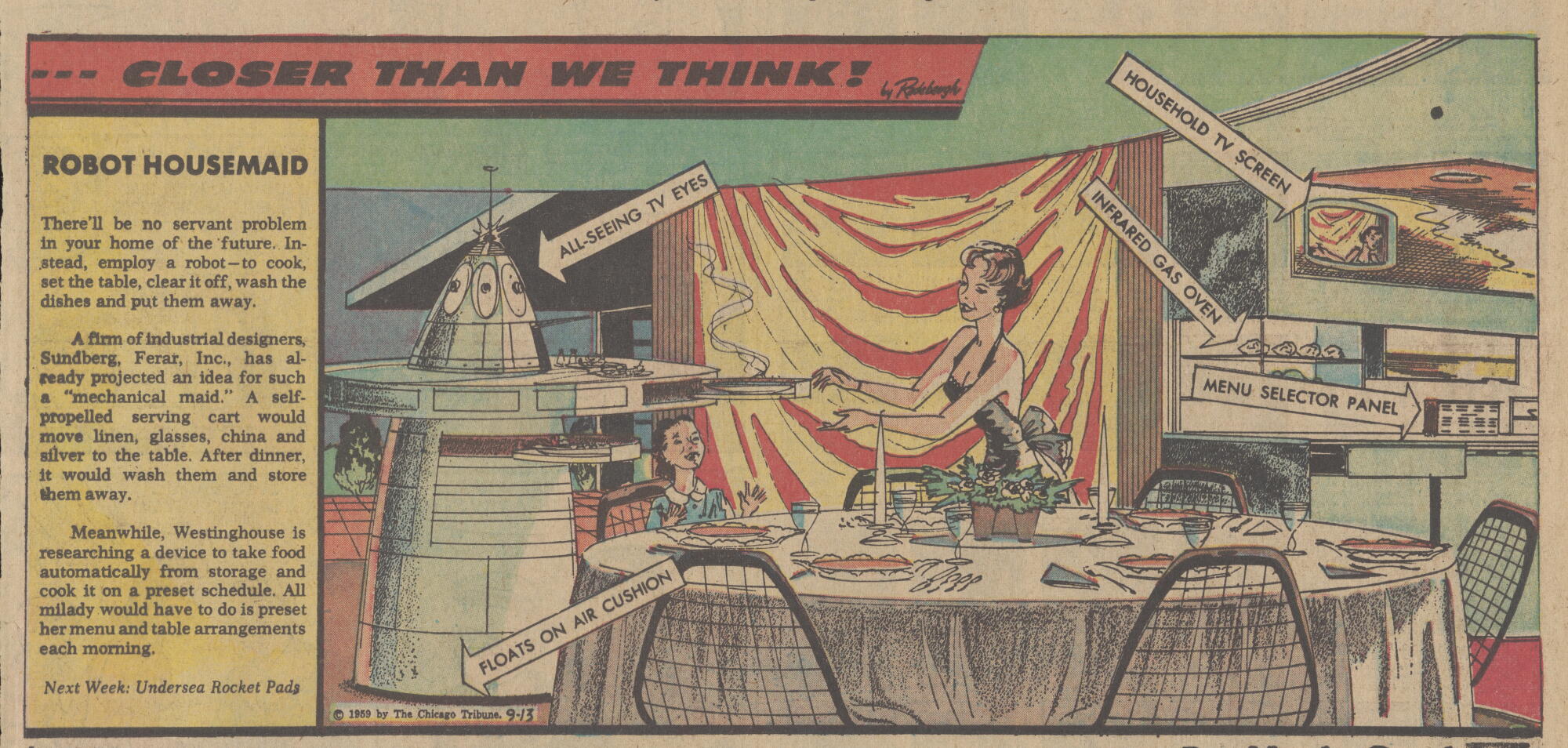
Arthur Radebaugh, “Closer Than We Think! Robot Housemaid,” 1959.
(Chicago Tribune / TCA, photo courtesy San Francisco Academy of Comic Art Collection, Billy Ireland Cartoon Library and Museum, Ohio State University)
At every turn a vision of a better life was made to seem desirable and, just as important, inevitable. Like any good advertising, it worked best when soothing our anxieties and tapping into our fantasies.
In the 1920s and ’30s, new discoveries about hygiene inspired products by soaring talents in the nascent field of industrial design who set out to create clean, easily maintained homes — laboratories for healthy living in an age still ravaged by diseases like polio and tuberculosis. Mathias J. Weber and Russell E. Vanderhoff’s seductively streamlined Health-o-Meter scale gave the illusion that homeowners could be scientists, for the first time monitoring their own weight and growth. Kohler’s Integra, introduced as “the toilet of the future” at the Chicago fair, had a dramatic black finish made to equate sanitation with modern design. And Bruce Goff’s gleaming Vitrolite kitchen for Libbey-Owens-Ford glass company, shown in Charles Turzak’s rendering, integrated pigmented structural glass counters and cabinets into a polished, easily cleaned whole.
American Stove Co., Magic Chef stove, series 1400, introduced 1935.
(Lynton Gardiner / The Wolfsonian–Florida International University )
Vast expansions in electricity, telecommunications and production promised to connect the country and ease the tedious work of cooking, washing and cleaning. The American Stove Co.’s Magic Chef stove, one of the first ovens to be equipped with a clock, recast kitchen work as something that could be measured and controlled. Frank G. Brotz’s Kohler Electric Sink, which incorporated a motorized dishwasher into the familiar basin, promised release from the “thrice-daily drudgery” of washing dishes. Western Electric’s clear-cased Model 302 telephone enticed gawkers with an impressively complex system of wires and mechanisms.
George R. Lum for Western Electric Co., Telephone, model 302, desk set 1938.
(AT&T Archives and History Center)
Many of the names who dreamed up these wonders are now etched in design history. Isamu Noguchi created a baby monitor before baby monitors were a thing: the Radio Nurse, a dark Bakelite receiver resembling an abstract face. Walter Dorwin Teague gave corporate products a precise, machine-age polish, while Raymond Loewy brought the same sleek optimism to objects like the globe-shaped New World radio for Colonial Radio Corp., molded in glossy, heat-resistant Catalin and embodying quite literally the new reach of communications.
Selling this promise of a technological future to those clinging to the dream of American prosperity was an especially potent exercise during the Depression. In his illustrated 1932 manifesto “Horizons,” Norman Bel Geddes cast “new design” as a path toward “economy, efficiency, comfort and happiness.” As the economy faltered, an orderly, healthy home could be sold as a form of salvation, with prosperity seemingly within reach. At the Chicago fair, corporations sponsored full-scale model homes and filled them with products already available or soon to be. For rural households still without electricity, Lester Beall’s 1937 Rural Electrification Administration poster “Wash Day” turns federal infrastructure into a household fantasy. Inside the black silhouette of a farmhouse, a pristine white washing machine appears at an almost monumental scale, set against flat fields of saturated color.
Irving Harper of George Nelson and Co. for Herman Miller Inc., Marshmallow Love Seat, model 5670, designed 1956, this example made c. 1960s.
(Jonathan Urban / Museum Associates / LACMA)
By the ‘40s and ‘50s, the postwar home and its many accouterments — powered by wartime advancements, growing abundance and an ethos of “buy now, pay later” — amplified the promise. Plastic, prefabrication and push-button convenience suggested that mass production could bring elegant, futuristic living — and freedom from drudgery — within reach of the masses. George Nelson treated furniture as a flexible system, producing (with designer Irving Harper) the candy-colored Marshmallow Love Seat; replacing conventional upholstery with 18 brightly colored circular cushions mounted on a spare steel frame. Eero Saarinen produced the molded-fiberglass Pedestal chair, sweeping the seat and stem into a single sculptural form intended to eliminate what he called the “slum of legs” beneath tables and chairs.
Eero Aarnio for Asko Oy, Ball Chair, designed 1963.
(Jonathan Urban / Museum Associates / LACMA)
Architects attempted to make the home itself into a sexy product. At Disneyland, Monsanto’s House of the Future, designed by architects Richard Hamilton and Marvin Goody, was a gleaming, cross-shaped structure of molded plastic, raised above the ground on cantilevered supports and partnered (in renderings) with a plastic heliport. Its kitchen featured molded surfaces and electric appliances. Promotional images and films conjured a playful, adaptable and benevolent house — plastic as the building block of family happiness.
Buckminster Fuller’s Dymaxion house was an aluminum, factory-made “dwelling machine” that could be delivered by air and assembled almost anywhere. Its unified form, modular furnishings, water-recycling system and labor-saving technology promised a more efficient life, less tied to conventional building and household routines.
Hamilton & Goody Architects, Monsanto House of the Future, 1956.
(MIT Museum)
Institutions like the Museum of Modern Art and magazines like Arts & Architecture promoted prototype homes from now legendary industrial designers and modernist architects like Saarinen, Charles and Ray Eames, Marcel Breuer, Albert Frey, Gregory Ain and even Frank Lloyd Wright.
Effective pitches could turn a product, whatever size, into a fantasy of freedom. In the General Motors film “Design for Dreaming” (1956), directed by William Beaudine, a woman enters a fabulous kitchen as if in a magical dream. The promise, said curator Wendy Kaplan, was that the fictional woman would have more time for “tennis and hanging with … friends.” The dream even hinted at a life beyond domesticity — perhaps even freedom to “actually have a profession,” Kaplan added.
But the housewife in these displays was still expected to remain responsible for the home. Liberation came through a more efficient kitchen, not a change in who cooked. And appliances that reduced some labor often raised the bar: more frequent washing, more cleaning, more elaborate meals, as University of Chicago home economics professor Hazel Kyrk described in “Economic Problems of the Family.”
Frank G. Brotz for Kohler Co., Electric Sink, introduced 1926, this example 1928, Kohler Co.
(Kohler Archives)
That universal “everyone” did not, however, include everyone. Government-backed home ownership and the suburban boom excluded many Black, Latino and Asian Americans through redlining, restrictive covenants and discriminatory lending — a fact reflected in the almost complete absence of minorities in these vast selling campaigns.
A few welcome exceptions on the creators’ side are architect Paul R. Williams’ “Small Home of Tomorrow,” which proposed a simple, well-designed home fitted with gee-whiz appliances; Arthur Elrod and William C. Raiser’s swirling, vivid orange Ebony test kitchen, which treated cooking as creative craft; and the proposed multiracial community of Soul City, founded by Floyd McKissick, which imagined homeownership as a claim to economic autonomy that segregation denied.
The vision of a utopian domestic future took a strange turn during the Cold War, marrying the breathless excitement of the space age with the existential dread of nuclear annihilation. The same scientific power that had transformed lives now produced weapons capable of destroying humanity. The home was imagined as both shelter and command center.
Office of Donald Deskey Associates. Drawing, design for Undersea Lounge: Scheme 3 Interior Perspective, ca. 1960s. Designed by Russell Heston (b. 1929).
(The Estate of Donald Deskey, courtesy Cooper Hewitt, Smithsonian Design Museum / Art Resource, NY)
As the age’s potent mix of terror and delirium spun on, designers and illustrators proposed ways to live comfortably in space, underwater or in underground bunkers. Paul László’s “Atomville, U.S.A.,” a vision of suburbia half a century in the future, buried the family home beneath an earthen shell that doubled as a helicopter landing pad. Its sunken gardens and swimming pool promised comfort, while a blast door, escape hatches and air filtration protected against nuclear fallout. Donald Deskey Associates imagined a hypnotic “Undersea Lounge,” a self-contained interior for living beneath the water, while NASA illustrator Rick Guidice vividly depicted physicist Gerard K. O’Neill’s proposed Stanford Torus — an enormous, wheel-shaped suburb in space.
Bob Lerner for LOOK Magazine, Anne Anderson in RCA Whirlpool Miracle Kitchen, 1959, kitchen designed 1956.
(Library of Congress, Prints and Photographs Division, LOOK Magazine, Photograph Collection / Robert S. Lerner Photography, LLC)
An endless array of products leaned into the public’s awe at the age’s sci-fi possibilities. This included prescient pieces ahead of their time, like the video-enabled AT&T Picturephone, and those that would never come to pass, such as the RCA Whirlpool Miracle Kitchen. The latter’s spread in Look Magazine (displayed for crowds at the 1959 American National Exhibition in Moscow) showcases a Roomba-like vacuum and other astonishing appliances that seem to work by themselves. But men hidden behind two-way mirrors actually operated them. Others, like the two-wheeled Ford Gyron Remote Control Car of the Future, only managed to come to life as children’s toys; and some were just plain ridiculous, like Honeywell’s H316 Kitchen Computer, which required a two-week training course just to retrieve a recipe.
By the late 1960s, confidence in technological progress was fraying. Environmental damage, plastic waste and the conformity of suburbia prompted designers and countercultural communities to imagine other ways of living — up to a point. The residents of Drop City, a Colorado artists’ community, built domes from the curved steel tops of salvaged cars. Architects Barry Simpson and Charles Hosford made a folding stool that could serve as a seat, stepstool or side table. Small, portable, multipurpose designs, from inflatables to cardboard furniture offered a life with fewer possessions. The Whole Earth Catalog, founded by writer and editor Stewart Brand, promoted ecological knowledge and self-sufficiency, but was still a compendium of things to buy.
Companies, too, found ways to sell all natural products, flexibility and individual expression. Zanotta advertised the first beanbag chair, the polystyrene-filled “Sacco,” as “A Big Bag, a Soft Seat.” Its formless body accommodated slouching, lounging or lying down, selling freedom from both conventional posture and the bourgeois living room. Even resistance to consumerism could be packaged as a new consumer ideal.
The pairing of objects with their promotional campaigns is the show’s most illuminating contribution, shedding light on the massive, often strange apparatus needed to drive these incredible designs — some icons, some welcome surprises — forward in each age. It reveals how the country’s 20th century manufacturing prowess expanded into the production of dreams. Corporations, government and the media taught consumers what progress should look like, which anxieties a product might soothe, and what kind of future to desire.
Isamu Noguchi; Zenith Radio Corporation, Radio Nurse receiver and Guardian Ear transmitter with original box, 1937.
( Museum Associates / LACMA)
But the sheer abundance of objects — I haven’t even mentioned the fascinating companion show-within-the-show, “The Kitchen and Its Discontents” — leaves less room for examining those campaigns and the work they performed. The excellent catalog follows those connections further, tracing how often hypnotic visions of the future home both reflected and shaped ideas about lifestyle, progress, gender, race, labor and consumption; in the galleries, those ideas remain largely suggestive.
Still, the exhibition offers a revelatory history — and a telling roadmap to our present. While the future imagined here made life easier, cleaner, more beautiful and more exciting, it did not arrive as advertised. The plastic home didn’t remake housing; the automated kitchen didn’t free women from domestic work; the self-sufficient home gave way to new forms of reliance. Yet a similar techno-utopian pitch survives in today’s smart homes and domestic technologies, from assistants like Alexa to artificial intelligence marketed as a way to make life easier. These tools may offer real benefits even as they addict and distract us. And while the systems sustaining our comfortable, consumption-driven lives launch us toward climate disaster.
These rooms powerfully evoke what Kaplan in the catalog calls America’s “restless forward motion, powered by the conviction that tomorrow’s design would solve today’s problems.” That ingenuity is worth celebrating. But its promises deserve open-eyed scrutiny.
LAS VEGAS — Kayla Thornton scored 18 points and the second-year Golden State Valkyries became the quickest expansion team to reach the WNBA Finals, sweeping the defending champion Las Vegas Aces 87-77 in overtime Friday night in Game 3.
The second-seeded Valkyries will have home-court advantage and will host No. 4 Atlanta beginning Oct. 17. The Dream swept New York earlier on Friday, and now teams are 22-0 in playoff history when leading a series 2-0.
Las Vegas, which was seeded third, had won three of the past four championships.
Gabby Williams added 16 points for the Valkyries, including eight in overtime. Former Aces Kiah Stokes and Tiffany Hayes each had 11 points, and Stokes also grabbed 10 rebounds.
A’ja Wilson, honored before night’s game for winning an unprecedented fifth MVP, scored 21 points, but on six-for-19 shooting for the Aces. She also had 10 rebounds, joining DeWanna Bonner as the only players with 1,300 points and 600 rebounds in the postseason.
Jackie Young added 18 points and Chelsea Gray 17.
A 17-point run bolted Golden State past the Aces for a 53-47. Las Vegas closed within a point by the end of the quarter, giving the Aces only seven points in the period.
The Aces led by six points late in the game before the Valkyries evened the score when Gabby Williams stole the ball from Wilson and Thornton finished with a transition layup to make it 69-69 with 1:50 left.
Golden State then took the lead Veronica Burton’s 9-foot floater with 1:12 remaining. The Aces tied the score on Gray’s inbound pass to Young with 27 seconds left and ultimately force overtime.
The extra period belonged completely to the Valkyries, who outscored the Aces 16-6.
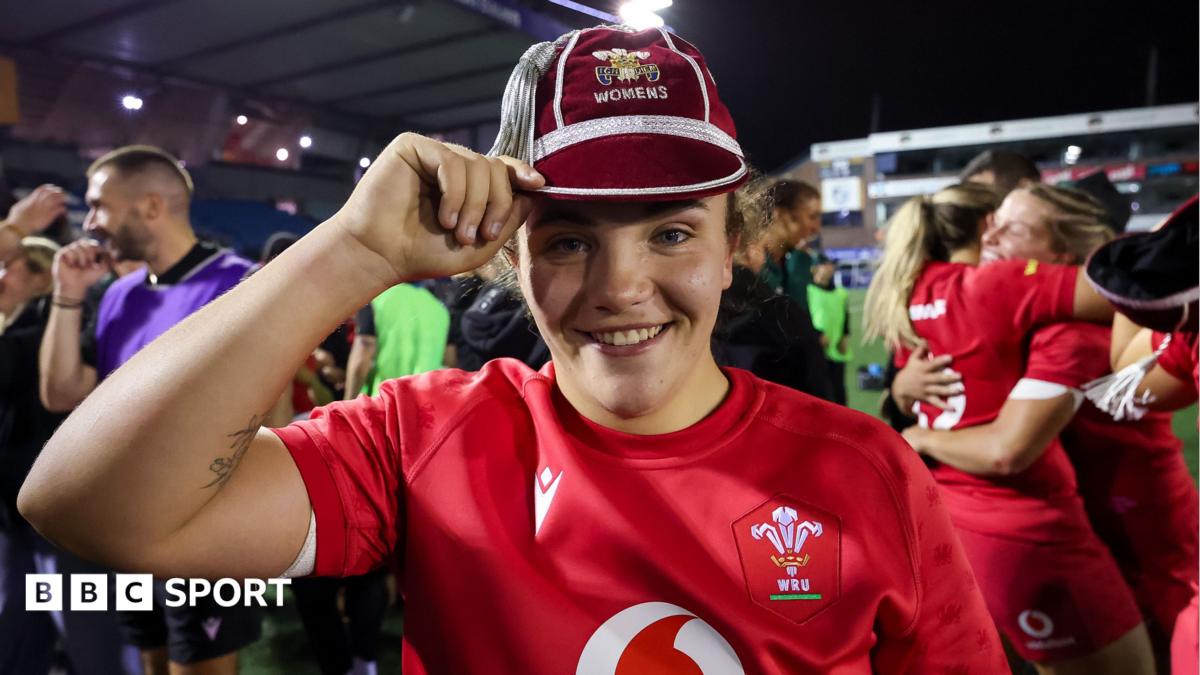
Shanelle Williams has already fulfilled one childhood ambition after making her Wales debut and now she is preparing for another milestone in Japan.
The 19-year-old former Gwernyfed RFC junior came off the bench in Wales’ 50-19 win over South Africa in the WXV Global Series in September.
As a child, Williams had written on her Christmas list that she wanted to play for Wales.
“I didn’t actually know that there was a women’s team,” the hooker said.
“I used to tell my dad that I was going to play for Wales with the boys.
“Then I obviously realised that I actually can play for Wales. Since then, everything I’ve done, rugby’s always been a priority.”
Williams had forgotten about the Christmas list until her older sister reminded her after she won her first Wales Under-18 cap.
“It’s quite a nice reminder that I have been working for this for so long, so it has all been worth it,” she said.
Williams started playing rugby at Gwernyfed aged eight, spending four years there before joining the Red Kites and later moving into the Wales pathway.
She went on to play for Cardiff Quins and Cardiff Rugby before attending Hartpury College.
Her father played a key role, regularly making the journey from home to Cardiff for training.
“Obviously I’m from Gwernyfed, so it was about an hour and a half down to Cardiff,” she said.
“He used to take me for training on Friday nights straight after school.
“I wouldn’t have been able to do it if my dad hadn’t given me that opportunity, so I’m very lucky.”