Over the last year, activists have organized droves of people across the United States to protest and petition Congress over concerns that the Trump administration will sell off our most beloved outdoor spaces.
We’ve worried about general threats to public lands, such as whether the 700,000-acre Angeles National Forest or the 150,000-acre Santa Monica Mountains National Recreation Area will remain pristine protected landscapes. We’ve also seen specific examples of what activists have cautioned could happen: a large mining operation that could open just outside Joshua Tree National Park and a large housing development proposed at the border of Yosemite National Park.
And although that attention is more than warranted, for those of us living around Los Angeles, it’s crucial that we not miss a similar, quieter battle being fought locally by nonprofits and public agencies. Here in L.A., our wildlands are often protected parcel by parcel.

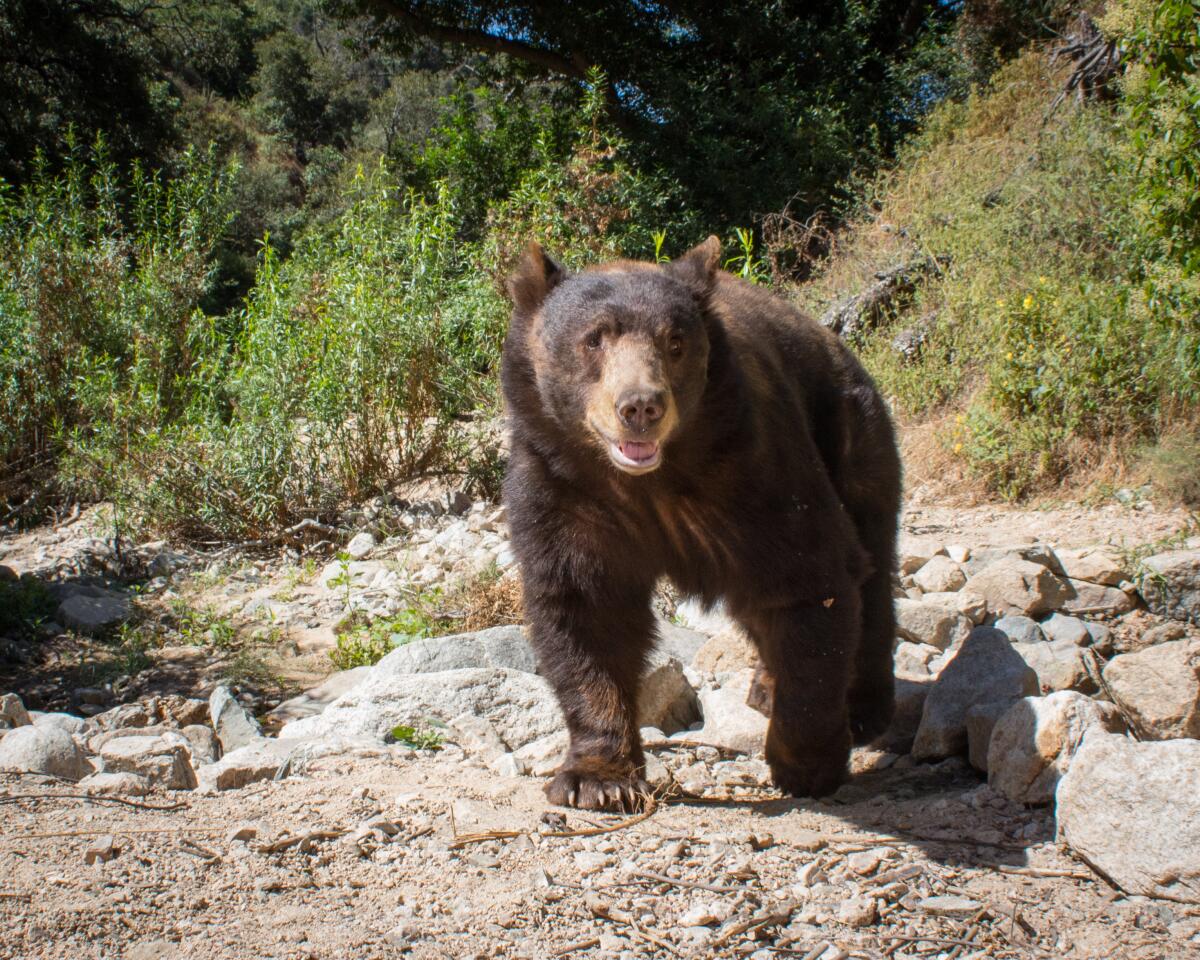
A bear meanders through the Rubio Canyon Preserve.
(Johanna Turner)
It’s a time-consuming, expensive and rewarding job that the Arroyos & Foothills Conservancy has been performing for, as of Friday, when the group celebrates its anniversary, 25 years.
I spoke with conservancy leaders about their vision to create an expansive corridor for wildlife moving among our mountain ranges. This would help combat climate change locally, make hillsides more fire resistant and ensure biodiversity among our local animals.
The Arroyos & Foothills Conservancy started with four neighbors — Altadena residents Nancy Steele, Astrid Ellersieck, Diane Walters and Lori Paul — who organized against a housing development that ultimately was constructed.
“They were unsuccessful in preventing the project, but they realized that working together, they could be powerful,” said Barbara Goto, the conservancy’s director of operations.
The group first launched the Altadena Foothills Conservancy with the hyperlocal focus of protecting the neighboring hillsides and canyons from development. Over the next seven years, the organization’s vision expanded to include the foothills of the San Gabriel Mountains, and it started operating under its current name.
The organization has saved more than 140 acres from development since its founding. To identify ideal properties, they’ve used wildlife cameras, mapping software and other available data.

A Pacific tree frog (Pseudacris cadaverina) male, calling with extended throat, at Rubio Canyon.
(Althea Edwards)
The process to purchase those properties is often long and arduous. Conservancy staff must persuade a property owner to sell at fair-market price — a stipulation when the conservancy uses state funding to buy property. The owner must also be patient enough to wait for the conservancy to cobble together grants to buy the land.
After buying the land, the conservancy establishes a “friends” group — like Friends of Rubio — comprised of volunteers who yank invasive plants, reestablish trails (if applicable) and rebuild or restore passageways to make the property as appealing to animals as possible.
And it works.
The 41-acre Rubio Canyon Preserve, which sits about four miles northwest of Eaton Canyon, is regularly frequented by bears, mountain lions and deer passing to and from Angeles National Forest and the foothill landscape.

Two gray foxes appear to play together in Millard Canyon.
(Denis Callet)
At the conservancy’s Rosemont Preserve, volunteers have essentially removed all invasive castor bean, arundo (which clogs streams) and tree tobacco, which crowd out native plants and harm the landscape. It’s no surprise that the conservancy has documented 10 different mountain lions over the last nine years there (even though the preserve is surrounded on multiple sides by neighborhoods).
When the conservancy staff invited me to visit one of their preserves, I was eager and skeptical. I grew up in rural America, where my family’s 300-acre goat ranch was considered small. I’ve met ranchers who own essentially entire counties of land, especially around the Oklahoma-Texas Panhandle.
I had a bias going into this story. I assumed you needed big swaths of property to really make a difference. I realized how wrong I was when I visited the conservancy’s Cottonwood Canyon in Pasadena.
It is only 11 acres, but it is one of the most significant properties the conservancy has acquired. But that wasn’t immediately obvious.

A coyote trudges through the Rosemont Preserve.
(Denis Callet)
As John Howell, the conservancy’s chief executive, and Tim Martinez, the organization’s land manager, led me through the preserve, shaded by massive oak trees, they explained that a local educator had reached out to let the organization know that the property, which had been owned by the same family since 1885, would be up for sale.
The organization soon realized a few key details about the land. For one, it has a small-but-mighty spring that flows year-round into the Arroyo Seco. It is one of only two known year-round water sources for wildlife in the region, they said, a significant resource given how drought can dry up much of the nearby rivers and creeks.
But Cottonwood’s importance grew much larger when a staffer at the California Department of Fish and Wildlife pointed out during a visit to the property, Goto said, that the land could serve as a vital piece in a wildlife corridor puzzle. The land sits between the Hahamongna Watershed Park in La Cañada Flintridge to its east and the San Rafael Hills and Verdugo Mountains to its west.
“They’re like, ‘These are natural open spaces that need to be connected — these natural open spaces are large enough to support wildlife populations,’” Goto said. “So that is when our mission changed.”

A lesser goldfinch sings a little tune at Sycamore Canyon Preserve.
(TJ Hastings)
The organization has since pushed for the creation of the Hahamongna to Tujunga Wildlife Corridor, a 20-mile stretch that would link the San Gabriel Mountains at Hahamongna Watershed Park to the San Gabriels at Big Tujunga Wash for wildlife passage through the San Rafael Hills and the Verdugo Mountains. (For a great visual, visit arroyosfoothills.org.)
This type of effort helps ensure that, for example, mountain lions don’t end up like the famous Griffith Park mountain lion P-22, surrounded by roadways and unable to safely look for a mate, or worse.
“P-41 was the resident cougar in the Verdugos and was there for 10 years with Nikita, and they sired two sets of two cubs,” Howell said. “And [with] the first set, one died on the 134 [Freeway] and the second one died on the 210 [Freeway]. And the second set were found emaciated under a car in Burbank, and they had to be saved.”

A mountain lion crosses through Millard Canyon.
(Johanna Turner)
One challenge the conservancy faces in building out the Hahamongna to Tujunga Wildlife Corridor, Goto said, is how state funding is allocated. It is coincidentally similar to my own bias going into this piece.
Goto said that, as incredible as California’s “30×30” goal is — to conserve 30% of California’s lands and coastal waters by 2030 — “it makes it very difficult to get funding for small parcels.”
Much of the money to buy public lands comes from bond measures, and although L.A. County arguably has one of the biggest voting blocks that passed those measures, a substantial amount of bond money goes to buy property in Northern California, where large plots are more ample, Goto said.
“It’s when we’re working on these wildlife corridors that don’t necessarily have water and are much smaller, that’s where it really gets difficult,” Goto said.
And sometimes all that’s needed is a parcel of land.

A curious deer at Cottonwood Canyon Preserve.
(Arroyos & Foothills Conservancy)

3 things to do

The L.A. River bike trail near Griffith Park.
(Los Angeles Times)
1. Mosey on down the river in Elysian Valley, a.k.a. Frogtown
L.A. Climate Week has organized an L.A. River Crawl from noon to 5 p.m. Saturday in Frogtown. Several local organizations and businesses will be open along the route, offering live music, poetry, food pop-ups and family-friendly activities about climate change and ecology. To learn more, visit laclimateweek.com.
2. Gaze at the stars in San Diego
San Diego County Parks will host the Festival of the Night Sky and Nocturnal Creatures from 5 to 10 p.m. Saturday at the Los Peñasquitos Ranch House (12122 Canyonside Park Drive) in San Diego. This free all-ages event will include birdwatching, stargazing via telescopes and a night hike where participants will try to spot scorpions, crickets and bats. Visitors are encouraged to bring binoculars, flashlights, jackets, drinks and snacks. Learn more at the agency’s Instagram page.
3. Journal with genuine curiosity in L.A.
The L.A. City Department of Recreation and Parks will host a guided walk with nature journaling from 9 to 11 a.m. Sunday at Griffith Park. A guide will take hikers on a short walk before the group pauses to capture what they’ve noticed in journals. Some materials will be provided, but guests are encouraged to bring what supplies they have. Register at eventbrite.com.

The must-read

A professional guide with Times reporter Jack Dolan, right, set off near Donner Pass trailhead on a route taken by a backcountry ski group struck by an avalanche north of Tahoe on Feb. 17.
(Danny Kern / For The Times)
After hearing news of the deadliest avalanche in California history, many of us wondered how such a thing could happen given our access to weather data even in the most remote places. Times staff writer Jack Dolan retraced the steps of a guided backcountry ski trip where 13 people, including nine who died, were buried in snow during an intense blizzard. “Deep in a wooded ravine, bathed in warm sunlight, we knelt behind the makeshift memorial of flowers and looked up the slope that sent tons of snow barreling down,” Dolan wrote. “All we could see was a slight rise and a healthy forest of full-grown pine trees.”
There are no right words to say to capture the magnitude of heartache around this tragedy. The search for answers is one step in a long grieving process.
Happy adventuring,

P.S.
Valentine continues her quest for love, folks! The wolf who made history earlier this year when she entered Los Angeles County in search of a mate has made history for a second time. “The 3-year-old female with black fur entered Inyo County around 7 a.m. Sunday about 20 miles south of Mt. Whitney,” Times staff writer Lila Seidman wrote. “She became the first documented wolf to set paws in the Eastern Sierra county in more than a century, according to state wildlife officials.” It’s only been two months, meaning Valentine and her future mate could still qualify for a canine version of “90 Day Fiancé”!
For more insider tips on Southern California’s beaches, trails and parks, check out past editions of The Wild. And to view this newsletter in your browser, click here.