As Latin America turns to the dollar, development capital tests its reach.
This article appears in the October issue of Global Finance Magazine.
Whether dollarization works has been debated for decades, and in late summer it landed in Venezuela. Steve Hanke, known as the “Money Doctor” for advising governments on dollarization in Eastern Europe, Asia, and Latin America, told multiple media outlets that he had been hired as a special adviser to a Venezuelan official to explore dollarizing the bolivar.
If it converted to the dollar, Venezuela would join several Latin American countries that have done so. Panama has used the dollar as legal tender since 1904. Ecuador has used the dollar since 2000; El Salvador converted in 2001. Although Argentina has not dollarized, there is evidence that President Javier Milei has accelerated its de facto shift to the dollar. Less examined is which organizations are investing in dollarization—and whether that capital is doing something dollarization alone can’t.
For CFOs with projects, suppliers, or growth aspirations in dollarized countries—or those moving that way—the balance sheet is the best way to assess the role of development capital. A currency conversion can affect hedging costs, discount rates for capital projects, and the timeline for moving cash. But the money now supporting these transitions or future moves to dollarization, including billions in US development-finance capital, political risk insurance, sovereign debt refinancing, and project loans, carries its own track record worth mulling over before using “dollarized” as shorthand for “de-risked.”
Where Development Capital Lands
The International Development Finance Corp.’s (DFC) Latin American strategy is more than writing large checks. Its CEO Ben Black calls the strategy “economic statecraft”—capital deployed to counter Beijing. “You don’t want to compete against state capitalism with more money from the government,” Black said at a March forum. “You want to create capital structures that bring in private capital.” In Ecuador, where the U.S. dollar is legal tender, the agency’s 2021 framework was linked to a proposed, broader $3.5 billion financing structure. It combined up to $2.8 billion of potential DFC-backed project financing with roughly $700 million from commercial banks, intended to help Ecuador refinance China-related liabilities.
The agency’s completed transactions are more varied. DFC made a $150 million direct loan to expand Ecuador’s Puerto Bolívar port. It also provided political-risk insurance of more than $656 million for the 2023 Galápagos debt conversion and $1 billion for the country’s 2024 Amazon Biocorridor conversion. The latter helped refinance about $1.53 billion of Ecuadorian international bonds. For CFOs looking through a balance sheet lens, Puerto Bolívar is a DFC loan asset. The two larger headline amounts are insurance commitments that could help attract third-party capital.
In Argentina, where dollars are widely used but not the official currency, DFC’s financing is smaller and tied to resource development. The agency approved $4.07 million for early-stage work at Argentina Potash Corp.’s El Ceibo potash project earlier this year. The company expects more dollars to follow. “The US$4.07 million DFC funding is expected to be matched dollar-for-dollar by strategic investors, resulting in total Phase 1 funding of US$8.15 million,” according to a company statement.
Leading Risk vs. Following Money
The Argentina Potash deal points up a divide over where development finance has the most impact: taking risks that private capital won’t or reinforcing markets where private capital is already willing to go. DFC and its defenders argue that the capital leads: the agency takes on risk private investors won’t touch and proves out a sector or structure until commercial capital is comfortable following. Another group argues DFC capital mostly follows. Its development dollars tend to land in the safest, most liquid corners of an economy, such as banks, infrastructure and assets that would likely have attracted private capital anyway.
The harder, riskier investments that dollarization was supposed to encourage still go unfunded. If development capital leads, it’s doing something dollarization alone can’t. It is building the risk tolerance and track record that pulls in private money on its own. If it mostly follows private capital, DFC funding may simply be competing for the safest returns, while the risks that keep money out of harder-to-finance sectors remain.
That’s the view of Byron Villacis Cruz, a University of Oregon sociologist and former head of Ecuador’s national statistics institute, who has studied Ecuador’s dollarization. He said DFC-linked capital has gone toward “traditional banks that … have a lot of liquidity and coverage and stability by itself” rather than higher-risk, higher-need sectors.
“I don’t see investments that are truly analyzing the real opportunities of profit and development in the country,” he said. “That’s kind of like going where the money is versus leading the money.” He also cautions that dollarization solved currency volatility in Ecuador without touching the risks investors cite—regulatory whiplash, contract enforcement and political interference. Foreign investment after 2000 flowed overwhelmingly into oil, he noted, driven by commodity prices, not the new monetary regime.
Casey Halloran has a different view: his tourism and real estate development company, Namu Travel Group in Costa Rica, borrows from the Inter-American Development Bank specifically to relend to small suppliers—boutique hotels and tour operators across the region—that banks often consider too risky to touch. Over the years, Halloran estimates his business has lent about $15 million since first obtaining IDB financing. He’s convinced development capital leads, saying, “Somebody has to go first.”
Weld Royal is a contributing writer based in the U.S.
The decision has drawn sharp criticism from left-wing politicians and environmentalists.
Published On 21 Oct 202621 Oct 2026
The United Kingdom’s government has approved a natural gas project off the coast of Scotland, as the Labour government seeks to balance its climate goals with energy security concerns.
Energy Minister Miatta Fahnbulleh said on Wednesday that the Jackdaw gasfield would begin supplying energy to UK homes by the end of the month and would help to boost the country’s energy security.
Recommended Stories
list of 3 itemsend of list
The government said the North Sea project would increase UK gas production by about 6 percent at its peak.
Prime Minister Andy Burnham said the decision will “protect hundreds of jobs and help keep millions of homes warm”, but stressed it would not hinder the government’s targets on renewable energy.
The government also announced a New Energy Wealth Fund, which will invest in renewable and low-carbon energy projects as part of the green transition.
The fund has been established with an initial 2 billion pounds ($2.7bn), with plans to raise additional funds through tax revenues from North Sea oil and gas.
Higher energy prices amid the Russia-Ukraine war and the United States-Israel war on Iran have weighed on households and businesses, dragging on Britain’s economy.
Fahnbulleh told UK radio station LBC that the development of Jackdaw would not bring down household energy bills.
“I think it’s really important that we’re honest about this,” Fahnbulleh said.
“That was not a consideration in the decision because it won’t mean cheaper bills. This was about energy security.”
The announcement has drawn criticism from left-wing politicians and environmental groups.
Zack Polanski, the leader of the opposition Green Party, described the decision as “climate vandalism”.
“Surreal to hear [the] energy secretary try and say this is a ‘pragmatic decision’,” Polanski wrote in a post on X.
“It will do nothing to lower bills. It will do lots for the profits of the oil and gas companies. And will continue us further down the path of floods and wildfires.”
Environmental group Greenpeace said the decision showed “the toxic grip fossil fuel lobbyists still hold over our energy policy”.
“True pragmatism means severing our reliance on expensive oil and gas that leaves British households broke, supercharges extreme weather, and leaves our energy security at the mercy of petrostates,” said Ami McCarthy, head of politics at Greenpeace UK.
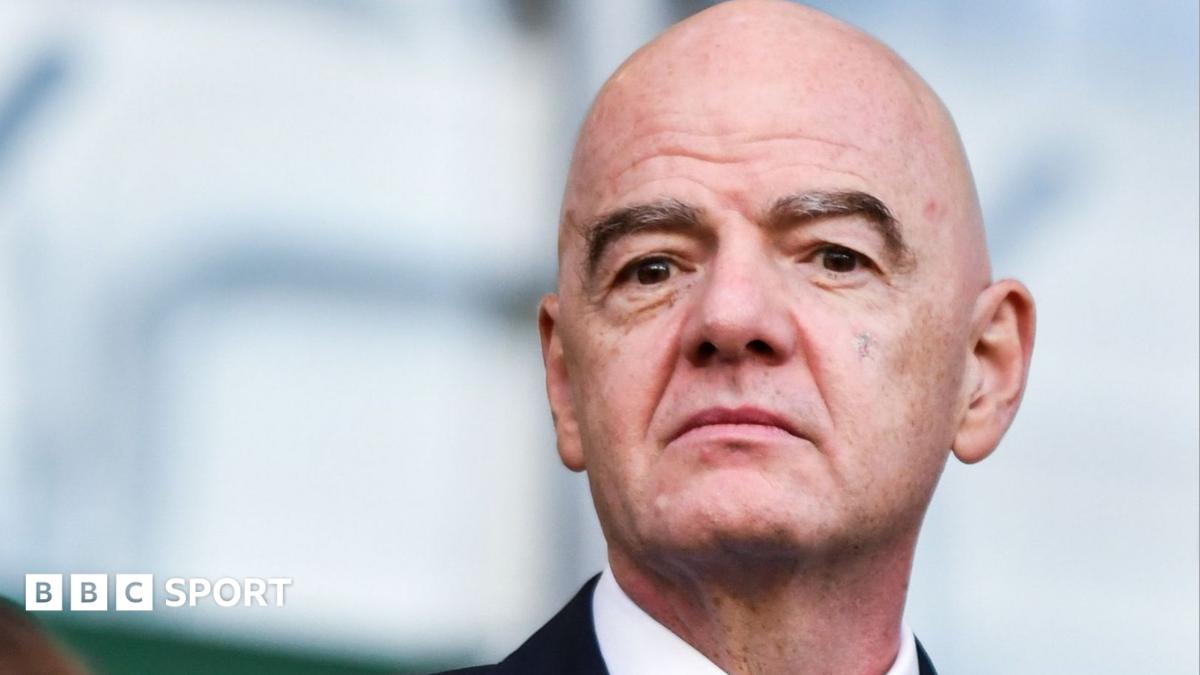
Fifa is set to propose a $3.4bn (£2.6bn) increase in the amount of money it hands out for football development across the world.
World football’s governing body wants to release the money from its reserves in a move which BBC Sport has been told would double the level of planned distribution funding for 2027-2030.
The proposal will be made at a meeting of Fifa’s council on Thursday and comes at a time when the organisation is under pressure following president Gianni Infantino’s aborted Fifa Forward Enterprise (FFE) plan.
Infantino wanted to sell stakes in the World Cup and other competitions to private investors but faced huge criticism for the proposal, with Uefa, Concacaf and the Asian Football Confederation questioning his position.
In a letter then sent to Fifa’s six continental confederations, Infantino – who will be standing for re-election for a fourth time in March 2027 – said he would support “the greatest level of additional funding that can responsibly be delivered”.
Fifa will now offer extra money from its reserves in addition to the current $2.7bn budgeted to be paid to all 211 member associations, the confederations, regional associations and certain non-Fifa affiliated associations.
The breakdown is as follows:
• $25m (£19m) per member association
• $99m (£75m) for each of the six confederations
• $8.25m (£6.3m) for each of the 13 zonal/regional associations
• $1.1m (£836,000) for 100 member associations for travel and equipment solidarity
The terms of the distribution would be as follows:
• One third would be allocated to women’s and youth football development
• One third would be allocated to infrastructure (of which there shall be equal access to women’s and youth football)
• One third would be allocated to projects
The plan, including the eligibility, application, approval, disbursement, control and audit requirements, will be finalised by the Fifa council at its next meeting in December 2026.
It will all be subject to approval by the 77th Fifa congress in March 2027.
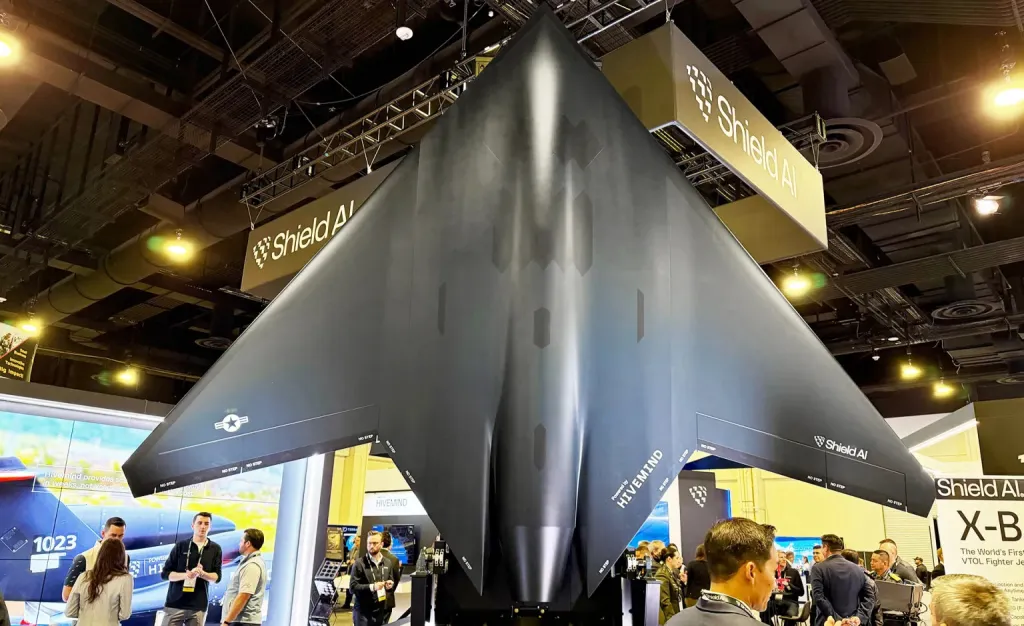
Shield AI says it is on track to roll out the first prototypes of its X-BAT jet-powered stealth ‘fighter’ drone by the end of this month. Flight testing of this uncrewed aircraft, which is designed to take off and land vertically from a tail-sitting position, is still scheduled to kick off before the end of the year. X-BAT’s core concept was already highly ambitious, but an extremely aggressive timeline to reach some degree of operational capability through the U.S. Navy’s Runway Independent Maritime Expeditionary Strike (RIMES) program has now been disclosed.
TWZ got an update on X-BAT, which we were first to report on in-depth last year, in an interview yesterday with Shield AI’s Armor Harris, Senior Vice President and General Manager of the company’s aircraft division. This came ahead of today’s announcement that the company has received an additional $150 million in funding from the Office of the Under Secretary of War for Acquisition and Sustainment through its Defense Exportability Features program via the Navy. This is on top of the $50 million investment the Navy, in cooperation with the Pentagon’s Defense Innovation Unit, made in X-BAT’s development earlier this year as part of the RIMES effort. Shield AI has committed an equivalent amount of internal funding, for a combined total of $400 million.
Jamie Hunter
“In broad strokes, the last year has been a bunch of collaborative risk reduction with the Navy. So, wind tunnel testing, engine testing, thermal testing, all kinds of stuff to basically take the major risks in the program, [and] burn them down, so we can move confidently into the production design,” Shield AI’s Harris told us. “The last culmination of the risk reduction is the flight testing of the two full-scale prototypes. The first one of those will be done at the end of October.”
“That’s a full-scale vehicle,” he continued. “It’s got the outer mold line, it’s got the F110 engine, the full propulsion path, everything in it.”
To date, Shield AI has only shown models of the X-BAT publicly. A new one displayed at the Navy League’s Sea-Air-Space 2026 exposition in April revealed major changes to the core design. This included a complete reworking of the planform from a ‘cranked kite’ type arrangement to one with a distinctly different arrowhead-shaped profile featuring a straight leading edge with a more dramatic sweep.
The video below includes clips showing the original X-BAT design and the current one.
X-BAT is on the way.
The aforementioned “propulsion path,” testing of which has already been conducted on the ground, primarily consists of the General Electric F110 paired with an Axisymmetric Vectoring Exhaust Nozzle (AVEN). The nozzle was originally developed in the 1990s for an experimental thrust-vectoring F-16 fighter. Shield AI is using the original AVEN, which had been in storage for decades, to support development of X-BAT. The nozzle will provide pitch and yaw control, with roll control for the drone coming from bleed air routed through thrusters in the drone’s wings.
No runway, no problem.
Shield AI and @GE_Aerospace just cleared a critical path to vertical flight, completing engine light-off testing of the Axisymmetric Vectoring Exhaust Nozzle (AVEN) for X-BAT.
Shield AI has previously said that the roughly fighter-sized X-BAT will have a maximum range of 2,000 nautical miles and a service ceiling of around 50,000 feet. The company has also said in the past it is targeting an effective combat radius roughly twice that of the F-35, or around 1,340 nautical miles, but also that it could be closer to 1,000 nautical miles. Space has been made within the X-BAT design for a potential in-flight refueling capability, but there is no active work yet to integrate that feature.
In terms of payload, X-BAT’s design includes internal weapons bays roughly the same size as those on the F-35, as well as two external hardpoints under the wings. Those hardpoints are plumbed, meaning that range-extending drop tanks, or even buddy refueling stores to allow the drone to act as a tanker, could be carried. Baked-in modularity and open-architecture mission systems are intended to make it easier to fit various sensors, data links, and other capabilities down the line.
A rendering highlighting X-BAT’s stores carrying capabilities. Two AGM-154 Joint Stand-Off Weapon (JSOW) glide bombs are depicted here in the internal bays. The silhouette of an AGM-158C Long Range Anti-Ship Missile (LRASM) cruise missile is shown under the wing. Shield AI
“X-BAT’s really designed to be a multi-role capability, and, if you look out at the 10-20 year time horizon, it’s hard to predict what the future fight is going to look like,” Shield AI’s Harris noted. “We fundamentally believe that multi-role capabilities are critically important. And, so, X-BAT, the reason why it’s sized to where it is is [sic] to be able to carry serious strike weapons internally and externally, in addition to being able to do air-to-air [combat], electronic warfare, and other mission sets.
“You could think of it as like X-35 versus F-35,” he also said yesterday when asked about any expectations now for further changes between the initial pair of prototypes and the final production design.
Lockheed Martin’s X-35 demonstrators are, in very broad strokes, similar to, but distinct from any of the resulting variants of the Joint Strike Fighter. Shield AI has notably already talked in the past about integrating more low-observable (stealthy) attributes to the exhaust end of the design down the line.
A side-by-side look at an X-35 demonstrator, at left, and a production F-35A, at right. USAF
“Then we’ll get into flight testing around the end of this year,” Harris added. “We’ll be doing vertical takeoff and landing testing with that [the initial prototypes] to actually prove out and develop the VTOL [vertical takeoff and landing] technology for X-BAT.”
Shield AI’s X-Forge 2 facility at the Newton City-County Airport in Kansas is set to be the main flight testing hub for X-BAT, as well as the focal point for sustainment of the drones. A production facility, X-Forge 3, is also being built in Des Moines, Washington. The company’s original site, X-Forge 1, is in Frisco, Texas.
A rendering of the X-Forge 2 facility. Shield AI
In terms of the actual flight test campaign, “you remember the X-BAT system has the air vehicle and the launch and recovery vehicle, which is the trailer that it launches and lands from,” Harris said. “Basically, the way the testing works is, we start with the vehicle horizontal, sitting on that launch and recovery vehicle, running the engine. Then we bring it up vertical, run the engine vertically, run the vehicle vertically.”
“Then we have one of the biggest cranes in the world that’s getting set up at our test site in Kansas right now, and we hang the vehicle suspended from that crane and do a bunch of testing while it’s hanging from the crane in free flight,” he continued. “Then we take the crane away, and then we do the actual untethered flights.”
Shield AI’s goal is to fly a fully missionized X-BAT in 2028 and start series production the following year.
A rendering of the X-Forge 3 production facility being built in Des Moines, Washington. Shield AI
On top of that, “the way that the [RIMES] program has been structured is getting to an early operational capability in 2029 is the end goal,” Shield AI’s Harris said.
When asked if this meant that RIMES is aiming “to eventually arrive at not just a demonstration of capability, but a real operationalized capability,” he said that was “correct.”
We will come back to this more later on, but suffice it to say up front, the prospect of X-BAT reaching an operational level of maturity within three years is extraordinarily ambitious, to say the least.
In the meantime, Shield AI has already been testing the mechanisms to “latch and unlatch” X-BAT to the launch and recovery system using an unpowered “battleship” test article, according to Harris. The design of the launch and recovery system has also evolved, and it is now self-propelled, at least to a degree, rather than just being a towed trailer.
“The launch and recovery vehicle is actually critical to the operation of the X-BAT weapon system because it enables survivability on the ground. So when you’re operating in a land-based environment, it enables basically shoot-and-scoot tactics,” Harris also noted. “Enemy transporter-erector-launchers [for missiles] are like pretty hard to find because they’re constantly moving around. Just like X-BAT, when it’s mated onto the launch and recovery vehicle, [it] is always moving around, makes it hard to track, hard to find, hard to destroy.”
A rendering of an X-BAT on a launch and recovery trailer in the fully erected position. Shield AI
The plan now is to “build the one-to-one launch and recovery vehicles to air vehicles. So the air vehicle is always on the trailer. It never comes off of it,” he continued. “Even maintenance to the air vehicle is done while it’s sitting on that launch and recovery vehicle.”
“In fact, we’re actually planning on building more than one-to-one of the launch and recovery vehicles, so that way you can preposition them around different islands, different places in the theater, and have multiple places the aircraft can lily pad from,” he added. “But you’re never putting multiple aircraft onto one launcher and launching them or something like that.”
“When you typically operate a jet, there’s a whole bunch of ground carts and stuff that you bring, like the ground power cart, the ground cooling cart, the air start cart, etc,” Harris further elaborated. “So we’ve moved a lot of those systems onto [the] launch and recovery vehicles, so you don’t have all these separate carts, which is pretty critical when you’re trying to do expeditionary operations.”
“The model for land-based operations is kind of a hub-and-spoke type model. So the squadrons are based at air bases. All the fuel and the weapons are generally based at the air bases, as well. But then you can distribute the aircraft all over the airfield,” he continued. “So, you think about what the enemy’s doing, they’re targeting the runways, they’re targeting the tarmacs, but you can disperse the aircraft around the perimeter of the airfield. You can launch them from the golf course. You can launch them from empty space in the taxiway, etc.”
A graphic highlighting various options for deploying X-BATs on land and at sea. Shield AI
Harris said that another “spoke” could be X-BATs operating from forward arming and refueling points (FARP). All of this is part of larger concepts of operations for the drone that Shield has been envisioning, and that are not at all limited to deployments at locations on land. Harris noted during the interview that the self-propelled nature of the current launch and recovery system would also help with moving the drones around on virtually any ship with sufficient deck space. This is where the RIMES program, which is separate and distinct from the U.S. Navy’s carrier-based Collaborative Combat Aircraft (CCA) drone ambitions, really comes in.
“I’ll say the fundamental value proposition of RIMES is that if you have a carrier-based CCA, you’re fundamentally constrained by the square footage of the deck of the aircraft carrier,” Harris explained. “So if you are taking an F-18 or an F-35 off, you better be replacing it with better capability per square foot of deck space than the thing that you’re taking off.”
“So, F/A-XX [the Navy’s sixth-generation carrier-based fighter, now to be built by Boeing] is a huge leap in capability, right? Which is why that program makes a lot of sense,” he continued. “The challenge with CCA is: Does it really make sense to take a manned aircraft off of an aircraft carrier and replace it with an unmanned aircraft?”
Shield AI’s argument here is that X-BAT disrupts this core equation by opening the door to a CCA-like capability, or even something more capable, that can be employed in a ship-based mode without sacrificing any crewed aircraft capacity on an aircraft carrier. Shield AI envisions dozens of X-BATs being employed from amphibious assault ships, as well as other kinds of amphibious warfare ships, including expeditionary sea base type vessels, as seen at the top of this story.
A rendering depicting X-BAT drones on the deck of the US Navy’s future America class amphibious assault ship USS Bougainville. Shield AI
“So when you think about the number of carrier air wings that the Navy has to deploy, deploying X-BAT across all these other ships basically significantly increases the number of carrier air wings,” Harris said.
As already mentioned, the current structure of the RIMES includes a target for an early operational capability in 2029, according to Harris. “We have a program defined to get there, and there’s basically milestone-based payments along the way, so as Shield performs and hits milestones, then the Navy kicks in additional funding,” he added.
“I don’t want to get ahead of the Navy, and give you a specific number, but like hundreds to low thousands,” he also said when asked if there was even a very rough planning figure for the eventual size of the RIMES drone fleet.
Many questions remain about X-BAT, which still has to demonstrate the viability of its vertical takeoff and landing capability, which underpins everything else. As we noted in our original in-depth report on this design, the core concept here is not new, and there have been many unsuccessful attempts to operationalize it in the past. There has been skepticism that Shield AI’s effort will succeed where others have failed. The company is of the view that groundwork has now been more firmly laid, including through its own work with its much smaller internal combustion-engine-powered V-BAT tail-sitting VTOL drone, to truly realize a design of this kind.
V-BAT: Deep Recce-Strike for GPS and Comms Denied Battlefields
The performance and capabilities that Shield AI expects from X-BAT once it is flying at all are also ambitious. A high degree of autonomy is also part of the full planned package, which will leverage the company’s already extensive work in this domain with its Hivemind software.
Shield AI flies Hivemind AI Pilot on 6th Aircraft
There are also questions about the Navy’s exact plans for RIMES, as well as its broader future drone fleets. Just this year, the service has issued several contracting notices pointing to rapidly evolving views about future carrier-based strike drones and other uncrewed aircraft. New requirements that Naval Air Systems Command (NAVAIR) released in August ostensibly for future CCA-type drones notably pointed more toward something that sounded very much like an advanced uncrewed combat air vehicle (UCAV), as you can read more about here.
Whether the 2029 operational timeframe the Navy is said to be aiming for under RIMES is firm, or even realistic in any way, remains to be seen. The actual definition of what constitutes an “early operational capability” could be very flexible, as well. It is also worth noting here that Shield AI is not the only company currently conducting work under RIMES. Whether the Navy might be planning to acquire more than one design through this program is unclear. We have reached out to the service for more information.
Other services could be interested in any operational capability produced through the RIMES effort, too. TWZ regularly highlights how runway-independent drones would be particularly well-suited to the U.S. Marine Corps’ new expeditionary and distributed concepts of operations. That service is already in the process of acquiring MQ-58B Valkyrie drones from Kratos that will be able to operate from conventional runways. They will also be capable of runway-independent launches, though they will still have to land conventionally. The baseline Valkyrie design lands via parachute.
A rendering of a landing gear-equipped version of the Valkyrie in line with what the Marines are now acquiring. Kratos
In general, runway independence is of growing interest elsewhere across the U.S. military as threats to large, established bases continue to expand in scale and scope. The proliferation of various tiers of weaponized drones is a particularly significant factor in this, asTWZ just examined in detail this week in the context of the recent withdrawal of B-1 bombers from RAF Fairford in the United Kingdom. Ever more capable cruise, ballistic, and hypersonic missiles are also part of the full threat picture.
The conflict with Iran has also underscored the limits of what can be gained survivability-wise by dispersing traditional fixed-wing aircraft, especially within an existing airbase. As highlighted earlier, X-BAT could be dispersed very differently to nearly anywhere within a facility that can handle the thrust from the F110 engine in hover.
As it stands now, we are set to get our first view of a full-sized X-BAT prototype within the next few weeks as Shield AI continues to gear up for the start of actual flight testing before the end of the year.
The Sea Ranch Lodge, a focal point of a Northern California getaway destination that blends minimalist design with the rocky shores and meadows of the Sonoma County coastline, might have a growth spurt in its future.
Owners of the Lodge at Sea Ranch, which includes 17 hotel rooms, on Sept. 3 presented neighbors in the closely restricted community with plans that include 23 added guest rooms, a dining courtyard, a new dining space, a library and a “space for relaxation and movement.”
The Danish architecture firm BIG: Bjarke Ingels Group and San Francisco-based landscape architects Lutsko Associates are part of these plans. To become reality, however, those plans need to win design approval and permits from the Sea Ranch Assn. (which includes the lodge and surrounding homes) and Sonoma County.
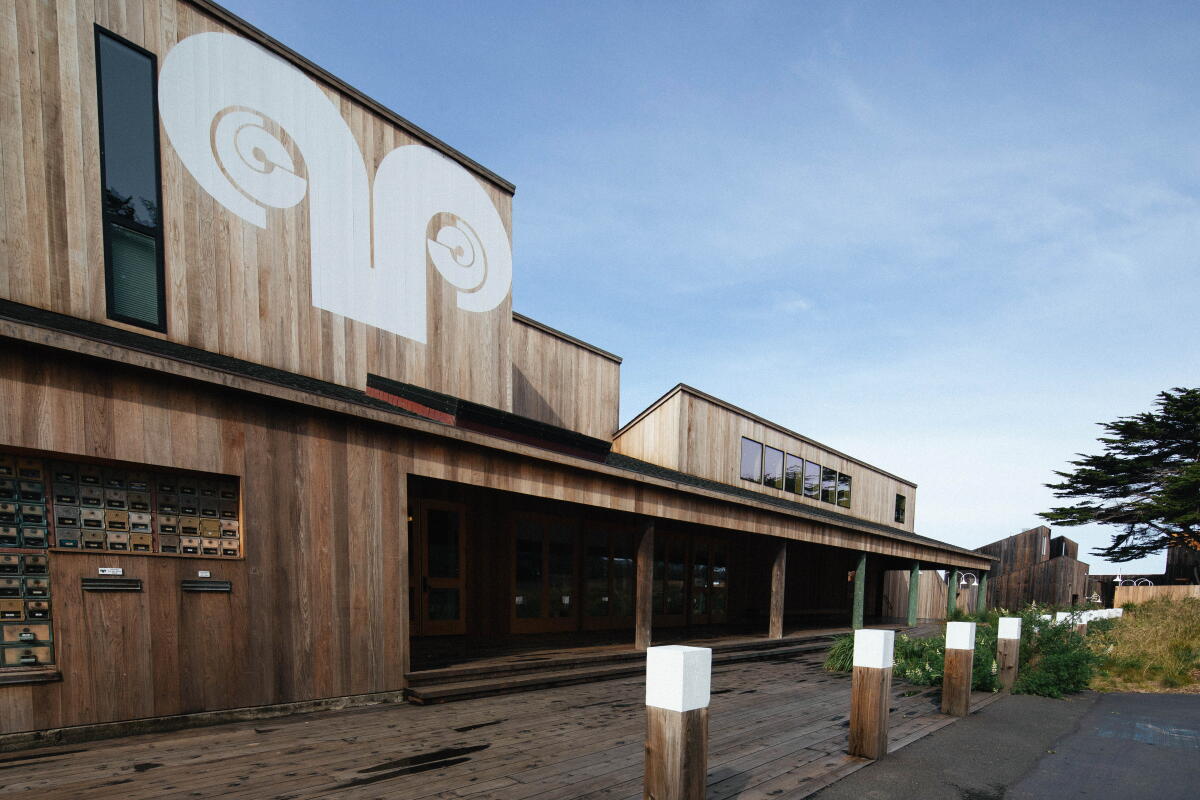
The ram’s horns at the Sea Ranch Lodge were designed by artist Barbara Stauffacher Solomon.
(Myung J. Chun / Los Angeles Times)
The current owners of the lodge took over in 2018, completed a major renovation in 2023 and wish “to remain private,” a representative said. The Wall Street Journal has reported that the investors’ group includes San Francisco-based brothers Patrick and John Collison, who founded the tech company Stripe; venture capitalist Robin Chan; and Twitch co-founder Justin Kan.
The 53-acre lodge property is only one piece of the Sea Ranch puzzle. The surrounding development, which broke ground in 1964, includes about 2,200 homes and lots on roughly 7,000 acres, all subject to strict design standards enforced by the Sea Ranch Assn.
The homes, mostly clad in wooden exteriors, none more than two stories high, are scattered along 10 miles of coastline about 100 miles north of San Francisco. The nearest town is Gualala, about six miles north.
Rooms at the Sea Ranch Lodge often rent for $600 nightly or more. Many visitors rent neighboring Sea Ranch homes from Airbnb, Vrbo or local companies including Gualala-based Sea Ranch Rentals and Sea Ranch Escape. In fall, rental rates for homes often start around $400 nightly.
Widely praised as an model for environmentally sensitive building, the development sparked a years-long legal battle over public access to the coast. The result is a combination of private and public access: Six public-access trails cross Sea Ranch to on their way to the shoreline, while Sea Ranch residents retain access to several private beaches.
An ocean view along the trails at the Sea Ranch Lodge.