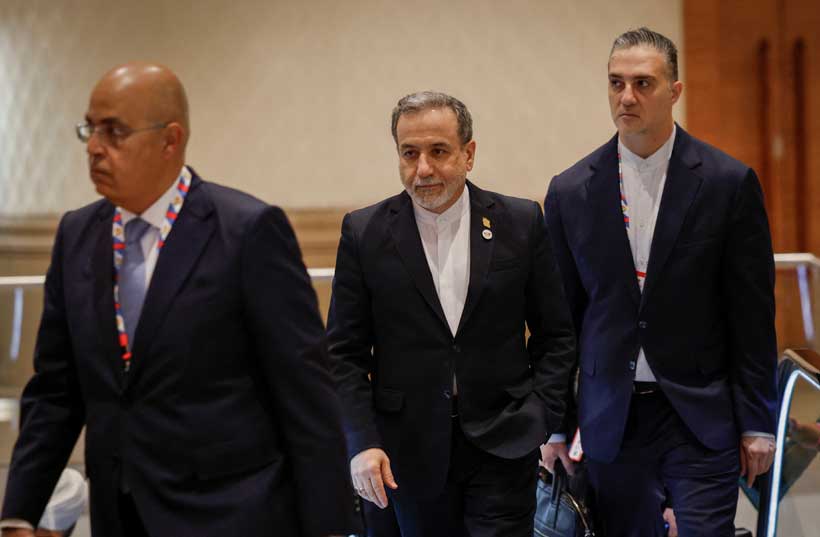
Iran is set to join the New Development Bank (NDB), the development lender established by the BRICS group, Iranian central bank governor Abdolnaser Hemmati said on Wednesday, as Tehran seeks to deepen financial ties with emerging economies amid sweeping international sanctions.
Hemmati made the remarks ahead of a BRICS finance ministers and central bank governors meeting hosted by India, which holds the group’s rotating chairmanship this year.
Iran joined BRICS in 2024 as part of the bloc’s expansion and has since expressed interest in becoming a member and shareholder of the NDB. The bank was established in 2015 by Brazil, Russia, India, China and South Africa to finance infrastructure and sustainable development projects.
“The most important result of cooperation among BRICS member countries is the establishment of the New Development Bank, and our country will soon become a member of this bank,” Hemmati said, according to Iranian state media.
Stay ahead of the geopolitical week.
MD Briefing delivers expert analysis across five global fronts — the Indo-Pacific, energy, geoeconomics, European security, and the Middle East — every Monday morning. Free.
Iran Seeks Alternative Financial Channels
Membership of the NDB would give Iran another avenue for economic cooperation outside traditional Western dominated financial institutions, although the extent of any benefit would depend on the bank’s ability to operate with a heavily sanctioned Iranian economy.
Iran remains under extensive U.S. and international sanctions and has yet to reach a peace agreement to end its current conflict with the United States and Israel. These pressures have increased Tehran’s incentive to strengthen economic relationships with non-Western powers and reduce its exposure to dollar based financial systems.
The NDB has expanded beyond its original five members to include countries such as the United Arab Emirates and Egypt, increasing its role as a financial institution connecting emerging economies.
BRICS Pushes for Local Currency Trade
Hemmati also said Iran supported greater use of national currencies in trade among BRICS members.
BRICS countries have increasingly promoted mechanisms intended to reduce dependence on the U.S. dollar, including greater use of national currencies for bilateral trade and financial transactions.
Iran is also seeking bilateral and trilateral monetary cooperation with other BRICS members, Hemmati said.
A Strategic Financial Move for Tehran
Iran’s expected entry into the NDB is significant not simply as a development financing decision but as part of Tehran’s broader effort to build an alternative economic network amid Western sanctions.
For Iran, deeper integration with BRICS could provide additional channels for investment, infrastructure cooperation and financial transactions while strengthening economic ties with major emerging powers such as China, India and Russia. However, membership alone will not remove the restrictions created by U.S. sanctions or guarantee access to international capital.
The move also reflects the broader evolution of BRICS from an economic grouping into a platform through which its members can challenge aspects of the Western dominated financial order. Iran’s participation strengthens that trend, particularly as the group promotes greater use of local currencies and seeks to diversify international financial relationships.
For Tehran, therefore, joining the NDB would represent both an economic opportunity and a geopolitical signal: Iran is seeking to reduce its vulnerability to Western financial pressure by embedding itself more deeply within emerging non-Western economic institutions.
With information from Reuters.