Beirut, Lebanon – Lebanon’s second airport is scheduled to begin operating test flights on Independence Day, November 22, in what experts and analysts say could prove to be a boon to the country after years of war and an economic collapse.
In June, Prime Minister Nawaf Salam and other officials took a test flight from Beirut to Rene Mouawad airport, located in the northern town of Qlayaat. Lebanese officials hope a new airport will stimulate growth in one of Lebanon’s poorest and most underserved regions.
Recommended Stories
list of 3 itemsend of list
Qlayaat airport was originally set to open mid-2026, but Israel’s war on Lebanon delayed it.
The beginning of commercial flights was deferred to November 22, but it was pushed further to mid-December, when many in the Lebanese diaspora return home for the winter holiday, due to construction delays. Commercial flights are now expected to start on December 14.
Chokepoint
Rafik Hariri international airport, Lebanon’s only functioning airport, located just south of the capital, Beirut, has been sensitive to political and regional disputes.
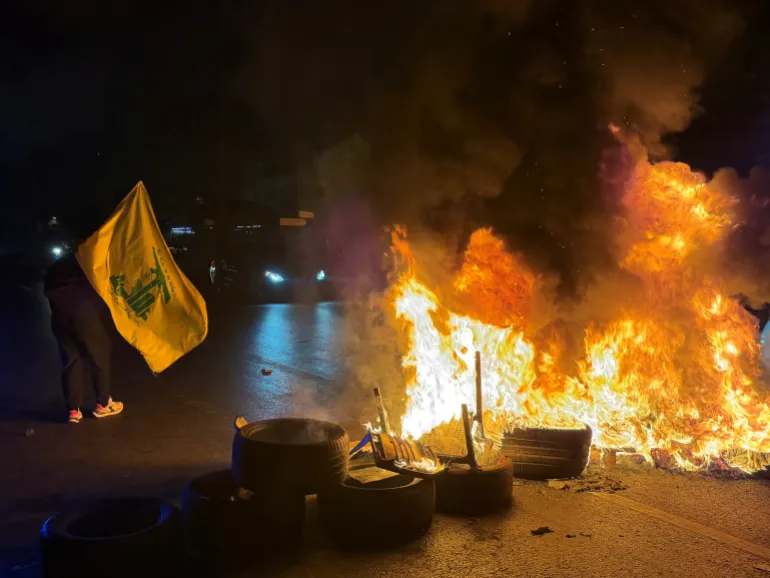
Supporters of Hezbollah, the Iranian-backed Shia armed group, have at times weaponised the vulnerabilities of Rafik Hariri airport’s location by blocking the road connecting it to the capital. In February 2025, Hezbollah supporters blocked the road when two Iranian planes were prohibited from landing in Beirut.
A new airport in the north, outside Hezbollah’s traditional zone of influence, could potentially weaken this logistical chokepoint, said Bassel Doueik, a Lebanese political analyst.
“Whenever tensions rise between them and the government, they [Hezbollah] tend to block the inbound and outbound [traffic] on the Beirut airport road through protests, and this is a strategic advantage for the group,” Doueik, a Lebanese political analyst, told Al Jazeera.
“I don’t think the new airport will remove this strategic advantage, but it will actually decrease it to a certain extent because the [Qlayaat] airport is small and it cannot substitute for the current airport.”

Hezbollah has been the strongest military and political actor in Lebanon in recent decades, but its role has come into open debate in the country following the 2024 ceasefire with Israel and the fall of Bashar al-Assad’s regime in Syria, the group’s key regional ally.
The opening of a new airport is not expected to change internal political calculations, but analysts say it gives the state alternatives in the event of future conflicts.
“The state gains manoeuvrability and alternatives by opening a second airport. But in terms of Hezbollah’s arms or anything else, it doesn’t change much for the state,” Marcel Baloukji, a Lebanese political and security analyst, told Al Jazeera.
“This airport becomes a factor in any potential future war. Beirut airport could be shut down, but alternatives [to fly in and out] would still exist, especially for foreign nationals and diplomatic missions present in Lebanon.”
Economic troubles
But officials say the reason for opening a second airport is economic rather than political.
Lebanon’s economy has struggled to recover from the 2019 economic crash due to Israel’s ongoing assault on the country and the US-Israel war on Iran.
Inflation is expected to hit 17.5 percent this year, and the World Bank predicts Lebanon’s economy to contract by 6.4 percent in 2026. Previous estimates suggest Lebanon has suffered damage estimated at more than $14bn since 2023.
Still, Dania Arayssi, assistant director of the New Lines Institute for Strategy and Policy, told Al Jazeera that she believes there is a legislative angle for the establishment of a new airport as well.
“Successfully managing a facility that can generate significant public revenue could help rebuild citizens’ trust in state institutions,” Arayssi said.
“It would show that the government can enforce its authority, protect public assets from Hezbollah’s interference, and lead on delivering services that benefit the country as a whole.”
South Lebanon, where an Israeli invasion has turned into an occupation that analysts believe could last years, has been the worst-affected part of the country as a result of Israel’s war. But other parts of Lebanon are also struggling and have a history of state neglect.
Qlayaat, on the other hand, is located in the northern Akkar region, just 6km (3.7 miles) from the Syrian border. Officials believe the new facility would serve much of Lebanon’s north, as well as important Syrian cities like Homs, Latakia and Tartous, with the northern neighbour struggling to modernise its dilapidated airports.
Experts told Al Jazeera that the fall of President al-Assad in December 2024 partially paved the way for the airport project, as Syria’s former government had been opposed to the idea.
After Salam formed the government in early 2025, plans for the new airport became a priority.
Officials said Qlayaat airport is likely to receive low-cost airlines. In June, Turkiye’s Istanbul and Mersin airports and Dubai in the UAE had been confirmed as destinations for flights from Qlayaat, with new locations likely to be announced in the coming days. Officials said the airport could serve 115,000 passengers in the first year, reaching about 600,000 by the fourth year.
Baloukji said the airport would also have domestic benefits and be a more reassuring route for foreign tourists.
“From the perspective of employing workers, it keeps people in that area and enhances tourism because many people are avoiding Beirut airport due to Hezbollah’s influence,” he said.