Toronto, Canada: As Canadian Prime Minister Mark Carney races to make the country less dependent on the United States, attract billions in new investment and get major projects built faster, his economic overhaul is running into resistance from a group that says it wants many of the same things: organised labour.
The latest clash, over the right to strike, comes after months of mounting pressure on Ottawa from Washington, DC.
Recommended Stories
list of 4 itemsend of list
US President Donald Trump, since taking up a second term in office last year, has imposed steep tariffs on Canadian goods and weakened trade agreements – perilous moves as Canada has historically sent close to 80 percent of its exports to its southern neighbour. He has repeatedly piled on with the tariff threats to make Canada the 51st US state.
Canada has responded with retaliatory tariffs, while a broader movement to “Buy Canadian” has taken hold. The hockey-inspired “elbows up” — meaning a readiness to defend against an opponent — has become a national rallying cry.
With trade talks stalled since August, Carney has moved with urgency to shore up the economy and invite new investments. Last month, he announced Bill C-39, known as the Building Canada Strong Act, promising to bring “speed, certainty and predictability” to investors.
Along with measures to speed up approvals for major projects, the bill would also give Ottawa clearer powers to intervene in legal strikes and lockouts in federally regulated workplaces — a provision that has put Carney on a collision course with unions.
Canada’s largest unions have come together against the changes. The largest, the Canadian Union of Public Employees (CUPE), had its national executive go as far as voting to defy the bill’s proposed limits on the right to strike if it passes Parliament without amendments.
CUPE National President Mark Hancock credited Carney’s handling of Trump and said the union’s 800,000 members, who work everywhere from hospitals to schools to municipal services, want to be part of “Team Canada”.
“But at what cost?” he said in an interview with Al Jazeera.
A fight over the right to strike
The controversy centres on Section 107 of the Canada Labour Code, which already gives the Labour Minister broad powers to step into disputes if needed to maintain “industrial peace”, end work stoppages and force the two sides into a binding arbitration.
Beginning in 2024, Ottawa used the provision eight times to intervene in disputes involving airlines, Canada’s two largest railways, three major ports and Canada Post and again during the Air Canada dispute in 2025 when flight attendants went on strike.
Unions have challenged the use of that law in court and had hoped the proposed C-39 would restrict, if not repeal, that clause while businesses wanted it strengthened.
The bill does neither. Instead, it introduces two conditions that the government would have to fulfil first before turning to Section 107.
Before stepping in, the government would have to appoint a special mediator, wait for a public report and consider whether a work stoppage is hurting the “national interest”.
Once a strike or lockout is underway, the minister could direct the Canada Industrial Relations Board to get operations running again and impose a binding process, such as arbitration.
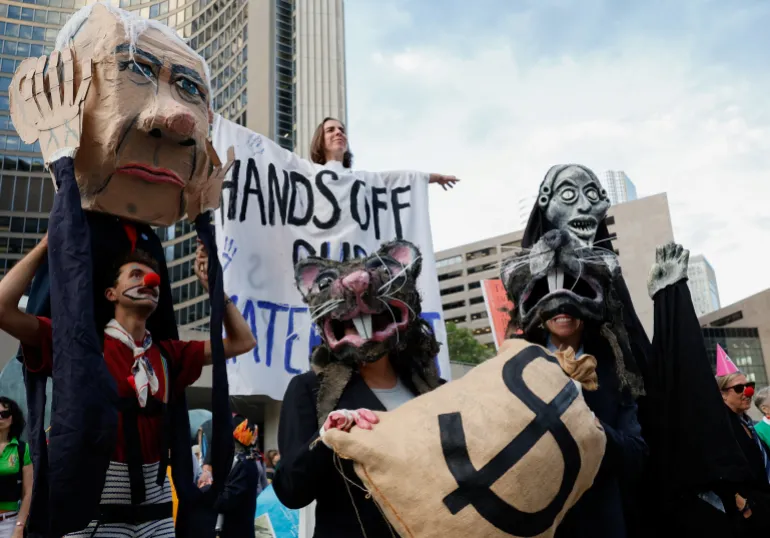
A protester carries an effigy depicting Canada’s Prime Minister Mark Carney as people march to protest against the Canada Investment Summit in Toronto in September [File: Carlos Osorio/Reuters]
The government says those steps put clearer guardrails around a power that already exists, and Carney has said the bill “absolutely reinforces the right to strike”, according to the Canadian Broadcasting Corporation.
Unions have rejected this defence, pointing out that the meaning of “national interest” would ultimately be decided by the minister. They also argue that the prospect of government intervention is bound to change what happens at the bargaining table.
“The political lesson that employers will draw from it is simple,” Larry Savage, a professor of labour studies at Brock University, told Al Jazeera. “Hold out long enough, emphasise the economic damage, and then Ottawa will remove the union’s leverage for you.”
Disruption, Savage said, is precisely what gives a strike its power. “Every effective strike is disruptive,” he said.
Unions say they have already seen employers expect Ottawa to intervene.
Teamsters Canada alleges the Canadian National Railway (CN) and the Canadian Pacific Kansas City (CPKC) railroad companies were counting on Ottawa to step in when they locked out thousands of workers in 2024. Section 107 was invoked within hours.
“Companies have gotten used to the idea that if there is a labour dispute, they can just wait for the government to intervene,” Christopher Monette, Teamsters Canada’s director of public affairs, told Al Jazeera.
CUPE said it saw a similar dynamic at Air Canada in August 2025. Hancock said bargaining stalled after more than 10,000 Air Canada flight attendants voted overwhelmingly to strike because the airline was “expecting the government of Canada to step in and end the strike” — an account Air Canada disputed.
Less than 12 hours after workers walked out, Ottawa invoked Section 107. Air Canada CEO Michael Rousseau later told BNN Bloomberg the airline had expected the provision to be enforced and did not expect a strike.
“That was why they didn’t have a strategy on how to deal with the strike,” Hancock said.
Building Canada faster
The fight over the right to strike is also part of a much bigger argument taking shape around Carney’s economic agenda: Who gets a say in how Canada should change, and how quickly, in the name of making itself less vulnerable to the US?
Critics accuse Carney of using the economic threat from the US to push through changes that go well beyond responding to Trump’s trade war.
New Democratic Party leader Avi Lewis has accused him of using the “fear and disorientation around the trade war to push through a series of unpopular measures that he did not run on, has no mandate for and would never get away with under normal circumstances”.
A protester carries an effigy depicting Canada’s Prime Minister Mark Carney outside the Canada Investment Summit in Toronto [File: Carlos Osorio/Reuters]
That tension was on display in Toronto just a week before C-39 was introduced. Inside Canada’s first national investment summit, hundreds of global investors met with government officials and executives as Carney pitched a country ready to build.
Outside, hundreds of protesters marched through downtown towards the summit’s opening gala under the banner “The Many vs The Money”. The rally brought together labour, Indigenous, environmental and migrant-rights groups, with signs and speeches taking aim at everything from fossil fuel and military projects to AI and the use of public money to attract private investment.
For unions, C-39 has sharpened that debate, pitting the government’s promise of greater certainty for investors against workers’ ability to exert pressure through strikes.
But Jim Stanford, an economist and director of the Vancouver-based Centre for Future Work, questions how much of an economic threat strikes actually pose.
While work stoppages can be costly for individual companies, Stanford said, “It is very, very rare that you would see a noticeable and sustained impact on GDP, employment or incomes.”
Production and transportation are often delayed rather than permanently lost, he added, with businesses catching up once work resumes.
Stanford also questioned the idea that strikes are driving away investment, noting that more than 95 percent of collective bargaining ends without a work stoppage and saying there is “no empirical evidence whatsoever” that strikes have reduced investment.
“This is more of the government giving some icing on the cake for business. It’s not that this has to happen or else our investment won’t work,” he said.
There is also an economic cost to weakening the right to strike, Stanford argued. Workers need bargaining power to win higher wages, which can support consumer spending, productivity and worker retention.
“It may seem like labour peace is a good thing, but if it means that a worker’s share of the pie shrinks, then this actually hurts the economy.”
For labour leaders, that’s where Carney’s economic push goes too far.
“Canada’s unions are part of Team Canada. We have our elbows up,” Canadian Labour Congress President Bea Bruske said in a statement. “But we can’t have our elbows up against Trump with our hands tied at the bargaining table.”
Savage said the government’s “Team Canada” rhetoric risks treating workers’ bargaining power as a national liability.
“I don’t think Canada becomes stronger by telling workers in ports or railways or airlines that their rights have to be surrendered whenever employers invoke competitiveness or the national interest,” he said.
As Iran and the United States work with mediators to end seven months of hostilities, the reality in the Strait of Hormuz is shifting in ways that could prove to be a game-changer in ongoing negotiations.
According to the latest data from tanker-tracker websites, traffic through the key waterway has been steadily increasing, with some estimates putting oil and petroleum flow through the Strait of Hormuz at nearly 80 percent of what it was before the US-Israeli war on Iran began on February 28.
Recommended Stories
list of 3 itemsend of list
This could dent Iran’s leverage in reaching a favourable deal for itself in its attempts to end the fighting, which has seriously hampered its already heavily sanctioned economy, amid the US blockade of Iranian ships and ports.
Despite that, experts believe it would be a mistake to think normality in the Strait of Hormuz is imminent, or that Iran will fold easily despite growing economic hardship.
“The fact that oil is getting through the Strait of Hormuz is encouraging, but flows are not yet regarded as completely secure or guaranteed, particularly while the wider conflict remains unresolved,” Susannah Streeter, chief investment strategist at Wealth Club, told Al Jazeera.
Moreover, oil prices remain high globally, including in the US, where President Donald Trump faces a crucial midterm election that could see his party swept away in both houses of Congress.
Tanker insurance costs also remain elevated and energy flows through Hormuz are still far from secure, suggesting Iran’s leverage may be weakening rather than disappearing.
Oil flows through Hormuz recovering
The latest data from commodity analytics firm Kpler points to a significant recovery in oil exports from the Middle East.
Crude exports reached an estimated 16.328 million barrels per day (bpd) in September – their highest level since the war began in late February, the firm reported this week.
Flows through the Strait of Hormuz itself were expected to reach about 9.719 million bpd during the month. Saudi Arabia has driven much of the increase, with its exports rebounding from 2.446 million bpd in August to about 5.4 million bpd in September.
Kpler said Middle East crude exports have recovered to just under 80 percent of their pre-war level. But the figures remain about 3.2 million bpd below the 19.513 million bpd exported in February.
The data also does not include ships crossing Hormuz with their tracking systems switched off, meaning actual traffic could be higher.
Prior to the war, an estimated 120-140 vessels crossed through the waterway daily, roughly half of them oil tankers moving approximately 20 million barrels per day. At the height of the fighting, traffic through the waterway collapsed to as few as two tankers a day after Iran in effect closed the strait in retaliation for US-Israeli attacks.
Is Iran losing leverage?
The rebound in oil flow presents a challenge for Tehran. Iran has sought to use its ability to disrupt the Strait of Hormuz – one of the world’s most important energy chokepoints – as leverage against Washington’s military and economic pressure.
But if large volumes of oil can continue moving through the strait while Iran itself remains under a US naval blockade, Tehran’s bargaining power could diminish.
Iran, however, rejects any assessment that its control over the strait is slipping.
Islamic Revolutionary Guard Corps spokesperson Hossein Mohebbi on Tuesday said the ability of vessels to transit the waterway with US assistance did not mean Hormuz had returned to normal.
Oil prices are another indication that Iran has not lost all of its leverage.
Villagers stand near plastic containers at a fuel station to fill their water pumps, as India faces rising oil prices, in Halvad, Gujarat, India [File: Amit Dave/Reuters]
Brent crude fell 2.6 percent to $102.59 a barrel on Tuesday as traders focused on recovering Middle East exports. But it was still heading for a roughly 13 percent gain in September.
Chris Beauchamp, an analyst at IG, said markets were beginning to incorporate evidence of recovering flows but remained wary about how durable that recovery would be.
“It takes time for evidence to filter through to markets,” Beauchamp said. “Oil prices came off yesterday as the narrative began to take hold, and should continue to fall.”
But he said concerns persisted over whether the US protection system could withstand a renewed barrage of Iranian missiles and drones.
Streeter of Wealth Club said the market still had a geopolitical risk premium built into crude prices, despite the improving flows.
“Insurance costs for tankers also remain elevated because of the perceived risks of operating in the region, adding to the cost of transporting crude even as more ships make it through the waterway,” she said.
Moreover, Streeter warned that crude figures tell only part of the story. Flows of refined fuels, particularly diesel and gasoline, remain constrained, while damage to infrastructure has placed additional pressure on energy supply chains, she added.
There is another vulnerability, the investment strategist pointed out. Countries including the US have relied heavily on strategic oil reserves to cushion the impact of the disruption and help contain prices.
“With those stockpiles now significantly depleted, there is a thinner buffer if there is another disruption, which is helping to keep a floor under crude prices,” Streeter added.
‘Economic war’ on Iran
There is little doubt that economic pressure on Iran is intensifying, potentially increasing Tehran’s incentive to reach an agreement.
Official data from the Statistical Center of Iran earlier this month showed gross domestic product (GDP) contracting 10.1 percent year on year between March 21 and June 20, while the crucial oil and gas sector shrank 26.4 percent.
Iran has also been battling high inflation and a plunging currency as the US blockade constrains oil exports and foreign currency earnings.
Twelve-month average inflation reached 69.9 percent earlier in September, while the rial had fallen beyond 2.2 million to the US dollar in early September.
People shop at Tajrish Bazaar in northern Tehran, Iran [File: Abedin Taherkenareh/EPA]
In August, the US announced a fresh economic pressure campaign against Iran, promising to target Tehran’s financial interests across the world.
Mohammad Eslami, a research fellow at the University of Tehran, told Al Jazeera that Iran was facing an “economic war” alongside the military conflict.
“There is a US blockade of the Strait of Hormuz, which affects Iran’s revenues from oil exports and other products such as petrochemicals, which are important to Iran’s economy,” Eslami said. “As a result, Iran’s dollar revenues have been affected by the blockade.”
But he cautioned against judging Iran’s economy solely through the value of its currency.
“The exchange rate is a very important indicator, but it is not the only measure for explaining what is happening or the difficulties and challenges facing Iran’s economy,” Eslami said, adding that Iran has faced US economic pressure for “five decades”.
Can a deal be reached?
Despite the military and economic pressure, negotiations have not collapsed.
At the United Nations General Assembly last week, Tehran and Washington engaged in three hours of indirect talks, as US special envoys Steve Witkoff and Jared Kushner met with Iranian Foreign Minister Abbas Araghchi.
President Trump later described the encounter as “very good” and “very productive.”
Iran also proposed a seven-day roadmap under which the Strait of Hormuz could be reopened and normal maritime traffic restored if Washington meets Tehran’s conditions, a plan Trump categorically rejected.
Those conditions included ending the naval blockade on Iran, easing sanctions and releasing frozen Iranian funds.
However, on Wednesday, Reuters news agency reported that Araghchi had received US feedback on the proposal through Qatari mediators.
An official briefed on the talks said the main disagreement now centred on the sequencing of measures rather than the components of the plan.
Sep 25, 2026, 12:00 AM ETBy: Jay Mehta, SA News Editor
kyoshino/E+ via Getty Images
5:15 AM John Williams Speaks
Participates in a policy panel at the 6th Monetary Economics Conference organized by the University of Oxford, the New York Fed, and the Bank of England.
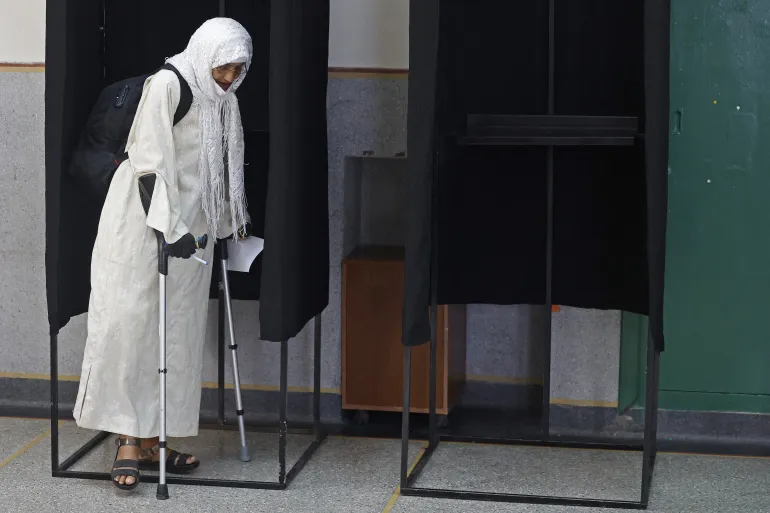
Millions of voters went to polls in Morocco on Wednesday to determine the makeup of the House of Representatives, the parliament’s lower house.
Twenty-seven political parties are competing for 395 seats in the country’s 12th legislative election since independence in 1956.
Almost 16 million people are able to vote, with 55 percent residing in urban areas and 45 percent in rural regions, seeing a mix of concerns among voters.
Economic frustrations
While King Mohammed VI will maintain most executive powers, the new government will manage many public affairs for the coming years.
Once the votes are counted, the king will appoint the head of government from the leading party, but they will still need the support of 198 deputies – an absolute majority – to gain parliamentary confidence.
The election comes at a time of mounting challenges for the country, with the economic situation creating discontent and frustration, Mohammed Masbah, head of the Moroccan Institute for Policy Analysis, told Al Jazeera.
“The upcoming elections will have special importance because they come in a context tied to a social and economic crisis, especially high prices and the cost of living on one hand,” Masbah told Al Jazeera.
“On the other hand, there is a state of frustration among broad segments of society, especially the youth. The Gen Z protests last year, as well as the attempt to cross towards Ceuta a few weeks ago, demonstrate this crisis.”
The introduction of a new financial system designed to support candidates aged 35 could encourage more youth participation. But the nearly six million Moroccans residing overseas, many of them younger citizens, will have to appoint a proxy in Morocco to cast their vote.
There is also an upcoming key milestone for the country with the 2030 World Cup, which requires huge investments. What will remain in the minds of most voters is the state of the economy and inflation, which have impacted the living standards of many Moroccans.
“I believe the upcoming elections will produce a government majority whose primary function will be to address these imbalances, especially the economic ones related to the high cost of living in Morocco,” Masbah said.
“Regarding the issues that were raised and discussed by the majority of political parties, whether represented in the government or the opposition, they are the issue of employment and high prices.”
Two of the main parties competing in the election, the National Rally of Independents and the Authenticity and Modernity Party, have put these issues at the front of their campaigns in what has been a heated election.
“Of course, this is the main topic, but in the public debate, we also noticed conflicts, especially between the top two parties currently running the government,” Masbah said. “We noticed mudslinging and accusations of squandering funds and stealing candidates, which may increase voter alienation from voting today.”
A woman prepares to cast her ballot to vote in Morocco’s legislative elections at a polling station inside a school at the Udayas neighbourhood, Rabat, on September 23, 2026 [AFP]
Despite the tense conditions, Morocco’s Public Prosecution has recorded a significant drop in election-related complaints compared with the 2021 vote.
But legal amendments that criminalise digital offences for the first time – including the dissemination of fake news and false allegations intended to defame candidates or voters – have been introduced. The digital space became the primary arena for violations this year, accounting for 22 complaints.
Masbah said that despite a mood of frustration in Morocco over the government’s inability to manage key economic and social issues, turnout is expected to remain steady, as it has been over the past 20 years, due to structural factors.
“Electoral and voting behaviour in Morocco is not primarily linked to electoral programmes and promises [of parties], as much as it is linked to the stable bloc formed by Moroccan deserts and villages, which relies primarily on a network of notables who have influence and the ability to win voters’ voices through utilitarian voting,” Masbah said.
“I expect that if there is a decline in the voting rate – and this is likely – it will not be catastrophic or a sharp decline, given the consideration I mentioned earlier, which is the focus on notables and traditional elites in winning over voters.”
Tehran, Iran – Amid dire fuel shortages and mounting economic challenges, the Iranian government is seeking cost-saving measures for government workers and other citizens to deal with the crisis.
On Saturday, the government set office attendance hours for 8am to 1pm from September 23 to the end of the current Iranian year (late March 2027), with the remaining contractual hours to be completed remotely.
Recommended Stories
list of 4 itemsend of list
Agencies must also designate one day a week when employees and managers travel to work by public transport. In recent days, government ministers have released videos showing themselves using the metro to commute to work as part of the campaign.
Metro and bus rapid transit (BRT) systems will also be free of charge until mid-November in a bid to encourage commuters to leave their cars at home. Worn-out government vehicles will also be replaced with electric, gas-powered or hybrid alternatives, although this is expected to take years to implement.
Government-linked offices are required to switch off heating and turn off lights after working hours, while schools, universities, healthcare facilities and operational services are to follow separate arrangements to be announced later.
President Masoud Pezeshkian signed a directive on September 12 instructing government agencies to facilitate remote work for suitable employees to save on petrol, electricity and natural gas costs for the state.
“We have begun consumption savings with the government,” Pezeshkian said earlier this month. This is seen as effectively framing remote work and other measures for government workers as in line with other energy-saving measures that the government has asked of the rest of the population.
Resource-rich Iran has dealt with energy crises before, rooted in mismanagement and dated infrastructure, when similar cost-saving measures were implemented. But the added pressure of war with the United States and Israel has forced the government to think of creative solutions to energy shortfalls.
In early September, the cash-strapped government raised the price of fuel for the third tier of quotas for a second time in less than a year, meaning that people will pay double for any petrol use beyond 110 litres (29 gallons) per month. Imported vehicles and some other categories of cars are also limited to the most expensive tier of fuel.
For the first five months of the current Iranian year, which ended on August 22, average daily petrol production was 122 million litres while consumption was at 132 milion litres, highlighting a shortfall in supply versus demand. In the first half of the sixth month, the gap between production and consumption was around the same, at a 10 million litre shortfall.
The US naval blockade of Iran’s southern ports in place since July has halted fuel imports that previously helped balance the gap. The blockade has also stopped Iran from exporting its oil via supertankers transiting the Strait of Hormuz, affecting its foreign currency income. Crude stored on open waters beyond the blockade line is still being gradually sold to China.
Oil and gas facilities, petrochemical companies and major fuel depots were also bombed by the US and Israel, impacting production and distribution. Oil Minister Mohsen Paknejad said in early September that “a significant portion of production capacity has now been restored, and the process is continuing”.
As rampant inflation continues to squeeze most Iranians, data released this week by the Statistical Center of Iran also highlighted the damage the war with the US has dealt to the economy.
Iran experienced a massive 10.1 percent year-on-year fall in real gross domestic product (GDP) and a 26.4 percent fall in oil and gas extraction between late March and late June 2026, the centre’s data showed.
Including oil, industries and mining were down 14.7 percent, while construction was down by 6.4 percent, services overall by 4.8 percent, and transport, storage and communications by 17 percent.
The government has not released any information on how many workers are estimated to be affected by the remote work directive, or how it expected efficiency to be impacted.
But after decades of mismanagement, corruption and inefficiency among government-linked organisations, some Iranians believe it highlights a wider issue of state inefficiency.
“My unpopular opinion is that if 85-90 percent of government sector personnel are fired and 70 percent of ministries closed down, absolutely no problem will occur in the country,” a user named Mohsen wrote on X.
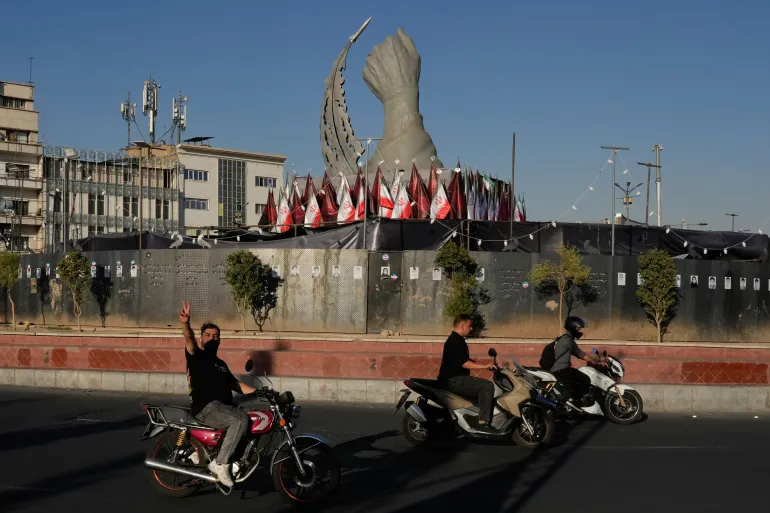
A man reacts to the camera while driving past a monument depicting the clenched fist of the late Iranian Supreme Leader Ayatollah Ali Khamenei, who was killed in a US-Israel strike on February 28, in downtown Tehran, Iran, on Tuesday, September 15, 2026 [Vahid Salemi/AP Photo]
Zabihollah Salmani, a deputy head of the Administrative and Employment Organisation of Iran, told reporters during a press conference in August that more than 2.43 million were on its payroll.
If council, fire brigades, social security and non-government organisation workers were included, this would bring the number to more than four million people. The average monthly pay for government personnel at the end of the previous Iranian year in late March 2026 was around 240 million rials ($104 at the current exchange rate).
Asked by reporters how many of these employees could potentially be taken off the payroll without hurting output, Salmani said, “We do not yet have these figures.” He added that agencies were being asked to submit that information.
About 1,075,000 people are on the payroll of the Education Ministry, including teachers and trainee staff, while 600,000 employees work under the Ministry of Health and its affiliated networks, according to official figures.
Amir-Hossein, a young man working at a research centre linked with the government-funded University of Tehran, said that since the start of the month, he had been assigned two days of remote work. Working hours were set for 7am-1pm before, but are to be shifted to 8am-1pm starting from Wednesday, per the government.
His work can be done on his laptop, but might require some coordination on the phone or short commutes to other centres, he said. Overall, the remote work lifestyle has been beneficial.
“Sometimes I get more work done than I would have at the office,” he told Al Jazeera, asking not to use his full name due to security reasons.
As Amir-Hossein regularly uses online ride-hailing services to commute to and from his job, working from home has been financially beneficial for him.
An Iran-based economist who spoke to Al Jazeera on background said the government measures are essentially crisis control at best, and not a long-term solution to the problem.
JEDDAH: Saudi-Chinese relations are currently in an excellent phase, according to China’s Consul General in Jeddah, Yang Yi.
Speaking to Al-Eqtisadiah, Yi said this year marks the 10th anniversary of the establishment of the comprehensive strategic partnership between the two countries, adding that bilateral trade reached $100 billion in 2025.
$100 billion in bilateral trade
Yi said China is Saudi Arabia’s largest trading partner, while the Kingdom ranks as China’s largest trading partner in the Middle East.
Bilateral trade amounted to about $50 billion during the first half of this year, with China’s imports from Saudi Arabia exceeding $26 billion during the same period. In contrast, the Kingdom’s imports from China amounted to about $24 billion.
Yi said trade between the two countries is “very balanced,” adding that bilateral trade relations have remained strong despite regional tensions. He also highlighted the growing economic and trade ties between Saudi Arabia and China.
Chinese firms support targets of Saudi Vision 2030
Regarding mutual investments, he estimated that Chinese investment in Saudi Arabia has exceeded $4.26 billion, while Saudi investment in China is also growing, particularly in new energy, advanced technologies and biotechnology.
Saudi investments also include the culture and education sectors, with Yi confirming that the strength of relations and the depth of the partnership are encouraging more Chinese companies to invest in the Saudi market.
At the same time, Saudi companies are showing growing interest in the Chinese market, with the consul general expressing his aspiration for “more prosperous and fruitful” bilateral economic relations in the coming period.
New energy and artificial intelligence
The Chinese official highlighted new areas of Saudi-Chinese cooperation, including new energy, green energy and artificial intelligence, noting that the two countries have held discussions on these areas in recent years.
The leaders of the two countries have also reached important understandings to strengthen cooperation in several areas.
Government entities, companies, and research centers in the two countries are working intensively to develop cooperation.
This aims to consolidate the Saudi-Chinese partnership and enhance cooperation in artificial intelligence and new energy.
China calls for the Strait of Hormuz to remain open
Yi said developments in the Strait of Hormuz are of great importance to countries in the region and the international community, stressing that China attaches great importance to the issue.
He said China supports a political settlement on the issue and called for an immediate ceasefire, adding that keeping the Strait of Hormuz open and free serves the interests of all parties.
He also stressed China’s support for efforts to find a peaceful solution to the issue, saying this would help maintain stability and security in the region while ensuring the continued flow of trade and energy.





![A woman prepares to cast her ballot to vote in Morocco’s legislative elections at a polling station inside a school at the Udayas neighbourhood, Rabat, on September 23, 2026 [AFP]](https://i0.wp.com/www.aljazeera.com/wp-content/uploads/2026/09/afp_6ab3c71f1ac5-1790166815.jpg?w=640&ssl=1)