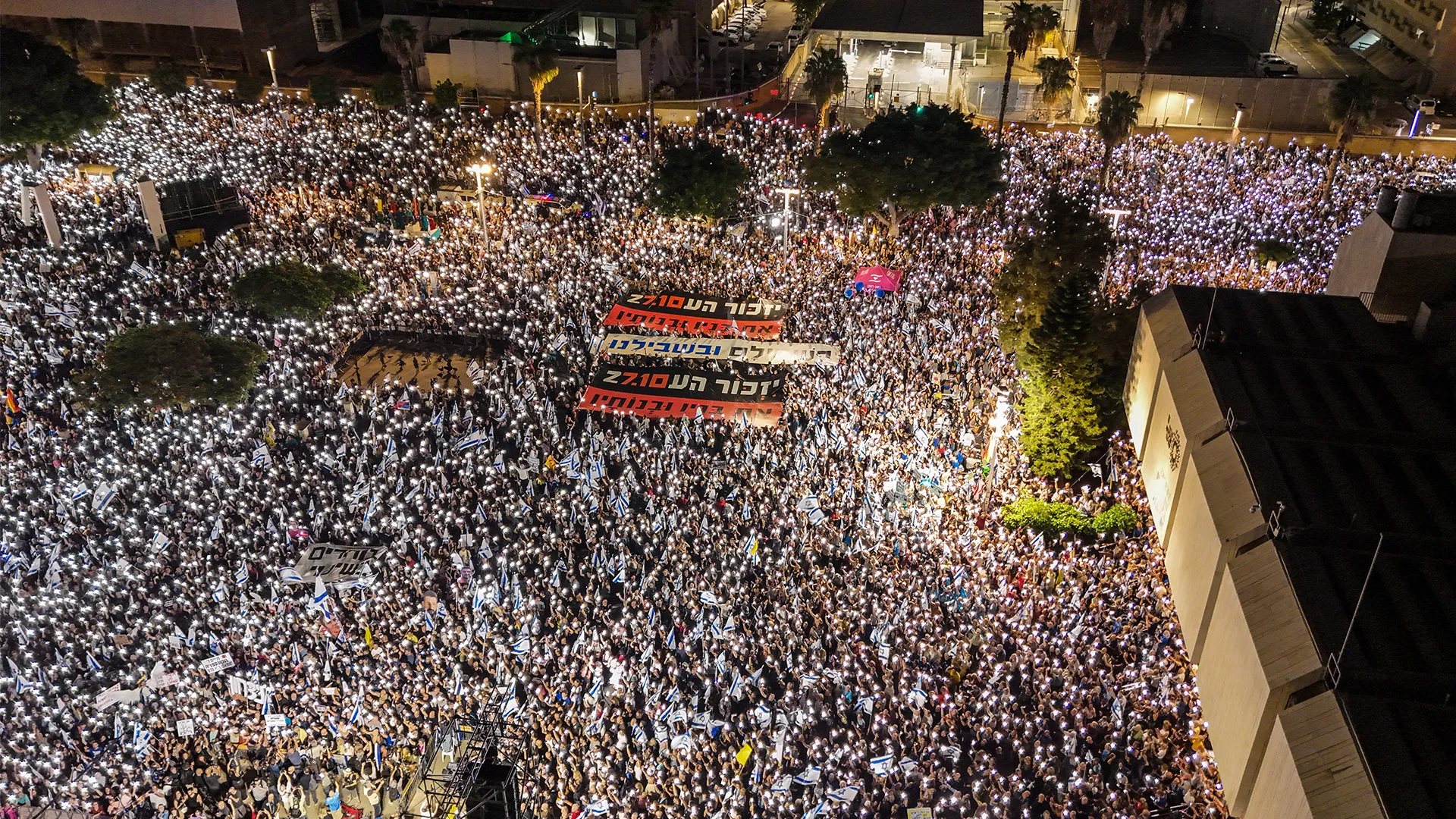
Thousands of Israelis rallied against PM Benjamin Netanyahu, demanding a change of government and an independent inquiry into the security failures surrounding the Hamas-led October 7th attacks. The election will be held on Tuesday October 27.
Opposition figures join Tel Aviv protesters demanding an independent October 7 inquiry.
Published On 24 Oct 202624 Oct 2026
Thousands of Israelis are protesting against the government and calling for an independent inquiry into the security failures that led to the October 7, 2023 attacks.
Demonstrators rallied in the public plaza known as Hostages Square in Tel Aviv on Saturday, three days before Israel’s first general election since the genocidal war on Gaza began.
Recommended Stories
list of 3 itemsend of list
The protest was organised by the October Council, a group founded by the families of captives taken to Gaza three years ago, to demand accountability for the government’s failure to prevent the Hamas attack that preceded the war.
“Three days before the election, we will hold the culminating event marking three years of struggle to uncover the truth, demand accountability and establish a state commission of inquiry,” the October Council wrote on X ahead of the rally.
Elsewhere in Israel, protesters were also gathering for antigovernment demonstrations, reported Haaretz newspaper.
Taking part were leading figures from opposition parties, including Gadi Eisenkot of the Yashar party, who is Prime Minister Benjamin Netanyahu’s main centre-right rival.
In Tel Aviv, Eisenkot was greeted by chants of “Who’s coming? The next prime minister”, according to The Times of Israel. The leader of the Democrats, Yair Golan, was also at the rally.
“Masses, masses of masses, flowing in the ‘Democrats’ march from Rabin Square to the Hostages Square – for change, for hope, for r-e-v-o-l-u-t-i-o-n. What energy. This time it’s ours completely!”, Israeli citizen and lawyer Dan Adin posted on X.
Polls ahead of Tuesday’s election suggest a tight race, with Netanyahu’s right-wing bloc, in power since late 2022, neck and neck with Eisenkot’s. Neither bloc is currently projected to obtain a majority of seats in Israel’s parliament.
The election could be pivotal in determining whether Israel launches another round of strikes on Iran. Eisenkot is believed to be less inclined to resume military action against Tehran if he becomes Israel’s next prime minister.
However, on most other foreign policy issues, leading Israeli parties and politicians remain united, including in their opposition to the creation of an independent Palestinian state.
Ahead of the protest, the October Council alerted law enforcement to possible “provocations” from pro-government agitators.
“We have sent an urgent letter to the Police Commissioner following alerts about attempts by entities linked to the coalition to disrupt tonight’s rally,” it wrote on X.
The October Council aims to hold Israeli officials deemed responsible for the October 7 attacks to account and deliver justice for affected families.
Netanyahu’s coalition government, however, has refused demands to establish an independent commission of inquiry. Instead, it has offered to set up a “political” commission. Half of the commission’s members would be appointed by the government, while the remainder would be appointed by opposition legislators.
Opposition leaders have said they would boycott a commission appointed by politicians.
Sheikh Mohammed also discussed Israeli ‘violations’ in Lebanese territory with Prime Minister Nawaf Salam.
Published On 16 Oct 202616 Oct 2026
Qatar’s prime minister has announced plans to set up what he described as a “massive” solar plant in Lebanon to help ease its energy crisis.
Sheikh Mohammed bin Abdulrahman bin Jassim Al Thani made the announcement during his visit to Beirut on Friday, after meeting his Lebanese counterpart, Nawaf Salam.
Recommended Stories
list of 3 itemsend of list
“We have agreed to establish a comprehensive framework for cooperation in the energy sector and to present viable solutions,” Sheikh Mohammed said.
QatarEnergy has reached an agreement with French company TotalEnergies to jointly develop a solar power plant in Lebanon as an initial project.
The aim is to develop a major investment project “that would benefit the Lebanese economy, as well as the Qatari companies and entities participating in it”, he added.
Prime Minister Salam said he would put the plans for Lebanon’s electricity sector to the Lebanese Cabinet soon.
“The Qatari side will fund, implement and activate the project without any cost on the Lebanese state,” Lebanon’s leader said, adding that such a move is important because of the country’s financial crisis.
Lebanon’s state electricity company is one of the biggest sources of debt, haemorrhaging about $40bn over past decades with a bloated workforce and outdated infrastructure. The company provides only a few hours of electricity a day and the state, until a year ago, took advances from the Central Bank when diesel fuel ran out.
Sheikh Mohammed said Doha stands in “solidarity with the Lebanese people” and the entire region “in this dire hour”. Lebanon has been struggling with multiple energy crises in recent years and the situation has been compounded by the country’s financial collapse and Israel’s ongoing assault.
Earlier in the day, the Qatari PM also met Lebanon’s president and parliament speaker.
Among the topics discussed was the situation in southern Lebanon, where Israel continues its assault, capturing dozens of towns and villages.
Sheikh Mohammed said “Israeli violations within the Lebanese territories” were a large part of his talks.
He said that Israel should withdraw from Lebanon and cease its attacks, adding that Qatar is working in coordination with the United States to help lay the groundwork for future reconstruction in southern Lebanon to allow displaced people to return to their homes.
Israeli attacks on southern Lebanon have continued despite a ceasefire agreed in June. Under the agreement brokered by the US, the Lebanese government is to disarm Iran-backed Hezbollah. In return, Israeli forces will gradually withdraw from southern areas that they occupy. However, Hezbollah is not part of the agreement and has refused to disarm until Israel withdraws from the country.
Lebanese authorities say Israeli attacks have killed more than 4,300 people in the country since March. About 1.2 million people were also displaced in Lebanon at the height of the war.
Although most have returned home since the June ceasefire, more than 300,000 people remain displaced, according to the International Organization for Migration.
Lebanon’s PM Salam thanked Qatar for its “continuous” support during some of Lebanon’s “darkest hours”.
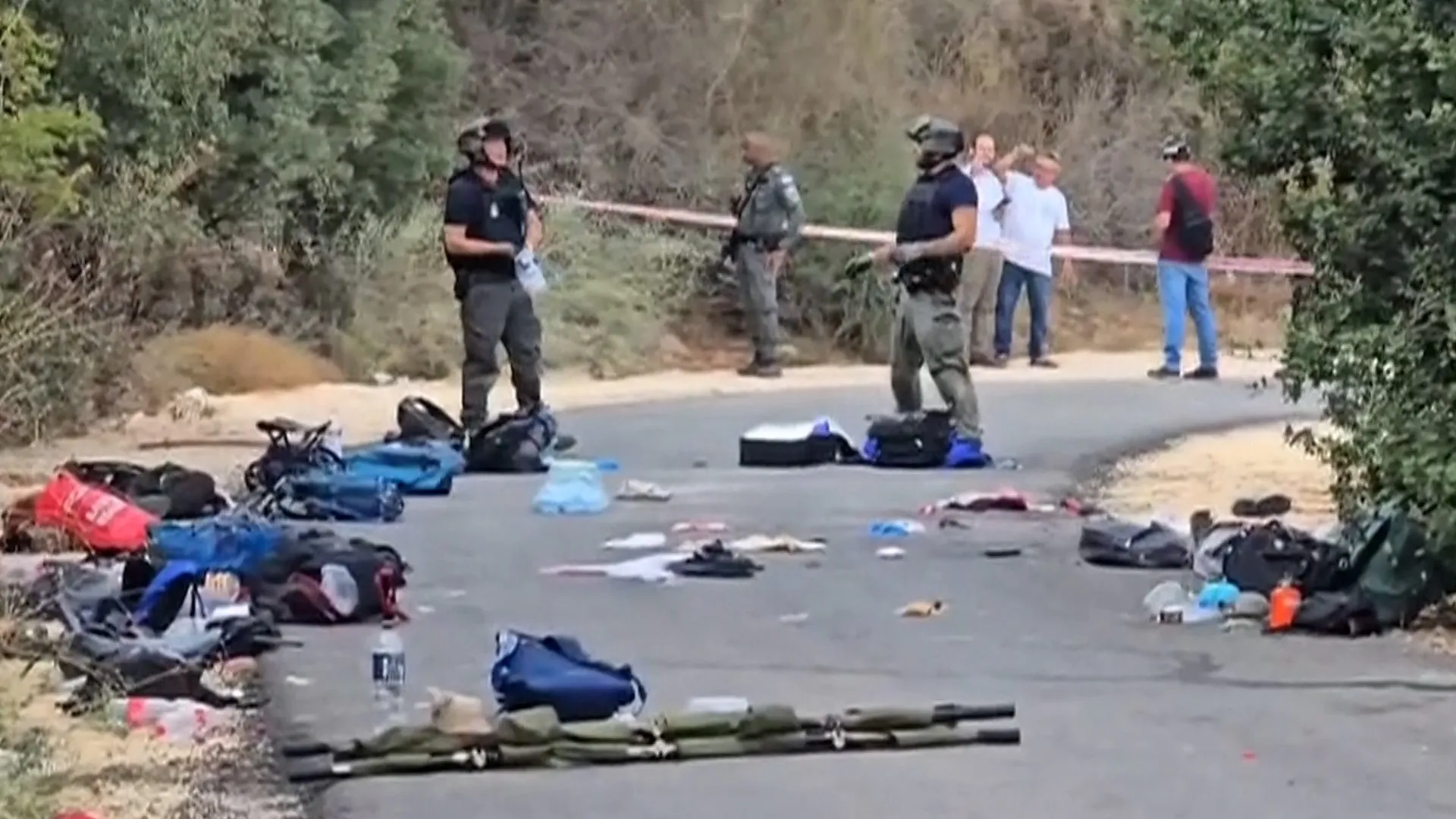
A 15-year-old was killed and around 20 people injured when unexploded ordnance detonated during a school trip in northern Israel. The army is investigating whether the munition came from Hezbollah or Israeli forces, amid recent fighting near the Lebanon border.
Despite a ceasefire agreement reached between Israel and Lebanon in June, Israeli attacks continue.
Published On 11 Oct 202611 Oct 2026
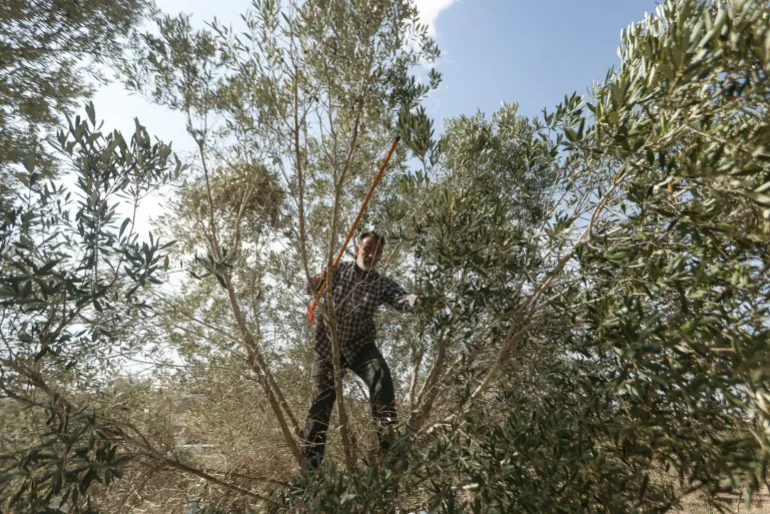
Two men have been killed in southern Lebanon’s Bint Jbeil district while taking part in an annual olive harvest, according to Lebanese state media and local authorities, as attacks by Israel continue.
One of the men died Sunday in the village of Froun from a munition left behind by recent fighting and the other in Yater as a result of Israeli shelling that “targeted the outskirts of the town while he was inspecting his land and olive harvest”, according to the official National News Agency (NNA).
Recommended Stories
list of 3 itemsend of list
The Lebanese army blamed Israeli tank fire and called the ongoing attacks “a flagrant breach of existing agreements”.
Afterwards, the Yater municipality urged residents “to avoid the outskirts of the town and refrain from crossing the earthen barrier separating some unsafe neighbourhoods” for fear of Israeli attacks.
In Froun, the NNA reported that “a foreign object” left over from previous Israeli operations exploded and killed the man, who was an engineer, as he and others tended their trees.
The engineer had come down from Beirut, where he lives, for the harvest, Froun mayor Hassan Bazzi told AFP.
The incident prompted local residents to call off the harvest and wait for “the Lebanese army to complete the decontamination of the village”, Bazzi said.
Displaced people
Since an agreement between Lebanon and Israel was struck in June, violence in the south has lessened, but not stopped.
Lebanon was pulled into conflict on March 2, when Hezbollah struck Israel in support of Tehran during the US-Israel war on Iran. Subsequently, Israel launched a bombing campaign and a ground invasion that authorities say have killed more than 4,300.
In August, Lebanon’s Prime Minister Nawaf Salam accused Israel of intentionally targeting homes and civilian infrastructure across the country. The International Organization for Migration (IOM) recorded nearly 350,000 internally displaced people in late August, a sign of the worsening displacement crisis.
One of the volunteers from Lebanon’s northernmost province of Akkar and the city of Sidon takes part in an olive-picking initiative in the southern Lebanese village of Jebchit near Nabatieh on October 11, 2026 [AFP]
Volunteers from the nearby town of Jebchit and locals came to help their southern neighbours with the harvest in an act of solidarity.
“From north to south, one people and one land,” said organiser Ahmad Chahhal.
Five Syrians and one Lebanese wounded in latest Israeli attack, officials say.
Published On 10 Oct 202610 Oct 2026
An Israeli drone attack has wounded six people in Lebanon’s Hermel district, close to the Syrian border, according to the Lebanese health ministry.
The ministry said on Friday that the six wounded included five Syrian nationals, two of them women, and one Lebanese.
Recommended Stories
list of 3 itemsend of list
Lebanon’s state-run National News Agency (NNA) reported that the drone attack targeted a car.
It added the area has largely been spared such attacks since an Israel-Hezbollah ceasefire was agreed in June.
Israel’s military claimed it struck “a Syrian terrorist” who “operated under the direction of the Iranian regime”, alleging that the man “planned and advanced attacks” against Israeli forces in Syria’s southern territory.
Since the ouster of longtime Syrian ruler Bashar al-Assad in December 2024, Israel has carried out hundreds of strikes against Syria. It has sent troops into a UN-patrolled buffer zone that had separated Israeli and Syrian forces in the Golan since 1974, and has carried out repeated incursions deeper into Syrian territory, sometimes seizing residents.
Israel has also continued to attack Lebanon since a ceasefire with Hezbollah was agreed in June.
It has vowed to keep troops in so-called security zones along its border in both Syria and Lebanon.
Syria’s President Ahmed al-Sharaa told the UN General Assembly last month: “We reject Israeli attempts to impose a fait accompli. We reject their aggressions, which undermine peace and security.”
He said Israel had carried out “500 air strikes, more than 1,200 incursions and 300 detentions” in Syria.
He also called for Israeli withdrawal from Syrian territory and for the international community to commit to a 1974 agreement that created a UN-supervised separation zone between Israeli and Syrian forces.
In the past three years, following the October 7 attacks and the start of Israel’s genocidal war on Gaza, the wider region has been marked by conflict, economic turmoil, and a shattering of the balance of power.
The network of alliances maintained by Iran, long central to its regional power, has been hit hard and severely weakened. Yemen’s Houthi rebels remain one notable exception.
Recommended Stories
list of 4 itemsend of list
Israel has made gains. Many of the leaders of the Lebanese group Hezbollah and the Palestinian group Hamas have been killed, while Iranian Supreme Leader Ayatollah Ali Khamenei was also assassinated in February. Israel occupies most of Gaza, where it has also killed more than 74,000 Palestinians and reduced much of the enclave to rubble.
Its military aggression has come at a cost, isolating it from its traditional allies and making it globally unpopular, including in the United States. The potential for more normalisation deals with Arab countries seems unlikely, at least in the short term.
Instead, Israel continues to launch attacks across the region, crossing previously held red lines – such as the 2025 attack on Doha, Qatar – and making many governments around the world view it as the primary source of unrest in the Middle East.
US not a protector
“Before October 7, the US’s entire policy in the Middle East rested on normalising Israel’s presence in the region through its so-called Abraham Accords,” HA Hellyer of the Royal United Services Institute said, referring to the normalisation deals with several Arab states, including the United Arab Emirates. “Israel’s response to the October 7 attack ended that.”
Instead, rather than a stable Middle East with Israel at its centre, the US entered into a war with Iran this year, and has since looked on as Tehran targeted US allies across the Gulf, shattering the perceived security of the US security umbrella.
Drones and missiles hit Qatar’s Ras Laffan gas hub and started fires near Dubai airport and at Fujairah’s oil zone. In September, the Houthis surged down Yemen’s Red Sea coast, taking the port of Mocha and nearby islands. Their gains tightened their grip on the Bab al-Mandeb strait, threatening a key route for global trade and energy supplies that had become even more important amid disruption in the Strait of Hormuz.
“There’s been a loss of faith in the US as a singularly sufficient security guarantor,” Hellyer continued.
“This is why you’re seeing many in the region talk to other external actors, in addition to continuing, and in some cases deepening their US ties, as well as initiatives such as the Mecca security pact as states in the region look elsewhere for ways to safeguard their security,” he said, referring to the defence agreement between Saudi Arabia, Turkiye and Pakistan, signed in August, agreeing that an attack on one was to be regarded as an attack on all.
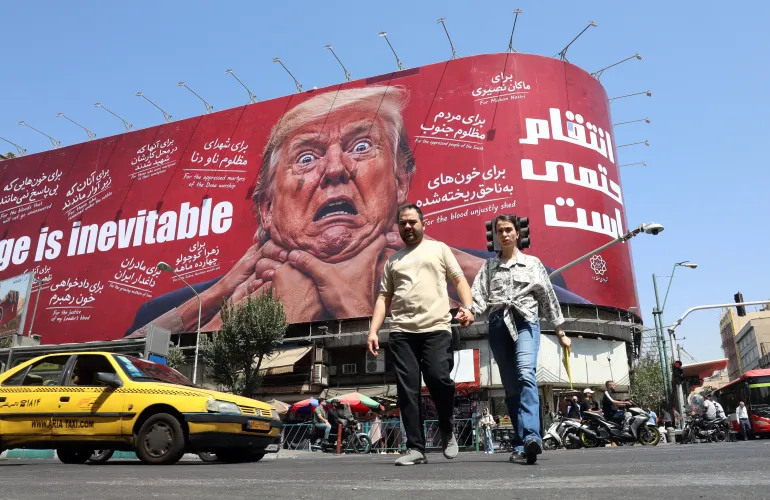
Iranians walk near an anti-Trump billboard in Tehran, Iran, August 19, 2026 [Abedin Taherkenareh/EPA]
Alliances
Alongside the loss of confidence in the US as a security guarantor has come a dramatic reordering of alliances and rivalries. Much of Iran’s network – most notably Hezbollah, whose reputation had long served as a deterrent against Israeli attack – appeared to buckle under Israeli pressure.
“The Middle East has always been multi-aligned. However, now it’s even more so,” Sanam Vakil, the director of the Middle East and North Africa Programme at Chatham House, said of the increased leverage given to external actors, such as Turkiye in Syria and China’s involvement in negotiations over the end to war on Iran, as Beijing finds its own energy supplies under threat.
“It’s ironic, since October 7, it’s Israel that has emerged as the revisionist power and Iran almost as the status quo power,” she said of the apparent reversal in status of the two belligerents, with Tehran seemingly more focused on regaining the ground it has lost in the last three years rather than advancing beyond them.
However, none of this was to overstate Israeli influence, or liken it to a regional superpower, Vakil cautioned. “Israel may currently be the preponderant military power in the Middle East, but real power is typically classed as being able to project stability, which Israel hasn’t shown itself able or willing to do,” she said.
Clogged arteries
While Israel and the US hoped February’s attacks would swiftly topple Iran’s government, they have instead opened a new front. Tehran now wields economic leverage over Israel, the US and their partners through the Strait of Hormuz, which borders Iran and typically carries about a fifth of the world’s oil and gas, and through Bab al-Mandeb, which is now threatened by its Houthi allies.
Whatever Tehran’s intentions, the economic pain has been uneven. The West, cushioned by emergency reserves, record US oil production and supplies from countries such as Norway, has so far avoided the turmoil of the 1970s oil shocks, when US drivers queued for petrol, even though the current disruption is on a greater scale. In April, the International Monetary Fund trimmed its 2026 global growth forecast only slightly, to 3.1 percent from 3.3 percent.
Gulf exporters, in contrast, have fared far worse. The same assessment cut its forecast for Saudi Arabia from 4.5 to 3.1 percent, and turned Qatar’s from growth of 6.1 percent into a contraction of 8.6 percent.
“It’s curious, in many ways the West’s reduced need for Gulf oil has increased the degree to which Israel has become a liability for the US,” Israeli political economist Shir Hever told Al Jazeera, referring to a diplomatic alliance between the two states long underpinned by Israel’s strategic position in an oil-rich region central to US interests.
“There’s a train of thought in Israel that the current crises may push the Gulf states into allying with it,” he said, while noting the irony that Israel had been the main aggressor in the conflicts that followed October 7. “Though that seems fairly unlikely.”
The United Nations Interim Force in Lebanon said there were no casualties after small arms fire targeted a border post.
Published On 7 Oct 20267 Oct 2026
The United Nations Interim Force in Lebanon (UNIFIL) says one of its posts on the Lebanon-Israel border was targeted by small arms fire, with no casualties reported.
The UN force said the incident occurred on Wednesday morning with several rounds of small arms fire targeting a UNIFIL position near Kfar Shouba along the UN-drawn border with Israel, known as the Blue Line.
Recommended Stories
list of 3 itemsend of list
“Such deliberate attacks gravely endanger the lives of peacekeepers,” UNIFIL said in a statement, adding that it was investigating the incident.
Under pressure from the United States and Israel, the UN Security Council decided earlier this year to set December 31 as the end of the mandate for the UN peacekeeping force in Lebanon.
UNIFIL was initially created to oversee the withdrawal of Israeli troops from southern Lebanon after Israel’s 1978 invasion, and its mandate has been renewed annually since then.
The mission was expanded after the 2006 war between Israel and Hezbollah. Proponents say it remains important to maintaining a demilitarised buffer between the two sides along the volatile Israeli and Lebanese border.
Israel has long accused UNIFIL of failing to prevent threats posed by Hezbollah and has increasingly pushed for the end of its mission since cross-border fighting escalated in the wake of the October 7, 2023, Hamas-led attacks on Israel and the start of Israel’s war on Gaza.
UNIFIL currently has 7,500 peacekeepers from around 50 countries operating in Southern Lebanon.
Last month, Lebanon’s Prime Minister Nawaf Salam pressed the UN on the need to “avert the vacuum” that would be caused by withdrawing the mission from the country’s south without a viable replacement.
Violence has decreased since a ceasefire following a June memorandum of understanding in the US-Iran war. Lebanon and Israel concluded a US-sponsored framework agreement later that month.
The Israel-Lebanon deal involves the disarmament of Hezbollah, a gradual withdrawal of Israeli forces from Lebanon’s south and the deployment of the Lebanese army to the region, starting in test areas known as “pilot zones”.
White phosphorus can cause severe burns, ignite repeatedly and produce intense heat and toxic smoke. Here’s how Israel has used it in southern Lebanon, its impact on civilians and farmland, and why its use in populated areas is restricted under international law.
Al Jazeera’s Reem Takieddine explains.
Iran’s foreign minister says his visit to the UN General Assembly last week was mainly to outline Tehran’s position on regional conflicts and the critical security situation in the Strait of Hormuz.