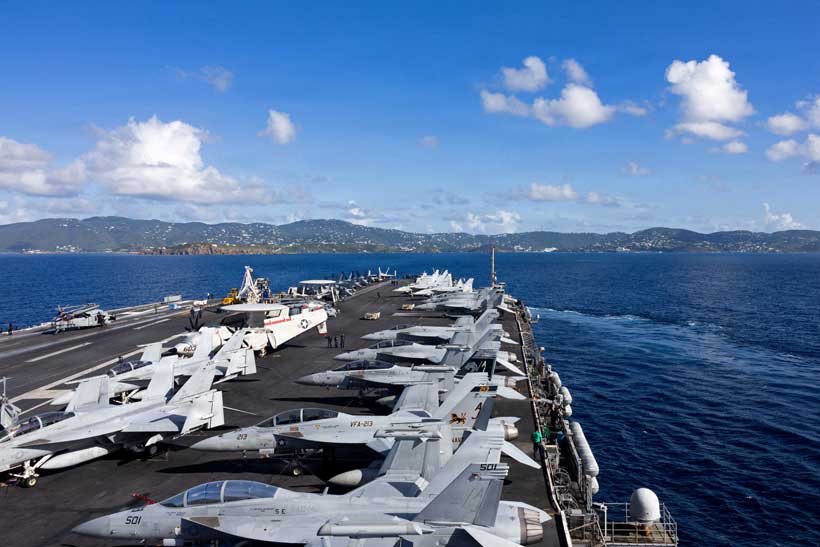
The aircraft carrier USS Abraham Lincoln, six frigates, three light warships, and approximately thirty fighter jets and support aircraft have entered the Middle East by order of Donald Trump who, by repeatedly touting the slogan “I have ended six/seven/eight wars,” has considered (and continues to consider) himself deserving of the Nobel Peace Prize. What objective do all these tensions that the U.S. administration has generated in the region actually pursue? The weakening of Iran, or the overthrow of the incumbent government? Whatever his and his administration’s aim may be, it appears that—within the cost–benefit calculations of his trader’s mindset—he has yet to arrive at a definitive conclusion as to what kind of blow, and at what scale, could deliver the desired outcome. His recent military posturing around Iran and his increasingly threatening rhetoric against the Islamic Republic have placed him in a no-win situation whose end few can predict.
Why a no-win situation for Trump?
First Strike Doubt: Trump and the constellation of officials currently in the White House—who, notably, are far from unified or aligned on how to approach Iran—have reached no certainty regarding the effectiveness of a first strike against Iran or the likelihood of achieving their desired results. It is evident to all that the Islamic Republic of Iran is neither Venezuela, nor Libya, nor Syria, nor Afghanistan, nor Iraq, nor anything akin to the historical cases in which the United States has intervened militarily in the name of democracy verbally and in pursuit of its own interests operationally. This very reality has, thus far, prevented Trump from issuing the order to “open fire” on Iran up to now.
On the other side, there is no sign of the flexibility or concession sought by the United States in the behavior or rhetoric of Iranian officials—a fact acknowledged by American officials themselves. This indicates that pressure, intimidation, and threats have thus far yielded no results. The reason is clear: the Islamic Republic views any potential confrontation as an existential war and is unwilling to grant any concessions. Trump, however—who seeks to manufacture achievements out of even the smallest events and whose penchant for exaggeration is among his defining traits—perceives such circumstances as detrimental to his personal prestige and standing.
Iran’s Resilience: The experience of the Israeli attack and the hybrid war launched against Iran in June 2025, with direct assistance from the United States and indirect support from so many others, demonstrated that the instability they sought within the governing structure of the Islamic Republic and even the internal social fragmentation and rifts that had been cultivated for years through various media tools did not materialize. Despite the blows inflicted on Iran, none of the long-term strategic objectives of the United States and Israel were achieved. Likewise, the unrest and riots of January 8 and 9, despite the violence and damage they caused to the public and the state, were ultimately brought under control and culminated in a multi-million-person rally on January 12 condemning the unrest and supporting the central government of the Islamic Republic.
High costs and Persian Gulf Worries: Operationalizing a military threat would impose heavy costs on the United States and its allies. The Islamic Republic has explicitly declared that any military action against its territory, at any scale, would be regarded as all-out war, and that, consequently, the entire region—as well as U.S. interests wherever they may be—would fall within range of Iran’s retaliatory strikes. This serious warning has also prompted Persian Gulf states to mobilize their capacities to dissuade Trump from attacking Iran. The strikes on U.S. bases at Ayn al-Asad and Al-Udeid entrenched the perception that the Islamic Republic does not shy away from responding to foreign aggression, even if large segments of the world regard the attacking state as a “superpower.”
Global Energy Risks: The ignition of war in the Persian Gulf would amount to a grave threat to global energy supply routes. Roughly 30 percent of the world’s crude oil and 20 percent of liquefied natural gas are supplied by Persian Gulf countries, and 20–25 percent of global crude oil transits the Strait of Hormuz. Any aggressive action by the United States would jeopardize the security of one-fifth of the world’s fuel and profoundly affect the global economy.
Although the U.S. National Security Strategy does not place the Middle East among America’s top strategic priorities, the same document states that: “We (the United States) want to prevent an adversarial power from dominating the Middle East, its oil and gas supplies, and the chokepoints through which they pass while avoiding the forever wars”, which shows Persian Gulf oil is still of high importance for Washington.
Tilting Power Balance: In addition, heightened tensions in the Persian Gulf would endanger China’s economic interests, and any large-scale military confrontation would likely lead to a more pronounced military-security presence by Russia and China in the Gulf—tilting the balance in favor of America’s rivals.
And finally?
The embers beneath the region’s ashes today could be ignited by the slightest breeze, engulfing a vast area. Israel, while likely the first target of Iran’s retaliatory response in the event of a U.S. attack, is nevertheless eager to initiate confrontation based on the calculation that a war waged with the full might of the United States could ultimately erode the very existence of the Islamic Republic or weaken it to the point of capitulation. In this context, it is not far-fetched to suggest that the disclosure of new documents and details concerning Trump’s links to the notorious Epstein case and his mysterious island may have been driven by the Mossad, as such revelations could compel the U.S. president to undertake an irrational action to divert attention elsewhere.
Today, Trump is acting more than ever in contradiction to his own professed principles—from trampling on his signature MAGA slogan and morphing it into MIGA (Make Israel Great Again), to undermining his administration’s efforts to reduce unnecessary international expenditures; from his paradoxical pride in having ended “eight wars” to the strategy of off-shore balancing the Middle East. Should a war of this magnitude and consequence erupt, no country involved—whether through direct action or geographic proximity—would be spared its consequences. Regarding these circumstances, it appears that the only desirable scenario for Trump, the region, and the world at large is the opening of a genuine dialogue, free from the shadow of threats, intimidation, and American bullying.