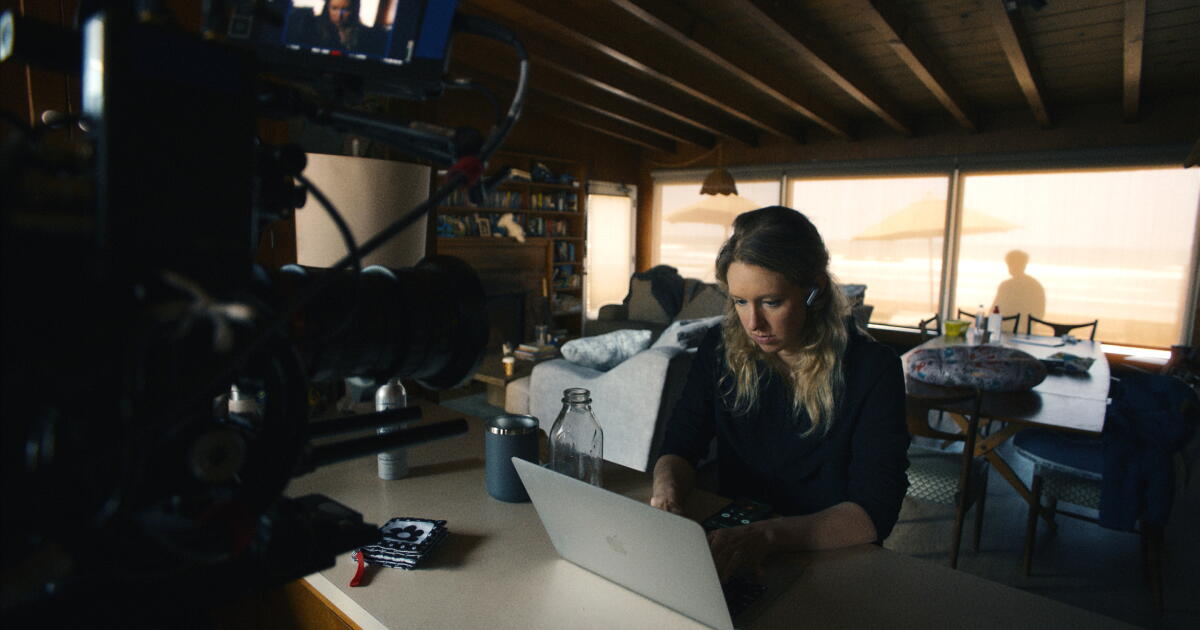
As it turns out, a lot of people wanted to see everything.
“You Can See Everything,” the Elizabeth Holmes film from co-directors Nathan Fielder and Lance Oppenheim, has earned over $100 million at the global box office — making it one of the few documentary titles to hit the theatrical milestone.
It is now the second-highest-grossing domestic non-music documentary, trailing only Michael Moore’s “Fahrenheit 9/11,” which earned $119 million domestically. The 2004 release examined the 9/11 terrorist attacks, George W. Bush’s presidency and the wars in Iraq and Afghanistan.
Most of the Holmes film’s haul has come from domestic audiences, where it has earned $93.4 million so far, according to data analytics firm Rentrak. The film has earned $8.5 million internationally. The A24 movie, made for a reported $7 million, opened in mid-October to $15.6 million, landing one of the biggest opening weekends for any documentary in film history.
Much of the fanfare over “You Can See Everything,” is due to its unconventional nature.
Until a few months ago, the movie was a closely guarded secret. Barely anyone at the studio knew it existed, let alone the public. The almost three-hour documentary was produced and filmed over the course of three years, and follows Holmes, the notorious founder of the health tech company Theranos, in the days before she began an 11-year prison sentence for defrauding investors. She is depicted mothering her children and planning to launch Theranos 2.0 with her partner, Billy Evans. Halfway through, the film takes a sudden turn when actress Amanda Seyfried, who previously played Holmes in the Hulu series “The Dropout,” reprises the role while Holmes is behind bars.
The unexpected, mysterious elements added to the film’s intrigue and ultimately worked in its favor, said Paul Dergarabedian, head of marketplace trends at Rentrak.
“It’s like the Energizer Bunny of movies,” Dergarabedian said. “It’s the ‘have you seen it?’ movie of the season. Everyone asks and then gets mad if you haven’t seen it yet. It’s such an unexpected cinematic and cultural phenomenon.”
Not every documentary release this year has found its audience in theaters. Alex Gibney’s four-hour documentary “Musk,” which chronicles billionaire Elon Musk’s life, released in October and flopped theatrically, earning about $760,000.
The Holmes film is one of the key contributors to New York-based A24’s banner year. The independent studio has earned over $530 million at the domestic box office this year, with “Backrooms” ($197.5 million) as its highest-grossing film, according to Rentrak. That is more than double the $235 million A24 earned domestically in 2025.
With the holiday season approaching, “You Can See Everything” will likely get an even bigger boost, Dergarabedian said. He predicts A24 will try to keep the title in theaters for as long as possible and that it will see a resurgence when it hits streaming platforms at home.
“It’s one of those movies that will be on a lot of people’s hit parade for the holidays, certainly for this extended Thanksgiving frame,” Dergarabedian added. “‘You Can See Everything’ is the gift that keeps giving, but the most unexpected box office gift, adding another $100 million to the bottom line of the box office that we didn’t think would be there.”