Article content
NOT FOR DISTRIBUTION TO UNITED STATES NEWSWIRE

Trade, Industry and Resources Minister Kim Jung-kwan attends a press conference at the government complex in Sejong, central South Korea. Photo by YONHAP / EPA
April 16 (Asia Today) — South Korea will begin receiving 27 million barrels of alternative crude oil in June, part of a broader effort to stabilize energy supplies and diversify import sources amid disruptions linked to conflict in the Middle East.
The Ministry of Trade, Industry and Energy said the shipments are part of crude secured by a presidential envoy team, with additional policy measures being introduced to support refiners facing supply uncertainty.
A senior ministry official said the envoy team secured about 223 million barrels of alternative crude, excluding 50 million barrels previously allocated from Saudi Arabia. Of that, 27 million barrels are scheduled for shipment beginning in June.
The earlier 50 million barrels are expected to be shipped in April and May through the Red Sea port of Yanbu, with confirmation from Saudi Aramco that deliveries will proceed as planned, the ministry said.
South Korean refiners had faced disruptions despite existing contracts, as shipments were affected by instability and constraints linked to the Strait of Hormuz, a key global oil transit route.
The envoy delegation has secured a total of about 273 million barrels of crude from countries including Kazakhstan and Saudi Arabia. Of that, roughly 250 million barrels from Saudi Arabia – which accounts for about one-third of South Korea’s crude imports – are expected to be delivered by the end of the year.
Officials said the government has already secured about 118 million barrels for April and May combined, indicating no immediate risk to domestic supply. Remaining volumes are expected to be shipped sequentially through the end of the year.
In parallel, the government is introducing measures to help refiners diversify import sources. For crude imported between April and June, authorities will ease requirements for refunds of the petroleum import levy and temporarily expand refund limits.
The ministry said it simplified freight cost calculations using an international benchmark index and removed restrictions on shipment volume, duration and frequency. It also temporarily lifted caps on freight cost compensation for diversified imports to expand financial support.
The program is backed by about 127.5 billion won (approximately $95 million) in funding, based on estimated demand from domestic refiners.
Officials said broader reforms may be considered if the situation persists.
The ministry also pushed back against claims that fuel consumption has increased following the introduction of a price cap. Data showed that weekly gasoline and diesel sales fell in five of seven weeks from late February to mid-April compared to the same period last year.
From mid-March to mid-April, after the price cap took effect, total fuel sales declined 12.4% year-over-year, the ministry said, urging observers to focus on overall trends rather than short-term fluctuations.
— Reported by Asia Today; translated by UPI
© Asia Today. Unauthorized reproduction or redistribution prohibited.
Original Korean report: https://www.asiatoday.co.kr/kn/view.php?key=20260416010005112
In March, Bad Bunny performed his first-ever concert in Asia when he played in from of 2,300 fans in Tokyo as part of Spotify’s Billions Club Live series.
Starting April 8, a filmed version of that performance will be available on Spotify for the “Nuevayol” artist’s millions and millions of fans not in attendance.
The show, officially titled “Billions Club Live With Bad Bunny: A Concert Film,” was billed as a special stop in the Grammy-winning performer’s “Debí Tirar Más Fotos World Tour” — which kicked off with a November concert in the Dominican Republic and has since sold out stadiums across Latin America and Australia. He notably didn’t include dates in the United States as part of the tour.
Footage of the Japan concert swept social media, as it showed Bad Bunny doing a never-before-seen salsa rendition of his 2018 collaboration with Drake. He also notably sang his 2021 single “Yonaguni,” which features lyrics in Japanese.
The concert film will premiere two months after the “Callaíta” singer nabbed a historic album of the year win at the Grammy Awards and became the first fully Spanish-language act to headline the Super Bowl halftime show — which was lauded for its potent star power and political messaging.
Bad Bunny’s generational run looks to have no immediate end in sight, as he will kick off the European leg of his world tour with a May performance in Portugal before making stops in Spain, England, Sweden, France, Poland and Italy.
But the “Dakiti” artist’s newsworthy year hasn’t been limited to the music world.
In February, it was announced that Bad Bunny will star — alongside Academy Award-winning actor Javier Bardem and multiple-time nominees Edward Norton and Viggo Mortensen — in Puerto Rican rapper Residente’s directorial debut, “Porto Rico.” The film, which has yet to announce a release date, will explore the complicated colonial history of Puerto Rico through Western/historical drama storytelling devices.
Israeli air raids on Lebanon have killed more than 1,450 people, including 126 children, and displaced some 1.2 million residents since March 2, according to Lebanese authorities. The bombardment has wounded more than 4,400 individuals.
In southern Lebanon’s Kfar Hatta, an Israeli attack killed seven people, including a four-year-old girl and a Lebanese soldier, the Ministry of Public Health reported on Sunday. The Israeli military had ordered the forced evacuation of the town the previous evening, an area where many displaced Lebanese had sought refuge.
As invasion expands deeper into southern Lebanon, leaving devastated villages behind, Lebanese President Joseph Aoun has intensified calls for negotiation. “Why don’t we negotiate … until we can at least save the homes that have not yet been destroyed?” he pleaded in a televised address on Sunday, hoping to prevent destruction comparable to Israel’s Gaza operation.
In Toul village in the Nabatieh district, a couple were killed while their children, aged 15 and nine, were injured. Multiple bombardments have wiped out entire families in single attacks. Officials report that approximately 25 percent of all victims are women, children and medical workers.
On March 12, the Israeli military expanded its forced evacuation orders for southern Lebanon residents – from the Litani River to north of the Zahrani River, about 40km (25 miles) north of the Israeli border.
The massive displacement has overwhelmed the country’s shelter capacity. Many families are unable to find accommodation, spending nights in streets, vehicles, or public spaces as collective shelters reach maximum capacity. For many, this represents repeated trauma.
Between October 2023 and November 2024, amid cross-border fighting between Hezbollah and Israel, hundreds of thousands of residents of southern Lebanon’s border villages suffered the worst of the violence.
At its height, 899,725 people were forcibly displaced by Israeli forces back then. Most had returned by last October, only to be forced to flee again.
Israeli attacks during those 14 months inflicted extensive damage to homes and infrastructure. The World Bank estimated damage to residential buildings alone at approximately $2.8bn. About 99,000 homes were damaged or destroyed, preventing many families from returning even after the ceasefire.
Billionaire hedge fund founder turned environmental warrior Tom Steyer, a leading Democratic candidate for California governor, is facing mounting questions about how he earned his wealth — notably investments in private prisons that are now being used to house undocumented immigrants facing deportation.
Some of the most vicious political attacks come from his Democratic rivals and Sacramento special interest groups as the June 2 primary election fast approaches, but Steyer has been dogged for years about his past, controversial business ventures and how they help fund his unbridled campaign spending.
Steyer, 68, faced that ire during a town hall event in San Diego last week.
“Tom, you’re not going to come to San Diego and ignore this detention center,” Holly Taylor, a 37-year-old Democrat screamed at Steyer, holding signs with QR codes to help detainees at an Otay Mesa private prison that Steyer’s hedge fund backed. “It’s a concentration camp. They’re drinking water out of a toilet.”
Taylor, a crime scene cleaner from Pacific Beach, is among scores of people who gather weekly at the facility to raise money for detained immigrants to provide them some comfort amid the Trump administration’s Immigration and Customs Enforcement raids.
In 1986, Steyer, co-founded Farallon Capital, which had shares valued at $89.1 million in the Corrections Corp. of America in 2005, according to the Securities and Exchange Commission. That company, now known as CoreCivic, operates private prisons around the nation that are housing people picked up by federal immigration agents, including the one in Otay Mesa.
It is not the first time Steyer has faced criticism about the connection with private detention facilities. At the California Democratic Party convention in February, protesters dressed in orange prison jumpsuits sought to draw attention to the controversy.
His Democratic rivals have also seized upon the issue to question the billionaire’s progressive credentials.
“Before he was a progressive, he made millions off of companies that operate ICE detention centers, that operate private prisons that incarcerated young children,” state Supt. of Public Instruction Tony Thurmond said during a recent interview with a political influencer known as Mrs. Frazzled.
“His entire campaign is built on the backs of kids in cages,” Rep. Eric Swalwell, (D-Dublin) wrote Tuesday in a post on X.
People protest outside of a lunch held by California gubernatorial candidate Tom Steyer at the 2026 California Democratic Party State Convention in San Francisco on Feb. 21.
(Jeff Chiu / Associated Press)
Several years earlier, Yale University’s graduate teachers union called upon the school — Steyer’s alma mater — to divest from Farallon because of concerns about how the private prison company treated detainees, notably minorities.
Steyer has repeatedly expressed remorse about his former firm’s ties with the detention company. In 2012, he sold his stake in Farallon, which was named in reference to islands off the coast of San Francisco and was once one of the largest hedge funds in the world.
“I deeply regret that Farallon made that investment, and I personally ordered the investment in CCA to be sold because it did not accord with my values then or now,” Steyer told The Times in 2019 after he launched a short-lived presidential campaign.
Asked to comment about the latest iteration of the controversy, Steyer’s campaign pointed to comments he made in March at a town hall in San Francisco about how among the hundreds of thousands of companies his hedge fund invested in, the private prison company changed the course of his life.
“It was a mistake, and I sold it over 20 years ago, thinking, not that it won’t be profitable, it’s just a mistake. I don’t want to be in that business. But let me say this, it wasn’t just a mistake,” Steyer said. “It was also a big wake-up call that I was in the wrong place, that I was in a business that was taking me to places I absolutely didn’t want to go. And there’s a reason I walked away from that business and walked away from a ton of money, because I felt like that is not the life I want.”
He added that he and his wife, Kat Taylor, have spent the past two decades pushing for rehabilitative justice — treatment instead of mass incarceration except for violent felons.
“Am I a perfect person? No, have I made mistakes? Yes,” Steyer said. “But for those of you who like to read the Bible, there is a moment on the road to Damascus when someone makes a change, and I have made a big change, and I did it a long time ago, and I’ve been pushing very, very hard the other way.”
Farallon also invested in fossil fuel projects, including an Australian coal mine that denuded thousands of acres of koala habitat and generated an enormous amount of carbon emissions.
Steyer, who has a net worth of $2.4 billion according to Forbes, has painted himself as a reformed billionaire who walked away from Farallon because of angst about how he earned his fortune. He has spent hundreds of millions of dollars supporting Democratic causes, notably efforts to fight climate change.
“The truth is that is not where I think there is value, and that is not what I’m seeking in my life,” he said at a Sacramento town hall in March when retired state employee Gina Coates asked how, as a woman of color, she could believe his promises given his privilege as a wealthy white man.
“In terms of trusting me, let me say this, I left my business 14 years ago, and anybody who cared about money would not have done it,” Steyer said.
Steyer later said at the town hall that he left Farallon because he realized that he didn’t want to remain on that path.
“I want to have a meaningful life,” he said. “I want to stand with the people of this state and have actual prosperity. Twelve trillionaires and 40 million people who can’t make rent is not success.”
But Steyer and his wife continue to receive significant income from the hedge fund, including millions of dollars in investments, holdings and various complicated transactions in 2024, according to a statement of economic interest and tax returns he was required to file with the California Secretary of State’s office because of his gubernatorial run.
A Steyer campaign spokesman said Steyer created guardrails to ensure that he does not profit off companies he morally disagrees with.
“Tom has put in place an investment policy to ensure that he does not directly invest in fossil fuels, payday lending, or private prisons,” spokesman Anthony York said. “To the extent he inadvertently incurs exposure to those industries through third-party managers or liquid legacy investments, Tom will donate all profits to charity.”
After leaving Farallon, Steyer became one of the nation’s top Democratic donors. And he has used his wealth to fund his political ambitions. Steyer contributed nearly $342 million of his own money to his short-lived 2020 presidential campaign, according to the Federal Election Commission.
In the 2026 governor’s race, Steyer has donated nearly $112 million to his campaign as of Thursday, according to the California secretary of state’s office. He has been an ubiquitous presence on the airwaves, including local news programs and campaign ads that aired during the “Puppy Bowl” on the Animal Planet channel on Super Bowl Sunday. In the past month, Steyer has aired more than 5,000 ads, according to iSpot, which tracks television commercials.
California, home to 23.1 million registered voters, is home to some of the nation’s most expensive media markets. And candidates, particularly those who are not well known, need to spend heavily on television advertising if they hope to have a successful campaign.
But money is no guarantee of success. Billionaire Meg Whitman, the former eBay chief and formerly a longtime Republican donor, spent $144 million of her money on her 2010 gubernatorial bid. That set a record for a candidate’s contribution in a state race at the time, but Whitman lost to Jerry Brown by nearly 13 percentage points.
In 1998, Democratic multimillionaire Al Checchi who had been the co-chair of Northwest Airlines spent $40 million of his wealth on an unsuccessful run for governor, also a record at the time.
Steyer is one of the top three Democrats in the sprawling field to replace termed-out Gov. Gavin Newsom. And his liberal positions are drawing the ire of powerful forces in Sacramento. On Tuesday , the state’s Realtors donated $5 million to an independent expenditure committee opposing Steyer’s bid.
Taylor, who confronted Steyer at the San Diego town hall, said she had not planned to be so vocal. But as the event unfolded, she decided she had to speak, not only to Steyer but to the attendees. She and her compatriots gather every Sunday outside the Otay Mesa facility to raise money to help detainees buy food in the prison commissary and call their families.
“My main issue is that he has gotten financial gain off of these people suffering,” she said.
WASHINGTON — President Trump is requesting $152 million from Congress to begin “rebuilding” the prison on Alcatraz Island for operational use, though his administration appears to have taken few steps toward advancing the project.
The request, in the president’s proposed budget for fiscal year 2027, resurrects Trump’s attention-grabbing concept of converting the crumbling site — which has stood as a piece of history for more than 60 years — into a working federal prison.
But the Bureau of Prisons on Friday said it had no new information to share about the potential project and no updates about whether assessments that the agency had said it launched last year had been completed.
A spokesperson said the bureau was “moving forward, evaluating, and formulating the actions necessary” and pointed to to a May 2025 statement from bureau director William K. Marshall pledging to “vigorously pursue all avenues to support and implement the President’s agenda.”
The funding request was included in Trump’s budget proposal, which provides Congress with a look at the administration’s priorities ahead of the next fiscal year. Congress makes the ultimate funding decisions for the government.
Creating a working prison on the San Francisco Bay island would be extremely costly, the administration’s critics say, and would raise questions about its fate as a historic site that draws more than a million tourists a year.
Rep. Nancy Pelosi (D-San Francisco) said Friday she would attempt to block Trump’s proposal in Congress by any means possible, calling it “a stupid notion that would be nothing more than a waste of taxpayer dollars.”
“Alcatraz is a historic museum that belongs to the public, and San Franciscans will not stand for Washington turning one of our most iconic landmarks into a political prop,” she said in a statement.
The $152-million request is for only the first year of the project’s costs. How long the project could take or what the total cost could be are not clear. The budget proposal described the project as a “state-of-the-art secure prison facility.”
The White House did not respond to a request for comment Friday.
“It represents something very strong, very powerful, in terms of law and order,” Trump told reporters last year. “It housed the most violent criminals in the world. … It sort of represents something that’s both horrible and beautiful, strong, and miserable.”
He characterized the historic site as “rusting and rotting.”
Sen. Patty Murray (D-Washington), vice chair of the Senate appropriations committee, said Trump would waste taxpayer money on Alcatraz “while ignoring billions of dollars in repair-backlog needs for existing” federal prisons.
The government opened the federal penitentiary on Alcatraz in 1934, hoping to use the remote island to house particularly difficult prisoners, according to the National Park Service. Its cells held infamous criminals such as Al Capone, and several unsuccessful escape attempts captured public imagination.
The prison was closed in 1963 after becoming too costly to run. A group of Native American activists occupied the land during a period between 1969 and 1971, and in 1972, Alcatraz became a national recreation area under National Park Service management. It opened to the public as a national park attraction the following year and was later designated a National Historic Landmark.
Trump, who has pushed to round up criminals and pursued plans to open new detention centers in his second term, floated the Alcatraz idea last year, saying he wanted to send “America’s most ruthless and violent Offenders” there.
He directed the Bureau of Prisons to take up the task. In July, then-Atty. Gen. Pam Bondi and Interior Secretary Doug Burgum visited the island.
“Alcatraz could hold the worst of the worst, it could hold middle-class violent prisoners, it could hold illegal aliens,” Bondi told Fox News during the visit. “This is a terrific facility; it needs a lot of work, but no one has been known to escape from Alcatraz and survive.”
The Bureau of Prisons said at the time that no final decision had been made as to whether to use the site, but that the agency would determine whether “it makes sense operationally, legally, and financially.”
The bureau said then that was working on a cost estimate and feasibility report to present to Congress following a site assessment with the National Park Service and work by engineers and planners on potential budgets and models.
Sen. Adam Schiff (D-Calif.) said Friday opening Alcatraz would be “prohibitively expensive” for the federal government to undertake. He has previously characterized the concept as part of an attack by the Trump administration on national parks.
“Trump’s continued push to reopen it as a federal prison is a wasteful exercise in futility,” Schiff said. “He should focus on lowering the cost of living for the American people, not raising the cost of our prisons.”
Article content
NOT FOR DISTRIBUTION TO UNITED STATES NEWSWIRE
THIS CONTENT IS RESERVED FOR SUBSCRIBERS ONLY
Subscribe now to read the latest news in your city and across Canada.
SUBSCRIBE TO UNLOCK MORE ARTICLES
Subscribe now to read the latest news in your city and across Canada.
REGISTER / SIGN IN TO UNLOCK MORE ARTICLES
Create an account or sign in to continue with your reading experience.
THIS ARTICLE IS FREE TO READ REGISTER TO UNLOCK.
Create an account or sign in to continue with your reading experience.
or
Article content
SERVICES OR FOR DISSEMINATION IN THE UNITED STATES
Article content
Article content
TORONTO — Sherritt International Corporation (“Sherritt” or the “Corporation”) (TSX:S) today announced that it has agreed with certain new and existing shareholders of the Corporation to complete a non‑brokered private placement of common shares of Sherritt (“Common Shares”) for aggregate gross proceeds of up to $50 million (collectively, the “Private Placement“). As part of the Private Placement, Seymour Schulich, through a corporation controlled by him, has agreed to subscribe for up to 68,600,000 Common Shares for aggregate gross proceeds of up to $14,406,000.
Article content
Article content
Pursuant to the Private Placement, the Corporation will issue up to 238,095,238 Common Shares from treasury at a price of $0.21 per Common Share. The Private Placement is expected to close on or about April 7, 2026, subject to customary closing conditions and the receipt of required regulatory approvals, including approval of the Toronto Stock Exchange.
Article content
Top Stories
Get the latest headlines, breaking news and columns.
By signing up you consent to receive the above newsletter from Postmedia Network Inc.
Thanks for signing up!
A welcome email is on its way. If you don’t see it, please check your junk folder.
The next issue of Top Stories will soon be in your inbox.
We encountered an issue signing you up. Please try again
Article content
The net proceeds from the Private Placement are expected to be used for general corporate purposes and to support the Corporation’s operations and strategic initiatives.
Article content
An existing shareholder of the Corporation holding approximately 13.5% of the outstanding Common Shares is expected to participate in the Private Placement. Such participation constitutes a “related party transaction” within the meaning of Multilateral Instrument 61‑101 – Protection of Minority Security Holders in Special Transactions (“MI 61‑101”). The Corporation expects to rely on exemptions from the formal valuation and minority shareholder approval requirements of MI 61‑101 on the basis that the fair market value of the securities issued to the related party does not exceed 25% of the Corporation’s market capitalization. The Private Placement will not result in a change of control of the Corporation.
Article content
The securities offered have not been, and will not be, registered under the United States Securities Act of 1933, as amended, or any U.S. state securities laws, and may not be offered or sold in the United States absent registration or an applicable exemption from the registration requirements. This news release shall not constitute an offer to sell or the solicitation of an offer to buy nor shall there be any sale of the securities in any jurisdiction in which such offer, solicitation or sale would be unlawful.
Article content
Commenting on the Private Placement, Brian Imrie, Chair of Sherritt’s board of directors (the “Board”) said, “This private placement marks a significant development for Sherritt as we continue to navigate through a challenging operating environment. We appreciate the strong support shown by both new and existing shareholders, which reflects their confidence in Sherritt’s future prospects.”
Article content
Board of Directors Update
Article content
In addition, Sherritt announces that Louise Blais has stepped down from its Board effective today, to focus on her commitments at her strategic advisory firm Blais Global.
Article content
“On behalf of the Board, I would like to thank Louise for her invaluable contributions and dedication during her tenure,” said Mr. Imrie. “Her insights and leadership have helped guide Sherritt through an important period, and we wish her continued success in her future endeavors.”
Article content
Article content
About Sherritt
Article content
Sherritt is a world leader in using hydrometallurgical processes to mine and refine nickel and cobalt – metals deemed critical for the energy transition. Leveraging its technical expertise and decades of experience in critical minerals processing, Sherritt is committed to expanding domestic refining capacity and reducing reliance on foreign sources. The Corporation operates a strategically important refinery in Alberta, Canada, recognized as the only significant cobalt refinery and one of just three nickel refineries in North America. Sherritt’s Moa Joint Venture produces cost competitive critical minerals while maintaining high sustainability standards and has an estimated mine life of approximately 25 years.
Article content
The Corporation’s Power division, through its ownership in Energas, is the largest independent energy producer in Cuba, processing domestically sourced raw natural gas to generate electricity for sale to the Cuban national electrical grid. Sherritt’s common shares are listed on the Toronto Stock Exchange under the symbol “S”.
Article content
Forward-Looking Statements
Article content
This press release contains certain forward-looking statements. Forward-looking statements can generally be identified by the use of statements that include such words as “believe”, “expect”, “anticipate”, “intend”, “plan”, “forecast”, “likely”, “may”, “will”, “could”, “should”, “suspect”, “outlook”, “potential”, “projected”, “continue” or other similar words or phrases. Specifically, forward-looking statements in this press release include, but are not limited to, statements regarding the Private Placement, including the intended use of proceeds therefrom.
Article content
Forward-looking statements are not based on historical facts, but rather on current expectations, assumptions and projections about future events, including commodity and product prices and demand; the level of liquidity and access to funding; share price volatility; production results; realized prices for production; earnings and revenues; global demand for electric vehicles and the anticipated corresponding demand for cobalt and nickel; the commercialization of certain proprietary technologies and services; advancements in environmental and greenhouse gas (GHG) reduction technology; GHG emissions reduction goals and the anticipated timing of achieving such goals, if at all; statistics and metrics relating to Environmental, Social and Governance (ESG) matters which are based on assumptions or developing standards; environmental rehabilitation provisions; environmental risks and liabilities; compliance with applicable environmental laws and regulations; risks related to the U.S. government policy toward Cuba; and certain corporate objectives, goals and plans for 2026. By their nature, forward-looking statements require the Corporation to make assumptions and are subject to inherent risks and uncertainties. There is significant risk that predictions, forecasts, conclusions or projections will not prove to be accurate, that the assumptions may not be correct and that actual results may differ materially from such predictions, forecasts, conclusions or projections.
A rolling wave of “No Kings” protests swelled through America’s small towns and big cities Saturday, with crowds gathering to blast President Trump, Immigration and Customs Enforcement crackdowns, the war in Iran and high gas and food prices.
Saturday’s demonstrations were expected to draw millions of people nationwide, including thousands for a downtown Los Angeles rally. More than 40 protests were planned for L.A., Orange and Ventura counties, part of the national “No Kings Day of Nonviolent Action.”
No Kings Coalition organizers were hoping that turnout for the rallies in all 50 states could combine to form the largest single-day protest in U.S. history. They pointed to growing anger over the country’s direction, including fatal ICE shootings and troops dispatched to the Middle East, since the first “No Kings” demonstration was held last June.
On Saturday morning, hundreds gathered around the reflecting pool at Pasadena City College. A band rolled through with a fascism-themed parody of Johnny Cash’s “Folsom Prison Blues.” Sign-toting protesters lined Colorado Boulevard, drawing a constant stream of honking from the cars driving by. For many, the Iran war was top of mind.
“Every time we protest, there’s something completely new, which speaks to the chaos of the Trump administration,” Cindy Campbell told The Times. “ICE raids last year, Epstein files a few months ago. Now, war.”
“This administration doesn’t serve us. It serves billionaires,” said Kent Miller, of Monrovia, who participated in the Pasadena protest. “War with Iran is only making life harder for working people.”
Miller pointed to a Chevron gas station advertising gas for $6.45 per gallon.
“See?” he said.
National coordinators said there has been increased interest in smaller communities, including Republican bastions, with higher-than-expected attendance during Saturday’s protests.
“I’m out here because I’m disgusted with what I’m seeing,” said Kersty Kinsey, a mother who was protesting near the Beaufort, S.C., City Hall. “People are suffering, and he’s playing golf. People are suffering, and he’s going other places and blowing things up.”
In Beaufort, an antebellum city founded in 1711, an estimated 3,000 people turned out — a marked increase over earlier “No Kings” rallies, said Barb Nash, one of the coordinators. Amid the moss-draped live oaks and blooming pink and white azaleas, a person in a purple Barney dinosaur costume held a sign reading: “Dino’s for Democracy.” A young girl handed out homemade “Resistance Cookies.”
Los Angeles coordinators said they expect more than 100,000 people at the local events, which were being planned for Beverly Hills, Burbank, West Covina, West Hollywood and Thousand Oaks. One group planned a “Road Outrage” car caravan to motor through Mid City with flapping flags calling for “No War,” and “ICE Out of LA.” At a Torrance gathering, cars honked, protesters waved flags, and a person in an inflatable green cow costume hoisted a large American flag.
The White House, in a Saturday statement, dismissed the protests as a “Trump Derangement Therapy Session.”
Organizers said they have been particularly encouraged by the surge of interest from groups in rural communities that wanted to join the loose-knit No Kings Coalition and hold protests.
Jaynie Parrish, founder of the Arizona Native Vote project, started planning a protest for her tiny town of Kayenta, on the Navajo Nation in northern Arizona, only earlier this week.
“My dad, who’s a [military] veteran and an elder, said: ‘We should go,’ and I said, ‘OK,’” Parrish told The Times.
“Our folks don’t always protest for things, but this was very important,” Parrish said. “A lot of our families are feeling the impacts right now of higher prices and things being cut. A lot of our healthcare benefits are being cut … and our tribal sovereignty is being threatened.”
Upbeat Midwestern activists withstood whipping winds to form a line of protesters stretching nearly three blocks of Burlington Avenue in Hastings, Neb. Under the crisp blue skies, one of the protesters, Drew Fausett, told The Times in a phone interview that he is a registered Republican in the decidedly red state.
“My politics haven’t really changed — but the party around me has,” Fausett said. “It used to be the two parties were two sides of the same coin, and they would work together — but not anymore.”
He and his wife, Becky, have attended “No Kings” and other protests because “it’s the only way to show that people have different opinions,” he said. “People are out here speaking for their families and their neighbors. That’s what this is all about.”
Trump’s policies are hurting many in Nebraska — including farmers, said Debby Thompson, one of the Hastings organizers.
“We want to urge our representatives in Congress to not just rubber stamp whatever Trump wants because it’s really hurting rural folks and farmers,” Thompson said. “The tariffs and huge increase in prices on fertilizer are hitting farmers really hard.”
The “No Kings” campaign sprouted in June as an act of defiance on Trump’s 79th birthday. He wanted a military parade in Washington to mark his milestone, and anti-Trump protesters came out in force — an estimated 5 million people around the country — with their own display. At the time, Trump’s second-term policies were coming into focus, including ramping up immigration raids, deploying the National Guard to L.A. in response to protests, and mass firings within the federal government.
A subsequent event in mid-October drew even larger crowds, with an estimated 7 million people protesting around the country.
Saturday’s event coincided with a dip in Trump’s approval ratings. A Reuters/Ipsos poll last week found 36% approve of Trump’s job performance, marking the lowest level since his return to office last year. In a separate Fox News Poll released last week, 59% disapproved of his job performance.
“Since the last ‘No Kings,’ we’re seeing higher gas prices and groceries, all while there’s an illegal war in Iran,” national organizer Sarah Parker of the organization 50501 said during a Thursday press briefing. “We’ve also seen our neighbors executed — American citizens executed.”
Widespread protests and candlelight vigils followed January’s fatal shootings by ICE agents in Minneapolis of Renee Good, a 37-year-old mother of three, and Alex Pretti, a 37-year-old intensive care unit nurse.
“The defining story of this Saturday’s mobilization is not just how many people are protesting — but where they are protesting,” Leah Greenberg, co-founder of Indivisible, said during the press briefing. She said two-thirds of the RSVPs to national organizers came from outside of major urban centers.
The Los Angeles event was organized by the local chapter of 50501 (short for “50 protests, 50 states, 1 movement”) and other progressive groups, including the ACLU, Human Rights Campaign, Indivisible and Public Citizen, as well as labor unions such as Unite Here Local 11 and the Service Workers International Union.
“There’s an affordability crisis in this country — people can’t afford groceries or healthcare,” Joseph Bryant, SEIU executive vice president, said in a statement. “But this administration is focused on expanding its power, starting unnecessary wars that benefit billionaires, and targeting immigrants and citizens who dare to stand up for them.”
11:40, 27 Mar 2026Updated 11:47, 27 Mar 2026

Around five million more Brits plan to holiday at home rather than go abroad this Easter(Image: Parkdean Resorts)
Around 12.5 million Brits are planning an Easter staycation – as the Middle East war deters families from jetting abroad.
The number of people who say they intend to holiday in the UK over the Easter weekend is up sharply from 10.6 million last year. The near two million surge will help deliver a bumper £4.8billion boost to tourism and the wider economy, according to VisitEngland, which published the data.
The number saying they hope to holiday at home dwarfs the estimated 7.4 million who are planning a trip abroad this Easter. Of those definitely aiming to take a staycation during the Easter break, the majority will be short breaks of one to three nights.
READ MORE: UK drivers urged to do three-second car check as clocks change this weekendREAD MORE: UK’s ‘holiday park of the year’ is on family-run farm near beautiful beaches
It came as VisitEngland’s Trip-Tracker revealed that more than a quarter of those it surveyed, 28%, were worried about the impact of the Middle East conflict on their upcoming travel plans in April and May. The top concern was having less money to spend due to the economic impact. There have already been fears of air fare price hikes and possible flight cancellations.
The number of people planning an Easter staycation this year also marks a big jump on 2024’s 11 million, and nearly double the 6.5 million in 2023. A further 5.1 million people surveyed said they were undecided about whether to take an overnight holiday trip in the UK during the Easter weekend. The top reasons were “waiting to see if I can afford it” and “waiting to see what the weather is like”. Forecasts for the weather suggest it will be a mixed bag next week, but with settled conditions over the Easter weekend itself.
However, those driving for days out and holidays in the UK face a hit to the wallet from soaring fuel prices on the back of the Iran war. The nationwide average for unleaded has jumped to 150p a litre, up 17p since before the conflict erupted. Diesel drivers have been hit even harder, with diesel now averaging 176.68p per litre, a leap of 34p in recent weeks.
RAC head of policy Simon Williams said: “Petrol has now broken through the unwelcome milestone of 150p a litre (150.11p), something drivers haven’t seen since mid-May two years ago while the average price of diesel is now approaching 180p at 177.68p.
“With the long-awaited four-day Easter weekend almost within touching distance, the cost of getting away by car is going to be noticeably higher this year.
“And with average prices at motorway services at 166p for unleaded and 182p for diesel, drivers on long journeys will need to plan very carefully where they refuel. The best advice remains to shop around for fuel and make use of free apps such as myRAC to never pay a penny more for fuel than is absolutely necessary.”
Some families may also think twice given another wave of bill increases – including water and council tax – from the start of April, and warnings that food price inflation could jump again.
Kate Allen, owner of Devon-based Finest Stays, said: “For now, we’re not seeing a slowdown. Bookings are up around 10% on this time last year, with more guests opting to stay in the UK rather than travel further afield to places like Dubai.
“The Great British holiday is very much in favour, as we’re a nation that prioritises getting away, and domestic breaks are benefiting from that shift. That said, there’s a nervous undercurrent. Fuel costs feel like a slow leak, pressure building rather than bursting.
“We’re expecting more guests to postpone or cancel, and that’s where it gets tricky. Terms and conditions may cover it, but it doesn’t make refund conversations any easier when the wider impact on businesses and homeowners isn’t fully understood.”
Tourism Minister Stephanie Peacock said: “It is wonderful that so many people are planning on having a staycation this Easter weekend, whether that’s spending time visiting our stunning landscapes and coastlines or exploring our vibrant towns, cities and cultural landmarks. Supporting domestic tourism helps local areas thrive – fuelling small businesses, boosting pride, and strengthening community economies.”
VisitEngland chief executive Patricia Yates said: “Tourism businesses and destinations will be looking to the critical Easter weekend for much needed cash flow so it’s encouraging to see so many of us are planning a holiday at home, with its ease, convenience and certainty of budgeting. We also know that the cost of living remains a concern for holidaymakers, leaving it difficult too for businesses to plan in advance.
“We have incredible activities, experiences and places to stay for all tastes and budgets, and there really is nowhere quite like Britain in springtime. From walks in our beautiful countryside with the promise of a pub lunch or discovering contemporary culture in our buzzing cities to enjoying fish and chips on the beach, there is something for everyone. So, a rallying cry to please go out and explore the amazing destinations and events here on our doorstep this spring. Tourism businesses will be very pleased to welcome you, you will have an amazing time and create memories to make you smile all year.”
It came as trade body UKHospitality stepped up criticism of what has been dubbed a new “tourist tax”. Labour is proposing to allow regional mayors in England to introduce a “visitor levy” on overnight stays, as already happens in some European countries. While details of how it would work are still to be finalised, it could either be a per head charge or a percentage of the cost of the stay. Small businesses – from guesthouses to B&Bs – say it could lead to closures.
Modelling by Oxford Economics, commissioned by UKHospitality, which assumed a 5% levy, warned it could lead to a £1.6billion tax increase for holidaymakers by 2030, and a £2.2billion hit to the economy.
WASHINGTON — The Justice Department has settled for roughly $1.2 million a lawsuit from Michael Flynn, the former national security advisor to President Trump who pleaded guilty during the Republican’s first term to lying to the FBI about his conversations with a top Russian diplomat and was later pardoned.
Court papers filed Wednesday do not reveal the settlement amount, but a person familiar with the matter, who spoke to the Associated Press on condition of anonymity to disclose nonpublic information, confirmed the total as about $1.2 million.
The settlement resolves a 2023 lawsuit in which Flynn sought at least $50 million and asserted that the criminal case against him amounted to a malicious prosecution. It also represents a stark turnabout in position for a Justice Department that during the Biden administration had pressed a judge to dismiss Flynn’s complaint. Atty. Gen. Pam Bondi, a former personal lawyer for the president, has openly criticized the Russia investigation in which Flynn was charged and the Justice Department in the last year has opened investigations into former officials who participated in that inquiry.
The Justice Department cast the settlement as an “important step in redressing” what it says was a “historic injustice” of the Russia investigation that shadowed Trump for much of his first term.
“This Department of Justice will continue to pursue accountability at all levels for this wrongdoing. Such weaponization of the federal government must never be allowed to happen again,” a spokesperson said.
In a separate statement, Flynn said: “Nothing can fully compensate for the hell that my family and I have endured over these many years — the relentless attacks, the destruction of reputations, the financial ruin, and the profound personal toll inflicted upon us all. No amount of money or formal resolution can erase the pain caused by a prosecution that should never have been brought.”
The settlement is the latest turn in the long-running legal saga involving Flynn, one of six Trump associates charged as part of special counsel Robert Mueller’s investigation into potential ties between Russia and Trump’s 2016 presidential campaign. That investigation found Russia interfered in the election on Trump’s behalf and that the Trump campaign eagerly welcomed the help, but it ultimately found insufficient evidence of a criminal conspiracy.
Flynn, a retired Army lieutenant general who vigorously campaigned at Trump’s side, served for weeks as his first national security advisor before being pushed out of his position. He remained a Trump ally even after agreeing to cooperate with Mueller’s team. He was pardoned in the final weeks of the president’s first term.
Flynn pleaded guilty in December 2017 to lying to the FBI when he said he had not discussed with the Russian envoy, Sergey Kislyak, sanctions that the outgoing Obama administration had just imposed on Russia for election interference. During that conversation, Flynn advised that Russia be “even-keeled” in response to the punitive measures, and assured him “we can have a better conversation” about relations between the countries after Trump became president.
The conversation alarmed the FBI, which at the time was investigating whether the Trump campaign and Russia had coordinated to sway the election. In addition, White House officials were stating publicly that Flynn and Kislyak had not discussed sanctions, which the FBI knew was untrue.
Flynn was ousted from his position in February 2017 after news broke that Obama administration officials had warned the White House that Flynn had indeed discussed sanctions with Kislyak and was vulnerable to blackmail. He pleaded guilty months later to a false statement charge.
But Flynn later sought to withdraw his guilty plea, saying federal prosecutors had acted in “bad faith” and broken their end of the bargain when they sought prison time for him.
The Justice Department in 2020 moved to dismiss the case, asserting that the FBI had no basis to interview Flynn about Kislyak and that any statements he made during the interview were not material to the FBI’s broader counterintelligence probe.
Flynn was pardoned by Trump in November 2020, ending the court case and the legal wrangling.
In his lawsuit, Flynn maintained his innocence and said he was targeted by the “virulently anti-Trump leadership” of the FBI’s Russia investigation. He contended that investigators pursued him despite knowing there was no evidence of a crime and coerced his guilty plea.
“He was falsely branded as a traitor to his country, lost at least tens of millions of dollars of business opportunities and future lifetime earning potential, was maliciously prosecuted and spent substantial monies in his own defense,” says the lawsuit, adding that Flynn will continue to suffer “mental and emotional pain.”
Tucker and Richer write for the Associated Press.
The war launched by the United States and Israel has killed more than 1,500 people in Iran.
This number is considered conservative, as actual calculations are yet to be released by the authorities.
list of 4 itemsend of list
But the devastation from the war has also triggered mass displacement in the country: the United Nations refugee agency, UNHCR, estimates that 3.2 million people – more than 3 percent of the population – have already been displaced within Iran since US-Israeli strikes began on February 28.
Twenty-seven days into the conflict, aid agencies and countries bordering Iran are bracing themselves for a potential refugee crisis as civilians begin to flee the violence.
Cross-border flows have been limited and largely economic or short-term. In Afghanistan, most arrivals are Afghan returnees from Iran, citing insecurity or forced returns. Pakistan reports only authorised entries by citizens or traders, with no refugee inflows.
Turkiye, Turkmenistan and Azerbaijan report stable borders, limited authorised crossings, and occasional evacuations of third-country nationals.
Iraq has seen small-scale returns and 325 Iranian nationals crossing the border, citing the crisis. Within Iran, people have been forced from the ruins of their homes, and several hospitals, nuclear facilities, refineries and desalination plants have been hit.
However, pressure on the ground in Iran is mounting as more than 85,176 civilian sites have been damaged since the war began, including 282 healthcare facilities, 600 schools and 64,583 homes. In Tehran alone, the city administration said to local media that nearly 14,000 residential units in the capital have been damaged and at least 6,000 people have been accommodated in municipal hotels.
The growing risks of disruption to essential services are driving complex mobility patterns.

But Iran is not the only country where the rapidly expanding war has led to a displacement crisis.
The Israeli army has expanded its forced displacement orders for residents of southern Lebanon – from the Litani River to north of the Zahrani River, about 40km (25 miles) north of the Israeli border.
According to the Norwegian Refugee Council, Israel’s sweeping evacuation orders now cover more than 1,470sq km (568sq miles), or about 14 percent of the country’s territory.
The map below shows more than 100 towns and villages across the country that are under forced evacuation orders from the Israeli military.

Israel’s ground troops are also now increasingly expanding their de facto occupation of parts of southern Lebanon, with Israeli authorities claiming that they want to create what they describe as a “buffer zone”.
Nearly one in five people in Lebanon – or 18 percent of the population – have been displaced over the past two weeks.
According to the International Organization for Migration, the total number of registered displaced people has reached 1,049,328, and the number of displaced people residing in collective shelters is 132,742.
The pace of displacement has outstripped the country’s shelter capacity. Many families have been unable to secure accommodation and are spending nights in streets, vehicles or public spaces as collective shelters fill up. For many of them, this is not the first time.
More than 250,000 people have left Lebanon over the past two weeks, a 40 percent increase compared with the last two weeks of February.

Much of the outward movement has been towards neighbouring Syria. As of March 17, more than 125,000 people had crossed the border. Nearly half are children. Most are Syrian nationals, with about 7,000 Lebanese among those crossing.
Israel has struck several bridges in southern Lebanon, connecting the country through the Litani River.
Israeli forces have attacked:
Footage and photos of the locations, verified by Al Jazeera, show each bridge specifically bombed, making them impossible to use. These were key crossings linking Lebanon’s south.
Israeli Defence Minister Israel Katz had last week ordered the military to destroy all crossings over the Litani River and homes close to the border between the two countries.
The areas in Lebanon near the Israeli border to the Litani River are the same locations where at least a million people have been pushed out.
Lebanese President Joseph Aoun has said the attacks on the bridges are “an attempt to sever the geographical connection between the southern Litani region and the rest of Lebanese territory”.
He said they fell “within suspicious schemes to establish a buffer zone along the Israeli border, solidify the reality of the occupation and seek Israeli expansion within Lebanese territory”.

Could data, powered by AI, help bring about a revolution in football? BBC Sport investigates the technological advances that could change the game.
Source link
Governing, the political sages tell us, is all about making choices, particularly when leadership faces finite resources and the choices are between war and peace; this is the “guns or butter” balancing raised by Lyndon Johnson’s pursuit of the Vietnam War and, appropriately, by President Trump’s Iran war.
Thus far, according to budget experts and the Trump administration itself, the war has cost Americans about $25 billion, with the White House reportedly preparing to seek $200 billion more in military funding. That points to the obvious question of what the U.S. could buy if it stopped spending on the Iran adventure.
Here’s the short answer: Medicaid coverage, free school lunches, and housing, child care and community college assistance for tens of millions of Americans. Those estimates come from Bobby Kogan, senior director for federal budget policy at the liberal Center for American Progress.
$11.3 billion would have fully funded the training of 100,000 new nurses to solve our staffing crisis. Instead, it was spent in just six days on an illegal war with no endgame.
— Rep. Diana DeGette (D-Colo.)
Kogan is not alone in doing the math. Similar estimates have been published by the Century Foundation and Mother Jones.
Democrats in Congress have offered their own juxtapositions: “$11.3 billion would have fully funded the training of 100,000 new nurses to solve our staffing crisis,” Rep. Diana DeGette (D-Colo.) observed on social media. “Instead, it was spent in just six days on an illegal war with no endgame.” (She wrote when that was the government’s estimate on spending in only the first week of the Iran war.)
Commentary on economics and more from a Pulitzer Prize winner.
By continuing, you agree to our Terms of Service, which include arbitration and a class action waiver. You agree that we and our third-party vendors may collect and use your information, including through cookies, pixels and similar technologies, for the purposes set forth in our Privacy Policy such as personalizing your experience and ads.
Details will follow. But first, a reminder that the “peace dividend” — that is, the surge of available resources for socially beneficial spending after the cessation of hostilities — has always been an elusive concept.
In part that’s because it invariably gets tied up in conflicts over precisely what peacetime programs political leaders wish to fund, and that often involves tougher decisions than whether to mount a bombing campaign against a perceived adversary.
“What happened to the peace dividend?” economist Augusto Lopez-Claros asked last year, referring to the supposed surfeit of funds that was to flow after the end of the Cold War. His answer was that there were always alternatives, many of them militaristic in nature, in the wings to suck up the funds that had been spent in the past.
The issue has especially acute significance today, not merely because of the Iran war. The Trump administration and Republicans in Congress have been campaigning to cut federal spending, almost entirely on social programs such as Medicaid and on Social Security and Medicare benefits, ostensibly because they contribute heavily to our “unaffordable” federal budget deficits.
Never mind that the largest single contributor to the deficit is the massive tax cut enacted by Republicans in 2017, during the first Trump term, which were made permanent by the GOP’s budget bill last year.
Placing military spending in the context of alternatives is typically shunned by Republicans and conservatives. The Wall Street Journal editorial board derided the exercise as “dorm room politics,” referring specifically to an estimate by Rep. Ro Khanna (D-Fremont) that the $200 billion reportedly sought by the White House “would pay for free college for every American,” and more.
That doesn’t mean the exercise isn’t worthwhile, however. Kogan acknowledges that it wouldn’t be up to the Pentagon to redirect its budget to the social programs that could be funded with its funding request, but his point in making the comparisons is “to get a sense of scale.”
So let’s dive in, starting with Kogan’s work. He matched the cost of several social services against the $25 billion estimated to be spent on the war through the end of this week and the $200-billion new request. He also broke down some of the spending by ordnance. The price of one Tomahawk missile, invoiced about $3.5 million each, could cover Medicaid for a year for 275 people, for example; the U.S. has fired an estimated 300 of them in the Iran war so far, for more than $1 billion.
Kogan calculated that more than 3.1 million people could be covered by Medicaid for $25 billion, and 24.8 million could be covered for $200 billion. He based this estimate on the Congressional Budget Office’s finding that the federal share of Medicaid came last year to $668 billion to cover about 82 million adult and child enrollees, or about $8,048 per person annually.
Then there’s free school lunches, which the government has pegged at up to $4.69 per day for about 30 million children receiving meals in school. If they all received free lunch, that would come to a little over $25 billion, based on a 180-day school year. (Only about two-thirds of those children receive free meals, with the rest receiving cut-price meals or paying full price.)
Child care isn’t typically a governmental responsibility (though it should be); Kogan uses an estimate from the nonprofit organization Child Care Aware that care cost Americans about $13,128 on average in 2024; inflating that to a 2026 figure yields an average of $14,048, meaning that 1.78 million households could be covered for about $25 billion, and about 14.2 million for $200 billion.
Tuition for a two-year path to an associate degree in community college, that portal to higher education for millions of Americans, will cost an average of $8,700 this year by Kogan’s reckoning, based on the College Board’s estimate of $8,300 for 2025. That means that about 2.87 million Americans could have their tuition fully covered for about $25 billion, and nearly 23 million students could be covered for $200 billion.
The progressive Century Foundation contributed estimates of how much in social program spending could be accommodated for $200 billion. Its roster includes the cancellation of all medical debt for the 100 million Americans shouldering about $194 billion in medical debt. The enhanced Affordable Care Act premium subsidies that expired this year could be continued for almost six years for about $200 billion, extrapolating from the 10-year, $350-billion estimate produced by the CBO. “Ensuring health coverage for all Americans,” the foundation noted, “could save an estimated 68,000 lives per year.”
The foundation also notes that $200 billion could ameliorate the draconian cuts in Medicaid imposed by the preposterously named One Big Beautiful Bill that the GOP enacted as a budget measure in July. The work requirement in that bill is estimated to reduce Medicaid spending by $326 billion over 10 years, according to the CBO, mostly by throwing enrollees out of the program. The work rules, which as I’ve reported do nothing to enhance employment, could be deferred for six years, preventing the loss of coverage for about 5.2 million Americans.
Mother Jones reported soberly that $200 billion would cover the wages of 2.8 million public school teachers, based on an average salary of $72,030, as reported by the National Education Assn.
The publication took a rather more fanciful approach for some calculations. It reported that $200 billion would pay for 2,666 sequels to the “Melania” documentary, based on the $75-million reported cost of its production and marketing by Amazon, its sponsor. And 500 more White House ballrooms, based on the latest projection of $400 million for just one.
Obviously all these calculations are somewhat chimerical. No one really believes that if Congress rejects the $200-billion ask, that money would be redeployed for any of these social programs, at least while the GOP remains in control of the government purse strings. The basic arithmetic itself is subject to cavils resulting from the murkiness of some of the cost calculations and projections.
But they’re not far wide off the mark in terms of orders of magnitude. Millions of dollars in social spending could be covered by billions of dollars in military spending, and much more productive investments could be made in the years and decades to come.
The lost “peace dividend” encompasses not just domestic needs, but also “the potentially catastrophic risks that we are taking on in the future because we are misallocating resources now,” Lopez-Claros observed — “spending massively on defense while leaving unattended climate change mitigation, pandemic preparedness, the shamefully high levels of malnourishment in the world, among others. We may well come to regret this and by then, unfortunately, it might be too late.”
Even before the first bombs fell on Iran, after all, the U.S. was shortchanging all those imperatives. “Just last July, Trump signed into law the biggest cuts to the social safety net in all U.S. history,” Kogan says, including “the biggest cuts to Medicaid ever, and the biggest cuts to SNAP, ever.” (The GOP budget bill cut SNAP, the food stamp program, by $186 billion, leaving “nearly 3 million young adults ages 18 to 24 who receive SNAP vulnerable to losing that assistance,” the Urban Institute estimated after the bill was signed.
At their heart, these calculations are not really about dollars and cents. The financial figures just help us keep score of the choices that define us as a nation.
Some 450,000 people without electricity in Belgorod region, while power cut off for 150,000 consumers in Chernihiv.
Russia and Ukraine have targeted each other’s energy facilities in tit-for-tat attacks, leaving hundreds of thousands of people without power, officials from both countries said, as the world’s attention has shifted to the US-Israel war on Iran.
Nearly half a million people were left without electricity in Russia’s Belgorod region, while 150,000 consumers in the city of Chernihiv and surrounding areas were without power on Wednesday.
list of 3 itemsend of list
The electricity distribution company in Ukraine’s northern Chernihiv region said on Wednesday that the energy facility was damaged and repair work would begin as soon as the security situation allowed.
Belgorod Governor Vyacheslav Gladkov said power outages affected some 450,000 people across several districts, including the regional capital of Belgorod, with many residents also facing disruption to heating and water supply. The temperature in Belgorod hovers around 0C (32F).
Gladkov said repair works have already started, but that it would take several days to complete.
Belgorod, which lies about 40km (25 miles) from the border with Ukraine, has been a frequent target of Ukrainian drone and missile attacks in the four years since Russia invaded its neighbour.
In Ukraine’s southern region of Odesa, Russian attacks late on Tuesday killed one person and wounded another, emergency services said.
The attack damaged a private house, sparking a fire, and caused damage to six buildings nearby. Photos posted on Telegram by emergency services showed firefighters putting out flames in a partially destroyed building.
Meanwhile, in Russia, officials said on Wednesday a Ukrainian drone attack targeting a major oil export hub sparked a fire at the Baltic Sea port of Ust-Luga.
Alexander Drozdenko, governor of Russia’s Leningrad region, said the fire was being brought under control and that no casualties had been reported.
Ukraine has stepped up drone attacks on Russian oil refineries and export routes over recent weeks in an attempt to weaken Russia’s war economy.
According to Russia’s Ministry of Defence, 389 Ukrainian drones were shot down across the country overnight, including over the Moscow region.
Meanwhile, Latvia, a NATO member, said a drone from neighbouring Russia crashed in the country.
A Russian attack or a miscalculation involving a NATO member could prompt allies to invoke the mutual defence Article 5.
Riverside County Sheriff Chad Bianco, who is a leading Republican candidate for governor, has seized more than 650,000 ballots from last November’s election and is investigating whether they were fraudulently counted.
“This investigation is simple: Physically count the ballots and compare that result with the total votes recorded,” Bianco said at a news conference Friday.
The unusual probe drew a sharp rebuke from California Atty. Gen. Rob Bonta, who said in a statement Friday that it is “unprecedented in both scope and scale” and appears “not to be based on facts or evidence.”
“There is no indication, anywhere in the United States, of widespread voter fraud,” Bonta said. “Counts, recounts, hand counts, audits, and court cases all support this.”
According to Bonta’s office, Bianco’s department on Feb. 26 seized about 1,000 boxes of ballot materials in Riverside County related to the November election for Proposition 50, which temporarily redrew the state’s congressional districts to favor Democrats in response to partisan redistricting in Republican states, including Texas.
The sheriff said his investigators are looking into allegations by a local citizens group that “did their own audit” and found that the county’s tally was falsely inflated by more than 45,000 votes — a claim that local election officials have rejected.
President Trump, who remains fixated on his 2020 election loss, continues to amplify election conspiracy theories and has repeatedly called for the federal government to “nationalize” state-run elections to counter what he says is widespread fraud.
Bonta and California Secretary of State Shirley Weber, both Democrats, have vowed to fight federal interference that could affect voting in California, including efforts to seize election records, as the FBI recently did in Georgia.
Bianco is an outspoken Trump supporter who said in an endorsement video in 2024 that, after 30 years of putting criminals in jail, he figured it was “time to put a felon in the White House — Trump 2024, baby” — referencing Trump’s conviction by a New York jury for falsifying business records while paying hush money to a porn actor.
Bianco’s investigation, which includes all the ballots cast in Riverside County in November, raises questions about how he would handle the election denialism movement if elected governor.
A poll released last week by UC Berkeley’s Institute of Governmental Studies and co-sponsored by The Times showed Bianco and conservative commentator Steve Hilton leading the crowded field of gubernatorial candidates by slim margins, in a left-leaning state.
Last fall, Proposition 50 passed in Riverside County with 56% of the vote — a margin of more than 82,000 ballots.
A citizens group called the Riverside Election Integrity Team has said it performed an audit finding that 45,896 more ballots were counted than were cast.
In a lengthy February presentation to the Riverside County Board of Supervisors, Registrar of Voters Art Tinoco disputed that figure, saying it was based on a misunderstanding of raw data that had not been fully processed.
The actual discrepancy, Tinoco said, was 103 votes, a variance of 0.016% that was far below what he said was the state’s preferred 2% margin of error for certifying results.
Bianco on Friday said that there “is no acceptable error, small or large, in our elections.”
The sheriff did not name the Riverside Election Integrity Team, but his description of the allegations brought to him by “a group of citizen volunteers” matched theirs.
Bianco said the investigation was “not a recount” for the Proposition 50 contest and was “just as much to prove the election is accurate as it is to show otherwise — we will not know until the count is complete.”
Bonta said his office has “attempted to work cooperatively” with the Sheriff’s Department to understand the basis for the probe. The sheriff, Bonta said, “has delayed, stonewalled, and otherwise refused to work with us in good faith” and failed to provide most of the requested documents.
“We’re concerned that there is not sufficient justification for seizing every ballot that was cast in this very largely populated county,” an official in Bonta’s office said in an interview Friday night.
In a March 4 letter to Bianco, the attorney general cited Bianco’s plan to use Sheriff’s Department staffers, “who are not trained and have no experience,” to count the ballots.
“Let me be clear: this is unacceptable,” Bonta wrote. “Your decision to seize ballots and begin counting them based on vague, unsubstantiated allegations about irregularities in the November special election results sets a dangerous precedent and will only sow distrust in our elections. You are also flagrantly violating my directives.”
At his news conference Friday, Bianco fired back by calling Bonta “an embarrassment to law enforcement.”
A Riverside County Superior Court judge, Bianco said, has ordered the appointment of a special master to oversee the ballot count.
In a statement Friday, Secretary of State Weber said “the Sheriff’s assertion that his deputies know how to count is admirable. The fact remains that he and his deputies are not elections officials and they do not have expertise in election administration.”
Millions of people have rung in the ancient Persian New Year, Nowruz, as war grips the Middle East. The 3,000-year-old Zoroastrian-rooted celebration marks the beginning of spring in the northern hemisphere and is celebrated by 300 million people in Iran and Central Asia.
Published On 21 Mar 202621 Mar 2026
Share
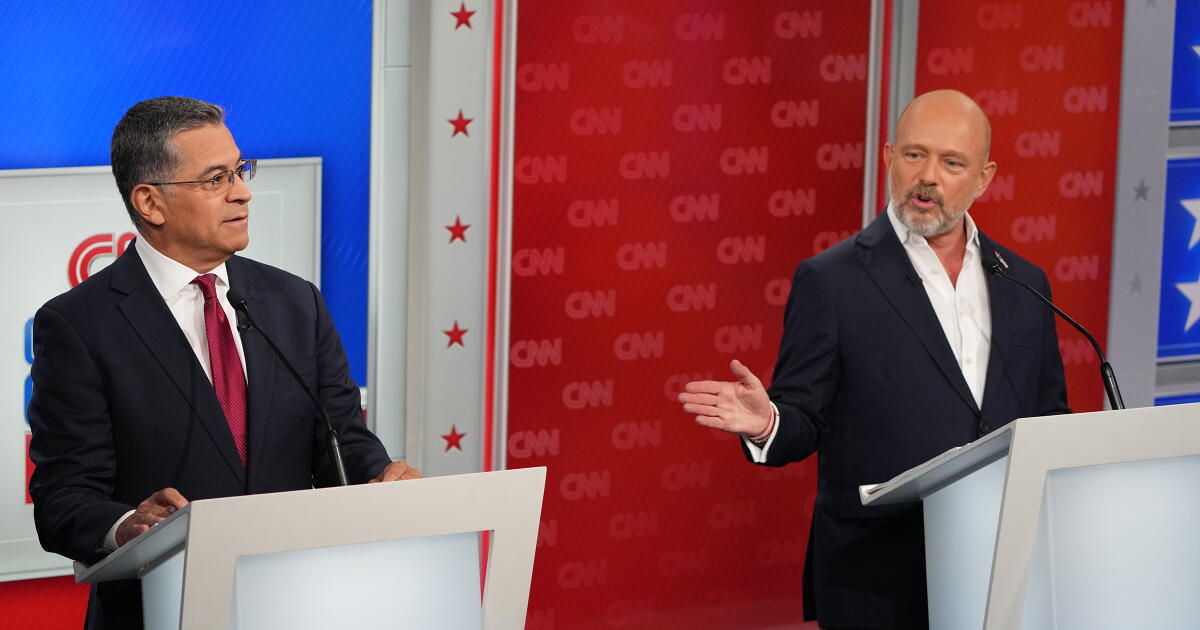
Four Democrats running for governor called on their fellow candidates to boycott an upcoming debate at USC, reiterating concerns that the criteria used to determine who was invited to participate resulted in every prominent candidate of color being excluded from the forum.
“We ask each and every candidate who is in this race to recognize that if we can’t have a fair process for a debate, then we should all not participate,” said Xavier Becerra, the former U.S. Health and Human Services secretary. “We call on them to withdraw from this biased forum.”
Becerra’s call was echoed by former Los Angeles Mayor Antonio Villaraigosa, state Supt. of Public Instruction Tony Thurmond and former state Controller Betty Yee during a Friday afternoon news conference.
The candidate’s request comes a week after some of them raised concerns about the criteria for Tuesday’s debate, arguing that it was engineered to allow the inclusion of San José Mayor Matt Mahan, who entered the race in late January and quickly raised millions of dollars from Silicon Valley executives.
“The rules initially were polling and money. Matt Mahan is [polling] lower than some of us, period,” Villaraigosa said, adding that the debate organizers “then added time in the race,” which resulted in Mahan’s invitation.
Mahan’s campaign did not respond to a request for comment on Friday, but when Becerra raised such concerns last week, Mahan said the former Biden administration official ought to be included in the debate.
The matter is further complicated by Mahan supporters who have notable ties to the university.
Mike Murphy, a co-director of the USC center hosting the debate, has been voluntarily advising an independent expenditure committee backing Mahan. The veteran GOP strategist said last week that he had nothing to do with organizing the debate and that he has asked for unpaid leave at the university through the June 2 primary if he takes a paid role in the campaign.
USC has also received tens of millions of dollars in donations from billionaire real estate developer Rick Caruso and his wife. Caruso, a USC alumnus who served as a trustee for years, is also a Mahan supporter.
A representative for Caruso did not respond to a request for comment.
The debate, hosted by the USC Dornsife Center for the Political Future, KABC-TV Los Angeles and Univision, is scheduled to take place on campus at 5 p.m. Tuesday — less than two months before ballots begin arriving in voters’ mailboxes. The forum will be streamed and broadcast on ABC and Univision affiliates across the state.
USC and the television stations put out a joint statement Friday morning, prior to the candidates’ news conference, justifying the criteria used to determine who was invited to participate and saying none of the debate partners had any influence on the methodology.
“We want to be clear that we categorically, unequivocally deny any allegations that the debate criteria was in any way biased in favor or against any candidate and want to clarify the facts,” they said in a statement, adding that Christian Grose, a USC political science professor, was asked to develop “data-driven” benchmarks to determine which candidates were invited.
“The methodology was based on well-established metrics consistent with formulas widely used to set debate participation nationwide — a combination of polling and fundraising — and developed without regard to any particular candidate.”
After the Democratic candidates called for their competitors to not participate, USC and KABC declined to comment further. Univision did not respond to a request for comment.
Grose defended the methodology he crafted as “objective” in an interview Friday, and said he met with Becerra as well as the staff of other candidates to explain it.
“The idea that it was biased or designed to create some sort of outcome to disfavor the candidates who spoke at the press conference is just not correct,” Grose said, adding that attacks on the methodology have a “chilling effect” on universities and media outlets who sponsor debates.
“I’m not worried about the optics,” he said. “The optics are we are having a debate at USC to inform voters and educate students.”
Jarred Cuellar, a political science assistant professor at Cal Poly Pomona, described Grose’s methodology as “thoughtful” and “empirically grounded,” and characterized the concerns raised by candidates not included in the debate as unfounded and not credible.
“The formula is methodologically sound and represents a clear improvement over how debate participation has often been determined,” he said. “Rather than relying on a single metric such as polling, it takes a multidimensional approach to evaluating candidate viability. That approach better reflects how political scientists measure complex phenomena like electoral competitiveness.”
But the controversy has caused consternation among USC professors past and present.
“It seems like an unforced error that is casting the entire event in a bad light,” said a current USC professor who closely follows politics but is not involved in the debate, and who asked for anonymity to speak candidly. “It’s super important that if the debate happens, it happens correctly.”
Darry Sragow, a veteran Democratic strategist who taught election and environmental law at USC for 19 years, said that while he believes the large field of Democratic candidates needs to be winnowed, that’s not the job of a university or media outlets.
“Every one of these eight [Democratic candidates] is capable of running the state of California,” he said. “ It would certainly be my advice to USC and to Univision and to ABC to allow all the candidates to take part, or to cancel the debate.”
The four Democratic candidates not invited to the debate argued that voters are just starting to pay attention to the thus-far sleepy race and that diverse candidates should be represented.
“We are a minority-majority state, and the idea that the four candidates of color are not going to be on the stage to bring those perspectives, to really speak to those communities, is really not doing right by the voters,” Yee said.
Becerra said some of the candidates had requested to speak with top university leadership, including President Beong-Soo Kim. In other conversations, he said university officials raised the possibility of “either canceling this debate or incorporating more of the candidates in it. Evidently they could not agree to do that. … I think they recognize that there were problems with the way this debate had been organized.”
Becerra said he reviewed the formula and has “never seen” debate criteria like it before during his decades of serving in elected office.
“Your fundraising numbers are divided by the number of days you’ve been out there campaigning in front of voters,” he said. “So you could have raised millions of dollars, but if you’ve been in longer than someone else who just raised millions of dollars very quickly, you get penalized.”
Campaigns for the invited candidates — Democrats Rep. Eric Swalwell of Dublin, former Orange County Rep. Katie Porter, climate activist Tom Steyer and Mahan; as well as Republicans Chad Bianco, the sheriff of Riverside County, and former Fox News host Steve Hilton — did not respond to requests for comment on the call to boycott the debate.
WASHINGTON — Democratic lawmakers on Wednesday stormed out of a closed-door briefing on the Jeffrey Epstein files by Justice Department leaders, and said they would push to force Atty. Gen. Pam Bondi to answer questions under oath about the case that has plagued the Trump administration.
Bondi and Deputy Atty. Gen. Todd Blanche went to Capitol Hill to try to quell bipartisan frustration over the Justice Department’s handling of millions of files related to Epstein’s sex trafficking investigation.
But less than an hour into the briefing, Democrats walked out in protest of the arrangement and said they would press to enforce a subpoena for Bondi to appear for a sworn deposition next month.
“We want her under oath because we do not trust her,” said Democratic Rep. Maxwell Frost.
Asked by reporters after the briefing whether she would comply with the subpoena, Bondi said, “I made it crystal clear I will follow the law.” She also defended the department’s handling of the Epstein files, saying officials are proud of their work to release millions of documents to the public.
The committee’s Republican chairman, Rep. James Comer, accused Democrats of political grandstanding.
“This for us, for the Republicans, it’s about getting answers,” Comer said after the briefing. “For the Democrats, it’s a political game, and they just demonstrated that today. There’s no reason for them to walk out and clutch their pearls and act like they were offended and outraged.”
Justice Department leaders had hoped the release of documents tied to the disgraced financier would put an end to a political saga that has dogged the president’s second term, but the agency remains consumed by questions and criticism over Epstein’s case and its management of the files. Bondi has accused Democrats of using the furor over the documents to distract from Trump’s political successes, even though some of the most vocal criticism has come from members of the president’s own party.
Five Republicans on the committee voted with Democrats to support the subpoena for Bondi to appear for a deposition on April 14. Lawmakers have accused the Justice Department of withholding too many files and criticized the agency for haphazard redactions that exposed intimate details about victims.
The Justice Department has called the subpoena “completely unnecessary,” noting that members of Congress have been invited to view unredacted files at the Justice Department and that department leaders have made themselves available to answer questions from lawmakers.
The department has sought to assure lawmakers and the public that there has been no effort to shield President Trump, who says he cut ties with Epstein years ago after an earlier friendship, or any other high-profile figures close to Epstein from potential embarrassment. Justice Department leaders have also rejected suggestions that they have ignored victims and insist that while there is no evidence in the files to prosecute anyone else, they remain committed to investigating should new information come forward.
“I’m not trying to defend Epstein — I’m not,” Blanche said in an interview this week with Katie Miller, who is married to top Trump advisor Stephen Miller. “I do defend the work that this department is doing today, right now, which is going after every single perpetrator anyway, and if there is a narrative that exists that we are ignoring Epstein victims, that is false.”
The documents were disclosed under the Epstein Files Transparency Act, the law enacted after months of public and political pressure that requires the government to open its files on the late financier and his confidant and onetime girlfriend, Ghislaine Maxwell. Maxwell, 64, was convicted in December 2021 and sentenced to 20 years in prison for her role over a decade in sexually exploiting and abusing underage girls with Epstein.
Criminal investigations into the financier have long animated online sleuths, conspiracy theorists and others who have suspected government cover-ups and clamored for a full accounting.
After missing a Dec. 19 deadline set by Congress to release all the files, the Justice Department said it tasked hundreds of lawyers with reviewing the records to determine what needed to be redacted, or blacked out. The Justice Department in January said it was releasing more than 3 million pages of documents along with more than 2,000 videos and 180,000 images.
Richer and Groves write for the Associated Press.
U.S. hockey star Jack Hughes might have lost more than a couple of teeth during the gold-medal-winning victory against Canada at the Milan-Cortina Olympics last month.
The puck that Hughes smacked into the net in overtime to give the United States its first men’s Olympic hockey gold since the 1980 “Miracle on Ice” was seemingly forgotten amid the raucous celebration.
But this week, the Hockey Hall of Fame began displaying that puck along with the one Megan Keller knocked into the net in overtime to give the U.S. women’s team gold in Milan. The International Ice Hockey Federation apparently secured the frozen vulcanized rubber disks immediately after the games and handed them to the Hall of Fame located in Toronto.
Hughes is happy “his” puck surfaced but believes he is the rightful owner of a piece of memorabilia that David Kohler, president of SCP Auctions, estimated might be worth $1 million.
“I don’t see why Megan Keller or I shouldn’t have those pucks,” Hughes told ESPN. “I’m trying to get it. Like, that’s [B.S.] that the Hockey Hall of Fame has it, in my opinion. Why would they have that puck?”
Hughes might not like the answer. The provenance of the puck is similar to that of a basketball or football used in a notable moment. It is dissimilar to a historic home run because a baseball leaves the field of play, and the owner becomes the fortunate fan.
“Because of the increasing value of memorabilia, ownership of items has become standardized over the last decade or so,” said an expert who agreed to speak anonymously because they work in the acquisition of such items. “Whoever purchased the puck owns it. Jerseys belong to the team, shoes and gloves to the player, the puck to whoever supplied it to the Olympics.”
That would be the International Ice Hockey Federation, the governing body of the Olympics hockey tournament. The IIHF employees who immediately secured those precious pucks amid gold-medal bedlam apparently did their job well.
“The puck was designated for archival preservation with the Hockey Hall of Fame to ensure its long-term safekeeping and historical recognition,” an IIHF spokesperson said.
The pucks are featured in an “Olympics ‘26” display that also contains a hockey stick used by Brady Tkachuk of the U.S. team and a U.S. jersey worn by four-time Olympian Hilary Knight.
It might strike some as odd that the display is in Canada, where fans are mourning the loss to the United States, but that’s been the location of the Hall of Fame since it was established in 1943. HOF president Jamie Dinsmore said in a statement that the display contains “donated items,” although it is unclear whether the IIHF has donated or merely loaned the pucks to the HOF.
“The Olympics ’26 display will help ensure that these unforgettable Olympic moments are preserved for our guests from around the world to experience,” Dinsmore said.
Meanwhile, Hughes told ESPN he wants the puck to become the property of one particular fan — his father, who collects memorabilia for him and his brothers Quinn and Luke. All three play in the NHL.
“I wouldn’t even want it for myself. I’d want it for my dad. I know he’d just love, love having it,” Hughes said. “When I look back in my career, I don’t collect too many things for myself, but my dad’s a monster collector for the three of us. I know he would have a special place for it.”
Or it could be sold at auction, where certainly it would pay for any dental work Hughes needs after getting teeth knocked out during the gold-medal game. Various auction houses have estimated the value of the puck to be from $40,000 to $1 million.
Should he acquire the puck, though, Hughes might not even consider selling it. The first pick of the 2019 NHL draft, he signed an eight-year, $64 million contract extension with the New Jersey Devils four years ago.
ABC’s Sunday telecast of the 98th Oscars averaged 17.9 million viewers, ending a four-year streak of audience increases.
The figure from Nielsen is down 9% from the 19.7 million viewers who watched the telecast on ABC and Hulu in 2025.
After ratings for the Oscars cratered to an all-time low of 10.5 million viewers in 2021, the event’s audience levels ticked back up in recent years.
But the show has not topped 20 million viewers since 2019, as younger viewers are content to watch highlights of the ceremony on social media, rather than sit through a three-hour-plus telecast on traditional TV.
The awards held at the Dolby Theatre in Hollywood honored “One Battle After Another” for best picture, Michael B. Jordan for lead actor in “Sinners,” and Jessie Buckley for lead actress in “Hamnet.” Conan O’Brien was the host for the second straight year.
Critics said the ceremony was light on political statements about President Trump, whose name was not mentioned during the telecast. The show’s highlight was an extended “In Memoriam” segment that gave extra tribute to legendary actor and filmmaker Robert Redford and slain actor, director and producer Rob Reiner.
ABC had success in selling out the commercials for the Oscars, which is perennially the most watched non-sports telecast of the year. But the network will only have the event for two more years as the Academy of Motion Picture Arts and Sciences chose to take a better financial offer from YouTube for the rights to the telecast starting in 2029.
O’Brien poked fun at the YouTube move. He closed with a video that shows him being appointed Oscars “host for life.” As he takes in the honor, poison gas seeps into the office he is given. After O’Brien’s lifeless body is wheeled out, a name plaque with a new host is put on the door. His successor is YouTube star Mr. Beast.
WASHINGTON — Atty. Gen. Pam Bondi was subpoenaed Tuesday to answer questions from Congress about the Justice Department’s sex trafficking investigation of Jeffrey Epstein and the agency’s handling of millions of files related to the disgraced financier.
Bondi was ordered to appear for a deposition on April 14 by the Committee on Oversight and Government Reform after a vote earlier this month that five Republicans supported.
The Justice Department’s failure to fend off the subpoena from the Republican-led committee underscores widespread discontent among President Trump’s own base over Bondi’s management of the review and release of a trove of documents from the criminal investigation into Epstein.
“The Committee has questions regarding the Department of Justice’s handling of the investigation into Jeffrey Epstein and his associates and its compliance with the Epstein Files Transparency Act,” Rep. James Comer, the Republican chairman, said in a letter to Bondi.
“As Attorney General, you are directly responsible for overseeing the Department’s collection, review, and determinations regarding the release of files pursuant to the Epstein Files Transparency Act, and the Committee therefore believes that you possess valuable insight into these efforts,” he wrote.
The department on Tuesday called the subpoena “completely unnecessary.” Bondi and Deputy Atty. Gen. Todd Blanche were expected to provide a private briefing Wednesday to members of the committee.
“Lawmakers have been invited to view the unredacted files for themselves at the Department of Justice, and the Attorney General has always made herself available to speak directly with members of Congress,” the department said in a statement. The agency said it looks forward to “continuing to provide policymakers with the facts.”
The Trump administration has faced constant political headaches since the rollout of the files began in December, with critics accusing the department of hiding certain documents and over-redacting files. In other cases, victims have slammed the department for sloppy redactions that revealed their sensitive information.
The Justice Department has fiercely defended its handling of the Epstein files, saying it worked as quickly and diligently as possible to review and release millions of documents required under the law. The department has denied any accusations that it used redactions to protect certain people or improperly withheld certain materials. And it has said it immediately worked to fix any redaction errors raised by victims.
Richer writes for the Associated Press.
The Middle East conflict risks adding a staggering 45 million to acute hunger levels, warns the UN’s World Food Programme.
Tens of millions more people will face acute hunger if the United States-Israel war on Iran, and its reverberations through Iran’s retaliation, continue through to June, the United Nations warned.
“If the Middle East conflict continues through June, an additional 45 million people could be pushed into acute hunger by price rises,” Carl Skau, the deputy executive director of the UN’s World Food Programme (WFP), said on Tuesday.
list of 4 itemsend of list
“This would take global hunger levels to an all-time record, and it’s a terrible, terrible prospect,” Skau said, with 319 million people, already a historic high, currently acutely food insecure.
The US-Israeli attacks on Iran that began on February 28 have choked up key humanitarian aid routes, delaying life-saving shipments to some of the world’s worst crises.
Skau said shipping costs are up 18 percent since the war began and that some have had to be rerouted.
The extra costs come on top of deep spending cuts by the WFP, as donors focus more on defence, he added.
In Gaza, residents are rushing to stockpile dwindling goods as border closures and the Iran war further strain already fragile supplies, with shortages worsening across the besieged enclave as Israel presses on with its genocidal war there.
Israel is set to partially reopen Gaza’s Rafah crossing with Egypt on Wednesday, ending a two-week shutdown that has deepened an already catastrophic humanitarian crisis in the decimated territory.
Israel shut the crossing the same day it and the US launched strikes on Iran, citing “security” reasons.
The World Health Organization’s regional director for the Eastern Mediterranean warned last week that only about 200 trucks a day were entering Gaza, far short of the estimated daily requirement of 600.
Meanwhile, more than 21 million people in Sudan, nearly half of the population, face acute hunger. Famine has been confirmed in areas where months of fighting have made access for aid workers largely impossible.
In January, the UN warned that aid to Sudan could run out within months unless hundreds of millions of additional dollars are pledged.
Three years of brutal war between the military government and paramilitary Rapid Support Forces have killed tens of thousands of people and displaced 14 million.
COLUMBUS, Ohio — Joshua Bogdan was born and raised in the United States. The only time the New Hampshire resident has left the country was for a day and a half in seventh grade, when he went to Canada to see Niagara Falls.
Even so, that did not mean proving his U.S. citizenship in last fall’s local elections was easy.
The 31-year-old arrived at his voting place in Portsmouth and handed the poll worker his driver’s license, just as he had done in other towns when arriving to vote. She said that would no longer do.
The poll worker said that under the state’s new proof-of-citizenship law, which took effect for the first time during town elections in 2025, Bogdan would need a passport or his birth certificate because he had moved and needed to re-register at his new address. A scramble ensued, turning the voting process that he had always found fun and invigorating into a nerve-racking game of beat the clock.
“I didn’t know that anything had officially changed walking in there,” he said. “And then being told that I had to provide a passport that I’ve never had or a birth certificate that’s usually tucked away somewhere safe just to cast my vote — which I’ve done before — it was frustrating.”
Bogdan’s experience in New Hampshire is a glimpse into the future for potentially millions of voters across the country. That is if Republican voting legislation being pushed aggressively by President Trump passes Congress and a “show your papers” law is put in place in time for the November midterm elections.
The Safeguard American Voter Eligibility, or SAVE America Act, cleared the House last month on a mostly party-line basis. Republicans say it would improve election integrity. Trump has called its safeguards common sense. Democrats and voting rights advocates call it a clear act of voter suppression. The bill is scheduled to come up for debate and voting in the Senate next week.
Republican messaging has mostly highlighted a less divisive provision in the bill that would require voters to show a photo ID. But the mandate for people to provide documentary proof of citizenship to register to vote in federal elections is likely to have the most wide-ranging consequences. Noncitizens already are prohibited from voting in federal elections, and it is not allowed by any state. Cases where it occurs are rare and harshly punished.
Obtaining the necessary documents under the SAVE Act is not as easy as it might sound. A similar effort was tried in Kansas a decade ago and turned into a debacle that eventually was blocked by the courts after more than 30,000 eligible citizens were prevented from registering.
Rebekah Caruthers, president and chief executive at the Fair Elections Center, said the legislation’s strict documentation requirements could move the U.S. “in the opposite direction” of representative democracy.
“If this bill passes, it would deny millions of eligible Americans their fundamental freedom to vote,” she said in an email. “This includes millions of people who make up your communities, including married women, people of color and voters who live in rural areas.”
The list of qualifying documents in the SAVE Act for proving citizenship appears long, but many of them come with qualifiers.
Under the bill, a Real ID-compliant driver’s license would have to indicate that “the applicant is a citizen,” but not all do. Only five states — Michigan, Minnesota, New York, Vermont and Washington — offer the type of enhanced Real IDs that explicitly indicate U.S. citizenship.
Standard driver’s licenses, generally available to both citizens and noncitizens, often do not include a citizenship indicator. Some states, including Ohio, have recently added them.
The stipulations continue, buried in the fine print.
While military ID cards are listed as qualifying documents under the act, they will not suffice on their own. The bill says a military ID must be accompanied by a military “record of service” that indicates the person’s birthplace was in the U.S.
A DD214, the current standard-issue certificate of release or discharge for all military service branches, does not fulfill that requirement. According to the Pentagon, that document lists only where someone lived at points of entry and discharge and a person’s current home of record. It does not list where someone was born.
For most provisions, the SAVE Act contains no phase-in period that would give voters and local election offices time to adjust. If passed by Congress and signed by Trump, its documentary proof-of-citizenship mandate would apply immediately, meaning it would be in place for this year’s midterm elections.
That could lead to a rush to obtain documents by those who want to register or need to reregister. A 2025 University of Maryland study estimates that 21.3 million Americans who are eligible to vote do not possess or have easy access to documents to prove their citizenship, including nearly 10% of Democrats, 7% of Republicans and 14% of people unaffiliated with either major party.
A passport would most effectively meet the requirement, but only about half of American adults have one, according to the State Department. The SAVE Act requires the passport to be current; an expired one does not count.
Obtaining a passport in time for a looming voter registration deadline is another potential hurdle.
Workers who process passports had layoffs at the State Department reversed, but just last month the department forbid passport processing at certain public libraries that had long helped relieve pressure at the department. Government libraries, post offices, county clerks and others still provide the service.
It takes four weeks to six weeks to get a passport, according to the department’s website, excluding mailing time. A new passport costs $165 for adults and renewals cost $130, while the photo costs $10 or $20 more. The turnaround time can be sped up to two weeks or three weeks for an additional $60 — and for even faster processing, add $22 more. The fully expedited process for a new passport would cost at least $257, a significant burden for many voters.
A birth certificate may be a quicker and cheaper choice for most people, but there are twists.
The SAVE Act requires a certified birth certificate issued by a state, local government or tribal government. What does not appear to qualify is the certificate signed by the doctor that many new parents are given in the hospital when their child is born. It provides information similar to a certified birth certificate, but would not meet the letter of the federal legislation.
Like passports, birth certificates can sometimes take weeks to obtain. Those who live near their birthplaces can visit the local vital statistics office, but staffing shortages and escalating demand for Real IDs have caused significant backlogs in some states. In New York, the waiting period for certified copies is four months, the state said. Average processing times for online certificate requests vary widely by state, from as few as three days to 12 weeks or longer.
People whose birth certificates don’t match their current IDs — mostly women who changed their names when they married — would probably need additional documentation to register to vote under the bill. A 2023 Pew Research Center survey found about 80% of women in opposite-sex marriages in the U.S. take their husband’s last name.
Notably, the SAVE Act does not provide any money to help states and local governments implement the changes or promote them to voters.
For Bogdan, that was part of the problem when New Hampshire’s proof-of-citizenship law took effect. People who have voted elsewhere in the state are not required to show proof of citizenship in their new towns if poll workers confirm their registration history. But Bogdan said workers at his polling place did not seem to know that or try to look up the information.
He eventually was able to cast his ballot because, by luck, he had recently retrieved his birth certificate from his parents’ house more than an hour away so he could apply for a Real ID. But he said government notices to voters would help prevent possible disenfranchisement.
“Young voters like myself don’t always carry around our birth certificate, Social Security card, all that important stuff, because it’s not used ever or very often,” he said. “And so all those young kids who are going to go out and try and vote will be held back from that.”
Smyth writes for the Associated Press.